Webinar

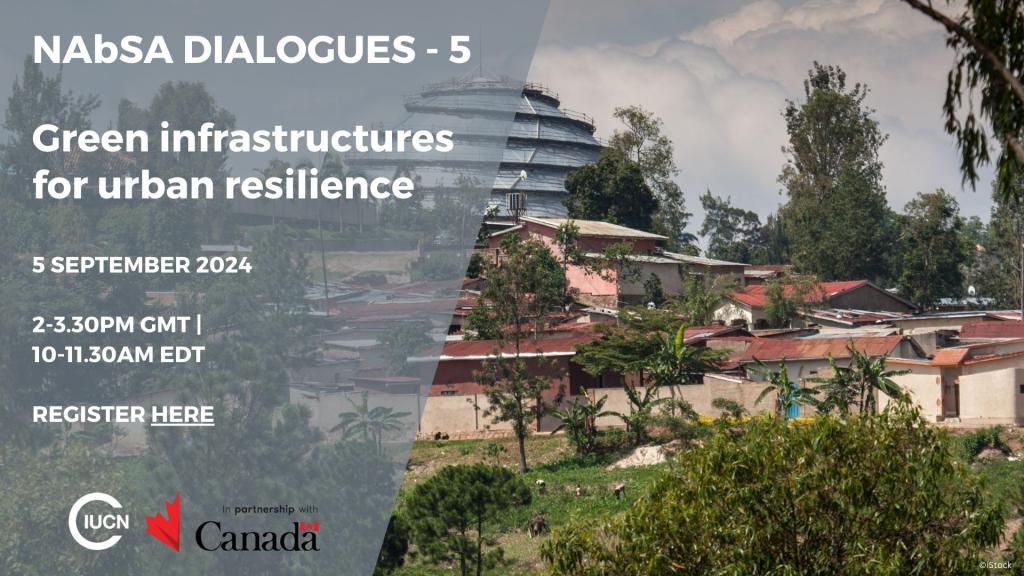
NAbSA Dialogues | Green Infrastructures for Urban Resilience

Green infrastructure and nature-based solutions (NbS) are proven, cost-effective means to reduce climate risks and strengthen the resilience of vulnerable communities to the impacts of climate change, such as floods, landslides, and the urban heat island effect.


The fifth session of the NAbSA Dialogues series highlighted IISD’s Scaling Urban Nature-Based Solutions for Climate Adaptation in Sub-Saharan Africa (SUNCASA) Project. The discussion explored how NbS and green infrastructure can help cities adapt to climate change, manage extreme weather, preserve biodiversity, and provide healthier living environments.

September 5, 2024 10:00 am - 11:30 am EDT

(Open to public)

Social Media card - NAbSA Dialogues Green Infrastructure for Urban Resilince


Green infrastructure and NbS play a vital role in preparing urban communities for the impacts of climate change. By integrating green spaces and natural systems into city planning, NbS enhance urban resilience, reduce flood risks, improve air quality, and boost biodiversity. These approaches help cities adapt to climate change, manage extreme weather events, and create healthier living environments.

The fifth session of the NAbSA Dialogues series was held on September 5, 2024, and featured the SUNCASA Project. Funded by Global Affairs Canada through the Partnering for Climate (P4C) initiative, SUNCASA collaborates with the World Resources Institute and a diverse group of local partners to implement NbS in Dire Dawa (Ethiopia), Kigali (Rwanda), and Johannesburg (South Africa). The project aims to enhance resilience, gender equality, social inclusion, and biodiversity protection in the three cities.

This session included a panel discussion with speakers from SUNCASA partner governments and organizations, as well as the International Union for Conservation of Nature's Urban Team. They shared their experiences with NbS in urban contexts, focusing on water resources and watershed management to ensure equitable access and use for communities.

Watch the recording of the event and check out slideshow below to learn more:


The NAbSA Dialogues is a platform for experts and stakeholders interested in the practical implementation of NbS, green infrastructure techniques, and water resource management to increase climate adaptation and resilience in urban landscapes. Don’t miss this opportunity to learn more and hear from experts!

 Upcoming Topics in the NAbSA Dialogues:

  • September 25: Safeguarding Coastal Communities With Nature
  • October 29: Policy and Governance for Supporting NbS
  • November 26: Financing NbS
Press release

How South Africa can Improve Grid Battery Deployment to Unlock Economic and Security Benefits

June 12, 2024

June 12, 2024, Cape Town—South Africa can take action to boost the deployment of grid-located batteries through better understanding of the sector, co-operative planning, increasing access to finance, and supporting localized production, new research suggests.

While South Africans are already rapidly installing consumer batteries (located at consumer premises), grid batteries (storage installed on the grid) are an under-recognised part of the solution to the country’s electricity supply issues. 

A report by the International Institute for Sustainable Development (IISD), based on interviews with over 70 experts in the field, identifies a broad lack of understanding of battery opportunities, disjointed planning processes and financial obstacles for energy storage projects as key areas constricting the roll out of grid batteries. 

The second in a two-part series examining the role energy storage can play in resolving South Africa’s energy crisis, the paper, Watts in Store Part 2: Creating an Enabling Environment for the Deployment of Grid Batteries in South Africa, recommends the core steps policy-makers and stakeholders in the energy system may take to foster grid battery deployment. 

These are: to improve understanding of grid batteries at almost every level, from awareness of current battery technology to battery integration into the grid; to promote collaborative energy planning; to facilitate battery developers’ access to multiple revenue streams and upfront investment; and to identify and support local value chain opportunities, such as mineral processing and battery assembly.

“South Africa’s electricity crisis, exemplified by years of damaging loadshedding, means the country desperately needs a coherent electricity supply strategy that aligns with climate change goals. Batteries can play a fundamental role in this,” says Richard Halsey, a policy advisor at IISD and lead author of the report.

“Political will is a crucial piece of the puzzle, while addressing issues with tariffs and revenues linked to battery projects  can provide clarity for potential investors. This will help South Africa to build a dependable, forward-looking electricity supply system.”

The report comes as South Africa faces political upheaval following a general election at the end of May, in which the incumbent ANC party lost its majority for the first time in 30 years. The incoming government therefore has an opportunity to recognise the value grid batteries can provide.  

Meanwhile, plans for major restructuring of the state electricity utility Eskom also opens further doors to creating an enabling environment for the deployment of grid batteries. 

The paper suggests successful battery deployment in regions such as South Australia and California can guide South Africa, but solutions are location specific. Replicable strategies include enabling battery operators to benefit from multiple revenue streams, clear government policy support, and specific financing mechanisms for initial battery projects to help accelerate adoption.

Growing demand for batteries is also an opportunity to boost the South African economy and job creation, due to availability of many of the critical minerals required for both the market-leading lithium-ion batteries and also the vanadium required for vanadium redox flow batteries which due to their longer-duration storage are forecast to play a growing role in the sector.

Grid batteries have only recently gained traction internationally, with most of the world’s capacity installed in just the last 6 years. But growth has been fast, with annual capacity additions increasing significantly each year, with 75% more in 2022 than in 2021, the report notes.

Halsey added: “Grid batteries can bring a new era of flexibility to South Africa’s creaking grid. As well as operating as stand-alone stores of power, grid batteries can also be used to great effect in conjunction with renewables, particularly solar power. With a shift underway in South Africa toward a more open electricity market with competitive trading, there will only be increasing prospects for grid batteries.”

Media contacts:

Richard Halsey, Policy Advisor, Energy – [email protected]

Harry Cockburn, Communications Consultant, Energy – [email protected]
 

Webinar

Supercharging Grid Battery Deployment in South Africa

June 12, 2024 9:30 am - 11:00 am SAST

via Zoom

(Open to public)

Energy storage is a key part of future energy systems, and grid batteries have been improving in terms of capabilities and cost with rapid technological development.

This webinar provides an exclusive first look at new research on grid-located batteries in South Africa and examines how to maximize benefits, minimize environmental and safety risks, and solve challenges to deployment.

A diverse panel, including representatives from Eskom, municipal government, project development, and finance and research institutions, provides an in-depth discussion on the challenges and opportunities for South Africa.

The research, conducted by the International Institute for Sustainable Development, included interviews with over 70 stakeholders covering a wide range of experience and knowledge on grid-battery topics and the energy landscape in South Africa.

Agenda

Welcome and Housekeeping

Opening Remarks

Report Presentation: Watts in Store, Part 2

Richard Halsey, Policy Advisor, International Institute for Sustainable Development

Panel Discussion

Swasti Raizada, Policy Advisor, International Institute for Sustainable Development

Mari-Louise van der Walt, Principal Consultant, Alakriti Consulting

Monde Soni, Chief Engineer, Network Planning, Eskom

Sherwin Harris, Engie

Vincenzia Leitich, Executive Energy and Infrastructure, Standard Bank

Bashkaran Vandeyar, Head of Green Energy, City of Cape Town

Q&A

Closing Remarks

Webinar details

Press release

Tackling flash floods, urban heat, and other climate change threats in three sub-Saharan African Cities

A new project will use solutions found in nature to improve the resilience of 2.2 million people in Dire Dawa (Ethiopia), Kigali (Rwanda), and Johannesburg (South Africa).

May 22, 2024

WINNIPEG  – A new 3-year project will reduce climate-fuelled flood risks and enhance the resilience of approximately 2.2 million people in three sub-Saharan African cities while promoting gender equality and social inclusion and strengthening biodiversity protection.

The Scaling Urban Nature-Based Solutions for Climate Adaptation in Sub-Saharan Africa (SUNCASA) project will undertake watershed restoration and adaptation actions in Dire Dawa (Ethiopia), Kigali (Rwanda), and Johannesburg (South Africa). Jointly managed by the International Institute for Sustainable Development (IISD) and the World Resources Institute (WRI)—and guided and implemented by a wide array of local partners, policy-makers, and stakeholders—SUNCASA will directly benefit approximately 2.2 million people in high-flood-risk areas, while indirectly benefiting an estimated 7 million residents in these cities. The project is funded by Global Affairs Canada through the Partnering for Climate Program. Approximately CAD 29 million will be invested in the three cities until 2026.

Specific actions were identified through multiple rounds of engagements with key stakeholders in each of the three cities. Through the City Water Resilience Approach, stakeholders worked collaboratively to develop high-impact solutions to critical resilience challenges. These include:

  • catchment restoration in the Dechatu River in Dire Dawa for flood risk reduction and water stress mitigation, and urban tree planting and green space development to alleviate the heat island effect in lower-income neighbourhoods;
  • restoration of six critical upstream micro-catchments of the lower Nyabarongo River watershed in Kigali to reduce downstream floods and landslides risks;
  • removal of alien invasive species, afforestation, reforestation, and riverbank restoration in the Johannesburg Jukskei River catchments to reduce flood risk and increase water quality.

Challenges in Dire Dawa: Flash floods continue to pose a significant risk to Dire Dawa’s residents, while catchment degradation has affected water security and the livelihoods of vulnerable communities. In Dire Dawa, SUNCASA will work with women farmers and local small and medium-sized enterprises to rehabilitate the Dechatu Catchment through a combination of reforestation and agroforestry, helping to address water stress and enhance the economic resilience of the most vulnerable. The project will also aim to reduce stormwater runoff and heat within the city through tree-planting campaigns that target low-income neighbourhoods.

Challenges in Johannesburg: Invasive species in wetlands and river systems threaten the water security of the City of Johannesburg, increasing flood risk and impacting biodiversity. The SUNCASA project will work with local communities along the Jukskei River Catchment to remove alien invasive species clogging waterways, helping to reduce flood risk by rehabilitating riverbanks. The project will directly support 14 local cooperatives, expanding employment opportunities and ensuring women and youth leadership in ecosystem conservation.

Challenges in Kigali: Climate change and urban expansion are increasing the impact of flood events and landslides in Kigali. The SUNCASA project will support local farmers and women-led cooperatives in rehabilitating the Kigali sub-catchment, reducing flood risks in densely populated urban areas. Restoration efforts will prioritize the protection of agricultural lands and the expansion of urban forest cover, reducing soil loss, improving agricultural productivity, and boosting air quality.

By choosing actions that reinforce or restore natural solutions for managing water—and by selecting projects that engage and strongly benefit women and vulnerable communities in these cities—the SUNCASA project will demonstrate the “triple win” possible for climate, society, and biodiversity with gender-responsive nature-based solutions.


Quotes

"As Mayor of the Dire Dawa Administration, it is my priority to rally political support for solutions that help our administration address citizens’ vulnerability to climate change-related disasters, like rapid onset floods. The Dire Dawa Administration welcomes the recent announcement from Global Affairs Canada regarding new funding to support locally led nature-based solutions for the rehabilitation of the Awash River Basin’s Eastern Catchment. This investment means more women and youth at the forefront of our climate adaptation measures, helping to boost water security not only in Dire Dawa but in our neighbouring cities as well."

H.E. Kedir Juhar, Mayor of Dire Dawa, Ethiopia

“The City of Kigali welcomes the recent commitment from the Government of Canada to support the city’s green aspirations with the resources needed to increase its climate resilience through nature-based solutions for watershed restoration targeting urban high-risk areas. We look forward to advancing this work with our partners, in alignment with Kigali’s ambitious green development goals, and strengthening communities against climate impacts.”

Lord Mayor Samuel Dusengiyumva, Mayor of Kigali, Rwanda

"Flood protection is a critical aspect of the City of Johannesburg's Water Security Strategy. Exacerbated by climate change and urbanization, flooding poses a significant risk to lives, livelihoods, and infrastructure, causing devastation and disruption on a massive scale. Through the protection and restoration of ecosystems, we can address flood risk across the city while enhancing water quality, preserving critical habitats, and safeguarding ecological integrity for generations to come. This is where the SUNCASA project comes into play, as it will implement the nature-based solutions outlined in our strategy."

Kabelo Gwamanda, Mayor of Johannesburg, South Africa

“Canada is proud to continuously partner with IISD, a Canadian organization that leads the charge for sustainable development around the world. Together, we are pleased to support the cities of Johannesburg, Dire Dawa, and Kigali in advancing their climate change adaptation, biodiversity conservation, and livelihood priorities through gender-responsive nature-based solutions. As part of Canada’s CAD 5.3 billion Climate Finance commitment (2021–2026), Partnering for Climate supports projects that use nature-based solutions to help communities and people in sub-Saharan Africa become more resilient to the impacts of climate change.”

Honourable Ahmed Hussen, Canada’s Minister of International Development

"Despite their wide-ranging benefits for people and the planet, nature-based solutions are not being scaled up enough to fulfill their potential. SUNCASA is a tremendous opportunity to advance this cause. IISD is pleased to be applying our experience with nature-based solutions to the management of this project in partnership with WRI, and we look forward to working with our wide array of local partners to implement it for the benefit of communities and ecosystems in sub-Saharan Africa.”

Patricia Fuller, CEO and President, IISD

“Africa’s cities are the fastest growing in the world. Yet half of these urban residents are living in informal settlements and are dangerously threatened by climate risks from droughts, floods, and extreme heat. To address these challenges, we must harness the power of nature—trees and other forms of “green infrastructure” that can clean and cool the air, build flood resilience, and improve people’s health and well-being. Canada’s Partnering for Climate Initiative will allow IISD and WRI to work with cities across the continent to mobilize political support, deliver technical assistance, and unlock finance, effectively streamlining the process to scale up nature-based solutions to support vulnerable communities.”

Ani Dasgupta, President and CEO, World Resources Institute


Media Contacts

For further information or interview requests, please contact:

Cesar Henrique Arrais

Senior Communications Officer, International Institute for Sustainable Development

[email protected] 

Eden Takele

Engagement & Communications Specialist, World Resources Institute

[email protected] 


About IISD

The International Institute for Sustainable Development (IISD) is an award-winning independent think tank working to accelerate solutions for a stable climate, sustainable resource management, and fair economies. Our work inspires better decisions and sparks meaningful action to help people and the planet thrive. We shine a light on what can be achieved when governments, businesses, non-profits, and communities come together. IISD’s staff of more than 250 experts come from across the globe and from many disciplines. With offices in Winnipeg, Geneva, Ottawa, and Toronto, our work affects lives in nearly 100 countries.

About WRI

Founded in 1982, the World Resources Institute (WRI) is an independent, nonprofit global research organization that turns big ideas into action at the nexus of environment, economic opportunity, and human well-being. We are working to address seven critical challenges that the world must overcome this decade to secure a sustainable future for people and the planet: climate change, energy, food, forests, water, sustainable cities, and the ocean. WRI has a global staff of over 1,800 people with work spanning 60 countries. We have offices in Africa, Brazil, China, Europe, India, Indonesia, Mexico, Colombia, and the United States, as well as a growing presence in other countries and regions.

 

Press release

South African Fossil Fuel Subsidies Hit Record Highs as Country's Energy Crisis Deepens

April 10, 2024

April 10 2024, Cape Town—South Africa's fossil fuel subsidies tripled between 2018 and 2023, hitting ZAR 118 billion (USD 7.5 billion), up from ZAR 39 billion (USD 2.9 billion) 5 years earlier, a new report by the International Institute for Sustainable Development (IISD) reveals. 

The increase was largely driven by the global energy crisis, with consumer subsidies rising to reflect higher prices for oil, gas, and coal following Russia's invasion of Ukraine, according to the report Blackouts and Backsliding: Energy Subsidies in South Africa 2023. 

The increases came as global fossil fuel subsidies hit a record high of USD 1.5 trillion in 2022, with governments around the world scrambling to respond to the energy crisis. 

The largest share of fossil fuel subsidies in South Africa in 2023 went to oil and gas consumption, carbon tax exemptions, and the electricity sector. 

Fossil fuels provided 91% of South Africa’s total energy supply in 2021, compared to 80% globally. Coal dominates the electricity sector, accounting for 86% of all generation, while wind and solar make up just 6%. This is despite the fact that the average cost of renewable energy installation bids in South Africa has decreased by more than 77% since 2011.

But while fossil fuel subsidies have increased, the country's creaking electricity system is deteriorating rapidly, with rolling blackouts (known as load shedding) reaching record levels in 2023. The country experienced outages on 335 of 365 days of the year, taking a significant toll on the economy.

Core issues include a lack of investment in new generation and in the grid by the government and Eskom, the heavily indebted state-owned utility, the report said. 

"Soaring fossil fuel subsidies in South Africa mean the country is still locked into dependence on economically volatile fuels, with ill-targeted consumer subsidies failing to protect the poorest families," said Anna Geddes, co-author of the report and associate consultant at IISD.

She added: "Carbon tax exemptions for big emitters like Eskom, as well as current plans to expand gas-generated power, are undermining South Africa’s commitments to shift away from fossil fuels. Government support should send a clear signal to investors and the market, and therefore be consistent with climate targets and social priorities, such as ending load shedding and ensuring access to energy for all.”

South Africa committed to phasing out inefficient fossil fuel subsidies as a member of the G20 in 2009 and, more recently, as part of the COP 28 agreement, to tripling the world’s installed renewable capacity to 11,000 GW by 2030 and to transitioning “away from fossil fuels in energy systems in a just, orderly and equitable manner…to achieve net zero by 2050.”

Despite these commitments, the South African government’s latest draft Integrated Resource Plan 2023 outlines a future energy system increasingly dependent on gas, potentially at the expense of renewables.

Geddes added: “Worsening blackouts are taking a heavy social and economic toll on South Africa. Expanding subsidies for economically volatile fossil fuels will ultimately increase the risks South Africans face and fail to address long-term energy security concerns.

“In a world increasingly united in bringing an end to fossil fuel dependency, South Africa must set its sights higher or risk being left in the dark.” 

Media Contacts:

Anna Geddes, Associate Consultant: Energy—[email protected]
Harry Cockburn, Communications Consultant: Energy—[email protected]
 

IISD in the news

Don’t write off the Just Energy Transition Partnership just yet

When it was announced at COP26 in 2021, South Africa's Just Energy Transition Partnership seemed to offer an answer to a weighty question: how can we not only usher in large-scale renewables investment into developing countries, but also rapidly wind down their coal sectors? However, in the nearly two years since the JETP was announced, critics have taken issue with everything from the way the JETP packages are funded to the pace at which they are being rolled out. 

September 18, 2023

IISD in the news details

IISD in the news

Just Energy Transition Partnerships and How They Work

To limit the damage caused by climate change, the world needs to rapidly reduce carbon dioxide emissions everywhere, not just in rich countries. To get there, poor and middle-income places will require trillions of dollars for replacing coal plants with cleaner energy, improving electrical grids and retraining workers, among other measures. Just Energy Transition Partnerships, or JETPs, are among the most high-profile financing mechanisms designed to funnel money from wealthy economies to some of the bigger developing-world emitters for the purpose of weaning off fossil fuels. South Africa signed the first agreement in 2021, and a handful of others are getting off the ground, including in Indonesia. But the process has been slow and politically fraught, raising the question of whether such flagship plans can be inclusive, effective and timely enough to fulfill their promise.

August 14, 2023
IISD in the news

Richard Halsey: Revised electricity infrastructure plan must admit benefits of energy storage

As the government concludes a much-delayed revision of the Integrated Resource Plan (IRP) for electricity infrastructure there is one technology that can offer multiple benefits to SA's struggling power system and shouldn’t be underrepresented in the new proposal—energy storage. Strategically located energy storage can help optimise the use of the existing transmission grid. While this is just one of many benefits it can provide, it is an important one for the government to factor in when deciding how much storage capacity to procure at the national level.

August 11, 2023
IISD in the news

Minister attacks South Africa's climate finance deal

South Africa's JETP deal, signed at Cop26, is supposed to provide a just transition to clean energy, but critics question whether the scheme will really benefit the country and its people.

July 27, 2023

IISD in the news details

IISD in the news

Call for coordinated battery storage facilities

The International Institute for Sustainable Development says more battery storage systems are needed. It says the use of batteries by both businesses and households is increasing, but it's not coordinated. Adviser at the Institute, Richard Hasley, spoke to eNCA.

July 21, 2023

IISD in the news details