Press release

South Africa’s Just Energy Transition Plans Miss the Mark Without Communities at the Centre, New Study Finds

Experts recommend community-level mapping to reflect lived realities and informal economy assets.

November 14, 2025

November 14, 2025, Johannesburg—South Africa’s plans for a just energy transition risk leaving communities behind unless they are grounded in local realities and built on long-term, trust-based engagement, according to new research.

The study by the International Institute for Sustainable Development (IISD) and the Public Affairs Research Institute (PARI) reveals a deep disconnect between national policy and community experience in Mpumalanga’s coal towns, where residents perceive the transition as an external, top-down process. Researchers warn that procedural justice—genuine participation and shared decision making—remains the missing link in the country’s transition.

Over the course of a year, researchers conducted ethnographic fieldwork in Phola, Komati, Hendrina, Kriel, and eMalahleni, engaging with 43 community members, business owners, and local officials through participant observation, interviews, and focus groups.

The study mapped both formal and informal roles in the coal value chain, showing how mine closures are reshaping livelihoods, services, and local economies—especially for women and other marginalized groups.

A pilot project in Phola, eMalahleni went a step further, mapping 275 local businesses, public assets, and informal networks to understand how communities envision a post-coal economy. It found that informal livelihoods, the care economy, and local food systems are critical entry points for sustainable local development.

The pilot showed that working with communities and building local strengths can increase ownership and make transition planning fairer and more inclusive.

“Just transition cannot be just in name only; it must be just on the ground,” says Bathandwa Vazi, policy advisor at IISD and the lead author of the report. “Our work in Mpumalanga shows that effective transition projects must be built with communities, not simply for them. Ethnographic research has taught us how trust building should be done to draw communities into policy-making, making them part of the process.”

The findings highlight that just energy transition planning processes are often unclear, top-down, and insufficiently transparent, with women and informal workers excluded from decision making. The researchers argue that without deeper local engagement, the transition risks further entrenching inequalities.

“A truly just transition depends on relationships,” said Mahlatse Rampedi, researcher at PARI. “Procedural justice should mean more than a consultation checklist—it’s about ensuring communities see their realities reflected in the policies shaping their futures.”

To ensure a fair and inclusive transition, the study recommends to-

  • Adopt co-production as core planning principal: Involve communities, especially women, youth and marginalized groups from the earliest stage of decision making.
  • Build government capacity for community engagement: Develop training programs to help officials in building their skills in community research—such as in mapping the resources, strengths, and networks that exist within local communities, trust building, and inclusive engagement that goes beyond standard public consultations.
  • Align Local Development Plans with Just Transition: Municipalities should align their development plans to reflect community priorities by integrating co-production results. These plans should address the risks and opportunities of energy transition and support fair and equitable local development.
  • Use Local Data to Guide Transition Planning: Before closing any coal facility, build relationships in affected communities and gather insights into local economies, care systems, and social networks. This information should shape job transition plans, retraining programs, and community support services.

Media Contact

Bathandwa Vazi, Policy Advisor, IISD: [email protected]
Madhulika Verma, Senior Communications Officer, IISD: [email protected]
 

About PARI

PARI is an African research institute affiliated to the University of Johannesburg and Wits University, providing new and original social science research, advocacy and implementation support for South Africa, the global South and beyond.

Press release details

Insight

Why Gender Inclusion Must Drive the Just Energy Transition

The clean energy transition is an opportunity to advance gender equality and social inclusion, but policies must be grounded in the lived reality of women and under-represented groups.

August 15, 2025

As the global clean energy transition gains momentum, one principle becomes increasingly clear: we cannot talk about equity without addressing gender. Yet, for many women in South Africa—especially those in coal-affected regions like Komati in Emalahleni—the energy transition feels divorced from their everyday realities.

Women and underrepresented groups are among the most vulnerable to climate change and tend to face higher rates of energy poverty. As economies and communities transition away from fossil fuels, marginalized groups could be disproportionately impacted if governments depend on top down policy-making and overlook lived realities.

Yet, the energy transition is also an opportunity to help level the playing field. With a fair share of government resources and a voice in decision making, communities can shape their own futures—and evidence shows that this has shared benefits for the whole economy.

During a Think 20 convening hosted by Oxfam South Africa and the International Institute for Sustainable Development (IISD)—held in recognition of South Africa’s G20 presidency and putting the spotlight on the role of women in the energy transition during women’s month—the message was clear: climate justice is gender justice. If the energy transition is to be truly just, it must centre the voices, needs, and leadership of women and underrepresented communities.

A System That Excludes Women by Design

Too often, the models used to finance and implement energy transition projects are designed around a formal economy—one that assumes business registration, credit history, and institutional connections. This leaves many women, especially informal workers and entrepreneurs, locked out.

As Linet Miriti, Chief Gender Officer at the African Development Bank noted in remarks on gender and just transition, even with progressive initiatives like Affirmative Finance Action for Women in Africa, systemic barriers persist—from gender data gaps to rigid eligibility requirements and male-dominated value chains. Still, progress is possible. In Mpumalanga, 25 women farmers are leading the way in climate-smart agriculture, supported by AfDB-backed initiatives that combine financing with skills development.

Women are not just energy consumers. They are innovators, producers, and community leaders—and yet they’re structurally locked out of the very solutions meant to empower them.

Linet Miriti, African Development Bank

Decision-making power also demands much-needed attention. Women, youth, and persons with disabilities must have the power to inform and decide on the solutions that will actually work for them. Placing those affected in charge of decision making can have a multitude of benefits for governments and communities supporting inclusive solutions and community buy-in of energy transitions.

If there’s no childcare, no transport, no stipends, women won’t access skilling programs. It’s not about availability. It’s about accessibility.

Lebogang Mulaisi, Presidential Climate Commission

Participation That Is Not Just Performative

Recent research on community participation in Mpumalanga’s energy transition demonstrates that while institutions insist that consultation has occurred, community members often feel otherwise. The issue is not whether draft policies have been shared with communities—it is about the relevance of those policies and the respect shown for community input in their formulation.

Often when communities say, “We haven’t been consulted,” it does not mean they are not aware of the consultations, but rather that they “weren’t heard.” Presentations offered at town halls are often pre-packaged, focused on what has already been decided. When community members ask about schools, water, safety, or children's well-being—questions central to their lives—there are no answers.

This disconnect is rooted in how problems are defined. Policy-making still operates from the top down, with experts diagnosing problems and designing solutions before communities are brought in—if at all.

Researchers from the Public Affairs Research Institute, in partnership with IISD, adopted a different approach: ethnographic research. Listening to stories, rather than distributing questionnaires, uncovered critical, overlooked issues, such as

  • vanishing community infrastructure (e.g., water, roads, sports fields) previously provided by coal companies,
  • a lack of child care and support for children with learning difficulties,
  • a lack of qualified psychologists in regions dealing with intergenerational disadvantage, and
  • the essential role of informal care and local networks in community survival.

These findings underline the urgent need to move beyond performative participation in the just transition process toward the genuine co-production of solutions and policies. When women are included from the outset, they are not just beneficiaries of new programs but active creators, leaders, and decision-makers. This leads to more equitable participation in training, access to resources, entrepreneurship, and leadership in the green economy for sustained, long-term social transformation.

Rethinking the Role of the G20 and the Energy Transition

South Africa’s G20 presidency offers a unique platform to push an equitable energy transition forward. Yet for many citizens, the G20 still feels like a distant diplomatic process. As Bertha Chikoro from GenderCC-Southern Africa noted, “It’s happening here—but to most South Africans, it’s happening out there.”

It’s very important that government support for clean energy and just transition doesn’t exacerbate or perpetuate disadvantage as we move through the energy transition.

Tara Laan, IISD

The just energy transition is not just about megawatts and solar panels. It is about transforming entire economic systems, reshaping value chains, and redefining who drives development. As Mmathebe Zvobwo from True Caller South Africa put it, we should view this transition like the steam engine in the first industrial revolution or AI in the current digital era—it’s a moment to rebuild the economy from the ground up. That means

  • integrating energy transition jobs and skills into local economies;
  • rethinking value chains so that women and marginalized groups are not merely included, but centred; and
  • creating local economic ecosystems where renewable energy becomes a driver of both public and economic good.

A Call to Action

Lebogang Mulaisi of the Presidential Climate Commission warned: If we don’t act now—with urgency and accountability—we risk repeating the failures of the past.

This transition is not just about technology or emissions—it is about who holds the power to shape the future.

Without a mindset shift that sees underrepresented people as solution-holders, not just “vulnerable groups,“ we’re not transitioning—we’re reinforcing old systems.

Nkateko Chauke, Oxfam South Africa

If we get it right, this moment could be a turning point—not just for clean energy, but for equity and justice. If we get it wrong, we risk deepening the very inequalities the transition promises to address.

To make the energy transition truly just, governments in South Africa and across the G20 have a powerful opportunity: to design policies and investments that put women and marginalized communities at the heart of the new energy economy—not on the sidelines.

This article is based on expertise and insights shared at the T20 side event, Powering Equality

Insight

How State-Owned Power Companies Are Impacting the Energy Transition in Emerging Economies

State-owned power companies are often overlooked in global climate conversations, but in many emerging economies, including South Africa, India, Viet Nam, and Indonesia, they are quietly advancing the clean energy transition. 

August 12, 2025

When it comes to tackling climate change, state-owned power companies (SPCs) aren’t usually the first institutions that come to mind, yet they are some of the most powerful actors in the global energy landscape. Controlling about half of the world’s power production capacity—and an equally significant share of the sector’s carbon emissions—SPCs hold the keys to ensuring energy security and a successful energy transition in many countries.

So far, however, the spotlight has rarely landed on them, especially in the emerging economies. Yet, as our recent State of Transition report reveals, several major SPCs in these regions are beginning to take meaningful steps toward a cleaner, low-carbon energy future. How?

SPCs Showing Leadership

In South Africa, Eskom has had no shortage of issues: financial constraints, operational challenges, and an overwhelming dependence on coal that still generates over 90% of its electricity. But the company has recognized the importance of implementing just energy transition (JET) initiatives.

In 2020, Eskom opened a Just Energy Transition Office, reporting directly to the CEO to ensure it received the necessary resources to fulfil its mandate. This office was deliberately established as a separate entity from the generation division to avoid potential conflicts of interest regarding coal phase-down. The JET Office has established good working relationships with international financial institutions, increasing collaboration and trust in Eskom’s JET activities.

In India, the country’s largest power producer, NTPC, has shown that even a fossil fuel-dominant SPC can still effectively drive renewable energy investments, including in partnership with the private sector. From 2010, NTPC played an important role in promoting the growth of solar power in India, partly by acting as a reliable off-taker of electricity to reduce risks for private developers. In 2013, the company started investing directly in renewable energy, and in 2022, it created a renewable energy subsidiary. 

By 2024, NTPC had become the top winner of utility-scale renewable energy auctions in the country, and it has used joint ventures and acquisitions to scale up its reach in the renewable energy sector even further.


In Viet Nam, rapid growth in renewables created an unexpected problem: grid congestion. State-owned utility EVN, responsible for the county’s transmission and distribution grids, responded by accelerating grid upgrades, rolling out technical solutions, such as improved forecasting of renewable energy supply and smart metering, and working closely with government to improve regulatory frameworks. The National Power Transmission Corporation, a subsidiary of EVN, has been able to secure official development assistance and loans to help finance these actions.

Meanwhile, in Indonesia, PLN has begun laying the groundwork for the early retirement of coal power stations, an initiative that remains politically sensitive and financially complex. In 2022, it developed a roadmap for phasing out coal plants, including some ahead of schedule. It even investigated financial options for these early closures and designated a pilot plant to test this approach and shorten operational lifespan by 9 years. But without—primarily international—financial backing and the full regulatory mechanisms in place, the pilot is stalled. Still, PLN’s effort marks a bold step in a country where coal remains politically entrenched.

Emerging Patterns

These stories may seem like isolated actions, but together they tell a bigger story about the evolving role of SPCs in the energy transition. Across countries, similar themes emerge.

First, financing is a critical bottleneck. Many SPCs in emerging economies, including Eskom, PLN, and EVN, are burdened with significant debt and struggle to mobilize capital. This is limiting their ability to invest in new technologies and infrastructure, such as grid upgrades to support renewable energy, or face potential loss of earnings, like in the early retirement of coal plants. Even the financially strongest among them, like NTPC, have had to implement measures to improve their financial resilience.

Second, political dynamics matter deeply. SPC’s energy transition ambitions may hit the hurdle of outsized support for fossil fuels in national power systems. Governments may voice support for climate action at the international level, but vested interests—especially in coal-heavy sectors—can stall or even reverse progress. For example, in South Africa and Indonesia, there is pushback on coal plant closures, and even NTPC, for all its renewables achievements, continues to expand coal capacity.

Third, SPCs may soon be better placed than ever to lead on energy transition. The declining costs of clean energy and storage are making it increasingly feasible for SPCs to invest in low-carbon technologies while continuing to deliver secure, reliable, and affordable electricity.

What Comes Next?

Unlocking the full potential of SPCs in emerging economies to drive energy transition will require coordinated support.

Governments need to support SPCs’ ambitious energy transition plans by enabling visionary leadership and developing the required legal frameworks. This includes shifting public financial support away from fossil fuels and toward clean energy.


What’s more, SPCs need to collaboratively develop energy transition plans that include just transition principles from the outset, are context specific, align with national objectives, and address international and domestic financing solutions. A JET office is a model that could be replicated.

Finally, the international finance institutions should partner with SPCs to design new, innovative funding models that reward SPCs for measurable progress on decarbonization.  

And the international research community has a role to play, too. There is still a lack of reliable, comparable data on how SPCs are advancing (or not) on decarbonization. Filling that gap will help build accountability and showcase what works.

Insight

Reimagining the River: How art can help us adapt to climate change

Thandokuhle Zungu, a gender equality expert supporting SUNCASA implementation in Alexandra Township, Johannesburg, reveals how imagination, storytelling, and the beauty of collaboration are reshaping climate action.

July 9, 2025

On the 10th of June 2025, I presented before an audience full of environmental leaders, gender advocates, and climate thinkers at the Nature, Climate, and Gender Symposium. I was there to represent the SUNCASA (Scaling Urban Nature-based Solutions for Climate Adaptation in Sub-Saharan Africa) Project, but I was also there to tell a story. Not just about climate adaptation or sustainability, but about a township called Alexandra, nestled on the banks of the Jukskei River in Johannesburg, where 1.2 million people live at the frontline of the climate crisis. A story about art, about women, about reclaiming dignity—and about the river that holds it all together.

A River in Crisis, a Community at Risk

SUNCASA | Litter trap installed in Jukskei River, Alexandra Township, Johannesburg. (Photo: Hannelie Coetzee)
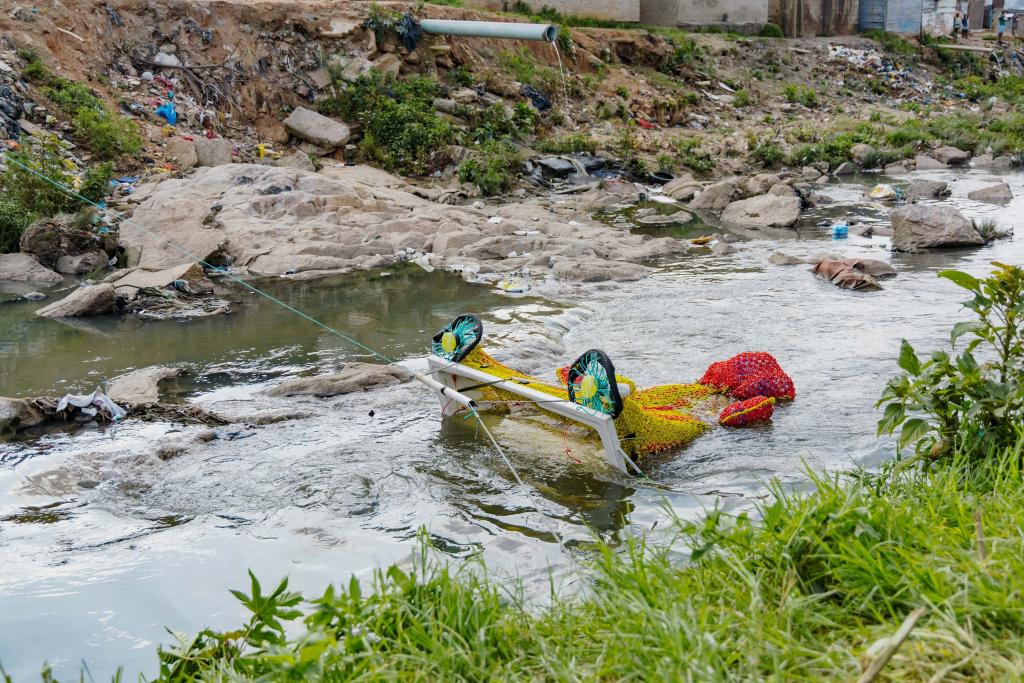
Litter trap installed in the Jukskei River in Alexandra Township, Johannesburg. (Photo: Hannelie Coeztee)

In Alexandra, the Jukskei River is both a lifeline and a threat. Floods arrive each season like clockwork—ripping through informal settlements, displacing families, and wrecking infrastructure. But while climate change might be the big-picture cause, the immediate trigger is often far more tangible: solid waste. Plastic debris, discarded appliances, and rotting refuse clog stormwater drains and choke the river.

And yet we’ve long known that solving this isn’t just about cleaning up. You can’t engineer your way out of neglect. What Alexandra needs—and what we dared to attempt—is a different relationship with the river. One that merges science with story, infrastructure with imagination.

Where Science Meets Storytelling: The river creatures are born

In 2022, a team led by Namina Foundation, Armour, and Willem Synman developed a simple litter trap—an elegant engineering fix to a persistent problem. Alexandra Water Warriors (AWW), the organization I proudly serve, installed the trap along the Jukskei. When David van Niekerk from the Johannesburg Inner City Partnership saw it, he didn’t just see a tool. He saw potential.

This vision sparked something bigger: a reimagined river corridor—a “Green Corridor” that’s alive with culture, nature, and public space. With the artistic vision of Hannelie Coetzee and support from the City of Johannesburg and the SUNCASA Project, the idea blossomed into the River Creature Series.

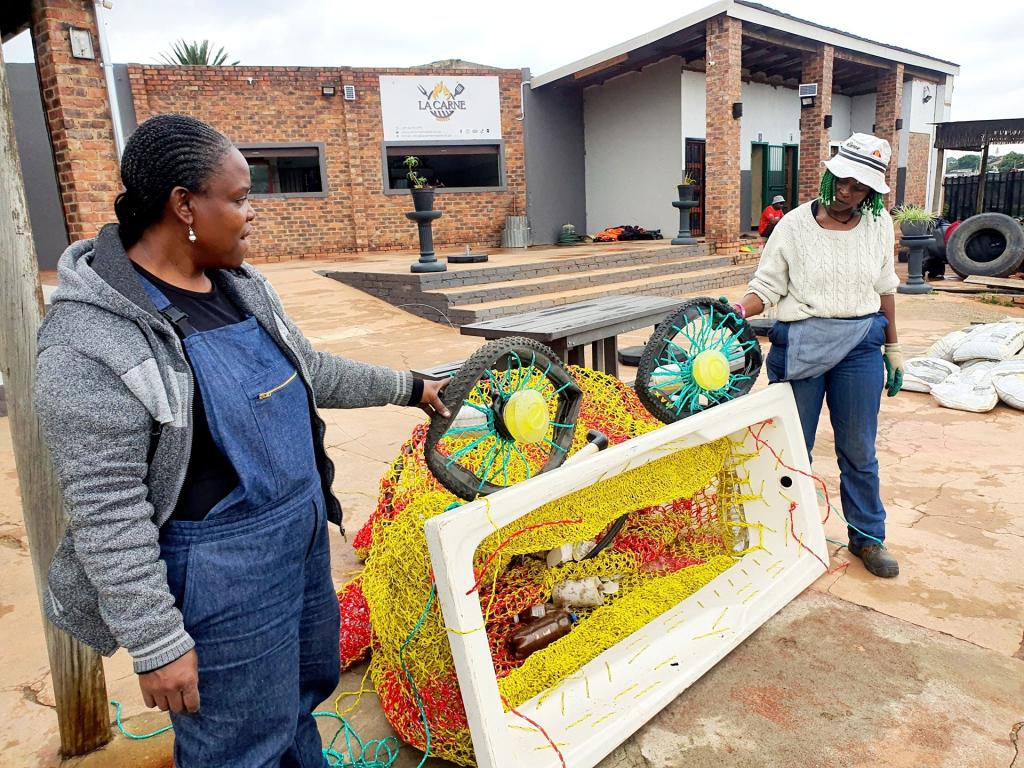
We took what was functional and made it magical. Litter traps became interactive public sculptures—part infrastructure, part storytelling. A bathtub turned into a fish. A metal frame into a crab. The river became a gallery.

SUNCASA | Women from Alexandra Township showing an artistic litter trap made with a salvaged bathtub (Photo: Hannelie Coetzee)
Women from Alexandra working on The River Fish: A Living Litter Trap: A filter-feeding fish made with a bathtub salvaged from Jukskei (Photo: Hannelie Coetzee)

Co-Creation and Community Wisdom

But this was never just about aesthetics. It was about ownership. Before a single sculpture was built, we held community workshops—deep, messy, joyful sessions where science met tradition, and art met oral history. The participants shared stories of the river and drew their versions of river creatures. These weren’t focus groups. They were ceremonies of reconnection.

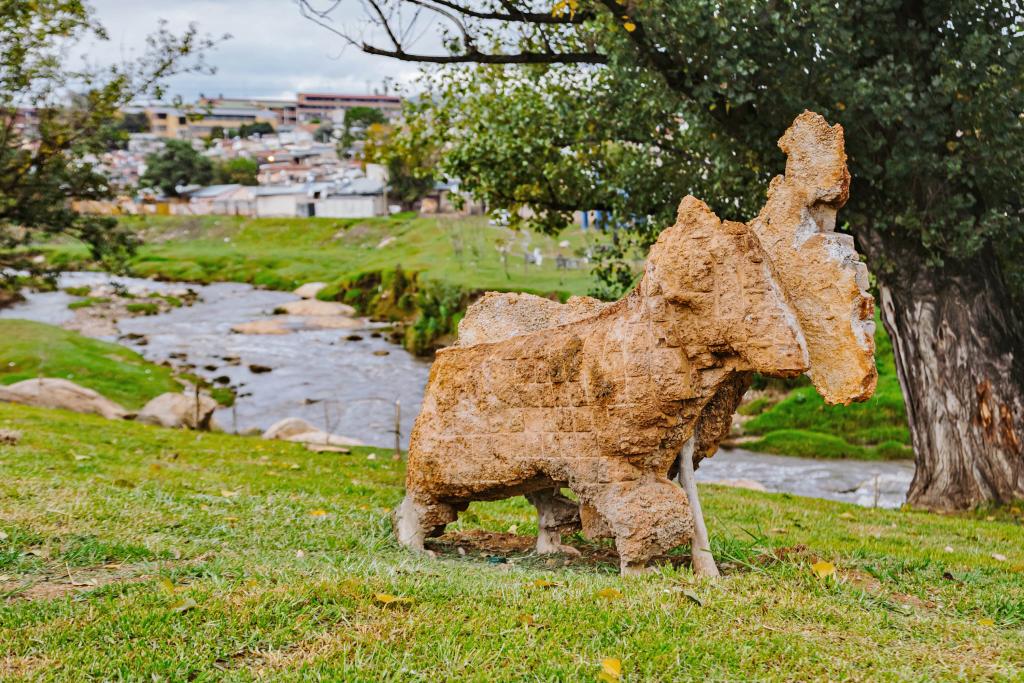
As AWW, our role was to ensure Alexandra’s voice rang loud and clear. The sculptures—Goat, Bird, Rat/Mongoose, Crab, Water Spirit—are more than creative installations. They are reflections of our lived experience and our hope.

Inclusion Is a Climate Solution

SUNCASA | Women from Alexandra making litter traps during the training sessions. (Photo: Alexandra Water Warriors)
Women from Alexandra making litter traps during the training sessions hosted by KULA Marolen Foundation. (Photo: Alexandra Water Warriors)

Of all the partners that have made this work possible, one stands out for me personally: the KULA Marolen Foundation, based in Alexandra, which trains local women to weave recyclable materials into the litter traps. They are the only organization in South Africa doing this.

For too long, women—especially in places like Alexandra—have been left out of the picture when it comes to innovation. KULA flips the script. They’ve turned waste into wages. They’ve made green jobs a reality. They’ve woven dignity into every fibre of those traps.

When I watch the KULA women work, I see more than skill: I see agency. I see mothers building futures. I see women no longer pleading to be included in the climate conversation but leading it.

A New Relationship With the River

Today, the Jukskei River feels different. Yes, the litter traps are helping. Yes, the art draws crowds. But more importantly, there’s a shift in mindset.

Children play near the sculptures and ask questions. Locals stop to take photos. Our Community Volunteers help clean and maintain the spaces. This river, once a no-go zone, has become a source of pride.

What’s unfolding here is not just adaptation. It’s restoration of land, but also of identity.

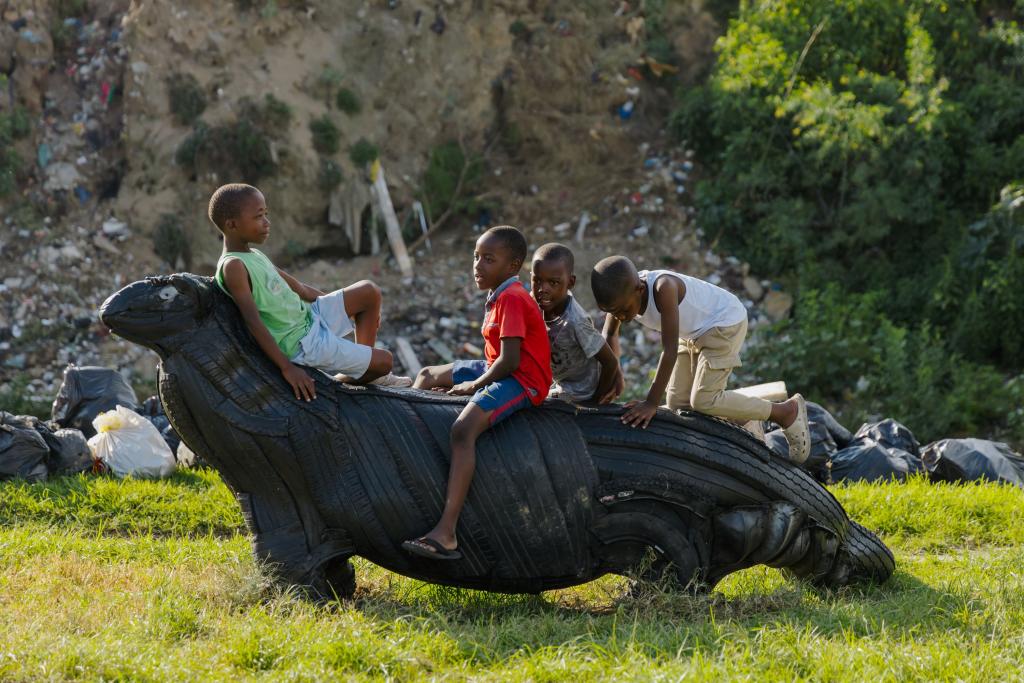
SUNCASA | Kids playing on a mongoose sculpture in Alexandra, Johannesburg.
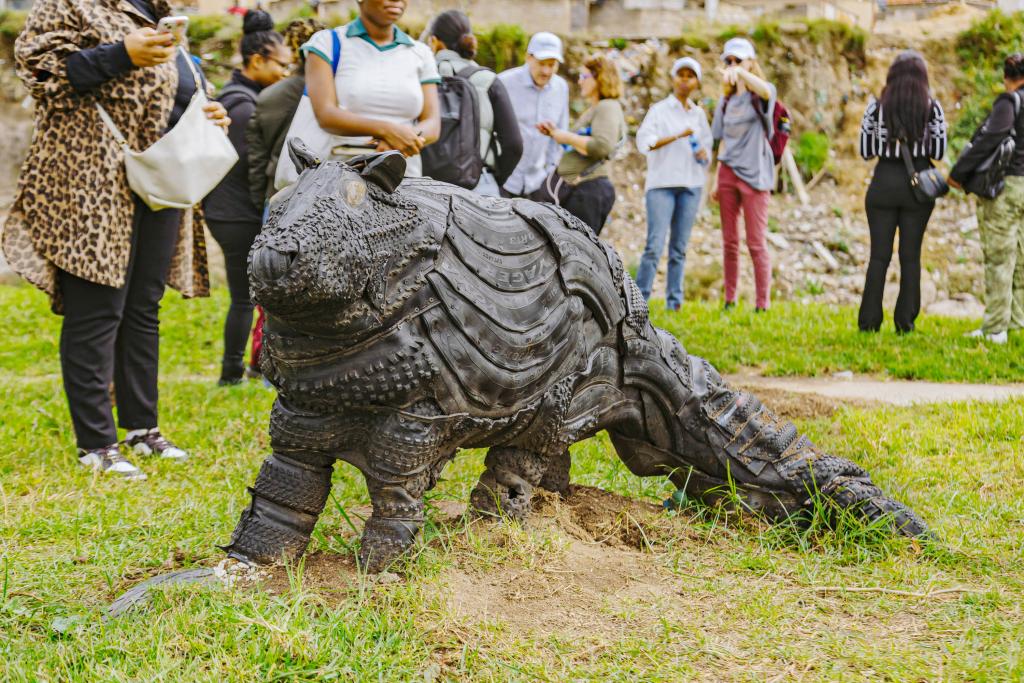
Kids playing with the Mkhuseli the Mongoose: The Pest Controller:  Sculpted from discarded tires, the artwork highlights the role of urban wildlife.

What Does It Really Take?

People often ask: How did SUNCASA gain traction in a place as complex as Alexandra, where government often fails, where trust is fragile, where the daily struggles are so urgent that climate change can feel like a luxury concern?

The answer is simple, but not easy. Show up. Listen. Stay. Co-create.

SUNCASA didn’t come in with a “solution.” It came with humility. It didn’t ask us to adapt to it—it adapted to us. From the first workshop to the final installation, it honoured Alexandra’s knowledge, pain, and power.

It also gave us something rare in climate work: beauty. Not the polished, distant kind—but raw, rooted, joyful beauty born of collaboration.

Why Art Matters in the Fight for Climate Justice

SUNCASA | Launch of the "Art and Litter Traps" initiative in Alexandra, Johannesburg, on April 16, 2025.
Launch of the Art and Litter Traps initiative in Alexandra in April 2025. (Photo: Hannelie Coetzee)

In places like Alexandra, technical language doesn’t always land. But a sculpture? A mural? A song? Those speak in tongues we understand.

Art bypasses shame and builds connection. It doesn’t lecture. It invites. That’s why the River Creature Series worked. It gave us symbols we could love—and therefore protect.

In Alexandra, where inequality is etched into the landscape, art has become a form of resistance. It claims space. It tells us we belong. It says: We are not invisible.


A Different Kind of Future

I don’t know what the next flood will bring. I don’t know whether funding for climate projects like SUNCASA will continue. But I do know this: when people see themselves in the solution, they protect it.

When women are empowered, families are transformed. When rivers become stories, they become sacred. And when art meets activism, transformation is not only possible—it’s irresistible.

In Alexandra, we’re not just adapting. We’re rewriting the script.
One river creature at a time.
One woman at a time.
One story at a time.

And that, I believe, is how change really flows.

 Watch this video to learn more about the Arts and Litter Traps Initiative in Johannesburg.


News

SUNCASA | Turning trash into treasures along the Jukskei River in Johannesburg

SUNCASA and its local partners in Johannesburg, South Africa, launched a unique initiative that blends environmental action with artistic expression in the heart of Alexandra Township. Led by environmental artist and scientist Hannelie Coetzee, local artists have turned waste carried by the Jukskei River into thought-provoking sculptures and litter traps to tackle flooding and pollution in the region.

April 22, 2025

Adapted from the Johannesburg Inner City Partnership’s (JICP) original publication.

Alexandra, Johannesburg — Along the once-neglected banks of the Jukskei River, a powerful new collaboration is finding innovative nature-based solutions. Through the SUNCASA  (Scaling Urban Nature-based Solutions for Climate Adaptation in Sub-Saharan Africa) Litter Traps and Art Project, the Alexandra community in Johannesburg is transforming solid waste into river cleaning installations and public art to reduce flooding, improve biodiversity, and ignite climate action from the ground up.

This initiative is being implemented under the SUNCASA project. The 3-year initiative is aimed at revitalizing the Upper Jukskei River catchment through nature-based solutions that address flooding and erosion, manage urban heat, improve water security, and enhance biodiversity protection—ultimately increasing climate resilience for over 1.045 million people.

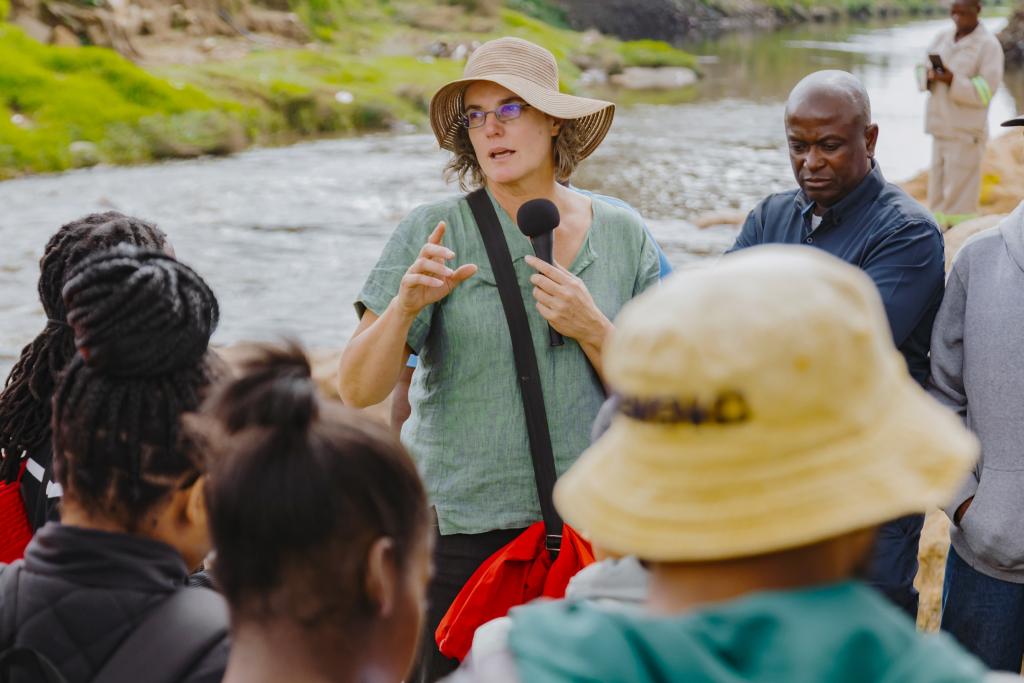
SUNCASA | Scientist and artist Hannelie Coetzee speaking to Alexandra community members during the launch of the "Art and Litter Traps" initiative in Johannesburg, South Africa.
Artist and environmental scientist Hannelie Coetzee led the development of the artworks displayed along the Jukskei River in Alexandra Township, Johannesburg: “We’ve turned the detritus of urban life into guardians of the river.”

“It struck me that we could turn the rather unsightly litter traps into vibrant community spaces by activating them through public art installations,” says David van Niekerk, CEO of the Johannesburg Inner City Partnership (JICP). “They could then be used not only for river cleaning, but also to involve the local community in the activation process, as well as places where locals and tourists could learn about the river and nature-based approaches.”

The Jukskei River Community Litter Trap and Art Launch took place on April 16, 2025, in Alexandra Township. The program included a visit to the Kula Marolen Foundation for an introduction to Alexandra’s weaving community, followed by guided site visits along the Jukskei River led by artist and scientist Hannelie Coetzee, working with The Art Collective and Alexandra Water Warriors. The event concluded with reflections from key partners, including the City of Johannesburg and Global Affairs Canada, and a networking lunch, showcasing collaborative efforts to revitalize the river.

SUNCASA | Litter trap installed in Jukskei River, Alexandra Township, Johannesburg.
Litter trap installed in the Jukskei River: Alexandra’s Kula Marolen Foundation provided training in macrame to support the creation of adaptable litter traps that can be installed in various locations as the river's conditions change, tackling flooding and pollution.

“We’ve turned the detritus of urban life into guardians of the river,” says lead artist and environmental scientist Hannelie Coetzee. “Each trap speaks to what has been discarded — physically and socially — and transforms it into a symbol of care. Art is not an add-on here; it is central to ecological restoration.”

Each trap speaks to what has been discarded — physically and socially — and transforms it into a symbol of care. Art is not an add-on here; it is central to ecological restoration.

Hannelie Coetzee, artist and scientist leading the "Art and Litter Traps" initiative.

Attending the launch ceremony, Janina Schinck, SUNCASA's Project Lead, underscored that community engagement is a key component of SUNCASA's implementation. "It has been inspiring to see the engagement of the Alex community in our project activities. With the River Creature Series, they have created something really special to showcase the importance of community-led watershed management for years to come."

See below the other artworks comprising the Alexandra River Creature Series along the Jukskei River:

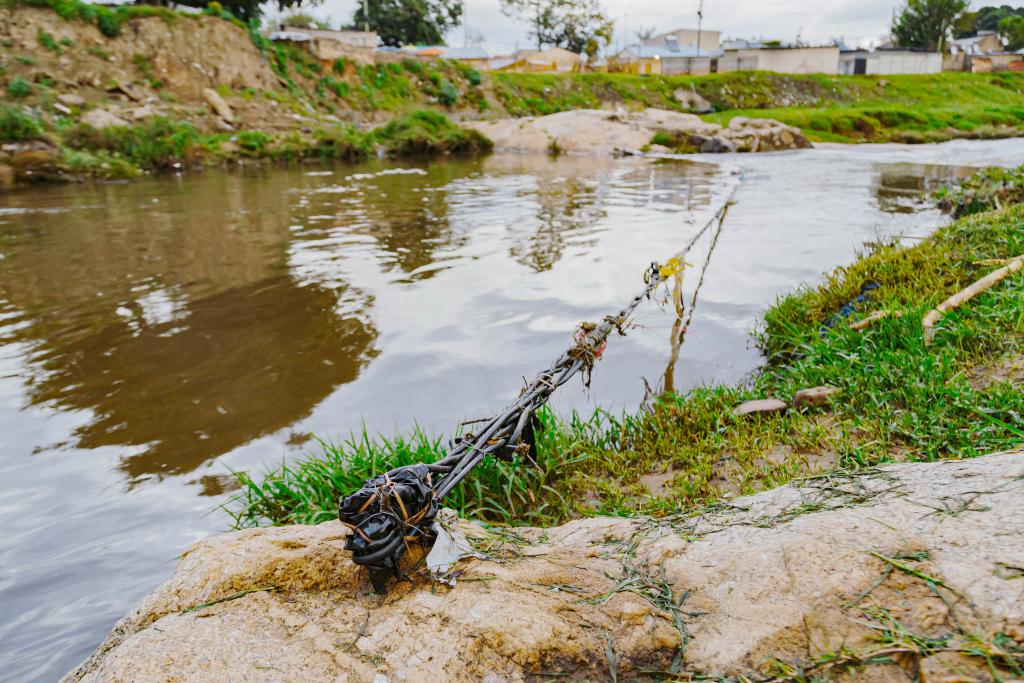
SUNCASA | Log harvester installed in the Jukskei River in Alexandra Township, Johannesburg.
The Log Harvesting Trap: An upcycled fibre optic cable guides heavy invasive logs to shore, reducing flood damage and protecting downstream areas.
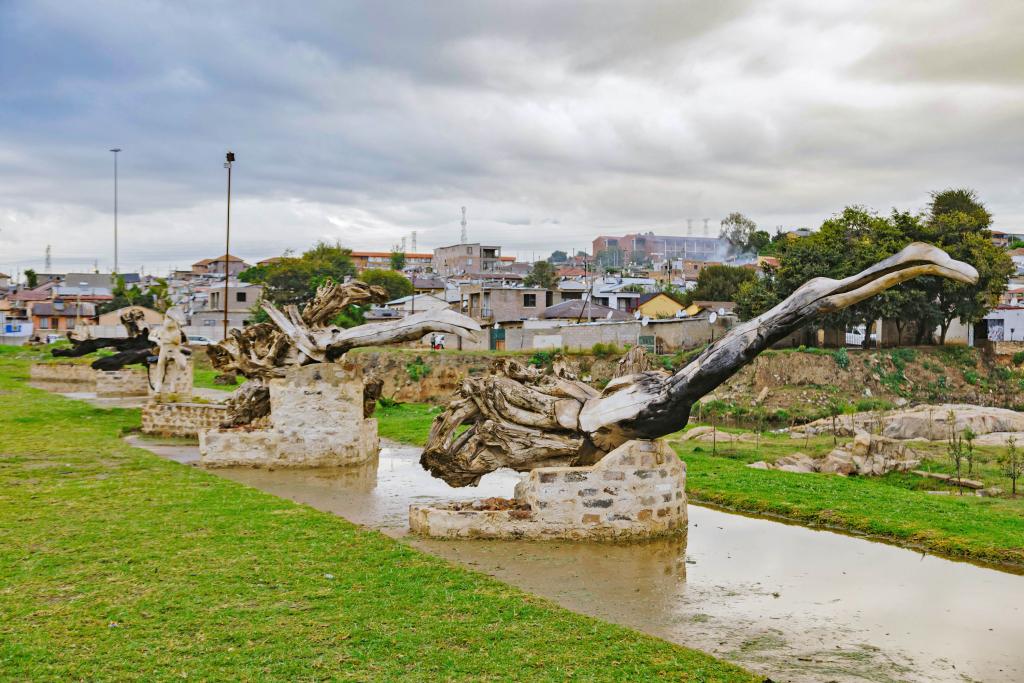
SUNCASA | Birds sculptures made of logs from the Jukskei River in Johannesburg.
lzizwe the Bird: A River's Messenger | Artist: Collen Maswanganyi leading a team of wood carvers | Carved from invasive logs, the sculpture symbolizes the health of rivers, spiritual connection, and peace, reminding us to observe nature and protect our waterways.
SUNCASA | Fish sculpture (litter trap) installed in the Jukskei River, Johannesburg.
The River Fish: A Living Litter Trap | Artists: Samiksha Singh, Hannelie Coetzee, and Solomon Ndlovu. Woven by the Kula Marolen Foundation. | This woven sculpture, with a bathtub salvaged from the river, traps plastic debris. Inspired by filter-feeding fish.
SUNCASA | Goat sculpture made from salvaged tiles and stones as part of the SUNCASA's "Art and Litter Traps" initiative.
Musa the Goat: The Resilient Grazer | Artist: Sifiso Gumede, in collaboration with Hannelie Coetzee | Crafted from salvaged tiles and stones, the goat sculpture symbolizes resilience and biodiversity, underscoring the goat’s role in preserving river ecosystems in Alexandra.
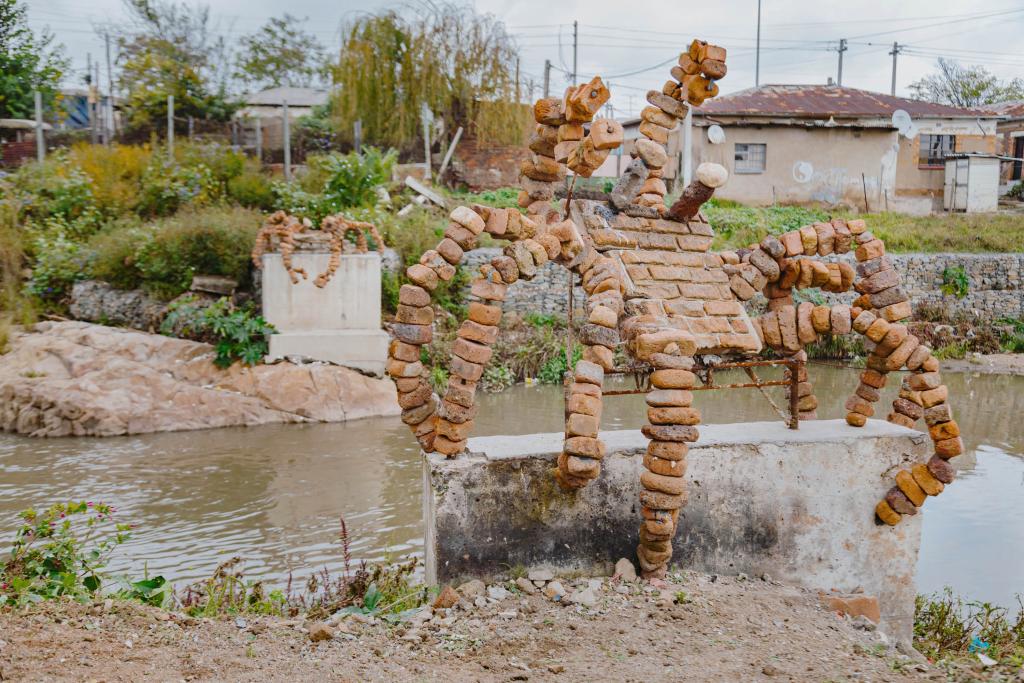
SUNCASA | Crab sculptures made from illegal construction waste as part of the SUNCASA's "Art and Litter Traps" initiative.
Nhlakanipho the Crab: Nature's Cleaner | Artist: Sipho Gwala, in collaboration with Hannelie Coetzee | Made from illegal construction waste, the sculptures stand for balance.  Crabs clean riverbeds, ensuring water quality, but face threats from pollution.
SUNCASA | Mongoose sculpture made from discarded tires as part of the SUNCASA's "Art and Litter Traps" initiative.
Mkhuseli the Mongoose: The Pest Controller | Artist: Albert Rasetlapa | Sculpted from discarded tires, the artwork highlights the role of urban wildlife—mongooses naturally control rats, whose populations rise with pollution.  
SUNCASA | Mosaic made from riverbank tiles as part of the SUNCASA's "Art and Litter Traps" initiative.
Sbusiso Malinga: A Legacy of Action | Artists: Hannelie Coetzee, with Mosa Mosikidi leading the mosaic team | This mosaic memorial, made from riverbank tiles, honours Sbusiso Malinga—Alexandra Water Warriors founder whose legacy of river cleanup inspired litter traps.

The SUNCASA initiative is funded by Global Affairs Canada and delivered by the International Institute for Sustainable Development and World Resources Institute. Implemented across three sub-Saharan cities: Johannesburg, Kigali (Rwanda), and Dire Dawa (Ethiopia), the project aims to enhance climate resilience, gender equality, social inclusion and biodiversity protection through community-driven nature-based solutions. In Johannesburg, SUNCASA’s NbS will benefit over 1 million people.

In Johannesburg, the program’s alignment with the City’s Integrated Development Plan strengthens efforts to combat key environmental challenges in vulnerable areas like Alexandra— where informal settlements face regular flooding, rising heat, and pollution.
Key interventions include:

  • removal of alien invasive species and replanting of indigenous vegetation
  • solid waste removal and recycling
  • urban greening and tree planting to reduce urban heat
  • community education and local capacity building
  • public art using creative reuse of waste for environmental awareness

The engagement of local partners like Water for the Future, Alexandra Water Warriors and Gender CC exemplifies the value of locally rooted partnerships in climate resilience work. Their involvement and leadership ensure that gender-responsive and socially inclusive nature-based solutions are not only implemented but also embraced and maintained by the community in the long run.

The educational component of the project translates the science and creativity into accessible resources for learners. Community-focused lesson plans cover topics such as biodiversity, including the mongoose’s role in managing rat populations, and goats being a more sustainable livestock choice, offering an integrated understanding of ecosystem health.

Hundreds of community members have already engaged with the dynamic litter harvesting devices and the process of waste transformation. The next phase involves a co-designed plan for the riparian zone of the Jukskei River Park, activating participation from thousands more who live along the riverbanks.

Charting Opportunities at the Nexus of Climate and Trade in Brazil, Indonesia, and South Africa

Trade policy can be a powerful tool for advancing climate action in Brazil, Indonesia, and South Africa. IISD conducts research, engages stakeholders, and provides strategic recommendations to align trade policies with climate goals, focusing on key sectors like food, agriculture, and energy transitions to drive sustainable economic growth.

IISD is exploring how trade policies and practices can better advance climate action in Brazil, Indonesia, and South Africa. The project focuses on the food and agriculture sector, as well as industries critical for climate action—such as heavy industries that need to be decarbonized and those driving energy transitions. It will identify key trade and climate policy levers that can boost emissions reductions, improve livelihoods, enhance food security, and support the transition to more sustainable economies.

The project will involve mapping out the most important policy- and market-driven changes needed in each region, followed by in-depth analysis of stakeholders—governments, businesses, civil society organizations, and advocacy groups—who are actively working to shape trade and climate policies. By understanding what has worked and what challenges and gaps remain, IISD will provide strategic recommendations on how targeted philanthropic investments can amplify positive change.

Supported by the ClimateWorks Foundation, and through local partnerships and rigorous research, IISD aims to ensure that trade policy becomes a tool, rather than a barrier, for advancing climate goals. The project will deliver clear insights on how to support fair and sustainable trade in ways that align with the priorities of local actors and the global climate agenda.

News

Year One of SUNCASA Progress: Lessons in Nature-Based Solutions

In its first year of implementation, the Scaling Urban Nature-based Solutions (NbS) for Climate Adaptation in Sub-Saharan Africa (SUNCASA) project has delivered significant results, laying the foundation for scaling up gender-equitable and socially inclusive climate adaptation efforts in 2025 and 2026 in Dire Dawa (Ethiopia), Kigali (Rwanda), and Johannesburg (South Africa).

March 7, 2025

As we celebrate the achievements of SUNCASA’s first year, IISD also extends its heartfelt support to our colleagues in Johannesburg who have been facing severe storms and flash floods in the past few days. Moments like these reinforce the importance of our shared work in building more resilient cities that are better protected from the impacts of climate change. This sentiment came through loud and clear most recently when SUNCASA partners from 14 organizations reviewed progress made in the first year of the project at SUNCASA’s inaugural peer learning event (PLE) in Kigali.

More trees, fewer invasives, cleaner rivers

In Kigali, Rwanda, 60% of the agroforestry target for the project was achieved in 2024, with 820 hectares out of the 1,262-hectare goal planted with fruit trees. This addresses flood and landslide risks and will help with the future food security and enhanced livelihoods of local communities. Regarding urban tree planting, 94% of the goal was reached with 56,000 trees planted along roadways to increase canopy coverage and green corridors within the city, tackling urban heat and contributing to increased biodiversity. 

SUNCASA | ARCOS Network staff working on a reforestation site in Kigali.
SUNCASA reforestation site in Kigali: 60% of agroforestry and 94% of urban greening targets were achieved in project's first year. 

"In just 1 year, we have been able to achieve remarkable milestones," said Kigali’s Mayor Samuel Dusengiyumva during the opening of the PLE. "We have made tremendous strides in urban greening. More importantly, we have ensured that these efforts directly benefit our communities by distributing 32,000 fruit trees to households, reinforcing the idea that sustainability and well-being go hand in hand."

SUNCASA | Mayor of Kigali, Samuel Dusengiyumva, opening the SUNCASA Peer Learning Event in Kigali
Kigali’s Mayor Samuel Dusengiyumva: “In just 1 year, we have been able to achieve remarkable milestones. We have made tremendous strides in urban greening.”

In Dire Dawa, Ethiopia, 313,330 seedlings were planted during SUNCASA’s first year. Over 128,000 of those were planted as part of the afforestation efforts, recovering 60 hectares of bare land—more than half of the 105-hectare target. When it comes to agroforestry, the goal of 115.5 hectares was overachieved in just one year, with the planting of 142,600 trees on 131 hectares. Additionally, 14 hectares of buffer zones—56% of the project’s target—were created with over 42,000 trees and shrubs planted to protect the banks of the Dechatu River.

In Johannesburg, South Africa, where activities are much more concentrated in densely populated urban areas, 80% of the urban greening and buffer zones target was attained in 2024 with the planting of 6,324 trees. "SUNCASA partners have made incredible progress on our NbS targets during the first year of project implementation," said Janina Schnick, International Institute for Sustainable Development Project Lead. "Bringing everyone together in Kigali to exchange achievements, challenges, and learnings allowed them to optimize their approaches and interventions and maximize the project's impact. I can’t wait to see what they accomplish in year two of SUNCASA."

SUNCASA | Community members working on an afforestation site at Harla Kebele, in Dire Dawa, Ethiopia.
In Dire Dawa, Ethiopia, the agroforestry goal for the entire project was overachieved in year one.

For Marc Manyifika, the World Resources Institute’s Lead for Urban Water Resilience, the first year of SUNCASA has showcased the transformative potential of gender equality and social inclusion (GESI)-responsive nature-based solutions—not only in strengthening climate resilience but also in promoting social inclusion and economic opportunity.

"Across Kigali, Dire Dawa, and Johannesburg, we’ve made remarkable progress—restoring landscapes, enhancing urban green spaces, and improving community well-being," said Manyifika. "What excites me most is that this is just the beginning. With the momentum we’ve built and the enthusiasm from communities and city leadership, SUNCASA is set to scale its impact even further in the years ahead, demonstrating that climate adaptation, biodiversity, and local livelihoods can go hand in hand."

SUNCASA | Afforestation site next Victoria Yards in Johannesburg, South Africa
Afforestation project site in Johannesburg: 80% of the urban greening and buffer zones target was attained in 2024.


"What excites me most is that this is just the beginning. With the momentum we’ve built and the enthusiasm from communities and city leadership, SUNCASA is set to scale its impact even further in the years ahead."

Marc Manyifika, WRI’s Lead for Urban Water Resilience


In its first year, SUNCASA both advanced NbS and strengthened local capacity through 11 training sessions for local partners. These sessions covered key topics such as urban NbS implementation, procurement, vulnerability and risk assessments, biophysical water monitoring, economic valuation, monitoring, evaluation, and learning, strategic communications, and GESI.

For GESI targets, SUNCASA collaborated with AVEGA Agahozo in Kigali, Hararghe Catholic Secretariat in Dire Dawa, and Gender CC in Johannesburg to deliver workshops for 694 community members, including women, men, youth, elders, local leaders, and people with disabilities. These workshops focused on addressing social and gender biases, promoting equitable participation in NbS planning and implementation, and encouraging shared decision-making within households.

These training sessions sparked discussions on marginalization, exclusion, and gender-based violence in the context of NbS and climate adaptation, fostering shifts in gender and social norms at the personal and family levels. SUNCASA is committed to protecting the rights of women and other underrepresented groups, ensuring that at least 50% of participants came from marginalized communities.

SUNCASA | Participants of the GESI workshop in Dire Dawa, Ethiopia, holding a SUNCASA banner. (Photo: Hararghe Catholic Secretariate)
GESI training sessions brought together 694 community members from the three SUNCASA cities, including women, men, youth, elders, local leaders, and people with disabilities.


SUNCASA Year One in Numbers
 

Dire Dawa

  • 313,330 seedlings planted.
  • Afforestation: 128,550 trees planted, recovering 60 hectares of bare land—more than half of the 105-hectare target.
  • Agroforestry: 142,600 fruit trees planted in 131 hectares, overachieving the project’s initial goal of 115.5 hectares.
  • Buffer Zones: 56% of the target achieved with 42,000 trees and shrubs planted in 14 hectares.

Kigali

  • Agroforestry: 60% of the project target achieved with 820 hectares out of the 1,262-hectare goal planted with fruit trees
  • Urban Greening: 94% of the goal reached, with 56,000 trees planted along roadways to increase canopy coverage and green corridors.
  • Gullies: Planting of 31,900 trees out of 46,000 in ravines.

Johannesburg

  • Urban greening and buffer zones: 80% of the project’s target achieved with the planting of 6,324 tress in highly populated urban areas.
  • Remove an alien species, Kikuyu grass, from two hectares.
  • Development and installation of litter traps along the Jukskei River in Alexandra Township.

 Training sessions

  • 11 training sessions for local partners, including urban NbS implementation, procurement, vulnerability and risk assessments, biophysical water monitoring, economic valuation, monitoring, evaluation, and learning, strategic communications, and GESI.
  • Gender equality and social inclusion workshops for 694 community members, including women, men, youth, elders, local leaders, and people with disabilities.
Press release

Kigali Shares Lessons on Flood Risk Reduction and Gender Equality With Other Sub-Saharan African Cities

KIGALI, RWANDA—Representatives from 14 organizations and city governments delivering the CAD 29 million (USD 21 million) SUNCASA project will meet in Kigali this week to exchange experiences and insights on advancing nature-based solutions (NbS) for reducing flood and climate risk while improving the lives of women and vulnerable groups.

February 6, 2025

From February 10 to 12, experts in NbS, climate change adaptation, gender equality and social inclusion (GESI), water systems, and data management drawn from governments and civil society organizations in Kigali, Johannesburg, and Dire Dawa will come together for the SUNCASA project’s peer learning event. The event will take place at the Mille Collines Hotel and will be opened by the Mayor of Kigali, Samuel Dusengiyumva, on February 10 at 9 am.

Experts will review the first year of the SUNCASA’s project’s activities, which included tree planting, invasive species removal, watershed restoration, and community workshops to set out strategies grounded on the lessons learned across the three cities.

"At the heart of this event is the opportunity to come together and learn from one another what works, what doesn't, for whom, and why. It's a chance to exchange, engage and reflect on the SUNCASA story so far across three very unique, dynamic African cityscapes,” explains Samantha Boardley, IISD’s climate adaptation specialist and one of the event’s lead facilitators. “It is an occasion so few projects or stakeholders make the time for, but one that offers so much not only to the project but to our broader understanding of nature-based solutions for climate change adaptation."

The first year of SUNCASA in Kigali achieved significant results. Fruit trees and shrubs were planted in 820 hectares and urban green areas were expanded with 56,000 new trees. Other NbS actions, such as reforestation and afforestation, will kick off in March 2025.

In Dire Dawa, Ethiopia, implementing partners planted more than 313,000 seedlings in 2024, established new forests on 60 hectares, revitalized 131 hectares with 142,600 fruit trees, and created 14 hectares of buffer zones along the Dechatu River.

In Johannesburg, South Africa, the tree-planting activities started in December 2024, with more than 6,300 seedlings planted to expand urban areas and create buffer zones to protect the Jukskei River. Additionally, alien invasive species were removed from 2 hectares, and another hectare was strategically rehabilitated by planting indigenous species. In one of the crucial project sites, Alexandra Township, local communities are manufacturing litter traps from waste collected in the river, which will contribute to reducing watercourse pollution.

Launched in 2024, SUNCASA is a 3-year project developed and implemented in close collaboration with local organizations. Delivered by the International Institute for Sustainable Development (IISD) and the World Resources Institute (WRI), with funds from the Government of Canada, SUNCASA seeks to enhance resilience, gender equality, social inclusion, and biodiversity protection in urban communities in Ethiopia, Rwanda, and South Africa. The project aims to benefit 2.2 million people living in climate-vulnerable areas.

SUNCASA PEER LEARNING EVENT

Where: Mille Collines Hotel, 2 KN 6 Ave, Kigali

Available Interviews: 

  • Lord Samuel Dusengiyumva, Mayor of Kigali
  • Janina Schnick, Lead, SUNCASA Project
  • Marc Manyifika, Country Lead for Urban Water Resilience, WRI Africa
  • Project scientists and community leads are available for interview. (Please request in advance to confirm availability.)

QUOTES

“Climate change is a reality. As a matter of fact, this year alone (2024), in the month of September, Kigali recorded its highest urban heat in history. And if you look at the amount of rain we are having, we have to do something. And I have to say that it can only be done in a coordinated manner. SUNCASA project is an initiative that symbolizes not only progress but a shared vision for our city and our continent. Kigali has long been a city that embraces bold ideas and transforms them into tangible results.”

Lord Samuel Dusengiyumva, Mayor of Kigali

“SUNCASA partners have made incredible progress on our NbS targets during the first year of project implementation, and we are excited to bring them together in Kigali to exchange achievements, challenges, and learnings. This will allow them to optimize their approaches and interventions in the three SUNCASA cities and maximize the project's impact. I can’t wait to see what they accomplish in Year 2 of SUNCASA!”

Janina Schnick, Lead, SUNCASA, IISD

“The peer learning event is SUNCASA’s first milestone—after a year of implementation, it’s bringing together partners from all three cities to exchange lessons, share valuable tools, and inspire new approaches for advancing nature-based solutions and gender equality and social inclusion. From the ARCOS Network showcasing their approach to community engagement, Haramaya University spotlighting their research on soil moisture and GenderCC sharing their expertise in integrating gender & social inclusion, participants will have the chance to learn, collaborate, and spark new and innovative pathways for building more inclusive and resilient cities.”

Marc Manyifika, Urban Resilience Lead, World Resources Institute - Africa

SUNCASA IN NUMBERS

  • 2.2 million people benefited from the NbS actions.
  • CAD 29 million will be invested in NbS actions in the three cities.
  • reforestation: 640 ha will be recovered with the planting of 1.4 million trees.
  • afforestation: More than 1.5 million trees will be planted in 867 ha of degraded land.
  • agroforestry: Over 500,000 fruit trees will be planted in an 885-ha area.
  • 1,143 ha of buffer zones will be established to protect the riverbanks.
  • 469 ha will be revitalized by removing alien invasive species and debris.
  • Public green spaces will be expanded with the planting of 150,000 trees.
  • Around 22,000 people from vulnerable communities will directly benefit from capacity-building and implementation activities.


For media inquiries, please contact:

Cesar Henrique Arrais

Senior Communications Officer, IISD

[email protected]

Eden Takele

Engagement & Communications Specialist, WRI Africa

[email protected]


Deep Dive

Challenging Gender Discriminatory Norms, Practices, and Beliefs in Sub-Saharan Africa

SUNCASA held a series of training sessions to support women and other underrepresented groups in overcoming the barriers preventing their access to natural resources and meaningful participation in nature-based solutions governance. 

January 27, 2025

“Before the training, we didn’t know if our men could be engaged in a domestic role, such as cooking and baking. Now we know, and we will practice after the training.”

A woman participant from Hareall Kebele, Dire Dawa, Ethiopia

“I don’t care if other men laugh at me while I’m supporting my wife with household chores! I know what I’m doing and how my family will benefit from that.”

A man participant from Gasabo District, Kigali, Rwanda

“We all have the same or similar problems and life challenges, so it is important to solve them together.”

A woman participant from Johannesburg, South Africa

Socially and culturally constructed gender norms are widely recognized as a major obstacle for women and other underrepresented groups in achieving social and economic empowerment and participating in political processes. The pressures of domestic and caregiving responsibilities, along with restrictive norms that suppress the voices, agency, mobility, and earning potential of these groups, often prevent them from engaging in paid, productive work. These barriers also limit their involvement in local leadership and community governance, amplifying deep-rooted inequities.

To address these challenges in sub-Saharan Africa, the SUNCASA  project was designed with a clear mandate of reducing barriers to the participation of women and other underrepresented groups in planning, implementing, and monitoring urban nature-based solutions (NbS) in Dire Dawa (Ethiopia), Kigali (Rwanda), and Johannesburg (South Africa).

In addition to ensuring that at least 50% of the project’s participants are from these marginalized groups, SUNCASA, in collaboration with local gender equality and social inclusion (GESI) organizations, has designed a series of activities to enhance the protection and promotion of the human rights of women and other underrepresented groups. These efforts seek to challenge harmful and discriminatory social beliefs, gender norms, and practices that limit their access to resources and meaningful participation in NbS activities.

From October 2024 to January 2025, SUNCASA’s local partners—the Association of the Widows of the Genocide (AVEGA Agahozo) in Kigali, the Hararghe Catholic Secretariat (HCS) in Dire Dawa, and Women for Climate Justice Southern Africa (Gender CC) in Johannesburg—held training sessions for community members with two related goals:

  1. Challenge social norms and gender biases within communities, enabling equitable participation in the planning, implementation, and monitoring of NbS.
  2. Facilitate participatory discussions among couples to promote equitable division of labour and inclusive household decision making and to support NbS efforts.

The training sessions were attended by 694 community members, including women, men, youth, elders, local leaders, and people with disabilities, creating a foundation for more inclusive and sustainable NbS in the three cities. The workshops triggered discussions on the root causes of historical marginalization, exclusion, and gender-based violence related to NbS and climate change adaptation. It also started conversations on positive or negative gender and social norms and how individuals or families can shift them.

One of the training program outcomes was to provide participants with a deeper understanding of concepts related to gender equity, including how societal norms shape gender roles, as noted by a young woman from Kigali: “I always thought gender was just another word for sex, especially when we talk about ‘gender balance’ as a way to support women’s rights. Now I see that gender is something we learn from society and is not the same as being a woman.”

By engaging in participatory and interactive exercises, participants were also encouraged to recognize the importance of the equitable division of labour between men and women within their households. The activity created a safe space for men and women to openly share their challenges, acknowledging that both face societal pressures. As a man participant from Dire Dawa said, “If men are engaged in culturally ascribed women’s roles, neighbours and the community give names that ridicule men and that discourage and shame them to engage.” 

Amid a conversation on the shifting roles of men and women in society, an elderly man participant from Kigali shared, “In the past, we used to have women’s roles and men’s roles, but with the development and the cost of living becoming expensive, it’s no longer the case! Men cook food and care for kids, which was not the case in the past.”

Similarly, in Johannesburg, a young man told a personal story about subverting cultural expectations. “I was left alone to look after my niece, and I could not change a diaper, and nobody could teach me as both parents were at work! But guess what I did: I went on Google and learned how to change a diaper, and these days, I am so close to my niece, as I know how to look after her and feed her.”

Acknowledging the success of the GESI sessions, a woman from Dire Dawa highlighted that “Before the training, we didn’t know if our male [family members] could be engaged in the domestic role, for example, cooking and baking. Now we know, and we will practice that after the training.”  Building on this sentiment, an elderly couple from Ejaneni Kebele emphasized the broader impact of the training, particularly the couples’ demonstration training. “Though we are old to engage in the various activities assigned to males and females based on their gender, still the training enables us to teach and advise our children and kids.”

While the program advanced SUNCASA’s GESI goals of raising awareness and bringing forward positive stories of change, participants also acknowledged that meaningful change is a long-term effort. As one local leader from Kigali pointed out, “The world cannot be just unless all barriers related to gender are addressed.”

The training sessions kick-started fundamental discussions about the diverse roles that different community members play in climate action. As participants shared their experiences and committed to challenging societal norms, it became clear that achieving equity in NbS requires collective action and continuous dialogue.

With the conclusion of the training program, many participants will focus on sharing the lessons learned during the sessions within their communities. For example, in Kigali, the takeaways from interactive discussions among 45 trained couples will play a vital role in this effort. These couples will engage in meaningful dialogues and receive practical homework assignments to implement at home, challenging social norms and fostering positive change within their families and neighbourhoods. Over the course of 5 months, this initiative aims to inspire transformative shifts in attitudes and behaviours, shaping future strategies to ensure that everyone—regardless of gender or other social factors—can actively contribute to and benefit from NbS for climate change adaptation initiatives.

Furthermore, the GESI experts from SUNCASA will focus on strengthening the capacity of local governments, as duty-bearers, to foster and practice enhanced gender-responsive policy-making processes.

SUNCASA is a 3-year NbS project delivered by IISD and the World Resources Institute (WRI), in collaboration with a wide array of local partners, with funds from Global Affairs Canada.  


* We greatly appreciate the dedication and competence demonstrated by our GESI expert colleagues from the three cities—Bertha Chiroro (Gender CC), Cleopatre Cyezimana (AVEGA), Emebet Belete (HCS), Gisele Umuhoza (AVEGA), Hadas Temesegen (HCS), Ndivile Mokoena (Gender CC), Patrick Shyaka (AVEGA), Rediat Tassew Mezgebu (HCS), and Theogene Niyirora (AVEGA)

Long-form article

SUNCASA in Kigali: Beyond planting trees

The City of Kigali and SUNCASA launched the “My Tree” campaign to promote tree sustainability and community ownership.

The City of Kigali, in collaboration with SUNCASA and its local partners, launched the ‘#IgitiCyanjye’ (#MyTree) community tree planting campaign on October 26, with the goal of ensuring the long-term sustainability of trees planted across the city. In Kigali, SUNCASA aims to restore the Nyabarongo River catchment through gender-responsive nature-based solutions, reducing flash floods, landslides, and erosion risks to enhance the resilience of 975,000 residents. 

November 4, 2024

As part of Rwanda’s monthly Umuganda community service, the campaign engages residents, organizations, and the broader community to ensure the long-term sustainability of trees planted throughout Kigali, encouraging shared responsibility for their care and maintenance. The October event also marked the community launch of SUNCASA in the districts of Kicukiro, Nyarugenge, and Gasabo. Hundreds of residents gathered at the three sites to participate in the community work, planting around 9,200 trees. The City of Kigali expects to plant 3 million trees in 5 years. SUNCASA will be pivotal in achieving this goal, as the project seeks to collaborate with 2 million new trees planted to restore the Nyabarongo River catchment.

Speaking at the event, Lord Mayor of Kigali Samuel Dusengiyumva underscored the importance of the partnership with SUNCASA and community-driven environmental initiatives, stating, “What we are doing with the ‘My Tree campaign,’ Igiti Chanje, is to encourage citizens to go beyond planting trees to ensure that the trees that we plant, we take care of them, we ensure that they grow so that they can serve the purpose.”

“Together with the SUNCASA project, we are aiming to plant 2 million trees within only 3 years or 2 years to come. The SUNCASA project is a perfect match with the city plan to become a city in the forest,” remarked Lord Mayor Samuel Dusengiyumva.

Lord Mayor of Kigali, Samuel Dusengiyumva, speaking at lthe aunch the “My Tree” campaign to promote tree sustainability and community ownership.
Lord Mayor of Kigali, Samuel Dusengiyumva: "The SUNCASA project is a perfect match with the city plan to become a city in the forest.” (Photo: Willian Bidibura | ARCOS Network | SUNCASA)

Through various communication channels, the campaign seeks to create a lasting commitment to tree care, positioning Kigali as a green, sustainable city where every individual and organization plays an active role in preserving and nurturing the urban environment. “By leveraging the voices of community champions and influencers, the campaign aims to raise awareness about the environmental, social, and economic benefits of trees while fostering a deep sense of ownership, particularly among Kigali’s residents,” said Lord Mayor Samuel Dusengiyumva.

Check out the highlights of the launch of the “My Tree” campaign. (Footage and edition: Willian Bidibura | ARCOS Network | SUNCASA)

Through a gender-responsive nature-based solution approach, SUNCASA will see the reforestation of steep slopes, the creation of agroforestry systems, and the establishment of urban tree-planting efforts that will help protect high-risk households, stabilize gullies, and reduce the vulnerabilities associated with Kigali’s rapidly urbanizing topography. In addition to the City of Kigali, SUNCASA is being implemented along with ARCOS Network, AVEGA-Agahozo, and Rwanda Young Water Professionals.

Marc Manyifika, World Resources Institute Lead of Urban Water Resilience for Africa, observed that the ‘My Tree’ campaign and SUNCASA align with global efforts to tackle climate change. “Kigali is leading by example. We cannot ignore the pressing threats of landslides and flooding that affect thousands of households. By working together, we are actively shaping the future we want to see for a greener Kigali. The city is setting a strong example in addressing climate challenges.

The ‘#IgitiCyanje’ campaign aligns perfectly with SUNCASA’s vision and mission, as it not only promotes tree planting across this vibrant city but also fosters community engagement to ensure the long-term sustainability of the NbS that are making Kigali greener and more resilient to the impacts of climate change,” said Kulupa Mkindlanyana, SUNCASA’s Project Manager representing IISD at the event.

SUNCASA IN KIGALI

  • Investing CAD 9 million (USD 7 million) in gender-responsive nature-based solutions through 2026.
  • Enhancing the resilience of 975,000 residents living in climate-risk areas.
  • Planting 827,000 trees in 220 ha through afforestation (new forest) actions.
  • Reforesting 650 ha with more than 1 million trees.
  • Planting 125,000 trees through agroforestry across 1,292 ha.
  • Developing 395.6 ha in buffer zones.
  • Urban green gardening with the planting of 41,600 trees along 52,488 km of roadways and 43,400 trees in 44.7 ha of public gardens.
  • Creating 5,000 green jobs in SUNCASA implementation activities.

ABOUT UMUGANDA

Umuganda, also known as community work with the purpose of contributing to the overall national development, was reintroduced to Rwandan life in 1998 as part of efforts to rebuild the country after the 1994 Genocide against the Tusti. It takes place on the last Saturday of each month.