Webinar

Improving Legal Frameworks for ESIA and Management

Join the Intergovernmental Forum on Mining, Minerals, Metals and Sustainable Development (IGF) on Wednesday, July 8, at 9 a.m. Ottawa / 3 p.m. Geneva for a webinar to discuss its newest Guidance for Governments: Improving Legal Frameworks for Environmental and Social Impact Assessment and Management.

July 7, 2020 8:00 pm

(Open to members)

Join the Intergovernmental Forum on Mining, Minerals, Metals and Sustainable Development (IGF) on Wednesday, July 8, at 9 a.m. Ottawa / 3 p.m. Geneva for a webinar to discus its newest Guidance for Governments: Improving Legal Frameworks for ESIA and Management.

The Guidance provides IGF’s 76 member governments with a comprehensive overview of international best practices in legal frameworks for ESIA and related management plans for large-scale mines.

  • The webinar will be moderated by IGF Director Greg Radford and include a multi-stakeholder panel discussion about emerging ESIA issues in the mining sector.
  • Paula Dobbelaar, Technical Secretary, from the Netherlands Commission for Environmental Assessment (NCEA) will present findings from its peer review of IGF's guidance and discuss the critical issues on the topic.
  • Harriet Wachira, Program Coordinator with Transparency International, will also speak on the importance of transparency and accountability in ESIA legal frameworks.
  • Time will be reserved for a Q&A with participants.

Register today for the webinar.


Webinar details

Topic
Mining
Impact area
Sustainable Economies
Webinar

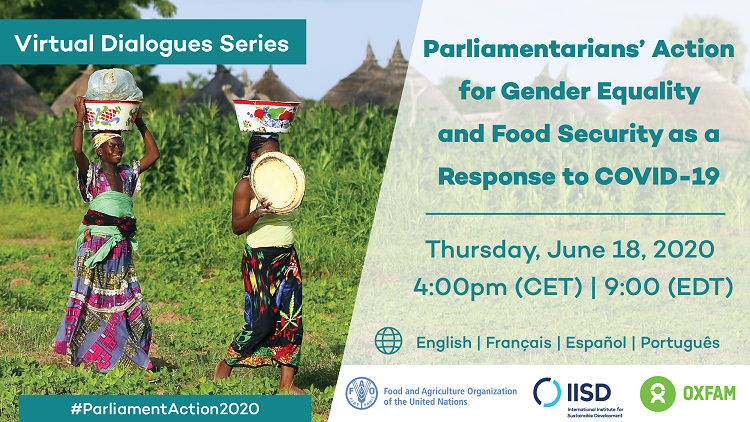
Parliamentarians' Action for Gender Equality and Food Security as a Response to COVID-19

June 17, 2020 8:00 pm

(Open to public)

In 2020, IISD together with the Food and Agriculture Organization of the United Nations (FAO) and Oxfam organized a series of online dialogues as part of their policy support to the ECOWAS Network of Parliamentarians on Gender Equality and Investments in Agriculture and Food Security.

This series of webinars served to explore and generate a reflection on the role of parliamentarians in mitigating the gender-differentiated impacts of COVID-19 on agriculture and food systems.

In total four webinars were held virtually and attended by 200 participants on average. Please refer to the webinars specific webpages in the right hand margin of this page for further details related to speakers, recording and reports.


Parliamentarians' Action #1 | Gender Equality and Food Security as a Response to COVID-19


This webinar offered a unique opportunity for a transversal discussion among parliamentarians from Africa, Europe, Latin America, and the Caribbean, and  contributed to generating a reflection on their role in tackling the COVID-19 crisis. Participants shared examples of good practices in terms of gender-responsive policy measures undertaken in their respective regions to reinforce food security and food systems.

During this webinar, parliamentarians from Africa, Europe, Latin America, and the Caribbean adopted a call for action in response to the impacts of Covid-19 on gender equality, food secutiry and nutrition. The declaration is available at the bottom of this page in English and in French.

We will act as champions for ensuring that the policy responses to COVID-19 and beyond are gender- responsive by addressing women’s needs and priorities, especially in rural areas, including the adoption of mitigation and temporary special measures, if necessary.

Excerpt from the Parliamentarians Call to Action

During this event, parliamentarians learnt about the call from the Parliamentary Front Against Hunger in Latin America and the Caribbean urging countries not to neglect the fight against hunger and malnutrition during the COVID-19 period. 

The webinar enhanced parliamentarians' actions on the implementation of policies and legislation for empowering women in agriculture and food systems during COVID-19 and beyond.

This virtual meeting was the first in a series of dialogues organized by the Food and Agriculture Organization of the United Nations (FAO), IISD, and Oxfam as part of their policy support to the ECOWAS Network of Parliamentarians on Gender Equality and Investments in Agriculture and Food Security. The objective of the series is to enhance the role of African parliamentarians in mitigating the gender-differentiated impacts of COVID-19 on food systems.

Speakers:

  • Maria Helena Semedo, Deputy Director-General, FAO
  • Siga Fatima Jagne, Commissioner for Social Affairs and Gender, Economic Community of West African States (ECOWAS)  
  • Ana Regina Segura Martínez, Head of Unit for Rural Development, Food and Nutrition, Spanish Agency for International Cooperation and Development
  • Monica Eva Copa, President of the Senate, Bolivia
  • Jario Flores, General Coordinator of the Parliamentary Front Against Hunger in Latin America and the Caribbean  
  • Soraya Rodriguez, Member, EU Parliamentary Alliance on Food Security and Nutrition 
  • Mathias Kasamba, Chairperson, Committee on Agriculture, Tourism and Natural Resource, East African Legislative Assembly
  • Teresa Cálix Raudales, Honduran Representative and Coordinator, Parliamentary Front Against Hunger in Mesoamerica  
  • Abdoulaye Vilane, Chairperson, ECOWAS Network of Parliamentarians on Gender Equality, Responsible Investment in Agriculture and Food Security
  • Tacko Ndiaye, Senior Gender Officer, FAO
  • Francine Picard, Policy Officer, IISD 

Date: June 18, 2020, 4:00 p.m. (CET) (duration: 2 hours)

Event hashtag: #ParliamentAction2020


Webinar

South Africa's Electricity Sector Reform: Experience from emerging economies

This webinar will look at electricity sector reform in South Africa, and how Eskom can adapt this reform to the post-pandemic economy by prioritizing social and environmental impacts.

June 9, 2020 8:00 pm

(Open to public)

Join us for a webinar presented by the Global Subsidies Initiative looking at electricity sector reform in South Africa, and how Eskom can adapt this reform to the post-pandemic economy by prioritizing social and environmental impacts. The webinar take place on Wednesday, June 10 at 14:00 SAST / 12:00 GMT.

South Africa’s electricity sector has been under considerable strain during the last decade. In the 90 years since its inception the entity has remained vertically integrated, with little or no structural change. The current structure is ill-suited to meet the country’s energy needs and has been susceptible to corruption and state capture. As a response to this, in October 2019, Eskom published a roadmap to inform electricity sector reform in South Africa. Although reform is long overdue, similar electricity sector reforms in emerging markets highlight the need to adapt the standard model of reform to meet individual country needs. The aftermath of COVID-19 further emphasises the need for Eskom to adapt its reform agenda to the post-pandemic economy by prioritizing social and environmental impacts, creating good jobs without damaging public health or the environment.

As part of the webinar, we will launch the IISD paper Rethinking Eskom: Lessons from electricity sector reform in India and Mexico. The paper analyzes electricity sector reform in India and Mexico, two emerging countries with characteristics comparable to South Africa. The paper assesses the impacts of electricity sector reform on electricity sector ownership, decarbonization, jobs and electricity prices, focusing on lessons for Eskom’s reform.

Webinar details

Impact area
Climate
Webinar

How Are African Governments Responding to Avert a COVID-19 Hunger Crisis?

This Ceres2030 webinar brought together African ministers responsible for agriculture and trade to discuss the measures their countries are taking to avert a hunger crisis by ensuring that livelihoods are secured and food systems remain functional.

June 9, 2020 8:00 pm

(Open to public)

This Ceres2030 webinar brought together African ministers responsible for agriculture and trade to discuss the measures their countries are taking to avert a hunger crisis by ensuring that livelihoods are secured and food systems remain functional. Ministers shared insights into the role the international community can play to support their efforts.

*En francais ci-dessous*
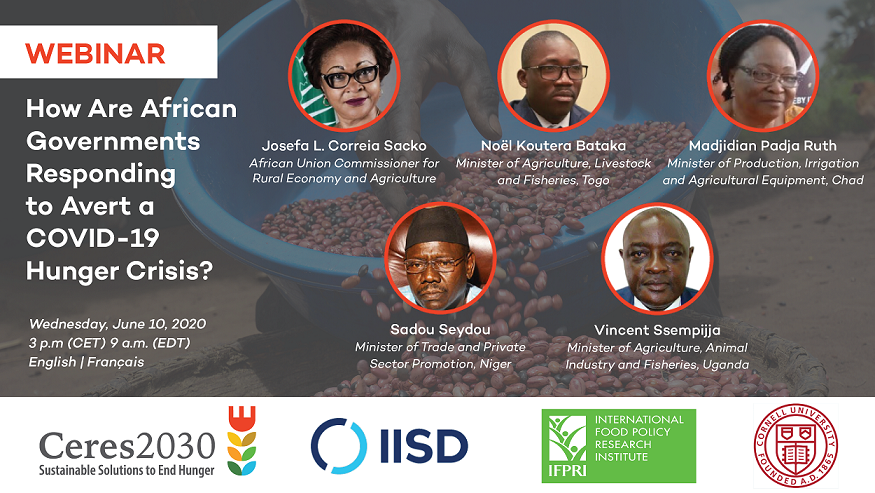
The webinar took place on June 10, 2020.

With the global economy reeling from COVID-related measures, the world faces the risk of a dramatic rise in hunger that has not been seen in decades. On April 16, the ministers from African Union member states agreed that efforts to contain the spread of the virus need to be accompanied by measures to minimize disruptions to the food and agriculture systems while supporting the livelihoods, food security and nutritional access of all African citizens during and after the COVID-19 pandemic. In their statement, Ministers reiterated Africa’s commitment to ending hunger by 2025. They appealed to governments to prioritize the food and agriculture system as an essential service and to recognize that all types of food systems—modern, traditional, and informal—play critical roles in serving different markets.

This dialogue sought to provide a global space for African governments to share their experiences on how they are averting a hunger crisis.

Speakers:

H.E. Noël Koutera Bataka, Minister of Agriculture, Livestock and Fisheries, Togo

H.E. Madjidian Padja Ruth, Minister of Production, Irrigation and Agricultural Equipment, Chad

H.E. Josefa Leonel Correia Sacko, Commissioner for Rural Economy and Agriculture, African Union Commission

H.E. Sadou Seydou, Minister of Trade and Private Sector Promotion, Niger 

H.E. Vincent Ssempijja, Minister of Agriculture, Animal Industry and Fisheries, Uganda


Moderators:
Francine Picard Mukazi & Carin Smaller, IISD
 

The virtual dialogue was hosted by the Ceres2030 project. Ceres2030 is a joint initiative by the International Institute for Sustainable Development (IISD), the International Food Policy Research Institute (IFPRI), and Cornell University that provides the donor community with a menu of policy options for directing their investments, backed by the best available evidence and economic models.

Funding support comes from Germany’s Federal Ministry of Economic Cooperation and Development (BMZ) and the Bill & Melinda Gates Foundation (BMGF).

Date: June 10, 2020, 16h EAT/ 15h CEST/ 9h EST (duration: 1.5 hours)

En français 

Ceres2030 a organisé ce webinaire avec les ministres africains responsables de l'agriculture et du commerce. Ils ont présenté les mesures prises par leurs pays pour éviter une crise alimentaire, garantir les moyens de subsistance et assurer le bon fonctionnement des systèmes alimentaires. Les ministres ont partagé également leurs points de vue sur le rôle que la communauté internationale peut jouer pour soutenir leurs efforts.

Le webinaire a eu lieu le 10 juin 2020 à 15 heures (CET)

L'économie mondiale étant ébranlée par les mesures sanitaires liées à la pandémie du COVID-19, le monde fait face au risque d'une augmentation sans précédent de la faim et de la malnutrition. Le 16 avril, les Ministres Africains de l'agriculture membres de l'Union africaine ont reconnu que les efforts visant à contenir la propagation du virus doivent s'accompagner de mesures visant à minimiser les perturbations des systèmes alimentaires et agricoles et  soutenir les moyens de subsistance de tous les citoyens africains pendant et après la Pandémie de covid19. Dans leur déclaration, les Ministres réitèrent l'engagement de l'Afrique à éliminer la faim d'ici 2025 et  appellent les gouvernements à donner la priorité au système alimentaire et agricole en tant que service essentiel et à reconnaître le rôle primordial de tous les types de systèmes alimentaires pour servir les différents marchés  - qu'ils soient modernes, traditionnels ou informels.

L'objectif de ce dialogue ministériel a été de partager des expériences et d’identifier des actions concrètes permettant d’éviter une crise alimentaire. 

Intervenants:

S.E. Noël Koutera Bataka, Ministre de l'agriculture, de la production animale et halieutique, Togo

S.E. Madjidian Padja Ruth, Ministre de la production, de l'irrigation et des équipements agricoles, Tchad

S.E. Josefa Sacko, Commissaire  chargé de l'économie rurale et de l' agriculture, Commission de l’Union Africain

S.E. Sadou Seydou, Ministre du Commerce et de la Promotion du Secteur Privé, Niger

S.E. Vincent Ssempijja, Ministre de l'agriculture, de la production animale et halieutique, Ouganda 


Modératrices: 

Francine Picard Mukazi & Carin Smaller, IISD

Le dialogue virtuel a éte organisé par le projet Ceres2030 , une initiative conjointe l'Institut international du développement durable (IISD), de l'Institut international de recherche sur les politiques alimentaires (IFPRI) et de l'université de Cornell. Cette initiative propose  à la communauté des donateurs un menu d'options politiques soutenu par les meilleures recherches disponibles et les meilleurs modèles pour orienter leurs investissements.

Ceres2030 reçoit le soutient financier du ministère fédéral allemand de la coopération économique et du développement (BMZ) et de la Fondation Bill & Melinda Gates (BMGF).

 Date : 10 juin, 16h EAT/ 15h CEST/ 9h EST (durée : 1,5 heures)

Watch the webinar's full recording (mostly in French) | Regardez la vidéo du webinaire 
 

Webinar

SEMI FINAL: How Canada is Hacking Lake Winnipeg

Want to discover what innovative and exciting ideas Canada's young professionals and entrepreneurs have tucked up their sleeves to help save Lake Winnipeg?

June 10, 2020 8:00 pm

(Open to public)

Want to discover what innovative and exciting ideas Canada's young professionals and entrepreneurs have tucked up their sleeves to help save Lake Winnipeg?

JOIN US AT 4:00 P.M. (CENTRAL TIME) ON THURSDAY, JUNE 11, 2020, FOR OUR FACEBOOK LIVE EVENT

The virtual semi-final for IISD’s AquaHacking Lake Winnipeg 2020 Challenge is just around the corner!

Since the competition launched earlier this year, multidisciplinary teams of students and young professionals have been working with mentors to develop innovative tech solutions to urgent freshwater issues facing the Lake Winnipeg basin.

At the semi-final, these teams will pitch their solutions to a panel of expert judges from the business, water, and technology sectors (see names below), who will determine which teams will advance to the final phase of the competition.

You will discover all of the exciting ideas Canada's innovators have been carefully concocting over the last few months and get to meet the young innovators themselves!

So, join us on Thursday, June 11, at 4:00 p.m. (Central time) on Facebook live to learn which five teams are moving on to the finals to compete for $50,000 in seed funding plus incubator space!

JOIN US AT 4:00 P.M. (CENTRAL TIME) ON THURSDAY, JUNE 11, 2020, FOR OUR FACEBOOK LIVE EVENT

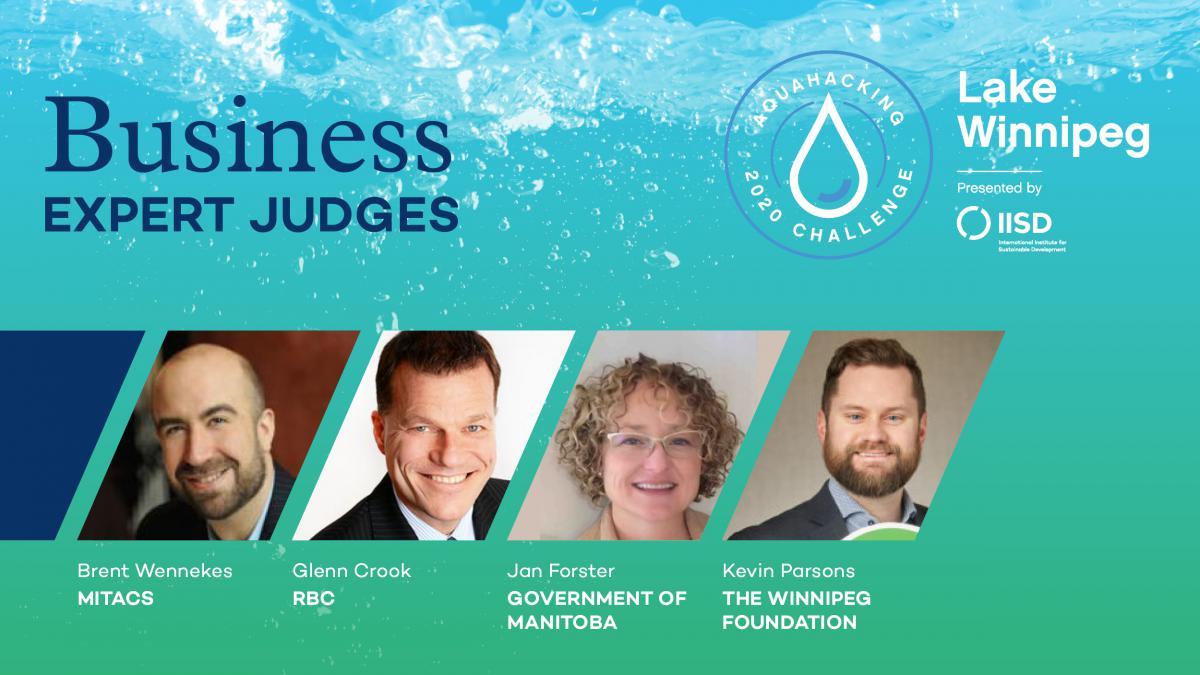
Poster for an aquahacking Lake Winnipeg virtual semi final

Poster for an aquahacking Lake Winnipeg virtual semi final with names of business expert judges

Poster for an aquahacking Lake Winnipeg virtual semi final with names of business expert judges

Poster for an aquahacking Lake Winnipeg virtual semi final with names of water expert judges

Webinar details

Impact area
Nature
Webinar

[FR] Mining Tax Policy Responses to COVID-19

Join IGF and the African Tax Administration Forum (ATAF) for a webinar exploring mining tax policy responses to the COVID-19 health crisis (in French).

May 25, 2020 8:00 pm

(Open to members)

Join IGF and the African Tax Administration Forum (ATAF) for a webinar exploring mining tax policy responses to the COVID-19 health crisis. The webinar will take place on Tuesday May 26, at 9:00 a.m. (Ottawa) / 2:00 p.m. (London) / 3:00 p.m. (Switzerland) and you can register here. This French webinar follows the initial English webinar, hosted by IGF and ATAF on the same theme in April.  

** Français ci-dessous**

As COVID-19 spreads, governments are responding with drastic measures to combat the pandemic’s health and economic impacts. 

In the mining industry, the virus has harmed workers, disrupted supply chains, and halted operations in many nations. The crisis presents commodity-specific risks to supply and/or demand, which is reflected in ongoing price volatility throughout the sector. Mining companies, under pressure to balance worker safety with business imperatives, may seek supportive tax relief. 

There is a risk that countries dealing with this unprecedented crisis may adopt unnecessary or poorly designed tax policies that cut vital government revenues while providing minimal benefits. 

Trust between government and citizens is especially critical during this period. To this end, tax measures should be transparent, based on clear policy objectives, clearly prescribed in law, and subject to monitoring and review. 

This webinar will provide guidance on which tax measures may be appropriate in this context and outlines specific policies to avoid. 

Register today.

**En Francais** 

Webinaire : nouvelles mesures de politique fiscale pour le secteur minier face au COVID-19 

Rejoignez le webinaire organisé par IGF et le Forum sur l’Administration Fiscale Africaine (ATAF) pour discuter des réponses possibles au COVID-19 en termes de politique fiscale minière. Ce webinaire d’une heure quinze minutes aura lieu le mardi 26 mai 2020 a 9h00 (Ottawa) / 14h00 (Londres) / 15h00 (Genève), inscrivez-vous ici. Ce webinaire, entièrement en français, fait suite à un premier webinaire organisé par ATAF et IGF le 16 avril 2020, en anglais, sur le même thème.  

Alors que le virus COVID-19 se propage, les gouvernements des pays affectés prennent des mesures drastiques pour combattre les impacts sanitaires et économiques de la pandémie. 

Dans l’industrie minière, le virus a porté préjudice aux travailleurs, perturbé les chaînes d’approvisionnement et interrompu les activités dans de nombreux pays. La crise crée des perturbations importantes qui affectent l’offre et la demande de matières premières, ce qui se traduit par une volatilité importante des prix. Les sociétés minières, à la recherche d’un équilibre entre la sécurité des travailleurs et les impératifs commerciaux, pourraient demander des allègements fiscaux. 

Sous la pression sociale et économique, les pays confrontés à cette crise sans précédent risquent d’adopter des politiques fiscales mal conçues qui réduiraient leurs recettes publiques sans pour autant résoudre les menaces réelles pesant sur la viabilité de leurs entreprises minières.  

La confiance des citoyens que les citoyens placent dans leurs gouvernements est essentielle pendant cette période. C’est pourquoi toute mesure d’allègement fiscal devrait être transparente, basée sur des objectifs clairs, avec un fondement juridique, et sujet à des mécanismes d’évaluation et de révision. 

Le webinaire proposera des recommandations sur les mesures fiscales qui pourraient être appropriées et celles à éviter dans le contexte actuel.

Webinar details

Topic
Mining
Impact area
Sustainable Economies
Webinar

Trade and Climate after COVID-19: Subsidies, Stimulus, and Energy Price

The COVID-19 pandemic is forcing governments to rethink their economic policies, systems, and agendas, while responding with stimulus packages, which sometimes include fossil fuel subsidies. The webinar will discuss global trade policy responses and the broader climate and environment policy conversations taking place now.

May 27, 2020 8:00 pm

(Open to public)

Join us for an IISD Global Subsidies Initiative webinar looking at global trade policy responses to COVID-19, as well as the broader climate and environment policy discussions happening as a result of the crisis. The webinar, part of a series initiated by the Friends of Fossil Fuel Subsidy Reform, will take place on Thursday, May 28, at 14:00 GMT.

The COVID-19 pandemic poses both threats and opportunities for international efforts on trade and climate change issues. This crisis is forcing governments around the world to consider implementing wider circular economy policies, greening and localizing larger parts of the supply chain. The pandemic may also potentially lead to more stringently protectionist agendas. Governments are also currently responding to the pandemic with stimulus packages to address all affected areas in their economies, and in some cases these packages include energy pricing and fossil fuel subsidy reform. Due in part to the global lockdown, demand for oil reduced by more than 15 million bpd in April 2020. This resulted in the lowest energy prices the world has seen in decades, another important factor in today’s trade and climate considerations.

This webinar intends to discuss global trade policy responses to COVID-19, as well as the broader climate and environment policy discussions happening as a result of the crisis. The first session will provide a global perspective on current events worldwide and discuss examples of response measures taken by a number of specific governments. The second session will focus on the present current situations. The Friends for Advancing Sustainable Trade (FAST) and Friends of Fossil Fuel Subsidies Reform (FFFSR) will also share their views along with suggestions for trade policy measures to support resilience from both a climate and pandemic perspective. 

Webinar details

Impact area
Climate
Webinar

Geneva Virtual Seminar: Joint Statement Initiative on Micro, Small, and Medium-Sized Enterprises

This virtual seminar, held on Friday, May 8, 2020, focused on the Joint Statement Initiative on Micro, Small, and Medium-Sized Enterprises (MSMEs).

May 7, 2020 8:00 pm

(Open to members)

This virtual seminar, held on Friday May 8, 2020, focused on the Joint Statement Initiative on Micro, Small, and Medium-Sized Enterprises (MSMEs).

The event involved presentations on the history and developments in the discussions among an Informal Working Group on MSMEs, currently involving over 90 WTO Members and launched at the organization’s Eleventh Ministerial Conference in Buenos Aires, Argentina, in 2017.

The seminar included an update on the current state of play, as described in a new publication prepared for the event and related presentations.

Bringing together Geneva-based delegates from developing and least developing countries, it also looked at issues of particular interest to those countries, which are under analysis for a forthcoming paper. The presentations from the event are available online.

The seminar was part of the TAF2+ Umbrella Grant Project on New WTO Issues, which covers the areas of investment facilitation, electronic commerce, and micro, small, and medium-sized enterprises (MSMEs), and which will include national workshops, regional workshops, and the production of various papers, among related activities, in the lead-up to the WTO’s Twelfth Ministerial Conference (MC12).

Please note that event attendance was by invitation only and that the discussions were held under the Chatham House rule. 

This seminar and related materials have been produced with funding by UK aid from the UK Government. The Umbrella Grant is a project of the Trade and Investment Advocacy Fund (TAF2+), and implemented by the International Institute for Sustainable Development, in consortium with CUTS, BKP Economic Advisors, and InterAnalysis.

Views expressed in the seminar and related publications are the participants’/authors’ own and do not necessarily reflect HM Government’s official positions or those of TAF2+.

Webinar details

Topic
Trade
Impact area
Sustainable Economies
Webinar

Cutting Emissions for a Post-Pandemic World: Fossil fuel subsidy reform and carbon pricing

Governments must consider emissions and climate-resilience in their coronavirus response. This webinar addresses the role of fossil fuel subsidy reform and carbon pricing.

May 19, 2020 8:00 pm

(Open to public)

Join us for an IISD Global Subsidies Initiative webinar exploring the role of subsidy reform and carbon pricing in governments' post-pandemic recovery responses. The webinar, part of a series initiated by the Friends of Fossil Fuel Subsidy Reform, will take place on Wednesday, May 20, at 8:00 GMT.

In the aftermath of the coronavirus crisis, governments must react to rising budget deficits and the need to stimulate damaged economies. At the same time, they need to make “finance flows consistent with a pathway towards low greenhouse gas emissions and climate-resilient development” as set out in Article 2.1.c of the Paris Agreement on climate change. Fossil fuel subsidy (FFS) reform and carbon pricing—putting a price on greenhouse gas emissions through taxation or carbon markets—can both contribute to an overall signal to the market. This webinar will discuss how carbon pricing and subsidy reform can contribute to post-pandemic recovery stimulus measures.

As part of the webinar, we will present findings of the IISD working paper Cutting Emissions for a Post-Pandemic World: Fossil Fuel Subsidy Reform and Carbon Pricing. This study finds that governments continue to simultaneously apply taxes, subsidies, and carbon markets to many sectors of the economy, often for historical, institutional or political reasons. Given their coexistence it is necessary to consider the aggregate effects of these tools and the overall impact of these instruments on financial flows and broader governmental targets. As the world recovers from the COVID-19 crisis and deploys stimulus measures that will shape the economy over the coming decades, understanding these aggregate effects becomes even more crucial. 

Register Now

Webinar details

Topic
Subsidies
Impact area
Climate
Webinar

COVID-19 and Local Procurement: How will the mining sector’s supply chains adapt?

Join us May 13 to discuss the impact of COVID-19 on supply chains and local content policies in mining.

May 12, 2020 8:00 pm

(Open to public)

COVID-19 is changing the world in various ways, but how is it impacting the mining industry and local procurement?

Join the Intergovernmental Forum on Mining, Minerals, Metals and Sustainable Development (IGF) Wednesday, May 13, at 9:00 a.m. Ottawa / 3:00 p.m. Geneva as our experts discuss this timely issue. The webinar will focus on the impact of COVID-19 on domestic supply chains as a result of the mining industry’s temporary closure due to lockdown restrictions. We will also explore challenges and potential opportunities for local procurement policies arising from global supply chain disruptions.

Isabelle Ramdoo, Senior Associate with IGF, will moderate the webinar with:

  • Jeff Geipel, Managing Director, Mining Shared Value, Engineers Without Borders
  • Ousmane Ilboudo, Permanent Secretary SAMOA, Ministry of Mines and Quarries, Burkina Faso

Register today.

Webinar details

Topic
Mining
Impact area
Sustainable Economies