The Production Gap Report tracks the misalignment between governments’ planned and projected production of coal, oil, and gas and the global production levels consistent with the Paris Agreement’s temperature goal. Now, in its fourth edition, this year’s report features two major updates to the production gap analysis, drawing on changes in government plans and projections since August 2021 and the new mitigation scenarios database compiled for the Intergovernmental Panel on Climate Change’s Sixth Assessment Report. The report also provides a more detailed assessment of the global coal, oil, and gas reduction pathways needed to keep the 1.5°C goal in reach.
The report also features individual country profiles for 20 major fossil-fuel-producing countries, evaluating governments’ latest climate ambitions and their plans, policies, and strategies that support fossil fuel production or the transition away from it: Australia, Brazil, Canada, China, Colombia, Germany, India, Indonesia, Kazakhstan, Kuwait, Mexico, Nigeria, Norway, Qatar, the Russian Federation, Saudi Arabia, South Africa, the United Arab Emirates, the United Kingdom of Great Britain and Northern Ireland, and the United States of America.
Learn about all this and more in a special event highlighting this year’s key findings with the lead authors and climate experts. This report is produced by the Stockholm Environment Institute (SEI), Climate Analytics, E3G, the International Institute for Sustainable Development (IISD), and the UN Environment Programme (UNEP).
Natural infrastructure is a cost-effective way to meet our water infrastructure needs. However, if we want to meaningfully advance this solution, we need both the recognition of its benefits and access to capital.
While the public sector continues to be the key source of funding for natural infrastructure projects, we need to find ways to mobilize capital from the private sector and capital markets.
Some key takeaways from this webinar were:
Investors perceive natural infrastructure financing as less risky than it used to be, owing in part to successful financing examples in the United States and other regions.
Outcome-based financing is a promising mechanism to help address the natural infrastructure financing gap. It needs to be designed collaboratively and uphold the rights of Indigenous Nations.
The key to make nature investable is standardizing the measurement and monitoring of natural infrastructure outcomes. Existing studies, measurement frameworks, and resources are available, with capacity and collective momentum being challenges.
Money is not the only solution for protecting and restoring nature. We need to be more radical and reinvent the way we relate to nature and use this to guide our decisions of capital allocation and evaluation.
The webinar was moderated by Kim Neale, Project Manager and Indigenous Affairs Associate at the Natural Assets Initiative.
This webinar took place on November 21, 2023. Watch the full recording below or on YouTube.
Diane-Laure Arjaliès is an Associate Professor at the Ivey Business School, Western University (Canada). She ambitions to push the boundaries of knowledge and practice by investigating how fashioning new devices, and collective actions can help transform financial markets towards sustainability. Over the years, she has studied the emergence of responsible investing, ESG integration, impact assessment, integrated reporting, and cryptocurrencies. Her work in this area has won her several academic, teaching, and professional prizes.
She founded and has led the Sustainable Finance Lab, an impact lab from the Centre for Building Sustainable Value. She is currently conducting an extensive research program on conservation finance, aiming to channel capital toward protecting ecosystems, notably through conservation impact bonds. As an ethnographer, she enjoys doing field research and sharing her experience with students and practitioners. She published her work at the Oxford University Press, Chains of Finance: How Investment Management is Shaped, and in major academic journals across various disciplines.
Robert Wilson is the Director of Conservation Finance at The Nature Conservancy of Canada (NCC) and a senior member of NCC’s Nature + Climate Accelerator group. He is responsible for advising on conservation finance-related programs that support NCC’s nature-based, natural climate solutions work, with a particular focus on carbon finance.
Rob is currently a member of the Technical Expert Group designing a federal Improved Forest Management carbon protocol, a member of the federal Conservation Exchange Working Group and has been an active member of two previous provincial Forest Carbon Policy working groups designing provincial offset programs. He graduated from the University of Toronto with an undergraduate degree in political science, a Resource Management Diploma from its Faculty of Forestry and an M.B.A. from the Rotman School of Management.
Rob is involved in a number of large-scale, land conservation projects in his work at NCC, with a focus on designing impact-based approaches and investment opportunities by which to attract more sources of private capital into nature-based solutions projects across the country – in short, Making Nature Investable.
Marina Puzyreva is a senior policy advisor with the International Institute of Sustainable Development (IISD)’s Water Program. With an extensive background in economics, finance, and public policy, she is investigating a business case for nature-based solutions for improved water outcomes and their co-benefits.
Marina is the lead author of IISD’s upcoming report examining viable financing mechanisms for natural infrastructure and their application to the Canadian Prairies, with a focus on attracting private capital. Marina also collaborates with Indigenous partners in Canada to broaden the understanding of value in policymaking and to develop cooperative approaches to managing and protecting our waters. She has also engaged with municipal partners in Canada, focusing on natural infrastructure, including analyzing municipal decision-making and establishing criteria and metrics to prioritize natural infrastructure over conventional solutions.
Transport is a crucial part of modern society, connecting communities and fostering development. However, the impact of the transport sector on the planet is huge, causing over 20% of global carbon dioxide emissions. It is therefore one of the main drivers of climate change while also having significant direct and indirect negative impacts on human health.
As populations and cities grow, the world’s transport networks will need to expand and modernize to meet demands. Sustainable transport can provide safe, accessible, efficient, and resilient mobility while minimizing carbon dioxide and other emissions. Despite these benefits, sustainable transport infrastructure is not being developed at the scale needed to adapt to ever-increasing climate impacts and to meet net-zero targets by 2050.
All infrastructure investments generate benefits and costs, which is why it is crucial to identify, quantify, and analyze all impacts surrounding a project. Our Sustainable Asset Valuation (SAVi) methodology is rooted in systems thinking and uses tools like spatial, Excel-based, and system dynamic models to provide a more holistic understanding of the value of sustainable transport infrastructure by weighing the environmental, economic, and social co-benefits of a project. These approaches can be key instruments for helping investors, planners, and policy-makers make informed decisions about sustainable transportation investments.
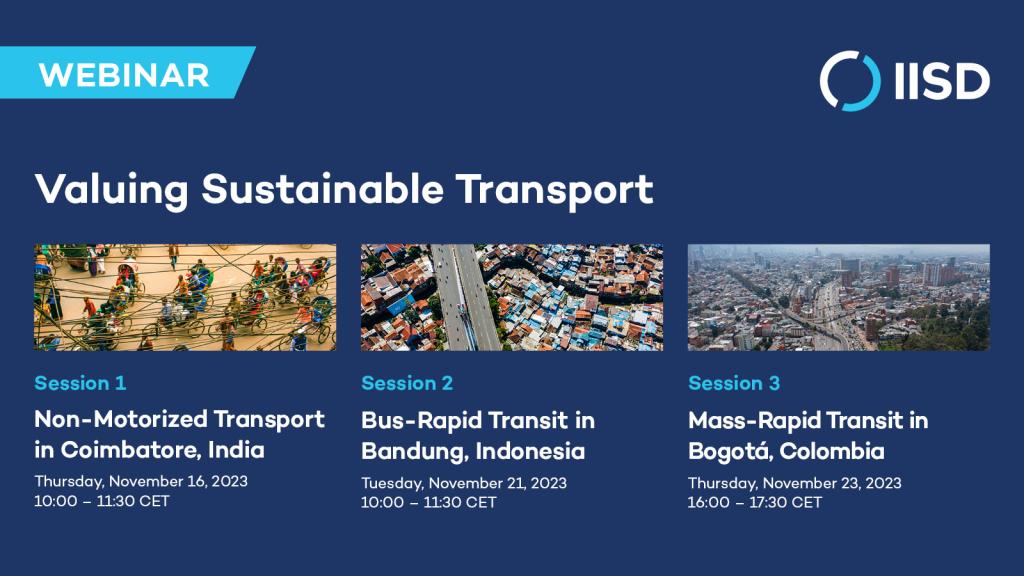
We led this three-session webinar series on valuing sustainable transport with SAVi:
Session 1: Thursday, November 16, 10:00–11:30 CET
Sustainable Transport Investment: a case study in Coimbatore, India
In the first session, we introduce the role that sustainable transport infrastructure can play in producing economic, social, and environmental benefits. We take you, step-by-step, through our SAVi methodology, which uses a combination of system dynamics, spatial modelling, climate data, and financial analysis to assess the environmental, social, and economic performance of infrastructure assets. We then look at this in focus through the lens of a case study of a non-motorized transport network in the city of Coimbatore, India.
Session 2: Tuesday, November 21, 10:00–11:30 CET
Systems Thinking for Sustainable Transport Projects: a case study in Bandung, Indonesia
In the second session, we delve deeper into systems thinking and systems dynamics. We introduce causal loop diagrams and examine how the simulation and interpretation of a variety of scenarios can help assess sustainable transport infrastructure investment options. During this session, we present a case study of a bus rapid transit system in Bandung, Indonesia.
Session 3: Thursday, November 23, 16:00–17:30 CET
Integrated Cost-Benefit Analysis for Transport Projects: a case study in Bogotá, Colombia
In the final session, we explore the added value of integrated valuations and cost-benefit analyses versus more traditional project costing approaches. We also demonstrate how to identify key added benefits and avoided costs for sustainable transport projects and how this enables decision-makers to delve beneath the surface of a transport project, looking at the longer-term benefits throughout its life cycle. This is illustrated by the case study of a mass-rapid transit system in Bogota, Colombia.
Overcoming Capacity Limitations for Rural and Small Municipalities Across the Prairies
This webinar explores the challenges of Prairie municipalities as they struggle with capacity limitations in resilient infrastructure, as well as the efforts of Canadian organizations to help address the lack of capacity.
Municipalities own nearly two thirds of the core infrastructure assets—roads, bridges, water, and wastewater facilities—that are critical to Canadians’ quality of life and our country’s competitiveness. Yet many rural municipalities with limited tax bases and capacity struggle to meet their resilient infrastructure needs, including both traditional infrastructure and natural infrastructure.
This session explores the challenges of Prairie municipalities as they struggle with capacity limitations, as well as the efforts of Canadian organizations to help address the lack of capacity. The webinar will begin with representatives from two Prairie communities describing the capacity limitations, followed by a presentation on support available for rural and small municipalities and a discussion with the participating municipalities to address their specific needs.
Some key takeaways from this webinar were:
Despite the capacity challenges facing rural and small municipalities, the RM of Piney and Parkland County are advancing natural infrastructure and natural asset management with:
careful planning that allows them to strategically select opportunities that meets their needs, and
by harnessing the abilities and skills of their local community to help address gaps and promote community leadership.
Unlike grey infrastructure, which depreciates overtime and requires significant financial investment for maintenance and replacement, natural infrastructure provides greater infrastructure services over time, with less cost as compared to grey.
This webinar took place on October 27, 2023. Watch the full recording below or on YouTube.
Dustin Carey is the Lead, Climate Adaptation with the Federation of Canadian Municipalities' Green Municipal Fund and an Expert Consultant with the United Nations Department of Economic and Social Affairs. After receiving his Master of Climate Change degree from the University of Waterloo, he applied his understanding of climate science to practical municipal climate solutions. Specializing in climate adaptation, municipal asset management, capacity development, and sustainable land-use practices, Dustin works to enable local governments to create low-carbon, resilient communities. He wrote the Climate-Resilient Asset Management chapter of the United Nations' Managing Infrastructure Assets for Sustainable Development: A Handbook.
Martin Van Osch is Chief Administrative Officer with the Rural Municipality of Piney in southeast Manitoba. He’s spent the last 21 years working throughout Manitoba in various municipal roles. With a diverse background, Martin Van Osch embraces municipal challenges with an innovative approach, understanding what is necessary to develop and implement services in rural or remote communities. He is currently working on projects that will address seniors' housing, rural transit supports, and climate action. His success is supported by a strong team approach with the goal of bettering the community, improving the lives of residents, and protecting the environment. Martin holds a Diploma from Keewatin Community College in Natural Resource Management and a certificate in Manitoba Municipal Administration from the University of Manitoba. He is a certified Level 2 Water and Wastewater Operator.
Stephanie Over is the Natural Asset Project Coordinator for Parkland County’s Agriculture and Environment Services Department. In her current role, Stephanie is responsible for coordinating the county’s Natural Asset Inventory and Valuation Project. Stephanie worked in the environmental consulting industry prior to starting with Parkland County as a Monitoring Technician over 3 years ago.
From Promise to Practice: Unpacking Canada’s Sustainable Jobs Act and its impact on a just transition
September 28, 2023 12:00 pm - 1:30 pm ET
via Zoom
(Open to public)
Canada has started acting on its international commitments to ensure a just transition for workers and communities as we move away from oil and gas. The government recently introduced the Sustainable Jobs Act and the Sustainable Jobs Interim Strategy, along with initial funding commitments. Does this draft legislation meet the needs of workers and communities, or could it be strengthened to do so? What are the next steps forward for a just transition in Canada? In this webinar, labour, Indigenous, and environmental experts share their analysis of the federal sustainable jobs legislation and key amendments, their assessments of the government’s progress to date, and their visions of the path forward.
The webinar comes at a critical time, as the legislation will move through committee hearings this fall, with opportunities for amendments. The session includes short presentations from each speaker, followed by a moderated Q&A.
Agenda
Welcomes and Introduction
Laura Cameron, Policy Advisor, International Institute for Sustainable Development
Speaker Presentations
Ken Bondy, National Representative, Health, Safety, and Environment, Unifor
Cara Sanders, Board of Directors Chair, Indigenous Clean Energy
South-South Trade and Voluntary Sustainability Standards: Challenges and opportunities
Webinar exploring new research on how sustainability standards can promote trade relationships that protect the environment and improve farmers’ livelihoods in developing countries.
September 27, 2023 8:30 am - 10:00 am Eastern Daylight Time (GMT -4)
(Open to public)
Governments in developing countries are increasingly recognizing the benefits of working with voluntary sustainability standards (VSSs) to promote trade that supports more sustainable production practices while also addressing some of the concerns associated with their adoption.
This webinar brought together developing country trade officials, producers, and standard-setting bodies to discuss new IISD research exploring how integrating VSSs in trade policy can potentially improve producers’ livelihoods in developing countries and promote trade relationships that protect the environment.
From a Memorandum of Understanding seeking to boost the trade of organic certified products between Chile and Brazil to the development of a recognition system for VSSs across the African continent, experts unpacked five examples of developing country governments and regional blocs in the Global South that are integrating VSSs in trade policy.
These examples illustrate the role that governments can play in enhancing VSSs’ potential to deliver positive sustainability outcomes and generate trade opportunities for small-scale farmers and small and medium-sized enterprises. They can also inform other countries and regions seeking to achieve similar objectives.
Speakers
Steffany Bermúdez, Policy Advisor, IISD
Claudio Cárdenas, Head of the Department of Organic Agriculture, Division of Protection of Renewable Natural Resources, Agricultural and Livestock Service, Ministry of Agriculture, Chile
Charles Gachahi, Eco Mark Africa Coordinator, African Organization For Standardization
At the halfway point of the 2030 Agenda and its Sustainable Development Goals (SDGs), where does the world stand? And how concretely were world leaders willing to commit to climate action, reform of the international financial system, and reducing inequality within and between countries?
The SDG Lab, CEPEI, and IISD hosted a panel discussion and Q&A session after the 2023 SDG Summit closed. Experts provided a brief snapshot of highlights stemming from the 2023 SDG Summit and their links to next year’s Summit of the Future:
The SDG Lab, CEPEI, and IISD will host a virtual conversation and Q&A session with SDG experts exploring why this Summit is crucial, how to raise ambition for SDG implementation, and discuss successes and lessons learned so far.
Ahead of the 2023 SDG Summit, marking the halfway point for the achievement of the 2030 Agenda and its Sustainable Development Goals (SDGs), the SDG Lab, CEPEI and the International Institute for Sustainable Development will host a virtual dialogue on what to expect for the Summit, exploring why this Summit is crucial, how to raise ambition for SDG implementation, and discuss lessons learned pivotal to turbocharging the 2030 Agenda in the remaining seven years.
Hosted as a conversation between the Global Youth Coordinator at the Coalition for the UN We Need (C4UN), and representatives of the Permanent Missions of Ireland and Qatar, the co-facilitators of the Political Declaration for the SDG Summit, this webinar will discuss what to expect of the SDG Summit by addressing the following aspects:
How will the SDG Summit raise ambition for SDG implementation?
What can we expect for the 7.5 years left of the 2030 Agenda, and will the SDG Summit address sustainable development beyond 2030?
What are the successes and lessons learned so far that we should keep in mind to strengthen action in the next 7.5 years?
The conversation will be moderated by Trine Schmidt, Strategic Advisor with the UN SDG Lab. The webinar will allow ample time for questions from participants.
Speakers
Ms. Nudhara Yusuf, Executive Coordinator of the Global Governance Innovation Network & Global Youth Coordinator at the Coalition for the UN We Need (C4UN)
Mr. John Gilroy, First Secretary, Lead on Sustainable Development, Permanent Mission of Ireland to the United Nations
Sheikh Abdulrahman Al-Thani, Second Secretary, Permanent Mission of the State of Qatar to the United Nations
Programme
Welcome by Nathalie Bernasconi, co-CEO of the International Institute for Sustainable Development IISD
Conversation between Nudhara Yusuf and Co-facilitators of SDG Summit, Ireland and Qatar, on expectations for the SDG Summit, moderated by Trine Schmidt, Strategic Advisor SDG Lab
Discussion / Q&A with participants, facilitated by the SDG Lab
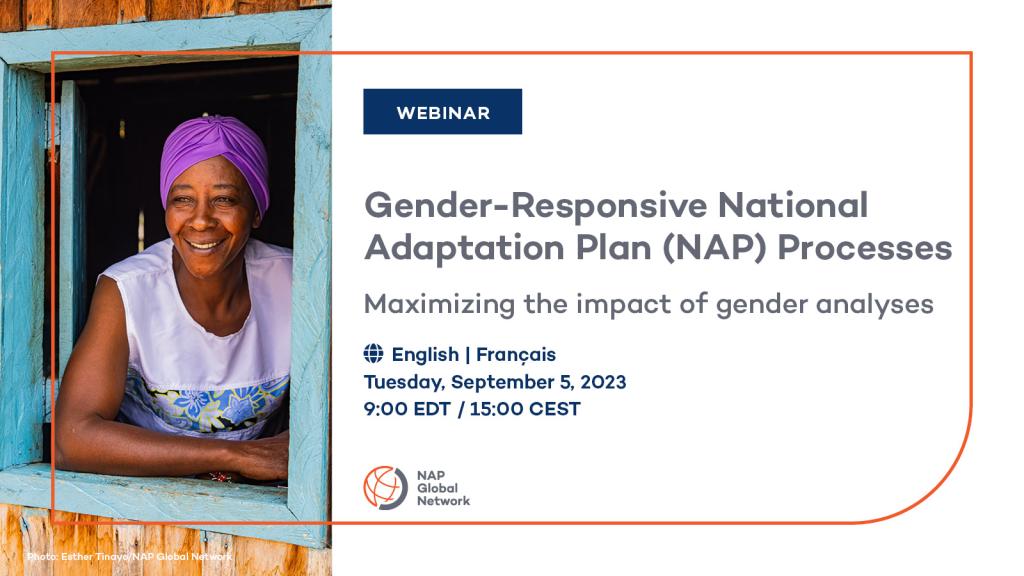
The National Adaptation Plan (NAP) process offers a crucial opportunity to achieve effective and sustainable climate change adaptation, ensuring equitable benefits for people of all genders and especially for the most vulnerable populations. In light of this, the NAP Global Network worked with nine countries between 2017 and 2022, conducting targeted gender analyses to inform their NAP processes.
This webinar will give the floor to representatives of three countries who will share their reflections on the gender analysis they conducted and the resulting changes they have seen in their NAP processes. In sharing these reflections and examples, we aim to demonstrate the value of targeted gender analysis in promoting adaptation action that is gender responsive while also providing advice to undertaking gender analyses for their adaptation planning processes.
During this 1-hour event, the NAP Global Network will also launch a new briefing note that reflects on the impact of these nine targeted gender analyses. The brief highlights lessons learned from this experience and identifies key enablers that will maximize the impacts of the analyses on countries’ NAP processes.
Panellists:
Aurélie Ceinos, Policy Advisor, Gender Equality and Social Inclusion, IISD
Anna Koffi KOUAME, Head of Gender and Social Inclusion Unit, National Programme on Climate Change (PNCC), Ministry of Environment and Sustainable Development, Côte d’Ivoire
Colette BENOUDJI, Main writer of the gender analysis in Chad, Responsible for the Lead Tchad Association
WTO Agriculture Negotiations and Sustainable Development
Ahead of the next World Trade Organization (WTO) Ministerial Conference in February 2024, the International Institute for Sustainable Development and the International Food Policy Research Institute (IFPRI) organized a series of webinars to provide an opportunity for WTO delegates and government officials to explore how WTO Agriculture Negotiations could further key sustainable development objectives, such as food security and environmental sustainability.
September 27, 2023 1:30 pm - September 29, 2023 2:45 pm CET
(By invitation)
As WTO members start preparing for the next WTO Ministerial Conference (MC13), to be held in the United Arab Emirates in February 2024, the IISD and the IFPRI organized a series of webinars on WTO Agriculture Negotiations and Sustainable Development. The webinars, held in late September 2023, aimed to bring insights from the research community on how WTO rules on agricultural trade could better contribute to food security and environmental sustainability, as envisaged in the preamble of the WTO Agriculture Agreement. During the webinars, WTO negotiators, capital-based officials, and independent experts discussed how to mainstream sustainable development objectives into areas of the WTO Agriculture Negotiations that have gained renewed momentum in the run-up to MC13, including Domestic Support, Public Stockholding for Food Security Purposes (PSH), and Export Restrictions.
Domestic Support Rules to Promote Food Security, Climate Action, and Healthier Diets
The first webinar in this series focused on "Domestic Support Rules to Promote Food Security, Climate Action, and Healthier Diets." This webinar explored how WTO Agriculture Negotiations on Domestic Support can promote sustainable development objectives, such as food security, climate action, and healthier diets, while addressing negative impacts on production and trade. The webinar brought together agricultural trade experts to discuss ideas proposed in the current negotiations, including (i) reductions of product-specific support, especially support that is highly concentrated in emissions-intensive products or unhealthy food commodities; (ii) the potential of the Green Box subsidies allowed under the WTO Agriculture Agreement to achieve sustainability objectives, including water management, biodiversity, and climate change; (iii) how repurposing agricultural support can contribute to healthier diets; and (iv) the opportunities and challenges of repurposing agricultural support to consumers.
Experts argued in favour of using product-specific caps to avoid the concentration of agricultural support in a few commodities, including emission-intensive commodities (e.g., beef, milk, and rice) or unhealthy foods (e.g., sugar). One of the key takeaways was that concentrating agricultural support into a few commodities could cause large distortions in production and trade, leading to large losses for producers in those countries that fail to match subsidy levels, such as cotton-producing countries in West Africa. In that regard, experts found that product-specific caps to avoid a concentration of agricultural support in a few commodities will not only deliver a reduction of highly distortive support but also increase agricultural production in middle and low-income countries (except Brazil, Russia, India, China, and South Africa [BRICS countries]).
Experts also discussed how to leverage domestic support to achieve sustainability objectives, including climate action and healthy diets. They underlined that while the WTO Agriculture Agreement provides a good amount of flexibility to grant payments for water management, enhance biodiversity, or mitigate climate change, further amendments to the WTO’s Green Box might be considered to achieve these sustainability objectives. An example could be adding nuance to the wording of the fundamental requirement of the Green Box subsidies, which establishes that these subsidies shall have no, or at most minimal, trade-distorting effects or effects on production.
There was also some discussion on the relationship between domestic support and healthy diets. Experts underlined that repurposing agricultural support to make healthy diets more affordable entails important trade-offs for countries across the world. There are trade-offs, for instance, between increased greenhouse gas (GHG) emissions and the affordability of healthy diets, as well as other important considerations, such as farm incomes and the prevalence of undernourishment.
Finally, there was a reference to the potential of consumer support (vis-à-vis agricultural support targeting specific commodities, which often has trade-distorting effects) to promote healthier diets. Experts highlighted that consumer support, which is contemplated under the WTO’s Green Box as domestic food aid to sections of the population in need, could increase the purchasing power of poor consumers, improve calorific intakes, and deliver healthier diets.
Public Stockholding (PSH) Programmes and Food Security
The second webinar, "Public Stockholding (PSH) Programmes to Promote Food Security of WTO Members," explored how new approaches to PSH can promote domestic food security while limiting harmful impacts on trading partners. Discussions focused on (i) the objectives and impacts of PSH programs on both food security and trade, (ii) updating the fixed external reference price (FERP) to calculate market price support for PSH programs, and (iii) options for WTO members to consider ahead of MC13 when negotiating a permanent solution for PSH.
Experts discussed the objectives of public stockholding programs, including distributing food, protecting consumers by stabilizing prices and reducing their vulnerability to price shocks, and supporting rural incomes. They also referred to the possible impacts—both positive and negative—of PSH programs on producers, consumers, and government budgets. There was a call to ensure proper targeting of PSH programs, both in procurement and in food distribution, to reach the most vulnerable populations. It was mentioned that given their market impacts and significant costs, these programs should be carefully evaluated against other policy alternatives.
Experts highlighted how the food price increases in the mid-2000s caused food prices to diverge significantly from the 1986–88 base-level FERPs used to calculate market price support for PSH programs. Responding to debates around the need to update FERPs, one expert suggested updating the concept of market price support at the WTO by using a moving average of recent border prices rather than FERPs. He claimed that such an alternative could largely resolve the PSH impasse: for developing countries and users of PSH programs, complying with their domestic support commitments would not require reducing artificially high measurements of market price support. For other countries, especially those that propose constraints on the use of PSH programs, this alternative could ensure that WTO disciplines on market price support have a sound economic basis.
Finally, experts discussed possible options for a permanent solution to PSH. In addition to updating the FERP to calculate market price support for PSH programs, these options include (i) revisiting the definition of "eligible production," which is also an important element in calculating market price support for PSH programs; (ii) exempting support when pre-announced "administered" or "fixed" prices are set below international market prices; (iii) exempting least developed countries (LDCs) and smaller economies from the requirement to count food purchased at "administered" or "fixed" prices in the aggregate measurement of support (AMS) or agreeing not to challenge the compliance of their PSH programs through the WTO dispute settlement process; and (iv) establishing a permanent solution based to some degree on the 2013 Bali Decision on PSH, under which WTO members would agree not to challenge the compliance of a developing country member with its obligations under the WTO Agriculture Agreement regarding their maximum allowed levels of domestic support.
Export Restrictions and Food Security in the Context of Climate Shocks
The third and final webinar of the series, "Export Restrictions Rules to Promote Global Food Security in the Context of Climate Change and Extreme Weather Events," covered (i) the effectiveness and impacts of export restrictions; (ii) how climate change and increased extreme weather events, such as droughts, heat waves, precipitation, and floods, reduce agricultural crops and yield and exacerbate the impacts of climate change and risks to global food security; (iii) options to improve the monitoring of export restrictions; and (iv) the impacts on food security of exempting food purchases by LDCs from agricultural export restrictions (the so-called LDC Exemption).
Experts underlined that while WTO members impose export restrictions to ensure the availability and affordability of food and agricultural products for their own consumers, these trade-restrictive measures tend to reduce food access in other economies, particularly in import-dependent countries that rely heavily on global agri-food markets.
One expert underlined that this situation is even more challenging in the context of increasingly frequent extreme weather events such as droughts, heat waves, precipitation, and floods, which increase political tensions, accelerate migration flows, and reduce agricultural crops and yields. This, in turn, creates additional incentives for food-exporting countries to impose export restrictions, exacerbating the impacts of climate change and risks to global food security.
Experts discussed options to improve the monitoring of export restrictions—including through the use of the IFPRI’s Export Restriction Tracker, an online tool to monitor export restrictions of agricultural products and fertilizers—and provide information on the duration of these trade-restrictive measures, the share of restricted products in total country food exports, the country global market share in restricted products, and the share of global exports impacted (in the cases of nitrogen-, potash-, and phosphate-based fertilizers).
Finally, experts discussed the pros and cons of a decision to exempt food purchases by LDCs from agricultural export restrictions at MC13 (the LDC Exemption). An LDC Exemption would mean that WTO members could refrain from imposing export bans when basic food products are purchased by LDCs for their domestic use only. Experts suggested that LDCs are particularly exposed to export restrictions on food, which would justify WTO members considering an agreement on an LDC Exemption. They warned, however, that other variables should also be considered when negotiating an LDC Exemption: LDCs are not always the most exposed to export restrictions (smaller islands are equally if not more exposed to the effects of these trade-restrictive measures), re-exports of food originally intended exclusively for LDCs' domestic use could occur (which may require the consideration of anti-circumvention and traceability mechanisms), and the effectiveness of an LDC Exemption to address the food availability dimension of food security (i.e., higher prices for food), which in times of crisis has proven to be more relevant than the dimension of food availability. In that regard, experts invited WTO members to support the use of a Global Food Import Financing Facility, as proposed by the Food and Agriculture Organisation of the United Nations or the International Monetary Fund’s Price Window.