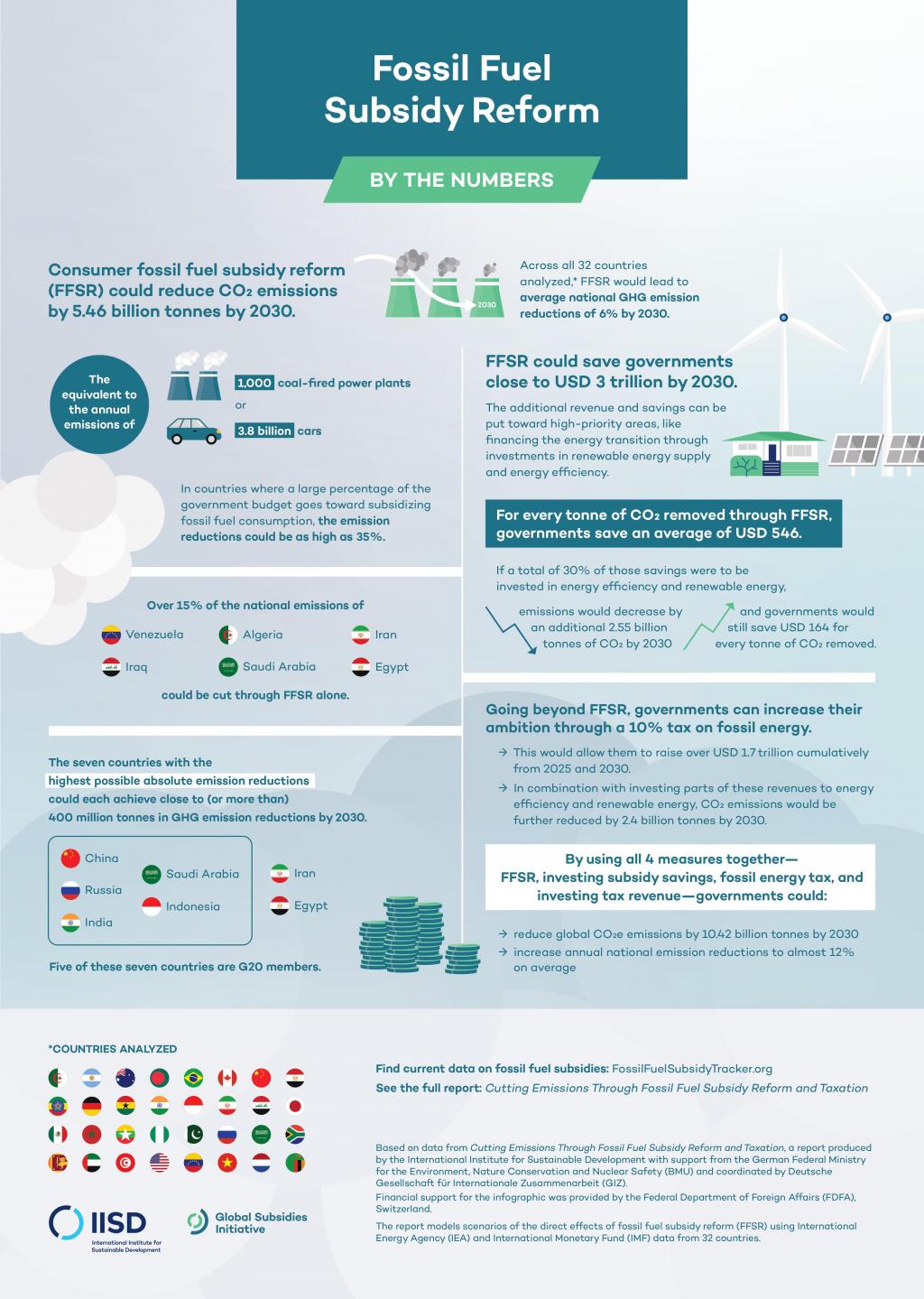
Fossil fuel subsidies reduce the price of fossil fuels and distort energy markets, further fuelling the climate crisis. Reforming these harmful subsidies can not only reduce emissions, but also save governments money and free up funds to support clean energy transitions. In this infographic, we visualize the potential of this critical emission reductions tool—by the numbers.
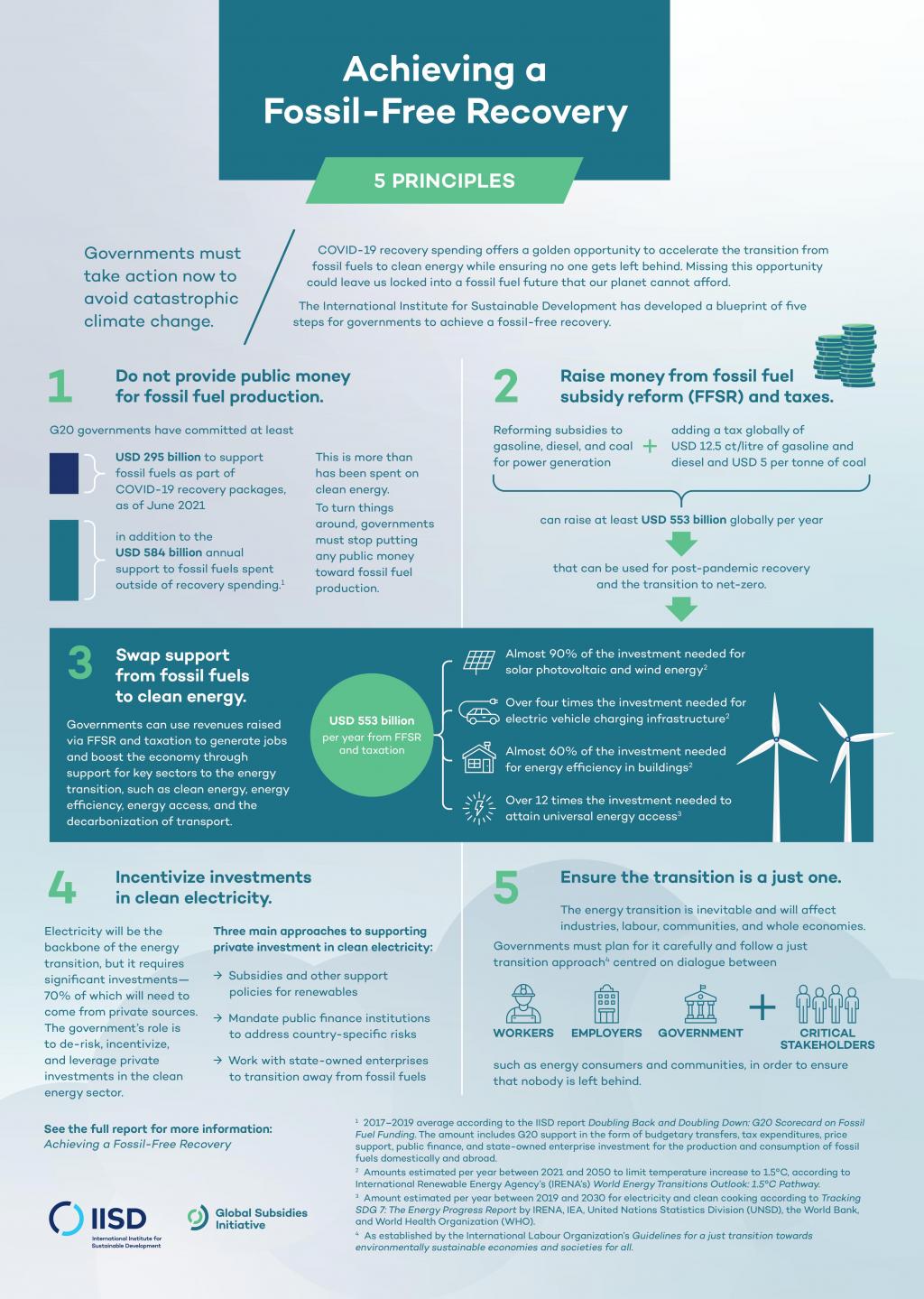
Governments must take action now to avoid catastrophic climate change. COVID-19 recovery spending offers a golden opportunity to accelerate the transition from fossil fuels to clean energy while ensuring no one gets left behind. Missing this opportunity could leave us locked into a fossil fuel future that our planet cannot afford. The International Institute for Sustainable Development has developed a blueprint of five steps for governments to achieve a fossil-free recovery.
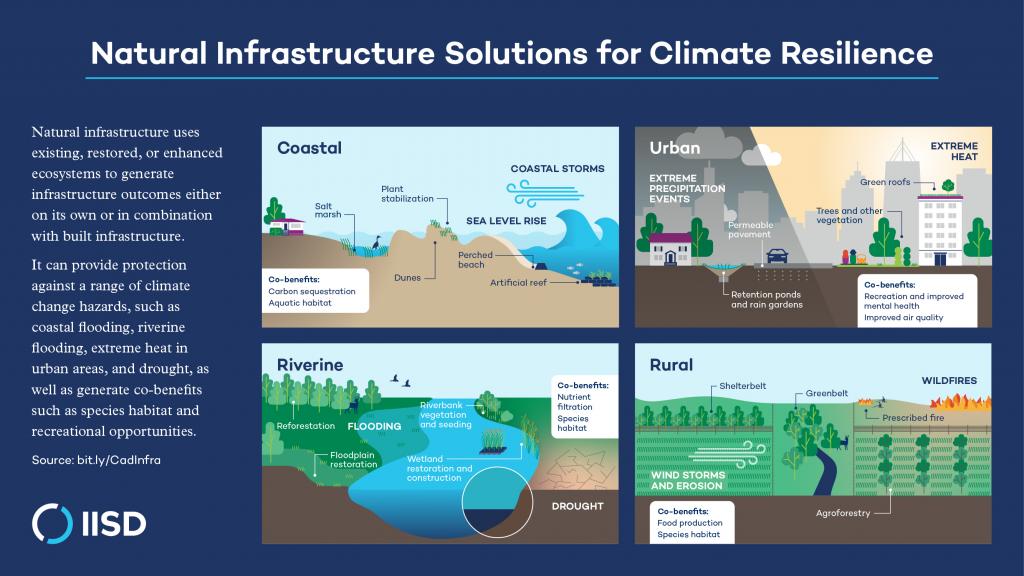
Natural Infrastructure Solutions for Climate Resilience
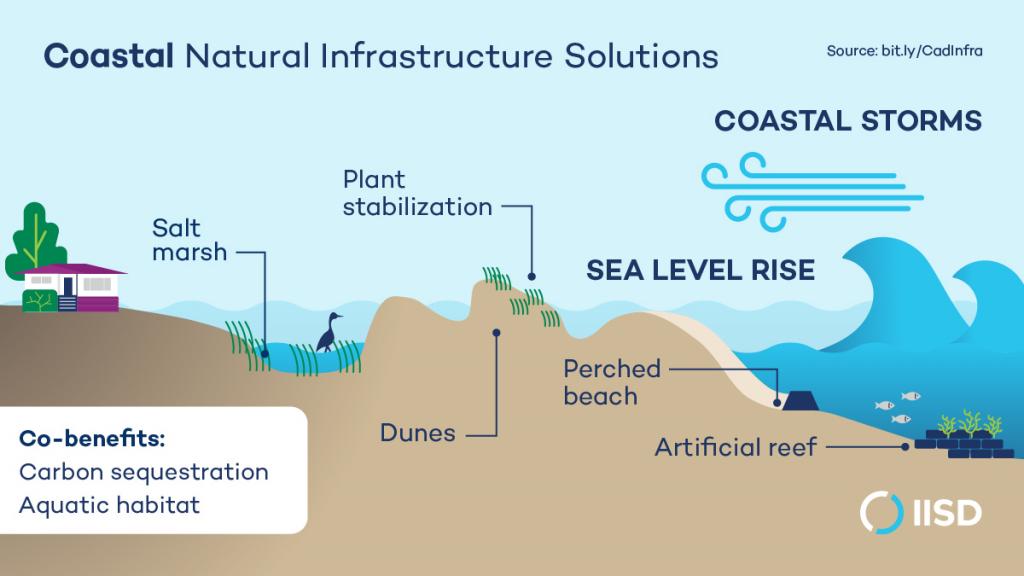
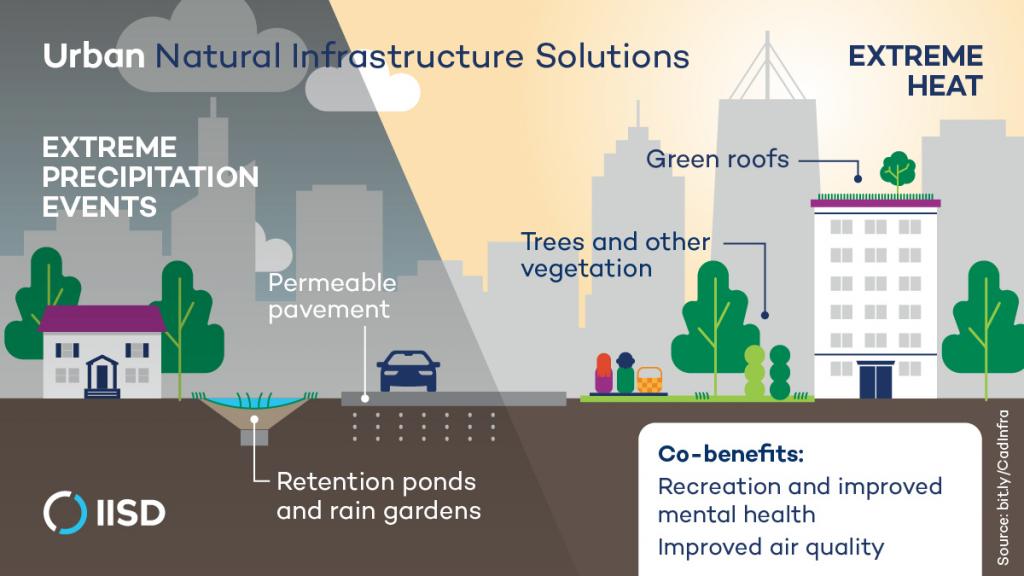
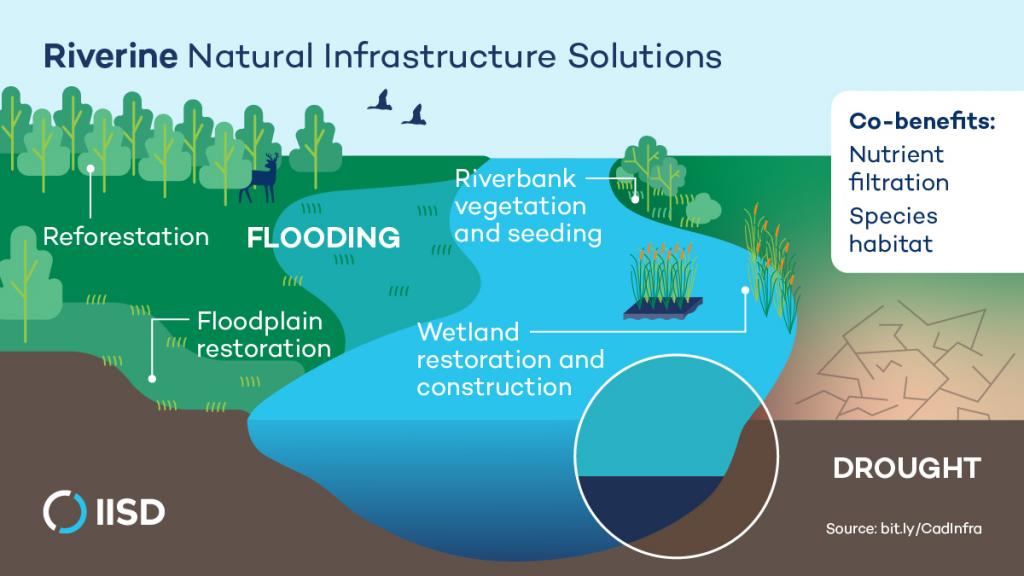
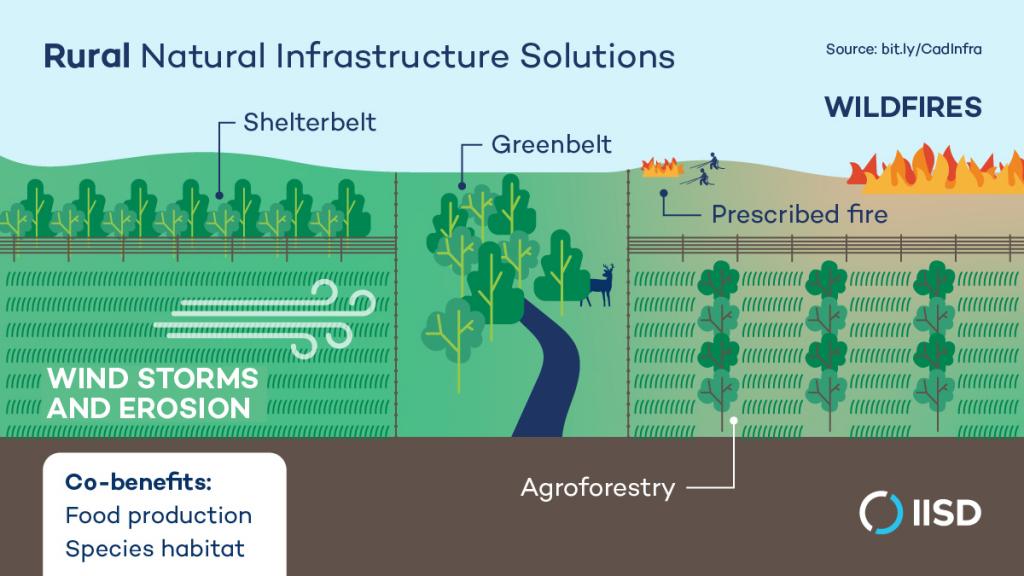
Natural infrastructure can provide protection against a range of climate change hazards, such as coastal flooding, riverine flooding, extreme heat in urban areas, and drought, as well as generate co-benefits such as species habitat and recreational opportunities.
July 9, 2021
Natural infrastructure uses existing, restored, or enhanced ecosystems to generate infrastructure outcomes either on its own or in combination with built infrastructure.
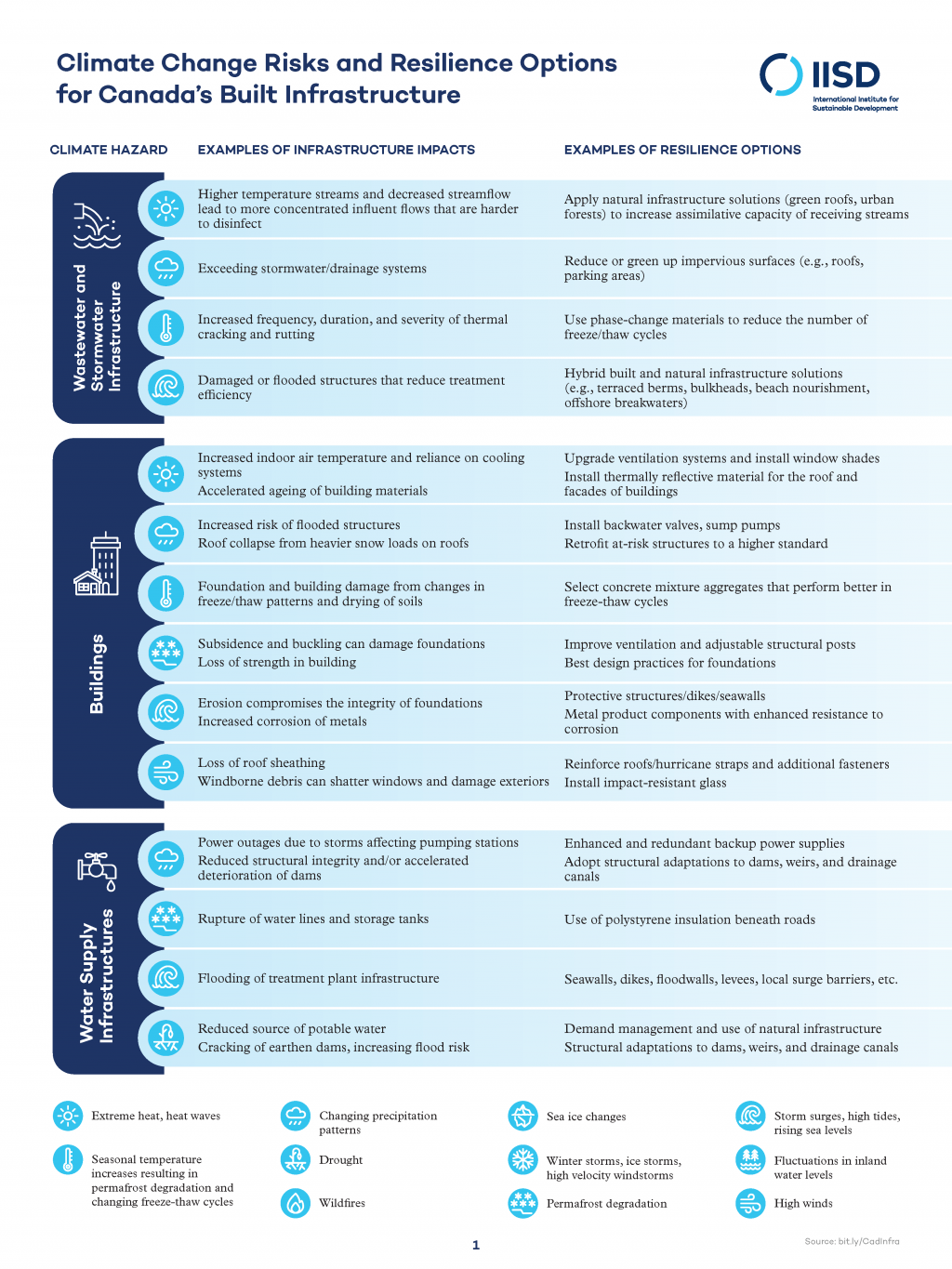
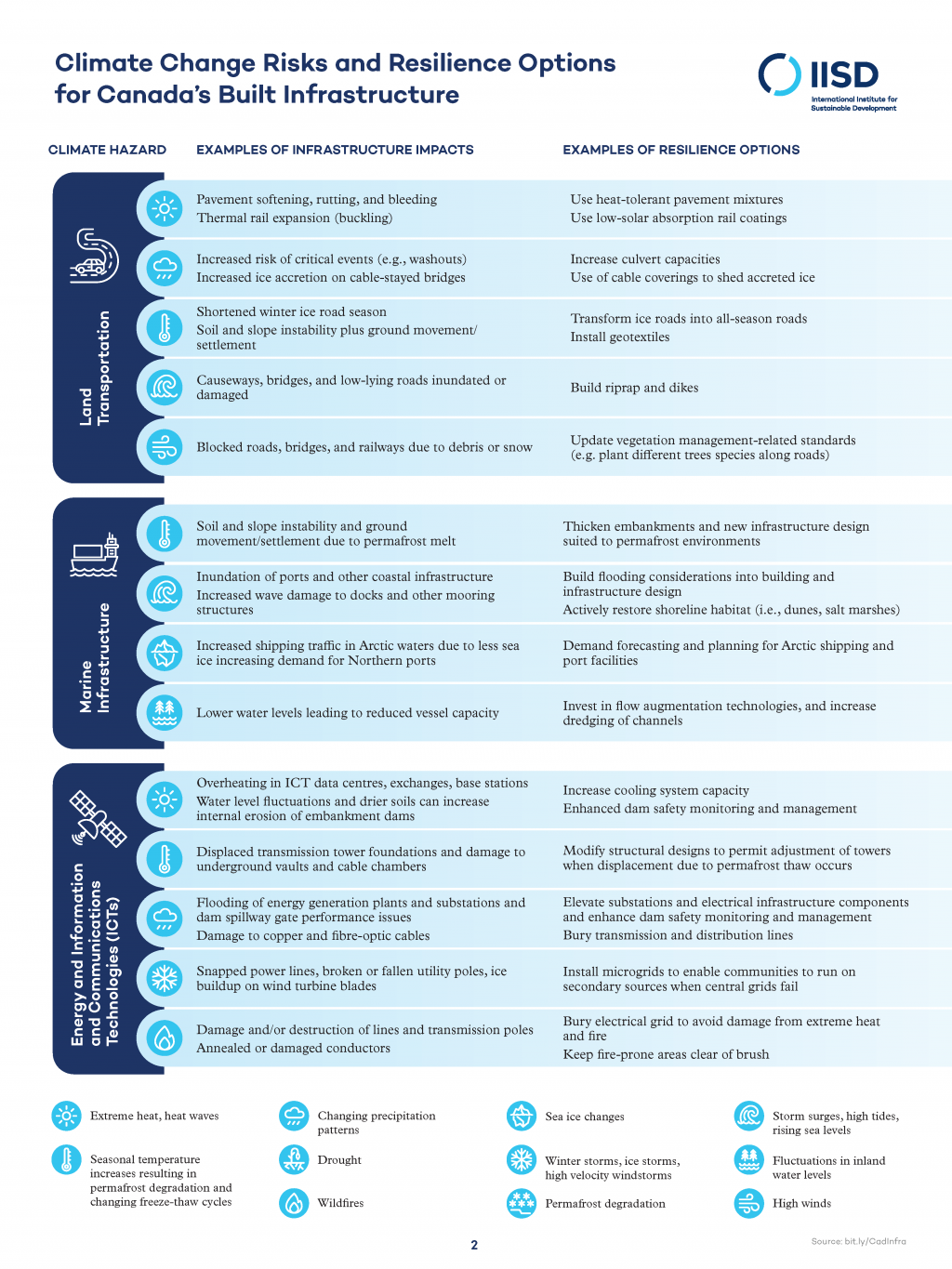
Climate Change Risks and Resilience Options for Canada’s Built Infrastructure
Canada’s climate is changing, bringing new risks and challenges for the nation’s infrastructure. A new IISD report, prepared with support from Infrastructure Canada, reviews current literature on climate change hazards, impacts, and adaptation options for six types of built infrastructure across Canada.
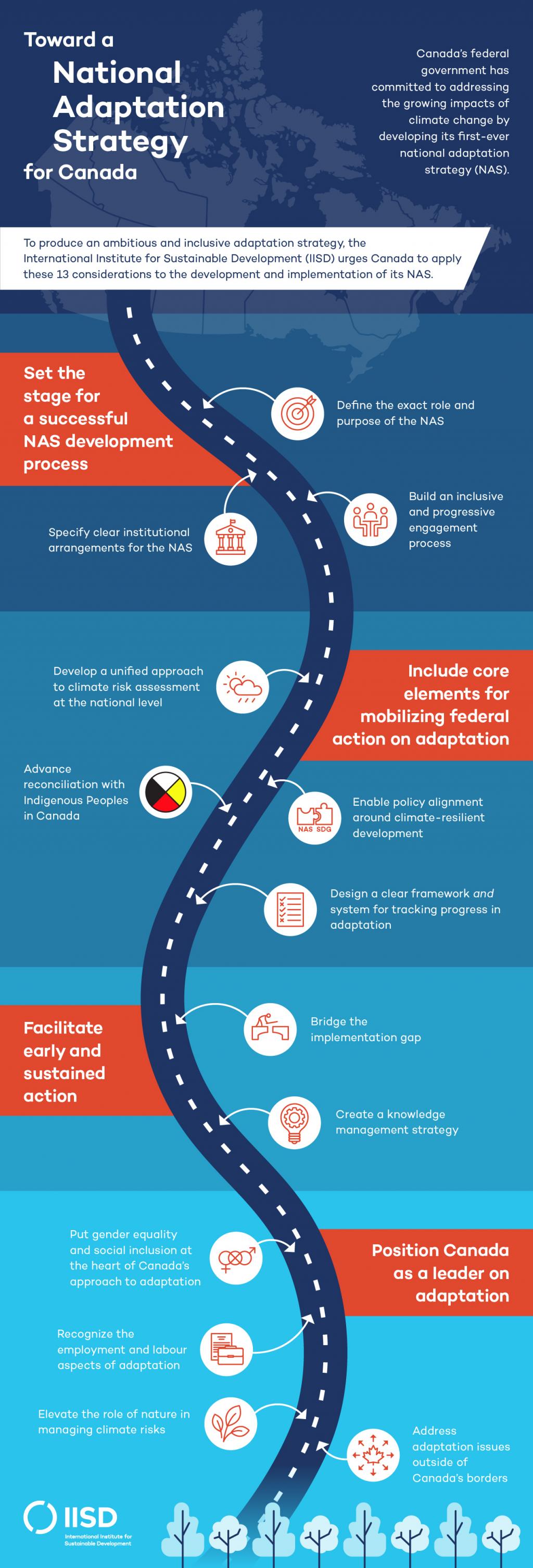
Most Canadians believe climate change is an urgent crisis and are feeling its impacts already. The federal government will soon develop Canada’s first-ever national adaptation strategy and our experts have ideas to make it effective.
How do we make sure that communities aren't left behind in the energy transition? What role does just transition play in the recovery from COVID-19? Transitions expert Philip Gass explains.
May 21, 2021
How does the economic recovery from COVID-19 correspond with the global need for a just energy transition?
The pandemic has exposed how urgently we need a just transition. At the same time, more public money is being invested in recovery measures than we could have ever foreseen. There's an opportunity to invest these funds strategically—not just to protect existing workers but to set up new jobs. We have to seize this opportunity to accelerate a just transition to a more sustainable and resilient economy.
Do you see governments seizing this opportunity as they spend billions on recovery packages?
The current global recovery package is greener than any we've had before, with substantial funding going to clean technologies. On the other hand, less than half of recovery funding in the energy sector has been invested in clean energy. The other half of the money is still supporting fossil fuel production and consumption.
There is a lot more work to do if we want a recovery that's green and just. It's not simply determining what type of energy is supported but also ensuring how that spending will directly support workers. If we emerge from the pandemic having missed this opportunity, we may not see another chance for such a sizable investment for several decades.
What does a just transition look like?
The process itself is more important than the individual elements; it's the social dialogue and planning between workers, employers, and government, and meaningful engagement with other critical stakeholders.
Just transition measures could include funding support for job transitions, training programs, or early retirement support. Some communities may need to diversify their economies, so there might be programs for agriculture, alternative manufacturing, renewable energy, or tourism. Solutions have to be locally tailored.
Another big part of it is necessary investments in the social safety net, such as employment insurance, poverty reduction programs, and childcare and healthcare support for families.
Over time, have we seen just transition policies increasingly included in recovery packages?
Not as much as they should be. At the moment, there are case studies, and a lot of hard work has been done laying out principles and guidelines for a just transition, led by organizations such as the International Labour Organization. But there aren't a lot of countries that have actually undergone the process through to completion. In those that have, it's been constrained to individual sectors, such as Canada’s and Germany's coal transitions, which started well before the pandemic. But I think we're going to see it grow. From an economic standpoint, it's self-evident that coal is no longer economically competitive, so transitions are happening, and it is necessary to ensure that they are just.
Why do you think some countries still don't consider social protection measures as a key element of the energy transition?
Awareness of just transition principles has accelerated over the past years, due in part to the tireless efforts of labour organizations, but there is still awareness and capacity building to do. It's also harder to have discussions between partners and stakeholders when we can't be in the same room together due to the pandemic.
Another challenge is that in countries where there isn't trust between the government, industry, and workers, or where there are fundamental barriers to human rights and social protections, a just transition cannot happen.
When we say "workers," who are we talking about?
In a just transition, the ideal approach considers all workers. For example, if a coal plant shuts down and the families move away, there are teachers, nurses and healthcare professionals, and workers in informal sectors who are affected as well. The idea is to have protections and plans in place for everyone impacted.
In a just transition, the ideal approach considers all workers.
What are the potential long-term risks of not investing in a just transition?
By delaying the inevitable, you risk sectoral collapse, and you risk major companies going bankrupt or otherwise defaulting on their investments or tax and environmental obligations. Workers are left jobless, communities suffer, and it's ultimately the public (i.e., government) that ends up having to pick up the pieces after damage has already been done. So you risk stranded assets; large-scale losses of livelihoods; and far-reaching impacts on areas such as social safety, poverty, domestic violence, and substance abuse.
Some people might argue that supporting fossil fuel companies is the best way to support workers and communities in fossil fuel-producing areas. What would you say to them?
Environmental organizations often face the criticism that we just want to put people out of work, shut down fossil fuel production, or get rid of consumer subsidies and increase everyone's electricity bill. But that's not the case. We're looking for equal footing between environmental, economic, and social outcomes. So when we look at recovery measures, the first question to ask is: does this support a long-term, sustainable low-carbon transition?
We're looking for equal footing between environmental, economic, and social outcomes.
The best way to support workers is to support them directly—not necessarily the company or the industry in question. We need to reach net-zero emissions by 2050, so it would be inconsistent to subsidize expanded fossil fuel exploration and production, especially when fuel prices are low. We need to identify and support what's best for workers while achieving our other goals in energy transition.
What are the barriers to getting more people and communities on board? And how can we address those barriers?
The first step is really listening. Instead of trying to come forward with the answers right off the bat, it's important to start understanding the problems. A lot of the groups affected by the energy transition are under immense pressure, facing the loss of livelihoods and a sense of identity that has gone back several generations. And now, whether it's due to economics, regulation, or technology advancements, that way of life is evolving. Our work needs to support and elevate local experiences and the solutions that local partners and stakeholders are identifying. Ultimately, just transition is local. External experts like us can provide some constructive input, but at the end of the day, a lot of the solutions will come from the people that are most affected by it. It's our job to support them.
Mind the Gap: Fossil Fuel Subsidies Could Fill the SDG Financing Gap
Research suggests that removing all consumer fossil fuel subsidies would decrease global carbon emissions anywhere between 6–8 per cent by 2050. Swapping savings into sustainable energy would improve emissions reductions further.
May 10, 2017
Research suggests that removing all consumer fossil fuel subsidies would decrease global carbon emissions anywhere between 6–8 per cent by 2050.
Swapping savings into sustainable energy would improve emissions reductions further. This infographic shows how swapped fossil fuel subsidies could fill the SDG financing gap. The findings are based on the report, “Making the Switch: From Fossil Fuel Subsidies to Sustainable Energy.”
This essay looks at eight examples drawn from the Building a Climate-Resilient City research series prepared for the City of Edmonton and the City of Calgary by the Prairie Climate Centre.
April 10, 2017
Climate change will have serious impacts for cities. In coming decades, building resilience will be essential urban policy and a smart investment for cities.
But what actions can cities take to foster resilience to climate change?
This essay looks at eight examples drawn from the Building a Climate-Resilient City research series prepared for the City of Edmonton and the City of Calgary by the the International Institute for Sustainable Development and the University of Winnipeg.
Negotiators gathering from November 7–18, 2016, in Morocco face the monumental task of preparing for the implementation the historic Paris Climate Change Agreement. IISD brings you up to speed on the status of negotiations and the most significant items on the Marrakech Climate Change Conference agenda.
November 1, 2016
The State-of-Play in the Run-Up to the Marrakech Climate Change Conference
Negotiators gathering from November 7–18, 2016, in Morocco face the monumental task of preparing for the implementation the historic Paris Climate Change Agreement. They are under intense pressure to move quickly. Countries must ensure that the various modalities of the Paris Agreement are ready before 2020, which is when implementation of the agreement will effectively start.
This publication serves as a guide to the Marrakech Climate Change Conference, bringing you up to speed on the status of negotiations and the most significant items on the agenda.