Sustainable Asset Valuation of the Recovery of the Bogotá River, Colombia
Hybrid infrastructure to reduce flood risk and improve water quality in the Bogotá River
This Sustainable Asset Valuation (SAVi) examines how nature-based infrastructure (NBI) interventions like wetland restoration and flood control transformed the Bogotá River basin. The results show that hybrid infrastructure delivers far more value than it costs—generating USD 349 million in net benefits across flood protection, cleaner water, and improved quality of life.
Restoring wetlands and river functions through NBI significantly reduced flood risk, avoiding up to USD 828 million in damages by protecting homes, businesses, and infrastructure across the Bogotá River basin.
Hybrid infrastructure that combines grey systems with NBI delivered a positive return on investment, generating USD 1.27 in benefits for every USD 1 invested and USD 349 million in total net benefits over the project lifetime.
Improvements in water quality and ecosystem services generated by NBI delivered USD 554 million in value, representing the largest share of total benefits and driving gains in urban resilience, environmental quality, and quality of life.
The Bogotá River is essential to central Colombia, providing drinking water for nearly 6 million people across 46 municipalities and supporting agriculture and industry across Cundinamarca. Rapid urban growth, untreated wastewater, and the loss of wetlands degraded water quality and increased flood risks. Extreme events, such as the 2010–2011 floods, highlighted the limits of traditional flood protection approaches.
To address these challenges, the World Bank and the Corporación Autónoma Regional de Cundinamarca funded a major restoration project combining conventional infrastructure, such as wastewater treatment and hydraulic works, with NBI interventions, including wetland restoration and river rehabilitation.
These interventions improved water quality, restored natural flood buffers, and increased the river's capacity to manage high flows. The project closed in December 2022.
The NBI Global Resource Centre conducted a SAVi assessment to examine the long-term performance of these investments over a 50-year period at the basin scale.
Results show that hybrid infrastructure delivers strong economic returns when the full range of benefits is considered. The project generates USD 1.27 in benefits for every USD 1 invested, with total net benefits of USD 349 million. Avoided flood damage represents a major share of this value, with an estimated USD 828 million in avoided losses to homes and businesses.
In addition to financial returns, the project strengthened climate resilience and improved environmental quality and living conditions for millions of people. The findings highlight the role of hybrid infrastructure as a cost-effective strategy for river basin management, delivering integrated economic, social, and environmental benefits.
Sustainable Asset Valuation of Mining Closures in Artisanal and Small-Scale Gold Mines in Marmato, Colombia
Nature-based infrastructure’s role in mining closure plans
This Sustainable Asset Valuation (SAVi) examines how nature-based infrastructure (NBI) interventions like reforestation, slope stabilization, and hydrological restoration can strengthen mine closure plans in Marmato, Colombia. For every USD 1 invested in progressive closure with NBI, the region gains USD 1.44 in return while also reducing exposure to landslide risk, water contamination, and ecosystem degradation.
Starting mine closure early delivers stronger results at lower cost. For every USD 1 invested in progressive closure, the region gains USD 1.44 in return, a conservative estimate, as several social and health benefits could not be monetized.
The most significant benefit of closing a mine properly is protecting human life. Reducing exposure to landslides, rockfalls, and tunnel collapse is where the economic case for structured closure is strongest.
When mines close without structured rehabilitation, contaminated land, unstable slopes, and degraded ecosystems remain. NBI interventions such as reforestation, slope stabilization, and hydrological restoration reduce risks, restore land, and benefit surrounding communities.
Marmato, in the department of Caldas, is one of Colombia's most historically significant gold-mining territories, where artisanal and small-scale gold mining has shaped local livelihoods and cultural identity for centuries. But mining in Marmato also carries serious risks. Steep hillsides, unmanaged waste, water contamination, and the near-absence of structured closure planning have left the territory exposed to landslides, ecosystem degradation, and long-term environmental liabilities.
Colombia's regulatory framework for artisanal and small-scale mine closure is still emerging. Most mining areas in Marmato currently lack approved closure plans, meaning environmental risks accumulate without a clear pathway for remediation. The NBI Global Resource Centre applied the SAVi methodology to evaluate three closure pathways: a baseline scenario in which mines are abandoned without intervention; a comprehensive closure plan implemented at the end of mine life; and a progressive closure plan in which stabilization, rehabilitation, and NBI measures are implemented gradually during operations. The quantitative analysis is based on a pilot assessment of a representative artisanal mine, with results intended as indicative rather than definitive.
The results show that mine closure in Marmato is fundamentally a risk-reduction investment. Avoided mortality risk—linked to reduced exposure to landslides, rockfalls, and tunnel collapse—represents the largest share of monetized benefits. The progressive closure plan outperforms end-of-life closure: for every USD 1 invested, the region gains USD 1.44 in return—a conservative estimate, as several social and health benefits could not be monetized due to data limitations. Earlier implementation reduces costs by making use of materials generated during operations rather than purchasing external inputs at the end of mine life, and allows risk reduction and ecosystem service benefits to accrue sooner.
NBI plays a central role in this performance. Reforestation, slope stabilization, soil remediation, and hydrological restoration contribute ecosystem services, including erosion control, carbon sequestration, and biodiversity recovery, and reinforce the long-term effectiveness of closure outcomes.
COP 16 in Cali Delivers Key Outcomes for Nature but Questions Remain on Funding
November 3, 2024
Delegates departed from the United Nations Biodiversity Conference (CBD COP 16) yesterday after two weeks of negotiations in Cali, Colombia. The talks, which comprised the biggest biodiversity COP to date, focused in large part on how to implement and finance the Global Biodiversity Framework (GBF), adopted two years ago, as well as how to measure progress.
"COP 16 was an opportunity to double down on our commitment to halt and reverse biodiversity loss and ecosystem degradation," says Alec Crawford, Director of Nature for Resilience at IISD. "There were some very real wins, and the Colombian government should be applauded for the energy, coordination, and strong sense of community that they brought to the conference as well as to the profile of biodiversity. But the lack of progress on some key negotiation items is concerning."
First, the positive. The critical role of Indigenous Peoples and local communities in biodiversity protection was elevated through the adoption of a new work programme and creation of a permanent body of the CBD to represent their interests. A series of modalities for placing into effect the multilateral benefit-sharing mechanism from the use of digital sequence information on genetic resources were adopted, and the Cali Fund was established. Further pledges were made to support and expand the GBF Fund, to the tune of USD 163 million. And modalities for ecologically or biologically significant marine areas were agreed.
Also encouraging was the decision on climate change and biodiversity loss, as well as the attention—both in the negotiations and across side events—to the need to align related international efforts. "These crises are inextricably linked, we can’t tackle one without the other," says Crawford. "Thankfully, negotiators continued to explore how to more effectively bring these two agendas together."
Without new biodiversity plans in place, governments will be hard pressed to protect and restore nature in a way that reverses the catastrophic losses we’re witnessing across many ecosystems.
Alec Crawford, Director, Nature for Resilience at IISD
National Biodiversity Strategies and Action Plans (NBSAPs) are critical for implementing the GBF, and countries were expected to submit updated NBSAPs in line with the framework in advance of the COP. By the end of the conference, however, 119 countries had submitted national targets aligned with the GBF but only 44 had submitted updated NBSAPs. "It’s very clear that more support is needed for developing countries to ensure NBSAPs are revised and aligned with our collective 2030 biodiversity targets," says Crawford. "National policies and financing plans to support implementation must also urgently follow. Without new biodiversity plans in place, governments will be hard pressed to protect and restore nature in a way that reverses the catastrophic losses we’re witnessing across many ecosystems."
The lack of agreement on several financing decisions needed to address the biodiversity crisis ultimately led to the suspension of COP 16. Pledges continue to fall well short of the estimated USD 200 billion needed annually to tackle the biodiversity crisis. And the Cali Fund is—at least provisionally—voluntary, lending a lack of clarity to how much it can realistically generate.
An Andean cock-of-the-rock perches on a branch near Cali, Colombia. Photo by Alec Crawford.
"It’s no surprise that we need to rapidly increase the amount of funding available for nature," says Crawford. This includes more funding for nature from developed countries, repurposing environmentally harmful subsidies, and providing positive incentives for protecting nature. And yet little progress was made at COP 16 on financing, despite—and likely because of—the enormous scale of funding at stake. We need to raise our ambition on positive finance but can’t do so without ending disproportionally more harmful financial flows; only by doing both can we achieve optimal impact for people and planet.
"The host government’s theme for COP 16 was 'Making Peace with Nature'," notes Crawford. "This theme holds a double meaning: not only is it an urgent call to halt humanity’s assault on the natural world, but it also speaks to the central role that nature can play in building peaceful, just societies. Colombia’s declaration on the theme is a clarion call for governments to learn from the failures of the past, realize the promise of the GBF, and put nature back at the centre of peace and development. Hopefully they're listening."
Using Systemic Approaches and Simulation to Support Transformation Toward Sustainable Mobility
Transport is a crucial part of modern society, connecting communities and fostering development. However, the impact of the transport sector on the planet is huge, causing over 20% of global carbon dioxide emissions. It is therefore one of the main drivers of climate change while also having significant direct and indirect negative impacts on human health. This project aims to drive investment towards sustainable mobility and transport.
As populations and cities grow, the world’s transport networks will need to expand and modernize to meet demands. Sustainable transport can provide safe, accessible, efficient, and resilient mobility while minimizing carbon dioxide and other emissions. Despite these benefits, sustainable transport infrastructure is not being developed at the scale needed to adapt to ever-increasing climate impacts and to meet net-zero targets by 2050.
All infrastructure investments generate benefits and costs, which is why it is crucial to identify, quantify, and analyze all impacts surrounding a project. We use our Sustainable Asset Valuation (SAVi) methodology, which is rooted in systems thinking and uses tools like spatial, Excel-based, and system dynamic models, to provide a more holistic understanding of the value of sustainable transport infrastructure by weighing the environmental, economic, and social co-benefits of a project. These approaches can be key instruments for helping investors, planners, and policy-makers make informed decisions about sustainable transportation investments.
For this project, we will deploy the SAVi methodology in 9 countries, as well as providing capacity building and training activities for policy makers and decision-makers. The general goals of this project are threefold:
To review strategic frameworks, methods, and models for sustainable transport.
To generate evidence of the societal benefits of a variety of projects, considering direct, indirect, and induced social, economic, and environmental project outcomes.
To inform decision making for upscaling investments in sustainable transport, also in the context of green and resilient recovery packages.
The project will specifically estimate investment avoided costs and added benefits of sustainable transport based on social, economic, and environmental indicators with a view of informing and influencing decision making on project selection, financing strategy, and implementation. It will also focus on the macro-economic level by providing an estimation of the contribution of sustainable transport to national sustainable development, considering its role in strengthening growth and in reducing public and private costs.
This will result in increased knowledge of the benefits of investing in sustainable transport infrastructure, as well as guide decision-makers on why and how to plan, choose, and implement sustainable transport and mobility-related investments.
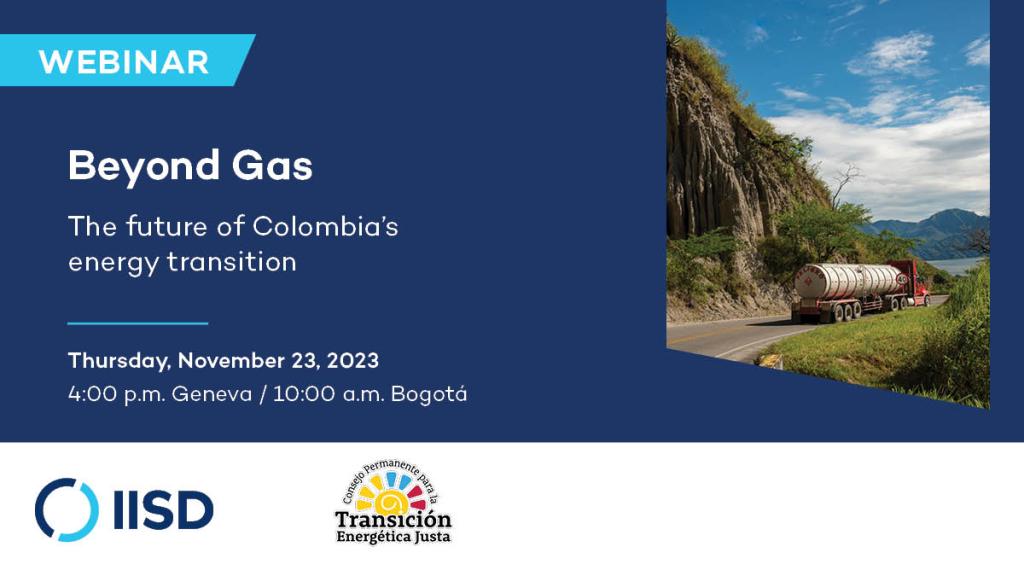
At the end of 2022, the Government of Colombia announced its commitment to not grant any new licences for oil and gas exploration. This political will is also behind Colombia’s decision in August 2023 to join the Beyond Oil and Gas Alliance (BOGA) as a Friend of BOGA.
These decisions have sparked important debates in the country, both from an energy and economic security perspective, with some discussions focused on the role of ongoing exploration of existing gas reserves and others on the ongoing characterization of fossil gas as clean fuel.
To address the intensifying global climate crisis, gas needs to be phased out as quickly as possible. While it is evident that gas will continue to be present in Colombia’s energy matrix in the coming years, it is essential for the country not to deepen its dependence by developing new gas fields and to promote its phase-out by deploying alternatives that are already competitive.
This webinar questions some of the narratives in favour of gas extraction and discusses various arguments around the need to phase out fossil fuels, including gas. This is a fundamental discussion for Colombia, which aims to become a global leader in building a public policy for fossil fuels phase-outs.
Transport is a crucial part of modern society, connecting communities and fostering development. However, the impact of the transport sector on the planet is huge, causing over 20% of global carbon dioxide emissions. It is therefore one of the main drivers of climate change while also having significant direct and indirect negative impacts on human health.
As populations and cities grow, the world’s transport networks will need to expand and modernize to meet demands. Sustainable transport can provide safe, accessible, efficient, and resilient mobility while minimizing carbon dioxide and other emissions. Despite these benefits, sustainable transport infrastructure is not being developed at the scale needed to adapt to ever-increasing climate impacts and to meet net-zero targets by 2050.
All infrastructure investments generate benefits and costs, which is why it is crucial to identify, quantify, and analyze all impacts surrounding a project. Our Sustainable Asset Valuation (SAVi) methodology is rooted in systems thinking and uses tools like spatial, Excel-based, and system dynamic models to provide a more holistic understanding of the value of sustainable transport infrastructure by weighing the environmental, economic, and social co-benefits of a project. These approaches can be key instruments for helping investors, planners, and policy-makers make informed decisions about sustainable transportation investments.
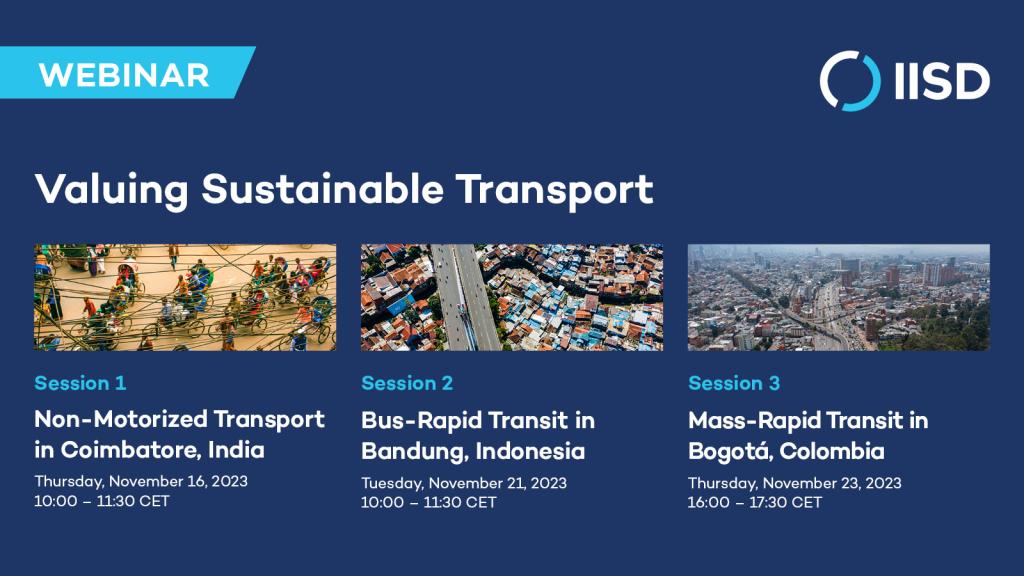
We led this three-session webinar series on valuing sustainable transport with SAVi:
Session 1: Thursday, November 16, 10:00–11:30 CET
Sustainable Transport Investment: a case study in Coimbatore, India
In the first session, we introduce the role that sustainable transport infrastructure can play in producing economic, social, and environmental benefits. We take you, step-by-step, through our SAVi methodology, which uses a combination of system dynamics, spatial modelling, climate data, and financial analysis to assess the environmental, social, and economic performance of infrastructure assets. We then look at this in focus through the lens of a case study of a non-motorized transport network in the city of Coimbatore, India.
Session 2: Tuesday, November 21, 10:00–11:30 CET
Systems Thinking for Sustainable Transport Projects: a case study in Bandung, Indonesia
In the second session, we delve deeper into systems thinking and systems dynamics. We introduce causal loop diagrams and examine how the simulation and interpretation of a variety of scenarios can help assess sustainable transport infrastructure investment options. During this session, we present a case study of a bus rapid transit system in Bandung, Indonesia.
Session 3: Thursday, November 23, 16:00–17:30 CET
Integrated Cost-Benefit Analysis for Transport Projects: a case study in Bogotá, Colombia
In the final session, we explore the added value of integrated valuations and cost-benefit analyses versus more traditional project costing approaches. We also demonstrate how to identify key added benefits and avoided costs for sustainable transport projects and how this enables decision-makers to delve beneath the surface of a transport project, looking at the longer-term benefits throughout its life cycle. This is illustrated by the case study of a mass-rapid transit system in Bogota, Colombia.
Sustainable Asset Valuation of Restoring the Mallorquín Swamp, Colombia
The assessment combines a spatially explicit analysis with a system dynamics model to quantify direct and indirect costs and benefits of mangrove restoration in the Mallorquín Swamp and grey infrastructure alternatives that provide similar benefits. This study demonstrates that the restored Mallorquín Swamp will provide multiple benefits, such as income from ecotourism and improved climate adaptation, including avoided flooding and erosion.
Barranquilla is Colombia’s fourth largest city, and population expansion in and around the city has created numerous environmental problems. For example, encroachment in the Mallorquín Swamp on the northern edge of Barranquilla has made residents more vulnerable to climate change and harmed livelihoods. Mangroves in the swamp have historically provided significant value by mitigating floods, protecting biodiversity and fisheries, storing carbon, and supporting tourism. However, urban development and waste disposal have damaged the ecosystem and limited the swamp’s capacity to provide these important services.
We conducted a sustainable asset valuation (SAVi) assessment of nature-based infrastructure (NBI) in the Mallorquín Swamp. Throughout the analysis, we engaged with World Resources Institute Colombia and Barranquilla Verde (the city’s environmental authority). The assessment incorporates a spatially explicit analysis with a system dynamics model to quantify the economic, environmental, and social impacts of mangrove restoration in Barranquilla. We used an integrated cost-benefit analysis to assess the monetized social, economic, and environmental outcomes of restoration over 20 years.
Key results:
Restoration can counteract degradation and address environmental concerns.
NBI in the Mallorquín Swamp creates more value for society at a lower cost than the grey infrastructure alternatives.
The restored swamp could support the local economy and provide significant climate adaptation benefits.
Supporting the local economy by providing a sustainable source of income increases the net value of the investment.
NBI can be an effective long-term climate adaptation strategy.
Investing in ecotourism infrastructure has a strong impact on the financial viability of the intervention.
NBI is preferable to grey infrastructure from a financing perspective.
The report is complemented by technical appendices with methodological details about the system dynamics model and spatial analysis that were developed for the valuation.
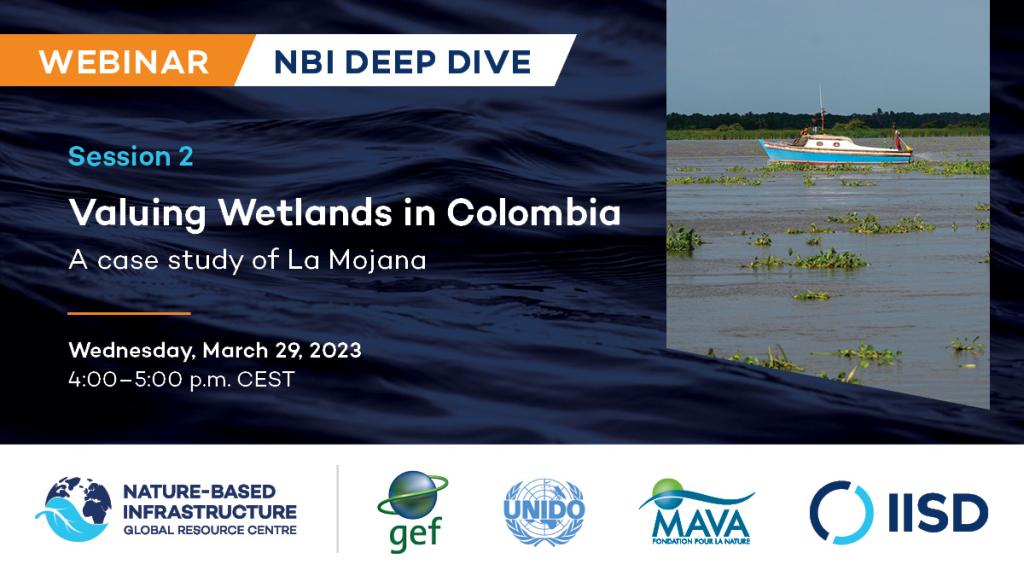
In the second session of our NBI Deep Dive series, we focused on a Sustainable Asset Valuation (SAVi) case study of wetland restoration in La Mojana, Colombia. The region’s complex wetland ecosystem is under pressure from population growth and climate change. Local communities face devastating floods as well as increasing water scarcity, putting their livelihoods in fishing and agriculture at risk. Planners and policy-makers are therefore considering different infrastructure options to mitigate flood risks and improve the water management in La Mojana, such as restoring wetlands, rehabilitating indigenous drainage channels, and building dikes along rivers.
In this webinar, we went step-by-step through the Sustainable Asset Valuation (SAVi) for infrastructure options in La Mojana. We explained how creating a causal loop diagram helped us identify the socioeconomic and environmental factors at play, and how we used this as a blueprint for the mathematical system dynamics model. We also explained the use of climate data, spatial models and financial analysis. Taking all these elements into account, we concluded with the integrated cost-benefit analysis for the infrastructure options and explain how stakeholders can use the results.
SPEAKER
Georg Pallaske
Associate, IISD and Project Manager at KnowlEdge Srl
MODERATOR
Liesbeth Casier
Lead, Public Procurement and Sustainable Infrastructure Policy and Coordinator of the NBI Global Resource Centre
This series will focus on the technical aspects of our Sustainable Asset Valuation (SAVi) methodology, providing in-depth explanations of our process as well as applied examples in the form of case studies. The first three sessions will feature Nature-based Infrastructure (NBI) projects that address water-related challenges, alongside the UN Conference on Water.
We will look at systems modelling, spatial modelling, and financial modelling of various case studies to give the method context and explain its practical application.
These sessions are intended as a further building block from our training sessions, providing technical depth on the methods of assessing the value of specific NBI projects. We also hope to raise awareness on the importance of integrated assessments and scenario analysis, valuing all social, economic and environmental risks and opportunities for NBI projects.
No Oil Producer Wants to Be the First to Give Up the Fuel. Except Gustavo Petro's Colombia
Brazil’s former president was laughing at me. I was sitting opposite 76-year-old Luiz Inácio Lula da Silva, in an overly air-conditioned studio in São Paulo this March, interviewing him for a story on Brazil’s October elections, for which he is leading the polls. I had just asked Lula if he would be interested in signing up to a bold climate pledge made by Gustavo Petro—then the leftist front runner in Colombia’s 2022 presidential race and, as of this week, the nation’s president-elect. As part of his campaign, Petro vowed to immediately stop issuing new permits for oil exploration—a big deal in a country where oil makes up 40% of exports, and 12% of government income. Petro also called on Lula, who could become his most important regional ally, to join him. So, would he?
National Oil Companies and Climate Change: Economic Challenges and Potential Responses
Policy-makers and climate activists alike often overlook National Oil Companies’ role in global efforts to address climate change.
May 4, 2021
National oil companies (NOCs) are key players in the global oil and gas industry—they produce half of the world’s oil and gas, and invest 40% of capital into the sector. But policy-makers and climate activists alike often overlook NOCs’ role in global efforts to address climate change. Omission of NOCs from climate strategies will significantly hamper governments’ attempts to meet global climate goals, and NOCs—along with the countries that depend on their revenues—could be left behind.
On April 21, the National Resource Governance Institute (NRGI) and IISD co-hosted the first in a series of webinars aiming to fill this gap. Three key lessons emerged:
Political will is crucial. Governments must drive the energy transition. This is valid for both producer country governments, which should direct their NOCs in line with national strategic and political priorities, and wealthy consumer country governments, which must provide climate finance to enable developing and emerging producer countries to overcome the serious challenges of transition.
Tunnel vision is deadly. NOCs can’t continue on the costly assumption the oil market won’t change. Climate advocates must increasingly consider the developmental challenges of producer countries and the needs, and potential roles, of NOCs.
Economic diversification is key. Oil- and gas-producing countries have struggled with diversification for decades. Solving this is even more urgent now as producer countries must start actively investing in the long-term future. New producers should avoid making investments from the beginning that lock the country into a high-carbon pathway.
No more business as usual
Making incremental reductions in emissions compared to a business-as-usual baseline is no longer enough to mitigate the effects of climate change. This is because of the rapid and fundamental transformation in the way we produce and consume energy.
This change creates a challenge for companies whose core business is extraction of oil and gas, and especially for governments heavily dependent on revenues from NOCs.
Making incremental reductions in emissions is no longer enough to mitigate the effects of climate change.
These companies and governments should consider any new oil and gas investments in light of the significant uncertainty about future demand for their products and the economic returns they will generate, as well as their impact on climate change targets. Meanwhile, the status quo approach in many countries—whereby NOCs reinvest most of their oil revenues straight back into the sector—poses a growing risk to efforts to move away from fossil fuels.
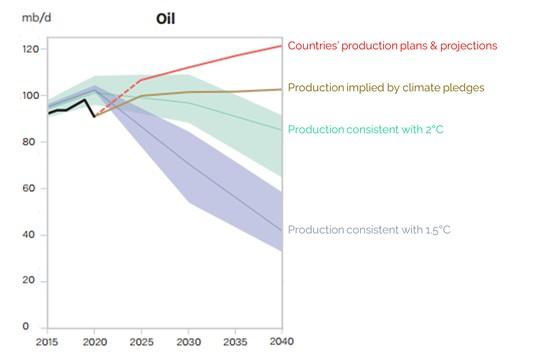
Global oil production would have to decline by 4% every year from 2020 to 2030 to be consistent with a 1.5°C pathway, according to the Production Gap Report. Yet current government plans and projections indicate an average 2% annual increase. This raises the question: what is the role for NOCs in a world of climate change adaptation and declining oil?
Executives from two NOCs, Colombia’s Ecopetrol and Uganda’s UNOC, joined our event to share their approaches to energy transition. Valérie Marcel of Chatham House, one of the world’s leading experts on NOCs, also contributed.
Juan Manuel Rojas shared Ecopetrol’s climate strategy, based on four pillars. While still focused on oil and gas, Ecopetrol aims to diversify its business into other sources of energy. The company bid for 51% of ISA, the state electricity grid operator. While many NOCs aim to reduce their direct operational emissions—so-called scopes 1 and 2—Ecopetrol’s energy transition strategy also targets scope 3, the indirect emissions that occur in its products’ value chain. The company aims to reduce emissions across scopes 1, 2 and 3 by 50% by 2050.
Asked to what extent these changes are driven by investors (88.5% of the company is state-owned and the rest is held by private investors), Rojas said often they are skeptical of the importance of an energy transition. From a financial perspective, many investors prefer their holdings to focus on one business area: if they want more electricity or more renewables, they would make those choices themselves. This creates a key tension in NOCs’ diversification efforts.
NOCs have two purposes: to deliver revenues to governments and to meet energy demand in their countries.
Peter Muliisa of UNOC shared Uganda’s challenges as new petroleum producer and a country with pressing socio-economic development needs. Like other countries in Africa, Uganda is highly vulnerable to climate change, and many officials and citizens see oil revenue as a means to help the country cope. However, with the global energy transition underway, UNOC has expressed a desire to develop a clear strategy on what the company needs to do to avoid exacerbating the effects of climate change on Uganda. Muliisa shared that, as a first step, early discussions are under way on how to restructure UNOC as an energy company rather than an oil company, ensuring Ugandans increasingly gain access to clean energy.
However, the government’s green light for construction of the East Africa Crude Oil Pipeline, which will carry Uganda’s oil to the Tanzanian coast, raises the question of potentially stranded assets. Muliisa explained that Ugandan officials hope to export oil through the pipeline before energy demand significantly shifts to renewables, but that the energy transition may affect longer-term production in the country.
Valérie Marcel, drawing also on the experience of these two companies, observed that NOCs have two purposes: to deliver revenues to governments and to meet energy demand in their countries (including often non-commercially). While clean energy is generally profitable, it does not create economic rents in the way oil does, which raises challenges for the countries’ economic strategies and government revenues. The second part of NOCs’ mandate could point to a role for NOCs in supplying renewable energy domestically. However, while NOCs can focus on reducing their costs or operational emissions, transitioning to renewable energy requires clear direction from their governments and consistent development strategies and climate policies, especially given the political consequences of lost economic rents.
Finally, Marcel said, the transition will affect different types of NOCs variously: high-cost versus low-cost, exporting versus importing, gas-focused versus oil-focused. Will it be easier for NOCs in new producing countries to transition than for established producers? In some ways yes, she said, as they are not yet locked into an oil development pathway. However, these producers often lack the financial resources needed for such a transition.
Our discussion series aims to increase learning between experts in the extractives governance and climate change fields, who have too often worked in silos. Our next event, on May 27, will explore whether NOCs should get directly involved in renewable energy investment and economic diversification.
Patrick Heller is an advisor at NRGI and a senior visiting fellow at the Center for Law, Energy & the Environment, University of California, Berkeley. Greg Muttitt is senior policy advisor for energy supply at IISD.