Insight

IISD Experimental Lakes Area's Lake 626 Climate Change Diversion Project

IISD-ELA's Lake 626 Diversion project has been exploring the effects of climate change on water since 2008. How does it work? And what have we discovered so far?

June 16, 2017

The ground shakes as dynamite blasts through the earth of a mining site, creating a channel to redirect water from a nearby lake. The roar of a bulldozer fills the air. It moves along, pushing dirt and rocks to build a dam at the lake’s original outflow. How will the lake downstream respond to reduced water inputs?

A lake trout swims in the middle layer of a boreal lake, its dark green body with yellow spots moving along, looking for food. The year is 2040, and the effects of climate change are becoming more evident, including in this lake. There has been less precipitation, and the lake is getting warmer each year. But what will this mean for this lake trout in search of food?

These two scenarios, both involving a decreased amount of water entering lakes, are exactly what researchers at IISD Experimental Lakes Area (IISD-ELA) are currently investigating.

The Lake 626 Diversion Project started in 2008 with scientists from IISD-ELA—or the Experimental Lakes Area, as it was known before 2014—conducting background research on both Lake 626 and a reference lake, Lake 373. Lake 626 was a fourth-order lake (three lakes upstream of it) with a watershed area of 388 ha and water residence time (that is, how long a drop of water stays in the lake) of 2.1 years.

In 2010, the researchers built a 200-metre diversion channel, redirecting water from Lake 627, which is the lake upstream of 626, to a wetland area. They blocked the flow of water from Lake 627 to 626 by building a dike. Lake 626 became a first-order lake (no lakes upstream of it) with a watershed area of 74 ha and water residence time of 10.9 years. The diversion and the dam reduced water inputs to Lake 626 by 80 per cent, mimicking an industrial diversion or decreased precipitation due to climate change.

Image removed.

This part of the experiment itself—reducing how much water enters a lake through redirection—was a first of its kind, says Christopher Spence, a hydrologist with Environment and Climate Change Canada who has been involved with the Lake 626 Diversion Project since the beginning.

“The lake hydrometeorology crowd, we go in and we watch lakes for a few years, and then try to find relationships that way,” Spence says. “But we don’t do experimental manipulations.”

Until now, that is.

Creating the Channel

Ken Beaty started working at IISD-ELA in 1969. Though he has been retired for six years, “they keep calling me in,” he says with a laugh. But he’s happy to help—the site has been a big part of his life.

“There are some things that I remember that none of these people know,” Beaty says, for example, how certain data were collected.

He is a hydrologist and helped identify a suitable lake for the Lake 626 Diversion Project. He had to find a lake that met all the criteria the other researchers needed—the right fish population, water chemistry and so on. He consulted maps and air photos, completed land surveys, and ran a general profile of the area. Once he found a suitable site, he designed the diversion channel. Contractors came in to construct it. They cleared the trees, scraped the dirt and used dynamite to blast through the bedrock. It took about two weeks to complete.

Though this was the first time Beaty had designed a diversion channel, he has altered lakes and wetlands at IISD-ELA before. He has flooded land. He has lowered a lake by 10 feet using a siphon system. He has pumped water with sulphuric and nitric acid over a wetland to mimic acid rain.

And after each experiment is complete, the researchers at IISD-ELA restore the land. For example, once the Lake 626 Diversion Project is done, they wiill fill in the channel and plant trees in the area.

Image removed.

Surface Water Layer Extending Deeper

The researchers working on the Lake 626 Diversion Project monitored Lake 626 for a few years and discovered significant changes in the amount of dissolved organic carbon (DOC) found in the lake, light penetration and surface water temperature.

Reducing water inputs evidently reduced the amount of DOC, which comes from decomposed plant and animal material, in a lake. DOC is what makes lakes brown. Sunlight bleaches the DOC, and since minimal additional DOC is coming into the lake, the lake gets clearer. Sunlight travels deeper, which warms the lake.

Lake trout, a cold water species, spend their time in the middle layer of a lake. They prefer water high in oxygen that is less than 15°C. The surface layer of the lake is too warm for trout, and the bottom layer doesn’t have enough oxygen.

Since the Lake 626 Diversion Project started, the warm surface layer of Lake 626 is extending deeper, squeezing the lake trout’s habitat. Fish biologists at IISD-ELA are studying how this affects the behaviour of the trout to ultimately understand what drives variations in fish populations among years and among lakes.

“It’s a very basic question,” says Michael Paterson, IISD-ELA’s Senior Research Scientist who has been involved with the diversion project since the start. “People have been looking at that for a long time, but we still don’t have very good answers.”

Image removed.

How Fish Respond

To observe fish behaviour, the biologists implant a tag about the size of a double-A battery into the gut cavity of an adult fish by performing a basic surgery. The tag lasts between 3 and 3.5 years. About 10 to 12 fish are tagged at any given time in both Lake 626 and the reference lake, Lake 373, which are home to up to 350 and up to 300 fish, respectively.

These tags send signals through the water to receivers that record the fish’s depth and spatial position. The researchers can see where the fish spend their time, and how the decreasing habitat size affects them.

The research is ongoing, but there have been some subtle changes in behaviour. For example, lake trout have been spending more time in the water with less than their ideal amount of oxygen.

“It’s still the kind of thing that we’ll have to take a couple years to see if that pattern is consistent or to see how that continues,” says Lee Hrenchuk, a biologist working on the Lake 626 Diversion Project.

Image removed.

Why It Matters

So why should people care about the decreasing size of a coldwater fish’s habitat?

Well, people like fish, and specifically, they like lake trout, as multiple Lake 626 Diversion Project researchers say.

“There will be an impact to fish populations from climate,” says Paul Blanchfield, a former ELA scientist who now works at the Department of Fisheries and Oceans. “We can have an idea of not only how sensitive lake trout are to those changes, but also people can really form the basis for understanding how future changes in our climate will impact these lakes.”

Plus there is the industry side of the project and its results, which can help set guidelines and make judgements on industrial projects, like mines and hydroelectric dams.

Image removed.

Monitoring Continues

Last year, all the scientists—biologists, chemists, hydrologists—working on the project met to discuss where the research is at so far. They decided to continue with the study but to sample the lake minimally with more intensive sampling every third year.

After the researchers built the diversion in 2010, the experiment has pretty much run itself, Hrenchuk says. They don’t need any additional infrastructure, so as long as they have the proper permits and monitor the lake, it can be a long-term study.

Like other studies at IISD-ELA, the Lake 626 Diversion Project has many facets—there is research on not only fish behaviour and habitat, but also on fish bioenergetics, zooplankton, aquatic colonization of diversion channels, and whatever else the scientists come up with.

“There are lots of side pieces that come out of the experiment regardless of what the main overarching goal of the original study design was,” Hrenchuk says.

The researchers will continue monitoring the Lake 626 Diversion Project, with the next intensive year of sampling in 2019.

Image removed.Click here to download this infographic of the Lake 626 Diversion Project.

Insight details

Topic
Water
Region
Canada
Video

Welcome to IISD Experimental Lakes Area

Give us a minute, and we will show you around the most unique laboratory in the world!

June 13, 2017

Give us a minute, and we will show you around the most unique laboratory in the world!

At IISD Experimental Lakes Area, in northwestern Ontario, we experiment on real lakes to reveal a full picture about what pollutants and contaminants are doing to our lakes.

Since the late sixties, we have been exploring what pollution is doing to fresh water, leading to many changes in policy around the world. 

Now, we are opening our doors to invite students, communities, First Nations, young people and more to the site, to learn first hand what we do and why we do it...

Video details

Video

Welcome to IISD Experimental Lakes Area (with subtitiles)

Give us a minute, and we will show you around the most unique laboratory in the world!

June 13, 2017

Give us a minute, and we will show you around the most unique laboratory in the world!

At IISD Experimental Lakes Area, in northwestern Ontario, we experiment on real lakes to reveal a full picture about what pollutants and contaminants are doing to our lakes.

Since the late sixties, we have been exploring what pollution is doing to fresh water, leading to many changes in policy around the world.

Now, we are opening our doors to invite students, communities, First Nations, young people and more to the site, to learn first hand what we do and why we do it...

Video details

Video

Cost of Pollution: Extreme Weather

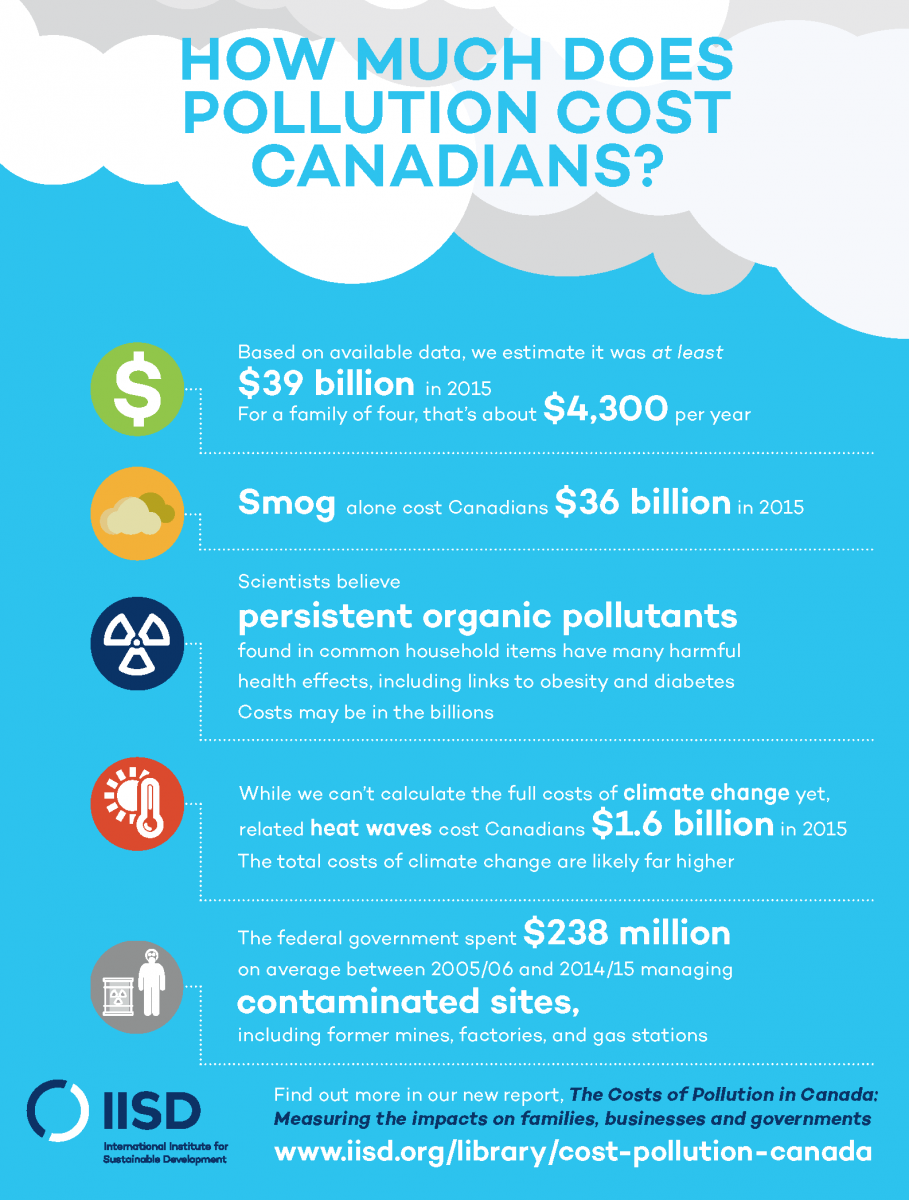
Did you know that the cost of climate change-related heat waves in Canada is estimated to have been $1.6 billion in 2015?

June 2, 2017

Did you know that the cost of climate change-related heat waves in Canada is estimated to have been $1.6 billion in 2015?

Pollution costs Canadians tens of billions of dollars every year in terms of impacts on their health and well-being, their pocketbooks and the value of their homes, buildings, roads and the natural environment. 

We have just released 'Costs of Pollution in Canada: Measuring the impacts on families, businesses and governments'. The report offers the most comprehensive portrait of pollution and its costs ever undertaken in Canada.

In this short video we explore the report's findings, and look closely at the impact of extreme weather on Canada's economy.

Video

Cost of Pollution: Contaminated Sites

Did you know that average annual cost of managing contaminated sites under federal jurisdiction in Canada was $283 million between 2005/06 and 2014/15?

June 2, 2017

Did you know that average annual cost of managing contaminated sites under federal jurisdiction in Canada was $283 million between 2005/06 and 2014/15?

Pollution costs Canadians tens of billions of dollars every year in terms of impacts on their health and well-being, their pocketbooks and the value of their homes, buildings, roads and the natural environment. 

We have just released 'Costs of Pollution in Canada: Measuring the impacts on families, businesses and governments'. The report offers the most comprehensive portrait of pollution and its costs ever undertaken in Canada.

In this short video we explore the report's findings, and look closely at the cost of contaminated sites to Canada.

Video

Cost of Pollution: Persistent Organic Pollutants

Did you know that the cost of persistent organic pollutants to Canada is estimated to be in the billions, but we still don't know for sure?

June 2, 2017

Did you know that the cost of persistent organic pollutants to Canada is estimated to be in the billions, but we still don't know for sure?

Pollution costs Canadians tens of billions of dollars every year in terms of impacts on their health and well-being, their pocketbooks and the value of their homes, buildings, roads and the natural environment. 

We have just released 'Costs of Pollution in Canada: Measuring the impacts on families, businesses and governments'. The report offers the most comprehensive portrait of pollution and its costs ever undertaken in Canada.

In this short video we explore the report's findings, and look closely at the effect of persistent organic pollutants on Canada's economy.

Video

Cost of Pollution: Smog

Did you know that smog cost Canada $36 billion in 2015?

June 2, 2017

Did you know that smog cost Canada $36 billion in 2015?

Pollution costs Canadians tens of billions of dollars every year in terms of impacts on their health and well-being, their pocketbooks and the value of their homes, buildings, roads and the natural environment. 

We have just released 'Costs of Pollution in Canada: Measuring the impacts on families, businesses and governments'. The report offers the most comprehensive portrait of pollution and its costs ever undertaken in Canada.

In this short video we explore the report's findings, and look closely at how much smog costs Canada.

Report

Costs of Pollution in Canada: Measuring the impacts on families, businesses and governments

Pollution costs Canadian families, businesses and governments a startling amount every year. These costs add up to tens of billions of dollars at least. These are our findings from a new report on the cost of pollution in Canada.

June 1, 2017

Pollution costs Canadian families, businesses and governments a startling amount every year. These costs add up to tens of billions of dollars at least. These are our findings from a new report on the cost of Pollution in Canada.

Pollution harms human health, damages forests and crops and degrades the quality of land and water—to name just some of its impacts. The result is higher costs for many things: medical care, raw materials, food and public services. In these and numerous other ways, pollution threatens not only Canadians’ current well-being but also the prospects for sustaining that well-being into the future.

Despite pollution’s widespread costs, Canadians are not adequately informed about them. Various studies have assessed the costs of specific pollutants (for example, additional hospital stays due to urban smog), but no single study covers them all. For many pollutants, no cost information is available at all. The result is an incomplete and complicated array of information that an average citizen would be hard-pressed to sort through. 

With financial support from the Ivey Foundation, the International Institute for Sustainable Development reviewed and synthesized existing studies on the costs of pollution in an effort to improve the data available to Canadians. Our findings, which represent the most comprehensive assessment of pollution and its costs undertaken in Canada, are summarized here and outlined in detail in the main report. The methods used in compiling the report were scrutinized and approved by the Conference Board of Canada. 

Our hope is that the report better equips Canadians, policy-makers and industry leaders to understand and make decisions about pollution. The challenge is to balance the trade-off between pollution’s costs on the one hand and the benefits of the activities that lead to its creation on the other. The report shows that the costs involved are very significant. Allowing the costs to be obscured by poor data serves no one well.  


Report details

Policy Analysis

NAFTA’s Environmental Record: History, outcomes, impacts and options

IISD has asked various experts from across Canada, the United States and Mexico to give their perspectives on NAFTA and the pending negotiations. This commentary, written by IISD President and CEO Scott Vaughan, is the introductary piece in this series.

June 1, 2017

The NAFTA renegotiations have begun, and the fate of the various environmental provisions in NAFTA look bleak. 

It is unclear if the proposed White House budget cuts will prevail. What is clear is that the Trump Administration’s pitting of environmental protection against a jobs agenda is a throwback to an old jobs-versus-environment debate that empirical evidence has discounted.  

It is too early to tell what role the environment will play in the NAFTA negotiations: Canada has promoted a new generation of progressive trade policies, while Mexico has shown leadership across a range of environmental, biodiversity and forestry issues. Meanwhile, some points of irritation for the United States—namely softwood lumber and dairy—fall outside of NAFTA altogether, and demands to change NAFTA Chapter 19 dispute settlement rules are confounding, given the United States' track record in winning those cases.  

As the outcomes of these renegotiations are still unkown, IISD has asked various experts from across Canada, the United States and Mexico to give their perspectives on NAFTA and the pending negotiations. This commentary, written by IISD President and CEO Scott Vaughan, is one piece in this series.


Insight

Microplastics: What are they and what can we do about them?

What exactly are microplastics? What are they doing to our water? And why should you be worried? We sat down with IISD Experimental Lakes Area research fellow Dr. Michael Rennie, who has recently worked on the impact of microplastics on fresh water, and he gave us the lowdown on them.

May 10, 2017

You’ve seen the headlines. In fact, it seems like everyday we are exposed to articles about how plastic pollution is affecting our environment and water supplies—microplastics in particular. Recently, Canada and the United States took action to remove microplastics from cosmetic products and scrubs.

But what exactly are microplastics? What are they doing to our water? And why should you be worried? We sat down with our research fellow Dr. Michael Rennie, who has recently worked on the impact of microplastics on fresh water, and he gave us the lowdown on them.

What are microplastics?

Basically, microplastics are small particles of plastic that are smaller than 5 mm.

Where do they come from?

Microplastics come from a variety of sources. While much hype has been made about the presence of microplastics in facial scrubs and cosmetic products (take a look at your scrubs or toothpaste at home—if they list polyethylene in the ingredients, those are microplastics), these sources actually make up a relatively small quantity in most regions.

It is estimated that up to 75 per cent of the microplastics found in the ocean are from the breakdown of larger material (bottles, plastic bags, fishing gear, etc.). For anyone who has participated in a riverbank cleanup this spring, this should not be terribly surprising. More recently, another major culprit of microplastic fibers is turning out to be synthetic clothing (like your favourite cozy solar fleece that you might be wearing right now).

Image removed.

While wastewater treatment plants can effectively remove a large quantity of microplastics moving through them (up to 98 per cent), a 2016 study determined that the average wastewater treatment plant was still releasing 4 million particles per day (and as many as 65 million) despite these high removal rates.

Another recent study also demonstrated that microplastic particles are airborne and settle in large quantities in urban settings.

How much of this stuff is out there?

In 2014, it was estimated that the ocean had approximately 270,000 tonnes of plastic floating on the surface, and we don’t really know how much has settled out. However, somewhere between 5 million and 13 million tonnes is added annually from coastal cities—a shocking number.

In a recent study on Lake Winnipeg, researchers at Lakehead University, the University of Manitoba and IISD Experimental Lakes Area found densities of around 1 microplastic particle for every square metre of water, which was comparable to how much was found previously in Lake Erie.

Why should we care?

For starters, plastic is a manufactured product—it does not occur naturally, so anywhere we find it in nature is directly because of us. In the case of microplastics, there are few applications where one can say it was intentionally added to ecosystems, so this represents the waste product of our current lifestyle, which is heavily reliant on plastic products.

Secondly, there is evidence that these particles can act as vectors of contaminants and carry these harmful substances from the water column and into the organisms that consume them, such as fish.

Subscribe | Get IISD blogs delivered to your inbox

There is also increasing evidence that fish do ingest these microplastics. While this contaminant transfer has been demonstrated in the lab, there is still a lot of work to be done to figure out what the effects are on fish in the wild, as they are exposed to the levels of plastics that we observe currently.

What can we do about it?

We have seen some good moves in the right direction, but there is still a long way to go. Many governments have legislation in place to ban microplastics from personal care products in the very near future, but, as we have learned, this only addresses a small part of the problem. Outdoor clothing manufacturers have been proactive, and are actually funding research into the rates of shedding of their clothing and evaluating new manufacturing methods that can reduce these losses.

Most of all, people can have a positive impact on plastic pollution through their lifestyle choices. You should avoid purchasing products with excess packaging; choose glass or metal drink containers over plastic; avoid disposable plastic bags and bring reusable bags with you; choose wool over synthetic garments. And to help with the plastic that you don’t purchase, why not sign up to participate in a shoreline cleanup near you?

Image removed.

Insight details

Topic
Water
Region
Canada