IISD in the news

U.S. realigns focus in fighting climate change

A Seismic shift occurred Wednesday, as U.S. President Joe Biden took the oath of office and stood before the American people, and the world, and vowed the climate crisis was among his top priorities for the nation.

January 21, 2021

IISD in the news details

IISD in the news

Government of Canada launches consultation process for the new Canada Water Agency

The federal government is following through on its commitment to establish a Canada Water Agency (CWA) and improve freshwater management across Canada with the launch of public consultations last month. 

January 20, 2021

IISD in the news details

Topic
Water
Region
Canada
Project
IISD Experimental Lakes Area
Impact area
Nature
IISD in the news

Prairie provinces reportedly chipped in for new climate data hub ClimateWest

Canada’s three Prairie provinces are particularly vulnerable to the climate crisis, and now their governments are helping make climate data more accessible, according to the head of a new non-profit.

January 20, 2021

IISD in the news details

IISD in the news

Winnipeg-based resource hub to help Prairies adapt to climate change

A new, government-funded, not-for-profit organization opened its doors Tuesday, with the express purpose of helping the Prairie region recognize the risks, and potential opportunities, presented due to climate change.

January 20, 2021

IISD in the news details

Success story

Speaking Each Other’s Language

In Canada, First Nations people are at the highest risk of poisoning from consuming freshwater fish that have been contaminated with mercury (and its toxic form, methylmercury).

January 19, 2021

Mercury poisoning, or Minamata disease, comprises a wide range of physical and mental symptoms. These include hair loss, muscle weakness/paralysis, organ damage, loss of senses, depression, and even death.

First Nations communities in Canada often depend on freshwater fish for sustenance and are traditionally accustomed to catching their own fish.

It is therefore critical that we communicate the potentially harmful impact of mercury on fresh water and freshwater fish.

Historically, there has been little communication available in First Nations languages of the Western scientific understanding of the harmful nature of mercury accumulation in freshwater fish.

A Unique Approach to Western Science

For over 50 years, our very own Experimental Lakes Area has been conducting whole-ecosystem experiments on lakes and the impact of pollutants on lakes in Ontario, Canada. This is the only place in the world you can conduct this kind of research.

Some of this research involved intentionally introducing minute quantities of mercury to a freshwater lake over a given period and tracking the impact and build-up of mercury in the food web—including in freshwater fish. Unsurprisingly, the researchers discovered that the amount of mercury found in the fishes increased, but when they stopped adding mercury, the amount found in fishes decreased.

Scientists with blue gloves holds a fish down and takes a tissue sample

When it came to communicating the results, First Nations communities were top of the list, in the spirit of sharing knowledge and ensuring that we make our science accessible to all of our audiences.

We developed a six-minute animated video in Ojibwe (an Algonquian language spoken in parts of Canada) parsing our Western approach to mercury pollution and what we found.

We collaborated with Ojibwe language experts Elder Nancy Jones and Elder Don Jones, Ojibwe language teacher Jason Jones from Nigigoonsiminikaaning (Red Gut) First Nation in Ontario, and retired science instructor Bruce Townsend.

The translation process depended on innovative methods to develop new terms for concepts that do not currently have Ojibwe equivalents, such as “mercury.” The Ojibwe term for mercury we settled on was “Biiwaabikowaabo gaa-waawaageshkaag,” which literally means “liquid metal that shines.”

Jason Jones, our translator, said it best: 

"Our language has vitality, with the ability to create new words."

Opening Our Doors to the World

Every step of the way, we collaborated with local First Nations in the development, translation, and communication of the video. For the translation, we collaborated with Nancy Jones, Don Jones, and Jason Jones of Nigigoonsiminikaaning (Red Gut) First Nation, and worked with Emma Bruyere of Couchiching First Nation, to voice the video.

This was a critical step in ensuring young First Nations voices were heard and amplified through the project.

Group of people pose for photo

For Emma, this wasn’t just about communicating the science of a particular issue—it was about preserving a language and its parent culture.

"I want to be working with the language my entire life… I know that I want to work with the language and help other people learn because of how much it's dying out."

As tends to be the case when we collaborate with local First Nations, the lessons proved to be a two-way street. Our deputy director, Pauline Gerrard, also learned a great deal from the process of translating our science into a different language.

"On a personal level, I've really learned a lot about the importance of water to Anishinaabe culture and the kind of personal responsibility that Indigenous people take for water management and water protection."

The video was well received by everyone from the CBC to the panel of judges at the 2020 Prospect Magazine Awards in London, who awarded the video the runner-up prize in the Medicine, Science & Technology category.

Next step? Integrating the research and its findings into Canadian school curricula. We are developing a lesson plan (including Ojibwe and English transcripts of the video, breakdown of sentences, neologisms, etc.) to supplement the video and act as an additional resource for all-level Ojibwe language learners or teachers to use. It will be available free of charge—all in the spirit of promoting the Ojibwe language and our understanding of mercury pollution.

Click here to learn more about how the world’s freshwater laboratory is collaborating with local First Nations communities to further our understanding of freshwater health. If you are interested in collaborating with IISD Experimental Lakes Area on any of this work, please contact Dilber Yunus at [email protected].

Conference

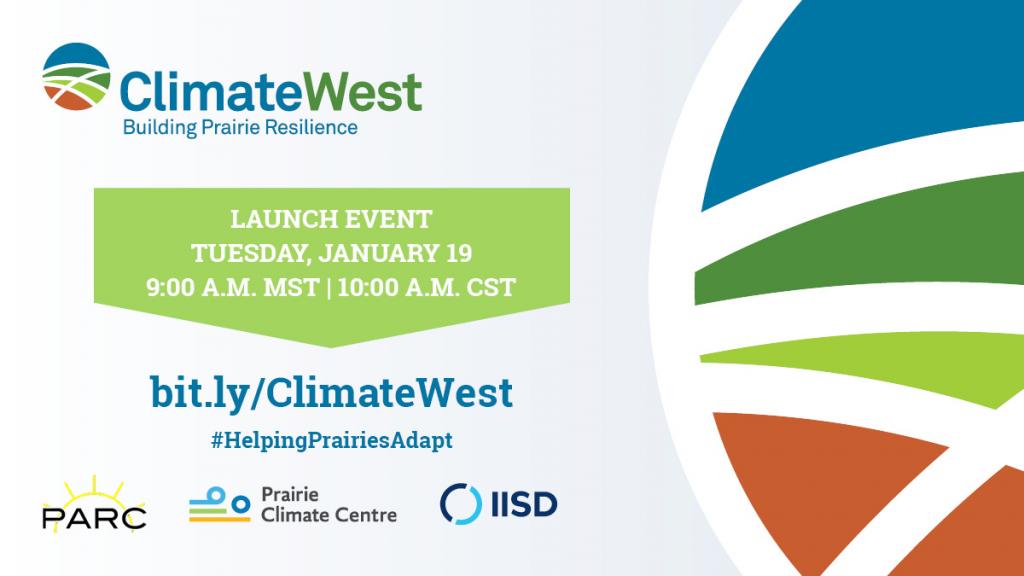
Launch of ClimateWest

The International Institute for Sustainable Development is excited to announce a new resource for climate change adaptation on the Canadian Prairies!

January 19, 2021 10:00 am CST

(Open to public)

ClimateWest will work with people, communities, businesses, and governments across Manitoba, Saskatchewan, and Alberta to help address the risks and opportunities generated by climate change. To learn more about ClimateWest, please register to join the virtual launch at 10:00 a.m. CST on January 19.

climatewest-launch-event.jpg

ClimateWest's founding partners include the International Institute for Sustainable Development (IISD), the Prairie Climate Centre (PCC) at the University of Winnipeg, and the Prairie Adaptation Research Collaborative (PARC) at the University of Regina.
At the event, you'll hear from ClimateWest’s Executive Director Jane Hilderman, and from many of the collaborating organizations who helped to create ClimateWest:

  • Terry Duguid, Parliamentary Secretary to the Minister of Environment and Climate Change
  • Hon. Sarah Guillemard, Minister of Conservation and Climate, Government of Manitoba
  • Hon. Warren Kaeding, Minister of Environment, Government of Saskatchewan
  • Dr. Richard Florizone, President & CEO, International Institute for Sustainable Development
  • Dr. Thomas Chase, Interim President and Vice-Chancellor, University of Regina
  • Dr. James Currie, Interim President and Vice-Chancellor, University of Winnipeg

The launch will also include a short moderated discussion with opportunity for Q&A.

In case you missed it, ClimateWest launches on the heels of the recently released Prairie Chapter of the national assessment process (led by the Government of Canada), which affirms the Prairies as Canada’s second fastest warming region due to climate change. ClimateWest seeks to support governments, businesses and communities with credible climate information, capacity-building, and adaptation guidance tailored to the Prairie region in order to build climate resilience.


If you have questions, please contact [email protected].
Follow ClimateWest on Twitter @climatewest_ca & Facebook @ClimateWest_CA

Conference details

IISD in the news

Only a far-reaching climate plan will transform the Canadian economy

As hope for the end of the COVID-19 pandemic grows with encouraging news about vaccines, the Liberal government will increasingly turn its attention to recovery, and its promise to make climate change a central focus of the economy’s rebuilding.

December 28, 2020

IISD in the news details