Insight

What the Next Generation Needs From a Green Recovery

A conversation with Canadian youth climate activist Aliénor Rougeot

The race to net-zero is accelerating, and Canada can no longer delay implementing a just and clean energy transition. But how effective will a green recovery be if we aren’t listening to the next generation—the youth who will actually be most affected by these policies in the years ahead?

February 25, 2021

IISD energy expert Vanessa Corkal sat down with Aliénor Rougeot, coordinator of Fridays for Future Toronto, to get her take on Canada’s new climate plan, how we can ensure our green recovery leaves no one behind, what we need to see in the 2021 federal budget, and why young people need a seat at the decision-making table. Follow their exchange below.

VC: What got you started with Fridays for Future Toronto?

AR: At the University of Toronto, I was doing sustainability work on campus. And then we had a Conservative government get elected here in Ontario, and we had the first wave of massive school climate strikes in Europe. That really combined in my mind into, “I need to do something bigger.” So with the support of people that were already doing environment work, I created Fridays for Future Toronto and it grew to be the youth-led group that it is now. It was very organic.

VC: In our Green Strings report, we identified seven principles the government should follow to ensure green recovery. When you look at those, what are the main principles you want to see adhered to as we recover from COVID-19 and tackle climate change? And did we miss anything?

AR: The part that really resonated with me the most is the idea of transparency and accountability. It's absolutely key, because I think we have a distrust of our institutions and the youth have it with regards to climate change. A just recovery would help to reconcile us with our institutions, but still more climate action is going to be needed. And the youth would like to be a part of a constant feedback process—instead of us needing to give unsolicited feedback in the streets.

VC: Where does your vision differ from what you see as the government's vision, and what is your perspective on the government's current level of ambition?

AR: We work as part of an international network, and when we talk to Fridays for Future in the Global South, and they see us committing to net-zero by years like 2050, they say, “No, you folks need to be at net-zero by 2030, 2035. Because we're the ones that are going to be drowning or facing these droughts.” And so for us, it's really hard to look at these targets and feel all right with them.

The vision we have is to look at everything that led us to this climate crisis and say, “What was the root cause?” How do we constantly let the promise of profit come before the need for community wellness? How do we constantly pretend that Indigenous issues are separate from climate issues? The word we use is climate justice. The way I simplify it is by looking at how addressing a climate issue can also address other issues. For example, cooperative community gardens can help address current climate issues. But at the same time, they address a social issue (the right to food) and can help people reconnect with their community, reconnect with the land. This kind of policy can bring about a more lasting change.

The vision we have is to look at everything that led us to this climate crisis and say, “What was the root cause?”

Our biggest fear as youth is that we will have solved the carbon issue of climate change. But then there will be another reason why our environment is hurting. I think we're scared to just constantly be reacting and fighting another crisis. I don't think anybody wants to live a life like that.

VC: What is your perspective, and the perspective of your colleagues at Fridays for Future, on the government's new climate plan?

AR: The main thing we’ve noticed is the constant focus on individuality. For example, electric vehicles are an individual solution. And it felt like there was still no willingness to say, “Hey, this is a collective thing and we're actually going to try to look at the root causes.”

And then the second big thing that I see is the idea that we can replicate the system we have, but “clean,” which to me is absolutely crazy. Because it shows a lack of understanding. It's not only about reducing carbon: there are other environmental and social problems. As a student of public policy, I think I understand why—it's easier to have these targeted solutions. But there's a problem of not being courageous enough to take a bigger step back.
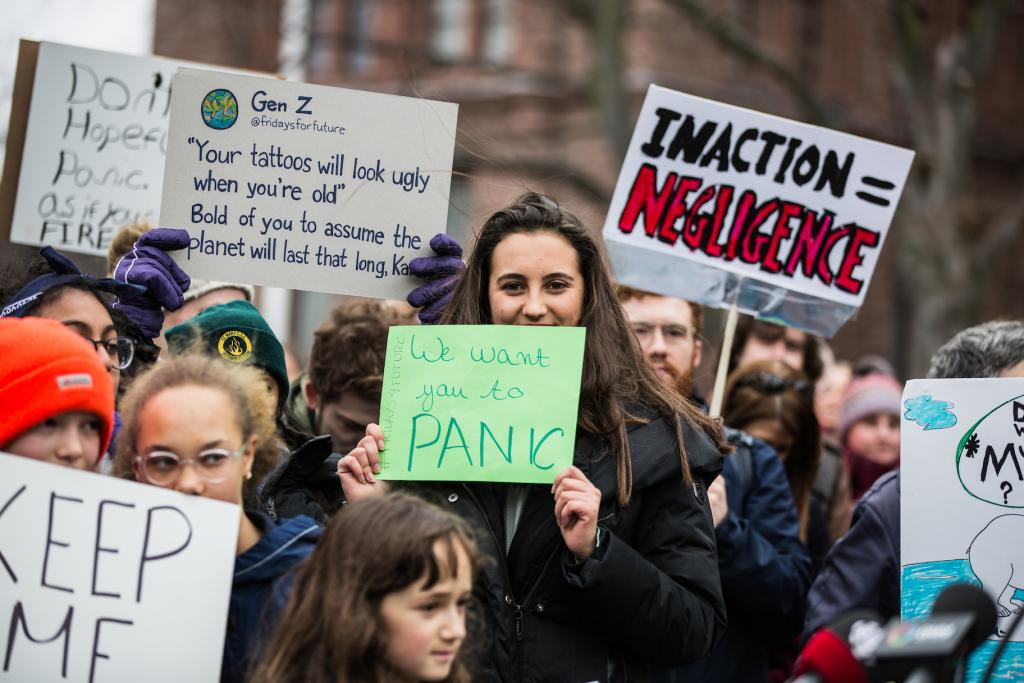
Alienor Rougeot at a Fridays For Future Toronto march in 2015
Aliénor Rougeot at a Fridays for Future Toronto climate strike in March 2019 / Photo by Dina Dong, CC BY 

VC: We have Budget 2021 coming up, and we know that the government's promise is CAD 100 billion in stimulus. What do you want to see coming out of that budget?

AR: Budget 2021 has to have something that your Green Strings report talks about—conditions when money is given to industry. We have to know that industry is not going to replicate the harm they did before. That money needs to go toward people, toward innovation, toward a recovery. It shouldn’t be redistributed as dividends.

And we want cohesion. I think our budgets have never been climate coherent. For example, the government has put a lot of money into pipelines, like Trans Mountain. And when you look at it from afar, it's not coherent.

VC: How do you think the government can better engage with and listen to youth on green recovery? What would that look like?

AR: You can have youth councils, youth delegates, but I think first we need an understanding that on the climate issue, treating youth as only youth might be a flaw, as we have more at stake. I'm a little bit afraid of the government seeing youth councils as junior partner councils. They shouldn’t treat it as a separate consultation, but more as “these are the main people we need to get to.”

The youth would like to be a part of a constant feedback process—instead of us needing to give unsolicited feedback in the streets.

A lot of youth are either afraid or disheartened. Afraid to say something that's going to sound unknowledgeable and so politicians aren't going to listen, or disheartened, because they feel like they've actually learned the material but haven't been listened to. We want to hear, “We understood your ideas, that makes sense. And you don't have to speak our lingo. We're the politicians—it's our job to speak your language.” Concretely, we would love to be invited into conversations early on, instead of being told at the end, “This is what’s going to happen. What do you think?” By then it’s too late.

VC: Organizations like IISD also have a role to play in elevating youth voices. What advice do you have for non-governmental organizations to better integrate the needs of youth in their recovery and climate change work?

AR: Non-governmental organizations, to me, are doing a good job when they specifically reach out and we figure out the best angle to work together. But we need to remember that every time a member of one community takes time to do something with your group, it takes time away from their community work.

Before you bring a group in, take the time to look at their content and learn about their priorities.

If you do want a Youth Advisory Board or something similar, simplify the process by making sure to give us a time commitment that is clear and then really respect that. Try to compensate when you can—it makes a big difference for students or people that do a lot of this work unpaid. And when we feel like the time we spend and the input we give is going somewhere, that's very positive, obviously.

VC: Who is your climate change hero and why?

AR: My heroes are the older people that decide to support us or similar groups. I really find it wonderful to have folks dedicate their retired free time to empowering youth. The ones that come in and say, “I'm here if you need, and these are the skills I have.” We have people helping us pick up supplies, because I don't have a car. We have people telling us, you know what, we'll be the liaison at a long City Hall meeting. Doing that work is heroic for me in a very simple way. It really makes you feel like you're not being abandoned with the burden of the climate crisis.

IISD in the news

Pandemic increased direct aid to fossil fuel producers, new study shows

A new report suggests the economic impact of the pandemic led to a massive increase in federal aid to Canada's oil patch.

But the annual inventory of fossil fuel subsidies published by the International Institute for Sustainable Development also highlights that almost all of the direct aid was paid out in two programs to protect jobs and cut greenhouse gas emissions.

February 25, 2021

IISD in the news details

Topic
Energy
Subsidies
Region
Canada
Impact area
Climate
Press release

Canada’s Federal Fossil Fuel Subsidies Jumped More than 200% from 2019 to 2020

New report finds federal subsidies to fossil fuels increased to $1.9 billion last year as government responds to the economic effects of the COVID-19 pandemic

February 25, 2021

February 25, 2021, Ottawa—Canada’s quantified federal fossil fuel subsidies rose to CAD 1.9 billion last year, marking a threefold increase since 2019, according to a new report from the International Institute for Sustainable Development (IISD). The findings indicate that this increase can be largely attributed to fossil fuel funding commitments made in COVID-19 recovery packages. 

“With the Canadian government expected to release its budget for the upcoming year in March, policy-makers need to carefully consider how to spend billions of stimulus dollars in a way that accelerates the transition away from fossil fuels and towards zero emissions while also protecting workers and communities,” says Vanessa Corkal of IISD, lead author of Federal Fossil Fuel Subsidies in Canada: COVID-19 edition. “How recovery funds are spent could make or break the success of Canada’s newly strengthened climate plan, and ultimately, our ability to ensure an equitable and climate-safe future.”

While some of the fossil fuel subsidies provided since the start of the pandemic aim to address environmental or employment-related issues, others do not. To achieve Canada’s climate targets, the report emphasizes that governments must phase out fossil fuel subsidies. 

The report also highlights the importance of applying green strings—clear environmental and social conditions—to all COVID-19 recovery measures. This must be coupled with increased transparency and accountability, experts say, noting that the CAD 1.9 billion total is incomplete since many fossil fuel subsidies are unquantifiable due to a lack of government data.

“The reported $1.9 billion in federal fossil fuel subsidies is only part of the picture in Canada since that figure doesn’t encompass the even higher total for subsidies extended at the provincial level,” says Philip Gass, Transitions Lead at IISD Energy. “The increase in fossil fuel support since the pandemic began is mirrored by some provinces as well, so the upward trend is consistent across different levels of government.”

As Canada reinforces its international climate commitments, the report offers policy-makers concrete steps to realize their promises and bridge the gap between words and action through subsidy reform. The government should avoid introducing new fossil fuel subsidies whenever possible, the report urges. 

The report calls for the federal government to develop a detailed roadmap for fossil fuel subsidy phaseout by 2025, complemented by strong just transition measures for fossil fuel workers and communities. Other actions recommended in the study include completing Canada’s overdue fossil fuel subsidies peer review with Argentina, phasing out public finance for fossil fuels including by aligning Export Development Canada’s policies with the country’s climate ambitions, and employing subsidy reform as a key emissions reduction tool in Canada’s next Nationally Determined Contribution to the Paris Agreement.

“Any serious plan to address the climate crisis must include a phase-out of subsidies and public finance for fossil fuels,” says Corkal. “Among G20 OECD member countries, Canada was recently ranked as the worst performer in terms of the scale of government support for oil and gas production. However, with the right policies and political will, a genuine turning point for Canada’s climate action is within reach.”

Report

Federal Fossil Fuel Subsidies in Canada: COVID-19 edition

Federal fossil fuel subsidies in Canada reached at least CAD 1.9 billion in 2020 in part due to responses to COVID-19.

February 25, 2021
  • In total, the Canadian government provided at least CAD 1.91 billion in fossil fuel subsidies in 2020, a jump of over 200% from 2019 levels.

  • While there are clear social and environmental elements of some of the subsidies provided since the onset of the pandemic, this cannot be said of all measures introduced.

  • Canada recently unveiled a strengthened climate plan to support its target of net-zero emissions by 2050. These new efforts must be accompanied by fossil fuel subsidy reform.

Federal fossil fuel subsidies in Canada reached at least CAD 1.9 billion in 2020 in part due to responses to COVID-19. This is a threefold increase compared to 2019.

The following are recommendations to government to phase out fossil fuel subsidies as Canada recovers from the impacts of COVID-19:

  • Commit to not introducing new subsidies for fossil fuels unless no other viable alternatives exist.
  • Transparently release information on quantified amounts of all federal fossil fuel subsidies and support.
  • Provide a public update on the G20 peer review of fossil fuel subsidies with Argentina and complete the review within the first half of 2021.
  • Develop and publish a roadmap to achieve Canada’s commitment to phase out inefficient fossil fuel subsidies by 2025.
  • Ensure that Export Development Canada’s policies align with Canada’s climate change and subsidy phase-out commitments.
  • Include fossil fuel subsidy reform as a key element of focus in Canada’s next Nationally Determined Contribution to the Paris Agreement.
  • Work with the provinces and territories to address fossil fuel subsidies at the subnational level.

Report details

Topic
Climate Change Mitigation
Energy
Subsidies
Region
Canada
Impact area
Climate
Publisher
IISD
Copyright
IISD, 2021
Brief

Recovery Through Reform: Assessing the climate compatibility of Canada's COVID-19 response in 2020

This brief focuses on 2020 fiscal commitments by the Canadian federal government in key energy-related sectors in the wake of the COVID-19 pandemic, drawing on data from the Energy Policy Tracker.

February 25, 2021
  • According to the Energy Policy Tracker, from March to December 2020, the federal government had committed at least CAD 14.7 billion to "clean" energy, compared to CAD 3.6 billion for "fossil" energy and CAD 4.7 billion for "other" energy.

  • Less transparent and available data is available for "fossil energy" commitments in Canada, making it significantly harder to track.

  • In 2020, government made significant announcements for building retrofits, electric vehicles, public transit, and more. However, some pledges are below best practices in other countries who are leading on green recovery, and trends in fossil fuel support are concerning.

Governments around the world are leveraging unprecedented amounts of capital to respond to the pandemic and bailing out struggling industries. Trends in energy-related spending indicate that despite the green push, the world’s largest economies have still favoured fossil energy over clean energy.

We evaluate energy-related spending in Canada in 2020 (since the onset of COVID-19), using data from the Energy Policy Tracker. Trends in Canada are then compared to flagship policies in key jurisdictions with recent progressive climate policy announcements, including France, Germany, and the United Kingdom. The brief ends with broad recommendations on how Canada can better align its recovery funding with climate action and fossil fuel subsidy reform.

This brief is one of three International Institute for Sustainable Development (IISD) policy briefs in its Recovery Through Reform series, which assesses how efforts to achieve a green recovery from COVID-19 in Canada rely on—and can contribute to—fossil fuel subsidy reform.

Brief details

Topic
Climate Change Mitigation
Energy
Subsidies
Region
Canada
Impact area
Climate
Publisher
IISD
Copyright
IISD, 2021
Brief

Recovery Through Reform: Advancing a hydrogen economy while minimizing fossil fuel subsidies

This brief explores recent momentum on hydrogen and evaluates potential implications for subsidies for fossil fuel-based hydrogen given the government's commitments on fossil fuel subsidies.

February 25, 2021
  • There is a risk that new blue hydrogen projects may, by 2030, be at a competitive disadvantage, at least from that point forward.

  • Funding for carbon capture projects already represents a significant source of fossil fuel subsidies in Canadian jurisdictions.

  • Given Canada's commitment to phasing out inefficient fossil fuel subsidies and reach net-zero by 2050, and the need to rapidly transition to clean energy, a very high bar must be set to justify subsidies for blue hydrogen.

Spending on hydrogen has the potential to significantly influence the direction taken by the world’s energy systems. In December 2020, Canada unveiled a national hydrogen strategy following the announcement of a strengthened climate plan. The strategy emphasized both blue and green hydrogen. As the government considers whether to provide subsidies for hydrogen, we recommend government:

  • Ensure that any subsidies for hydrogen are in line with the government’s commitments to phase out inefficient fossil fuel subsidies by 2025 and meet net-zero by 2050.
  • Thoroughly evaluate the potential efficiency of subsidies for hydrogen against robust social, environmental, and economic criteria. • Improve transparency by publicly reporting on direct spending and tax expenditures for hydrogen production.
  • Follow international best practices being set by Canada’s peers. For example, Germany and Spain have laid out hydrogen strategies prioritizing green hydrogen.

Based on IISD's analysis, subsidies for hydrogen based on natural gas without significant levels of carbon capture and storage (CCS) should not be eligible for government assistance. Subsidies for blue hydrogen should only occur if blue hydrogen can meet the same level of environmental performance (including emission intensity) and is at or below the cost of green hydrogen.

This brief is one of three International Institute for Sustainable Development (IISD) policy briefs in its Recovery Through Reform series, which assesses how efforts to achieve a green recovery from COVID-19 in Canada rely on—and can contribute to—fossil fuel subsidy reform.

Brief details

Topic
Climate Change Mitigation
Energy
Subsidies
Region
Canada
Impact area
Climate
Publisher
IISD
Copyright
IISD, 2021
Brief

Recovery Through Reform: Export Development Canada's role in fossil fuel subsidy reform

This brief explores Export Development Canada's history in providing fossil fuel subsidies and support, examines its current role in the COVID-19 response, and proposes concrete actions to ensure future spending is aligned with the low-carbon transition Canadians need and expect.

February 25, 2021
  • Export Development Canada, a Crown corporation, provides an average of over CAD 13.2 billion in support for oil and gas every year, representing over 12% of finance committed by the institution.

  • EDC's support for fossil fuels significantly outpaces its support for cleaner options.

  • There is a lack of transparency regarding how EDC screens potential clients for social and environmental risks, including climate change.

Canada’s export credit agency, Export Development Canada (EDC), has been a primary vehicle for supports to businesses in the wake of the COVID-19 pandemic. As the federal government continues to plan for economic recovery and provision of stimulus, EDC’s role will be key. However, EDC also has a troubling history of providing public finance for fossil fuels, both domestically and abroad. To better leverage EDC's role in green recovery, Canada should:

  • Draw inspiration from—and match the ambition of—leading public finance institutions that are restricting investments in fossil fuels.
  • Improve EDC's internal climate policy and targets to align with Canada's net-zero goals.
  • Apply "green strings" to finance provided through EDC, including financial conditions, requirements for companies to have net-zero plans, and transparency on spending.

This brief is one of three International Institute for Sustainable Development (IISD) policy briefs in its Recovery Through Reform series, which assesses how efforts to achieve a green recovery from COVID-19 in Canada rely on—and can contribute to—fossil fuel subsidy reform.

Brief details

Topic
Climate Change Mitigation
Energy
Just Transition
Subsidies
Region
Canada
Impact area
Climate
Publisher
IISD
Copyright
IISD, 2021
Report

Climate Action in Agriculture Policy Around the World

How does Canada stack up when it comes to climate policy in agriculture? While the nation has made important strides in allocating climate-related funding for agriculture in its updated climate plan, it remains far behind global peers.

February 22, 2021

Around the world, countries are pledging significant funding to tackle greenhouse gas emissions and build resilience through more sustainable agriculture systems.

Many countries that were already rolling out sustainable agriculture policies pre-pandemic have doubled down on these investments, acknowledging that supporting farmers to tackle the climate crisis while producing good food is a critical part of "building back better." Others have announced new roadmaps in recent months.

The countries that are most advanced in climate policy in agriculture now have clear targets, comprehensive strategies, and recognize that climate-friendly agriculture can be a pillar for both economic recovery and for addressing the climate and biodiversity crises.

Report details

Topic
Food and Agriculture
Climate Change Mitigation
Climate Change Adaptation
Region
Global
Canada
Project
Farmers for Climate Solutions Task Force
Impact area
Climate
Nature
Publisher
Farmers for Climate Solutions
Copyright
Farmers for Climate Solutions, 2021