Insight

Leveraging the Linkages: How human rights data can advance SDG monitoring

To create opportunities for synergies between the "leave no one behind" principle and the "realize human rights for all" principle in implementation and improved monitoring, there is a need to properly leverage data and legal mechanisms. 

May 13, 2022

The 2030 Agenda principle to “leave no one behind” is closely tied to another principle: to realize human rights for all. By properly leveraging data and legal mechanisms, this close relationship creates opportunities for synergies in implementation and improved monitoring.       

The Universal Declaration of Human Rights and other core human rights instruments identify basic human needs that must be respected for everyone, everywhere, always. Realizing and protecting human rights are prerequisites for progress on many of the Sustainable Development Goals (SDGs). Data that has been collected to track developments in human rights implementation also yields important insights on progress toward related SDGs and can be used to complement other data sources for SDG monitoring. Moreover, legal overlaps could mean states can be held accountable for SDG implementation if they are linked to relevant human rights mechanisms where states have obligations under international human rights law.  

Linkages Between Human Rights and the SDGs  

Trends in human rights monitoring illuminate some of the benefits of linking data on human rights and the SDGs. According to a recent study conducted by Steven L. B. Jensen of the Danish Institute for Human Rights (DIHR), key UN human rights bodies are increasingly referencing the SDGs in their recommendations. There is strong motivation for this shift: human rights monitoring mechanisms consider the 2030 Agenda an opportunity to further realize human rights for all. As SDG monitoring is bolstered and expands in frequency and reach, states will receive feedback from the international community as progress is continually assessed at every step of the way regarding not only the SDGs, but on human rights as well.  

The connection between the SDGs and human rights is mutually reinforcing. As states have obligations under international human rights law, they can be held accountable for SDG implementation if these are linked to relevant human rights mechanisms. Linking up data on the SDGs, which are non-binding in nature, with data on international human rights and labour standards ensures SDG implementation increases the respect, protection, and fulfilment of human rights since these two concepts are deeply intertwined. Human rights linkages could also strengthen the ability of the annual UN High-level Political Forum on Sustainable Development (HLPF) to ensure accountability from governments to their SDG commitments (Feiring & König-Reis, 2020).  

International human rights mechanisms can advance the SDGs at the national level as well: their recommendations can help identify priority areas for individual countries’ SDG action plans, indicate the marginalized groups that require additional support, and suggest concrete measures to combat exclusion and discrimination.  

Scope of Human Rights Data for SDG Monitoring 

The SDG-Human Rights Data Explorer created by DIHR shows the extent of the opportunity to complement SDG monitoring with human rights data. The online tool uses artificial intelligence to evaluate monitoring information from international human rights mechanisms and maps their recommendations and observations to relevant SDGs and targets. Users can explore how recommendations from human rights monitoring bodies, such as the Universal Periodic Review (UPR), relate to the implementation of each SDG and the 169 targets around the globe.  

At present, the database allows users to explore 145,000 recommendations from 67 mechanisms across the international human rights system. Over half of these recommendations are directly linked to specific SDG targets, and therefore immediately relevant for national SDG implementation. (DIHR, n.d.). For example, following the third UPR cycle in 2018, it was recommended that Canada “continue to strengthen protection of the rights of Indigenous women and girls against violence, in particular by systematically conducting investigations and ensuring the collection and dissemination of data on violence against Indigenous women.” The tool linked this recommendation to SDG targets 17.18 (capacity building for disaggregated data) and 5.2 (end all forms of violence against women and girls). Although target 17.18 is aimed at developing countries, the need to increase Canada’s data collection capacity on the issues faced by Indigenous Peoples, especially women, is emphasized.  

For any country, knowing which SDG targets matter from a human rights perspective can boost political momentum for increased action.

A second tool developed by DIHR, The Human Rights Guide to the Sustainable Development Goals, allows users to determine which international human rights mechanisms have direct applications for each of the SDG targets. A simple example is to look at SDG 11 (Sustainable Cities and Communities) and contrast it with the Convention on the Elimination of All Forms of Discrimination Against Women (CEDAW). In total, five articles within the text are connected to six different SDG targets only relating to SDG 11. The data organized by this tool is immense and shows the strong connection between international human rights tools and the SDGs, considering more than 92% of the 169 SDG targets have a direct link to international human rights mechanisms, labour standards, and environmental agreements. 

A Look at Canada’s Human Rights Recommendations 

The SDG-Human Rights Data Explorer developed by the DIHR maps 145,000 human rights recommendations from 67 international human rights instruments to the SDGs. A search on recommendations addressing Canada shows that human rights issues in Canada most often relate to SDG 16 (peace, justice, and strong institutions), SDG 10 (reduced inequalities), and SDG 5 (gender equality). 
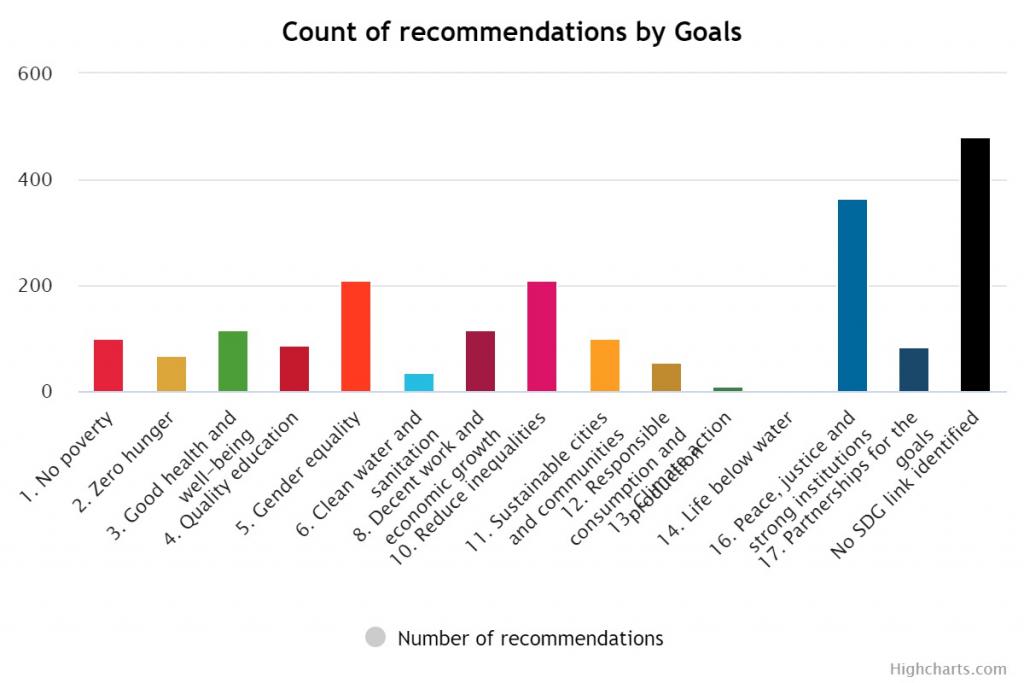
Count of human rights recommendations by SDG goals
Figure 1. Count of Canada’s human rights recommendations by SDGs (Source: SDG - Human Rights Data Explorer, The Danish Human Rights Institute)

The database also allows searching for recommendations that relate to specific rightholder groups. For Canada, human rights recommendations most often address Indigenous Peoples, women and girls, and children. This can be used as an indication of the groups most affected by human rights issues in Canada. 
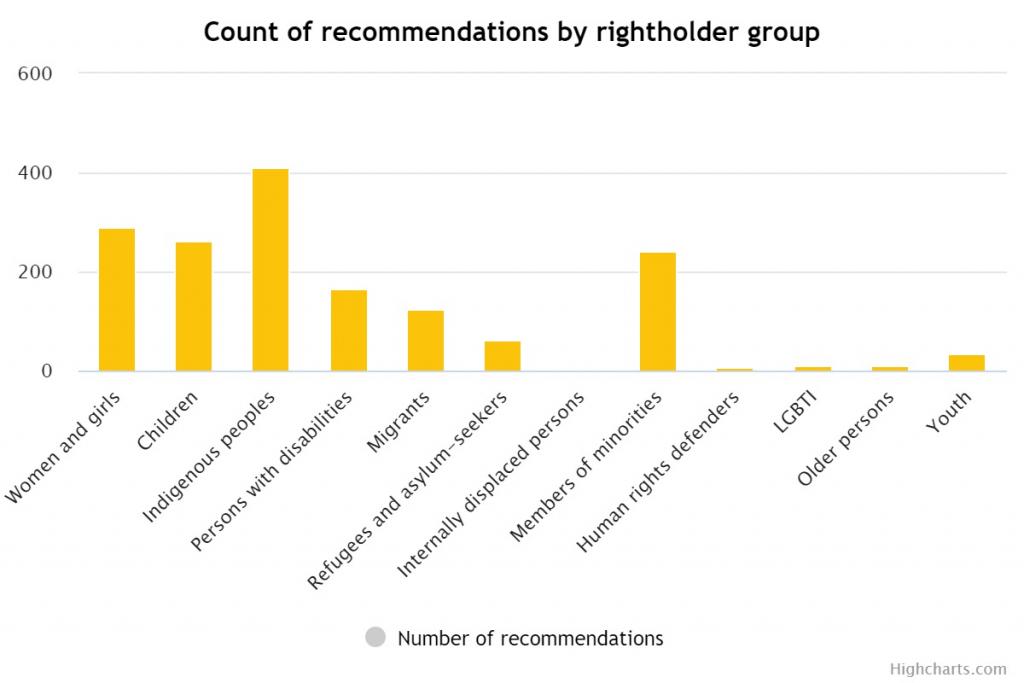
Count of human rights recommendations by rightsholder group
Figure 2. Count of Canada’s human rights recommendations by rightholder group (Source: SDG - Human Rights Data Explorer, The Danish Human Rights Institute)

Digging deeper, a search focusing on recommendations relating to the human rights of Indigenous Peoples reveals the SDG targets most often addressed relate to: 

  • SDG target 10.3 (ensure equal opportunities and end discrimination) 
  • SDG target 5.2 (end all forms of violence against women and girls) 
  • SDG target 16.7 (responsive, inclusive, and representative decision-making)  
  • SDG target 16.3 (promote the rule of law and access to justice for all). 
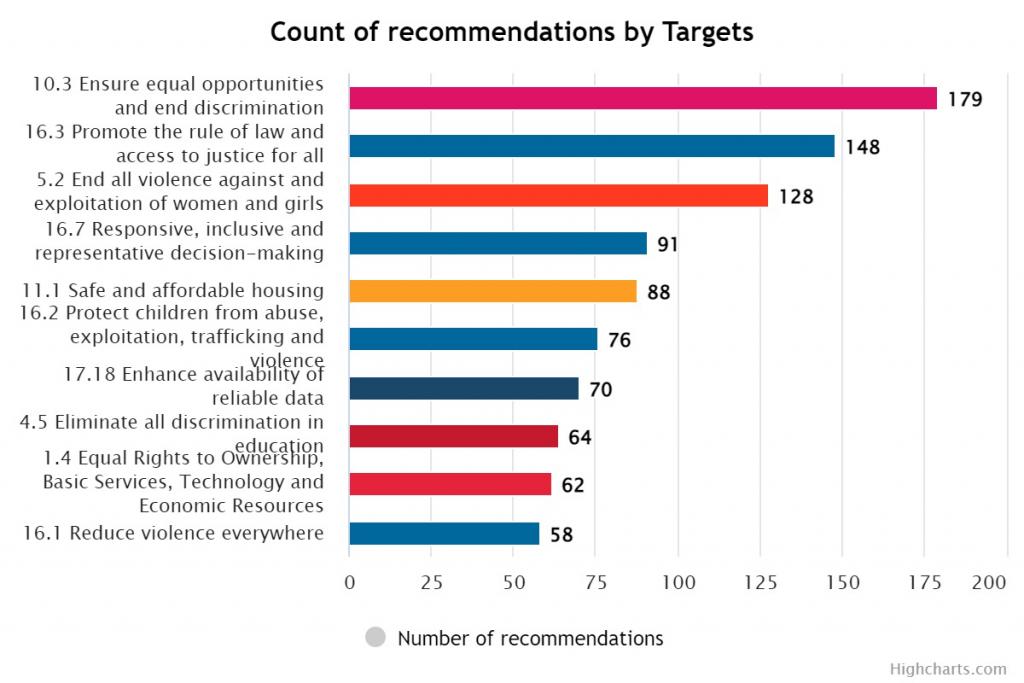
Count of human rights recommendations by SDG Targets
Figure 3. Count of Canada’s human rights recommendations by targets (Source: SDG - Human Rights Data Explorer, The Danish Human Rights Institute)

This initial analysis facilitated by the DIHR tools reveals a strong link between safeguarding human rights for Indigenous Peoples, particularly Indigenous women and children, and progress on SDGs 5, 10, and 16 in Canada. Addressing the human rights obligations relating to discrimination of Indigenous Peoples and violence against Indigenous women and girls, would directly impact Canada’s performance on these SDGs.  

Taking a wider perspective, data on human rights recommendations underline the importance for Canada to address its colonial legacy. Reconciliation could be one of the most effective ways for Canada to make progress on many SDGs. Analyzing the content of the recommendations identified through the SDG-Human Rights Data Explorer provides insights into the need for SDG planning, implementation, and measurement to reflect the dimensions of reconciliation; these have clear impacts on Canada’s progress toward the SDGs.  

The Role of National Human Rights Institutions 

For any country, knowing which SDG targets matter from a human rights perspective can boost political momentum for increased action. It can also illuminate related aspects that should be monitored during implementation, as demonstrated in the case study above. In practice, this means building on the existing monitoring mandates of National Human Rights Institutions (NHRIs) to highlight SDG links in their work and to utilize the human rights monitoring mechanisms as an avenue to also review progress on the SDGs (Feiring & König-Reis, 2020).  

Nearly 50% of existing SDG indicators produce data that is directly relevant to the monitoring of human rights instruments. NHRIs are sure to find significant benefits from engaging with the SDGhuman rights relationship. 

Integrating Human Rights Data in SDG Monitoring  

An obvious recommendation arising from this discussion is to encourage closer collaboration between NHRIs and national statistics offices in SDG monitoring. But this is not a simple task.  

Much of the data collected by NHRIs stem from complaints about human rights violations and the investigations and legal pursuits that may follow. Such data are sensitive, and careful processing is needed to publish them safely. Interpreting these data may be difficult as they often refer to specific groups or situations, making analysis and generalization tricky.  

Nonetheless, examples from other countries suggest the effort is worthwhile. For example, Feiring showed a set of SDG targets addressing discriminatory legal frameworks and policies, inclusion, and policy coherenceSDG target 5.c, SDG target 10.2, SDG target 10.3, SDG target 10.4, SDG target 16.b, and SDG target 17.14can all be measured by a single indicator on the number of countries that have ratified and implemented international conventions on equality and non-discrimination. 

International collaboration can be another way to move forward. In Europe, the NHRIs of 40 countries have formed a network to enhance the promotion and protection of human rights across the region. Members have developed joint guides on topics such as measuring poverty reduction and advancing SDG 16 and benefit from frequent exchanges on evolving practices.  

Finally, the Government of Canada could establish a process or body dedicated to measuring reconciliation progress in the context of the SDGs. Such an initiative would bring together the data experts of Statistics Canada, the human rights experts of Canada’s Commission on Human Rights, and most importantly the Indigenous Peoples whose rights must be established and protected to make progress on key SDGs in Canada. Such an initiative would establish accountability around the Government’s commitment to prioritize reconciliation and, with some investment, provide an appropriate framework to measure progress toward this goal.  

Insight

Who Is Being Left Behind in Canada?

Achieving the principle of leaving no one behind implies that implementation should start with those furthest behind, and adequate monitoring must be in place to ensure the well-being of marginalized groups improves—and no new groups are harmed.

May 13, 2022

The 2030 Agenda and the Sustainable Development Goals (SDGs) place a special emphasis on ensuring no one is left behind in implementation, meaning the SDGs must be realized for all people in all places. Achieving this principle implies that implementation should start with those furthest behind, and adequate monitoring must be in place to ensure the well-being of marginalized groups improves—and no new groups are harmed. 

But who is being left behind in Canada? A prerequisite for action is clearly identifying those at risk of being left behind so their progress in achieving the SDGs can be monitored. 

In 2019, with the support of the Canadian government, IISD investigated who is being left behind in the country. Our team looked at available data sources to identify who is being marginalized, how marginalization happens, and how government interventions may be helping. We looked at measurement challenges with respect to marginalization in Canada and surveyed emerging international practices on measuring—and ultimately addressing—the situation and needs of those being left behind.  

Members of First Nations, Métis, and Inuit groups are not only more likely to be poor and to suffer from food insecurity in Canada, they also experience health inequalities that reduce their life expectancy.

The COVID-19 crisis has pushed many of these groups even further behind, often adding new pressures to existing factors of marginalization. In their study of household food insecurity, Tarasuk and Mitchell found that in 20172018, one in eight people living in Canada experienced food insecurity. Observers expect the pandemic shifted this number to one in seven Canadians. 

Before the pandemic, recent immigrants were three times more likely than average Canadians to be poor. The situation was even worse for newcomers who are lone parents or older than 65 years. Recent immigrants were among the groups most at risk of contracting COVID-19 because they often worked in jobs where social distancing was challenging and because of inadequate living conditions.  

COVID-19 has also severely impacted the health and economic well-being of people with disabilities. More people with permanent conditions reported losing their job during the pandemic and being affected by economic hardship than other Canadians. They also struggled to buy food, groceries, and masks. Even before the pandemic, people with disabilities were poorer and had lower levels of education than other Canadians.  

Members of First Nations, Métis, and Inuit groups are not only more likely to be poor and to suffer from food insecurity in Canada, they also experience health inequalities that reduce their life expectancy. Data on the early stage of COVID-19 confirm these inequities. A survey from Manitoba showed in 2020 Indigenous Peoples, who represented 13% of Manitoba’s population, accounted for 17% of provincial COVID-19 infections. Data from Ontario showed that racialized groups had a 1.7-to-7.1-fold higher rate of COVID infection and a 1.7-to-9.1-fold higher rate of COVID-19 hospitalization compared to white Ontarians.  

As these examples show, it is vital for countries to identify and measure the factors that marginalize people and push them behind. Marginalization puts people at disproportionate health, social, and economic risks when a disaster strikes—such as a pandemic or a major climate change impact.  

Our research also shows that, while Canada is a data-rich country, official statistics often do not reflect the diverse factors that contribute to marginalization. We found three distinct measurement challenges to inclusive SDG monitoring in Canada. 

First, it is difficult to capture all dimensions of marginalization appropriately in data. Some groups, such as homeless people or members of First Nations living on reserve, are difficult to include in large-scale surveys that use household addresses to identify respondents. Many of these groups remained invisible during the pandemic, and we lack essential information on how their well-being has been affected by COVID, social distancing, and the repeated lockdowns.  

Second, data alone cannot adequately reflect differences in perceptions, values, and priorities that shape the needs of marginalized groups and the actions needed to improve their situation. Different marginalized groups may feel equally poor but for different reasons. If these reasons are not captured, response measures will likely miss their mark. Most attempts to measure COVID-19 impact focus on how the pandemic has affected people’s health and their economic situation. We know far less about how the loss of social contacts affects groups with different cultures and how the inability to gather has disrupted their lives.  

Third, we learned that because of the need to reflect different perceptions, values, and priorities, ownership over data matters. To adequately communicate the situation of marginalized groups in a respectful and unbiased way, these groups must have control over the data used to describe them. This empowers communities to tell their own story of marginalization, which is important both for decision-makers designing interventions as well as for community members stimulating engagement. The OCAP principles (Ownership, Control, Access, and Possession) developed by the First Nations Information Governance Centre embody these findings and provide a starting point for the respectful use of data describing First Nations groups.  

Based on the findings of our original study, we recommended developing a complementary, bottom-up measurement approach where local communities and organizations working with vulnerable groups participate in gathering, governing, and using data to measure the state of their well-being in the SDG context. 

In the second phase of this work, we aim to lay the groundwork for such a participatory approach by reaching out to marginalized groups to learn what data they collect in their work, what data they need to support the groups they work with, and how data can be used in a respectful manner to describe the needs of marginalized groups.  

The past 24 months have delivered powerful reminders of how important it is to collect and use the right data to understand the impacts of a global pandemic on people. At the same time, the demonstrations sparked by the violent murder of George Floyd are raising awareness of how systemic racism and institutionalized inequalities continue to hold back marginalized groups. And as we are writing these words, the ongoing horrific discoveries of the victims of Canada’s residential school system remind us that some causes of marginalization cannot be captured in data.  

We recognize the societal discourse on marginalization is rapidly evolving and so is the language we use to frame the problem and its solutions. In our first report, we referred to specific groups as broadly "vulnerable." Using the phrase “vulnerable groups” has been increasingly critiqued for, at best, being vague, and at worst, further reproducing stereotypes and inequalities. In their study of inclusion, Hayes and Carria find using the phrase “vulnerable groups'' risks greater omission and exclusion of the people that projects like ours are intending to serve. Instead, researchers and practitioners recommend using the term “marginalized,” and to be specific about which groups one is referring to. We will continue to educate ourselves on evolving language to address structural inequality. 

We cannot approach the need for more inclusive and respectful monitoring of the well-being of marginalized groups in Canada with the expectation for fast answers. Rather, we seek to learn how to ask the right questions.  

Insight

Funding for Fossil Fuels Could Derail Canada's New Plan to Reduce Emissions

May 4, 2022

The following paragraphs are from an op-ed originally published in The Hill Times on May 4, 2022, and are reprinted below with permission. The full op-ed is available at The Hill Times' website.

Canadian climate news this past month has been a bit of a rollercoaster.

Just over a month ago, the federal government released the 2030 Emissions Reduction Plan, the most comprehensive Canadian climate plan to date, and the 2022 budget, scarcely a week apart. That same week the urgent call of the world’s top scientists reached a fever pitch with the latest IPCC report charting the narrow pathways available for action to avoid irreversible climate change impacts. Meanwhile, on the eve of the budget release came the federal approval of Bay du Nord, Norwegian oil company Equinor’s deep water drilling project off the coast of Newfoundland which has the potential to produce up to 300 million barrels of fossil fuel resources.

The government aims to use their recent climate plan and budget as the basis to tackle climate change over the next few critical years. However, subsidies to the fossil fuel industry and new production projects threaten to undermine progress towards climate goals. 

Read the full op-ed at The Hill Times.

Insight details

IISD in the news

Time for Manitoba to take greater action to fight climate change, expert says

Manitoba is well-positioned to combat climate change — so it's time to stop "sitting on our laurels" and take greater action, according to an international think tank leader.

April 29, 2022

IISD in the news details

IISD in the news

Undergraduate student aids in study on environmental impact of pipelines

When asked about his interest in participating in an upcoming project in northwestern Ontario’s The International Institute for Sustainable Development (IISD) Experimental Lakes Area (ELA), Dr. Caleb Hasler not only leapt at the opportunity, but saw it as a chance to include an undergraduate student in important research into the environmental impacts of pipeline projects.

April 26, 2022

IISD in the news details

Topic
Water
Region
Canada
Project
IISD Experimental Lakes Area
Impact area
Nature
IISD in the news

Trevor Hancock: B.C. government's LNG infatuation makes it dangerously radical

The Sierra Club B.C. announced in February that it is ­taking the provincial government to court “for failing to present plans to achieve several key climate targets, as required by its own climate change legislation.”

April 24, 2022

IISD in the news details

IISD in the news

Rickford reflects on Ontario re-investing in Experimental Lakes Area

The IISD-Experimental Lakes Area just west of Kenora is relishing following a $9.5 million provincial investment made last week. The funds will go towards supporting much-needed vital research and having secure and stable funding to help the ELA become more financially self-sufficient.

April 20, 2022

IISD in the news details

Topic
Water
Region
Canada
Project
IISD Experimental Lakes Area
Impact area
Nature
Report

A Value on the Priceless: Ecological goods and services generated in the Seal River Watershed

This report assesses the economic value of ecosystem benefits provided by the Seal River Watershed, a large pristine region located in Northern Manitoba, Canada. The Seal River Watershed is not impacted by dams, industrial development, or forestry. It maintains clean water, is home to abundant wildlife, and supports the livelihoods and culture of Dene, Cree, and Inuit people. To stop and reverse global biodiversity loss and limit climate warming, it is critical to protect the world's last remaining intact regions like the Seal River Watershed.

April 18, 2022
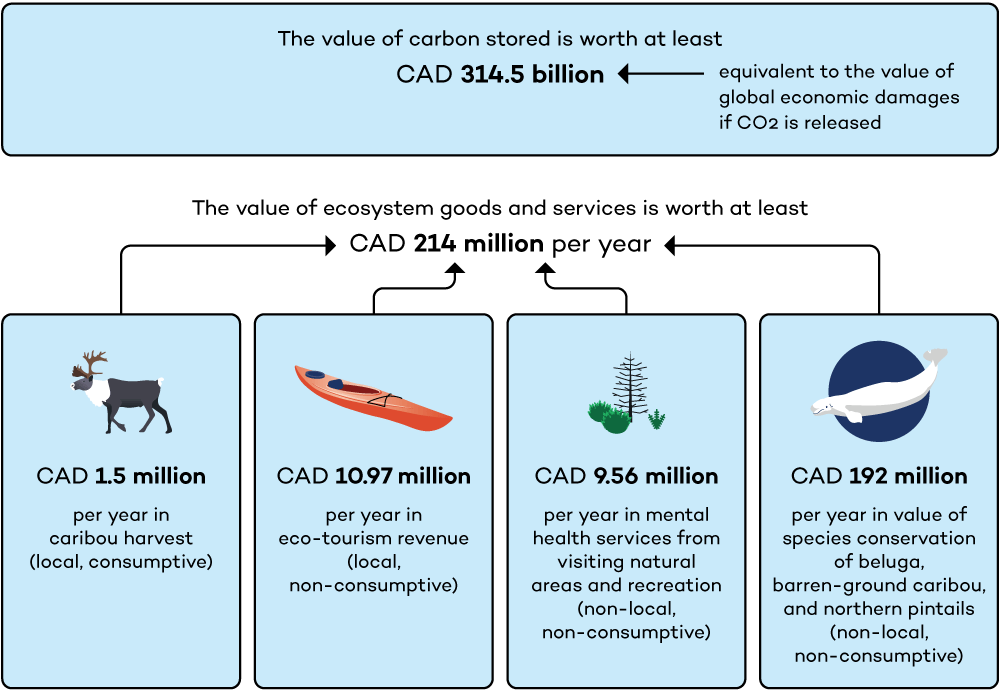
  • The Seal River Watershed provides at minimum CAD 214 million worth of ecosystem goods and services annually.

  • The importance and value of ecosystem goods and services provided by the Seal River Watershed will increase as we are faced with the global decline of intact forest ecosystems and the global decline in biodiversity, which reinforces the need for its protection.

  • A fully functioning, ecologically intact watershed that is sustainably managed and monitored by Indigenous stewards will help contribute to our action on climate mitigation, resiliency, and biodiversity conservation.

Articulating the values of intact regions in monetary terms is one way to demonstrate how they benefit local and global communities. Economic valuations inform decision-makers and help strengthen the case for conservation. They also identify data and monitoring needs.

The International Institute for Sustainable Development partnered with the Seal River Watershed Alliance and the Canadian Parks and Wilderness Society Manitoba Chapter in a project to assess the economic value of ecosystem benefits provided by the Seal River Watershed.

Our study found that in the Seal River Watershed:

The value of carbon stored and annual flow of EGS, CAD 2020 Seal River Watershed

This is a partial valuation based on the available data and economic valuation methods. Efforts are already underway to protect the entire watershed as an Indigenous Protected Area (IPA) led by the Sayisi Dene First Nation and supported by the Cree, Dene, and Inuit neighbours. The IPA model allows local Indigenous communities to chart their own path for the stewardship of the Seal River Watershed based on local and Traditional Knowledge and sustain the watershed’s people, culture, and animals into the future. Protecting the Seal River Watershed would add 0.5% to Canada’s protected areas targets.

Report details

Topic
Climate Change Adaptation
Climate Change Mitigation
Water
Region
Canada
Impact area
Climate
Nature
Publisher
IISD
Copyright
IISD, 2022
IISD in the news

Ontario Invests in Experimental Lakes

"The Experimental Lakes Area is the world’s most important freshwater research facility," said Greg Rickford, Minister of Northern Development, Mines, Natural Resources and Forestry. "The area is a living laboratory for critical research and scientific study that sustains healthy ecosystems for future generations. Our government is proud to invest in facilities such as these so that we can expand understanding of the critical changes in ecology over time, and continue our work building Ontario."

April 14, 2022

IISD in the news details

Topic
Water
Region
Canada
Project
IISD Experimental Lakes Area
Impact area
Nature
Brief

IGF Case Study: Regulatory Continuous Improvement

Lessons from British Columbia's new statutory audit function's application to mine tailings facilities

This IGF case study describes the new audit function to evaluate the effectiveness of the mining regulatory framework in British Columbia.

April 13, 2022

The purpose of this publication is to describe this new auditing function within the Ministry of Energy, Mines and Low Carbon Innovation in the Canadian province of British Columbia (BC).

The authors detail its development, implementation, and preliminary lessons learned from the first audit, to provide an example to other jurisdictions that are looking at their own efforts for more effective regulatory frameworks.

This case study provides the context for Audit Unit development as informed by lessons learned from the 2014 Mount Polley Tailings Storage Facility breach, a 2016 audit by BC’s Auditor General, and substantial research and engagement. These events informed dramatic changes to the Ministry's structure and the creation of several new work units.

Brief details

Topic
Mining
Region
Canada
Project
The Intergovernmental Forum on Mining, Minerals, Metals and Sustainable Development (IGF)
Impact area
Nature
Publisher
IISD
Copyright
IISD, 2022