Exhibition

Launch of the Winnipeg River Adaptive Monitoring Project

Want to discover how Manitoba is leading the charge when it comes to remotely monitoring whole watersheds to protect our precious freshwater supplies?

June 24, 2022 10:30 am - 12:00 pm Central

1 Vanier Avenue, Pinawa, MB R0E 1L0

(Open to public)

Join Aquatic Life and the International Institute for Sustainable Development (IISD) for a launch of the Winnipeg River Adaptive Monitoring Project.
 
You will discover how we can continuously monitor the health of the Winnipeg River from the comfort of our desks, thanks to remote sensors—and how we can expand this project, with YOUR help.

WHERE: 1 Vanier Avenue, Pinawa
WHEN: Friday, June 24 (10:30 a.m.–12:00 p.m.)
 
From 10:30 a.m., join us for mingling and light refreshments.
At 11:00 a.m., hear from the experts at Aquatic Life and IISD, as well as invited dignitaries.
At 11:30 a.m., get your hands dirty as we show you the technology and data firsthand.
Then join us at noon for a light lunch.

Please RSVP to Donna Laroque at [email protected].

Parking is available close by on Willis Drive and in front of the Pinawa Heritage Sundial.

Webinar

Notes From the Field: IISD-ELA celebrates its 2022 season

IISD Experimental Lakes Area is truly the world’s freshwater laboratory.

June 24, 2022 12:00 pm - 1:00 pm Central

(Open to public)

And as we celebrate our 2022 research season—the biggest one since the pandemic started—we want to share some notes from the field, from across the planet.

Watch videos from Vanuatu, hear notes from North Carolina, and read postcards from Phnom Penh*—from our collaborators excited to share what they’re going to be getting up to at IISD Experimental Lakes Area during its 54th research season.

*Disclaimer: These almost certainly won’t be the places you’ll be hearing from.

Join us on Friday, June 24, 2022 at 12:00 p.m. (CST)

SIGN UP HERE


Ad for IISD ELA event

Statement

IISD President and CEO Wins Visionary Leadership Award for HR Excellence

June 2, 2022

The International Institute for Sustainable Development (IISD) is pleased to announce that its president and CEO, Richard Florizone, won a Visionary Leadership Award from the Chartered Professionals in Human Resources (CPHR) Manitoba, presented at its annual HR Excellence Awards ceremony this week.

The prize recognizes executives outside of the human resources field who endorse, support, or champion the HR function within their organization.

IISD was also recognized as a finalist in two other categories: The Impact Award, for our innovative talent attraction strategies, in particular through the new Employer on Record model; and the Leadership Award, which recognizes individuals who are a trusted resource at their organization, advancing corporate objectives, setting policy, and supporting sound governance—IISD’s Director of Talent and Culture, Anumeha Baldner, was nominated for this.

"Without Richard’s unwavering support, along with his steady encouragement and collaborative spirit, the Human Resources team at IISD would not have been able to achieve as much as we did this year," says Baldner. "We are fortunate to have worked under his inspiring leadership."

"This truly is a tribute to Anu’s talent and vision," says Florizone, "along with IISD’s senior management team, who have worked hard together over the past year and a half to ensure our staff and associates were supported during the COVID-19 pandemic."

Statement details

Region
Canada
Impact area
International Governance
Insight

Citizen-Generated Data: Data by people, for people

Investments in a rich data ecosystem that supports citizen-generated data alongside official data sources empowers marginalized groups, provides a holistic understanding of marginalization, and supports inclusive decision-making to ensure that no one is left behind in SDG implementation. 

May 24, 2022

A key challenge in following through on the 2030 Agenda’s principle to address the needs of those who have been left behind is that their perspectives and values are not adequately reflected in official data collected by national statistical offices. People who have been left behind also suffer from data marginalization, with some groups being outright invisible in national statistics. Citizen-generated data can complement official data and provide important context for decision-makers. Investments in a rich data ecosystem that supports citizen-generated data alongside official data sources empower marginalized groups, provide a holistic understanding of marginalization, and support inclusive decision making to ensure that no one is left behind in SDG implementation. 

What is citizen-generated data? 

Put simply, citizen-generated data is “data generated by people, for people,” meaning that the individuals who stand to benefit from data collection are directly involved in the design, collection, analysis, and use of data that describes them. The CIVICUS DataShift program defines citizen-generated data as data that “people or their organizations produce to directly monitor, demand, or drive change on issues that affect them. It is actively given by citizens, providing direct representations of their perspectives and an alternative to datasets collected by governments or international institutions.”

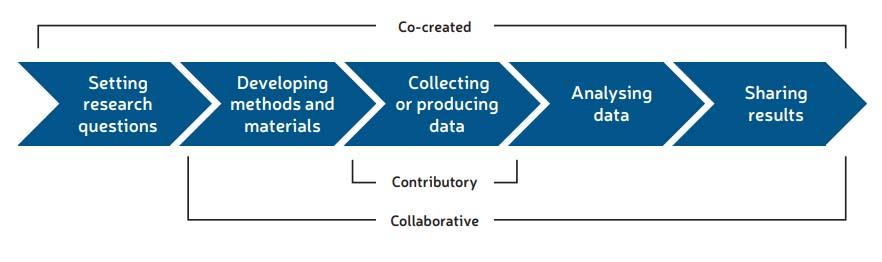
Citizen-generated data includes a wide variety of approaches and methods. Depending on the purpose at hand, the term is used interchangeably with concepts like citizen science, community-driven data, or participatory data. All of these terms represent people taking an active role in one or several stages of the data value chain, from identifying questions and objectives to developing methods, collecting data, and analyzing and disseminating the results.  

stages of engagement in citizen science projects
Figure 1. Stages of engagement in citizen science projects (Source: Shirk et al., 2012)

In their 2012 study, Shirk et al. distinguish between contributory, collaborative, and co-created data depending on the extent of citizen engagement at different stages. Other forms of partial engagement are also possible; for example, consultations to determine the analysis and interpretation of data sets collected by official sources provide people with the opportunity to influence and correct the messages that are transported through the data in question.   

Why is citizen-generated data needed? 

The UN University Institute on Computing and Society identifies five types of data marginalization that can exclude the voices of marginalized groups in data collection and decision making. Like the factors causing marginalization, the factors of data exclusion can intersect so that a group's voice is missing from official data sets for multiple reasons. 

 
Unknown voices Population groups that are unknown to the institutions collecting data. These groups include isolated and untouched communities; modern-day enslaved people, such as victims of forced labour, human trafficking, and sex slaves; and individuals concealing themselves because they are illegal immigrants, afraid of losing assistance, or involved in criminal activities. 
Silent voices People unable to participate in data collection or other activities through which their concerns could be heard. While their objective well-being can be documented, their lived experience remains hidden. Silent voices include people who are weak and vulnerable because of socio-economic status or old age, persons with disabilities, and children.
Muted voices Population groups that are marginalized because of social norms, societal values, and social practices. Information about their well-being is being suppressed through structural means like missing questions and categories in questionnaires or active exclusion from social life. The muted voices include members of the LGBTQS2S+ community, women, stigmatized groups facing prejudice and racism, and low-skilled migrant workers and refugees.
Unheard voices Population groups that are excluded in sampling approaches and data collection efforts because they are hard to reach or inconvenient to involve. Unheard voices include people that are illiterate, have no permanent address, lack digital connection, experience language limitations, or do not participate in activities that are used to generate data, such as cellphone use, banking, or filing tax returns. 
Ignored voices Individuals whose concerns are lost due to shortcomings of statistical methods, such as aggregation bias or ecological fallacy—assuming that correlations at the aggregate level are true for individuals—leading to the well-being of those individuals being disregarded or misrepresented.

 Figure 2: Data marginalization (Source: UN University Institute on Computing and Society, 2018)

Data is never perfect. Data gaps and the challenges of adequately describing people’s needs, perspectives, and values are more prevalent for marginalized people than other groups, partly because marginalization results from a complex interplay of many factors, some of which also affect data collection (Figure 2). 

The causes of data exclusion vary between countries depending on their economic status and culture, but it is fair to say that marginalized groups in all countries struggle to make their voices heard. Decision-makers, on the other hand, lack adequate information to design effective interventions. Data marginalization of any kind means that even well-intentioned strategies and programs risk being ineffective at best and creating adverse outcomes, such as inflicting harm or reinforcing stigma, at worst.  

Citizen-generated data in action 

Citizen-generated data comprises many methods and approaches, as the following examples show. In each case, data was collected for a specific purpose that determined the process, how people engaged, and ultimately the outcome achieved.  

  • In Canada, many communities participate in Everyone Counts, a community-level survey of sheltered and unsheltered homelessness conducted on a specific day (point-in-time), also referred to as a Street Census. Data collection is conducted by trained volunteers from the community using a toolkit and standard provided by Employment and Social Development Canada as part of Canada’s Homelessness Strategy. The data collected is used to determine community needs for shelter and housing and directly connect with the people affected. In Winnipeg, for example, a Street Census has been conducted in 2015, 2018, 2021 and 2022. The End Homelessness Winnipeg Initiative uses Street Census data to track the progress of its 10-year plan to end homelessness in the city. Some of the data is also made available on Peg, Winnipeg’s community indicator dashboard.  

  • Making Voices Heard and Count is a global initiative by the International Civil Society Center that promotes the use of community-driven data to give a voice and agency to marginalized groups that are at risk of being excluded from official data. National coalitions of civil society organizations and other actors use various community-driven methods to collect data on the most marginalized groups. In Nepal, for example, a local coalition uses community scorecards to collect data on young women and girls to assess gender equality. In India, civil society organizations trained thousands of volunteers to collect community data on 20 marginalized groups across the country.  

  • Open street mapping allows citizens to annotate maps with data on physical features like buildings and infrastructure, as well as data on the incidence of violence, damage resulting from extreme weather events, or the quality of services available. The Humanitarian Open Street Map team supports open mapping to improve disaster management and reduce risks. The IDEAMAPS (Integrated DEprived Area MAPing) Network facilitates the combination of data from geospatial, statistical, and community-driven sources to improve information about informal “slum” dwellings in many counties. In Canada, Statistics Canada has used open mapping to crowdsource data collection about building footprints for the Open Database of Buildings to fill a critical data gap on housing.  

Challenges  

Citizen-generated data is not without challenges and limitations. Any data collection is naturally limited in scope and scale. Citizen-led data collection tends to focus on a smaller set of issues, is conducted in a limited geographic area like a city, or involves only individuals of specific groups. Another constraint is that citizen-generated data cannot easily be joined with other data sets, as it is designed for the purpose at hand and is often incompatible with the standards of official data collection. Finally, like all participatory processes, empowering citizens to collect, analyze, and disseminate their own data takes time and resources to build capacity, develop relationships, and compensate those shouldering the work. Insufficient long-term support or a failure to realize benefits for those involved can quickly lead to a loss of momentum and volunteer fatigue. Citizen-generated data is best thought of as a necessary complementary effort that can reveal gaps and inadequacies in the data used to support marginalized groups, highlight misconceptions, and provide a more holistic picture of the situation of those left behind.  

None of these challenges is insurmountable, but overcoming them requires a coordinated approach by different stakeholders. For example, governments can adopt regulations that create a data ecosystem that supports citizen-generated data and recognizes its legitimacy as a separate but equally important source of information for decision making. National statistical offices can support the ecosystem by acting not only as data stewards but also as partners for organizations collecting data by providing technical support and ensuring that data and its benefits are owned by the organization. Governments and donors should invest in the capacity of people and their organizations to collect and use data. Enhanced data literacy and engagement will create tangible benefits for marginalized groups while boosting the ability of people to engage in the overall implementation of the Sustainable Development Goals.  

The Bern Data Compact for the Decade of Action on the SDGs, adopted at the 2021 World Data Forum, includes a strong call to build trust in data by investing in rich data ecosystems and strengthening the role of all data stakeholders. Citizen-generated data is an essential part of those ecosystems to ensure that no one is left behind.  

IISD in the news

B.C. to release 'full' climate adaptation strategy this spring

The B.C. government expects to release a climate adaptation strategy in the coming weeks, but it is unclear whether the plan will include elements that experts say are needed to make it effective.

A draft released in 2021 provided some high-level goals: increasing community climate resiliency, fostering a climate-resistant ecosystem and building a climate ready economy and infrastructure.

May 24, 2022

IISD in the news details

Topic
Climate Change Adaptation
Region
Canada
Impact area
Climate
IISD in the news

Un groupe de travail du secteur privé demande aux premiers ministres d'élaborer une stratégie d'électrification pour le Canada

Électrifier le Canada, un groupe de travail du secteur privé qui souhaite accélérer l'électrification au pays, demande aux premiers ministres canadiens, par l'entremise du Conseil de la fédération, de diriger la création et la mise en oeuvre d'une stratégie d'électrification nationale.

May 24, 2022

IISD in the news details

Topic
Energy
Climate Change Mitigation
Region
Canada
Impact area
Climate
Insight

What Is Alternative Data and How Can It Help Efforts to Leave No One Behind?

Official statistics and measures of poverty do not fully capture the causes of marginalization and how they intersect and interact. The 2030 Agenda is catalyzing a shift in how the world thinks about data and the use of "non-official data sources" to better reflect the needs of the most marginalized.

May 13, 2022

The commitment of the 2030 Agenda to leave no one behind and to address the needs of the “furthest behind first” acknowledges that previous efforts to reduce poverty and end marginalization have failed to reach some of the individuals, communities, and countries that need them the most. While poverty has been reduced in many countries, the most marginalized have seen little to no benefit. One reason is that official statistics and measures of poverty do not fully capture the causes of marginalization and how they intersect and interact. The 2030 Agenda is catalyzing a shift in how the world thinks about data to better reflect the needs of the most marginalized. 

Recognizing that better data will be required to achieve the SDGs while leaving no one behind, the UN Statistics Division established the World Data Forum on Sustainable Development Data. The Forum is intended to be a platform for improved cooperation between data stakeholders at the national and international levels to mobilize data for sustainable development and to fill data gaps. At its first session in 2017, the Data Forum adopted the Cape Town Global Action Plan for Sustainable Development Data, which calls for integrating new and innovative data generated outside the official statistical systemincluding administrative data and geospatial datainto official statistics. The Plan also encourages the development of multistakeholder partnerships involving national statistical offices (NSOs), governments, academia, civil society, private sector, and other stakeholders involved in the production and use of data for sustainable development.  

In subsequent discussions, participants in the Data Forum increasingly recognized that NSOs must collaborate with the entire data ecosystem—that is, all stakeholders involved in producing and using data, including communities, government, business, and civil society—to produce data fit for the task of leaving no one behind. Participants highlighted innovative data sources and citizen-driven data as essential tools to “fill data gaps on the status and needs of people by income, sex, age, race, ethnicity, migratory status, disability and geographic location and other characteristics.” The discussion also shifted from a focus on “integrating” non-official data sources into statistical systems, which requires other data stakeholders to apply standards and procedures used by NSOs, to a focus on complementing official data with data from alternative sources using their respective standards.  

The concept of alternative data thus encompasses any data collected by stakeholders other than the NSO using a minimum of standards to ensure privacy, confidentiality, transparency, and accessibility. This broad definition allows for drawing on a wide variety of potentially useful data sources, several of which are emerging as particularly important for leaving no one behind.  

  • Citizen-generated data, where the individuals concerned participate in the development of frameworks and data collection and decide over the use of data that describes them. Citizen-generated data is purpose driven and provides important insights into the drivers of marginalization affecting certain groups or localities.  
  • Human rights data, which includes data on human rights cases and data on legislative review. This data helps understand where marginalization is the consequence of systemic racism or a failure to protect the rights of individuals and groups  
  • Geospatial data, which in combination with other statistical data can identify where marginalized groups live and how geography and locally specific factors influence marginalization. Geospatial data can overcome challenges of data collection arising from the fact that marginalized people often live in informal settlements, lack a permanent address, or are reluctant to share their data for fear of further marginalization.  
  • Administrative data, which is collected by government agencies and non-governmental organizations serving marginalized groups as part of routine operations. While not intended for statistical purposes, this data can be turned into datasets that can fill specific data gaps in official data sources.  
  • Private sector data collected by companies as part of efforts to report on the environmental, social, and governance impacts (ESG). ESG data can enable companies to assess their impact on marginalized groups through their activities as well as their employees, but public access to data is often limited, and common foundations for impact measurement that would enable broader use of ESG data are still being developed.  

These are some examples of a rapidly growing field of alternative data sources and innovative uses of existing data to leave no one behind. In addition to what alternative data can be used to complement existing sources, the 2030 Agenda is also catalyzing a discussion on how data should be used. Traditionally, NSOs or equivalent institutions act as the main data steward for a country, responsible for collecting and publishing high-quality data adhering to agreed standards to protect data privacy and safety. This means that decisions on what data is collected, how it is disaggregated, and ultimately how it is used are centralized in a top-down fashion. 

This model is coming under scrutiny as mounting evidence shows that data can be used far more effectively if people have a say in the collection and use of data describing them. Participation in decisions on what data is collected and how it is disaggregated and communicated ensures that data reflects the experience, values, and perspectives of marginalized groups and that data collection ultimately provides benefits to those who agreed to sharing data about themselves. There are several initiatives that support this transformation in data governance from different perspectives, including, for example, principles for a human rights-based approach to data, the definition of common data values, or best practices for the responsible use of data.  

The latest edition of the World Data Forum, held in Bern, Switzerland, in late 2021, also captured these trends in its final declaration, the Bern Data Compact for the Decade of Action on the SDGs. The compact appeals to all members of the data ecosystem to develop data partnerships and urges investments in data literacy and trust in data to better understand the world through data and leave no one behind. Speakers at the Forum echoed these ambitions, noting that “data is power” and we “have it in our hands to give that power to the people.” 

Insight

Disparities in COVID Impacts Underline the Importance of Racialized Data to Understand and Address Systemic Racism

Racialized data on risk exposure and health impacts can help understand inequities in the impact of COVID-19 and support preventive policy decisions, but collection to date has been haphazard. The federal government should build on provincial and non-governmental initiatives and be more deliberate in the collection and safe use of race-disaggregated data.


May 13, 2022

The COVID-19 pandemic has exposed the underlying racial inequalities that plague our society. Globally, wide disparities in infection and death rates by race and ethnicity reveal the true fault lines in our society. Racialized data on risk exposure and health impacts can help understand these inequities and support preventive policy decisions, but collection to date is haphazard. The federal government should take a cue from provincial and non-governmental initiatives and be more deliberate about collecting and safely using race-disaggregated data.

As evident in data compiled in the United States, racialized individuals are at a higher risk of contracting COVID-19 due to socio-economic factors and higher likelihood of occupying low-paid and precarious positions, such as work in the food, sanitation, transportation, and health sectors. Those positions took on even greater levels of risk than usual during the pandemic, as they were considered “essential,” meaning they were largely exempt from lockdowns and other safety restrictions. This effectively increased those individuals’ exposure to the virus.

Within Canada, data collected by the Public Health Ontario reveals that ethnoculturally diverse neighbourhoods experienced incidence rates of COVID-19 at a rate three times higher than the least diverse neighbourhoods. Death rates were twice as high. These rates point to the existence of systemic inequalities, but the available data cannot determine the causes of higher risk for more diverse neighbourhoods. Globally, studies have shown that social determinants of health, i.e., income, employment, and housing, vary vastly between racialized and non-racialized groups, which feeds into racial health disparities.

It is harder to get a clear picture of the depth of inequality across Canada as only a few efforts to collect racialized data exist. Despite increasing evidence that racialized peoples are disproportionately vulnerable to and affected by COVID-19, the Canadian data landscape remains ill equipped to relay the depth of this issue. Race-disaggregated data concerning COVID-19 was initially not considered worthy of collection outside of the elderly and individuals with underlying health conditions, as expressed by government representatives. But the widening knowledge gap, coupled with public calls for race-disaggregated data, invigorated the conversation. The topic has been brought back into the conversation with greater consideration of collecting race-based data in several Canadian provinces.

Over the course of the pandemic, the White population accounted for one fifth of the COVID-19 cases despite representing two thirds of the population.

Certain provinces have also taken concrete steps toward data collection. Since May 2020, Manitoba has started collecting race, ethnicity, and Indigeneity data from people who have tested positive for COVID-19. The results revealed that racialized persons, including people belonging to the Filipino, African, Indigenous, or South Asian communities, represented half of the total of COVID-19 cases despite only accounting for 35% of Manitoba's population. Racialized groups were also overrepresented in the manufacturing sectorthe sector with the highest number of COVID-19 cases.

Similarly, in Ontario, data on racialized groups with COVID-19 has been collected since June 2020 through a series of questions on race, income, and language. The data highlighted the wide disparities in COVID-19 cases and rates of hospitalization for COVID-19 between the White and racialized populations. Over the course of the pandemic, the White population accounted for one fifth of the COVID-19 cases despite representing two thirds of the population. In contrast, members of the Latino and Middle Eastern populations experienced nine times and seven times higher hospitalization rates compared to White individuals, respectively.

Both sets of data critically demonstrate the importance of collecting race-disaggregated data. The lack of statistical evidence of racialized and inequitable health outcomes inadvertently perpetuates systemic racism in Canada. In times of crisis, like the COVID pandemic, decision-makers lack critical information to take the measures needed to prevent disproportionate harm to racialized populations. Race-based data enables the necessary introspection into the wide disparities between members of our society.

Outside of government initiatives, communities are taking the reins in ensuring better representation in data, as evident in the case of the “Our Data Indigenous” app. The app, created by University of Manitoba researchers, enables community health directors to gather timely health data with the distribution of questionnaires. It is holistic in practice as it accounts for the social determinants of Indigenous health and well-being. This is particularly crucial as such factors largely account for the degree of racial and ethnic health disparities.

This app reflects an acknowledgment that Indigenous health data is limited and the legitimate fears that further isolation of these communities would create inequitable health outcomes. In addition, to ensure data ownership and transparency, communities stay in control of their data, including the final say about sharing their information.

But until the federal government and all provinces mandate the collection and dissemination of race-based data, marginalized groups will continue to face institutional barriers to equitable health care. To accurately assess racial disparities in health, it is necessary to understand the severity and intricacies of crises in view of varied experiences across regions. Without such an approach, policies are likely to be based on flawed conclusions.

The importance and usefulness of race-based data cannot be overstated when considering response efforts to health crises. Race-disaggregated data helps reveal systematic issues that would otherwise go unseen.

Case studies across the United States show evidence of how inclusive data contributes to the development of robust social and health protection for racial minorities. In Hawaii, race-disaggregated COVID-19 data revealed significant disparities in cases and mortality rates among Native Hawaiians, Pacific Islanders, White and Asian populations. For instance, despite only accounting for 5% of the population, Pacific Islanders represented 22% of COVID-19 cases in Hawaii. In response, the Hawaii State Department of Health created the Pacific Islander Priority Investigations and Outreach Team, featuring culturally and linguistically aware health workers and contact tracers. The team improved access to COVID-19 prevention information and related resources that incorporated cultural values and norms. It highlighted the value of race-based data in developing culturally and community-responsive effortskey to targeting racial and ethnic minorities.

Following analysis of race-disaggregated data, various states in the United States developed targeted COVID-19 response initiatives, cognizant of the racial disparities in health access. Government officials rolled out various new testing sites in Austin, Texas noting the communities’ particular challenges with access. Similarly, the cities of Baltimore, Maryland and Orange County, California created testing sites in specific communities that reported high incidences of COVID-19 and developed long-term partnerships with organizations to ensure other similar communities are covered as well.

But collecting COVID-19-related data on race should just be the start. The impacts of crises cut across all socio-demographic groups, and policy-makers need tools to understand the pathways and system structures that create racialized experiences. Across Canada, health profiles will vary based on several factors including race, and disaggregated data is the tool to reveal the true depth of disparities.

Despite the clear benefits of collecting racialized data, currently this knowledge is restricted within provincial jurisdictions. It must be extended federally.

Racialized data would help us contextualize the overrepresentations of certain racial groups in data sets on social outcomes including housing, employment, poverty, police-related deaths and more. Also, race-based data complements other types of data to provide a clearer picture of diverse experiences across Canada.

Objecting to race-based data or failing to collect it is a willfully neglectful choice against prioritizing health for all racial groups equally. What does this absence leave in its place? The semblance of colour-blind treatment, perpetuating systematic racism, and standing in the way of policies that could affect systemic change.

Even a patchwork approach to collecting race-disaggregated data in Canada comes at a disservice to racialized groups and their lived experiences. A nationwide system of data collection works for the benefit of policy-makers, researchers, public institutions, and communities alike.

To advance racial equity and the values Canada espouses, comprehensive race-disaggregated data is a critical and key step. 

Insight

Not Just Who, But Where: The need for geospatial data to achieve the Sustainable Development Goals

To improve data collection on those left behind, organizations are working to improve the availability of geospatial data and fill data gaps to determine not only who is being left behind, but where they are. 

May 13, 2022

The 2030 Agenda aims to ensure that no one is left behind in pursuit of a more just and sustainable world. To fulfill this commitment, it is necessary to first ask the question, "Who is currently being left behind?" While the question may seem simple, empirically answering it can be technically and methodologically difficult. This is because the data used to monitor and evaluate the impact of the SDGs come largely from National Statistical Offices (NSOs)national agencies responsible for the conceptualization, collection, and dissemination of statistics. NSOs typically operate using standardized approaches (e.g., censuses and surveys), and many populations experiencing marginalizationsuch as those experiencing homelessness or undocumented individualscan fall through the gaps. If NSOs are unable to collect information on those left behind, they also don’t know where those being left behind are. In this way, it is not just a question of who is being left behind, but where they are located. 

To improve data collection regarding those left behind, there is a push among the global statistical community to utilize georeferenced datadata that can be ascribed to a particular location. This type of data is also referred to as geospatial data, spatial data, or geographical information. The benefits of georeferenced data are obvious; you cannot implement policy to improve housing conditions if you cannot locate where inadequate housing exists. Therefore, data are most effective when information relates to location. However, bridging the gap between information and location can be difficult for NSOs for several reasons. This article explores efforts to improve the availability of geospatial data by NSOs and showcases how other organizations are filling data gaps. 

To promote the availability of georeferenced data among NSOs, the Partnership in Statistics for Development in the 21st Century (PARIS21) and Statistics Sweden released a comprehensive, eight-step guide for NSOs to integrate their statistics and geospatial data seamlessly across all geographic scales (PARIS 21, 2021). The guide was motivated by the realization that the NSOs of many low- and middle-income countries rely on outdated technology or lack the capacity required to develop the geospatial data necessary for effective and efficient decision making. The eight steps comprise a sequential process to guide NSOs from identifying the groups that need to be mapped and setting up a basic framework for geographies, all the way to the final step of making sure data is interoperable. In short, it supports countries in operationalizing the complex process of developing georeferenced data. By providing this guide, PARIS21 hopes to help achieve the 2030 Agenda by making available the data necessary to determine not only who is being left behind, but where they are. 

You cannot implement policy to improve housing conditions if you cannot locate where inadequate housing exists.

One significant barrier to NSOs’ ability to identify populations being left behind is the statistical method of enumerating households. To administer surveys, NSOs need a method to send and receive them. Traditionally this is done by mailing physical copies of the surveys to households, which excludes people who do not have an address. The World Bank estimates that in 2018 nearly 30% of the urban population lived in informal settlements and potentially without an address. Therefore, even if NSOs can georeference their data, these individuals would never be accounted for. 

Alternative approaches are arising to fill the data gaps left by this surveying method. IDEAMAPS was founded in 2020 with the aim of developing informed slum mapsgeoreferenced data about slums and their inhabitants. Inhabitants of slums are often underrepresented in both general information and georeferenced data due to their informal status, often unrecognized by governments. By combining community-based field mapping with digitized imagery and machine learning, IDEAMAPS has developed a "deprived area map" of slums that provides key georeferenced data for evidence-based decision making.  

The need to identify those left behind is not just a problem of informal settlements in low- and middle-income countries. In Canada, the method of enumeration used by Statistics Canada to conduct the census excludes the population experiencing homelessness. In Winnipeg, Canada, community organizations have initiated a way to address this gap, by conducting a Street Censusa point-in-time count of Winnipeg’s population experiencing homelessness. The survey asks questions similar to the national census and helps to identify service needs  

While surveying is one example where georeferenced data is important, surveys are typically conducted annually or even less frequently in the case of censuses. To achieve the SDGs, there is a need for georeferenced data that is up-to-date and available in real time. As part of its strategy for the prevention and control of snakebite envenoming, the World Health Organization launched the Snakebite Information and Data Platform. Using geospatial software built by Esri, the platform allows users to both identify the potential location of venomous snakes and upload geo-tagged sightings of venomous snakes. The availability of this data to the public not only helps educate individuals on the presence and identity of venomous snakes, but it also provides resources on how and where to treat potentially fatal bites. The tool puts geospatial data into the immediate service of those who may find themselves in desperate need. 

The World Bank estimates that in 2018 nearly 30% of the urban population lived in informal settlements and potentially without an address

Geospatial data can do more than just provide real-time information; it can also be used to analyze data for decision making. One of the earliest instances of geospatial data was compiled in 1854 by English physician John Snow. During this time, London was experiencing a cholera outbreak, and it was believed that pollution was causing the disease to spread. By mapping outbreak locations, Snow began to see patterns emerge and determined that the clusters of outbreaks were related to drinking water sources. This type of mapping, first conducted over 150 years ago, has become commonplace in how we present and analyze data, and it is once again proving important as we endure the most severe pandemic of our time.  

Using the same principle, in 2020, the government of Ontario launched the COVID-19 School Dashboard to track cases in schools across the province. The tool also tracks the percentage of low-income households and the number of immigrant families near the schools to help identify disparities in socio-economic exposure to COVID-19. This type of platform has become widely available since COVID-19 began, due to growing demand to identify cases and locate potential areas of transmission. Access to localized data has helped governments to make evidence-based decisions that have slowed the spread of the virus. One only needs to imagine how difficult it would be to plan for a pandemic if we could not locate outbreaks to understand the importance of georeferenced data.   

These case studies highlight the varied uses of geospatial data. While there are many applications, no single actor or agency is responsible for georeferencing data. Instead, data projects must pursue a marriage between information and location to identify and account for those who are left behind. Only when we know where those who are marginalized are located can we make the evidence-based decisions required to make sure they are no longer left behind.