IISD in the news

NET-ZERO BREAKTHROUGH? Hopeful Signs as Regulator Finalizes Energy Futures Report

The Canada Energy Regulator (CER) may be on the verge of a breakthrough as it nears the end of a high-stakes, 18-month effort to map a net-zero pathway for the country’s energy sector.

The next edition of Canada’s Energy Future, the regulator’s flagship energy modelling report, is due next month. If it successfully models a realistic route to cutting the country’s energy-related emissions to net-zero, it will represent a major challenge to the conventional wisdom that Canada can meet its 2030 climate commitments while continuing to expand an oil and gas sector whose emissions have skyrocketed 85% since 1990.

May 16, 2023

IISD in the news details

IISD in the news

Voyage de Justin Trudeau en Asie : guerre et commerce au menu (in French)

Le premier ministre Justin Trudeau s'envole aujourd’hui pour un voyage de sept jours qui le mènera à Séoul, en Corée du Sud, et à Hiroshima, au Japon, pour le sommet du G7. Un voyage qui survient alors que l'Ukraine entre dans une phase cruciale pour son effort de guerre contre la Russie; que l'inflation et le coût de la vie continuent de secouer les économies, surtout dans l'hémisphère Sud; et que l'ingérence étrangère et l'influence chinoise préoccupent de plus en plus sur la scène internationale.

May 15, 2023

IISD in the news details

IISD in the news

New report: Funding for Canadian prairies water infrastructure urgently needed, but nature offers innovative solution

Our prairie provinces’ water infrastructure—from pipes to treatment facilities—upon which millions of Canadians depend is aging and depreciating at an alarming rate. However, natural infrastructure (NI) can offer a practical and cost-effective solution, when scaled up and adopted across all levels of government.

May 12, 2023

IISD in the news details

Topic
Water
Region
Canada
Impact area
Nature
Press release

Funding for Canadian Prairies’ water infrastructure urgently needed, but nature offers innovative solutions—new report

May 10, 2023

WINNIPEG, May 10, 2023–The water infrastructure upon which millions of Canadians in the Prairie provinces depend—from pipes to wastewater treatment facilities—is aging and depreciating at an alarming rate. However, natural infrastructure (NI) can offer a practical and cost-effective solution when scaled up and adopted across all levels of government.

This is all according to a new report released today by the International Institute for Sustainable Development (IISD), a Winnipeg-based think tank.

The report argues that communities across the Prairies face pervasive water infrastructure challenges, and the stress put on these systems due to the impacts of climate change—including natural disasters, such as flooding, drought, and wildfires—is making the situation worse.

According to IISD, natural infrastructure can help by providing essential water infrastructure services at a fraction of the cost of grey infrastructure while also improving the resilience of communities to the impacts of climate change.

“We need to up our game,” said Dimple Roy, Director, Water Management, IISD.

“With the pressures facing water systems across the Prairies, we need a renewed focus on water management and infrastructure,” said Roy.

“We found that natural infrastructure can help to bridge the gap, with many promising examples across the Prairies. It’s less expensive, easier to maintain, and comes with many other benefits to communities. But, if we are going to address the water infrastructure gap, we need to adopt natural infrastructure solutions at a larger scale. And soon.”

Several communities across the Prairies have implemented and had success with natural infrastructure projects, as outlined in the report. This includes:

  • 6.6 million acres of restored and conserved wetlands and natural habitat under Ducks Unlimited Canada’s care across Canada, estimated to provide more than CAD 5.31 billion in ecosystem services annually, including water supply, wastewater treatment, and water purification.
  • Pelly’s Lake, an engineered wetland in Manitoba, provides CAD 2 million annually in clean water and flood protection benefits.
  • Winnipeg’s urban tree canopy covers 17% of the city. It provides CAD 3.23 million annually in stormwater management by reducing runoff due to absorption from trees.

Smaller communities and networks in the Prairies, such as Okotoks in Alberta, Avonlea in Saskatchewan, Sagkeeng First Nation, and Dunnottar in Manitoba have also implemented NI projects. However, smaller communities typically face an uphill battle in putting these projects in motion, with less capacity to implement, a lack of policy direction to focus on these types of solutions, and the fact that funding often favours shovel-ready projects.

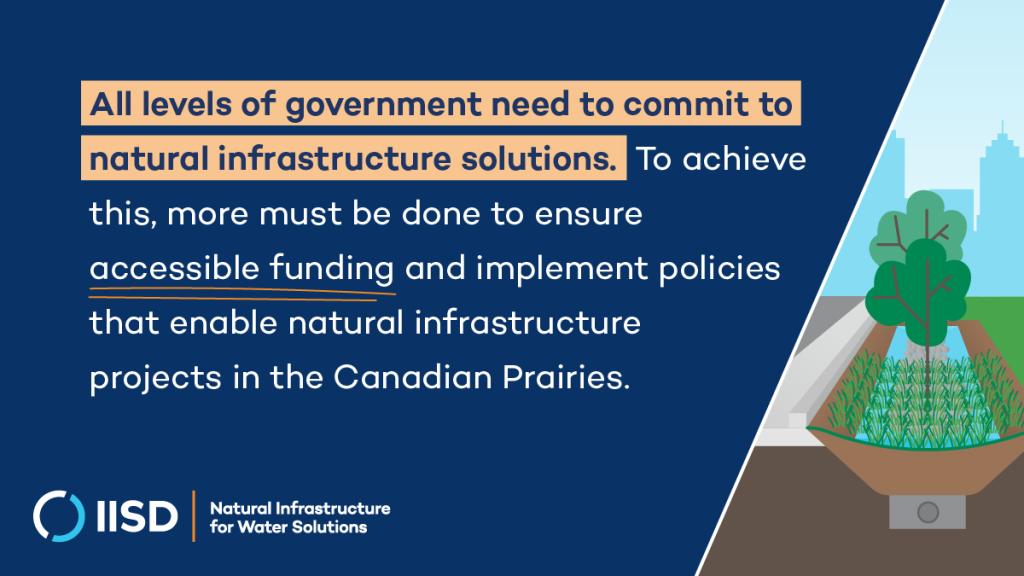
"To see more natural infrastructure on the Prairies, we need to ensure adequate and more accessible funding and to enact policies at all levels of government that make it easier for those who want to implement natural infrastructure to do so—including smaller municipalities, rural counties, Indigenous communities, agricultural producers, industry, and investors,” said Roy.

“To speak to the business sector, we also need to make a stronger business case to show why NI is a cost-effective and impactful option that provides a clear return on investment,” she added.

Natural infrastructure involves the conservation, restoration, or enhancement of natural landscapes to provide specific results. For example, wetlands can naturally house excess water during floods, green roofs can help manage runoff, and forests, grasslands, and restored stream banks can replenish groundwater, mitigate flood- and drought-related risks, support fisheries, and provide opportunities for recreation.

IISD has launched the Natural Infrastructure for Water Solutions (NIWS) initiative, bringing together NI experts from across the prairies. The intention is to better support the implementation of NI with a network of experts and resources, and to engage with governments to develop stronger policies, investments and decision-making processes that ensure Canada's Prairie provinces are better equipped to manage and maintain their water infrastructure. 

-30-

For more information or to schedule an interview to discuss these findings, please contact:

Sumeep Bath,

Editorial and Communications Manager, IISD Experimental Lakes Area,

[email protected]

IISD in the news

Funding for Canadian Prairies Water Infrastructure Urgently Needed, but Nature Offers Innovative Solution: New Report From International Institute for Sustainable Development

Our prairie provinces' water infrastructure—from pipes to treatment facilities—upon which millions of Canadians depend is aging and depreciating at an alarming rate. However, natural infrastructure (NI) can offer a practical and cost-effective solution, when scaled up and adopted across all levels of government.

May 10, 2023

IISD in the news details

Topic
Water
Region
Canada
Impact area
Nature
IISD in the news

Funding for Canadian Prairies Water Infrastructure Urgently Needed, but Nature Offers Innovative Solution: New Report From International Institute for Sustainable Development

Our prairie provinces' water infrastructure—from pipes to treatment facilities—upon which millions of Canadians depend is aging and depreciating at an alarming rate. However, natural infrastructure (NI) can offer a practical and cost-effective solution, when scaled up and adopted across all levels of government.

May 10, 2023

IISD in the news details

Topic
Water
Region
Canada
Impact area
Nature
IISD in the news

Adopting natural infrastructure can improve resilience to climate change: IISD

A new report released  by the Winnipeg-based think tank the International Institute for Sustainable Development (IISD) argues that communities across the prairies face pervasive water infrastructure challenges — the stress put on these systems due to the impact of climate change, including flooding, drought, and wildfires, is making things worse.

May 10, 2023

IISD in the news details

Topic
Water
Region
Canada
Impact area
Nature
Report

The State of Play of Natural Infrastructure on the Canadian Prairies

We sat down with key experts across the region and reviewed the latest literature to determine how we take natural infrastructure from novel to normal on Canada's Prairies. 

May 9, 2023
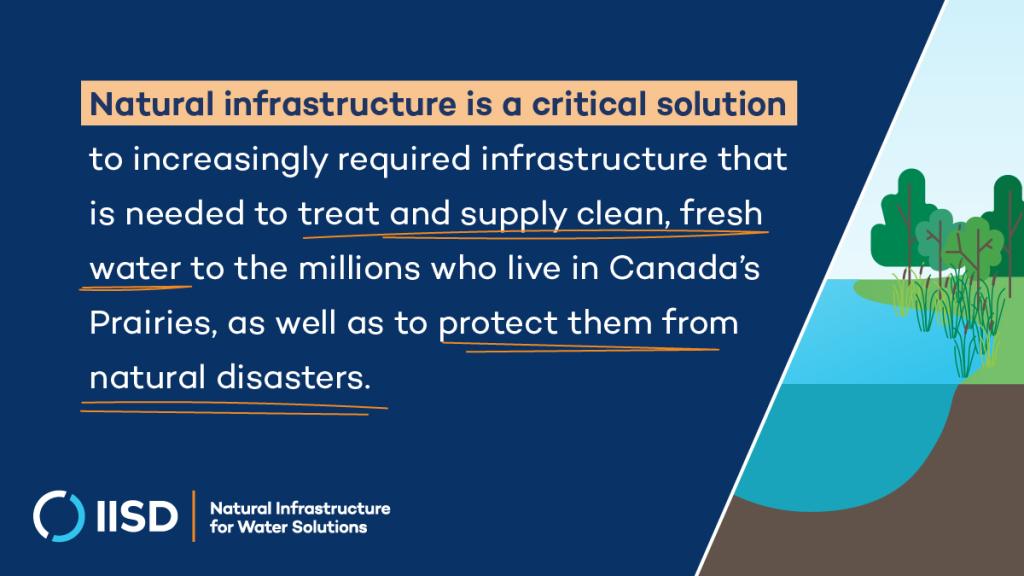
  • Natural infrastructure is a critical solution to the ever-increasing infrastructure required to treat and supply clean, fresh water to the millions who live on Canada's Prairies, as well as to protect them from natural disasters.

  • Canada's Prairies are highly vulnerable to floods, droughts, wildfires, and other impacts from climate change, but they also host unique ecosystems and opportunities for scaling up natural infrastructure.

  • We need more natural infrastructure—and soon. There are hundreds of water-related natural infrastructure projects across the region, but we need broad adoption of natural infrastructure at a societal level to reap the benefits it can provide.

Constrained finances, fragile water resources, and catastrophic weather events are driving the need to rethink water infrastructure for present and future generations. With aging and deteriorating water infrastructure across the Canadian Prairies, natural infrastructure can offer a unique and innovative solution.

But what is natural infrastructure, and how can it help?

Text definition of natural infrastructure

We sat down with key experts across the region and reviewed the latest literature to explore these pressing questions and determine what next steps are required to take natural infrastructure from novel to normal on Canada's Prairies.

Text description of how to scale up natural infrastructure in Canada
IISD in the news

Carbon capture: Separating fact from fiction

When scientists and activists first raised alarm bells on climate change, the oil and gas industry was a reluctant player. But now, it boasts that carbon capture is one of the fastest ways for the industry to reach net-zero emissions by 2050.

May 2, 2023

IISD in the news details

IISD in the news

How to ditch fossil fuels without leaving workers behind

What can Canada learn from Denmark and Germany? As oil demand is forecast to drop, we take a look around the world for lessons about supporting workers and communities through energy transitions. Then, we hear from Canadians in communities closely tied to fossil fuels about their hopes and fears for the future.

April 30, 2023

IISD in the news details