Insight

Aligning Sustainability Reporting Between the Public and Private Sectors

"Here’s the good news: sustainability reporting is now widespread in both the public and private sectors...."


May 19, 2016

Here’s the good news: sustainability reporting is now widespread in both the public and private sectors. Stakeholders currently have more information on the economic, environmental, and social performance of governments, public agencies, and corporations than ever before.

However, this information is often reported inconsistently and is almost entirely self-referential. Links between public and private sector reports are limited. Yet only through cohesive reporting from both sectors can we get a clear picture of overall global sustainability performance.

Unfortunately, efforts to better align public and private sector reporting are complicated by a number of factors, including differences in the content and structure of the reports. Private sector reports often vary widely on the types of goals and indicators disclosed, even in the same industry. Public sector reporting is so mixed that it is often difficult to predict what the report will contain prior to opening it.

Even in cases where there is overlap in the issues reported, there are often differences in the approach. For example, two municipalities might report on the same indicator, say greenhouse gas emissions; but they may do so in very different ways that aren’t readily identifiable. Moreover, these inconsistencies can be even more pronounced when comparing reports between public and private sector entities. This points to the need for a common reference point that orients public and private sector sustainability reporting in the same direction.

The UN Sustainable Development Goals (SDGs), which represent an “unprecedented political consensus” on sustainability priorities, offer such a reference. They are primarily targeted to the public sector and provide a starting point in standardizing the incredible range of reporting at the national-, regional-, and public agency-level. They also provide a basis for improving linkages between public and private sector reports, particularly given that many companies are already reporting on some aspects of the SDGs.

No one entity can adequately report on all of the 17 goals and 169 targets associated with the SDGs. Collectively, however, the public and private sector can ensure that all are addressed. A framework, consisting of a mix of prescriptive and non-prescriptive guidance, will be needed to drive improved alignment in reporting. Reporters must retain some discretion in determining which goals and targets are appropriate in light of their local circumstances. However, once these have been decided, definitions, boundaries, analytical techniques, and reporting methods must be standardized.

Standardizing key elements of sustainability reporting across the public and private sectors is undoubtedly difficult. A recent briefing note from our Knowledge Program showed that there are considerable discrepancies between what the Canadian province of Manitoba is reporting on sustainable development and the green economy, versus the targets and proposed indicators for the SDGs.

There are, however, some encouraging recent efforts at the corporate level to align reporting with the priorities expressed within the SDGs. Measure What Matters is a project devoted to “bring greater alignment between corporate, national and global actors as to how to better measure progress” in ways broader than profit alone. The Data Revolution Group is working on recommendations to the UN “to close data gaps and to strengthen national statistical capacities” around monitoring the SDGs. And the SDG Compass provides a list of over 800 business indicators mapped against the SDGs.

If the challenges of standardizing reporting practices can be overcome, improved linkages between public and private sector reporting can be facilitated through widely-accessible cloud-based reporting platforms. For example, a state-level government could use company data entered into the platform as a part of its reporting initiatives. Similarly, companies could make reference to global or regional trends to better situate their performance in the broader sustainability context. This would provide a much stronger basis for sustainability performance assessment and reporting than currently exists.

Collaboration between the public and private sectors is essential for us to get an accurate picture of overall global sustainability performance. There will never be perfect alignment, as different entities need to address different things. The public and private sectors are deeply connected, but their mutual influence and dependence is largely unacknowledged in sustainability reporting. The existing reporting landscape is so deeply fragmented that it is currently impossible to use data from one report in the development of another with any degree of confidence. This must change in order to accelerate improved sustainability reporting and, ultimately, improved sustainability performance at the organizational-, regional-, and global-levels.  
Insight

Reporting on the Sustainable Development Goals—Challenges for OECD Countries. Part 4: Finance

In part four of a blog series on the challenges that OECD countries face in reporting on their progress towards the Sustainable Development Goals, Mark Halle discusses how to to generate sufficient public and private investment.

May 18, 2016

In part four of a blog series on the challenges that OECD countries face in reporting on their progress towards the Sustainable Development Goals, Mark Halle discusses how to generate sufficient public and private investment.

Implementing the 2030 Agenda will require investment on a massive scale. Estimates of the sums needed for “Transforming our World” vary, but generally hover in the low trillions of US dollars annually through 2030. While these figures frighten and impress, even the highest estimates amount to only one or two percent of global capital stocks. So the issue is not absolute availability of financial resources in the economy, but very much how they are used.

Official development assistance (ODA) amounts to some US$131 billion a year, and increasing proportions of that are spent on refugee care in OECD countries. Even if SDG target 17.2 were reached and 0.7 percent of gross developed country national income were available as ODA (welcome as this would be), it would still not make much of a dent in the totals needed. Where, then, will we find the money needed to implement the 2030 Agenda?

The SDGs are not terribly clear on this question. Target 17.3 suggests that financial resources for developing countries should be mobilized “from multiple sources”, hardly a roadmap that can easily be followed. Developing countries are encouraged to mobilize domestic resources, for example through tax reform, and the richer countries are encouraged to address the debt burden of the poorer ones. All of these are good ideas but will not come close to generating the resources required to implement the agenda.

What is required instead is a realignment of private investment behind actions that advance the SDGs and achieve their targets, but how will that alignment take place? Private or corporate investment decisions tend not to respond to government admonition and, while capital owners may fully support the intentions behind the 2030 Agenda, they do not particularly regard it as their responsibility to attain the goals directly. What, then, will it take to align financial and capital markets to the imperatives of sustainable development?

In the end, it will take a substantial alignment between the interests of investors and the needs of sustainable development such that the behaviour that rewards investors is the same as the behaviour that advances sustainable development. But how do we get there?

With public sector funding an increasingly rare commodity, it is vital that what there is be well spent. Direct expenditure of the public budget on the creation of such public goods as health, education and social services—often priorities for which private investment is not readily available beyond the needs of the elite—remains a priority. Beyond such direct deployment of the public purse, there are two fundamental priorities for public sector action. First, it should focus strongly on “pursuing policy coherence and an enabling environment for sustainable development” (para 63 of the 2030 Agenda). We need an enabling policy, regulatory and institutional framework that will align the interest of investors with the needs of the real economy, and in particular with the SDGs and their targets. This framework must eliminate the perverse incentives that reward unsustainable development and instead reward behaviour that delivers on the 2030 Agenda.

The bad news is that such perverse incentives pervade our economy, from the massive waste of public money on ill-considered subsidies or low-priority projects that benefit particular constituents, to the corporate practices that reward short-term profit seeking or favour investments disconnected from the generation of real goods and services. 

The good news is that we now have a very precise idea of the reforms that would help bring about a favorable alignment between investment and sustainable development—covering everything from monetary policy to standards, disclosure and governance, and aimed not only at banking but also at pension funds, insurances, bond and stock markets. The United Nations Environment Programme's Inquiry into the Design of a Sustainable Financial System is brimming with examples of the sorts of reforms now underway and that would need to go to scale.

Second, the limited public funds available for the 2030 Agenda should be used to “catalyze additional resource mobilization from other sources, public and private”. The best way to do this is to use public funds to “de-risk” necessary green investments. Investment is still not flowing in adequate proportions to projects that would advance sustainable development in part because these projects are perceived to carry a level of risk greater than conventional projects. If we are to accelerate the transition to sustainable forms of development, a good use of public funds would be to lower the risk attendant on sustainable projects to the point that they become attractive to private capital. Good examples, from countries as diverse as Bangladesh and the United States, include favorable financing terms for green projects like renewable energy or waste management.

All of this is well known. And yet it is the implementation of this sort of reform that would do more than any other action to advance the implementation of the 2030 Agenda. Those most capable of acting on these reforms are the countries—like Switzerland and the other OECD countries—that are home to major financial and capital market actors: banks, insurances, pension funds, etc. They tend to be the rule-makers in finance. Given that it is the gift of these countries to act on finance sector reform, and that such reform represents the single most powerful means to create the kind of enabling policy framework that SDG implementation needs, it should also be central to their regular reporting on their efforts to advance this universal agenda. Civil society should ensure that this is the case.

Part one of this blog series is available here,  part two is available here, and part three is available here

Insight details

Insight

Fort McMurray Fires: A reminder that we need to prepare for the impacts of climate change

Fort McMurray can be a wake up call—a touchstone that reminds us how critically important it is to invest in preparing for (and even preventing) the next event, and all those that will follow.

May 11, 2016

My heart goes out to the devastated residents of Fort McMurray.

Their plight hit me hard because, like many residents of interior BC, I spent a large part of last summer with a box of essentials packed in the garage, ready to flee at a moment’s notice. As I watched the disaster unfold in Alberta, I fought a terrible nagging question: is this the new normal?

It may be. While we cannot immediately link the Fort McMurray fire or most individual events to climate change, we know that climate change in Western Canada will likely mean—has meant—drier hotter summers, and more frequent, more destructive fires. The details differ around the world—if you’re in Southern Africa it's crushing multi-year drought; if you’re in South Asia, it's violent storm surges and the interrupted monsoon—but the big picture is the same: more extreme weather events and greater climatic uncertainty.

Having worked for over 15 years as a policy analyst on climate issues, I know we need to work to change the way we are contributing to climate change through the generation of greenhouse gases, from the personal to the international levels. That's critical.

But we also need to admit that we have failed, and will fail, to insulate ourselves from climate change. The greenhouse gases we emit reside in the atmosphere for decades. Even if we achieve the goals agreed upon in the Paris Agreement last year, we will only limit the impacts on future generations. So we need to adapt and make our communities more resilient.

As a city councillor in Rossland—a small community in interior BC, surrounded by forest—I've worked on that battlefront as well. For years, Rossland has been systematically clearing fuel (flammable forest material) around the city's perimeter, with funding from BC’s Strategic Wildfire Prevention Initiative. With support from the Columbia Basin Trust, we led a process to identify the city's key vulnerabilities and needs in adapting to climate change impacts—from disaster preparedness to economic diversification—and built key lessons into our Official Community Plan. We are currently working with the Trust to become a pilot case for civic indicators of climate adaptation and resilience.

These kinds of initiatives take time, money and energy. But the cost of prevention seems like a bargain compared to the cost of the cure. BC’s Slave Lake fire in 2011 racked up damages of CAD 742 million; the Alberta floods in 2013 forced insurance payouts of almost CAD 2 billion; and Fort McMurray could top CAD 9 billion. Those figures don't begin to count the monumental human costs.

Good can come even from the most terrible tragedies. Fort McMurray’s fate has brought forth a flood of support from Canada and beyond as people band together in common cause. The heroic actions of the firefighters on site managed to avert what could have been a much worse disaster. Crisis brings out the best of the human spirit.

But I hope that Fort McMurray can also be a wake up call—a touchstone that reminds us how critically important it is to invest in preparing for (and even preventing) the next event, whether due to fire, drought or flood, and all those that will follow.

Aaron Cosbey is a policy analyst with IISD who works on climate change and energy, subsidies, green industrial policy and trade and investment law. 

Insight details

Region
Canada
Insight

Reporting on the Sustainable Development Goals—Challenges for OECD Countries. Part 3: Means of Implementation

In part three of a blog series on the challenges that OECD countries face in reporting on their progress towards the Sustainable Development Goals, Mark Halle discusses financing the implementation of goals.

May 10, 2016

In part three of a blog series on the challenges that Organisation for Economic Co-operation and Development (OECD) countries face in reporting on their progress towards the Sustainable Development Goals, Mark Halle discusses financing the implementation of goals.

It stands to reason that a country's ability to fulfill the Sustainable Development Goals (SDGs) is contingent on its ability to identify and mobilize the means that will permit it to take the necessary action. Not all of the commitments require new investment, but many of them do. So it is fair to ask: can a country unable to locate the necessary resources nevertheless be called to account for failing to fulfil these commitments? And who is responsible, in a universal agenda, for making these resources available?

In the past, it was taken as a given that, in the case of international commitments, the poorer countries would receive direct assistance from the richer ones. The term “means of implementation” (MoI) was code for increased development assistance. With the 2030 Agenda, the notion of MoI has been greatly broadened and specifically includes obligations on the part of the developing countries. The targets under SDG 17 spell out the elements of this rebooted MoI, and there is a further elaboration in paragraphs 60 through 71 of the 2030 Agenda. However this text, being a negotiated compromise, remains vague on some essential points.

Certainly, there are specifics in some areas. For example, the commitment by developed countries to dedicate 0.7 per cent of gross national income to offcial development assistance (ODA) (SDG 17.2), first proposed by the Pearson Commission in 1969 and endlessly reaffirmed over the past half-century, is prominently in place at a time when ODA is more threatened than it has been in decades. Similarly, there is a call to rebalance trade in favour of developing country exports (17.11), though the World Trade Organization has failed over the past 15 years to deliver such an outcome, and the mega-regional trade agreements don't even pay lip service to this aim.

While we must all accept that there is an aspirational element to the SDGs, their fulfillment will require action across the board, and not only on the limited set of topics agreed in the agenda. It is clear that, if we wish developing countries—to the extent possible—to locate the means of implementation domestically, then everything will need to be done to make that possible. This means improving terms of trade, correcting the imbalances in investment agreements, enabling developing countries to earn income through remittances from their citizens living abroad, and much more.

The danger of not doing this in good faith and at scale is that it provides a convenient excuse for any shortfalls in performance and compliance. If the “universal” 2030 Agenda is genuinely to be realized, the richer countries have only two acceptable choices: either help countries with an MoI shortfall or make it possible through less direct action for these countries to generate the means of implementation themselves. Failing this, we revert to the default choice—that of allowing implementation to stumble, leaving the world untransformed and watching sustainable development disappear below the horizon.

This is, of course, also a challenge for reporting. In many ways, how countries report on SDG 17 is the most delicate reporting challenge they face, especially for OECD countries like Switzerland that have signed up to a set of specific obligations. Naturally, it is important to report on the efforts made to meet the targets under the agreed categories—finance,  technology, capacity building, trade and systemic issues. But this may not be enough, because the implications of the expanded notion of MoI run considerably deeper.

Take, for example, the expectation that developing countries focus on domestic resource mobilization. One of the approaches designated in the targets under SDG 17 is reform of taxation. To fully succeed, however, this will require cooperation at the international level, such as that occurring through OECD's Base Erosion and Profit Shifting project. More disclosure of information on foreign citizens' holdings in rich country banks, greater cooperation on stamping out money laundering, gradual closure of off-shore tax havens—all of this is required to lay the foundation for successful tax reform in the poorer countries. Indeed, without such cooperation, it is difficult to imagine how domestic tax reform will yield its optimal share of resources mobilized domestically and, thereby, the means needed to implement SDG 17.

This form of action is implied in the targets relating to systemic issues, especially in addressing the challenge of policy coherence; but they are nowhere spelled out specifically as an adjunct to the obligations placed on countries for domestic action. However, if we are to track progress comprehensively, countries like Switzerland and its fellow OECD members should be reporting on measures they take in this and related domains.

Part one of this blog series is available here, and part two is available here. 

Insight details

Insight

Environmental Protection Boosts Productivity

"Adopting an actual price on carbon emissions and incorporating them into the market economy would affect decisions throughout the economy and help prevent harmful climate change."

May 9, 2016

"Adopting an actual price on carbon emissions and incorporating them into the market economy would affect decisions throughout the economy and help prevent harmful climate change."

In the most notable economics book so far this year, The Rise and Fall of American Growth, Professor Robert Gordon argues that the productivity gains of the last half century haven't matched the life-changing innovations of the previous period: electricity, automobiles, piped water and sewage, radio and telephone, antibiotics and others. This suggests, he concludes, that future growth prospects are more limited.

But, as he acknowledges, the usual measures of economic growth and productivity don't fully measure changes in living standards. For example, while Gross Domestic Product (GDP) increased by 238 per cent between 1970 and 2014, the volume of air pollutants (particulates, sulfur and nitrogen oxides, ammonia, and others) declined by 69 per cent, because in the early 1970s, the federal Clean Air Act Amendments and other important environmental protections were enacted. Cleaner air has brought significant benefits, mainly through large reductions in sickness and premature mortality from cancer, cardiovascular and respiratory diseases.

Conventional productivity measures don't capture these gains because they measure only an industry’s "good" outputs, which are sold, and ignore the "bad" outputs, which are often dumped into the air, water or land. Economists have rarely bothered much about the laws of thermodynamics, but Isaac Newton explained that material and energy are conserved—or, as Sesame Street's Big Bird put it: you can’t make nothing out of something. When coal is burned, everything goes somewhere and causes damages: all the carbon, the sulfur, the mercury, the arsenic, etc.  

If the resulting damages are measured in economic terms, as environmental economists have done, it becomes obvious that industries can raise productivity in two ways: by raising output relative to inputs (the way that is conventionally measured) or by reducing the bad outputs relative to the good outputs. In an earlier study, I have shown that adjusting the productivity estimates to capture this second way can significantly change the record.

Yale economists who estimated air pollution damage costs as of 2002 found that they amounted to between 0.7 and 2.8 per cent of GDP. Taking this benchmark of 2 per cent of GDP, the growth rates of GDP and the rate of decline in air emissions since 1970, I find that the contribution of improved air quality to total factor productivity growth, correctly measured, has been about 0.1 per cent per year, about 10 per cent of the historical trend. This greatly reduces the difference in productivity growth between the earlier and later periods, except for the remarkable temporary spurt in the decade during and after World War II.

If measures of airborne emissions were available to make it possible to carry out the same calculation for the period 1870 to 1970, it would be obvious that productivity growth in that era would be overstated by at least as much. The rapid growth of steel, chemicals and other auto-related industries, along with the rapid increase of electricity generation and other industrial growth, increased air pollution. Though national statistics aren't available, this chart of air quality in Pittsburgh provides an idea. Air quality deteriorated badly in this industrial city in the first half of the 20th century and improved just as dramatically after 1970.

The unmeasured increase and decrease in productivity growth because of these environmental trends was even starker, for two reasons. First, the earlier period was one of rapid urbanization. A tonne of pollutants released over cities is more than twice as damaging as a similar tonne discharged over rural areas because it affects many more densely-packed households, so the cost of air pollution damages increased even more rapidly than the increase in the tonnage of emissions in the earlier period. Secondly, the health effects of air pollution are greatly aggravated by cigarette smoking, which increased from virtually nothing in 1870 to a peak in 1970 and thereafter declined significantly to the present time. Taken together, the rise and decline in air pollution over the last century could fully account for the difference in measured productivity growth before and after 1970.

This raises important questions. First, how should we measure economic progress? Many economists, including myself, have argued for years that the GDP and related economic accounts, such as productivity growth, should be expanded to include environmental costs and benefits. In those expanded accounts, production would include production of harmful pollutants. The calculation of an industry's added value would incorporate the negative value of the pollution it creates. The Yale study mentioned above found that coal-fired power plants actually have had negative value added because the damage done by its air pollution has been so large.

Despite the recommendations of high-level commissions, ministerial meetings, the National Academy of Sciences, and numerous studies and influential pronouncements, this improvement has still not been implemented. The result is continuing confusion about the rate of economic growth and its causes. There are many who still argue spuriously that environmental protection is a drag on economic productivity, not a source.

Second, what kind of growth do we want—or, growth in what? There are many who have made GDP growth a central political and economic goal. Small changes in GDP growth rates are taken as indicators of success or failure in economic policy. Others have argued for a "no-growth" society, holding that economic growth does more harm than good. Surely, though, there are things we want more of, such as a stable climate; better schools; more efficient, effective and accessible health care; more livable cities; and upgraded transportation infrastructure. There are also undoubtedly things we want less of, such as pollution and the spending needed to clean up after disasters that might have been prevented. Rather than focus on a highly aggregated and undiscriminating measure such as GDP, shouldn't policy discussions focus attention on what we want to increase and what we want to eliminate?

The federal government has taken a step in the right direction by estimating the "social cost of carbon," which measures the damage caused by the release of an additional tonne of carbon into the atmosphere. This figure is being used in government planning decisions and could be incorporated into the national economic accounts, countering the argument that protecting against climate change would impose an economic burden and showing that rapid improvements in renewable energy technologies not only reduce energy costs but also reduce economic damages from carbon emissions. An even more important step would be to adopt an actual price on carbon emissions, incorporating them into the market economy, which would affect decisions throughout the economy and help prevent harmful climate change.

This article was originally posted on the Energy Future Coalition website on April 27, 2016, and is reprinted here with permission.

Insight

Why We Are Excited About Canada's 2016 Census

Charles Thrift explains why our Knowledge program shares Canadians' enthusiasm for the 2016 Census.

May 9, 2016

A lot has been written about the 2016 census.

I've seen articles about the importance of the census data for all manner of things; the Twitterverse has exploded with selfies taken with census forms; and my Facebook feed is full of people proclaiming their support of evidence-based decision-making. In fact, Statistics Canada's census webpage crashed due to higher-than-expected traffic (it seems many Canadians were keen to fill in their forms right away. Don’t worry—I got mine in before it crashed…!). For those interested in learning more about this year's census, Statistics Canada's blog post about the 2016 census is quite good and discusses some of the changes from previous years (e.g., use of administrative data for income).

Here at IISD’s Knowledge program, we share the same census excitement described above, but for us it takes on a special significance, given our interest in the accessibility and interpretability of that data for decision making. There are some exciting things coming with this census that should (hopefully) lead to broader use by Canadians.

Our work has taught us that many in the community are very interested in using data, but don't necessarily know how to find and interpret it. It is partly for this reason that we partnered with the United Way of Winnipeg to develop our Peg project. Without good data, how can we know if our community is going in the right direction?

To improve the accessibility of this vital data regarding Winnipeg's social and environmental health, we use appealing ways of visualizing data, simple messaging and an interactive website where people can look at the data for different geographies and thematic focuses. We also maintain a smaller dataset to focus on those issues that matter most to Winnipeggers. Peg makes good use of census data to track educational attainment, people's transportation choices, the condition of housing and how many people are living on a low income. We also use census income data to see how issues in the community affect, or are affected by, income. In one way or another, the census informs most of our indicators.

Canadians' enthusiasm for completing the 2016 census has us hoping that they will share the same interest in using the results. With such a high percentage of the population completing the questionnaire, the results will be highly accurate. So, will Statistics Canada move forward in trying to make this valuable data as usable as possible, as we have focussed on doing in the Peg project, to all Canadians?

Statistics Canada has a very different mandate from Peg, but they share the objective of improving decision making via improved data/evidence. Statistics Canada "encourages the downloading and reuse of its data," but much of the data you'll find on the Statistics Canada website are in tables and reports. This is great for those of us nerds who are keen to work with the raw data, but a little less appealing to many. The website is often difficult to navigate, and it can be hard to find what you're looking for. Even so, there are a couple of interesting changes that have caught our eye: their new infographics and the Census Program Data Viewer. Both make use of data visualization to help us see patterns easily.

Infographics are helpful for quickly communicating key messages. Statistics Canada has been producing these for a couple of years now, but it will be nice to see them for the census data.

Statistics Canada is also building a new Census Program Data Viewer, which should make accessing and understanding the trends much easier. It has yet to be developed, but it should take the form of an interactive dashboard, with the ability to map, show bar charts and compare parts of the country. It sounds like it might be similar to what the U.S. Census Bureau uses or what is produced by InstantAtlas.

Statistics Canada is definitely moving in the right direction. As we strive to complete our census forms, let's not lose our enthusiasm after we click 'submit.' It's equally important for us to look at the results, in a format that we can all understand, as it is only through access to data that we can clearly see how well our country is doing, and what decision-makers need to do to improve life for us all.

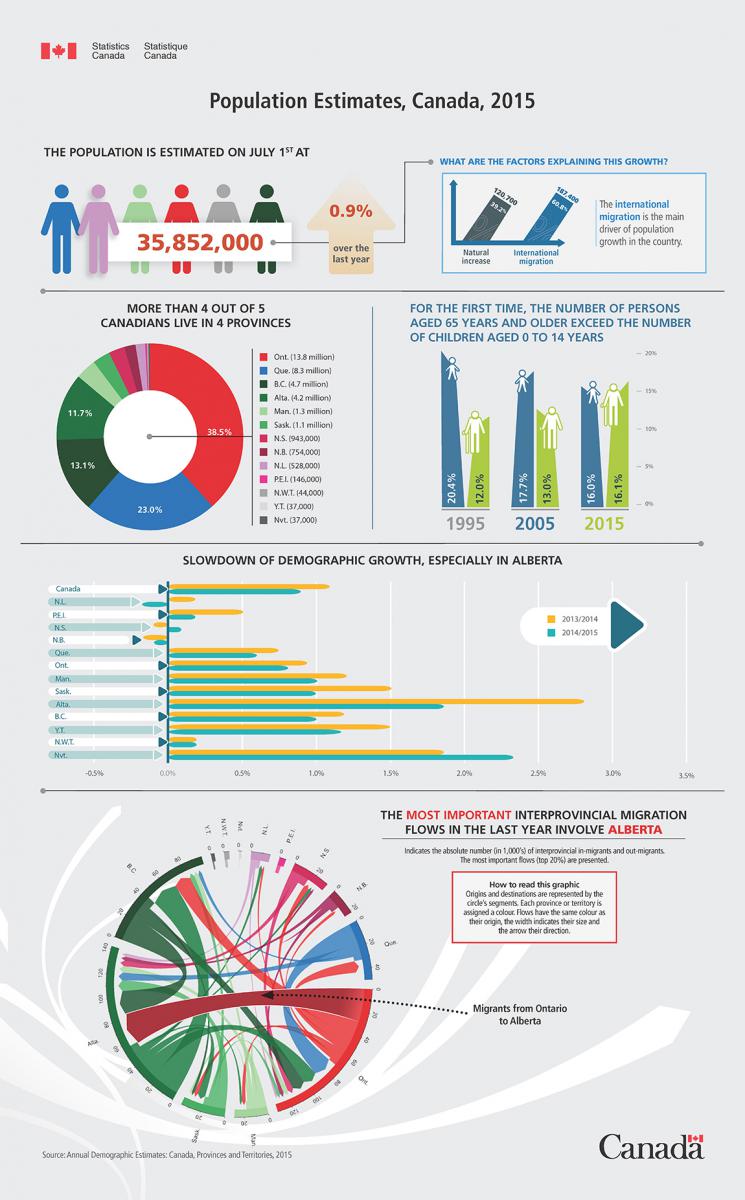
Source: Statistics Canada, Infographic: Population estimates, Canada, 2015. 2015. Reproduced and distributed on an "as is" basis with the permission of Statistics Canada

Insight details

Insight

Reporting on the Sustainable Development Goals—Challenges for OECD Countries. Part 2: Universality

May 3, 2016

In the second in a series of blog postings on the challenges that OECD countries face in reporting on their progress towards the Sustainable Development Goals, Mark Halle unpacks the meaning of "universality."

It is common in presentations of the 2030 Agenda for Sustainable Development to stress that, unlike the Millennium Development Goals, the Sustainable Development Goals (SDGs) are “universal.”  The primary meaning is that the goals are intended to apply equally to all countries, not simply the developing and emerging economies. Thus countries like Switzerland or Canada have, in adopting the 2030 Agenda, have solemnly undertaken to attain the SDG goals and targets by the 2030 deadline. In some cases, the undertakings are pro forma. The need for Switzerland—a  landlocked country—to address Goal 14 on oceans, for example, is limited. But to the extent that they apply, countries have made a commitment to implement all of the goals and targets fully, in practice and in spirit.

What, then, does the term “universal” or “universally applicable” mean in the context of reporting on SDG progress and implementation? The terms—and  especially the former—are  salted throughout the 2030 Agenda and are clearly intended to be taken seriously. Nowhere, however, are they elaborated or explained. I would suggest that the notion of universality has profound implications and that countries should report both on how they are advancing the SDGs at home and in other countries and on the planet more generally. Three examples will suffice.

First, the targets under Goal 13 (Take urgent action to combat climate change and its impacts) specify not only that countries must take action domestically and build climate considerations into their own plans and strategies, but also that they must contribute to mobilizing the funding needed by developing countries to meet their climate-related challenges and, more generally, build capacity and awareness around the climate challenge. Thus, it is clearly not sufficient for Switzerland to lower its own climate footprint—it must also act or contribute to action beyond its borders. Reporting on this is clearly part of its obligations. However, the principle of universality would suggest that Switzerland should also be monitoring the impact that its domestic energy consumption has on the “climate space” of other countries that consume less and reporting on steps it is taking to ensure that its actions are not making the path to full implementation of the 2030 Agenda rockier for other countries.

The difference is subtle but important. The universal nature of the SDGs implies that countries should clean up their own act and contribute to helping others to do so; but it also implies that their action must be commensurate with the extent to which they are part of the problem. Having this as the basis for reporting would respect the notion of universality; ignoring it would serve that notion poorly.

A second example comes from Goal 12 (Ensure sustainable consumption and production patterns). This complex goal, with its 11 targets, lays out a range of actions governments are expected to take, many of them calling for efficiency gains in production and consumption as well as a reduction of waste. All 11 targets can fully be reached, however, without the goal being achieved. Countries like Switzerland should have no difficulty reporting against these targets. If the goal is a universally-held commitment, however, the reporting should include progress towards the goal itself, including an assessment of how Switzerland’s patterns of consumption and production affect the ability of other countries to achieve the SDGs and for the goal itself to be reached. The extent to which production in Switzerland is depleting stocks of natural resources in other countries, or the extent to which the terms of trade undermine other countries’ ability to develop sustainably, are material to understanding its overall impact. Including this in national reporting is a far more complex task, but if the accumulation of national actions towards a goal do not amount to achieving that goal, it will be important to understand why and take appropriate action.

Finally, countries like Switzerland should identify and develop a means to assess how its overall impact on the planet might be made more amenable to success in reaching the SDGs through and beyond the fulfillment of the targets. The need for each country to bring its development fully within the boundaries dictated by sustainable development is strongly implied in the principle of universality, and it is fully articulated in the Declaration that forms the lead-in to the articulation of the SDGs themselves. The aim is, after all, “transforming our world.” A positive transformation will require ensuring a robust “social floor” and living within known “planetary boundaries.”  So the principal of universality strongly suggests that reporting should not simply allow the mechanical tracking of the goals and targets against indicators, but provide the basis for an assessment—perhaps by the High-level Political Forum charged with monitoring and reviewing the 2030 Agenda—of the extent to which our world is being transformed and a sustainable future secured.

Part one of this blog series is available here

Insight details

Insight

A Beef with Competition

Should the arrival of ethical beef at Earl’s restaurants be considered good news?

May 2, 2016

The arrival of ethical beef at Earls restaurants should be considered good news. But the Canadian chain’s controversial decision to snub humane producers in Canada and only buy from U.S. sources points to the disruptive potential of competitive forces within ethical labelling.

There are currently more than 400 voluntary sustainability standards operating across the planet. That makes it hard for consumers and businesses like Earls to make informed choices about what the labels mean and which ones they can trust. And it’s not clear that competition is helping to resolve the confusion.

Competition among different private standards is often touted as a driver of innovation and efficiency. The recent decision by Earls to source its beef only from the Humane Farm Animal Care’s Certified Humane program underscores one of the downsides of an over-reliance on competition—and market forces more generally—for the advancement of public welfare objectives.  

Presumably, most Canadians, and all of the diverse initiatives involved in certifying “ethical beef,” agree on the basic principle that the humane treatment of livestock is an important value to be protected and promoted. And while the values behind different initiatives such as the Humane Farm Animal Care’s Certified Humane program and the Animal Welfare Approved seal may be similar, the very fact that their survival depends on how much market share they are able to attract individually also means that they often have very little interest in seeing other would-be allies—that is to say other initiatives promoting “ethical beef”—actually succeed. 

Competition among private standards can incite labels to invest in expensive marketing campaigns designed, among other things, to squeeze out other labels. Competition also has the potential to fuel duplication and inefficiency in the market through secrecy and non-cooperation. Under conditions where the market itself struggles to provide sufficient resources for the credible operation of public-good oriented private standards, it is fair to ask whether unfettered competition represents an optimal use of voluntary standards and the consumer dollars supporting them. 

Voluntary standards typically carry an unbearably heavy load. They are responsible for organizing a multitude of stakeholders to carry out the identification, implementation, monitoring and enforcement of a complex set of requirements across equally complex supply chains. The market, on the other hand, is normally only willing to pay nominal fees for such processes, leaving the entire conformity assessment system under pressure. The limited resources available expose such labelling initiatives to significant reputational risks which, in turn, threaten the credibility of the entire labelling market. 

Governments have an important role to play in setting baseline rules on transparency, data sharing, harmonization and cooperation, with a view to ensuring that initiative self-proclamations of service to the public good are more than complicated forms of greenwashing aimed primarily at ensuring the livelihoods of those they employ. Rules requiring harmonization and mutual recognition could go a long way to avoiding the current private and public beefs with the ethical beef labelling industry.

Jason Potts is an expert in voluntary standards and the lead author of The State of Sustainability Initiatives, a project run by the International Institute for Sustainable Development that provides a bird’s-eye view of market and performance trends across the most prevalent standards initiatives. His latest report on the seafood industry will be published on May 11.  

Insight details

Insight

Reporting on the Sustainable Development Goals—Challenges for OECD countries (Part I)

Switzerland will be one of the first countries to report back to the UN's High-Level Political Forum on progress towards the Sustainable Development Goals. In the first of a series of postings, Mark Halle highlights critical issues for Switzerland—and by extension, other OECD countries—to address in its reporting. 

April 26, 2016

Switzerland will be one of the first countries to report back to the UN's High-Level Political Forum on progress towards the Sustainable Development Goals. In the first of a series of postings, Mark Halle highlights critical issues for Switzerland—and by extension, other OECD countries—to address in its reporting. 

The heady months following the adoption of the 2030 Agenda with its 17 Sustainable Development Goals (SDGs), 169 targets and its raft of indicators, are slowly giving way to a more sober assessment of what we have taken on and how we will deliver it. Countries around the world must now come to grips with how to implement this complex and ambitious agenda. Part of the challenge is measuring progress and reporting it to the High-Level Political Forum (HLPF)—the UN platform set up to oversee the implementation of the SDGs.

Switzerland is one of a handful of countries that has volunteered to report to HLPF in the first cycles, and it is important therefore that the Swiss report help set the standard that others might be inspired to follow. At a broad stakeholder meeting in the Swiss capital last week, I was invited to offer advice on how to approach the reporting challenge and was impressed with the serious, open and meticulous way in which Switzerland is preparing to meet its obligations. Its reports will be comprehensive and groundbreaking. Given that Switzerland is—at this early stage—setting the bar for other countries, it is important that the reports cover the ground as thoroughly as possible.

With that in mind I offer four suggestions—at the borders of the existing debate—for critical issues these reports would usefully cover. I set out the first of them here; the remaining three will be addressed in subsequent postings.

1. Alignment and coherence

Given the 2030 Agenda’s transformative ambitions, its success hinges on becoming the “defining agenda” for international cooperation, the framework into which all other agendas must fit. Past sustainable development agendas failed not because they were poorly crafted or lacked international legitimacy, but more often because they were undermined by other, more powerful agendas driving the behaviour of states and other stakeholder groups. Agenda 21, adopted at the Earth Summit in Rio in 1992, offered a perfectly good program, and the world would be a significantly better place had we genuinely tried to implement it. Unfortunately, it was adopted at a time when the present economic paradigm, based on the Washington consensus, took hold and markets were unleashed to pursue development through a singular focus on economic growth based on open competition. We now know that this alone could never guarantee a shift to sustainable forms of development, but the economic growth agenda was clearly dominant and the rest had to adapt to it or fall by the wayside.

If the world is to come anywhere close to achieving the 2030 Agenda, this must be reversed. The 2030 Agenda must be the gold standard, and other agendas—whether relating to trade, investment, taxation, employment, refugee policy or other priorities—should be required to demonstrate their compatibility with the primordial agenda. Similarly, institutions entrusted with advancing these other—especially economic—agendas should be accountable for ensuring that they not undermine progress towards the 2030 Agenda and that, where possible, they actively advance it.

While this is a challenge for all countries, it is especially important for the OECD countries whose influence on international cooperation agendas is particularly powerful. So what does this mean for Switzerland (and by extension for the other OECD countries) and how should it be reflected in their reporting to HLPF?  It means that there must be a major effort to ensure policy alignment among the positions Switzerland takes in these international regimes and organizations. Switzerland’s positions in respect of the World Trade Organization, to take an example, must be crafted and deployed bearing in mind the requirements of the 2030 Agenda. For instance, the rules governing intellectual property rights, or the ban on local content requirements relating to outside investments, might usefully be reviewed to determine whether, in their present form, they advance or undermine the 2030 Agenda. Likewise, the positions taken by the Swiss Executive Director at the World Bank or the African Development Bank—for example in approving a loan for coal-fired power generation—must be taken in light of the transformational imperatives of the 2030 Agenda.

Switzerland should create a space in its regular reporting to chronicle progress on this alignment process. This is a challenge, but it is clear that we will not reach the SDGs without a significant harmonization of policies across these broad economic, social and environmental agendas. Unless we are successful it is likely that the economic agendas that advance the interests of the powerful will, once again, make nonsense of the solemn commitment of our leaders—this time­—to genuinely act to ensure that our future is sustainable.

Insight details

Insight

India’s 2016 Budget: A mixed bag for clean energy alternatives

India's 2016 budget features some important concessions for increasing clean energy, but it is not without drawbacks. 

April 22, 2016

India's 2016 budget features some important concessions for increasing clean energy, but it is not without drawbacks. 

On February 29, 2016, India’s Finance Ministry released its 2016 budget, with important implications for clean and efficient energy. The budget pledges to reform subsidies and taxes provided to fossil fuels, which will do much to support renewable and more efficient energy. This is welcome as India seeks to do its part to meet the climate change commitments made in Paris last year.

Also notable is an increase in the clean energy cess, a charge on coal use that is partially allocated to support clean technologies. Under the new budget the coal cess increases from INR 200 (USD 3) to INR 400 (USD 6) per tonne. In effect, the coal cess is trying to kill two birds with one stone. First, it raises generation costs, making coal-based power more expensive. Second, the cess payments will generate additional income which the government can use for investment in clean energy.

However, less positive is a limit on accelerated depreciation, which is likely to negatively impact investment in renewable energy project.

Levelling the energy playing field

A cost comparison of renewable energy with coal provides some hints of the impact to be expected from the higher clean energy cess. Levellized generation costs for domestic coal-based plants are in the range of INR 2.5 (USD 0.04) to 3.5 (USD 0.05) per kWh. By contrast the cost of solar is currently around INR 4.35 (USD 0.07) per kWh. While the gap between the cost of renewables and coal has narrowed, it is still significant. However, generation from imported coal, which makes up about 9 per cent of total coal-based capacity, is now comparable with solar and wind. As renewables begin to compete on cost with imported coal there will be a positive impact on carbon emissions, though this will be limited as domestic coal will remain cheaper. Moreover, the quality of domestic coal used in existing thermal power plants tends to be of poor quality.

Importantly, not all of the cess will be borne by generators. Coal-based generators with fixed power purchase agreements (PPA) will face the brunt as they will be unable to pass on the higher cost. For generators with flexible PPAs, the increased cost will be passed on to the distribution utilities, and then either trickle down to consumers in the form of increased consumer tariffs, or distribution utilities will absorb the tariff hike (with a subsequent bailout from the central government, as has been the case in the in the past).

A modest share for clean energy technologies

Some of the revenue collected from the coal cess flows into the National Clean Energy Fund (NCEF), set up to support clean energy technology. However, a key concern is over the share that clean energy technologies receive from the total pie of funds collected from coal cess. The Comptroller and Auditor General of India (CAG) estimates for 2015–16 shows a meagre sum of INR 100 crore (USD 15 million) was transferred to NCEF from INR 12,623 crore (USD 1.9 billion) of tax revenue collected from coal cess (i.e., 1 per cent of the total amount). In 2013, the IISD Global Subsidies Initiative reviewed the operation of the cess, and found that much of the fund’s expenditure was allocated to budgetary shortfalls of ministries and projects that were not directly related to clean energy technology.

Limit on accelerated depreciation will affect investment

While its impact remains to be seen, the higher coal cess is a welcome effort to create a more level playing field for renewables. However, the budget is not entirely positive for renewable generators; a limit on accelerated depreciation to a maximum 40 per cent is also included in the announcements. Accelerated depreciation reduces taxes by allowing the value of assets to be written off quickly, thereby improving the economics of eligible projects. This will immediately affect the wind power plants that have based their revenue model on accelerated depreciation clause of the Income Tax Act. Wind power in India picked up largely due to the benefits of accelerated depreciation. The impact of this scheme was visible in 2012, when the government pulled it back. For two years, very little capacity was added in the wind sector until it was restored in 2014.

A forthcoming paper by GSI analyzes India’s accelerated depreciation policy for wind energy. The study finds that the policy was hugely influential in encouraging capacity growth, but not without flaws. Most notably, it rewards capacity, not generation; as a result, there was no incentive to develop or maintain efficient projects. There is plenty of evidence showing companies were constructing wind farms solely to take advantage of the tax benefit. Secondly, only those companies with booked profits can benefit from this scheme. The scheme did not pave the way for new companies looking to enter the market, particularly dedicated renewable energy companies.  

Conclusion

To further support renewable energy, measures that promote capacity such as accelerated depreciation should be combined with other schemes that ensure efficient operation. The use of NCEF should be not only used to finance large-scale projects but to provide loan guarantees to small and mid-sized enterprises so as to enable them to access debt financing from commercial banks. This will help government achieve the twin objectives of enhancing energy access with clean energy development.

Insight details

Topic
Subsidies
Region
India