Insight

Reducing Food Waste: The role of foreign investors in promoting efficiency

Agricultural investors can help to minimize food loss both on the farm and during transport and storage. Governments also have a role to play in promoting efficiency and reducing waste. This blog explores both sets of interventions. 

July 25, 2016

How would you feel if every time you left the grocery store someone grabbed a third of your bags and tossed them in the garbage? That’s how much food is wasted worldwide.

If even a quarter of global food waste was saved it would be enough to feed 870 million people; that could turn hunger into a historic artifact. It could also help save the planet. If food waste were a country, only China and the United States would produce more greenhouse gases.

Agricultural investors can help to minimize food loss both on the farm and during transport and storage. Governments also have a role to play in promoting efficiency and reducing waste. This blog explores both sets of interventions. But first a few words on the size and complexity of the challenges around food waste.

The scale and impact of wasted food

A third of global food production—about 1.3 billion tonnes a year—is  discarded before it is eaten. Almost half of fruit and vegetables grown are not consumed. It’s not just food we are wasting: we are also over-exploiting precious resources—land , water, seeds, energy, and fertiliser—because of the immense inefficiencies in the global food system. We are exacerbating conflicts over land and water resources in developing countries. Intensive agriculture is degrading our soils, tearing down our rainforests and depleting fish stocks to the point of extinction. The water used to produce wasted food is each year equivalent to three times the volume of Lake Geneva. The energy wasted to grow, process, package, store, transport and, finally, discard unwanted food is contributing to climate change. Perhaps most perversely, when discarded food ends up in landfill, as it often does, it produces methane—the most dangerous greenhouse gas with 25 times more global warming potential than CO2.

Yet people are hungry and we need to produce more food

The Food and Agriculture Organization (FAO) estimates that food wasted annually is more than twice the amount needed to feed the world’s 870 million undernourished people. Yet we are told we need to increase global food production by 70 to 100 per cent to feed the nine billion who will inhabit our planet by 2050.

Global figures of this nature are useful to highlight the absurdity of the global food system. But they gloss over a critical disconnect between where food is wasted and where more is needed. Per capita food wasted in Europe and North-America is 95-115 kg/year, but only 6-11 kg/year in sub-Saharan Africa and South/Southeast Asia. While many a frustrated parent may have sought to guilt-trip a child into eating their greens with the claim that “there are children starving in other countries,” even a child can deduce that the brussel sprout on their plate can end up in one of three places: their mouth, the bin, or the mouth of a defeated parent—none of which are in any other country. “Waste not” in the Global North does not equate with “want not” in the Global South.

Waste occurs at all segments of the food chain

Food is lost during production, harvest, sorting, shipping, processing, packaging, wholesale, retail and consumption. There are important differences in how food is wasted between developed and developing countries. In developed economies, most waste is at the consumption end of the food chain, in middle-income countries it is during processing and packaging (including determining what will be accepted by developed country consumers), and in developing countries most food is wasted through post-harvest losses due to inadequate transportation, storage and refrigeration facilities.

There are many reasons for food waste and plenty of blame to spread around. Depending on who you talk to, the main culprit may be supermarket cosmetic standards, confusing expiry dates, all-you-can-eat buffets, excessive portion sizes, meat- and dairy-based diets, unfaourable tax treatment for donations, fickle and vain consumers, over-stocking, poor transport, storage and refrigeration infrastructure, food standards, and so on.

Solutions and initiatives to tackle the issue

Solutions abound too, from beer made out of stale-bread, to the Eat More Offal campaign, to regulating how and where green beans are sliced, and everything in between.  Reducing food waste is firmly on the hipster agenda with past-expiry and ugly food supermarkets on the rise in Copenhagen, Berlin, Paris and San Francisco. Feeding the 5000, a global campaign which cooks street feasts from food that would otherwise have been discarded, has now visited over 30 cities.

The role and obligations of foreign investors in developing countries

In the wake of the food price crisis of 2008, and the ensuing contoversy surrounding “land grabbing,” investors in agriculture have come under pressure to invest responsibly. A myriad of principles and guidance documents have been spawned. A core element of responsible agricultural investment must be to play a role in reducing global food waste.

So what, concretely, can be done to ensure large-scale foreign investors put these principles into practice? How do we move beyond nice words about sustainable and efficient use of resources to actions that make a difference to reducing waste?

Here are some ideas for how governments and investors could reduce food waste in order to help eliminate hunger and more sustainably use our planet’s finite resource to feed the world.  

Investors can:

  • Provide training to farmers on storage and techniques to minimize post-harvest loss.
  • Help build better storage facilities in the communities where they operate.
  • Allow communities on the farm to collect produce that has been missed in the harvest.
  • Develop systems for the productive use of waste and by-products, such as bio-diesel from rice husks.
  • Play an active role in combatting cosmetic standards for food (not all bananas need to have a curve!).
  • Link up and finance food waste campaigns.

Governments can:

  • Require investors to have a food waste policy as part of their business plan, detailing how they plan to minimize waste.  
  • Promote and prioritize investment in storage, transport, refrigeration and other infrastructure to reduce post-harvest losses.
  • Improve national transport and trade infrastructure.
  • Encourage the use of food by-products for animal feed.
  • Prioritise investments with on-site processing facilities.

These are the seeds for an action plan to reduce food loss and waste.

To this end, IISD is working on a project to estimate the total cost of ending hunger worldwide. A key parameter in the model is an estimate of funding needs to pay for effective storage facilities in developing countries. Establishing how much money is required must be complemented with the means to raise the money. As such, IISD is also researching financing for infrastructure, including the development of financing tools and strategies for public and private investment in storage infrastructure. Food waste is egregious in many places and for many reasons, but it is the development of storage infrastructure in developing when most mileage is to be gained in alleviating hunger. 


William Speller is a consultant with IISD's Agricultural Investment team. 
Insight details

Insight

How Canada Should Support Low-Carbon Growth Abroad

Jason Potts, in an article originally published in The Hill Times, argues that Canada's overseas development assistance needs to focus on realizing the commitments of the Paris climate change agreement.

July 20, 2016

Last year’s Paris climate change agreement marked the first time that all countries have committed to help adapt to climate change and reduce emissions. Canada’s overseas development assistance (ODA) now needs to focus on realizing these commitments. Ensuring maximum impact will require attending to areas where need is greatest and where Canada has particular expertise.

A core focus should be on supporting fragile states where climate change is rapidly eroding prospects for peace and development. A decade of work by IISD has demonstrated the links between climate events such as severe drought or flooding, and the cornerstones of development such as food security, human health, migration and conflict. Proportionately, fragile states are the most vulnerable. These countries tend to be dependent on rain-fed agriculture, while poverty and weak governance undermine their ability to respond to climate stresses.  

There is therefore a pressing need to better prepare fragile states for climate change. Here, the United Nation Framework Convention on Climate Change has established a process—National Adaptation Plans (NAPs)for assisting developing countries. In addition to providing targeted support for climate-responsive growth across vulnerable sectors like farming, the NAP process provides a foundation to improve governance, so critical in fragile states and a key component of Canada’s international development strategy.

Last March, Prime Minister Justin Trudeau and President Barack Obama announced support for the National Adaptation Plan Global Network, created to promote peer learning among developing nations, improve coordination between bilateral donors, and support on-the-ground development and implementation of adaptation plans. Having pledged its support, Canada should take advantage of this network to help make sure our support for adaptation planning in developing countries can be as effective as possible.  

Climate resilient technologies in agriculture will be particularly important for developing countries facing an increasingly volatile environment. Canada should be a leader in supporting resilience-based innovation by, for example, bringing global climate impact mapping to scale, working with farmers to pinpoint vulnerable storage facilities, and supporting climate resilient seed development.

In addition to assisting countries to adapt to the impacts of climate change, the Paris agreement demands that all countries curb carbon emissions over time. Heading into the Paris conference, 188 countries outlined the actions they intend to take to do that; now they face a significant challenge in not only realizing those substantial emission reductions, but also increasing their ambition in the years ahead.

Here again, a focus on agriculture is needed. The sector is responsible for one third of global emissions, and two thirds of global mitigation potential from agriculture is located in the developing world. Climate-smart agriculture can both reduce emissions and stimulate economic growth through improved infrastructure and more efficient practices. Growing markets for certified sustainable products (such as organics fair trade and other eco-labels) represent an opportunity for facilitating this transition; however, this will require targeted investment from ODA sources to ensure that more marginalized producers can access these markets as they expand.

More broadly, the Paris objectives require a rapid scaling up of financing from both public and private sources for the large-scale investments needed in areas like clean energy and infrastructure. There are a growing number of options available ranging from the use of innovative instruments, such as voluntary offsets and green bonds, to improved coordination and transparency among actors committed to providing green finance through initiatives like the Global Impact Investment Network and Montreal’s own Finance Alliance for Sustainable Trade. For Canada there is an opportunity to engage its world class financial service sector to stimulate new and innovative climate finance approaches.

Finally, there is the question of Canada’s own contribution to assisting developing countries in the transition to lower-carbon, more resilient economies. Since 1970, developed economies have repeatedly committed to providing 0.7 per cent of their gross national income to overseas development assistance. However, historically only five countries have done so (Sweden, Netherlands, Norway, Denmark and Luxembourg). In 2015, the United Kingdom became the sixth, and the first G7 country, to formally commit to meeting this target. Canada has an opportunity to turn the United Kingdom’s bold move into a “trend” among G7 countries by making a similar commitment.

Today we know so much more; we know just how monumental the challenges are, and that it is now entirely untenable to consider ODA at anything below these 1970 targets as meaningful. The world is ready for change, but it will not be possible without significant investment. 

This article was originally posted on The Hill Times website on July 20, 2016, and is reprinted here with permission.

Insight details

Insight

How Subsidies for Kerosene are Holding Back Solar Power in India

Kerosene is used by millions of households in rural India to meet basic lighting needs, and subsidies have long been used to make the fuel more affordable. But for health, safety and environmental reasons, a switch to solar power is better—and more affordable in the absence of kerosene subsidies.

July 11, 2016

Kerosene is used by millions of households in rural India to meet basic lighting needs, and subsidies have long been used to make the fuel more affordable. But for health, safety and environmental reasons, a switch to solar power is better—and more affordable in the absence of kerosene subsidies.

Subsidies for kerosene have been at the centre of energy policy debates for many years due to the intrinsic problems with kerosene consumption and the inefficiencies in subsidized kerosene distribution. The poor quality light produced from kerosene lamps limits educational and income-generating opportunities, while the fuel is also responsible for serious negative health impacts. Moreover, the provision of subsidized kerosene is extremely costly and wasteful. The Indian Government’s Economic Survey estimates that 41 per cent of subsidized kerosene was lost due to "leakages" in the system in 2011–12 (see page 54 of the survey).

In order to curb the black market in subsidized kerosene, the Indian Government has proposed changing kerosene subsidy delivery from in-kind subsidies (i.e., sale of low-cost fuel) to cash transfers to consumers following the purchase of kerosene. This would allow the government to better control access the subsidy.  

However, the Government of India should reconsider subsidies for kerosene more fundamentally. Our analysis shows that kerosene subsidies are holding back a transition to solar power.

Replacing kerosene with solar power

Off-grid solar technologies, such as solar lanterns and solar home systems can effectively replace kerosene use for lighting in rural areas that are unserved (or poorly served) by the electricity grid and are likely to be so for some time. Solar can provide safer and better quality lighting, and is also friendly to the environment.  

Kerosene subsidies, however, reduce the competitiveness of off-grid solar solutions. To understand the extent to which kerosene subsidies are discouraging poor, rural households from making the switch to solar power, IISD examined the different cost scenarios that households face when making the choice between kerosene and solar lantern use.

The economics of kerosene and small solar lighting options

To make this assessment, the costs of three solar lantern types (entry-level, mid-level and high-level) were assessed. Further, in addition to upfront purchase, a simple financing option for the various solar lanterns was considered.

Detailed cost calculations reveal that—at the current level of kerosene subsidies—household expenditure on entry-level solar lighting systems is marginally lower than that on kerosene.  If kerosene subsidies are removed, however, and households shifted from kerosene to entry-level solar products they will save INR 760 over 1.5 years (approximately USD 12), equal to 150 per cent of the capital cost of an entry-level lantern. For both mid-level and high-level solar lantern systems, expenditure is greater than on kerosene over the two-year life of the systems in the case where kerosene subsidies are maintained. However, where kerosene subsidies are removed, households with mid-level systems make significant savings by switching to solar over two years. 

Given current kerosene subsidy levels, households using more expensive high-level systems incur additional expenditure of INR 1248 (USD 20) over two years when systems are paid for upfront. However, even for high-level systems—which also include mobile phone charging capacity—households save from shifting to solar when kerosene subsidies are zero and systems are paid for upfront.

Policies to move from kerosene to solar

The implication of this analysis is clear. A range of solar lantern products are more cost effective than kerosene over their lifetime when kerosene subsidies are removed. Where subsidies are left in place, the savings are relatively small for some systems and non-existent for others. To stimulate a large-scale transition toward solar lighting in rural India, kerosene subsidy reform is therefore crucial. There is much that governments at the central and state levels can do to promote this process of reform.

For example, the Indian Government can:

  1. Tighten the eligibility criteria of kerosene subsidies across states to restrict kerosene subsidy access to households below the poverty line, while strictly tying eligibility to a lack of electricity access in places where kerosene is mainly used for lighting.
  2. Establish funded retraining programs for kerosene dealers now, and allow fair price (i.e., ration) shops to sell accredited solar lighting alternatives in order to reduce political opposition to the process of reform.
  3. Begin testing an ambitious restructuring of the current kerosene subsidy to transform this into a general "lighting subsidy," under which direct subsidy benefits can be used by beneficiaries towards the purchase of a range lighting products, including kerosene and solar solutions.

Nevertheless, kerosene subsidy reform is an intrinsically difficult process. In the absence of affordable and widely available lighting alternatives, rapid kerosene subsidy reform risks depriving the poorest households in India of an important social benefit.

Indeed, while using a range of solar lanterns is often cheaper than kerosene use (when unsubsidized) over the full lifetime of the product, poor households often struggle to afford the one-off upfront cost of small solar appliances—the consumption of which is not spread over time as it is with kerosene. As such, in tandem with kerosene subsidy reform, government policy should focus on tackling the barriers to greater off-grid solar penetration, and in particular the financial and upfront cost barriers that exist, including through measures that allow for and encourage innovative payment options for solar solutions over time. This will in turn allow for more determined reform of kerosene subsidies. How exactly to encourage greater solar penetration in rural areas is the subject of second blog in this series.

For a copy of the calculations referenced above, contact the author Vibhuti Garg at [email protected].

Insight details

Topic
Subsidies
Region
India
Insight

North American Climate Leadership Can Be Good for the Environment and the Economy

Climate change will be high on the agenda as Prime Minister Justin Trudeau, President Barack Obama and President Peña Nieto meet in Ottawa this week for the North American leadership summit. With the right approach, cooperation will make it easier for the three countries to meet their respective climate commitments, while also creating economic opportunities.

July 6, 2016

Climate change will be high on the agenda as Prime Minister Justin Trudeau, President Barack Obama and President Peña Nieto meet in Ottawa this week for the North American leadership summit. With the right approach, cooperation will make it easier for the three countries to meet their respective climate commitments, while also creating economic opportunities.

Given the integrated nature of the North American market, there are natural synergies that we can capitalize on. Here are four key areas where our governments should focus.

Reducing Emissions in the Oil and Gas Sector

Methane emissions are 25 times more potent to our climate than carbon dioxide. Eliminating leaks as well as wasteful routine venting and flaring practices would provide low-cost emission reduction opportunities in the short term. Last March, Canada and the United States agreed to a 40–45 per cent reduction in emissions from methane by 2025, and also endorsed the World Bank Zero Routine Flaring Initiative. As a next step, it will be important for Mexico to join Canada and United States on the methane reduction goals. Harmonization will prevent a patchwork of policies, improve the energy sector’s competitiveness and create opportunities to expand exports of emission-reduction technology.

A North American Approach to Clean Energy

All three countries can better connect their electricity grids from where clean energy is produced to where demand is growing. This would result in a more resilient and reliable grid, and reduce price volatility. In parallel, we must increase our clean energy production capacity and quickly move away from coal-fired electricity production. This should include phasing out coal-fired electricity generation as quickly as possible. A harmonized North American renewable energy target would also optimize clean energy production while increasing the flow of capital to the sector.

Building a Competitive Transportation Sector

A similar approach should be applied to the transportation sector. There is much that our three countries can do to drive innovation and build a more competitive sector, such as setting clear targets for engine manufactures to build the cars of the future. A North American approach can increase the competitive advantage of the automotive sector as market demand grows globally for near-zero emission vehicles. North America’s automotive sector will face serious challenges if we fail to move quickly in this regard.

North American Global Leadership in Monitoring and Reporting

One of the fundamental problems with the global climate change regime is the lack of a common framework for monitoring, reporting and verifying reductions in emission. Without this, it is not only difficult to compare levels of effort and verify results between states and provinces, but to compare countries—a must if we want to know accurately which countries are meeting their commitments and which are falling behind. This lack of a common framework can also result in inefficiencies and missed opportunities for further emission reductions.

There is an opportunity for North America to lead on this front, by taking an evidence-based approach in determining standards for measurement and reporting among the three countries trilaterally, as well as providing guidance to other jurisdictions around the globe.

Leadership and cooperation in this regard will ensure that we are getting our money’s worth when investing in reducing emissions, and ensure that the outcomes of policy reflect the ambitions of the countries and their national targets. Having this common and evidence-based framework can also better position North America to advocate for more ambitious climate efforts in other countries.

This article was originally posted on The Hill Times website on June 28, 2016, and is reprinted here with permission.

Insight details

Insight

Cattails Into Clean Energy: Where to from here?

Richard Grosshans takes a look at the success our bioeconomy work harvesting cattails into clean-energy pellets, and discusses where the project is headed now.

June 17, 2016

Richard Grosshans takes a look at the success our bioeconomy work harvesting cattails into clean-energy pellets, and discusses where the project is headed now.

This past year has been a monumental success for IISD’s Cattail Harvesting for Nutrient Capture and Sustainable Energy project: We finally reached large-scale harvesting and commercial biomass fuel production simultaneously. It feels like we have been climbing a mountain for the past four years and we made it to the top. Now, we can finally catch our breath, and look down the other side at all the new possibilities ahead of us.

What did we set out to achieve?

The project was meant to last for only three or four years. But after four years we knew that we were onto something important, and fortunately had the opportunity to scale up that research into an entire research program.

When we initiated the program 10 years ago, Lake Winnipeg’s issues with phosphorus and algae had not been in the public spotlight for long. In the beginning, one of our main goals was simply to find innovative ways to reduce the phosphorus entering Lake Winnipeg and help reduce algae on the lake.

We asked ourselves: Could we harvest plants (such as cattail and other large aquatic plants from water retention sites, marginal land areas, or highway ditches) to capture phosphorus and other contaminants these plants absorb, and then use this biomass for sustainable low-carbon energy and other bioproducts? What are the impacts of harvesting? How much phosphorus does cattail absorb? Can we remove that phosphorus by harvesting? Can we harvest it successfully?

What did we discover?

The answers to all these questions? "Yes." Cattail is an incredible plant, with an uncanny ability to absorb large quantities of phosphorus and all kinds of other contaminants.

The idea of using cattail for nutrient removal was a not a new idea, nor was the notion of burning it for energy. However, our approach was innovative for not looking at these problems in isolation or as a cost, but considering the environmental, economic and social benefits together. Basically, we showed you can harvest cattail annually with little long term impact to remove phosphorus and other elements, improve wetland habitat, and when dried the harvested plant material is an excellent fuel for energy.

The first few years were a great success

Over the next four years we moved beyond research to demonstrate these concepts in the watershed. We proved that you can actually harvest cattail and other plants on a larger scale to remove stored phosphorus, and use the harvested material for sustainable energy and other higher-value products. We also showed that managing these water retention sites has significant benefits controlling invasive plant growth, and we restored incredible wildlife habitat in the site at Pelly’s Lake in Manitoba by removing dense cattail. 

Along the way we also explored other high-value products, including biochar, bioethanol, anaerobic digestion and biogas, fibres, and, of course, solid compressed fuel products such as fuel pellets. We are also now branching out into new bioremediation options, using floating platforms of plants for treatment of waste water lagoon systems, and potentially even more nasty treatment such as in oil ponds or landfills.

The move into commercial usage

Our next step was to encourage people to use these fuel pellets on a larger scale. In order for harvesting to be considered by local governments in Manitoba, there had to be a reason to harvest beyond just cleaning out the ditches and retention sites or capturing phosphorus. We needed to demonstrate that these pellets had the potential to be a viable and commercial source of clean energy just like any other fuel pellet on the market.

Manitoba had recently announced a ban on the use of coal for space heating, and so the demand and need was there. This past year, we found this last piece of the puzzle. With our partners, we harvested over a thousand tonnes of cattail and other mixed ditch grasses, and produced a blended biomass fuel pellet. In fact, the blended cattail/wood fuel pellets turned out to be a superior premium fuel pellet with excellent burn qualities and excellent heat value. If harvested cattail were available, our partners would use it to make fuel.

Winter of 2015 was an exciting time, as it was the first time when large quantities of blended cattail/wood pellets were used for heating—by Hutterite colonies, the Living Prairie Museum in Winnipeg, several local landowners, and Providence University College. The demand was there, and the demand for biomass in Manitoba is growing fast.

Where do we go from here?

We far surpassed our initial goal to explore innovative solutions to reduce phosphorus loading to Lake Winnipeg. We are proud to have contributed to the growth of the biomass industry in Manitoba, and helped to guide land and surface water management policies and practices in Manitoba, as well in other areas such as Minnesota, North Dakota, the American Great Lakes, and Germany.

The biomass market in Manitoba has gained incredible momentum and will grow at an even greater rate now over the coming years.

Local governments and organizations such as our Rural Municipalities and Conservation Districts are at the forefront of land and water management. We have new federal and provincial governments dedicated to reducing carbon emissions and protecting freshwater resources. It is our responsibility now more than ever to take what we have learned and continue to work with them to build a sustainable watershed of the future. 

Insight

Government Policies are Discouraging Adaptation to Climate Change

"Unless these perverse risk-shifting incentives are replaced with measures that strongly promote precautionary adaptation before disasters strike, climate change damages are likely to make the Wall Street meltdown seem like a minor blip."

June 8, 2016

"Unless these perverse risk-shifting incentives are replaced with measures that strongly promote precautionary adaptation before disasters strike, climate change damages are likely to make the Wall Street meltdown seem like a minor blip."

The 2008 financial crisis struck mainly because financial firms and institutions could shift the risks they created onto others, mostly taxpayers and homeowners, while keeping short-run profits for themselves. This led them to engage in reckless practices. Government programs dealing with climate change risks are now creating similar perverse incentives, raising the likelihood that future natural disasters will bring enormous losses.

We know that global warming is creating more extreme weather in the United States: intense storms and hurricanes, flooding, hailstorms and tornados; and in other regions, more frequent droughts, heat waves and fires. Munich Re, the world largest reinsurer, found that the frequency of large natural disasters has more than doubled in the last 50 years. We don't know when or where the next disasters will strike. Though the federal government preaches adaptation and risk reduction, many of its policies lead businesses, households and local governments to become even more vulnerable. Consequently, population and property values continue to concentrate in high-risk locations.

For example, in the 2014 Farm Bill, Congress enacted a highly subsidized crop insurance program that discourages farmers from acting to avoid future climate change damages by shifting most of the costs of future crop losses onto taxpayers. The main beneficiaries are the largest 20 per cent of farms, which get 80 per cent of the insurance subsidies. These sophisticated agribusinesses have the knowledge and resources to adapt to global warming but now have little incentive to do so.

The largest subsidies are linked to insurance policies that provide the most comprehensive coverage. Consequently, most farmers choose "Cadillac" policies that insure against yield and revenue losses in bad crop years and also against revenue losses when farm prices fall in bumper crop years. Such coverage promotes moral hazard, encouraging farmers to extend their planting onto more vulnerable acreage or to continue with riskier farm practices.

Taxpayers lose twice: once, by footing the bill for the subsidies, and again, by paying the higher food prices that crop losses will impose. The Congressional Budget Office projects that taxpayers pay more than USD 8 billion per year in subsidies and program costs, in addition to the losses from climate change. This program is not only counterproductive and costly to taxpayers, it's also unnecessary. Farmers can already hedge in well-established forward markets against price fluctuations. Private crop insurance against yield reductions would emerge but cannot compete against a government insurance program that charges farmers only 40 to 50 per cent of actuarially fair premiums.

The National Flood Insurance Program (NFIP) creates the same flawed incentives. In 2008 FEMA, which administers the program, was instructed to study increasing flood risks and adjust premiums to reduce the program's USD 20 billion deficit. Its study found that insured losses would increase significantly over coming decades, partly because of increasing shoreline development but mainly because of climate change. In response, in 2012 it raised insurance premiums substantially to risk-adjusted levels, but Congress, responding to complaints from affected homeowners, developers and local governments, delayed or eliminated those increases.

Subsidizing flood insurance discourages property owners from making changes that would reduce losses from future floods. Some state insurance regulators have compounded the problem by constraining private insurance rates below levels reflecting current risks and then filling the coverage gap with subsidized public insurance systems. Setting aside the dubious proposition that waterfront property owners cannot afford insurance, a better approach would be to bring premium rates up to the levels justified by increasing climate risks and then provide means-tested vouchers for genuinely low-income households to use to buy insurance.

These distorted incentives are exacerbated by the government's approach to disaster relief. Just as banks took on excessive risk before the financial meltdown in the expectation that, in a crisis, the government would bail them out, households and communities exposed to climate damages are also tolerating excessive risk, expecting government to bail them out—literally. For example, a large percentage of households supposedly required to have flood insurance policies have let them lapse, partly because disaster relief grants to individual property owners are a form of free insurance.

When a natural disaster strikes, the president typically declares a disaster and provides funds for relief and rebuilding, usually now through a special Congressional appropriation. Since 1950 the average number of declarations per decade has tripled and the federal share of the cost has risen dramatically: from 5 per cent for Hurricane Diane in 1955 to 80 per cent for Hurricane Sandy in 2012. Most relief goes to disaster-prone states and weakens the incentives of state and local governments to require unpopular but effective zoning and land-use changes.

Although the Disaster Mitigation Act of 1980 established a national program for pre-disaster mitigation and provided additional funding to states that develop approved mitigation plans, the vast majority of federal assistance is still provided only after a disaster occurs. Pre-disaster funding for mitigation, preparedness and planning is limited, and after 9/11, when FEMA was put into the Department of Homeland Security, funding available for local preparedness shifted toward terrorism.

Even though hazard zoning, building elevation, land purchase and setbacks have high benefit-cost ratios, they are given little attention or funding. Stronger carrots and sticks are needed to induce state and local governments to adopt them because developers, homeowners and local government don't want to limit new construction or rebuilding in hazardous areas. They prefer beach replenishment, levees and seawalls, which are much less effective in the long term but are politically attractive. The federal share of disaster relief should be lower for those communities that have not implemented mitigation plans involving high benefit-cost measures.

It's the same story with forest fires, which have been increasing in frequency and extent as the country warms and the West dries out. Ten per cent of all land in the lower 48 states and a third of all houses are already on the forest fringe or “wildland-urban interface”—and construction is increasing in these threatened areas. The Forest Service forecasts a 40 per cent increase in the number of Wildlife Urban Interface homes by 2030. Local governments welcome second home and vacation developments and are a strong constituency for federal fire protection, though not for imposing zoning restrictions or upgraded building standards and other straight-forward protective measures that can reduce risks.

The cost of firefighting, now more than USD 1 billion dollars annually, has increased dramatically. The Forest Service spends most of its regular budget plus special budgetary supplements putting out fires, especially large fires, and those efforts are concentrated on preventing losses to life and property. Much less attention or funding goes to fuel reduction or other loss prevention programs. Consequently, hazardous development on the forest fringes continues to increase despite the certainty that risks will increase as the winter snowmelt comes earlier and the hot dry summer season lengthens. One study estimated that a further one degree Celsius temperature increase would triple the annual area burned. To contain future losses, the federal government should require state and local governments to pick up a larger share of fire suppression costs if they have not adopted risk reduction measures and should shift more of the Forest Service budget towards prevention.

Other examples of perverse risk-shifting policies are easy to find. The Bureau of Land Management, which manages 400 million acres, grossly underprices grazing rights leased to private ranchers, leading them to overgraze and mismanage a deteriorating landscape that will be even more stressed as climate changes. Similarly, the Bureau of Reclamation underprices federal irrigation water to irrigators fortunate enough to get some, discouraging farmers from adopting water-saving crops and irrigation methods. State governments in the West and Midwest have allowed irrigators to draw down aquifers, depleting an asset that will be crucial in future drought conditions.

One recent study estimated that overcoming decades of natural disasters is expected to cost the government and taxpayers a shocking USD 7 trillion dollars. Private property owners and their insurers would lose trillions of dollars more. Unless these perverse risk-shifting incentives are replaced with measures that strongly promote precautionary adaptation before disasters strike, climate change damages are likely to make the Wall Street meltdown seem like a minor blip.

This article was originally posted on the Energy Future Coalition website on June 6, 2016, and is reprinted here with permission.

Insight

The Water Brothers Explore Climate Change at IISD-ELA

At the end of May 2016, the Water Brothers visited IISD Experimental Lakes Area to shoot an episode on the impact of climate change on fresh water. They performed some of the science themselves, spoke with researchers,  shot our beautiful vistas and, most importantly, met our fish.

June 6, 2016

At the end of May 2016, the Water Brothers visited IISD Experimental Lakes Area to shoot an episode on the impact of climate change on fresh water. They performed some of the science themselves, spoke with researchers,  shot our beautiful vistas and, most importantly, met our fish.

Insight details

Topic
Water
Region
Canada
Insight

Minister McKenna Talks Climate Change and Water Issues at IISD’s Winnipeg Headquarters

IISD was pleased to welcome the Honourable Catherine McKenna to our Winnipeg office to discuss some of the most pressing issues we all work on.

May 26, 2016

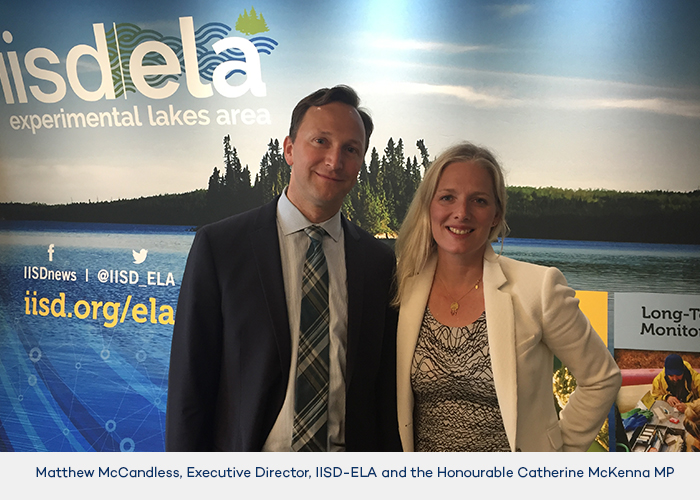
The Honourable Catherine McKenna, Canada’s Minister of Environment and Climate Change, impressed IISD staff by biking through the rain for a meeting at our Winnipeg headquarters on Thursday, May 26, 2016.

It was a great way for her to see some of the city’s sites—such as the Canadian Museum for Human Rights—and also to express her commitment to taking both small and larger actions on climate change.

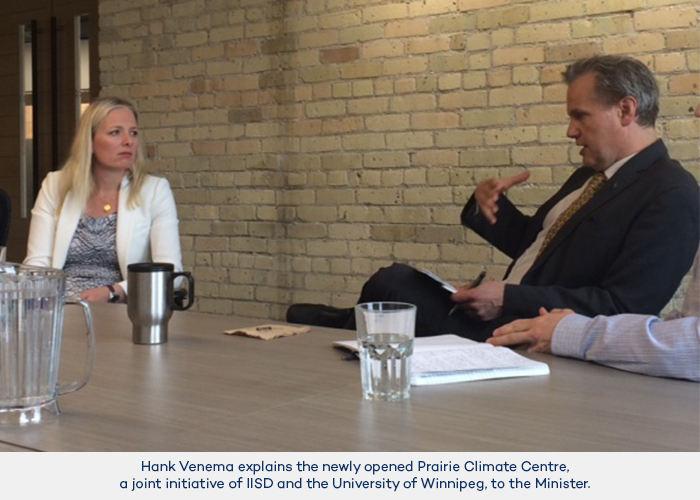
Minister McKenna used her visit to learn more about IISD’s work at IISD Experimental Lakes Area and the Prairie Climate Centre, our efforts to manage freshwater resources, and our work on climate change adaptation and mitigation; energy; resilience; bioeconomy and comprehensive wealth.

“You’re doing great work. It makes me really happy,” Minister McKenna told IISD research staff.

“We have really great people working really hard [in government]. But it is quite clear we need support and we need to be working in partnership with great organizations that are also focused on evidence-based approaches,” she added.

“We can’t do all of this on our own and you are out in the field doing some really great work.”

Minister McKenna praised IISD’s efforts to work in partnership with other organizations such as the Lake Winnipeg Foundation and said this type of coordination is critical to achieving results.

“We need to think more strategically about how do we make sure there’s an overlap and that everyone’s sharing the information and the data,” she said.

She also described the Government of Canada’s efforts to work with provinces and territories to take action on climate change, put a price on carbon and reduce carbon pollution.

“My focus is to get the best ideas and bring people together and really create momentum around climate change,” Minister McKenna said, describing the need to develop an “ambitious but realistic vision.”

“That’s the only way we’re going to get serious action on this.”

Insight details

Region
Canada
Insight

Financing Adaptation and Resilience Through Fossil Fuel Subsidy Reform and Fuel Duty

On Tuesday, 24 May 2016, the event “Financing Adaptation and Resilience Through Fossil Fuel Subsidy Reform and Fuel Duty” took place in Bonn, Germany.

May 24, 2016

On Tuesday, 24 May 2016, the event “Financing Adaptation and Resilience Through Fossil Fuel Subsidy Reform and Fuel Duty” took place in Bonn, Germany.

Organized by the International Institute for Sustainable Development (IISD), discussions explored options for increasing domestic resources for adaptation through using fiscal instruments: savings from fossil fuel subsidy reform and revenues from fuel duties. Examples from Costa Rica and from the National Adaptation Plan (NAP) Global Network and Friends of Fossil Fuel Subsidy Reform (FFSR) were also presented.

Insight details

Topic
Subsidies
Insight

Channeling the Flow—Rising to the Reporting Challenge for the 2030 Agenda

The plan of action set out in the 2030 Agenda for Sustainable Development requires implementation by all countries and stakeholders, acting in collaborative partnership. That action will not happen by itself. We have less than fifteen years to transform the world, and the task is complex.

May 23, 2016

The plan of action set out in the 2030 Agenda for Sustainable Development requires implementation by all countries and stakeholders, acting in collaborative partnership. That action will not happen by itself. We have less than fifteen years to transform the world, and the task is complex.

How will we know if we are making adequate progress? And how will we identify the obstacles that will necessarily need to be removed if we are to reach the level of ambition set out in the 2030 Agenda?  The answer is set out in the Agenda itself—largely in paragraphs 72 through 91. The high-level political forum on sustainable development (HLPF) is the apex of a pyramid for follow-up and review. If the other parts are not robust, however, the structure will collapse. One of the essential building blocks is the flow of information to the HLPF.

States agreed on a stream of progress reports from the national and regional levels as well as an annual synthesis report, a periodic Global Sustainable Development Report, and a myriad of other reports by UN entities and other international organizations, as well as reports on themes and on thematic clusters.  And these reports are only the ones specifically called for. It is likely that stakeholders will voluntarily submit a range of further reports of different levels of complexity and specificity. 

The challenge will not be the lack of information on which to assess progress, but the veritable blizzard of reports that will fall on New York in preparation for the HLPF.  There is still a great deal of work to be done in working out how this flood of information will be filtered and synthesized, who does the work, what is submitted to the HLPF and what is targeted elsewhere—most prominently at the United Nations Economic and Social Council.

The principal responsibility for implementing the SDGs lies with the UN Member States. Their periodic progress reports provide the fundamental building materials with which the follow-up and review system will be constructed. So the first lesson to stakeholders is that a strong focus must be given to making these reports as comprehensive, as sharp, as comparable and as practical as possible. This objective means designing and implementing adequate stakeholder consultation. It means a strong effort by international players not only to support the national process but to feed it with relevant, up-to-date information that often lies in their knowledge bases or in the world of big data. And it means adapting the framework of indicators so that it is useable at the national level.

The next key step is at the regional level, where the national reports must be aggregated and the key findings distilled to be passed upward for discussion and action at the HLPF.  This is the level at which practical, mutual learning can take place, assisted or not by peer review. It is also the level at which the particular needs and concerns of the regions can be crystallized and articulated, contributing to the richness and diversity of the picture presented in New York. The Secretary General’s synthesis can draw on these regional reports and complete the edifice.

This much is relatively straightforward, at least conceptually. Much less so is how the other streams merge and are integrated with the bottom-up stream coming from the base—from the implementation front. A great deal of creativity in design and process will be needed to avoid overwhelming the HLPF with information and drowning ministers in ‘white noise.’ This challenge is, first and foremost, one for the UN system and one that relates closely to ‘fitness for purpose’ and systemic coherence in rising to the challenge of the 2030 Agenda. Here multiple processes are underway at many levels to reconfigure the system around this challenge.

Even if this reconfiguration occurs, however, it will be far from sufficient. Indeed, there is a basic fallacy in the all-too-common assumption that the 2030 Agenda is primarily a matter for government action, ably assisted by a harmonious family of intergovernmental entities at the global and regional level.  While government action is essential, successfully reaching the finish line in 2030 will depend to a very considerable extent on the mobilization not only of the full range of stakeholders in the private sector, in civil society and in sub-national jurisdictions. It will depend also on tapping into the universe of data, understanding and innovative spirit increasingly in evidence outside formal government structures. This information mobilization will require a cultural shift in the intergovernmental process that is earth-shaking in its implications and that has not yet seriously been considered beyond the usual and half-disingenuous statements on the need for full stakeholder involvement and for innovative partnerships.

Steps that are needed now include stronger guidelines or templates for reporting to the HLPF in a way that allows other organizations to extract the information that might be relevant for them, and to include it in an online searchable database accessible to everyone. We suggest that any body submitting information to the HLPF might follow a simple template covering:

(a) an assessment of areas of progress and setback at the global level;

(b) the identification of areas requiring urgent attention;

(c) valuable lessons learned;

(d) emerging issues;

(e) links to the 2030 Agenda as whole, and the annual theme of the HLPF;

(f) areas where political guidance is required; and

(g) policy recommendations and tools to accelerate progress.

Perhaps it is not surprising that we are struggling with this shift in how to generate and present information.  Everyone, at all levels, is contemplating the dimensions of the challenge we have set for ourselves, and trying to work out how on earth we will meet expectations.  We have a short time left to configure the follow-up and review process before focusing solidly on the task of implementation.  Designing a comprehensive but manageable follow-up and review system is central to whether or not we succeed.  

Insight details