The National Adaptation Plan (NAP) Global Network supports developing countries to advance their NAP processes to help accelerate climate change adaptation efforts around the world.
The Network was established in 2014 at the 20th session of the Conference of the Parties (COP 20) in Lima, Peru, initiated by adaptation practitioners from 11 developing and developed countries. Today, the NAP Global Network connects over 1,400 participants from more than 150 countries working on national adaptation planning and action, and has delivered direct support to more than 40 countries. Financial support for the Network has been provided by Austria, Canada, Germany, and the United States. IISD hosts the Network's Secretariat.
Our vision is a world where communities and countries—particularly the poorest and most vulnerable—are able to articulate, work toward, and realize their development aspirations in a changing climate. This is possible by having robust adaptation planning processes that are:
Aligned with development priorities and plans.
Effective in channelling resources to the people, places and systems that need them most.
Our mission is to harness the collective knowledge and resources of governments, practitioners, donors, and civil society to build capacities and accelerate the formulation and implementation of NAP processes.
Enabling Voices, Demanding Rights: A guide to gender-sensitive community engagement in large-scale land-based investment in agriculture
This guide was prepared jointly by IISD and Oxfam in response to the adverse impacts that large-scale land-based investments in the agricultural sector have often had on women. It also provides suggested options that communities can use to respond to this challenge.
This joint IISD-Oxfam guide was designed in response to the long-standing challenges that women have faced as a result of large-scale land-based investments in the agricultural sector.
It sets out different "entry points" for communities to get involved in the decisions around such investments, with these "entry points" linked to different stages in that process. It clarifies how the guide can be used and what contexts might be appropriate. The guide is also informed by consultations undertaken in various countries regarding community engagement efforts.
The blog by EMILIO CATTANEO, “ Kigali Water: Lessons from one of sub-Saharan Africa’s first water PPPs,” offers insight into the blended financing structure of a public–private partnership (PPP) for water supply in Kigali, Rwanda. The financiers included the African Development Bank, the Emerging Africa Infrastructure Fund (EAIF), the Technical Assistance Facility (TAF) and DevCo (the specialist PPP advisory facility operating through Private Infrastructure Development Group and implemented by the International Finance Corporation). Of particular note is the USD 6.5 million viability gap fund provided by TAF. This enabled the lowering of upfront costs that enabled the Government of Rwanda to expand the number of people connected to the water purification plant while not raising tariffs on water.
Though the blog does not elaborate on the all-important demand and revenue pricing and related risks, it does offer insight into some of the complexities of financing and delivering on water PPPs. It also brings up the difficult question of the pricing of water. Indeed, we question if subsidies for water supply should be accompanied by incentives to reduce water use, decouple water from sanitation and, above all, increase charges and markets for waste water.
The large-scale water treatment plant, due for completion in 2020, will produce 40 megaliters of clean water per day, equivalent to one-third of Kigali's total supply. Water will be drawn from the Nyabarongo River to be treated before distributing a clean supply to up to 500,000 domestic, commercial, and industrial customers. Kigali Water is one of the first water projects to be developed using a public-private partnership (PPP) model in sub-Saharan Africa.
Three PIDG companies—The Emerging Africa Infrastructure Fund (EAIF), the Technical Assistance Facility (TAF), and DevCo—helped to finance the project at different stages of its development. Having previously backed Rwanda’s ground-breaking Gigawatt Solar and Kivu Watt, PIDG company EAIF was well-placed to arrange long-term finance to support developer Metito, a global provider of water management solutions with 60 years’ experience developing and managing water facilities in emerging markets.
Below are four key lessons learned that can help build on Kigali’s success.
Coordinated blended finance
Kigali Water benefited from a well-coordinated package of blended finance. EAIF led the arrangement of financing for the US$61 million plant, providing a US$40 million, 18-year-long term loan jointly with the African Development Bank and securing investment from other PIDG companies to galvanize a development, which otherwise may not have succeeded. DevCo—the specialist PPP advisory facility operating through PIDG and implemented by IFC—provided funding to help structure the transaction and its competitive tender. TAF granted US$6.5 million in crucial viability gap funding to reduce up-front costs and allow the government to expand the number of people connected to a reliable water supply without raising tariffs. 150,000 customers are expected to benefit in the first phase. This combined support gave developer Metito and the Rwandan Government the necessary assurance and security to proceed with an innovative plan that was affordable for all parties, including end users.
Focused on impact
The original scope of the project included distribution infrastructure such as pumping stations, reservoirs and piping, which would be vital to realizing its full impact. But during development it was discovered that it would be more efficient for the municipal utility to deliver part of this infrastructure. An agreement was reached between Metito and the government to split the construction of the production and distribution infrastructure, delivering the latter through Rwanda’s water utility WASAC, supported by a separate financing package from the Government of Rwanda and the African Development Bank. By considering water production and distribution holistically, and finding pragmatic financing solutions, the project retained key elements that will benefit users in surrounding communities.
Communication is key
It may seem overly simplistic, but clear communication between stakeholders was essential. Regular in-country meetings between the government, lenders and developers helped steer an inclusive, consultative path through delicate PPP negotiations. Having a strong team on the ground enabled partners to anticipate and mitigate issues in consultation with the developer and government.
Can Agricultural Growth Poles Solve Rural Poverty in Africa?
What are agricultural growth poles? Could they help solve rural poverty in Africa? Francine Picard explores...
February 20, 2018
African governments are deploying a new development tool: growth poles aimed at kickstarting the shift from subsistence to commercial agriculture.
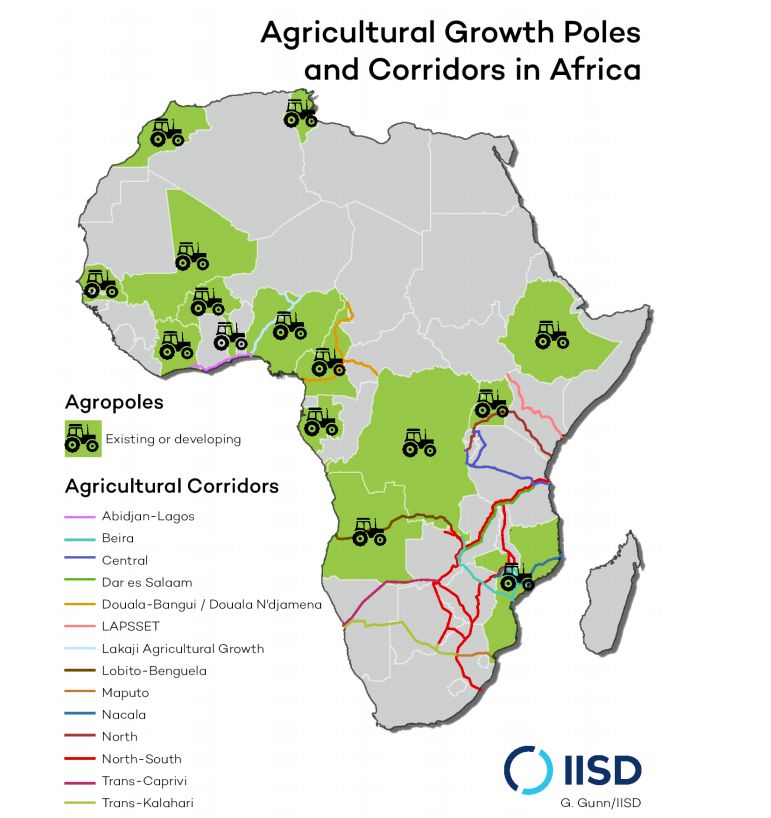
Over a dozen agricultural growth poles, or “agropoles,” were established in the past four years, bringing the total to 36 growth poles and 9 corridors since 2002. They cover at least 3.5 million hectares of land in 23 countries, our research has found.
What is an agricultural growth pole?
The theory behind agricultural growth poles makes a lot of sense. First, identify a potential "breadbasket." Then, develop a public-private partnership to invest in the infrastructure needed to spur agricultural transformation through roads, food storage facilities, electrification, irrigation and food processing plants. Help local farmers get access to training, financing, equipment and markets. Work with local communities to identify large tracts of land that can be farmed for commercial crops. The ultimate intended outcomes will be to increase production, reduce crop loss and create good jobs.
Over a dozen agricultural growth poles, or “agropoles,” were established in the past four years, bringing the total to 36 growth poles and 9 corridors since 2002.
Why is this happening now?
Agriculture is increasingly seen as the driving force for economic transformation in Africa. In 2014 African heads of state committed to eradicating hunger and rural poverty through a transformation of African agriculture. The growth pole strategy is spearheaded by African governments, with financial and technical support from regional and multilateral organizations such as the African Development Bank, the United Nations Industrial Development Organization and the World Bank.
Are agropoles just another land grab?
The 2007–08 food crisis led to a dramatic increase in large-scale investments in agricultural land. Foreign investors gained the right to more than 50 million hectares of land—an area larger than Germany—in more than 1,500 land deals, according to the Land Matrix. Land conflicts erupted across all continents.
If done correctly, agropoles could potentially avoid many of the negative impacts associated with the ill-designed deals that became known as land grabs. But if done wrong, many of the same problems could arise.
Agriculture is increasingly seen as the driving force for economic transformation in Africa.
Do agricultural growth poles work?
It is too early to talk about the success or failure of agricultural growth zones, but there are cases where countries are facing operational constraints. A lack of investment, weak strategies, poor coordination, governance challenges, a lack of available land and insufficient considerations are some of the factors identified in our research.
What can governments do to make agricultural growth poles succeed?
We are working to strengthen the legal frameworks of agricultural growth poles.
We have also identified a number of potential risks to avoid negative outcomes—including stabilization provisions and tax incentives—and outlined three key stages in the development of a responsible agricultural growth pole: vision, design and implementation.
Engagement with local communities and small-scale farmers, particularly women, is critical at all stages of the process to ensure that they are properly consulted, participate in decision making and are integrated into new projects. Transparency is also critical at all stages.
A clear vision
A strong agricultural development plan will help ensure the success of an agricultural growth pole. This plan must identify the types of sectors, crops and processing facilities to prioritize, and therefore the types of companies to attract. It requires the identification of land and water needs, including assessing the availability of land, water and soils, and mapping out all legitimate land users with formal and informal rights, in line with the Committee on World Food Security (CFS) Voluntary Guidelines on the Responsible Governance of Tenure of Land, Forests and Fisheries. It requires the identification of investment needs that will contribute to food security, decent employment and responsible management of natural resources, in line with the CFS Principles for Responsible Investment in Agriculture and Food Systems.
African governments are deploying a new development tool: growth poles aimed at kickstarting the shift from subsistence to commercial agriculture.
A strong design
Many investments fail for reasons that could have been identified prior to the commencement of operations. Screening of potential investments and investors does more than reduce the risk of failure—it also helps ensure the projects selected are most likely to deliver positive development benefits. The design stage requires the preparation of business feasibility studies, including commercial, financial and environmental feasibility, and the development of a business plan based on the outcome of those studies. Environmental and social impact assessments and management plans are also a necessary component of the design phase. Accessible, transparent and culturally appropriate grievance mechanisms should be implemented during the design phase to deal with concerns from employees and the local communities and to resolve disputes arising between the investor and the government or other stakeholders.
Good implementation
Implementation of agropoles, including monitoring and enforcement, can be the most challenging stage for governments because of limited resources and capacity. Setting aside a percentage of the revenue from investors can help ensure that the government and the agency responsible for the growth pole has the capacity to monitor and evaluate the project effectively. Setting out clear reporting requirements and indicators will ensure the government or agency can regularly track whether the investor is fulfilling its development and environmental obligations and its commitment to the local community. Compliance can also be strengthened through processes involving local communities and farmers.
The Rise of Agricultural Growth Poles in Africa: Investment in Agriculture Policy Brief #6
Africa has seen the emergence of 36 agricultural growth poles and 9 corridors over the past 15 years. They cover at least 3.5 million hectares of land in 23 countries. Ensuring that the new wave of agropoles and growth corridors is effective requires robust policies, laws and practices to ensure that a possible new trend of investment helps Africa achieve the sustainable development goals the continent has set.
Africa has seen the emergence of 36 agricultural growth poles and 9 corridors covering at least 3.5 million hectares of land in 23 countries. Ensuring they are effective tools to promote agro-industrial development requires robust policies, laws and practices.
A number of African governments see these growth poles and corridors as a way to attract private investment to promote agricultural transformation. They are also seen as a way to counter the negative impacts and publicity that resulted from leasing large tracts of farmland to investors, commonly referred to as “land grabs.”
Agriculture is increasingly seen as the driving force for economic transformation in Africa. Increasing investment flows into agriculture and food systems in developing countries is desperately needed. Over 800 million people go to bed hungry every night, of whom 70 per cent live in rural areas and depend on agriculture for their livelihoods. When done right, increased investment can help boost production, generate employment, increase incomes and promote economic development. But when done badly, it can exacerbate existing inequalities, undermine the livelihoods of small-scale farmers, and significantly deplete land, water, soil and other natural resources.
Many attempts to attract responsible and sustainable investment to African agricultural have failed. Ensuring that the new wave of agropoles and growth corridors is effective requires robust policies, laws and practices to ensure that a possible new trend of investment helps Africa achieve the sustainable development goals the continent has set.
This policy paper identifies challenges and opportunities of current agricultural growth poles, outlines the role of laws, policies and institutions and describes three key stages for the development of a responsible agricultural growth pole.
Président du Parlement panafricain: « Je crois en une Afrique, une voix. Je crois en l'intégration du continent. »
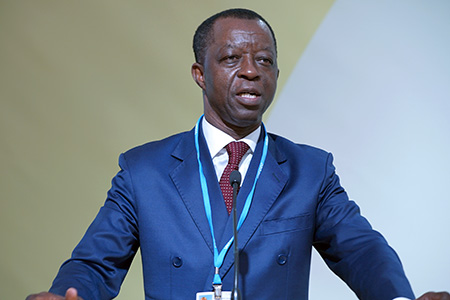
« Je crois que l’Afrique possède les forces vives et la volonté de relever les défis qui jalonnent son parcours. Je crois en une Afrique, une voix; je crois en l’intégration du continent. »: Son Excellence l’honorable Nkodo Roger Dang, Président du Parlement panafricain, partage ses pensées sur l’intégration régionale.
August 21, 2017
Les États et les rapports entre États, que l’on a parfois tendance à considérer comme particulièrement stables, singulièrement en Occident, ont été l’objet de chocs directs ou indirects qui, bien qu’annoncées par des signes avant-coureurs, ont des conséquences qui sont tout autant difficiles à évaluer.
Le Brexit, avec en toile de fond la montée des nationalismes en Europe, ou encore l’élection de Donald Trump aux États-Unis et la politique de l" « America First », témoigne d’un mouvement de repli sur soi-même susceptible d’infléchir l’intégration croissante qu'avance une mondialisation d’inspiration libérale.
En parallèle, les pays en voie de développement expriment plus ouvertement, et comme une nécessité, une volonté d’ouverture et d’expansion. Ainsi, l’Agenda 2063 exprime la volonté de voir naître une Afrique politiquement unie, sécuritaire et économiquement intégrée au sein d’un marché commun qui porterait le développement inclusif du continent.
Son Excellence l’Honorable Nkodo Roger Dang
Président du Parlement panafricain
J’aime à reconnaître en l’aspiration 2 de l’Agenda 2063 qui traite de l’intégration régionale du continent une motivation fortement personnelle. Et il m’est d’autant plus réjouissant que le Parlement panafricain poursuive, face à ces nouvelles dynamiques mondiales, une réflexion sur le thème « La problématique de l’intégration politique et socio-économique du continent africain: le rôle du Parlement Panafricain », réflexionqui donnera lieu à une rencontre du 22 au 26 août 2017 à Yaoundé.
L’intégration politique et économique de l'Afrique sont « inextricablement liées ». Elles passent par la démocratisation des organisations régionales africaines, par une circulation des personnes et des biens facilitée et surtout, elle passe par la formulation de réponses communes aux enjeux collectifs auxquels le continent doit faire face tels que le VIH/sida, le changement climatique, l’éducation ou la pauvreté.
L’intégration régionale politique telle qu’elle se déroule sur le continent résulte d’une dynamique qui est en phase avec les déclarations d’intention en faveur d’un idéal politique panafricain. L’architecture institutionnelle de l’Union africaine dispose en effet d’organes pour assurer l’équilibre entre le législatif, le judiciaire et l’exécutif.
Il faut reconnaître que bien des avancées ont été réalisées : la CEDEAO délivre un passeport commun pour faciliter les voyages intra-États. Les pays africains progressent aussi dans le sens d’une meilleure coordination de leurs politiques sectorielles (agriculture, électricité, eau, et cétéra) et ceci vaut promesses de belles perspectives en matière d’intégration continentale. Il n’en demeure pas moins que le bilan économique reste mitigé. Le volume du commerce intra-africain a constamment augmenté au cours des 20 dernières années, mais ne représente toujours que 12 pourcent du commerce total en Afrique contre 60 pourcent pour l’Union européenne. Plusieurs obstacles à l’intégration comme le manque d’infrastructure, la lourdeur des procédures administratives, les contrôles aux frontières ainsi que la corruption sont autant de chantiers sur lesquelles nous devons travailler.
Une intégration plus avancée, ne peut se ráliser sans les transferts de pouvoirs vers des entités supranationales. Le Parlement panafricain, tout en affirmant son attachement indéfectible à la souveraineté nationale, prérogative des États, ne peut être fonctionnel et opérationnel qu’en exerçant le mandat qui lui échoit. La ratification du Protocole à l’Acte constitutif de l’Union Africaine relatif au Parlement panafricain est l’un des impératifs qui sous-tendent un tel progrès.
Je crois que l’Afrique possède les forces vives et la volonté de relever les défis qui jalonnent son parcours. Je crois en une Afrique, une voix. Je crois en l’intégration du continent.
Son Excellence l’honorable Nkodo Roger Dang, Président du Parlement panafricain, a partagé ses pensées sur l’intégration régionale avec notre Bulletin Perspectives en vues des conférences régionales que le Parlement panafricain organise du 22 au 26 août 2017 à Yaoundé.
sNAPshot | Developing Capacity for Subnational Adaptation Action in the Republic of the Sudan
This sNAPshot policy brief explores Sudan's approach to developing capacity for subnational adaptation action, which supports the National Adaptation Plan (NAP) process.
The Republic of the Sudan is highly vulnerable to climate change. Recognizing the importance of climate change adaptation for its development progress, Sudan was one of the first developing countries to submit its National Adaptation Plan (NAP) document to the United Nations Framework Convention on Climate Change (UNFCCC).
Building on an earlier overview brief, this sNAPshot policy brief from the NAP Global Network focuses on a unique feature of the Sudan NAP: its emphasis on subnational adaptation action, led by state governments. This makes it an interesting example of vertical integration, which is the process of creating intentional and strategic linkages between national and subnational adaptation planning, implementation, and monitoring and evaluation (M&E).
sNAPshot | Information Sharing for Adaptation Planning at Subnational Levels: South Africa's Let's Respond Toolkit
This sNAPshot policy brief explores South Africa's approach to information sharing in the National Adaptation Plan (NAP) process to promote vertical integration, which is the process of linking national and subnational adaptation planning, implementation, and monitoring and evaluation.
Recognizing the important role played by provincial and local actors in addressing climate change vulnerability, South Africa has demonstrated a strong commitment to vertical integration, the process of linking national and subnational adaptation planning, implementation, and monitoring and evaluation (M&E).
Building on an earlier overview brief, this sNAPshot policy brief from the NAP Global Network focuses on information sharing, using South Africa’s Let’s Respond Toolkit as an example of how web-based platforms can be used for sharing information between different levels of government, as well as with non-governmental stakeholders.
Human migration is playing a significant role in driving land conversion and sustaining the overexploitation of key natural resources in the Misotshi–Kabogo ecosystem, to the detriment of conservation and traditional livelihoods.
The ecosystem is found in the eastern Democratic Republic of Congo (DRC), in the lower portion of the Albertine Rift, one of the most species-rich regions of Africa. Misotshi–Kabogo does not yet have formal protection, but is of great importance to the survival of local species due to the fact that forests in the ecosystem’s altitude range are increasingly rare in the DRC. Migrants have begun to arrive in the region, drawn by perceptions of abundant arable land and the return of security. The corresponding increase in local population, and the migrants’ livelihood choices, threaten to have a significant impact on the ecosystem.
This report presents an assessment of the migration context in the Misotshi–Kabogo ecosystem, as well as suggested response strategies. IISD and the Wildlife Conservation Society conducted the research with the generous support of the MacArthur Foundation. The research is part of the “Migration and Conservation in the Great Lakes Region” project, which attempts to address migration and conservation issues by: (a) developing a methodology to better understand the drivers and impacts of migration on critical natural resources, ecosystems and livelihoods in the Great Lakes region; (b) identifying effective responses for policy-makers and practitioners working on these issues; and (c) catalyzing further research and policy engagement on the topic in the region.
For centuries, people in east and central Africa have used migration as a strategy to respond to shocks, sustain livelihoods and adapt to changes in their environment.
Conservation actors, including both policymakers and practitioners, are not fully aware of the dynamics of migration and the potential impacts on ecosystems and biodiversity. The “Migration and Conservation in the Great Lakes Region” project attempted to address this gap by: (a) developing a methodology to better understand the drivers and impacts of migration on livelihoods, natural resources, ecosystems and biodiversity; (b) developing recommendations for policy-makers and practitioners working on these issues; and (c) developing a toolkit for conservation practitioners to help them design and implement conservation interventions that are sensitive to the existing and potential impacts of human migration on critical ecosystems.
To achieve these objectives, the project carried out research at three case study sites: the Bale Mountains ecosystem in southern Ethiopia, the Misotshi–Kabogo ecosystem in the eastern Democratic Republic of Congo (DRC), and the Lake Albert ecosystem in Buliisa District in northwest Uganda. The purpose of this document is to synthesize learning from the three case studies and provide analysis and recommendations for addressing the impacts of human migration on ecosystems. It is intended for conservation practitioners working in areas under pressure from migration, as well as development practitioners interested in gaining a better understanding of migration–conservation links.