COP 28 Side Event | A Strategic Imperative: Advancing climate-sensitive peacebuilding
December 3, 2023 9:45 am - 10:45 am GST (GMT+4)
U.S. Center
(Open to public)
Many of the world’s most fragile and conflict-affected countries are in regions most vulnerable to the impacts of climate change. This event will examine opportunities for aligning peacebuilding and adaptation objectives, highlighting perspectives from countries and development agencies, like the United States Agency for International Development, who are confronting these twin challenges on the ground. Discussions will focus on moving beyond rhetoric, speaking to the practicalities of integrating conflict sensitivity and peacebuilding into adaptation efforts.
COP 28 Side Event | Accelerating Impact: Implementing learning in climate change adaptation policy
December 2, 2023 1:15 pm - 2:30 pm GST (GMT+4)
The Commonwealth Pavilion
(Open to public)
The Paris Agreement emphasizes learning and ambition through initiatives like the Global Stocktake and the Global Goal on Adaptation. These should bolster national monitoring, evaluation, and learning (MEL) systems that influence global objectives and align with national plans like NAPs and NDCs. However, learning is frequently sidelined in policy and MEL cycles. Active efforts are required to foster learning in national policies, and sharing notable examples is crucial.
This panel will bring together governments from Commonwealth countries—including Belize and Fiji—to examine what governments and other actors have learned from implementing climate adaptation in the context of NAP processes, the factors that drove or contributed to learning, and challenges in knowledge.
COP 28 Side Event | Strategic Communications for NAP Implementation: Lessons from three francophone countries
December 1, 2023
Madagascar Pavilion
(Open to public)
A strategic approach to communications is critical for governments to further engage stakeholders and civil society in the implementation of their NAPs. This session will feature the experiences of three francophone countries—Central African Republic, Haiti, and Madagascar—in disseminating and promoting their NAP documents by using creative and strategic approaches to craft engaging key messages and target audiences through diverse channels. This event will be held in French, with simultaneous interpretation in English.
COP 28 Side Event | Gender-Responsive Adaptation Action: Progress in NAP processes
December 1, 2023 4:00 pm - 5:00 pm GST (GMT+4)
Canadian Pavilion
(Open to public)
The Paris Agreement acknowledges the need for adaptation action to be gender-responsive, recognizing gender differences in adaptation needs and capacities, ensuring equitable participation and influence in decision making, and achieving gender-equitable distribution of benefits resulting from adaptation investments, including finance
This session will provide an update on the progress made in mainstreaming gender considerations into NAP processes globally. It will also showcase the efforts of three francophone countries supported by the NAP Global Network—Côte d’Ivoire, Haiti, and Senegal—to address gender inequalities through adaptation action.
Government representatives from the three countries will participate in a panel discussion to highlight progress, discuss challenges, and share learning from the process. This event will be held in French, with simultaneous interpretation in English.
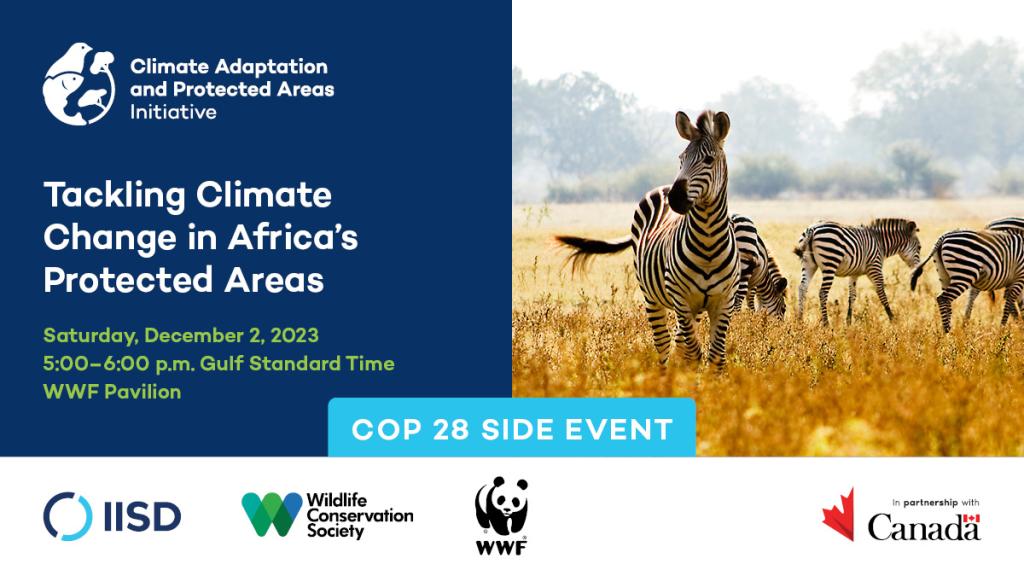
COP 28 Side Event | Tackling Climate Change in Africa's Protected Areas
December 2, 2023 5:00 pm - 6:00 pm GST (GMT+4)
WWF Pavillion
(Open to public)
Taking place on Africa Day, this event, hosted jointly by WWF’s Regional Office for Africa and IISD, will focus on climate change challenges in protected areas, showcasing the Climate Adaptation and Protected Areas (CAPA) Initiative, funded by Canada’s Partnering for Climate Initiative. It will provide a space to unpack the complexity of climate change impacts and potential interventions, including through nature-based solutions. This event will also highlight the benefits of transboundary protected areas to enhance adaptation, biodiversity conservation, and development cooperation among neighbouring countries.
Speakers:
Evelyn Namubiru-Mwaura, Director, Program Quality and Resource Acquisition, WWF International
Andrew Hurst, Executive Director, Climate Finance, Global Affairs Canada
Alec Crawford, Director, Nature for Resilience, IISD
Harisoa Hasina Rakotondrazafy, WWF Madagascar and West Indian Ocean Programme Office
Her Worship Gladys Kamasanyu, Chief Magistrate, Uganda Wildlife Court
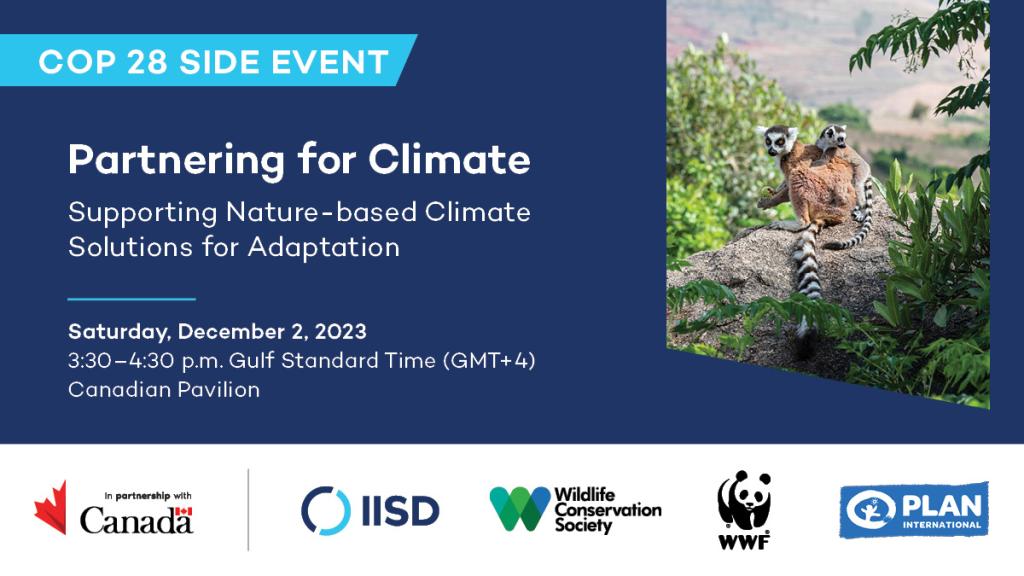
COP 28 Side Event | Partnering for Climate: Supporting Nature-based Climate Solutions for Adaptation
December 2, 2023 3:30 pm - 4:30 pm GST (GMT+4)
Canadian Pavilion
(Open to public)
This event, hosted jointly by Global Affairs Canada and IISD, will highlight Canada’s leadership on climate finance through the Partnering for Climate initiative and include interactive exchanges between Partnering for Climate project hosts and an international audience. It will feature IISD-led projects, such as the Climate Adaptation and Protected Areas (CAPA) Initiative and the Scaling Urban Nature-Based Solutions for Climate Adaptation in sub-Saharan Africa (SUNCASA) initiative, as well as Plan International Canada’s project: Conservation and Sustainable Management of Coastal and Marine Ecosystems (COSME) in Kenya. This event seeks to demonstrate the implementation potential and stories of nature-based solutions for adaptation in Canada, sub-Saharan Africa, and Small Island Developing States, as well as Canada’s role in accelerating global climate action.
Speakers:
Andrew Hurst, Executive Director, Climate Finance, Global Affairs Canada
Alec Crawford, Director, Nature for Resilience, IISD
Evelyn Namubiru-Mwaura, Director, Program Quality and Resource Acquisition, WWF International
Jeffrey Qi, Policy Advisor, Resilience, IISD
Kristen Ostling, Senior Advisor, Policy and Advocacy, Plan International Canada
To learn more, visit the Canadian Pavilion event page here. [Please note that the official page is being updated to reflect changes from Parks Canada to Plan International Canada]
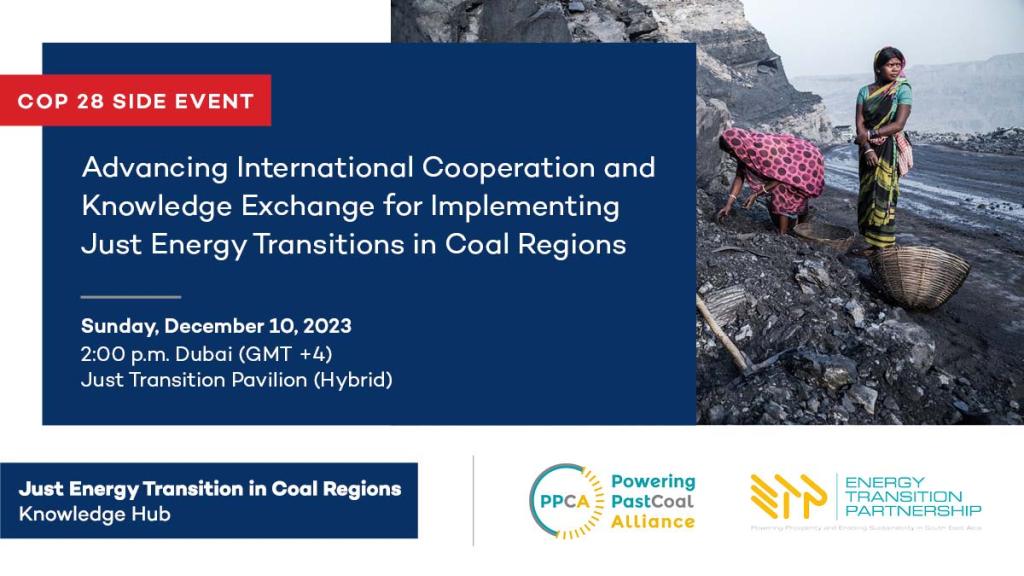
COP 28 Side Event | Advancing International Cooperation and Knowledge Exchange for Implementing Just Energy Transitions in Coal Regions
December 10, 2023 2:00 pm - 2:50 pm GST
In-person at the ILO Pavilion and online
(Open to public)
While transitioning away from coal-based energy systems and dependent local economies is critical, ensuring a just transition, particularly in the Global South, is challenging. Bringing together various stakeholders, this COP 28 panel will discuss how partnerships, including the Just Coal Transition Platform and the Powering Past Coal Alliance, foster collaboration and knowledge exchange across countries and how the new Just Energy Transition in Coal Regions Knowledge Hub serves as a digital “one-stop shop” on just energy transition.
The event is co-organized by Innovation Regions for a Just Energy Transition (IKI JET) partners, the Powering Past Coal Alliance, and the Energy Transition Partnership. It will take place in the International Labour Organization pavilion at COP 28 in Dubai, United Arab Emirates.
Agenda
Opening Remarks
Lutz Morgenstern, Head of Division, Federal Ministry for Economic Affairs and Climate Action, Germany
Stefano Signore, EU Commission
Presentation About the Just Energy Transition in Coal Regions Knowledge Hub
Jonas Kuehl, Policy Analyst, International Institute for Sustainable Development
Panel Discussion
Moderator: Christopher Beaton ,Director, Energy Program, Public Financial Flows, International Institute for Sustainable Development
Felipe Corral, Just Energy Transition Advisor, Colombia
Camilla Roman, Policy Specialist, Green Jobs Programme, International Labour Organization
Anabella Rosemberg, Senior Advisor on Just Transition, Climate Action Network International
Diana Junquera Curiel, Director, International Trade Union Confederation
Achmed Edianto, Indonesia Country Coordinator, Energy Transition Partnership
Closing Remarks
Binnu Jeyakumar, Senior Advisor, Powering Past Coal Alliance
Many areas around the globe have experienced large-scale damage caused by ongoing conflicts, extreme weather events, environmental degradation, and water stress. Reconstruction of these built environments is often taking place without supporting sustainability regulations. This leads to lower resilience of the newly built infrastructure to climate shocks and misses an opportunity to recover better, keeping in mind social, environmental, and economic aspects. To change this, sustainability has to be put at the forefront of recovery.
An assessment by the World Bank suggests that Ukraine's reconstruction and recovery from Russia’s aggression will cost more than USD 400 billion, with the highest estimated needs (50%) in the transport, housing, and energy sectors. Integrated into these needs are critical steps toward building Ukraine back better with an emphasis on transforming it into a modern, low-carbon, disaster- and climate-resilient country that is aligned with European Union policies and standards. With the massive scale of the damages, Ukraine is facing a big challenge in defining and implementing a sustainable and climate-friendly reconstruction.
In this COP 28 side event, international and Ukrainian experts will discuss frameworks, technologies, policies, and practical steps toward a sustainable reconstruction of infrastructure and the built environment after conflicts and disasters. Speakers will discuss how to reduce greenhouse gas emissions during reconstruction to avoid unnecessary climate impacts and share experience in planning reconstruction on national and city levels.
While there are commitments, agreements, and discussions within the United Nations Framework Convention on Climate Change (UNFCCC), G20, UN Sustainable Development Goals, Convention on Biological Diversity, and World Trade Organization (WTO), at a global level there has, so far, been limited progress on fossil fuel subsidy reform and on shifting public financial flows from fossil fuels to clean energy. There are, however, a number of domestic actions that have been taken by individual countries that serve as examples for moving from commitments to implementation.
Led by the Government of Finland on behalf of the Friends of Fossil Fuel Subsidy Reform, this event will first focus on domestic actions that countries are taking to act on their global fossil fuel subsidy reform commitments. Following this, the session will look at attempts to tackle fossil fuel subsidy reform across the climate and trade space, highlighting the actions being taken through UNFCCC processes and in the WTO, and focusing on the shared goals for reform from both perspectives that are influencing action at the domestic level. Speakers include Finnish Trade and Development Minister Ville Tavio and high-level speakers from Canada and the Netherlands, as well as experts from industry and think tanks.
Agenda
Opening Remarks
Ville Tavio, Minister for Development Cooperation and Foreign Trade, Finland
Steven Guilbeault, Minister of Environment and Climate Change, Canada
The 7th biennial Adaptation Futures Conference will bring together researchers, policy-makers, practitioners, industry representatives, and communicators in Montreal, Canada, and online to connect and share expertise about climate change adaptation.
October 2, 2023 1:00 pm - October 6, 2023 12:15 pm EDT
IISD is proud to be a partner of the conference, with our Associate Vice-President, Resilience, Anne Hammill, acting as co-chair. Experts attending the conference will explore new themes in the global adaptation community, expand the reach of their knowledge and support on key adaptation topics, and draw key connections between adaptation in Canada and internationally.
Events at Adaptation Futures 2023
Don’t miss the sessions we are attending or co-hosting during the conference. All times listed below are local.
Sessions Co-Organized by IISD
Reimagining the Adaptation Continuum to Include Loss and Damage
Tuesday, October 3, 11:00–12:30 | Room 524A | Session #875
Lead organizers: CJRF, IISD, ICCCAD
This session proposes to learn from experience implementing adaptation measures, showcasing examples of overlap between adaptation and loss and damage, and reimagining an Adaptation Continuum in which adaptation, disaster risk reduction, humanitarian action, and loss and damage can co-exist in ways that honour the reality of frontline communities’ lived experiences while also being useful to funders committed to loss and damage.
Multilevel Adaptation Governance in Dealing With Multiple Risks and Enabling Climate Action at Subnational Levels
Lead organizers: University of Regina, NAP Global Network/IISD
In this session, we will share experiences about the roles that different multilevel governance frameworks and institutions can play in enhancing participation in adaptation processes, as well as explore inter- and transdisciplinary approaches to co-construct evidence that can help clarify and overcome governance gaps.
Scaling up Ecosystem-Based Adaptation: Leveraging behavioral science for effective climate policy and action
Presenting work at the intersection of applied behavioural sciences and ecosystem-based adaptation (EbA), with examples ranging from Canada to Colombia, Fiji, and Kenya, this interactive session will showcase the critical role behavioural science should play in scaling up climate adaptation efforts and serve as an opportunity to better understand the various ways in which practitioners and policy-makers are approaching behaviour change for EbA.
Advancing Equity, Justice, and Indigenous Rights in Adaptation Through Canada’s National Adaptation Strategy – What is required for success?
Thursday, October 5, 8:30-10:00 | Room 525 | Session #730
Lead organizers: IISD, McGill University, University of Regina
Canada has committed to advancing equity and environmental justice, as well as upholding Indigenous rights, through the implementation of its National Adaptation Strategy (NAS). This session will explore different perspectives on the social dimensions of adaptation in Canada, addressing intersectional factors, including gender, disability, and Indigeneity. Speakers and participants will discuss what is needed for the NAS to be implemented in an inclusive, equitable, and Indigenous rights-based approach.
Scaling up Implementation of Community-Based Adaptation: Enablers and the way forward
Thursday, October 5, 14:00–15:30 | Room 524C | Session #115
Lead organizer: CARE Germany, FANRPAN, IISD, IUCN
This knowledge co-production session will explore how to scale up community-based adaptation using an inclusive, gender-responsive, and nature-based approach. In a knowledge café format, participants will be invited to actively engage in discussions around key issues such as governance mechanisms, gender equality and social inclusion, and generating evidence from community-based adaptation at the local level to inform national-level actions.
Sessions Attended by IISD
What Is Effective Adaptation, for Whom, and How Do We Know? Findings from adaptation policies, NAPs and M&E on vulnerability assessments, measurement, and effectiveness
Tuesday, October 3, 14:30–16:00 | Room 522 | Session #392
Lead organizer: Perspectives Climate Group GmbH
In Situ Conservation of Agrobiodiversity to Ensure Adaptive Capacity – Building on Indigenous and local knowledge from Andean Mountain ecosystems
Lead organizers: EUROCLIMA (GIZ / CLACDS-INCAE), NAP Global Network
Nature-based Solutions for Just Urban Adaptation – Case Studies from the Global South
Wednesday, October 4, 14:00–15:30 | Room 518C | Session #291
Lead organizers: GIZ, CitiesAdapt
Shaping the Future of Adaptation Monitoring, Evaluation, and Learning: New insights, tools, and opportunities for overcoming challenges and constraints
Find out more information about the full program and register for the conference on the Adaptation Futures website.
Media Opportunity
Experts will be available to speak about their research and experience with key adaptation planning elements, such as gender equality and social inclusion; monitoring, evaluation and learning; climate risk assessments; and governance.
To schedule an interview with our attending experts or for any background information, please contact Marie Royer at [email protected]