Webinar

London Climate Action Week | Avoiding a Zombie Recovery: Public money for clean energy, not for fossil fuels

November 16, 2020 9:00 am - 10:30 am EST

via Zoom

(Open to public)

EnergyPolicyTracker.org is a project by over 20 independent research organisations tracking public money commitments for both clean energy and fossil fuels in response to the COVID-19 crisis.

As of October 14, 2020, economic sectors responsible for production and consumption of fossil fuels received 52% of the public money commitments researchers tracked in the G20 and seven other countries. In other words, most governments have just continued what they were doing pre-pandemic, despite the Paris Agreement commitments: propping up zombie fossil fuel projects that would not be viable without their support.

But it’s still not too late to tip the balance toward a greener recovery.

That’s why, as part of London Climate Action Week, the Energy Policy Tracker partner organizations and their invitees will run an interactive session to respond to the following questions posed by the moderator:

Which G20 governments have achieved the most progress in phasing out support to fossil fuels, and what made it possible?
What are the most inspiring green recovery initiatives in the global North and South?
Do “green strings” work for bailing out fossil fuel projects?
How can public finance support green recovery in emerging and developing economies?

Moderator: Ivetta Gerasimchuk, International Institute for Sustainable Development

Panellists:

Mattias Frumerie, Ministry of Environment of Sweden
Tom Moerenhout, Columbia University
Anna Geddes, International Institute for Sustainable Development
Kanika Chawla, Council on Energy, Environment and Water
Elisa Arond, Stockholm Environment Institute
Laurie van der Burg, Oil Change International

Watch the full recording of this session

Webinar

Carbon Markets Virtual Pavilion | Resilient Recovery Through Fossil Fuel Subsidy Reform

It is critical to align climate ambitions with socioeconomic priorities. Unlocking revenues dedicated to fossil fuel subsidies can stimulate Paris Agreement-consistent COVID-19 recovery. This session highlights the role that energy price reform plays to increase ambition on climate change, as well as build back better from the current pandemic.

November 12, 2020 6:30 am - 7:30 am EST

via Zoom

(Open to public)

The narrative will be grounded by the interventions of international experts, including the group Friends of Fossil Fuel Subsidy Reform, a group of non-G20 countries across the global south and north aiming to build political consensus on the importance of fossil fuel subsidy reform through international cooperation.

A presentation will be given highlighting how the G20 is performing in meeting its fossil fuel subsidy reform efforts.  This ‘report card’ is intended to be launched only days before the event, which means this side session will be one of the first opportunities to review the work and discuss how countries are making progress (or not) on their reform commitments.

We will also bring forward the findings of the Energy Policy Tracker. The Energy Policy Tracker database is updated on a weekly basis, to provide the latest information about COVID-19 government policy responses from a climate and energy perspective. This analysis provides a detailed overview of the public finance flows as determined by recovery packages across the globe. 

Finally, a business perspective will also be provided on how pandemic recovery can spur low-carbon investment, if it is designed in the right way.

This panel discussion is part of the ICAP-IETA Carbon Markets Virtual Pavilion, and was co-organized by the International Institute for Sustainable Development, Friends of Fossil Fuel Subsidy Reform, and Switzerland Federal Department of Foreign Affairs.

Webinar

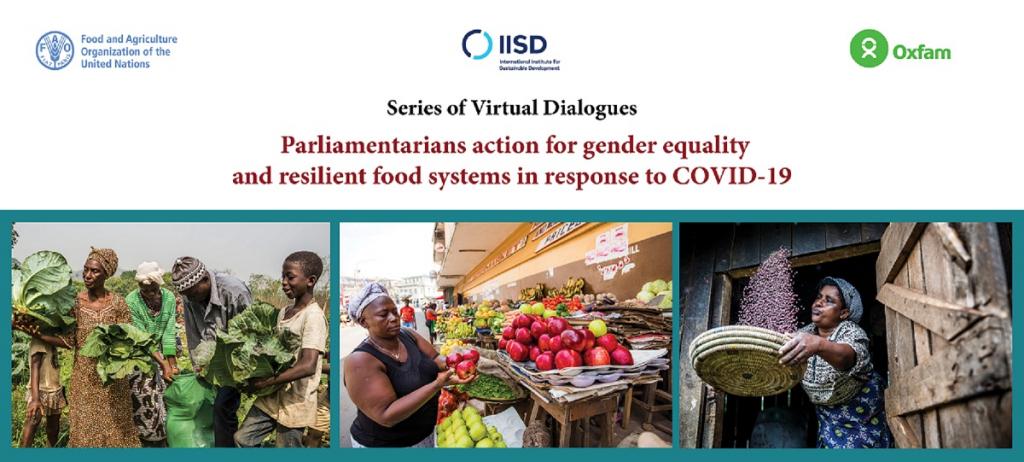
Parliamentarians Action #4 |Engaging young women and men in rural and agriculture development and resilience building in the face of COVID-19 and beyond

November 12, 2020 11:00 am - 1:30 pm CET

(Open to public)

joint banner fao oxfam iisd

Africa has the highest youth population in the world, with 218 million people aged between 15 and 24. This burgeoning youth population presents a great opportunity for harnessing a potential demographic dividend, but also economic and social challenges that can lead to political instability or conflict. With the COVID-19 crisis exacerbating the existing vulnerabilities of rural young women and men, better and more age- and gender-responsive policy and legislation become crucial. 

The fourth virtual dialogue in the Parliamentarians’ Action for Gender Equality and Resilient Food Systems in Response to COVID-19 series was held on November 12, 2020, from 11 a.m. to 1.30 p.m. 

This dialogue provided a space for parliamentarians, youth, and other stakeholders to discuss how to engage young women and men in our efforts to eradicate rural poverty, food insecurity, and malnutrition, as well as measures to foster youth empowerment, gender equality, and the Sustainable Development Goals. 

The specific objectives include: 
•    Raising awareness on the challenges faced by rural young women and men and the interlinkages with rural poverty and food insecurity, and potential opportunities to strengthen youth rights.
•    Sharing policies and strategies in the Economic Community of West African States (ECOWAS) region on youth employment in the agribusiness sector and enhance parliamentarians’ commitment toward the achievement of the SDGs, as well as the objectives of the ECOWAS regional support strategy to youth employability in the agro-sylvo-pastoral and fisheries sectors.
•    Promoting an exchange of experiences and good practices among parliamentarians, regional economic communities, youth organizations, and other stakeholders on approaches to empower rural young women and men and promote gender equality during and beyond the COVID-19 pandemic.

This virtual meeting was the fourth in a series of dialogues organized by the Food and Agriculture Organization of the United Nations (FAO), IISD, and Oxfam as part of their policy support to the ECOWAS Network of Parliamentarians on Gender Equality and Investments in Agriculture and Food Security. The objective of the series is to enhance the role of African parliamentarians in mitigating the gender-differentiated impacts of COVID-19 on food systems.

Watch the event's full recording

Event hashtag: #ParliamentAction2020

Webinar

IISD-UNIGE Webinar | Voluntary Sustainability Standards, Public Procurement, and Trade Policy: Trends, challenges, and development implications

This joint IISD-UNIGE webinar explored what the rapidly growing field of voluntary sustainability standards (VSSs) could mean for public procurement and trade policy, especially in developing and least developed countries.

November 10, 2020 3:00 pm - 4:15 pm CET

(Open to public)


IISD full logo
UNIGE logo


This webinar asked how these standards, which can be seen across commodities ranging from coffee to cotton, might be integrated into trade agreements, market access regulations, export promotion measures, and procurement policy. Presenters also explored the development considerations and implications, looking at what the integration of these standards into trade policy could mean for developing and least developed countries.

The event began with an in-depth presentation on the new report from the UN Forum on Sustainability Standards, entitled Scaling up VSS through Sustainable Public Procurement and Trade Policyby the report's authors, Santiago Fernandez de Cordoba of the UN Forum on Sustainability Standards and Axel Marx from KU Leuven. The webinar then explored in further detail issues of market access regulation, trade, and public procurement.

The presentations were followed by a Q&A with the audience. A full list of speakers is available below, as is the event video. 

This webinar is part of a joint series on trade and sustainability by IISD and the University of Geneva's Faculty of Law, which is made possible through the generous support of the United Kingdom's Foreign, Commonwealth & Development Office. Our work under the State of Sustainability Initiatives is made possible through the generous support of the Swedish International Development Cooperation Agency.

Speakers

Moderator: Cristina Larrea, Lead, Sustainability Standards, IISD

Panellists:

  • Santiago Fernandez de Cordoba, Senior Economist, UN Forum on Sustainability Standards Coordinator, United Nations Conference on Trade and Development
  • Axel Marx, Deputy Director at the Leuven Centre for Global Governance Studies, KU Leuven
  • Nathalie Bernasconi-Osterwalder, Executive Director, IISD Europe, and Senior Director, Economic Law and Policy, IISD
  • Liesbeth Casier, Policy Advisor, IISD
  • Makane Moïse Mbengue, Professor of International Law, University of Geneva, Faculty of Law


Leuven GGS Logo
UNFSS logo
Webinar

Virtual Fireside Chat: How Two Continents Are Working Together to Improve The Health Of The African Great Lakes

Did you know that scientists across North America and Africa are putting their heads—and expertise—together on issues including algal blooms, climate change, invasive species, fragile fisheries, to name but a few, to improve the health of the African Great Lakes?

October 28, 2020 9:00 am - 10:00 am Central

(Open to public)

And this matters because the seven African Great Lakes contain around 25% of the world's fresh water and underpin the welfare and livelihoods of over 50 million people across 10 countries.

To hear their stories, and to learn more, we invite you to a virtual fireside chat on Wednesday, October 28, 2020, at 9:00 a.m. (CDT); 10:00 a.m. (EDT); 3:00 p.m. (CET); 4:00 p.m. (CAT); 5:00 p.m. (EAT).

You will discover:

  • Exactly what the African Great Lakes are, and why we need to collaborate in order to protect them
    • from Dr. Kevin Obiero, Chair, ACARE & Centre Director, Kenya Marine and Fisheries Research Institute
  • The critical role that women are playing
    • from Stephanie Smith, Strategic Advisor, IISD-ACARE
  • A case study of work already underway to protect the African Great Lakes
    • from Ms. Cecilia M. Githukia; Research Scientist; Kenya Marine and Fisheries Research Institute, Aquaculture Division


REGISTER HERE

Webinar

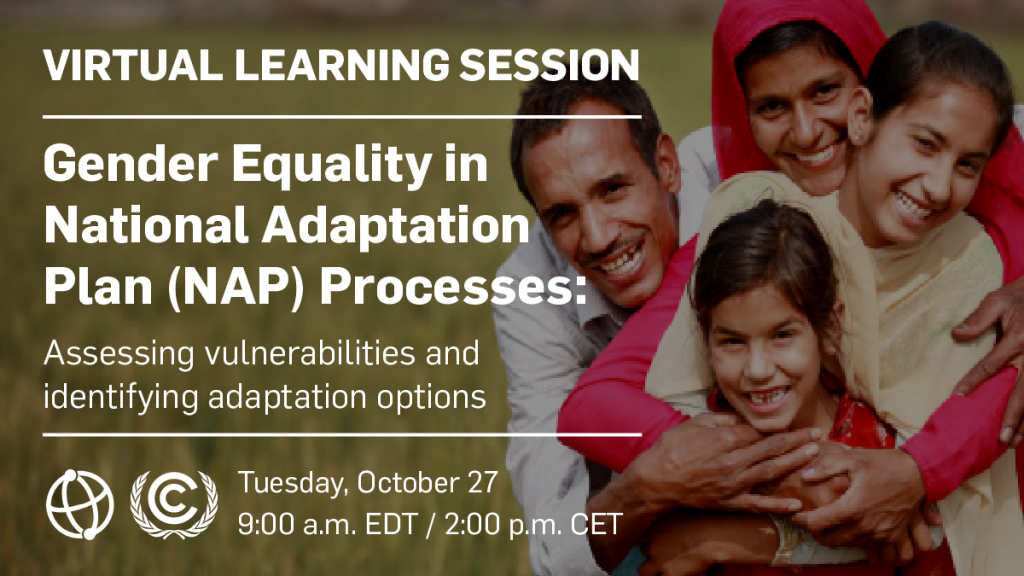
Gender Equality in National Adaptation Plan (NAP) Processes: Assessing vulnerabilities and identifying adaptation options

October 27, 2020 9:30 am - 10:45 am EST

(Open to public)

webinar-october 27-twitter-card.png

A key step in National Adaptation Plan (NAP) processes is to assess vulnerabilities and identify adaptation options that will help people and systems become more resilient to climate change. This process provides the opportunity to actively engage those whose voices are not always heard, to ensure that adaptation actions respond to the differing needs and priorities of women, men, and nonbinary people.

In fact, gender equality can be promoted throughout every step of a NAP. The key is knowing how.

This upcoming virtual learning session will provide guidance on how to make NAP processes gender responsive—with participants choosing which actions will be explored at key entry points in the NAP process!

Organized in collaboration with the UNFCCC Least Developed Countries Expert Group and Adaptation Committee, this NAP Global Network event will highlight how to use the Toolkit for a Gender-Responsive Process to Formulate and Implement NAPs to ensure gender equality is considered in the assessment of vulnerabilities and identification of adaptation options.

This interactive session will encourage participants to reflect on what they can do to put these actions into practice in their own countries.

Webinar details

Webinar

Short answers to big questions on the WTO and the environment

On Friday October 16, 2020, IISD will be participating in an online book launch organized by the World Trade Organization.

October 16, 2020 2:00 pm - 3:30 pm CEST

https://www.wto.org/english/tratop_e/envir_e/short_answers_event_e.htm

(Open to public)

The new publication, from the WTO's Trade and Environment Division, is entitled "Short answers to big questions on the WTO and the environment" and considers some of the key issues at the nexus of these policy areas.

Alice Tipping, Lead, Fisheries Subsidies, at IISD will be speaking on the expert panel involved in the launch.

The panel will be opened by WTO Director-General Alan Wolff and moderated by Aik Hoe Lim, Director of the WTO's Trade and Environment Division. The panel also includes Daniel Ramos, Legal Officer of the WTO's Trade and Environment Division, as presenter; Damaris Carnal of Switzerland's Mission to the WTO; Devabrata Chakraborty of Bangladesh's Mission to the WTO; and Anja von Moltke, Head of the Trade and Environment Hub at the United Nations Environment Programme.

The event will begin at 2 PM CEST. Please note that registration is required. Details about registration and how to access the online webcast are available at the following link.

Webinar details

Webinar

Geneva Trade Week Session: Ensuring Food Security, Sustainably: What role for trade?

September 29, 2020 3:00 pm - October 29, 2020 4:30 pm CEST

(Open to public)

How can trade—and trade policy—contribute to food security and environmental sustainability? The International Institute for Sustainable Development (IISD) joined forces with the  Food and Agriculture Organization of the United Nations (FAO) and Zurich University of Applied Sciences (ZHAW) to explore this question at a virtual session during Geneva Trade Week on September 29, moderated by FAO economist Ahmad Mukhtar.

ZHAW’s Professor Martina Bozzola laid the groundwork for the discussion, looking at definitions of sustainability and food security, and reminding participants of the three interconnected components of sustainable development—economic, social, and environmental.

“You really need to embrace all the three pillars,” Bozzola said.

Trade: Not an end in itself

Jonathan Hepburn from IISD then explored how food security and sustainability relate to trade policy in today’s world, and what governments can do differently to make progress in the future.

“Trade is a means of implementation—it’s not an end in itself,” he said.

Hepburn said that, alongside domestic productivity improvements, trade was set to become increasingly important in meeting future demand for food across the developing world. But he also cautioned that markets for food and agriculture remain poorly functioning and highly distorted.

Furthermore, the persistence of poverty means that many people remain unable to afford to access the food and nutrition they need even when food is otherwise available in the market.

Sustainable Agriculture in Action

Federica Angelucci, from the International Trade Centre (ITC), told participants how the ITC’s “Alliance for Action” was contributing to more sustainable agricultural value chains in practice. She also outlined what actions governments could take to support them.

She gave the example of the Sankofa cocoa project in Ghana, where the number of farmers adopting sustainable farming practice has quadrupled under the program.

“Policy-makers should also look at the barriers, especially non-tariff barriers, that are still affecting regional markets,” Angelucci said.

A “Key Role” for the World Trade Organization

Jamaica’s Ambassador Cheryl Spencer told participants that the World Trade Organization (WTO) had “a key role” to play in addressing these questions.

She highlighted how subsidies that distort patterns of trade and production continue to threaten producer livelihoods in the developing world and undermine food security. She also argued that global trade rules should ensure governments maintain the flexibility to provide other types of support to the sector.

“Trade distorting subsidies are, of course, the biggest danger to agricultural production and trade,” she said.

The COVID-19 crisis had seen some governments adopt large stimulus packages, she said, but warned that these could lead to unfair competition for farmers in low-income countries.

Ambassador Spencer emphasized that, although the pandemic has prompted governments to impose restrictions, countries should do their best to keep food flowing to where it’s needed.

“WTO members have a duty to keep supply chains open to facilitate movement of agricultural products, inputs, and workers across borders in order to prevent food shortages,” she said.

Restricting Food Exports

During the discussion, one participant asked what the panellists thought of moves to exempt humanitarian food aid from export restrictions when it is purchased by the World Food Program (WFP) for non-commercial purposes. Trade negotiators are currently discussing this question at the WTO.

“We believe this is one of those ‘low-hanging fruit’ for MC12,” Ambassador Spencer said, in reference to the trade body’s upcoming 12th ministerial conference.

Hepburn concurred, reminding participants that major economies in the G20 had already agreed to do so in a declaration earlier this year, as well as in another they issued in 2011.

“At the end of the day, we need to be able to bring the results of those declarations back to the WTO and turn them into something that’s actionable,” he said.

Event moderator Mukhtar underscored that WFP food aid “is targeted to people in extreme humanitarian need”: unlike other consumers, they may therefore have no choice in how they access adequate food and nutrition.

Climate Change and Future Shocks

“COVID is in the front of our minds—but we know that climate change is going to mean there’ll be a lot more extreme weather events in the years ahead,” Hepburn warned.

He said that WTO members needed to start thinking differently about risks and food system shocks, so as to ensure that countries have the tools they needed to respond to unexpected events, but without exporting shocks and volatility onto other markets in ways that could harm vulnerable producers and consumers.

Ambassador Spencer agreed. “The WTO has a role to play in cushioning shocks and guaranteeing food security,” she said.

Summing up the exchange, Mukhtar told participants that trade and trade policy “look very different” if seen from a developmental, rather than a transactional, perspective.

“It’s up to us,” he said: “How do we use trade to achieve food security or to achieve sustainability?”

See the recording of the panel session below
Webinar

IISD at New Advances for Sustainable Contaminated Lands Management

The workshop will bring together local British Columbia and international speakers to facilitate diverse and wide-ranging sharing of knowledge and best practices.

September 30, 2020 9:00 am - 12:00 pm PST

(Open to members)

In the past decade there has been significant progress on incorporating sustainability in the contaminated lands investigation and remediation process. There has been increased recognition of the importance of multiple dimensions of sustainability and need to balance the social, economic and environmental aspects of a project. When viewed from a social lens, stakeholder input and indigenous participation is vital to the success of a project.

There is also increasing recognition of the need to consider adaptation and resiliency of remediation to climate change impacts such as sea level rise or extreme weather events as this affects sustainability. With the global coronavirus pandemic, there are unknown implications for longer-term impacts ranging from work practices to possible effects of intensive use of chemicals for disinfection and cleaning on the environment.

This workshop hosted by the BC Science Advisory Board for Contaminated Sites (SABCS) and GeoEnviroPro Training Professionals aims to take a broad view of sustainability through multiple themes including: 

  • Innovative technologies and new developments to achieve more sustainable solutions to contaminated sites issues including nature-based solutions
  • Sustainable remediation in brownfields or infrastructure developments, including approaches and tools for evaluating and rating sustainability
  • Perspectives, practices and regulatory frameworks in different countries
  • Implications of carbon neutrality for projects
  • Considering the perspectives of stakeholders
  • Vulnerability, adaptation and resiliency of remediation to sea-level rise and extreme weather events


Day 1: Wednesday September 30: International and Local Perspectives on Sustainability and Climate Change

Moderator:  Shannon Bard (SABCS) & Jennifer Mayberry (GeoEnviroPro)

  • Event Kickoff: Zahra Pirani (President, SABCS)
  • Lynn Wagner, International Institute for Sustainable Development: "The Sustainable Development Goals and Lands Management"
  • Jonathan Smith, Shell Global Solutions (UK) Ltd: "Debunking Myths about Sustainable Remediation"
  • Dianna Allen, Simon Fraser University: "Connecting the Dots...Groundwater, Surface Water, and Climate Connections"
  • Panel and Session Closing

Webinar details

Webinar

Report on the United Nations High-Level Political Forum 2020: Japan's Role in Recover from the COVID-19 Pandemic and Achievement of the SDGs

Hosted by the Ministry of the Environment, Government of Japan, and co-hosted by the Institute for Global Environmental Strategies, this online event will explore how Japan can lead in the effort to "build back better" while advancing the 2030 Agenda for Sustainable Development.


September 30, 2020 3:00 pm - 5:00 pm JST

(By invitation)

The United Nations has designated the 2020s as the "decade of action to deliver the SDGs by 2030", and calls on all countries and stakeholders to take accelerated actions toward achieving the SDGs. However, at the start of this important decade, the spread of the novel coronavirus disease (COVID-19) has a serious impact on economies, societies, and human health worldwide. 

In this context, UN Secretary-General António Guterres said that in recovering from the COVID-19 pandemic, "far from undermining the case for the SDGs, the root causes and uneven impacts of COVID-19 demonstrate precisely why we need the 2030 Agenda, the Paris Agreement on Climate Change […]”. At the United Nations High-Level Political Forum (HLPF), held online in July 2020, the message was clear: the 2030 Agenda should be placed at the heart of the recovery from the COVID-19 pandemic, as a guide to building back better. 

One of the keys to accelerating action to achieve the SDGs is understanding interrelated issues, and enhancing synergies between different policies and initiatives. How can countries and stakeholders strengthen their actions to maximize these synergies, and take the lead on “building back better”? And what role can the Japanese government and stakeholders play in this process? This event will be held online with participation from UN officials, the business sector, academia, youth, and international media to explore these questions and share Japan's principal efforts with the world.


Opening Remarks

Ministry of the Environment, Japan

Video messages

  • Maria-Francesca Spatolisano, Assistant Secretary-General for Policy Coordination and Inter-Agency Affairs, United Nations Department of Economic and Social Affairs (UNDESA)
  • Ovais Sarmad, Deputy Executive Secretary, United Nations Framework Convention on Climate Change (UNFCCC)

Presentations

  • Results of HLPF2020 and the significance of the SDGs in the COVID-19 Era
    TAKADA Minoru, Team Leader (Energy), UNDESA
     
  • Building back better from COVID-19 Crisis and the Climate Crisis: A Message from the UN Secretary General
    NEMOTO Kaoru, Director, United Nations Information Centre (UNIC)
     
  • Initiatives by the Ministry of the Environment Japan for the Recovery from COVID-19
    Ministry of the Environment, Japan
     
  • The Role of International Media in the Recovery from the COVID-19 Pandemic
    Lynn Wagner, Senior Director, International Institute for Sustainable Development (IISD)

Panel

Exploring synergies between actions on SDGs and efforts to address climate change, biodiversity and disaster prevention, with advanced efforts from Japan

  • TAKEUCHI Kazuhiko, President, Institute for Global Environmental Strategies (IGES) (Moderator and Framing Presentation)
  • YAMAGUCHI Shinobu, Director, United Nations University Institute for the Advanced Study of Sustainability (UNU-IAS)
  • HASEGAWA Tomoko, Managing Director and Director of SDGs Promotion Bureau, Japan Business Federation
  • KURAISHI Haruna, Secretary General, Japan Youth Platform for Sustainability (JYPS)
  • Shinya Oda, Section Chief, Karatsu City

Webinar details