Press release

IISD Welcomes Five New Members to Its Board of Directors

WINNIPEG—June 24, 2016—IISD welcomed five new members to its board of directors today, following a unanimous vote at the board’s general meeting.  

June 23, 2016

WINNIPEG—June 24, 2016—The International Institute for Sustainable Development welcomed five new members to its board of directors today, following a unanimous vote at the board’s general meeting.  

"I am delighted to welcome our new members in what is a pivotal time for sustainable development—and therefore also for IISD,” said Alan Young, IISD Board Chair. “Each member brings tremendous depth of experience. Our talented board of directors is a credit to the Institute's strong reputation in Canada and abroad.”

New board members

Karen J. Bakker is an Associate Professor at the University of British Columbia, and holds a Canada Research Chair in Political Ecology and is Director of the Program on Water Governance.

Michelle Edkins is Managing Director at BlackRock and Global Head of its Investment Stewardship team.

Natan Obed is the President of Inuit Tapiriit Kanatami, the national organization representing Canada’s 60,000 Inuit.

Wanjira Mathai is Director of the Partnership for Women’s Entrepreneurship in Renewables (wPOWER) at the Wangari Maathai Institute.

Jukka Noponen has an extensive career in business management and development, venture capital investments and in green innovation, having worked on environmental issues in private consultancy as well as in innovation development for 40 years.

Press release

Indonesia Uses Savings from Fossil Fuel Subsidy Reform to Finance Development

Indonesia’s deep cuts to subsidies for fossil fuels have been matched by a substantial increase in spending on other areas of the state budget, which bodes well for the country’s economic and social development.

June 13, 2016

GENEVA—June 14, 2016—Indonesia’s deep cuts to subsidies for fossil fuels have been matched by a substantial increase in spending on other areas of the state budget, which bodes well for the country’s economic and social development.

In one of the first studies of its kind, the IISD’s Global Subsidies Initiative, the Faculty of Economics and Business (P2EB) at the University of Gadjah Mada, and the Asia Foundation delved into budgetary documents to identify, broadly, where the government had changed spending patterns following fossil fuel subsidy reforms in 2015.

The resulting analysis—Financing Development With Fossil Fuel Subsidies: The Reallocation Of Indonesia’s Gasoline And Diesel Subsidies In 2015—finds that that the majority of areas where extra funds were allocated were linked to social protection and infrastructure, through transfers to Ministries, state-owned enterprises (SOEs) and transfers to regions and villages.

“For a long time, the international community has talked about the benefits that can be gained by reforming subsidies, but there’s generally been a lack of detailed information about where the money goes after a policy change,” said co-author Christopher Beaton, an associate at the International Institute for Sustainable Development. “Does it really go to something better? Indonesia’s process of re-budgeting in early 2015 offers a sort of ‘natural experiment’ we can use to explore this compelling question.”

Major Investments in Social Protection and Infrastructure

Indonesia’s original 2015 budget allocated around IDR 276 trillion (USD 20.4 billion) to fossil fuel subsidies. Following retail price hikes and falling world oil prices in late 2014, Indonesia was able to eliminate the majority of gasoline and diesel subsidies by January 2015, requiring the budget to be revised very early in the year. The savings were equal to around IDR 211 trillion (USD 15.6 billion), or 10 per cent of all government expenditure.

One of the challenges of tracking subsidy reallocation is that most governments—including Indonesia’s—do not explicitly link savings in one area with additional spending elsewhere. However, the country’s large subsidy savings made it possible to reasonably assume that any substantial increases in planned expenditure were possible because of reforms.

The analysis found that budgets for Ministries were increased by 23 per cent, from IDR 647 trillion to IDR 795 trillion (USD 47 billion to USD 59 billion), with the highest increases given to the Ministries of Agriculture (106 per cent), Transportation (45 per cent), Public Works and Housing (40 per cent) and Finance (37 per cent). A number of “priority” programs were set out where it was expected that increased budgets would be used to achieve targets. This included programs related to education, health insurance, housing, clean water and transportation. One, for example, targeted the provision of housing for 60,000 poor households: another, clean water access for 10.3 million households.

Budgets for state-owned enterprises (SOEs) were increased over 11-fold, from IDR 5 trillion to IDR 61 trillion (USD 0.4 billion to USD 4.5 billion). This “capital injection” was designated to investments in infrastructure in five main areas: infrastructure and connectivity; food sovereignty; economic autonomy; maritime; and security and defence. This included distributions to SOEs responsible for air services, sea transport, construction, housing, plantations, agriculture, fisheries, shipping, mining, rail, tourism and ports.

Finally, the revised budget saw a 2.8 per cent increase in transfers to regions and villages, from IDR 647 trillion to IDR 665 trillion (USD 4.8 billion to USD 4.9 billion). Some of these funds were tied to special projects determined by the government, including food sovereignty, traditional local markets, regional connectivity and health services; while some funds were to have their exact use determined by local authorities according to local need.

Evaluating the Reforms

It is difficult to determine the exact impacts of Indonesia’s reallocation because much of it takes the form of investments that will take years to yield their full benefits.

A preliminary analysis of the budgetary reallocation, however, found that it scored well in three areas. First, the budget was well aligned with the needs that have been identified in Indonesia’s medium-term development plan. Second, the reallocation was projected to boost the economy and jobs, as most of the sectors that received increased funds are associated with higher economic growth and rates of employment than fuel subsidies. Third, the budget was judged to be much less vulnerable to fiscal risk following the reform, largely because smaller fuel subsidies made the budget less prone to unpredictable variation as a result of world oil price fluctuations and currency changes.

The study was conducted before data was published on actual budgetary expenditure in 2015, so it remains to be seen how well planning has been followed through by implementation.

What Could Be Done Better?

The research team, with support from the Asia Foundation, conducted interviews to collect opinions from Indonesian civil society organizations (CSOs) that specialize in government expenditure and government officials.

Generally, the reallocation was viewed positively: no interviewees considered the previous budget to have performed any better.

At a more discrete level, a range of viewpoints emerged. Among CSOs, the effectiveness of the capital injection to SOEs was debated. Some argued the types of infrastructure would disproportionately benefit big companies and already-affluent regions, while others had concerns about how confident the public could be in the SOEs’ use of public funds.

Energy also emerged as a topic of debate. Some interviewees argued that large investments in roads would only encourage private transport use, while others noted the distinct lack of investment in clean energy, despite the need for Indonesia to transition away from carbon-intensive energy sources, particularly amid plans to significantly expand coal power generation.

Government officials noted the need to strengthen planning and coordination, so that government agencies have the capacity that they need to make the most of additional funding.

Such issues led to recommendations that future reallocation of subsidies—such as for electricity and liquefied petroleum gas, likely to see reforms in 2016 and 2017—should involve more public consultation and dissemination, more capacity building, and greater levels of transparency and accountability to track what has been achieved.

The Big Picture

The analysis concluded that Indonesia has brought together a compelling case for what can be achieved by redirecting subsidies from wasteful consumption to investments in medium- and longer-term development. It has also suggested lessons for how future reallocations could be made more effective.

As world oil prices rise once more to levels of around USD 50 per barrel, Indonesia—along with other reforming countries around the world—must avoid public pressure to reintroduce subsidies. Tracking and explaining the benefits of a “year without subsidies” is surely one of the most compelling strategies to resist backsliding.

For more information please contact Damon Vis-Dunbar, [email protected], +41-22-917-8848 (in Switzerland). 

Press release details

Topic
Subsidies
Impact area
Climate
Press release

IISD Commends Ontario’s Ambitious Climate Change Action Plan

June 7, 2016

The Province of Ontario today released an ambitious plan of action to tackle climate change. Ontario plans to reduce greenhouse gas emissions by 15 per cent from 1990 levels by 2020, 37 per cent by 2030 and 80 per cent by 2050. 

Amin Asadollahi, IISD lead on climate change mitigation in North America, said: “We commend Premier Kathleen Wynne for positioning Ontario as a leader on climate change action in Canada, working in tandem with other provincial leaders. We hope that these provincial strategies will bolster our federal leaders’ efforts to develop a national action plan on climate change, including an ambitious cross-country price on carbon emissions.”

Philip Gass, IISD senior researcher, said: "Focusing on buildings is pivotal as it ensures that we lock-in a more efficient future in our building stock. Electrification of vehicles is also a logical next step given Ontario has already eliminated coal in its electricity grid and has to look now at its transport fuel emissions as one of the next major challenges."

A Price on Carbon

The plan follows the Province of Ontario's earlier announcement of its intention to join a cap and trade program with California and Quebec. The revenue from the program would help fund the $5.9 billion to $8.3 billion that Ontario plans to spend on climate change initiatives over the next five years.

“IISD strongly supports the decision Ontario has made to reinvest its cap and trade revenues into actions that will spur a transition to a lower-carbon economy and leverage even greater greenhouse gas reductions in the province. We applaud these efforts but note that more can be done and we must continually push for greater ambition,” said Gass.

“One particular area is fossil fuel subsidies.The Environmental Commissioner of Ontario identified in her recent report that Ontario provided tax concessions for fossil fuels in total of $628 million in 2015. We suggest that this is an area where Ontario can build on its laudable recent efforts to phase out these subsidies, such as increases to the tax rate for aviation fuel.”

For more information contact Sumeep Bath, media and communications officer, IISD at (204) 958-7740 or [email protected].

Press release details

Impact area
Climate
Press release

More Winnipeggers Walk or Bike to Work than National Average

June 7, 2016

Two events are celebrating active transportation in Winnipeg this June - the Commuter Challenge takes place June 5-11 as part of Canadian Environment Week, and Bike Week Winnipeg takes place June 18-24.

What does Peg tell us about active transportation trends in Winnipeg compared to the rest of Canada?

Peg tells us…

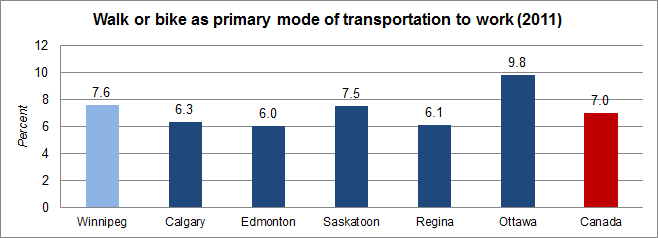
Between 2001 and 2011, the percentage of Winnipeggers walking or biking to work as their primary mode of transportation has decreased slightly, from 7.9% in 2001 to 7.6% in 2011. The national rate is 7.0%

The facts are:

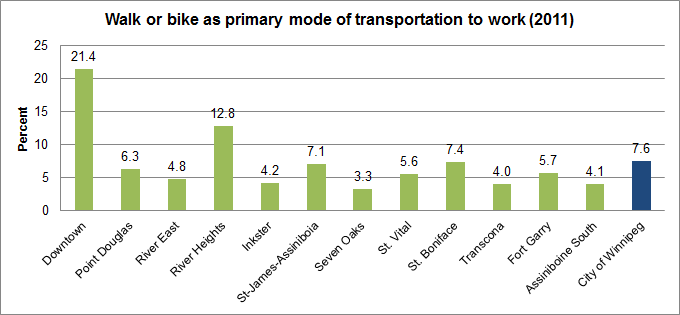
  • 21.4% of downtown residents walk or bike to work as their primary mode of transportation, compared to 7.6% of Winnipeggers overall.
  • Across Canada, the rates for similarly sized cities include 9.8% in Ottawa, 6.0% in Edmonton, and 7.5% in Saskatoon.


Why does this matter?

  • Active transportation is being increasingly embraced by cities as a transportation mode that provides multiple benefits, including improved citizen health, decreased road damage, better air quality, decreased costs to commuters, increased social interactions and even higher property values (City of Winnipeg, 2011).

Definitions:

  • The active transportation indicator shows the percentage of people who walk or bicycle as their primary mode of transportation to work.
  • This indicator does not take into account individual variation in the mode of transportation taken to work. For example, someone who drives a car to work 60 per cent of the time and bicycles 40 per cent of the time would only be recorded as using a car.
  • This indicator does not count outings not related to work, and does not take into account differences in distance.
  • *More detail and source data for the above facts available at http://www.mypeg.ca/explorer/WellBeing/NaturalEnvironment/ActiveTransportation/

Source of the data:

  • Peg’s data for the Active Transportation indicator is provided by Statistics Canada.
  • Peg creates short videos to illustrate data in a different way. Here are two stories featuring two Winnipeggers’ transportation choices:

Media inquiries:

For interviews on Peg, the data, or to be connected with organizations making a difference in the community, please contact:

Sumeep Bath, Media and Communications Officer

International Institute for Sustainable Development (IISD)

(204) 958-7740 | [email protected]

About us:

Peg (mypeg.ca) is a community indicator system that measures the health of our community year over year – in ways that count. Peg is led by two partnering organizations – the International Institute of Sustainable Development (IISD) and United Way of Winnipeg (UW).

Regularly, the team at Peg releases data and facts that help us understand our city better. This is one of those regular reports. Others can be found at http://www.mypeg.ca/blog.

Peg is the starting place for Winnipeg citizens, educators, policy makers, and many others to learn more about our city so we can lead change to create a better city for our children and their children. At Peg we can all learn how our lives, our neighbourhood and our city is changing – for the good and the bad. Learn more at www.mypeg.ca.

Press release details

Press release

IISD Welcomes Environment Commissioner’s Call for Canada to Build Climate Resilience

May 31, 2016

The International Institute for Sustainable Development (IISD) welcomes a new series of reports from the Office of Auditor General of Canada that call for urgent action by the federal government to support resiliency to climate change.

“Canada must build resilient buildings, roads, bridges, water and sewage facilities, and transportation networks so that we can move around, work, keep the economy going, and live in vibrant and healthy communities,” writes Julie Gelfand, Canada’s Commissioner of the Environment and Sustainable Development. “When resiliency is built into infrastructure, it is also built into communities as they are then better equipped to recover more quickly when disasters strike.”

The reports recommend a suite of resiliency policies, including updating the National Building Code, investing in climate-resilient infrastructure, and ensuring that infrastructure projects identify and manage climate risks.

“We welcome Commissioner Gelfand’s leadership in calling for swift action in Canada to manage climate risks to protect Canadian communities,” said Anne Hammill, Director of IISD’s Resilience Program. “Following through on the Commissioner’s recommendations to build climate-resilient infrastructure and prepare for extreme weather would be important steps towards a strong national adaptation strategy.”

The report cites a Public Safety Canada estimate that every dollar invested in disaster mitigation saves $3 to $5 in recovery costs. It also found that Canada’s Disaster Financial Assistance Arrangements program has had to spend more in disaster recovery funding in the past 6 fiscal years than in its first 39 fiscal years combined.  

Gelfand’s reports find that the federal government “has not put in place all the elements that are required to ensure that climate change considerations are effectively integrated into infrastructure and disaster mitigation programs, policies, and operations.”

Jo-Ellen Parry, a senior climate adaptation researcher with IISD’s Resilience Program, commented on the new reports: “There are concrete actions we can take to protect our towns and cities against risks associated with climate change. The federal government has a vital role in averting climate risks, and Gelfand’s recommendations to support better disaster mitigation through initiatives such as updating floodplains maps are timely. There are also pressing process-based changes we need, such as improving communications, monitoring and data access in a manner that reflects decision-makers needs.”

Anika Terton, a researcher with IISD’s Resilience and Energy Programs who has worked on climate change mitigation strategies, said: “Recent changes to federal policy could make it harder for communities to rebuild after disaster strikes by placing a heavier financial burden on provincial governments.

“New rules enacted in February 2015 dramatically raise the threshold for when federal assistance kicks in. Federal and provincial disaster financial assistance rules also discourage communities from preparing for the next disaster,” added Terton.

“Current regulations are based on historical frequency of extreme events. But the past is no longer a predictor of the future, and if the size or frequency of a climate event is changing then communities will need infrastructure built to a new standard.”

The Environment and Sustainable Development Commissioner’s 2016 spring reports are available on the Office of the Auditor General’s website.

Please contact Christian Ledwell at [email protected] or (613) 778-8767 ex.106 to arrange for an interview with one of our experts.


Press release details

Press release

Sustainable Seafood Market is Surging, Study Finds

May 10, 2016

In 2015, demand from big retailers and restaurant chains pushed seafood suppliers to certify a catch valued at $11.5 billion USD.

  • Certified seafood accounts for 14 per cent of global production, up from 0.5 per cent in 2005
  • Good news for the environment and fish stocks
  • The majority of certified seafood does not offer comprehensive protection of worker’s rights
  • The majority of certified seafood sold in retail markets comes from developed countries
  • Targeted investment in developing country certification is needed to facilitate transformative change on a global scale

Press conference live streamed on Wednesday, May 11, 15:00 CET—Click here to watch.

GENEVA—May 11, 2016—The sustainable seafood market is surging. In 2015, demand from big retailers and restaurant chains pushed suppliers to certify a catch valued at $11.5 billion USD, a study published Wednesday found.

Sustainable seafood now accounts for 14 per cent of global production, a dramatic rise from just 0.5 per cent in 2005, according to The State of Sustainability Initiatives (SSI) Review: Standards and the Blue Economy, which was produced by an alliance of international organizations.

In one of the first studies of its kind, SSI researchers took a deep dive into the market and performance trends of the nine most prevalent seafood certification schemes, including the Marine Stewardship Council, GLOBAL G.A.P. and Friend of the Sea.

The SSI Review documents that, globally, certified seafood production grew 35 per cent per annum over the last decade, nearly 10 times faster than conventional seafood production over the same period.

“The rapid expansion of sustainable seafood practices is helping to address decades of mismanagement, which has led to the collapse of fisheries and destruction of fragile marine ecosystems,” said lead author Jason Potts, a senior associate at the International Institute for Sustainable Development.

“By giving fishermen an economic incentive to protect the environment, these initiatives have the potential to help link sustainable livelihoods to sustainable production practices.”

$140 USD billion seafood industry is environmentally bankrupt

The seafood industry represents a critical source of both protein and employment globally. The overall trade value of the seafood sector was estimated at US$140 billion in 2014, making it one of the most valuable non-petroleum products traded internationally. 

Growing global demand for seafood products has continued to put pressure on global fish stocks, with an estimated 88 per cent of natural fish stocks being either fully exploited or overexploited.

While farmed fish has the potential to relieve the burden on wild fish stocks, it too faces a number of sustainability challenges, like ecosystem destruction associated with the use of synthetic inputs, feed and waste management.

The SSI Review maps the requirements of major seafood standards across environmental issues such as biodiversity, ecosystems, waste, greenhouse gas, energy, water, synthetic inputs and GMO prohibition. The review concludes that, while voluntary standards have established a strong foundation for enabling a transition to sustainable production practices across the global seafood industry, full integration of such practices will require the involvement of governments.

“While voluntary standards can certainly help, they can’t be expected to solve all of the problems facing our oceans, which inevitably require intergovernmental action,” Potts cautioned. “Even the successful implementation of voluntary standards on a wide scale will require significant investment from governments on issues like improved stock assessments and economic incentives for switching to sustainable production methods.”

Need for labour rights and worker protection

The report found that the majority of certified seafood is not required to demonstrate compliance with universally accepted core ILO labour conventions. Nor do they ensure that fishermen get paid a living wage for their catch.

The recent controversy over slavery-like conditions in the Thai shrimp industry – and the resulting call for change from consumers and retailers – highlights the importance of worker protection in the global seafood supply chain.

“Labour rights and improved access to certification are becoming increasingly important as certification schemes seek to provide meaningful benefits for poorer stakeholders in the seafood supply chain,” said Ann Wilkings, a researcher with IISD and co-author of the report.

Standards could spur much-needed economic development, but not alone

An estimated 3 billion people depend on seafood as their primary source of protein, while an estimated 10–12 per cent of the world’s population is either directly or indirectly dependent on seafood for their livelihoods. An estimated 80 per cent of fishermen are located in the developing world.

But Asia – which accounts for 69 per cent of global seafood production and is associated with some of the most important environmental impacts from fishing – only accounts for 11 per cent of certified production. Meanwhile, the five countries that account for 64 per cent of global certified production only account for 14 per cent of global seafood production. Those countries are: Peru (26 per cent of sustainable production), the United States (15 per cent), Norway (10 per cent), Chile (8 per cent) and Russia (5 per cent). Notably, North America and Europe account for more than 60 per cent of certified production destined for retail markets.

The concentration of production suggests that the benefits of certification are distributed unevenly across the world’s oceans and peoples. Adoption of certification by Asia and Africa is complicated by underdeveloped infrastructure and will require significant investment if certified production is to grow in these regions. 

“Seafood standards can provide transparency to economic relations and thereby facilitate investment. To date, as indicated in the report, actual premiums associated with certified seafood have been either low or non-existent, pointing to the need for external investment and finance to help the transition among developing economies,”  said Noemi Perez, of Finance Alliance for Sustainable Trade, a co-publisher of the report.

“Our research found little in the way of targeted funds linking investment to the adoption of sustainable practices, suggesting a potential opportunity for development banks, donor agencies and buyers.”

Overall, The SSI Review concludes that the opportunities for voluntary standards to enable positive transformational change in seafood markets are now well established and continue to grow within developed country markets.

Securing transformative change in global production, however, will require a simultaneous and concerted movement towards the integration of certification within national policy and investment decision-making, particularly as these apply to developing country producers.

The SSI Review is a collaborative effort by the International Institute for Sustainable Development (IISD), the International Institute for Environment and Development (IIED) and the Finance Alliance for Sustainable Trade (FAST). The SSI Review was made possible with the support of the Swiss State Secretariat for Economic Affairs.

For more information please visit us at www.iisd.org or http://www.iisd.org/ssi/standards-and-the-blue-economy/ or contact: Jason Potts, [email protected], +1-514-814-3452 (in Canada) or Damon Vis-Dunbar, [email protected], +41-78-818-0501 (in Switzerland). 
Press release details

Press release

IISD Welcomes Greg Radford as Director of Secretariat for Sustainable Mining Initiative

May 1, 2016

WINNIPEG, May 2, 2016—The International Institute for Sustainable Development (IISD) is pleased to welcome Greg Radford as Director of the Intergovernmental Forum on Mining, Minerals, Metals and Sustainable Development (IGF).

Radford brings more than 20 years of experience helping governments and businesses adopt and apply environmental and social standards. He has worked in over 50 countries on projects involving mining, manufacturing, oil and gas extraction, infrastructure, the financial sector, and energy systems such as hydro, thermal and wind power.

“Greg brings a wealth of experience and a deep knowledge of the mining industry and its challenges to the IGF,” said Scott Vaughan, president of IISD. “Greg has a strong commitment to sustainability and a proven track record of achieving results. We are counting on him to expand IGF’s advisory and technical support services, strengthen IGF’s management structure and advocate for optimizing the sustainable development benefits of mining.”

IISD was appointed to a five-year term as Secretariat for the IGF in October 2015. The IGF is a centre of excellence on mining and sustainable development and serves as a unique global venue for dialogue between its 55 member-country governments, mining companies, civil society and other stakeholders. Funding is provided by the Government of Canada.

The IGF provides capacity-building programs, tailored technical assistance and assessment services framed by its flagship policy tool, the Mining Policy Framework.

“The IGF represents a remarkable opportunity for systemic change,” Radford said. “I look forward to working with member governments who are committed to reshaping how they manage natural resources in order to reduce poverty and achieve inclusive growth, social development and environmental stewardship.”

Prior to taking the helm of the IGF, Radford was a managing partner and director of international operations for ESSA Technologies, an environmental and social sustainability consulting firm. He recently completed a three-year term as president of the International Association for Impact Assessment. He is the former director of the Environment, Social and Governance Department at the International Finance Corporation and also worked as chief corporate social responsibility advisor at Export Development Canada.

Radford brings extensive experience in policy development, training and capacity building, natural resource management, and climate change mitigation and adaptation. He has also worked to assist corporations and governments manage outreach work to engage locally affected communities and civil society.

About IISD

The International Institute for Sustainable Development is an independent, non-profit organization that provides practical solutions to the challenge of integrating environmental and social priorities with economic development. We report on international negotiations, conduct rigorous research, and engage citizens, businesses and policy-makers on the shared goal of developing sustainably. 

Visit us at:

IISD

http://www.iisd.org/
https://www.facebook.com/IISDnews
https://twitter.com/iisd_news

IGF

http://globaldialogue.info/
https://twitter.com/IGFMining

For more information please contact: Mira Oberman, IISD, [email protected], +1-204-958-7711

Press release details

Topic
Mining
Impact area
Sustainable Economies
Press release

Local College Heats Up with Cattails

Providence University College in Otterburne, Manitoba is proving what IISD researchers have been predicting for years: that biomass pellets consisting of a mixture of wood chips and cattails can be an affordable, reliable and environmentally-friendly source of heat for buildings.

April 14, 2016

Providence University College Providing Watershed Moments for Manitoba’s Bioeconomy

Winnipeg, April 15, 2016—Providence University College in Otterburne, Manitoba is proving what International Institute for Sustainable Development (IISD) researchers have been predicting for years: that biomass pellets consisting of a mixture of wood chips and cattails can be an affordable, reliable and environmentally-friendly source of heat for buildings.

“This is very exciting for IISD and all of our partners along our chain from those harvesting cattails on the landscape to production of the pellets and eventually to the heating of the college via their heating system,” said Richard Grosshans, a senior research scientist at IISD.

“We always believed that one way to keep wetlands on the landscape would be to prove their economic values alongside the environmental values that they provide to society. Through our partnership with Providence University College, we have proven that the system can work in the depths of a Manitoba winter with a product supply that can match demand.”

IISD’s innovative approach harvests cattail and other plants from marginal agricultural land, water retention sites, and drainage ditches to remove nutrients and contaminants absorbed by the plants, and then uses plant biomass to produce low carbon energy to replace fossil fuels. With the elimination on the use of coal for space heating in Manitoba, there is an accelerating strong demand for quality processed biomass fuel. Manitoba’s Hutterite communities are leading this charge.

The use of this exciting new source of renewable energy will be showcased at Providence University College at a media event today at 11am, with a demonstration of the university’s biomass-fuelled heating system in operation as well as a discussion of the economics and environmental benefits of this system for Manitoba with project leaders.

“Providence has been burning biomass since 2011 and burned its first cattail pellets in January 2016. They burned exceptionally, and we were extremely pleased with the product. At present our campus is powered by approximately 70 per cent renewable sources,” said Jarrad Peters, creative content specialist at Providence University College. “Providence is committed to being a leader in the green energy sector, as we believe sustainable solutions to environmental questions are integral to the fulfillment of our institutional mission.”

Grosshans says the great thing is these approaches can be applied globally in countries with far greater issues than North America.

“Innovative solutions developed here in Manitoba to collectively deal with our flooding, nutrient, and carbon reduction issues that also create economic growth and jobs will help us and the global community,” he said. “With coal no longer an option, several colonies are producing compressed biomass – including cattails- as fuel for their own heating demands. These are the foundations that support the green economy, bioeconomy-based water, and energy management concepts developed and used in Manitoba.”

-30-

For more information contact Sumeep Bath, media and communications officer, IISD at (204) 958-7740 or [email protected].

Press release details

Topic
Water
Impact area
Nature
Press release

Volunteerism in Winnipeg is increasing, Peg report reveals

April 12, 2016

April 10-16, 2016 is National Volunteer Week. What can Peg tell us about how many Winnipeggers volunteer their time?

Peg tells us…

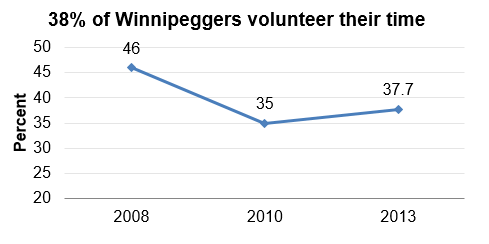
From the newly available 2013 Statistics Canada data - 38% of Winnipeg residents reported volunteering their time, skills, and commitment to a wide range of organizations within our community.

The Facts are:

  • Though volunteerism in Winnipeg declined from 46% in 2008 to 35% in 2010, it has since climbed back up to 38%.
  • Winnipeg’s 38% was below the 2013 national rate of 44%[1].


Definitions:

  • Volunteerism measures the percentage of Winnipeggers who reported volunteering their time within the last year.
  • This includes all persons aged 15 and over who indicated doing any activities without pay on behalf of a group or organization at least once in the 12 months preceding the survey.

Why does this matter?

  • Volunteerism makes a significant difference in Winnipeg, providing time and expertise to allow the operation of services and programs that could not otherwise be delivered. Contributions include fundraising, organizing events, sitting on a board, teaching or mentoring, and a wide range of activities that contribute to our society.
  • Volunteerism is strongly related to the social vitality of our community, and supporting the basic needs of our vulnerable populations: most volunteer hours contribute to organizations related to sports and recreation, social services, education and research, religion, development and housing, and health.

Source of the data:

Peg’s data for the Volunteerism indicator is provided by Statistics Canada. The 2013 data is the most up-to-date available.

Media inquiries:

For interviews on Peg, the data, or to be connected with organizations making a difference in the community, please contact:

Sumeep Bath, Media and Communications Officer

International Institute for Sustainable Development (IISD)

(204) 958-7740 | [email protected]

About us:

Peg (mypeg.ca) is a community indicator system that measures the health of our community year over year – in ways that count. Peg is led by two partnering organizations – the International Institute of Sustainable Development (IISD) and United Way of Winnipeg (UW).

Regularly, the team at Peg releases data and facts that help us understand our city better. This is one of those regular reports. Others can be found at http://www.mypeg.ca/blog.

Peg is the starting place for Winnipeg citizens, educators, policy makers, and many others to learn more about our city so we can lead change to create a better city for our children and their children. At Peg we can all learn how our lives, our neighbourhood and our city is changing – for the good and the bad. Learn more at www.mypeg.ca.


[1] Turcotte, M. Statistics Canada: Volunteering and charitable giving in Canada.

Press release details

Press release

Winnipeg voter turnout trending up

On April 19th, Winnipeggers head to the polls for the third time in two years. What can Peg tell us about trends in Voter Turnout in our Municipal, Federal, and Provincial elections?  

April 5, 2016

On April 19th, Winnipeggers head to the polls for the third time in two years. What can Peg tell us about trends in Voter Turnout in our Municipal, Federal, and Provincial elections?  


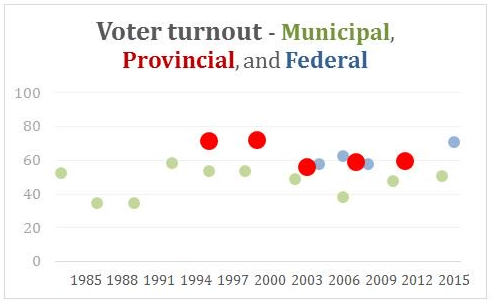
Municipal Voter Turnout (green dots)

Voter turnout has increased significantly over the past two elections. Turnout was 38.2% in 2006, 47.1% in 2010, and 50.2% in 2014. The highest turnout in the past twenty years was in 1992, at 58.4%.

Provincial Voter Turnout (red dots)

Provincial voter turnout dropped from a high of 71.6% in 1999 to 59.3% in 2011, however, turnout has increased over the last two elections.

*This data represents voter turnout in Winnipeg ridings only

Federal Voter Turnout (blue dots)

The 2015 federal election saw the highest voter turnout in ten years. Turnout climbed from a low of 57.6% in 2008 to 69.4% in 2015. 

More facts available at: http://www.mypeg.ca/explorer/WellBeing/Governance/VoterTurnout/

Why is this important?

  • Elections are the most fundamental processes of democratic engagement, and high turnouts are generally considered to be positive - voter turnouts are an indicator of the overall health of the democratic system.
  • Voter turnout varies across the population, with some groups better represented at the polls than others. Age, education, and income are three major factors that influence voter turnout.

Peg data reflects only registered voters, not those eligible to vote.


Source of the data:


Media inquiries:

For interviews on Peg, the data, or to be connected with organizations making a difference in the community, please contact:

Sumeep Bath, Media and Communications Officer

International Institute for Sustainable Development (IISD)

(204) 958-7740 | [email protected]


About us:

Peg (mypeg.ca) is a community indicator system that measures the health of our community year over year – in ways that count. Peg is led by two partnering organizations – the International Institute of Sustainable Development (IISD) and United Way of Winnipeg (UW).

Regularly, the team at Peg releases data and facts that help us understand our city better. This is one of those regular reports. Others can be found at http://www.mypeg.ca/blog.

Peg is the starting place for Winnipeg citizens, educators, policy makers, and many others to learn more about our city so we can lead change to create a better city for our children and their children. At Peg we can all learn how our lives, our neighbourhood and our city is changing – for the good and the bad. Learn more at www.mypeg.ca.

Press release details