Press release

A historic day as Paris Climate Agreement crosses a critical threshold

October 3, 2016

The global commitment to slowing the pace of climate change culminated today with the European Parliament approving the ratification of the Paris climate agreement thereby enabling its entry into force this week.

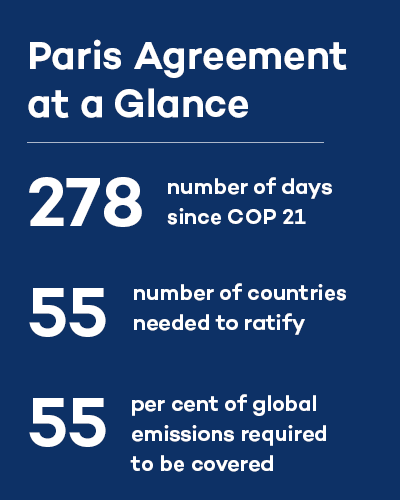
The historic agreement, adopted by 185 nations in the French capital last December, required ratification by 55 countries contributing to at least 55 per cent of global greenhouse emissions before coming into effect. With the European Union expected to deposit its ratification instruments on Friday, those thresholds will be crossed.

“Ratification of the Paris agreement has moved through national capitals with remarkable speed,” said Frédéric Gagnon-Lebrun, IISD’s program leader on climate change mitigation. “It’s a striking departure from past practice in international climate change negotiations and demonstrates the significant buy-in from countries that continues to build following the adoption of the agreement last December.”

“The environment has not eclipsed the political primacy of jobs and the economy. What’s changed, however, is the mainstream understanding that these priorities are incompatible with catastrophic climate change,” said Gagnon-Lebrun.

Countries will turn to the task of developing the rulebook that will guide the implementation of the agreement when they gather for the UNFCCC’s Twenty-second Conference of the Parties (COP-22) in Marrakesh, Morocco, from 7-18 November. “With the Paris Agreement now into force, the Marrakesh conference will go down in history as the first meeting of the Parties to the Paris Agreement,” said Gagnon-Lebrun.

"The Paris Agreement is an important victory towards preventing the worst effects of climate change," said Anne Hammill, director of IISD's resilience program. "But in order to prepare for the climate change impacts that our greenhouse gas emissions to date will cause, we hope all countries take urgent action on the Paris agreement's call to engage in adaptation planning and implementation."

In parallel, all countries now need to diligently start the hard work of implementing the climate change plans presented ahead of COP-21 in Paris, known as Nationally Determined Contributions, as well as mechanisms to report back to the international community on progress made.

Press release details

Impact area
Climate
Press release

IISD Recognizes Canada’s Carbon Pricing Proposal as an Important First Step

IISD responds to the Government of Canada's announcement today to introduce Canada-wide carbon pricing.

October 2, 2016

Today the Government of Canada announced its plans to implement Canada-wide pricing to curb carbon pollution.

The International Institute of Sustainable Development (IISD) recognizes this as an important first step in the federal government’s plan of action to meet the emission targets set out in the Paris Agreement on Climate Change.

Canada plans to charge a minimum of CAD 10 per tonne on carbon pollution from 2018, increasing by CAD 10 a year, and reaching CAD 50 in 2022.

“Today’s announcement is a clear signal that we are all in this together. It highlights the important role that pricing carbon pollution can play in reducing emissions while driving innovation,” said Amin Asadollahi, IISD’s North American Lead on Climate Mitigation.

“Carbon pricing is the most effective market mechanism of curbing carbon pollution. The Government of Canada is demonstrating strong leadership on climate change with this proposal. This price will be re-evaluated at a crucial moment in 2022. This review can inform Canada’s progress at the international level prior to the first global emissions stocktaking exercise scheduled for 2023. In addition to the carbon price, complementary measures will be necessary to ramp up efforts in order to put us on the right path to achieving the 2030 climate targets,” said Asadollahi.

“As the world’s temperatures soar, along with its levels of atmospheric carbon dioxide, we are all feeling a sense of urgency when it comes to taking action. Carbon pricing, therefore, should also form part of a larger diversified initiative to cut carbon emissions. It will also be important to push forward an accelerated phase-out of coal-fired electricity generation, championing clean and renewable energy sources, addressing emissions in the transportation sector and encouraging business action on climate.”

Press release details

Impact area
Climate
Press release

IISD Welcomes Transparency on Fossil Fuel Subsidies by China and the United States

China and the United States released voluntary peer reviews of their fossil fuel subsidies. The two countries are the first among G20 members to undertake peer reviews as part of the G20 commitment “to phase out inefficient fossil fuel subsidies that encourage wasteful consumption.” 

September 18, 2016

[下面中国版.] GENEVA—September 19, 2016—Today China and the United States released voluntary peer reviews of their fossil fuel subsidies. The two countries are the first among G20 members to undertake peer reviews of their fossil fuel subsidies as part of the G20 commitment “to phase out inefficient fossil fuel subsidies that encourage wasteful consumption.” 

The peer review process starts with the preparation of a “self-review” report to identify, measure and evaluate fossil fuel subsidies. This report is then reviewed by a peer review panel. The panel for China included Germany, Indonesia, United States and the International Monetary Fund. The United States report was reviewed by China, Germany and Mexico. The Organisation for Economic Co-operation and Development chaired the process and also peer reviewed both reports. 

“The United States and China—the two largest economies in the G20—are to be congratulated for their leadership,” said Peter Wooders, Director of IISD’s Energy Program. “This gesture of openness signals a genuine desire to remove subsidies that are both environmentally and economically harmful. I hope the peer reviews encourage other G20 members to talk openly about their fossil fuel subsidies and develop plans for phase out.”  

G20 peer reviews include inventories of fossil fuel subsidies, an evaluation of their effects and costs, and plans that countries have made to phase out those considered “inefficient” and which “encourage wasteful consumption."   

The published review for the United States lists 17 subsidies of the total value of US$ 8.2 billion. The review for China lists 9 subsidies worth US$ 14.5 billion. China’s peer review report is notable for also including a reform plan and timeline, identifying subsidies for phase-out in the near future. This sets an example for other G20 nations. 

“It is encouraging to see that the reviews list both consumption and production subsidies, encompassing the many forms of budgetary transfers, tax breaks and regulatory privileges that can encourage wasteful use of energy,” said Richard Bridle, Research Officer with the IISD Global Subsidies Initiative. 

Unfortunately, the G20 leaders have not been able to agree a definitive timeline for the phase out of all inefficient fossil fuel subsidies, despite mounting pressure to do so. Ahead of the G20 leaders’ summit earlier this month, more than 200 NGOs from 45 countries and a group of insurers with US$ 1.2 trillion under management urged G20 leaders to phase out subsidies for fossil fuels by 2020.

“Although the time is running short, the G20 leaders still have a chance to meet these expectations and set a timeline for reform under next year’s G20 presidency by Germany,” said Wooders.
 
The United States and China peer review documents are available here:

For more information on IISD’s work on fossil fuel subsidies, visit the website of our Global Subsidies Initiative www.iisd.org/gsi 
 

国际可持续发展研究院(IISD)欢迎中国和美国在G20峰会公开化石能源补贴,并再次呼吁设立行动时间表


中国和美国于2016年9月19号公布了在G20框架下自愿性同行评审化石能源补贴的结果。这两个国家率先在G20 成员国中开展同行评审,确定他们认为可以取消的化石能源补贴以及各自已有的取消化石能源补贴的方案。

中美同行评审基于2009年G20领导人的承诺:“取消没有效率的鼓励浪费性消费的化石能源补贴。”中美两国的同行评议首先准备“自我评估报告”以辨别、量化和评估相关的补贴内容。然后,自我评估报告交给专家组进行同行审议。中国的评审专家组由德国、印度尼西亚、美国和国际货币基金组织的专家组成,美国的评估报告由上述除了国际货币基金组织以外的相同专家,再加上中国的专家组成的评审组审议。两份报告的评估过程均由经济合作和发展组织任评审组的主席。自我评估报告以及同行专家组评估报告可在G20官方网站上获取(

)。这次公开的同行评审过程将会支持深入讨论G20成员国经济体化石能源补贴的规模和影响。

G20框架下化石能源补贴的同行评审,包括给出化石能源补贴的清单、评估其影响以及成本、还有每个国家已经制定的取消那些被界定为“没有效率的”和“鼓励浪费性消费”的化石能源补贴方案。同行评审比此前G20成员国的自我报告更进一步,自我报告中有些国家表明没有这样的补贴。同行评审未必将所有的化石能源补贴考虑在内,只是聚焦在同行评审的国家之间同意考虑的补贴项目。第三方补贴清单一般会确定和量化更多的补贴项目,通常没有对补贴否是“无效率的”或者符合其它标准进行评估,但任然是促进公开补贴的重要部分。

中国和美国相互之间进行同行评审的过程,被德国、墨西哥和印度尼西亚采用,同意进行类似的同行评审。但是,G20领导人没有同意达成一个确定的目标日期以履行其实施化石能源改革的承诺,而设定目标期限是外界对这届G20峰会关键的期待。

 “美国和中国这两个G20成员国中最大的经济体,祝贺他们率先进行化石能源补贴同行评审,” 国际可持续发展研究院能源项目的负责人皮特·伍德斯说。“中美公开同行评审结果表达了取消危害环境和经济的化石能源补贴的真诚愿望。我希望中美同行评审能够鼓励其他G20成员国公开讨论其化石能源补贴的情况,并制定取消化石能源补贴的计划,帮助中国和美国实施其取消化石能源补贴的方案。”

公开的评估报告显示,美国列出了17类补贴内容总计82亿美元。中国的评估报告包含了9项补贴内容总计145亿美元,而一些主要的补贴还没有被量化。中国的同行评审报告特别瞩目之处在于包括了改革化石能源补贴的方案和时间表,并确定了将要在近期内取消的化石能源补贴,为其他G20成员国树立了榜样。
 
“令人鼓舞的是看到了评估报告中列出了消费侧和生产侧的补贴,包括了不同形式的转移支付、税收减免以及政策性优惠等实质上鼓励浪费性能源利用的补贴”,国际可持续发展研究院旗下的全球能源补贴倡议研究员理查德·布莱德尔说。“中国类似土地税收减免等对化石能源企业的补贴确实比较难以量化,但是其补贴的额度很可能非常大,这类补贴改革对减少碳排放以及增加财政收入会有显著的贡献。”

同行评审过程是G20 承诺取消没有效率的化石能源补贴的重要内容。但是,G20领导人还没同意一个明确的时间表以取消所有没有效率的化石能源补贴。事实上,取消化石能源补贴的势头日渐突显。有四十多个国家支持一份鼓励取消化石能源补贴的公报,要求公开补贴和实施补贴改革。来自45个国家的200多家非政府机构、以及管理着1.2万亿美元资产的保险业组成的团体,呼吁G20领导人设定一个在2020年取消化石能源补贴的时间表。随着峰会临近,对中国主办的G20峰会实现这个目标寄予了很高的期望,结果还是没有如愿。

“虽然时间非常紧迫,但是G20领导人还是有机会实现这个愿望的:在明年德国主办的G20峰会设定化石能源补贴改革的时间表 ” 伍德斯说。

Press release details

Topic
Subsidies
Impact area
Climate
Press release

G20 Needs an Ambitious Timeline to Remove Oil and Gas Subsidies

As Prime Minister Justin Trudeau joins other G20 leaders in China this weekend, he should push for an ambitious timeline to remove fossil fuel subsidies.


August 30, 2016

As Prime Minister Justin Trudeau joins other G20 leaders in China this weekend, he should push for an ambitious timeline to remove fossil fuel subsidies.

“Fossil fuel subsidies work against Canada’s commendable progress in putting a price on carbon—they give money and tax breaks to the sources of carbon pollution that we’re trying to scale back,” said Amin Asadollahi, North American Lead on Climate Change Mitigation at the International Institute for Sustainable Development.

According to the latest estimate by IISD, federal and provincial governments provide about CAD$3.3 billion to oil and gas producers annually.

Examples of federal programs include the Canadian Development Expense and Canadian Exploration Expense, with a yearly average value of CAD$1 billion and CAD$148 million, over 2013 to 2015. Examples of provincial programs include Crown Royalty Reductions in Alberta with an average value of CAD$1.16 billion and the Deep Drilling Credit in British Columbia valued at CAD$271 million, over the same years.

In their election campaign the Liberal Party said that they “will fulfill Canada’s G20 commitment to phase out subsidies for the fossil fuel industry.” However, the Government of Canada has not yet publicized the details of its plan. Provinces should also follow the federal lead with commitments and plans to phase out subsidies for fossil fuels.

Pressure mounts on G20 to set 2020 deadline 

Insurers and investors with more than US$1.2 trillion (approx. CAD$1.57 trillion) in assets under management are urging G20 nations to phase out fossil fuel subsidies by 2020. The statement, signed by Aviva, Aegon NV and MS Amlin along with the Institute and Faculty of Actuaries (IFoA) and Open Energi, follows on from a statement signed by more than 200 civil society groups released ahead of the G20 Energy Ministers’ meeting earlier this year.
 
It also builds on the statement signed by 130 institutions with a combined total of US$13 trillion urging G20 nations to ratify the Paris agreement. This latest statement however focuses specifically on eliminating fossil fuel subsidies—a key factor if we are to have any chance of achieving the goals set at COP21.
 
Business, civil society and researchers all realise the need to transition from oil, coal and gas to clean energy—it is now time for governments, both national and provincial, to follow their lead and stop propping up fossil fuels.

G20 et l’élimination des subventions au pétrole et au gaz naturel : un calendrier ambitieux est nécessaire 

Le premier ministre Justin Trudeau devrait tirer profit de sa rencontre avec ses homologues du G20 en Chine, les 4 et 5 septembre, pour militer en faveur d’un calendrier ambitieux qui vise à éliminer les subventions aux hydrocarbures.

« Les subventions aux hydrocarbures vont à l’encontre des efforts louables de la part du Canada à tarifier les émissions de gaz à effet de serre — elles redonnent des fonds ou offrent des allégements fiscaux aux sources d’émission que nous tentons de réduire, » souligne Amin Asadollahi, responsable de la division sur l’atténuation des changements climatiques en Amérique du Nord à l’Institut international du développement durable.

Selon la plus récente analyse de l’IISD, les gouvernements fédéral et provinciaux subventionnent la production de pétrole et de gaz naturel à hauteur de 3,3 milliards de $ par année.

Certaines des subventions octroyées par le gouvernement fédéral prennent la forme de déductions de l’impôt pour frais d’aménagement au Canada et de déductions de l’impôt pour frais d’exploration au Canada, dont la valeur annuelle moyenne entre 2013 et 2050 s’élève à 1 milliard de $ et à 148 millions de $. Certaines des subventions octroyées par les gouvernements provinciaux prennent la forme de réductions des redevances en Alberta, dont la dépense fiscale annuelle s’élève en moyenne à 1,16 milliard de $, et d’un crédit d’impôt pour le forage en profondeur en Colombie-Britannique, dont la valeur moyenne entre 2013 et 2015 s’élevait à 271 millions de $ par année.

Lors de la dernière campagne électorale, le Parti libéral a souligné son intention de « respect[er] l’engagement que nous avons pris au G20 et, à moyen terme, supprim[er] graduellement les subventions accordées à la production de combustibles fossiles ». Néanmoins, le gouvernement du Canada n’a toujours pas dévoilé de politique en ce sens. De plus, les provinces devraient suivre l’exemple du gouvernement fédéral et elles aussi s’engager à éliminer les subventions aux hydrocarbures et dévoiler une stratégie pour le faire.

La pression monte pour que le G20 s’engage à éliminer les subventions d’ici 2020

Des compagnies d’assurance et des investisseurs gérant des avoirs d’une valeur totale de plus de 1200 milliards de $ américains exhortent les pays du G20 à éliminer les subventions aux hydrocarbures d’ici 2020. Dans une déclaration signée par Aviva, Aegon NV, MS Amlin, laInstitute and Faculty of Actuaries (IFoA) et Open Energi, ces organisations complètent cette démarche dans la foulée d’une autre déclaration similaire endossée par plus de 200 groupes de la société civile publiée en marge de la réunion des ministres de l’Énergie du G20 plus tôt cette année.
 
Ces investisseurs ajoutent ainsi leur voix à celles de 130 organisations dont les avoirs valent plus de 1300 milliards de $ qui ont exhorté les pays du G20 à ratifier l’Accord de Paris. Toutefois, la plus récente déclaration vise l’élimination des subventions aux hydrocarbures précisément — facteur décisif s’il en est un afin d’être en mesure d’atteindre les objectifs fixés lors de la CdP21.
 
Le milieu des affaires, la société civile et les chercheurs sont tous conscients qu’il est nécessaire d’effectuer une transition énergétique qui délaisse le pétrole, le charbon et le gaz naturel pour des sources d’énergie propres — il en revient désormais aux gouvernements, tant fédéral que provinciaux, de suivre l’exemple et de cesser d’offrir leur soutien aux hydrocarbures.

For more information please contact Christian Ledwell at [email protected] or +1 (613) 238-2296 ext. 106 (in Canada) or Damon Vis-Dunbar at [email protected] or +41 22 917-8848 (in Switzerland). 

Press release details

Topic
Subsidies
Impact area
Climate
Press release

Government of Canada provides new investment in freshwater research at IISD Experimental Lakes Area

Fisheries and Oceans Canada will be providing $1.7 million over the next two years to IISD Experimental Lakes Area.

August 9, 2016

Kenora, Ontario—IISD Experimental Lakes Area (IISD-ELA) is a unique research facility and the only place in the world where scientists can conduct research on real lakes and ecosystems for the most accurate and comprehensive results.

Research conducted at IISD-ELA supports Canada’s long-term understanding of our freshwater ecosystems and leads to better decision making on the use and protection of our freshwater resources for the benefit of future generations.

That is why, as committed in Budget 2016, Member of Parliament, the Honourable Bob Nault (Kenora), on behalf of the Honourable Dominic LeBlanc, Minister of Fisheries, Oceans and the Canadian Coast Guard, today confirmed the Government of Canada’s investment in freshwater research at IISD-ELA, situated in Northwestern Ontario.

Joined by Ontario Premier Kathleen Wynne and Manitoba Premier Brian Pallister, MP Nault announced that Fisheries and Oceans Canada will be providing $1.7 million over the next two years to the facility’s operator, IISD-ELA. This investment builds on the provinces’ support to ensure the continuation of the facility’s almost 50 years of ongoing research on how contaminants, climate change and other factors are affecting our freshwater ecosystems.

Quotes

“The Government of Canada and the International Institute for Sustainable Development share a common commitment to understanding and protecting our freshwater fisheries and the ecosystems that support them. We are pleased to provide federal funding to IISD Experimental Lakes Area and to support its legacy of informing important policy decisions in Canada and around the world.”

The Honourable Dominic LeBlanc, Minister of Fisheries, Oceans and the Canadian Coast Guard

“The unique environmental research being done at the Experimental Lakes Area is a crucial source of insights into some of the most important issues of our time. It is why, when the previous federal government cut its support for IISD-ELA two years ago, the Ontario government stepped forward to keep IISD-ELA going and support this essential research. Today I am delighted that the federal government is renewing its partnership in IISD-ELA and once again investing in this vital scientific work.”

Kathleen Wynne, Premier of Ontario

"Manitoba is proud to provide IISD its largest stable grant. IISD Experimental Lakes Area has the potential to achieve breakthroughs in the science around sustainable solutions to many of our province's water issues. Our lakes and waterways are more than a source of drinking water: they are a significant component of our province's economic, recreational and tourism potential. Working in partnership with organizations like IISD, we will ensure that future generations are able to rely upon and enjoy our waterways.”

The Honourable Brian Pallister, Manitoba Premier

“IISD Experimental Lakes Area, situated in beautiful Northwestern Ontario, is internationally known for its unique, whole-ecosystem research and its influence on policy decisions, such as the removal of phosphorous from household cleaners. This government recognizes the value of this important research facility and is committed to protecting our environment. It’s also very encouraging to see Premiers and Ministers from Ontario and Manitoba attend this important event, which demonstrates their commitment to science and the ELA.”

The Honourable Bob Nault, Member of Parliament (Kenora)

“We welcome this funding from the Government of Canada. With other partners, notably the Government of Ontario, IISD Experimental Lakes Area will continue to protect fresh water for future generations. Since the International Institute for Sustainable Development assumed operation of the Experimental Lakes Area two years ago, we have expanded its research and reach, from tracking the effects of pollutants in our lakes to assessing the impacts of climate change. For the first time, we have opened the facility to local communities and students, and are proud to have established a dialogue and partnership with local First Nations.”

Scott Vaughan, President and CEO, International Institute for Sustainable Development

“This support along with our existing partnerships with the governments of Ontario and Manitoba is vital to maintaining IISD Experimental Lakes Area’s unique repository of nearly 50 years of ecological experimentation and research. We are grateful to the federal government for recognizing the value of expanding our research capacity to provide evidence-based insight into the effects of pollutants, climate change and other threats to our lakes of rivers. “

Matthew McCandless, Executive Director, IISD Experimental Lakes Area

Quick facts

  • This funding comes from the $197.1 million investment in ocean and freshwater sciences that was announced in May 2016.
  • The federal funding to IISD-ELA will cover the salaries of researchers and technicians and contribute to the facility’s maintenance, data management, and equipment costs.
  • The research will cover the long-term study of freshwater ecosystems; fisheries productivity; and aquatic invasive species and other stressors influencing freshwater fisheries.
  • For almost 50 years, IISD-ELA has pioneered research into threats to our freshwater supplies such as phosphorus, nanosilver, acid rain, climate change and more, influencing water-management policies in Canada and around the world.
  • The Government of Ontario provides up to $2 million each year to IISD-ELA, and the Province of Manitoba has committed more than $6 million over six years to support and advance IISD’s operating costs, including the advancement of freshwater science and policy research.

For media

(This press release was originally released by the Government of Canada)
Press release details

Topic
Water
Impact area
Nature
Press release

In Memory of Luc Hoffmann (1923-2016)

IISD mourns the passing of Hans Lukas "Luc" Hoffmann, a celebrated Swiss conservationist and co-founder of the World Wildlife Fund (WWF). His vision and passion improved the lives of many around the world.

July 25, 2016

IISD mourns the passing of Hans Lukas "Luc" Hoffmann, a celebrated Swiss conservationist and co-founder of the World Wildlife Fund (WWF). His vision and passion improved the lives of many around the world.

Dr. Hoffmann left a deep imprint on environmental science and policy. He was a prolific writer, authoring more than 60 books. As a passionate birder, many of these focused on ornithology.

Among his accomplishments was the instrumental role he played in the establishment of the Ramsar Convention for the protection of wetlands. In 1994 he established the MAVA Foundation, with a mission to preserve biodiversity for the benefit of people and nature. The MAVA Foundation has both focused attention on sustainability within Switzerland and in many developing countries, and provided concrete solutions for biodiversity conservation. 

Dr Hoffmann was decorated with the French Legion of Honour in 2014 and the 2016 Prince Albert II of Monaco Foundation award for biodiversity conservation.

He was 93 years old. 

Press release

IISD Applauds Canadian Industry Support for Carbon Pricing

IISD responds to today's announcement that 23 major Canadian companies are to join the Carbon Pricing Leadership Coalition. 

July 14, 2016

This morning, the Honourable Catherine McKenna announced that 23 major Canadian companies are to join the Carbon Pricing Leadership Coalition.

"IISD strongly commends Canadian industry for showing leadership in carbon pricing and the fight against climate change," said Amin Asadollahi, IISD's North America Climate Change lead.

"Pricing carbon pollution is an effective way of creating incentives to reduce emissions, and can also result in economic growth and jobs through investments that can better prepare our economies to compete in an increasingly carbon constrained world."

"We are also pleased to see Canada's role in strengthening the Carbon Pricing Leadership Coalition; a vital, cross-sectoral force in the implementation of carbon pricing and business action on climate around the world."

Press release details

Impact area
Climate
Press release

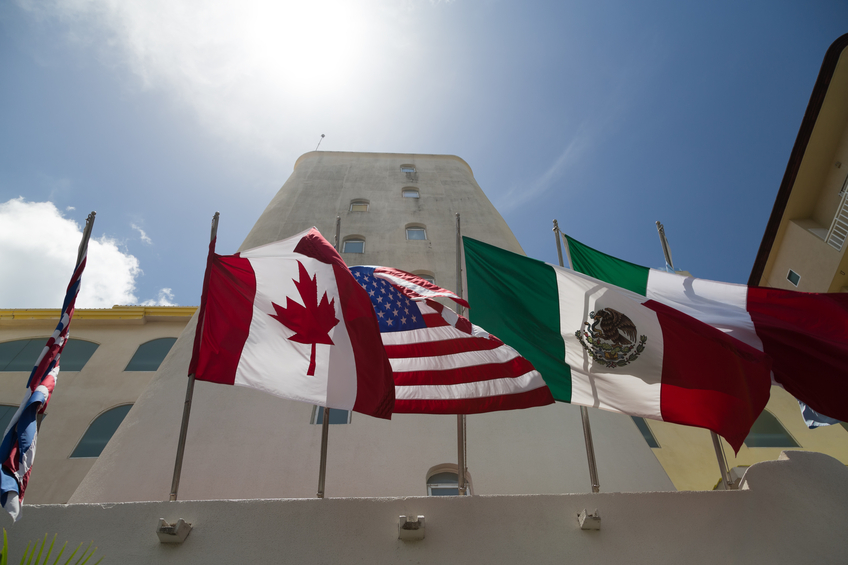
IISD Commends North American Leaders On Their Climate Change Statement

Canada, the United States and Mexico issued a statement today outlining a collaborative approach towards climate action. Amin Asadollahi, IISD lead on North American climate mitigation, made the following statement.

June 28, 2016

Canada, the United States and Mexico issued a statement today outlining a collaborative approach towards climate action.

Amin Asadollahi, International Institute for Sustainable Development’s (IISD) lead on North American climate mitigation, made the following statement:

“President Obama, President Peña Nieto and Prime Minister Trudeau have demonstrated climate leadership through their joint commitment to the Paris Agreement, by reducing greenhouse gas emissions, increasing renewable energy production and strengthening energy efficiency standards. Climate change transcends borders and through a collaborative approach, the three countries will be better positioned to compete in a world that is becoming increasingly carbon constrained.”

“A goal of 50 per cent clean power generation by 2025 puts the continent on the right path of building a more resilient energy sector. Governments should now provide policy signals needed to help the automotive sector to build cleaner vehicles, by setting continent-wide targets.” 

“We are also pleased to see the three leaders agreeing to advance previous commitments on short-lived climate pollutants and Mexico joining Canada and the United States in the common goal of reducing methane emissions from the oil and gas sector. Methane provides significant emission reduction potential and the three countries should aim to eliminate methane leaks as well as wasteful routine venting and flaring practices in the oil and gas sector, a target within reach by 2030.”

“Through a joint effort of protecting biodiversity, we can take advantage of opportunities that ecosystems provide for climate change mitigation and adaptation. We need sustainable development that avoids additional pressure on species, which face serious risks in a changing climate. With rapid decline of ecosystems, North America can take the lead in reversing this trend and meet global biodiversity commitments.”

Press release details

Impact area
Climate
Press release

Civil Society Organizations Join Forces to Call for G20 to End Fossil Fuel Subsidies by 2020

More than 200 civil society organizations, including the International Institute for Sustainable Development (IISD), have joined together to urge G20 governments to commit to end fossil fuel subsidies by 2020.

June 27, 2016

More than 200 civil society organizations, including the International Institute for Sustainable Development (IISD), have joined together to urge G20 governments to commit to end fossil fuel subsidies by 2020.

Environmental groups, campaigners and researchers have come together to sign a joint statement that calls for governments to set a clear timetable to phase out fossil fuel subsidies as well as public finance for oil gas and coal production.

The statement, sent to ministers ahead of the G20 energy meeting in Beijing this month (June 29-30), also urges G20 governments to commit to full transparency about fossil fuel subsidies from 2017 onwards and to include all commitments in the 2016 G20 communique ahead of this year’s summit.

Recent research by the Overseas Development Institute (ODI) and Oil Change International (OCI) found G20 governments spend USD 444 billion every year to support fossil fuel production.

Shelagh Whitley, Team Leader of Green Growth at ODI, said: "At a time when we should be investing in clean sources of energy, fossil fuel subsidies are locking us into using up oil, coal and gas resources and therefore undermining efforts to deal with the very real threat posed by climate change.

"Given the urgency of this threat, the G20 needs to take the next steps on its commitment to phase out fossil fuel subsidies, and set a clear timetable for how this will be done by 2020 to give us any chance of reducing carbon emissions to a safe level."

Peter Wooders, Group Director Energy, IISD, Global Subsidies Initiative (GSI), said: "Many countries are reforming subsidies to fossil fuels. GSI believes that the phase out of subsidies by 2020 from the G20 countries is also eminently possible, given a sound plan and deadline for action."

-30-

For more information, please contact Sumeep Bath, media and communications officer, IISD, at [email protected] or +1 (204) 958 7740 (ex 740).

Notes to editors

  • The statement, signed by more than 200 civil society organizations, is due to be published on Tuesday, June 28.
  • The meeting of G20 energy ministers will take place in Beijing on Wednesday, June 29, and Thursday, June 30.
  • The November 2015 report from ODI and OCI, Empty promises: G20 subsidies to oil, gas and coal production, found G20 governments spent USD 444 billion a year to support fossil fuel production – via national subsidies (USD 70 billion), investments by state-owned enterprises (USD 286 billion) and public finance (USD 88 billion).

The G20 Leader’s Summit 2016 will take place on September 4-5 in Hangzhou

Press release details

Topic
Subsidies
Impact area
Climate
Press release

How is Income in Winnipeg Related to Likelihood of Stroke?

June is Stroke Awareness Month. We took a look at data from Peg to explore how income is related to likelihood of stroke in Winnipeg.

June 27, 2016

June is Stroke Awareness Month. We took a look at data from Peg to explore how income is related to likelihood of stroke in Winnipeg.

Peg tells us…

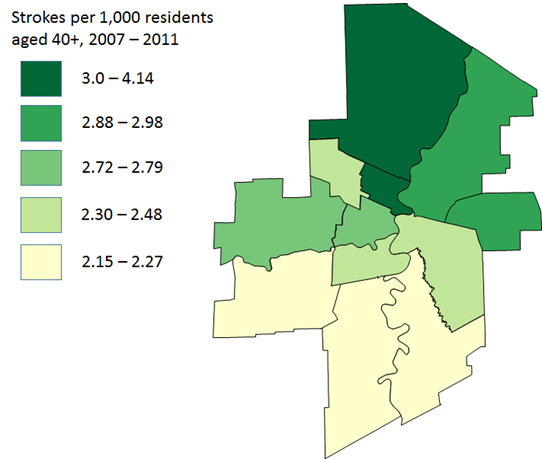
People living in Point Douglas have the highest rate of stroke of all community areas in Winnipeg at 4.14 per 1000 residents, double the rate compared to people living in Fort Garry.

The facts are:

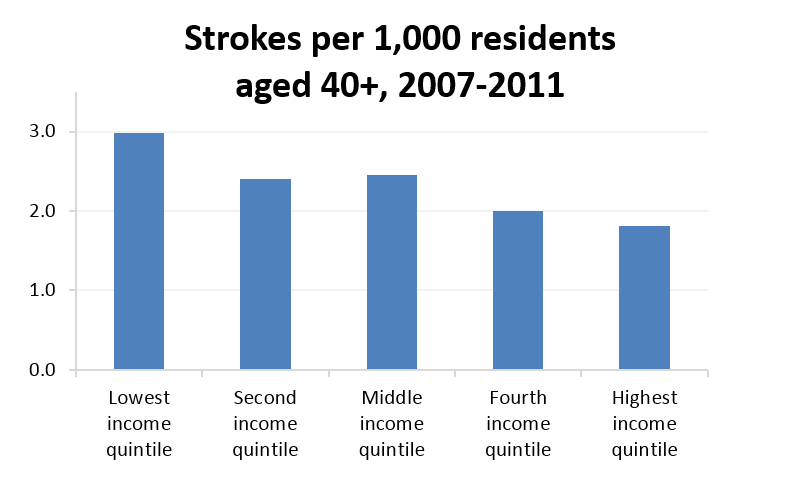
  • Lower-income Winnipeggers are significantly more likely to have a stroke than those in the highest-income quintile. The lowest-income 20 per cent were 64 per cent more likely to have a stroke than the highest-income 20 per cent.
  • The rate of hospitalization or death due to a stroke in Winnipeg was 2.6 per thousand residents aged 40 and over in 2007-2011. The rate has decreased slightly since 2002-2006, when it was 2.7 per thousand.


To view the complete map on Peg, visit http://www.mypeg.ca/maps/

Why does this matter?

  • Cardiovascular diseases, such as heart attack and stroke, are the leading causes of death globally, and represent a third of all deaths in Winnipeg in any given year. These diseases are also a leading cause of hospitalization and adult disability. Heart attacks and strokes are associated with social and economic disadvantage. Opportunities for employment, income, education, and housing have enormous potential to reduce the unequal burden of heart disease and stroke.

Definitions:

  • The stroke indicator measures the number of hospitalizations or deaths due to stroke per 1,000 residents aged 40 and older. Rates are sex- and age-adjusted.
  • It should be noted that patients who were attended by nurses, misdiagnosed, or did not seek treatment are not recorded in official statistics in the database.
  • More detail and source data for the above facts available at http://www.mypeg.ca/explorer/WellBeing/Health/Stroke/

Source of the data:

About us:

Peg (mypeg.ca) is a community indicator system that measures the health of our community year over year – in ways that count. Peg is led by two partnering organizations – the International Institute of Sustainable Development (IISD) and United Way of Winnipeg (UW).

Regularly, the team at Peg releases data and facts that help us understand our city better. This is one of those regular reports. Others can be found at http://www.mypeg.ca/blog.

Peg is the starting place for Winnipeg citizens, educators, policy makers, and many others to learn more about our city so we can lead change to create a better city for our children and their children. At Peg we can all learn how our lives, our neighbourhood and our city is changing – for the good and the bad. Learn more at www.mypeg.ca.

Press release details