Press release

66% of Winnipeg’s Homeless are Invisible to the Average Winnipegger

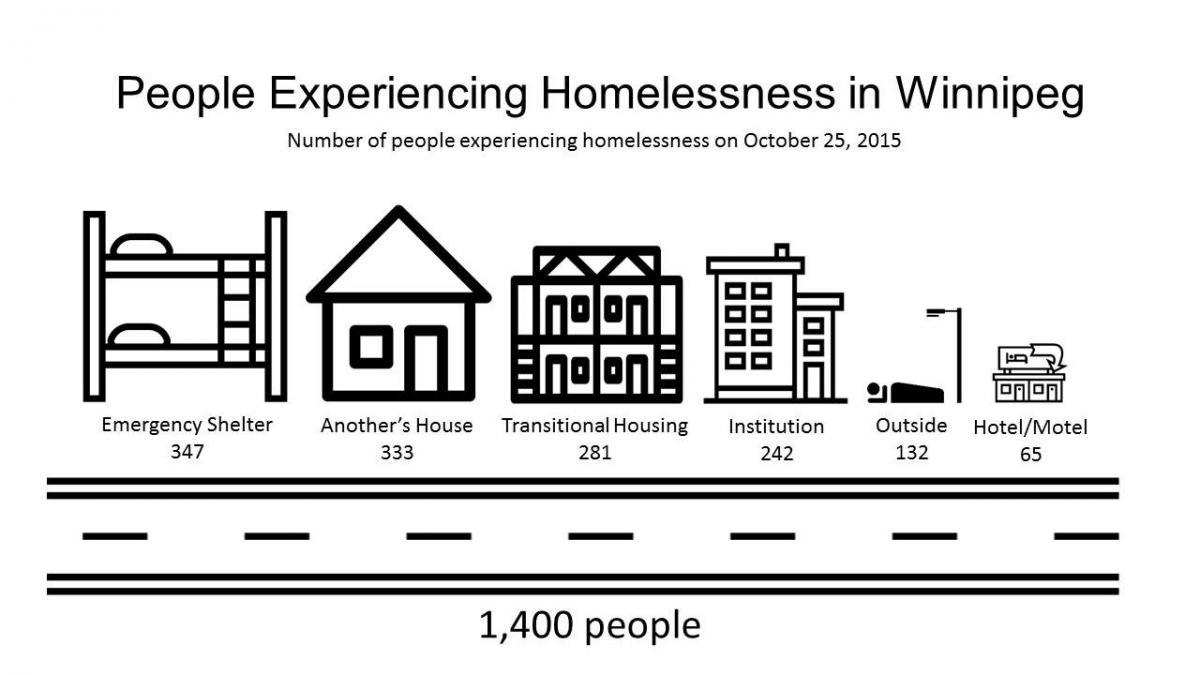
1,400 Winnipeggers were experiencing homelessness during the first Street Census Survey, completed in 2015. 66% of these people weren’t staying in shelter or sleeping outside, but were still without a home.

October 23, 2017

1,400 Winnipeggers were experiencing homelessness during the first Street Census Survey, completed in 2015. 66% of these people weren’t staying in shelter or sleeping outside, but were still without a home.

This is according to Peg, which is releasing this startling data just ahead of the National Conference on Ending Homelessness which is taking place October 25-27 in Winnipeg. For the first time, Winnipeg is greeting almost 1,000 individuals from across Canada, providing a forum for inspiration, information, tools and training to end homelessness. 

What else can Peg tell us about homelessness in Winnipeg?

Peg tells us…

  • Of those 1,400 experiencing homelessness on the night of the census:
  • 347 were staying at an emergency shelter
  • 333 were staying at another’s house
  • 281 were in transitional housing
  • 242 were in an institution
  • 65 were staying in a hotel/motel, and
  • 132 were sleeping outside.

Definitions:

  • The Canadian definition of homelessness was used when developing methodology for the Winnipeg Street census. This definition includes a spectrum of living situations including unsheltered, emergency sheltered, provisionally accommodated and at risk of homelessness.
  • Due to resource limitations and the use of point-in-time methodology, where all data is collected during a specific point in time, the complete range of homelessness was not included in the census. People not surveyed include people who were emergency sheltered due to fleeing natural disasters, people at imminent risk of homelessness and individuals and families who are precariously housed (SPCW, 2015, p.25).


Why does this matter?

  • Homelessness affects a broad spectrum of people, including some of the city’s most vulnerable populations; youth, women and children and seniors. As there are many factors that contribute to being homeless, it often becomes increasingly difficult to regain self-sufficiency the longer a person is homeless (Government of Canada, 2016).
  • Housing, more specifically affordable housing, is a basic need and is critical to well-being. It provides physical safety and peace of mind and allows individuals to prioritize other necessities that help improve quality of life such as continuing education, being employed, prioritizing health and the ability to build social networks within a community.
  • More detail and source data for the above facts available at: http://www.mypeg.ca/explorer/WellBeing/BasicNeeds/homeless/


Source of the data:


Media inquiries:

For interviews on understanding the trend (or the story behind the numbers), organizations making a difference in the community, the National Conference on Ending Homelessness, Peg, or the data, please contact:

Sumeep Bath, Media and Communications Officer, International Institute for Sustainable Development

(204) 958-7700 ex 740 | [email protected]


Social media:

Twitter: @Pegindicators                            

Facebook: MyPeg                        

Youtube: MyPegCIS


About us:

Peg (mypeg.ca) is a community indicator system that measures the health of our community year over year – in ways that count. Peg is led by two partnering organizations – the International Institute of Sustainable Development  and United Way of Winnipeg.

Peg is the starting place for Winnipeg citizens, educators, policy makers, and many others to learn more about our city so we can lead change to create a better city for our children and their children. At Peg we can all learn how our lives, our neighbourhood and our city is changing – for the good and the bad. Learn more at www.mypeg.ca.

Press release details

Press release

92 per cent of Winnipeggers Consider Quality of Life ‘Good’ or ‘Very Good’

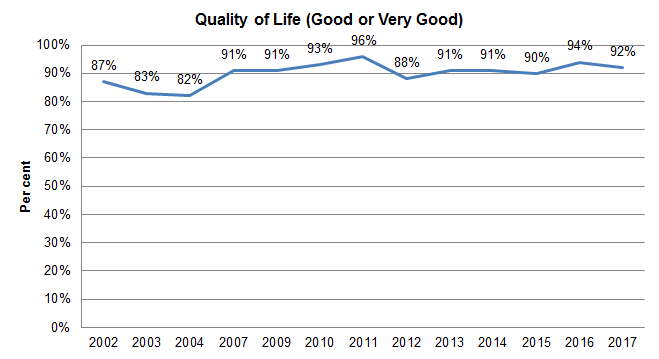
92 per cent of Winnipeggers believe that their quality of life is ‘good’ or ‘very good’—up from 87 per cent in 2002. This is according to the latest report from our Peg project.

October 10, 2017

92 per cent of Winnipeggers believe that their quality of life is ‘good’ or ‘very good’—up from 87 per cent in 2002.

This is according to new data from a survey on Winnipeg citizens’ satisfaction with life, just released by Winnipeg’s Peg project.

What else can Peg tell us about quality of life in Winnipeg?


Peg tells us…

  • Quality of life has been on a general upward trend over the past 15 years, growing from 87 per cent in 2002 to 92 per cent in 2017.
  • 2011 saw the highest number on record, at 96 per cent.
  • 2017 saw a slight dip from the previous year - 92 per cent, down from 94 per cent in 2016. 


Definitions:

  • Quality of life is measured differently by different organizations and there is no commonly agreed methodology. On a fundamental basis, however, quality of life indicators are meant to measure the subjective well-being or happiness/sense of satisfaction with life within a population.
  • The City of Winnipeg publishes the annual "Citizen Survey" which includes data on percentage of respondents who believe that the quality of life in Winnipeg is ‘very good’ or ‘good’.


Why does this matter?

  • Quality of life is receiving renewed interest with national and sub-national policy makers due to the emergence of concepts such as Gross National Happiness as an alternative or complement to strictly economic or financial indicators of well-being.
  • Many municipalities today continue their efforts to boost quality of life to attract and maintain investments and residents.
  • More detail and source data for the above facts available at: http://www.mypeg.ca/explorer/WellBeing/SocialVitality/QualityOfLife/


Source of the data:

  • Peg’s data for the Quality of Life indicator is provided by the City of Winnipeg Citizen Survey. Online copies of each survey may be found at http://winnipeg.ca/cao/surveys.stm.


Media inquiries:

For interviews on understanding the trend (or the story behind the numbers), organizations making a difference in the community, Peg, or the data, please contact:

Sumeep Bath, Media and Communications Officer

International Institute for Sustainable Development

(204) 958-7700 ex 740 | [email protected]


Social media:

Twitter: @Pegindicators

Facebook: MyPeg

Youtube: MyPegCIS


About us:

Peg (mypeg.ca) is a community indicator system that measures the health of our community year over year – in ways that count. Peg is led by two partnering organizations – the International Institute of Sustainable Development  and United Way of Winnipeg.

Peg is the starting place for Winnipeg citizens, educators, policy makers, and many others to learn more about our city so we can lead change to create a better city for our children and their children. At Peg we can all learn how our lives, our neighbourhood and our city is changing – for the good and the bad. Learn more at www.mypeg.ca.

Press release details

Press release

Lakehead University and IISD Experimental Lakes Area team up to safeguard Canada’s fresh water

IISD Experimental Lakes Area is thrilled to announce that it has signed a five-year MOU with Lakehead University, making collaboration between the two organizations much easier.

October 9, 2017

Officials from Lakehead University and IISD Experimental Lakes Area (IISD-ELA) have signed a five-year memorandum of understanding to foster collaboration between the two organizations.

Thanks to this new MOU, Lakehead University faculty and students can visit and perform research at the IISD-ELA much more easily, staff from both organizations will be able to participate in seminars and workshops together, and students can benefit from being supervised by staff from both institutions.

Staff from both organizations hope to mutually benefit from their respective knowledge and to further understanding about what impacts fresh water systems, and what can be done to protect the world’s water supplies.

Dr. Andrew P. Dean, Lakehead’s Vice-President, Research and Innovation, emphasized how beneficial this agreement will be for students.

 “The experiential learning that comes from performing research outside of the lab is invaluable,” Dr. Dean said. “I look forward to seeing the research that results from this agreement.”

This MOU will result in collaborative research projects that draw on the expertise of both institutions.

“What this means is that our two institutions can collaborate and share much more easily—all in the name of protecting the world’s freshwater supplies,” said Matthew McCandless, executive director, IISD Experimental Lakes Area.

“This is yet another step in IISD-ELA further opening its doors to the world, committing itself to educating the freshwater scientists of tomorrow, and building stronger partnerships with researchers across Canada and the globe,” McCandless said.

– 30 –

For more information or to arrange interviews, please contact Sumeep Bath, Media and Communications Officer, at (204) 958-7700 ex 740, or s[email protected].

Press release details

Topic
Water
Impact area
Nature
Press release

Media Availability: What effect does mercury have on fresh water?

Mercury can cause a wide range of physical and mental symptoms in humans. IISD Experimental Lakes Area (IISD-ELA) has a wealth of expertise on the effects of mercury on fresh water and fish, and its impacts on ecosystems overall.

September 20, 2017

Mercury can cause a wide range of physical and mental symptoms in humans.

The Minamata Convention on Mercury aims to reduce the amount of mercury released into the environment. The global community is currently meeting in Geneva to discuss how to enforce the treaty.

IISD Experimental Lakes Area (IISD-ELA) has a wealth of expertise on the effects of mercury on fresh water and fish, and its impacts on ecosystems overall.

To speak with any of the experts below, please contact Sumeep Bath at [email protected] or +1 (204) 958 7700 ext. 740.

Dr. Michael Paterson has focused his work on issues related to mercury for over 25 years. He has explored how mercury affects food webs and fish, and the relationship between hydro electric reservoir development and elevated concentrations of mercury.


As a biologist with IISD-ELA, Lee Hrenchuk  monitors and assesses the effects of a variety of environmental stresses, including mercury deposition, on fish ecology and behaviour in lakes in the boreal shield. 


Press release details

Topic
Water
Impact area
Nature
Press release

Winnipeggers’ Physical Activity Dips Below National Average

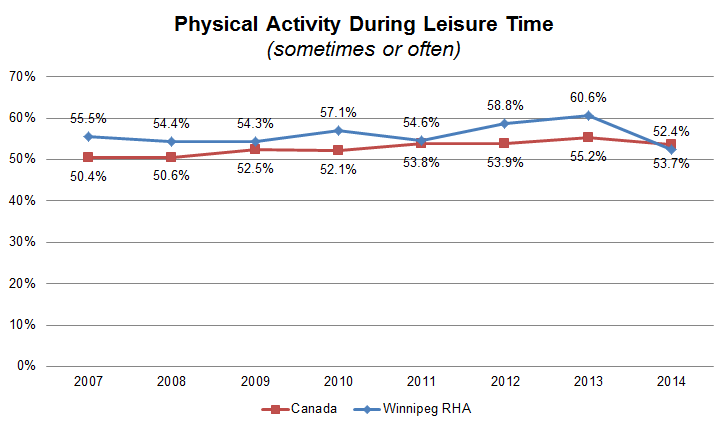
The latest report from our Peg project reveals that 52.4 per cent of Winnipeggers are ‘sometimes’ or ‘often’ physically active during their leisure time—a figure lower than the national average of 53.7 per cent.

August 22, 2017

Summer is winding down and Winnipeggers are gearing up to go back to school and begin recreational programming for the fall. What does Peg tells us about how active Winnipeggers are compared to Canadians overall?

52.4 per cent of Winnipeggers are ‘sometimes’ or ‘often’ physically active during their leisure time—a figure lower than the national average of 53.7 per cent.

Peg tells us…

  • In 2014, 52.4 per cent of Winnipeggers were sometimes or often physically active during their leisure time, down slightly from 54.3 per cent five years earlier.
  • For the first time in almost ten years, fewer Winnipeggers were physically active in 2014 than the national average (52.4 per cent of Winnipeggers vs. 53.7 per cent of Canadians).

Why does this matter?

  • Regular physical activity has many benefits. It helps growth and development, prevents chronic diseases, strengthens muscles, increases energy levels, decreases stress levels and helps keep people more independent as they age (PHAC, 2016).

Definitions:

Source of the data:

  • Peg’s data for the Active Leisure Time indicator is provided by Statistics Canada. 

Media inquiries:

For interviews on Peg, the data, or to be connected with organizations making a difference in the community, please contact:

Sumeep Bath, Media and Communications Officer

International Institute for Sustainable Development (IISD)

(204) 958-7700 ex. 740 | [email protected]

About us:

Peg (mypeg.ca) is a community indicator system that measures the health of our community year over year – in ways that count. Peg is led by two partnering organizations – the International Institute of Sustainable Development (IISD) and United Way of Winnipeg (UW).

Regularly, the team at Peg releases data and facts that help us understand our city better. This is one of those regular reports. Others can be found at http://www.mypeg.ca/blog.

Peg is the starting place for Winnipeg citizens, educators, policy makers, and many others to learn more about our city so we can lead change to create a better city for our children and their children. At Peg we can all learn how our lives, our neighbourhood and our city is changing – for the good and the bad. Learn more at www.mypeg.ca.

Press release details

Press release

Lake Trout adjust their behaviour in the face of a changing climate, new study

Canadian scientists at IISD-ELA have discovered that certain lake predators are altering their behaviour due to climate change, revealing what the future may hold for these fish and their food. 

August 14, 2017

WINNIPEG, August 15, 2017 - Canadian scientists have discovered that certain lake predators are altering their behaviour due to climate change, revealing what the future may hold for these fish and their food. 

For years scientists told tales of fish such as Lake Trout adapting their feeding behaviour as temperatures change, but no empirical evidence existed. Now, a recently completed 11-year study at IISD Experimental Lakes Area (IISD-ELA) in northwestern Ontario reveals that Lake Trout have a remarkable ability to adjust their behaviour in the face of changing water temperatures.

“These findings are important for understanding how Lake Trout and other temperature-sensitive fish will respond to climate change,” said Matthew Guzzo, a PhD candidate in the University of Manitoba’s Department of Biological Sciences and lead author of the study published in the Proceedings of the National Academy of Sciences. “Lake Trout are reacting rapidly to changes in water temperature. As soon as the water became too warm, the fish left the shallow, more productive water, and went to the deep part of the lake where the food is of lower quality. And when a top predator is forced to change what it eats, it impacts not only its own well-being, but the whole food web.”

Guzzo and co-authors Paul Blanchfield, Research Scientist at Fisheries and Oceans Canada, and Michael Rennie, Canada Research Chair in Freshwater Ecology and Fisheries at Lakehead University, found that changes in water temperatures, not food availability, guide the Lake Trout’s movements. This fact comes with complex repercussions.

“Our study confirms the importance of springtime shoreline resources in these small boreal lakes for Lake Trout, and how in warmer years their access to this resource is limited,” said Rennie.  “The prediction from this observation is that climate warming should result in slower-growing trout in poorer condition, due to reduced shoreline access.” 

The study focused on the ice-free season in the lakes. In a world warming due to climate change, earlier springs bring an earlier opportunity for the trout to forage on energy-rich minnows in shallow water. But a warmer climate means longer, hotter summers, and the water quickly heats beyond the predator’s preference, forcing them to move to cool, deep, less productive water. As a result, the scientists observed a reduction in the fish’s growth and condition, which can impact their reproductive success.

“Lake Trout are a sentinel species – the canary in the coal mine for boreal lakes,” said Blanchfield.  “Our findings provide evidence that Lake Trout are struggling to cope with a rapidly-changing and stressful thermal environment.” 

All this could have profound and severe impacts on future populations and their ability to persist through the ever-intensifying effects of climate change.

“This current study isn’t the whole climate change story. It’s showing that fish can adapt to changing conditions. Their behaviour is not static. They’re not just sitting ducks,” said Guzzo. “We are showing that for now Lake Trout can continue to live in these areas that will warm by making the best of a bad situation, but what this means for the long-term persistence of these and other cold-water fish populations is unclear.”

Funding for “Behavioural response to annual temperature variation alter the dominant energy pathway, growth, and condition of cold-water predator” was provided by the Natural Sciences and Engineering Research Council of Canada, the W. Garfield Weston Foundation, Manitoba Fish Futures, the University of Manitoba, DeBeers Canada, Fisheries and Oceans Canada, and IISD-ELA.

To interview one of the researchers please contact Sumeep Bath, Media and Communications Officer, IISD-ELA, 204-958-7700 ext 740, [email protected]


Press release details

Topic
Water
Impact area
Nature
Press release

Farm practices must change to protect endangered species and habitats

Sustainable agriculture practices must be widely implemented in order to stem an alarming loss of biodiversity and to protect endangered species, according to the Standards and Biodiversity report.

June 26, 2017

ZURICH, June 27, 2017 — Sustainable agriculture practices must be widely implemented in order to stem an alarming loss of biodiversity and to protect endangered species.

This is according to the Standards and Biodiversity report released Tuesday by the International Institute for Sustainable Development.

Agricultural production currently accounts for 40 per cent of global land surface and is responsible for 70 per cent of projected losses in terrestrial biodiversity due to widespread land conversion, pollution and soil degradation.

“What happens in agriculture matters,” said Scott Vaughan, President-CEO, IISD. “Growing demand for certified products presents a major opportunity to protect our natural resources. The market is rewarding efforts to conserve critical habitats, protect soil and water quality, and mitigate the impacts of climate change. But market forces are not enough.”

The market value of certified agricultural products was estimated to be USD 52.5 billion in 2015 for eight major commodities (bananas, cotton, coffee, cocoa, tea, sugar, palm oil and soybeans) according to Standards and Biodiversity. That is up from USD 31.6 billion in 2012, the previous estimate by the State of Sustainability Initiatives Review.

Two other major commodities—fisheries and forestry—also registered significant growth, according to the new estimates. The sustainable forestry market grew to USD 231.8 billion in 2015 from USD 200.3 billion in 2012. The sustainable fisheries market grew to USD 8.9 billion in 2015 from USD 6.8 billion in 2012. The total trade value of the top 10 sustainable commodity markets grew to USD 293.2 billion in 2015 from USD 238.7 billion in 2012.

Some agricultural commodity markets are now dominated by sustainability standards. Half of global coffee production was standard compliant in 2014 (the latest available data,) along with 30 per cent of cocoa production, 22 per cent of palm oil production and 18 per cent of global tea production.  

The study forecasts that four other agricultural commodities—bananas, cotton, sugar and soybeans—will have compliance rates of at least 10 per cent by 2020.

However, standards remain a negligible force across global agricultural production as a whole. If those eight agricultural commodities became 100 per cent certified, the study found it would still only amount to 12 per cent of global agricultural land area.

“If voluntary standards are to play a major role in reducing the impacts of agriculture on biodiversity loss, they will have to, at a minimum, establish a significant presence among other crops—most notably, staple crops such as wheat, maize and rice,” said study author Jason Potts, a senior associate at IISD.

“The good news is that we can build political will to address biodiversity loss,” Potts added. “Parties of the UN’s Convention on Biological Diversity (CBD) are leading efforts to identify concrete solutions and immediate actions to achieve their biological diversity targets.”

The IISD study builds upon the CBD’s Biodiversity Impact Indicators for Commodity Production (BIICP), which identifies a core set of biodiversity indicators that can help governments and the agricultural industry understand how best to reduce negative impacts on biodiversity. The CBD Secretariat contributed to the development of the report.

“Voluntary sustainability standards are an important element of the necessary policy mix to redirect funding towards sustainable production practices and reducing biodiversity loss,” said Cristiana Paşca Palmer, Executive Secretary, CBD. “This report makes an important contribution by providing a better understanding of the role and potential of different voluntary sustainability standards, and what policy-makers can do to promote their wider application and their more robust integration into overall policy frameworks.”

The study was released at ISEAL Alliance’s annual meeting—the 2017 Global Sustainability Standards Conference—in Zurich, Switzerland. It identifies a wealth of information about specific commodities, such as:

  • Cocoa certification appears to be well positioned to promote improved soil fertility where it matters most through a strong presence in countries facing soil fertility challenges.
  • Coffee certification appears to be well positioned to limit the negative impacts on lakes and other water sources because standards are highly active in areas where the threat of eutrophication is most prominent.
  • The banana sector may be approaching a “glass ceiling” on growth, as it is currently limited to the small portion of production that is traded internationally.
  • Cotton certification appears to be under-represented in countries where cotton-related water use is most problematic: the expansion of certified cotton across Pakistan and India is strategically important.
  • Palm oil certification is geographically focused where forest conversion is most problematic but may nevertheless have limited impact due to the scale of demand for conventional palm oil by Asian countries.
  • Soy certification is most active in key areas of biodiversity vulnerability but has low adoption rates due to low demand for certified soy from Asia.
  • Sugarcane certification is highly concentrated in Brazil, which has lower per-volume fertilizer use than other major producing countries. India, China, Pakistan and Mexico represent strategic opportunities for the expansion of certified sugarcane aimed at protecting water quality.
  • Tea production compliant with standards accounts for 18 per cent of global tea production (by volume) but only 13 per cent of global area under tea production, as it appears to be concentrated in higher-yielding production systems.

The research was made possible through the generous support of the Swiss Secretariat for Economic Affairs (SECO).

Please visit the study’s dedicated webpage to view the full report and additional details. A related policy brief can be viewed here.

To speak with one of our experts, contact Mira Oberman at [email protected] or +1 (204) 958-7700 ext. 728 (in Winnipeg, Canada).


ABOUT THE CONVENTION ON BIOLOGICAL DIVERSITY

The Convention on Biological Diversity (CBD) opened for signature at the Earth Summit in Rio de Janeiro in 1992, and entered into force in December 1993. The Convention is an international treaty for the conservation of biodiversity, the sustainable use of the components of biodiversity and the equitable sharing of the benefits derived from the use of genetic resources. With 196 Parties so far, the CBD has near universal participation among countries. The Convention seeks to address all threats to biodiversity and ecosystem services including threats from climate change, through scientific assessments, development of tools, incentives and processes, the transfer of technologies and good practices, and the full and active involvement of relevant stakeholders, including Indigenous and local communities, youth, NGOs, women and the business community. The Cartagena Protocol on Biosafety and the Nagoya Protocol on Access and Benefit Sharing are supplementary agreements to the Convention. The Cartagena Protocol, which entered into force on September 11, 2003, seeks to protect biological diversity from the potential risks posed by living modified organisms resulting from modern biotechnology. To date, 170 Parties have ratified the Cartagena Protocol. The Nagoya Protocol aims at sharing the benefits arising from the utilization of genetic resources in a fair and equitable way, including by appropriate access to genetic resources and by appropriate transfer of relevant technologies. It entered into force on October 12, 2014, and to date has been ratified by 99 Parties. For more information, visit www.cbd.int.

For additional information, please contact: David Ainsworth on +1 514 287 7025 or at [email protected]; or Johan Hedlund on +1 514 287 6670 or at [email protected]


Press release

IISD applauds Canada’s new Feminist International Assistance Policy

Statement from IISD President-CEO Scott Vaughan and Senior Researcher Julie Dekens.

June 15, 2017

Statement from IISD President-CEO Scott Vaughan and Senior Researcher Julie Dekens:

We applaud the Canadian Government’s new Feminist International Assistance Policy as an important step to show that Canada is an international leader on gender equality.

We fully share this new policy’s vision that gender equality is the most effective way to address poverty and achieve a world that is more prosperous, peaceful and inclusive.

Progress toward gender equality is underway, but much more needs to be done. Minister Freeland’s recent statement emphasized why it is worthwhile for Canadians to step up and place the promotion of women’s rights at the core of Canada’s foreign policy priorities.

Her call for multilateralism and a renewed commitment to working together on global challenges like climate change and human rights echoes the adoption by global leaders of the 2030 Sustainable Development Goals (SDGs).

Indeed, the SDGs send a similar message: gender equality is a prerequisite as much as an outcome for sustainable development.

To this end, Global Affairs Canada is placing women and girls at the centre of its international assistance policy. It commits 15 per cent of its bilateral development assistance to projects dedicated to advancing gender equality and women and girls’ empowerment by 2021/22.

IISD is engaged in on-going efforts to mainstream gender within our workplace and make gender equality a priority across our programs. Our work on climate change, energy, and trade and investment already supports the key priorities identified in the new development assistance policy.

For example, we are working to highlight women’s role in decision making on climate change adaptation, particularly in the context of National Adaptation Plan (NAP) processes in developing countries.  The NAP Global Network, which we host, is focused on exploring these issues in the Pacific with the support of the Canadian government.

Through our work, we understand that empowered women are important agents for change. Elisabeth Atangana, president of the Cameroon farmers organization, and Special Ambassador for Cooperatives at the Food and Agriculture Organization of the United Nations (FAO), explains what this looks like in practice: “Working with parliaments so they take into account the concern of women farmers to benefit from foreign investment in agriculture contributed to giving us a voice in the national parliaments in Central Africa, and allowed us to sit at the table with our leaders for the first time ever."

IISD looks forward to working with the Government of Canada and its partners around the world to advance this agenda.

Press release details

Press release

Media Availability: Zebra mussels and fresh water

IISD Experimental Lakes Area is pleased to offer expertise to media on zebra mussels and the effect they can have on our province's fresh water. 

June 7, 2017

IISD Experimental Lakes Area is pleased to offer expertise to media on zebra mussels and the effect they can have on our province's fresh water. 

The Province of Manitoba has announced that this summer it is ramping up its efforts to protect our water from invasive species, such as zebra mussels. Significant numbers of zebra mussels have been found in the Red River and the southern basin of Lake Winnipeg, with a limited number detected in the northern basin of Lake Winnipeg and Cedar Lake.

IISD Experimental Lakes Area is pleased to offer expertise to media on zebra mussels and the effect they can have on our province's fresh water.

Dr. Scott Higgins is an IISD Experimental Lakes Area research scientist who has studied the ecological impacts of zebra mussels across North America and Europe over the last decade. He has authored several research papers and book chapters on their impacts, and co-authored a national risk assessment of zebra mussels in Canada.

To arrange to speak with Dr. Higgins please contact Sumeep Bath at [email protected] or +1 (204) 958 7700 ext 740.

Press release details

Topic
Water
Impact area
Nature
Press release

Trump’s rejection of Paris Agreement is a call to action and resolve for us all

"U.S. President Donald Trump’s withdrawal from the Paris Agreement on climate change puts the United States at odds not just with the international community, but with overwhelming scientific evidence and the publicly expressed wishes of hundreds of American companies, from Apple to Exxon. U.S. President Donald Trump’s withdrawal from the Paris Agreement on climate change puts the United States at odds not just with the international community, but with overwhelming scientific evidence and the publicly expressed wishes of hundreds of American companies, from Apple to Exxon."

June 1, 2017

U.S. President Donald Trump’s withdrawal from the Paris Agreement on climate change puts the United States at odds not just with the international community, but with overwhelming scientific evidence and the publicly expressed wishes of hundreds of American companies, from Apple to Exxon.

Without the United States, the rest of the world will have a harder time meeting the Paris Agreement’s goal of preventing global temperatures from rising more than 2 degrees Celsius above pre-industrial levels. And the United States will miss out on the creation of more jobs and economic growth as well as reduced business risks.

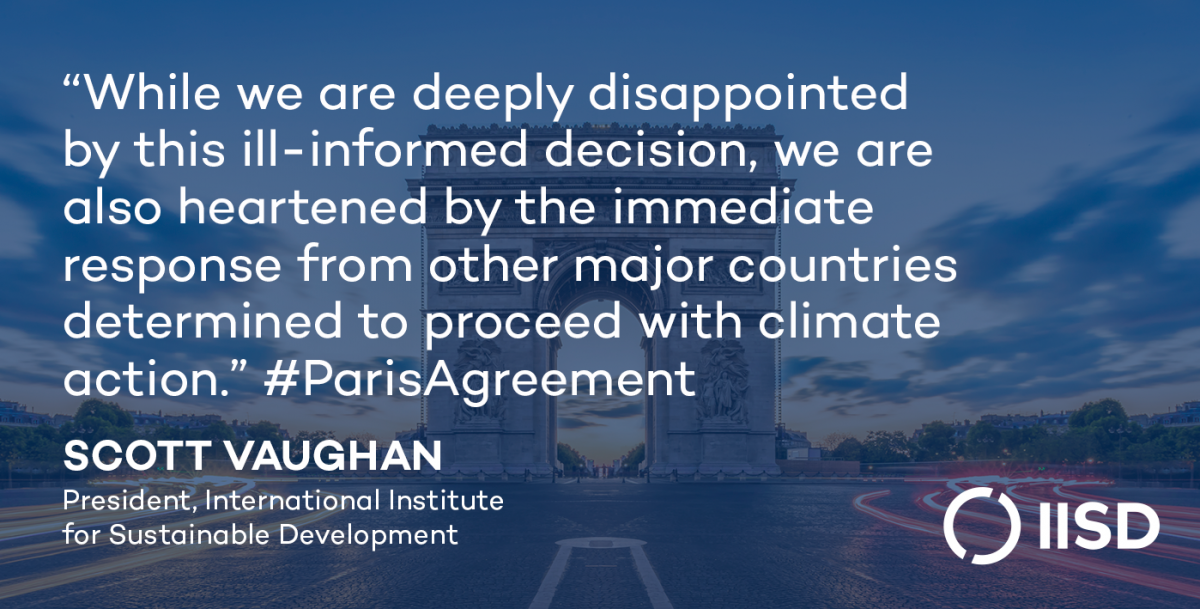
While we are deeply disappointed by this ill-informed decision, we are also heartened by the immediate response from other major countries determined to proceed with climate action. India, the European Union and China pledged to accelerate their efforts. Canada announced it will co-host a ministerial summit with China and the European Union in September to advance action on the Paris Agreement.

Even more importantly, new coalitions of states, cities and businesses within the United States have emerged in defiance of the president's decision.

Governors from California, New York and across the country declared they would work together to move ahead with climate action. Yesterday, 83 mayors signed a statement vowing to uphold the commitments to the goals enshrined in the Paris Agreement.

And finally, U.S. businesses have expressed their frustration and disappointment with the decision, but also stressed that it would have little impact on their own ongoing efforts. Brad Smith, CEO of Microsoft, said this about the Paris Agreement: "A global framework strengthens competitiveness for American businesses. It creates new markets for innovative clean technologies, from green power to smart grids to cloud-enabled solutions."

At IISD we will continue to work across the world and in the United States at every level of government to help implement climate action. We echo the words of the 83 U.S. mayors who committed to adopting and upholding the Paris Climate Agreement goals:

“The world cannot wait—and neither will we.”

Press release details