Press release

Winnipeggers are recycling more, using less water, and producing less greenhouse gas, says new report

Winnipeggers reduced the per capita amount of waste sent to local landfills over a 15-year period—using recycling, composting and other programs to more than triple diverted waste. Winnipeggers also used 50 per cent less water and produced fewer greenhouse gas emissions over the same period.

May 31, 2017

WINNIPEG, June 1, 2017 — Winnipeggers reduced the per capita amount of waste sent to local landfills over a 15-year period—using recycling, composting and other programs to more than triple diverted waste. Winnipeggers also used 50 per cent less water and produced fewer greenhouse gas emissions over the same period.

These are just some of the findings available in Our City: A Peg Report on the Natural and Built Environment. The report explores how the state of our environment has a profound impact on our health, well-being and ability to prosper. It also reveals how we as citizens are impacting the environment around us.

“This third Peg well-being report gives us insight into the relationship Winnipeggers have with the city’s natural and built environment,” said Scott Vaughan, President-CEO, International Institute for Sustainable Development (IISD).

“We can pride ourselves on our clean air and water, our parks, open spaces and joint actions to reduce our environmental footprint in so many ways by so many individual actions—such as diverting waste from the landfill and public and active transit decisions. The indicators discussed in this report mirror everyday actions and values of Winnipeggers in creating a city where we all aspire to live.”

The report is being released in advance of World Environmental Day, Monday, June 5, 2017. This year’s theme is Connecting People to Nature. As host country, Canada chose the theme to encourage more people to get outdoors, appreciate nature’s beauty and importance, and protect the Earth we share.

The Peg report intends to add to important conversations already underway in our community about how we can improve conditions and make Winnipeg a healthier, more sustainable place to live.

Results were measured using 13 indicators: air quality, water quality, parks and open spaces, dwelling density, core housing need, waste and water diversion, water use, greenhouse gas emissions, transportation, collision victims, active leisure time, activity limitation and perception of safety.

While some indicators such as core housing need and dwelling density are improving, other aspects of our environment, including water quality, need further attention. And while we are sending less to the landfill, overall, we are throwing more away (garbage, recycling and compost collectively).

“The relationship between humans and our environment requires attention, care and work to achieve our goals for sustainability and well-being,” said Vaughan. “This report affirms where our efforts have made a difference, while identifying where we must do more as a community.”

The full report is available online at: http://www.mypeg.ca/node/61

An accompanying video is available at: https://youtu.be/GeHh3_PFod0

Peg (mypeg.ca) is a community indicator system that measures the health of our city year over year – in ways that count. Peg is led by two partnering organizations – the International Institute of Sustainable Development and United Way Winnipeg.

Peg is the starting place for citizens, educators, policy-makers, and other Winnipeggers to learn how we can help make Winnipeg better for all of us, for generations. At Peg we can all learn how our lives, our neighbourhoods and our city are changing – for better or worse. Learn more at www.mypeg.ca.

-30-

For more information, please contact:

Sumeep Bath

Media and Communications Officer, International Institute for Sustainable Development
Phone: 204-958-7700, ext. 740                                                     

Email: [email protected]

or

Scott Sime

Vice-President, Marketing and Communications, United Way Winnipeg
Phone: 204-924-4250  (office) | 204-801-5877 (cell)                                                     

Email: [email protected]
Press release details

Press release

Pollution Costs Canadians Tens of Billions Every Year, Reveals New One-of-its-kind Report

Pollution costs Canadians tens of billions of dollars every year in terms of impacts on their health and well-being, their pocketbooks and the value of their homes, buildings, roads and the natural environment. These are the major findings from our latest report.

May 31, 2017

OTTAWA, June 1, 2017 — Pollution costs Canadians tens of billions of dollars every year in terms of impacts on their health and well-being, their pocketbooks and the value of their homes, buildings, roads and the natural environment.

(le français suit)

This is according to a new report released today by the International Institute for Sustainable Development (IISD) entitled The Costs of Pollution in Canada: Measuring the impacts on families, businesses and governments. The report offers the most comprehensive portrait of pollution and its costs ever undertaken in Canada.

Based on a systematic review of published Canadian and international studies, the report reveals that:

  • Pollution of all types cost Canadians at least $39 billion in 2015 in terms of lost health and well-being. The total health and well-being costs – which could not be measured because of data gaps – were possibly twice this amount.
  • Lost income and increased spending to deal with pollution’s impacts cost households, businesses and governments billions of dollars more. Just cleaning up sites contaminated by past pollution cost the federal government more than $300 million in 2015 – a cost that will grow in the future. Costs associated with common diseases, such as diabetes and obesity, caused by ‘persistent organic pollutants’ could have been tens of billions of dollars.
  • Loss in the value of Canada’s assets - houses, buildings, roads and the natural environment – from pollution is also significant. Lake Erie’s value for tourism, commercial fishing and water supply has dropped by $4 billion because of phosphorous pollution. Homes along the lake’s shoreline have dropped in value by more than $700 million. In total, Canada has trillions of dollars of assets at risk from pollution and we simply cannot say how much of their value – Canadians’ wealth – we are losing today. Better data are urgently needed here, especially with the growing threat of climate change.

“This report demonstrates that the costs of pollution amount to tens of billions of dollars a year. These costs are real and will be borne by Canadian families, businesses and governments into the future unless we take action to minimize pollution,” said Scott Vaughan, president-CEO, IISD. “Having strong data to demonstrate the costs is key to reducing them. The impacts of pollution are too great to allow poor data to stop us from taking action,” he added. 

“Our report reviewed the costs of all pollutants in Canada using a transparent method. Since costs vary, we wanted to examine everything we could,” said report author Robert Smith. “It is the most complete look to-date at the costs of pollutants in Canada. The seriousness of our findings underscores the need for more research to fill the gaps in our understanding of pollution costs,” added Smith.

The development of the report also identified several priority data gaps: climate change; persistent organic pollutants; heavy metals and freshwater pollution from phosphorus and nitrogen.

The Costs of Pollution in Canada: Measuring the impacts on families, businesses and governments report and highlights are available here. Report videos are available here, here, here, and here.

For more information or to speak with one of our experts about the report’s findings, please contact:   

Janet Weichel McKenzie, [email protected], (613) 808-4642

or 

Lisa Robertson, [email protected], (613) 739-7032

--------

La pollution coûte des dizaines de milliards de dollars à la population canadienne chaque année, révèle un nouveau rapport unique en son genre

OTTAWA, 1er juin 2017 — La pollution coûte des dizaines de milliards de dollars à la population canadienne s’agissant de sa santé et de son bien-être, de ses finances personnelles ainsi que de la valeur de ses résidences, de ses bâtiments, de ses routes et de son environnement naturel.

C’est ce qu’affirme un nouveau rapport publié aujourd’hui par l’Institut international du développement durable (IISD) intitulé Les coûts de la pollution au Canada : Mesurer les répercussions sur les familles, les entreprises et les gouvernements. Le rapport peint le portrait le plus complet de la pollution et de ses coûts jamais effectué au Canada.

À la lumière d’un examen systématique des études canadiennes et internationales qui ont été publiées, le rapport révèle les faits suivants.

  • Tous les genres de pollution ont coûté au moins 39 milliards de dollars à la population du Canada en 2015 au chapitre des pertes liées à la santé et au bien-être. Les coûts totaux en matière de santé et de bien-être, qui n’ont pas pu être mesurés en raison de lacunes dans les données, étaient probablement deux fois plus élevés.
  • Les pertes de revenus et les augmentations des dépenses pour faire face aux répercussions de la pollution coûtent des milliards de dollars supplémentaires aux foyers, aux entreprises et aux gouvernements. En 2015, le simple nettoyage de sites contaminés par des exploitations passées a coûté plus de 300 millions de dollars au gouvernement fédéral; un coût qui va augmenter à l’avenir. Les coûts connexes au traitement de maladies très répandues, telles que le diabète et l’obésité, causées par des « polluants organiques persistants » pourraient s’être élevés à des dizaines de milliards de dollars.
  • La perte de valeur des actifs canadiens, soit les maisons, les bâtiments, les routes et l’environnement naturel, causée par la pollution est également considérable. La valeur du lac Érié pour le tourisme, la pêche commerciale et l’approvisionnement en eau a baissé de 4 milliards de dollars en raison de la pollution par le phosphore, et celle des maisons situées sur ses rives a diminué de plus de 700 millions de dollars. En tout, le Canada possède des billions de dollars de biens menacés par la pollution et nous ne pouvons tout simplement pas quantifier la valeur, c’est-à-dire le patrimoine canadien, qu’ils perdent de nos jours. Nous avons un besoin urgent de meilleures données dans ce domaine, particulièrement eu égard à la menace croissante présentée par les changements climatiques.

« Ce rapport prouve que les coûts de la pollution s’élèvent à des dizaines de milliards de dollars chaque année. Ces coûts sont bien réels et ils seront subis par les familles, les entreprises et les gouvernements du Canada à l’avenir à moins que nous ne prenions des mesures pour réduire la pollution », a déclaré Scott Vaughan, président et chef de la direction de l’IISD. « Il est essentiel, pour réduire les coûts, de posséder de solides données les démontrant. Les répercussions de la pollution sont trop importantes pour laisser des données de piètre qualité nous empêcher de prendre des mesures », a-t-il ajouté. 

« Notre rapport a passé en revue les coûts de tous les polluants au Canada au moyen d’une méthode transparente. Puisque les coûts varient, nous souhaitions examiner tout ce que nous pouvions », déclare Robert Smith, l’auteur du rapport. « À date, il s’agit de l’examen le plus complet qui soit des coûts des polluants au Canada. La gravité de nos conclusions souligne la nécessité d’approfondir les recherches pour combler les lacunes de notre compréhension des coûts de la pollution », a-t-il ajouté.

L’élaboration du rapport a en outre permis de déterminer plusieurs lacunes en matière de données prioritaires : les changements climatiques, les polluants organiques persistants, les métaux lourds et la pollution de l’eau par le phosphore et l’azote.

Le rapport intégral Les coûts de la pollution au Canada : Mesurer les répercussions sur les familles, les entreprises et les gouvernements et le résumé de ses points saillants sont disponibles ici. Les vidéos du rapport sont disponibles ici, ici, ici, et ici (en anglais).

Pour obtenir de plus amples renseignements ou pour vous entretenir avec l’un de nos experts au sujet des conclusions du rapport, veuillez communiquer avec :          

Janet Weichel McKenzie, [email protected], (613) 808-4642

ou

Lisa Robertson, [email protected], (613) 739-7032

Press release details

Press release

IISD Board Member Lloyd Axworthy Honoured with Canada's Pearson Peace Medal

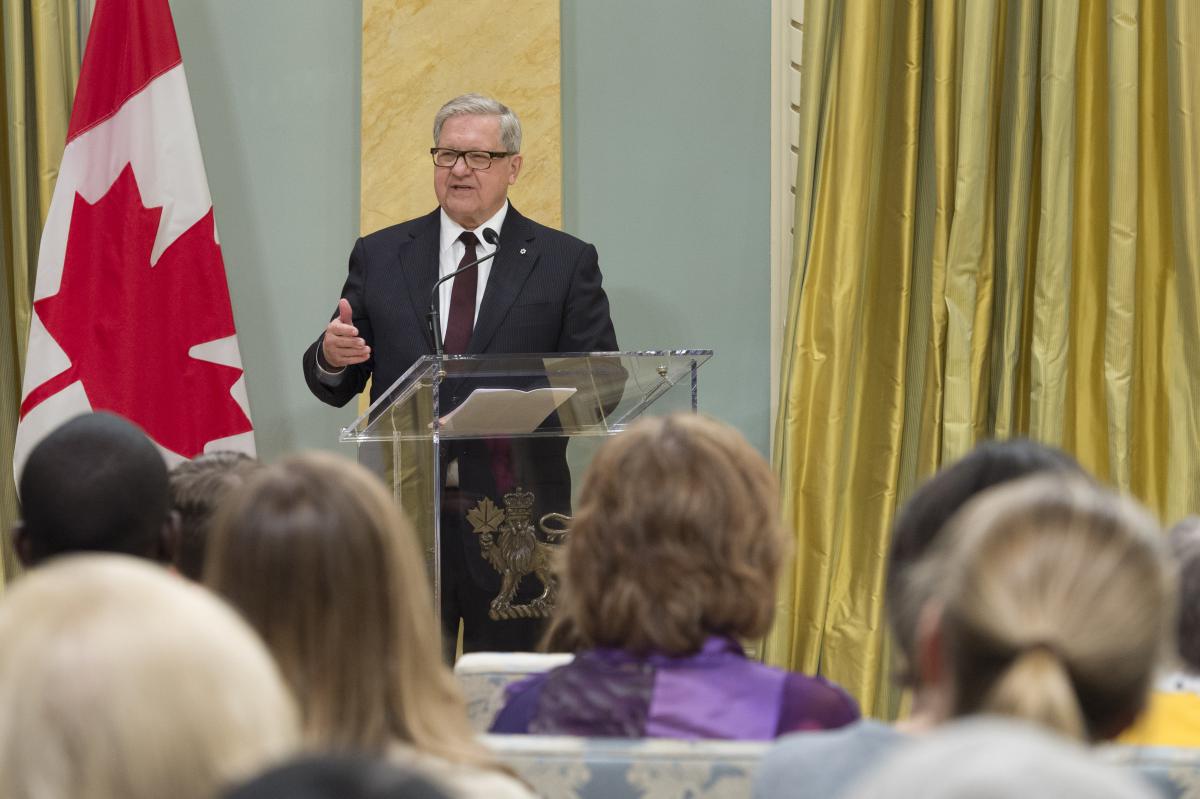
IISD is very pleased to announce that its board member Lloyd Axworthy was honoured with the 30th Pearson Peace Medal on Wednesday, May 24, 2017.

May 24, 2017

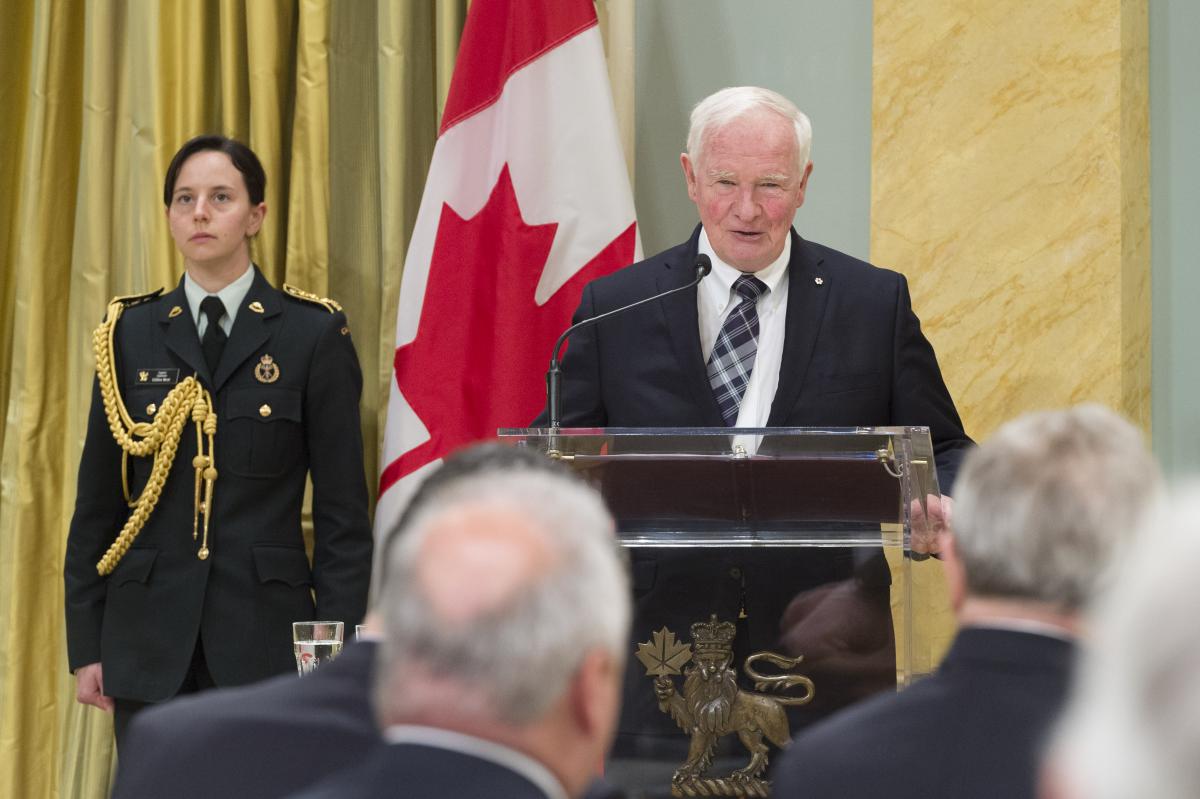
IISD is very pleased to announce that its board member Lloyd Axworthy was honoured with the 30th Pearson Peace Medal on Wednesday, May 24, 2017.

The event took place at Rideau Hall in Toronto, and the medal was presented to Axworthy by His Excellency the Right Honourable David Johnston, Governor General of Canada and honorary patron of the United Nations Association in Canada.

The Honourable Lloyd Axworthy has devoted his life’s work, in academia, politics and civil society, to highlighting and building the United Nations as a vehicle for peace and to promoting Canadian leadership and engagement in the UN. As a political leader and as minister of Foreign Affairs for Canada, he had a pivotal role in the development and strategic advancement of the Anti-Personnel Mine Ban Convention (often referred to as the Ottawa Treaty). At the time, his engagement of world leaders and civil society was innovative and ultimately successful in the adoption of this important treaty.

As an academic, both early in his career and later as the president and vice-chancellor of the University of Winnipeg, he instructed, led and wrote on the imperative of education on peace and of critical thinking, informed by ideals and ambitious aspirations for a better world. As a university leader, he focused attention and action on reconciliation with First Nations, launching important programs to reach and engage Indigenous students and communities, and to advance social justice.

About the Pearson Peace Medal
The Pearson Peace Medal is awarded to a Canadian who has personally contributed, through his or her working life and voluntary commitments, to those causes to which Lester B. Pearson devoted his distinguished career: aid to the developing world; mediation between those confronting one another with arms; succour to refugees and others in need; equal rights and justice for all humanity; and peaceful change through world law and world organization.

A jury of eminent Canadians selects the recipient of this honour. The medal is awarded by UNA‑Canada, a registered charity founded in 1946, with a mandate to educate and engage Canadians in support of the United Nations and its critical issues, which have a global impact.

Click here for more information.

(Credit for all the images below: Sgt Johanie Maheu, Rideau Hall © OSGG, 2017)


Press release

Increasing number of Winnipeggers face limitations due to inadequate physical or mental support

Our Peg project reveals that the percentage of Winnipeggers reporting activity limitations due to inadequate physical or mental support is consistently higher than the national average.

May 15, 2017

Peg Report 30, May 16, 2017 – A new indicator featured on mypeg.ca measures the percentage of Winnipeggers who are sometimes or often limited in their ability to participate in an activity or carry out a daily activity due to inadequate physical or mental support.

The Activity Limitation indicator is also featured in an upcoming Peg report on the natural and built environments, to be released in connection with World Environment Day at the beginning of June.

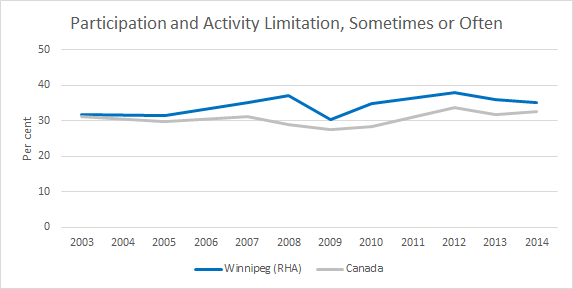
Peg data shows that the percentage of Winnipeggers reporting activity limitations is consistently higher than the national average.

What else can Peg tell us about activity limitation in Winnipeg?

Peg tells us…

  • Between 2003 and 2014, the percentage of Winnipeggers who reported facing participation or activity limitation increased from 31.7 per cent to 35.2 per cent.
  • An average of 34 per cent of Winnipeggers reported having activity limitations during this same period—3 per cent higher than the Canadian average of 31 per cent.

Definitions:

  • This is a broad indicator that speaks to individuals’ accessibility based on mental or physical impairment or disability. The data source reports on individuals’ limitations in carrying out daily tasks or participating in events, but does not ask to specify the nature of the limitation.

Why does this matter?

  • All Winnipeggers have the right to access services, participate in community and social events, and carry out daily activities. Common accessibility barriers are architectural or physical in nature, although they may also be technological, organizational, attitudinal or communication-related. Accessibility is important so that all Winnipeggers can reach their potential.
  • The Accessibility for Manitobans Act (AMA) became law in December, 2013. This legislation provides a proactive process to remove barriers affecting persons with disabilities and many other citizens. Under this landmark legislation, the Manitoba government will develop mandatory accessibility standards. Each standard will address barriers for Manitobans in key areas of daily living. Standards will apply to Manitoba’s private and public sector organizations.[1]
  • More details and source data for the above facts available at: http://www.mypeg.ca/explorer/WellBeing/BuiltEnvironment/Activitylimitation/

Source of the data:

  • Peg’s data for the Activity Limitation indicator is provided by the Statistics Canada Canadian Community Health Survey (CCHS) CANSIM table 105-0502.

Media inquiries:

For interviews on understanding the trend (or the story behind the numbers), organizations making a difference in the community, Peg or the data, please contact:

Sumeep Bath, Media and Communications Officer

International Institute for Sustainable Development

(204) 958-7700 ex 740 | [email protected]

Social media:

Twitter: @Pegindicators

Facebook: MyPeg

Youtube: MyPegCIS

About us:

Peg (mypeg.ca) is a community indicator system that measures the health of our community year over year—in ways that count. Peg is led by two partnering organizations—the International Institute of Sustainable Development and United Way of Winnipeg.

Peg is the starting place for Winnipeg citizens, educators, policy-makers and many others to learn more about our city so we can lead change to create a better city for our children and their children. At Peg we can all learn how our lives, our neighbourhood and our city are changing—for the good and the bad. Learn more at www.mypeg.ca.

Press release details

Press release

Transferring Fossil Fuel Subsidies to Clean Energy Could Yield Major Savings in Dollars and GHG Emissions – Report

A new report from the Nordic Council of Ministers finds that redirecting fossil fuel subsidies toward the clean energy transition could help climate vulnerable countries reap major savings while slashing greenhouse gas emissions.

May 10, 2017

BONN - 11 May 2017 - A new report from the Nordic Council of Ministers finds that redirecting fossil fuel subsidies toward the clean energy transition could help climate vulnerable countries reap major savings while slashing greenhouse gas emissions.

This is according to a study by the International Institute of Sustainable Development (IISD) Global Subsidies Initiative (GSI) and Gaia Consulting, "Making the Switch: From Fossil Fuel Subsidies to Sustainable Energy." Based on this study, countries already undergoing energy reforms (like Bangladesh, Indonesia, Morocco and Zambia) would especially benefit from SWAPs—the transfer of funds that normally go towards fossil fuel subsidies into sustainable energy investment, such as renewable energy and energy efficiency. The report includes examples of how Nordic countries have managed this switch.

“Current subsidies to fossil fuel subsidies from governments are worth around half the funding needed to bridge the global energy access gap, double renewable energy and energy efficiency rates by 2030,” said Laura Merrill, Senior Researcher and Operations Manager with IISD. “These subsidies are also three times higher than current global renewable energy subsidies, and continue to distort energy markets. Reform would create a level energy playing field for renewable energy takeoff and for energy efficiency to add up. Savings made by governments from removing subsidies to fossil fuels can be redirected or swapped to help fund a clean and just energy transition.”
 
Fossil fuel subsidies are a cost that governments can no longer afford to ignore from both economic and social perspectives. Global subsidies to both consumers and producers of fossil fuels are reported at USD 425 billion in 2015. Research estimates suggest that removing all consumer fossil fuel subsidies would decrease global carbon emissions anywhere between 6.4–8.2 per cent by 2050. By reinvesting these savings into renewable energy, energy efficiency, education, health care, and targeted social protection schemes for adaptation to climate change, countries have major opportunities to support the delivery of the both the Paris Agreement and the Sustainable Development Goals.
 
“Subsidies to fossil fuels work against the purpose of the 2015 Paris Agreement. Its targets related to holding temperature increase to below 2°C and 1.5°C,” said Peer Stiansen, Chair of the Nordic Working Group for Global Climate Negotiations (NOAK). “Instead, governments should facilitate a switch to massive investments into renewables and other low‐ or no‐ emission technologies. Savings from reduced consumer and producer subsidies can be used for large‐scale renewables, energy efficiency and public transport systems, and, in developing countries, toward the rural poor, through for instance cleaner cooking and lighting such as distributed renewables and clean cook stoves. Savings can also be channelled to building resilience of countries that will be hardest hit by climate change.”
 
To download a copy of the report please click here. Infographics are available here

For media inquiries, please contact:
 
Ziona Eyob, IISD, [email protected]
Heidi Orava, Nordic Co-operation, [email protected]

Press release details

Topic
Subsidies
Impact area
Climate
Press release

New research helps Calgary and Edmonton plan for climate change impacts

Cities that invest in climate resilience can save residents money while preparing for climate risks, says new research commissioned by Calgary and Edmonton.

April 9, 2017

APRIL 10, 2017—Cities that invest in climate resilience can save residents money while preparing for climate risks, says new research commissioned by Calgary and Edmonton.

The research series Building a Climate-Resilient City by the Prairie Climate Centre outlines steps that cities can take to engage in climate risk management in a range of areas, including transportation, agriculture, electricity infrastructure, disaster preparedness and emergency management.

“Strategies that build a city’s climate resilience are a smart investment and are essential for good urban policy,” said Dr. Hank Venema, director of planning for the Prairie Climate Centre, a joint initiative of the University of Winnipeg and the International Institute for Sustainable Development.

He continued, “This new research provides a suite of options that Calgary, Edmonton and other cities can pursue to make their cities’ healthier, more innovative, and better prepared for climate change. Cities that have demonstrated commitment to building resilience are more attractive places for businesses to move, as they can see the city has the infrastructure and planning in place to deal with the inevitable shocks and stresses that climate change will bring.”

The 2016 federal government Working Group on Adaptation and Climate Resilience report noted that Alberta was affected by 7 of the 10 most expensive disasters in Canadian history. In coming decades scientific projections show that Alberta should expect climate change impacts that include less predictable weather and greater risk of extreme weather such as flash floods, severe rainstorms, heat waves and droughts, among others.

Edmonton’s city council has asked the city’s administration to prepare a climate change strategy for 2018. Mark Brostrom, Edmonton’s Director of City Environmental Strategies, said: “As this strategy will involve a comprehensive stakeholder engagement process, the City of Edmonton was pleased to cooperate with the City of Calgary on the creation of these White Papers which will spark discussions on building resilient cities. Meeting the challenge of climate change is not something one city can do alone. We all have to cooperate, share ideas and learn from each other to meet the future together.

“It is important to recognize that responding to climate change requires a certain degree of ‘right-sizing’ and tailoring to our community,” said Dick Ebersohn, Program Manager with The City of Calgary’s climate team. “The Prairie Climate Centre’s work builds on leading international research, but grounds it in a Calgary context. As we build our Climate Resilience Strategy, these papers provide critical insight and will our help planners and stakeholders make informed, forward-looking decisions based on Calgary’s unique climate risks, strengths and opportunities.”

Dr. Jino Distasio, director of the Institute of Urban Studies at the University of Winnipeg said, “Building climate change considerations directly into urban planning and design will be standard practice in the coming decades and a priority for prairie cities, which we expect will experience a much more variable and hotter climate. This set of reports by the Prairie Climate Centre provides a practical roadmap for cities to build climate resilience directly into their planning processes.”

The research paper series is available online at: prairieclimatecentre.ca/publications.

Media contact:

Christian Ledwell
Media and Communications Officer, Resilience
International Institute for Sustainable Development
[email protected]
+1 613 238 2296 ex.106


About the Prairie Climate Centre

The Prairie Climate Centre is a collaboration of The University of Winnipeg and the International Institute for Sustainable Development. The Prairie Climate Centre works to enable governments, businesses and community members across the Canadian Prairies to reduce their vulnerability to climate variability and change by providing access to an innovative, stakeholder-driven hub for data, guidance, research, knowledge exchange, training and capacity building.

Press release details

Press release

Winnipeg housing: more affordable, more crowded, in greater need of repair than Canadian average

The percentage of Winnipeggers living in core housing need has been decreasing for the last twenty years, and is now lower than the national average and comparable to Canadian cities.

March 22, 2017

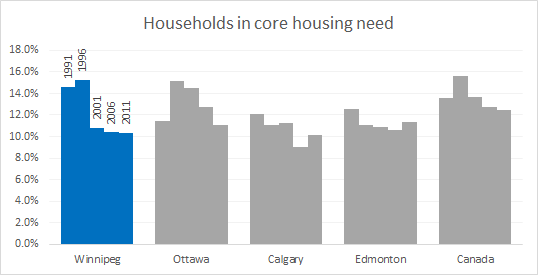
Peg Report 29, March 23, 2017 – The percentage of Winnipeggers living in core housing need has been decreasing for the last twenty years, and is now lower than the national average and comparable to Canadian cities.

This has all been happening as the cost of housing across Canada continues to climb, and while Winnipeg’s market has not seen the same growth as bigger centres like Toronto and Vancouver, finding suitable, affordable housing remains a challenge at every income level.   

Peg tells us…

  • Between 1991 and 2011, the percentage of people living in core housing need in Winnipeg dropped from 14.6 per cent to 10.3 per cent. The majority of this decrease happened between 1996 and 2001, with only very small decreases since that time.
  • Since 1996, Winnipeg has had a smaller proportion of people in core housing need than the Canadian average. In 2011, this rate was comparable to Calgary (10 per cent) and lower than Ottawa and Edmonton (11 per cent).

Definitions:

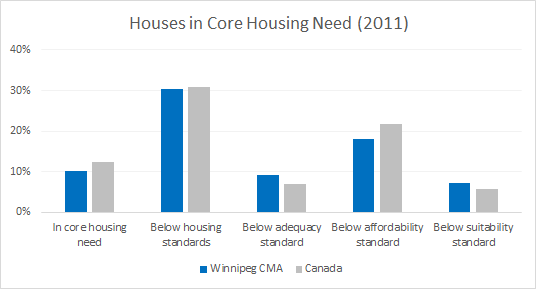
  • Core housing need measures the percentage of households whose housing: i) costs more than 30 per cent of their income, ii) requires major repairs, or iii) is too small for the number of occupants, and who cannot afford to pay the median cost of rent for housing that would meet these standards.

Why does this matter?

  • Core housing need speaks to the importance of having adequate, affordable housing with sufficient space. When any or all of the above criteria for standard living conditions are not met, households have more stress placed on their resources and health.
  • More detail and source data for the above facts available at: http://www.mypeg.ca/explorer/WellBeing/BasicNeeds/CoreHousingNeed/

Source of the data:

  • Peg’s data for the Core Housing Need indicator is provided by the Canada Mortgage & Housing Corporation (www.cmhc-schl.gc.ca/).

Media inquiries:

For interviews on understanding the trend (or the story behind the numbers), organizations making a difference in the community, Peg, or the data, please contact:

Sumeep Bath, Media and Communications Officer at [email protected] or (204) 958 7700 ex 740

About us:

Peg (mypeg.ca) is a community indicator system that measures the health of our community year over year – in ways that count. Peg is led by two partnering organizations – the International Institute of Sustainable Development and United Way of Winnipeg.

Peg is the starting place for Winnipeg citizens, educators, policy makers, and many others to learn more about our city so we can lead change to create a better city for our children and their children. At Peg we can all learn how our lives, our neighbourhood and our city is changing – for the good and the bad. Learn more at www.mypeg.ca.

Press release details

Press release

IISD Welcomes Jane McDonald as Managing Director

IISD is delighted to announce Jane McDonald as its new Managing Director.

March 13, 2017

The International Institute for Sustainable Development (IISD) is delighted to announce Jane McDonald as its new Managing Director.

Ms. McDonald has over 15 years of Canadian and international experience working on environmental issues in both the public and private sectors.
Her previous work includes advising companies on environmental risk at investment bank Cantor Fitzgerald and representing Canada in international climate negotiations.  She most recently served as Policy Director for Canada's Minister of Environment and Climate Change in Ottawa. 

At IISD, Ms. McDonald will advance research aimed at protecting the health of fresh water around the world and at exploring the impacts and mitigating the effects of climate change.

Press release

World’s Leading Up-To-The-Minute Report on Environmental and Sustainable Development Negotiations Turns 25

The Earth Negotiations Bulletin (ENB), the publication that changed how we learn about United Nations (UN) and multilateral negotiations, is celebrating its 25th birthday this month.

March 13, 2017

NEW YORK CITY, March 14, 2017—The Earth Negotiations Bulletin (ENB), the publication that changed how we learn about United Nations (UN) and multilateral negotiations, is celebrating its 25th birthday this month.

The ENB is a one-of-a-kind publication: a daily bulletin that, for 25 years, has offered unique access behind the scenes of negotiations, workshops and conferences on a variety of subjects in international environment and sustainable development policy and law.

“The ENB was crucial in creating transparency by opening up the doors of United Nations and other multilateral negotiations. For the first time, anyone could learn about what was happening during these meetings, in real time and in an accessible format. As a result, everyone can hold their governments accountable on these issues that have a direct impact on the lives and well-being of millions of citizens around the world,” said Langston James "Kimo" Goree VI, vice president and United Nations liaison, IISD Reporting Services.

The ENB was a grassroots endeavour started by three individuals who raised the funds to provide daily two-page briefing notes during the fourth UN Conference on Environment and Development preparatory meeting in March 1992 in Rio de Janeiro. It quickly became the “must read” publication each day, not just by non-governmental organizations (NGOs), but by government delegates and UN Secretariat officials.

Now 25 years and 3,784 issues later, the ENB, published by IISD Reporting Services since 1993, has become one of the world’s leading up-to-the-minute records of major multilateral negotiations on the environment and sustainable development. From climate change to biodiversity, land degradation and desertification to endangered species, chemicals management and toxic wastes to fisheries, the ENB has been there.

Today the ENB is actively covering 27 different negotiating streams under the auspices of the UN system. Twenty-five years of archives and 20 years of photos are freely available, providing one of the most comprehensive and independent sources of digital records of UN environment and development negotiations.

Read by hundreds of thousands of people over the years, including government delegates, NGOs, media, academics, UN officials and the business community from all parts of the world, the ENB is available in print formats at meetings, is shared online via social media and email lists, and is cited in numerous academic publications.

“As impressive as the numbers are, for us, the ENB has always been about the people. The writers, editors, photographers, translators and other staff members (270, in fact, throughout the years) who work tirelessly and around the clock at international negotiations around the world are to thank for the ENB’s continued success,” said Goree VI.

-30-

For more information, contact Sumeep Bath, media and communications officer, IISD, at [email protected] or +1 (204) 958 7700 ext 740.

Press release

IISD Researcher Receives Gender and Environment Advocate Award

IISD is very proud to announce that Julie Dekens, senior researcher with IISD’s Resilience Program, has received a major award from the Geneva Environment Network.

March 9, 2017

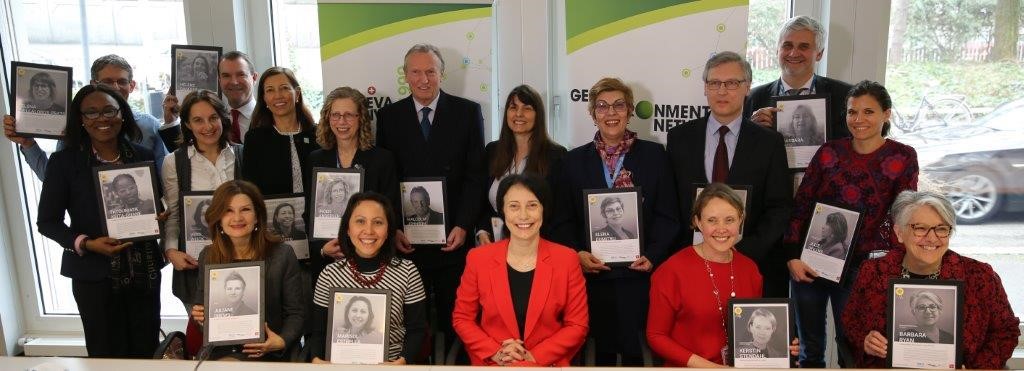
IISD is very proud to announce that Julie Dekens, senior researcher with IISD’s Resilience Program, has received a major award from the Geneva Environment Network.

The Gender and Environment Advocate Award recognizes Geneva-based individuals’ commitment and contribution to the advancement and support of gender equality and women's empowerment in the field of the environment.

Dekens was one of 18 Gender and Environment Advocates who accepted the award at a ceremony held on International Women's Day, March 8, 2017.

“It’s a great honour to receive this award,” said Dekens.  “Advancing gender equality—both in the environmental field and more broadly—requires collaboration and persistence, and I would not be receiving this award if not for the support of IISD colleagues who champion gender issues, as well as the many international groups and individuals we partner with who are committed to advancing women's empowerment.”

Dekens currently leads the development of IISD’s work in agricultural value chains and private sector engagement in climate adaptation. She is also leading research focused on ways in which National Adaptation Plan (NAP) processes are supporting gender equality.  

Nathalie Bernasconi-Osterwalder, director of IISD’s Economic Law and Policy program, was recognized as one of the Geneva Environment Network’s Gender and Environment Advocates in 2016.

For more information, please visit the Geneva Environment Network's website.


Press release details

Impact area
Climate