
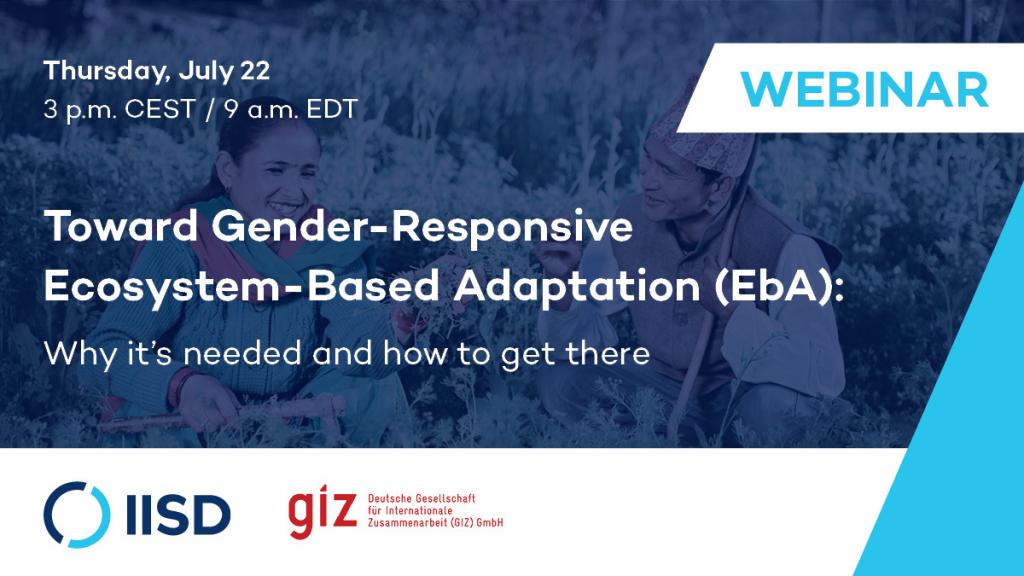
Toward Gender-Responsive Ecosystem-Based Adaptation (EbA): Why it’s needed and how to get there
The International Institute for Sustainable Development (IISD), in partnership with the Global Project Mainstreaming EbA, have co-organized the upcoming online session on how to ensure a gender-responsive approach to Ecosystem-based Adaptation (EbA).
As a type of nature-based solution, Ecosystem-based Adaptation (EbA) uses natural systems to build resilience to climate change while generating social and economic returns and providing multiple benefits, including improved health, biodiversity protection, food security, and alternative livelihood opportunities.
This event marks the launch of a new knowledge product by the Deutsche Gesellschaft für Internationale Zusammenarbeit GmbH and IISD. Building blocks for gender-responsive EbA will be pulled from this report and introduced at the webinar.
Following this, participants will have the opportunity to learn from an on-the-ground case of gender-responsive EbA in Nepal. Interactive components will allow for the sharing of participants' own experiences with the topic.
Speakers:
|
Angie Dazé, Senior Policy Advisor and Lead, Gender Equality, IISD
|
Gender-responsive EbA – insights from a new publication
|
|
Manorama Sunuwar, Gender Equality and Social Inclusion Coordinator, CARE Nepal |
Putting a gender-responsive approach to EbA into practice - an example from Nepal |
Please note that the session will be recorded. Recordings will be made available on the YouTube channel of the Global Project Mainstreaming EbA shortly after the event.
Upcoming events
Session 2 | Financing a Transition Away From Fossil Fuels: Building an implementation network for Santa Marta workstream 2
Tailored to the Americas, Africa, and European regions, this webinar will drawing on existing initiatives and useful precedents for the transition away from fossil fuels with the goal of building a network to support country-led implementation.
Session 1 | Financing a Transition Away From Fossil Fuels: Building an implementation network for Santa Marta workstream 2
Tailored to Asia-Pacific, Africa, and European regions, this webinar will drawing on existing initiatives and useful precedents for the transition away from fossil fuels with the goal of building a network to support country-led implementation.
Learnings from Implementing NbS for Adaptation in and around Protected Areas
A webinar exploring lessons learned from implementing nature-based solutions for climate adaptation and resilience in and around protected areas in Angola, Belize, Fiji, Namibia, Uganda, Zambia and Zimbabwe.
IGF 22nd Annual General Meeting
The 22nd IGF AGM will be held under the theme of Trust in an Interdependent World: Advancing inclusion and resilience in mineral value chains.