
What to Expect as Talks on Plastic Pollution Near Finish Line at INC 5.2
Diplomats, scientists, activists and business lobbyists will descend on Geneva in early August 2025 for the final round of talks to agree on an international legally binding treaty to end plastic pollution. After negotiators failed last year to finalize text in Busan at the fifth meeting of the intergovernmental negotiating committee (INC-5), there have been plenty of intersessional meetings to help countries find common ground and a path forward.
IISD-ENB Team Leader Tallash Kantai is the lead author on a guide to the plastic pollution talks. She shares what she’s learned from the intersessional meetings, which issues will be most difficult to resolve, and countries to watch as diplomats begin this “overtime” session.
Can you quickly sum up the state-of-play at the end of INC-5?
INC-5 in Busan, in December 2024, was supposed to be the final round of talks toward a treaty on plastic pollution, however, delegates failed to reach agreement. Many say they failed to agree on core elements of the draft—in reality, they failed to reach agreement on every part of the text. Even the objective of the treaty was not agreed.
But right now, the biggest outstanding elements relate to plastic products (currently article 3), supply/sustainable production (currently article 6), and financial resources and mechanism (currently article 11). The scope was also excluded—perhaps mistakenly—and the form and function of all other articles hinge on reaching an understanding on scope as well as these three other elements.
On the final day in Busan, INC Chair Luis Vayas circulated a text he said represented the meeting’s work as well as bilateral talks with States throughout the week. This text received mixed reviews, but delegates left Busan agreeing to use this as the basis for discussions at a resumed meeting.
Since then, States and stakeholders alike have held meetings and webinars to set out their positions or try to solve the intractable issues. One such get-together was a three-day informal meeting in Nairobi for heads of delegations—there are hopes any common ground reached here will feed into the resumed meeting in Geneva. Notably, INC-5.2 is set to be attended by ministers, which could be a political signal that this will indeed be the last round of treaty talks.
Strong lines have been drawn throughout these talks on whether the treaty will tackle downstream issues, such as managing plastic waste, along with upstream issues, such as how plastics are created or how much plastic is made. What level of ambition exists in the text as of now—and to what extent were these issues being pushed in the intersessional talks?
If the Chair’s text were adopted today, the world would have a treaty with a mix of mandatory and voluntary measures performed by States within their jurisdictions to regulate plastic pollution. These would nearly all deal with downstream issues, as there’s little agreement to “turn off the tap” of plastic production upstream.
Many States are still calling for higher ambition. At the end of the first part of INC-5 in December, two loose coalitions were announced. Rwanda announced 85 countries were calling for the inclusion of a global target to: reduce the production of primary plastic polymers to sustainable levels, phase out the most harmful plastic products and chemicals of concern; the provision of effective means of implementation; and enabling future development of the treaty through its annexes or amendments. Mexico spoke for 95 countries calling for a legally binding obligation to phase out the most harmful plastic products and chemicals of concern.
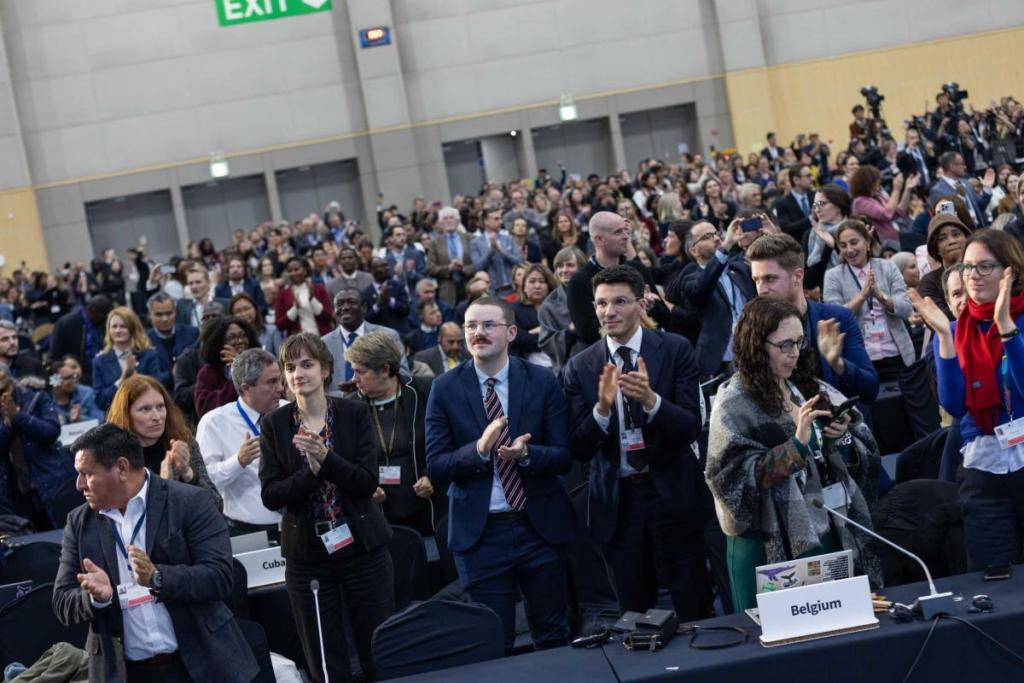
The calls to include production and chemicals of concern are still controversial because the Like-Minded Group of Countries and some others have expressed a strong preference to exclude language on plastic production and chemicals of concern from the text entirely. So strong was this preference that chemicals of concern were excluded from the latest Chair’s text altogether.
We’ve heard that several delegations are discussing ways to postpone inclusion of an article on plastic production (Article 6) but include some sort of placeholder language in the preamble or as an annex.
Other suggestions have been to roll relevant elements of this article into Article 3 on products. Some others have even suggested that language on production could be included in the cover decision for the instrument. All these options would allow for discussions on plastic production to be reopened at a different time in the life of the treaty.
Ambition also relates to whether States agree to global collective action to address plastic pollution or stick to national measures in their own jurisdictions—and whether either kind of measures are mandatory or voluntary.
The Chair’s current text leans toward voluntary measures at the national level. But many countries seek the opposite, saying mandatory measures at the global level will be required to end plastic pollution given its transboundary nature.
All said, the treaty’s ambition level will need to be carefully negotiated. In the end, it may be something of a package deal, taking into consideration interests on all sides. On this note, we’ve heard a vote may be in the offing—perhaps on including certain elements into the text. If negotiations shift from finding consensus to voting, it will be controversial and polarizing. It could mean sacrificing a universal treaty for a strong treaty or locking out States that could have been enticed to join at a later stage.
On one hand, if States feel their interests can be voted out, some amount of trust is lost. On the other hand, consensus can effectively become a veto, with a few States holding the majority at ransom. We will see how talks in Geneva play out.
Finance is almost always a sticking point in global environmental treaties. How is it shaping up for the plastic pollution treaty?
This is a particularly tricky issue comprising two broad parts: the source of funding and the seat of funding.
Traditionally, the source of international funding flows has been from developed countries to developing countries. But nowadays, across multilateral environmental agreements, fewer and fewer funds are flowing in this direction. Innovative sources have been suggested, which could compel producer industries to pay primary plastic polymer fees and/or additional fees related to Extended Producer Responsibility (EPR). Many have called for every State to pitch in what they can to the global cause, using the UN scale of assessed contributions. Some have suggested an even wider funding base, including philanthropies and high-net worth individuals, to end the scourge of plastic pollution.
To address plastic pollution, the additional complication is that some developing countries are also producers of plastic and plastic products, profiting from sales. Should they be made to contribute if they keep producing plastics, and can they be compelled, given their developing country status? At this point, no money is on the table and all money is welcome.
On the seat of funding, the lines are drawn. Developed countries prefer using the Global Environment Facility (GEF) as the instrument’s financial mechanism, since they wield the most influence there. Developing countries prefer a dedicated fund, owned by all States—such as under the Montreal Protocol—to ensure access and timely disbursement of funds for projects. In Busan, there was no clarity on how to bridge the gaps under Article 11 on financial resources and mechanism. Informal intersessional talks in Oslo may have shed some light on a middle ground, especially to address the needs of the most vulnerable.
Will developing countries that are polluters be compelled to pay? Will rich countries identified as polluters take on the responsibility of remediating sites in developed countries? Could a dedicated fund be established to perform certain functions, while the GEF takes others? These are enormous questions heading into Geneva. Let’s not forget financing is tied to the whole treaty, including some “low-hanging-fruit” articles, such as product design (Article 5), plastic waste management (Article 8), and existing plastic waste (Article 9).
Finally, what countries and coalitions are you keeping an eye on?
The Like-Minded Group, of course. Will they yield at all in their positions on production and chemicals of concern? Will all their members be identified? And the two loose coalitions that were introduced at INC-5.1 will be interesting to watch. Will others join these coalitions?
We’ll watch developed countries as a whole to see if there are any fractures within their positions. We don’t yet know how or if the US (one of the biggest producers and consumers of plastic) will participate, or if developed countries will negotiate as a bloc on financing or if some members will break away by supporting some developing country positions.
We’ll also observe developing countries to track any fissures in their alliances, especially the inclusion of production in the treaty, and in discussions around funding sources for the treaty’s implementation.
What do the lines look like in terms of a potential vote? In this regard, could some major plastic producers support a more ambitious treaty? Could the treaty be successfully implemented if major plastic producers do not sign on?
Despite how long these talks have gone on, we enter the final round of negotiations with a lot of uncertainty. In some ways, that is like plastics themselves. There is still so little we understand about their impacts on our bodies and our environment. What’s clear is that we must act as an international community if we’re to tackle this pollution that can now be found in every corner of our world.
You might also be interested in
Bonn Climate Talks: What to watch for the fossil fuel transition
As governments return to Bonn for the UNFCCC Subsidiary Bodies meetings (SB64), the transition away from fossil fuels will be a key test of whether growing political momentum can translate into practical progress.
Synergies for Monitoring and Reporting on Climate and Biodiversity Actions
This thematic paper discusses opportunities for enhancing synergies between the monitoring and reporting frameworks of the Paris Agreement and the Kunming-Montreal Global Biodiversity Framework.
Enhancing Synergies to Advance Gender-Responsive Approaches Under the Convention on Biological Diversity and UN Framework Convention on Climate Change
This paper provides key takeaways for national-level policy-makers to adopt a coordinated approach to the design and delivery of gender-responsive biodiversity and climate action, along with sample case studies that exemplify gender-responsive policy-making processes.
Synergies Between Biodiversity and Climate Policy Frameworks – A Series of Thematic Papers
These thematic papers have everything policy-makers need to pursue more synergistic responses to address the co-existing challenges of climate change and biodiversity loss.