
Stalemate on the Global Goal on Adaptation in Bonn: What does this mean for countries?
The impasse on the Global Goal on Adaptation in Bonn is frustrating, but it does not change the underlying architecture or the imperative for countries to track, assess, learn from, and communicate their adaptation story. If anything, writes Emilie Beauchamp, the Bonn outcome makes the case for stronger foundations for national monitoring, evaluation, and learning systems.
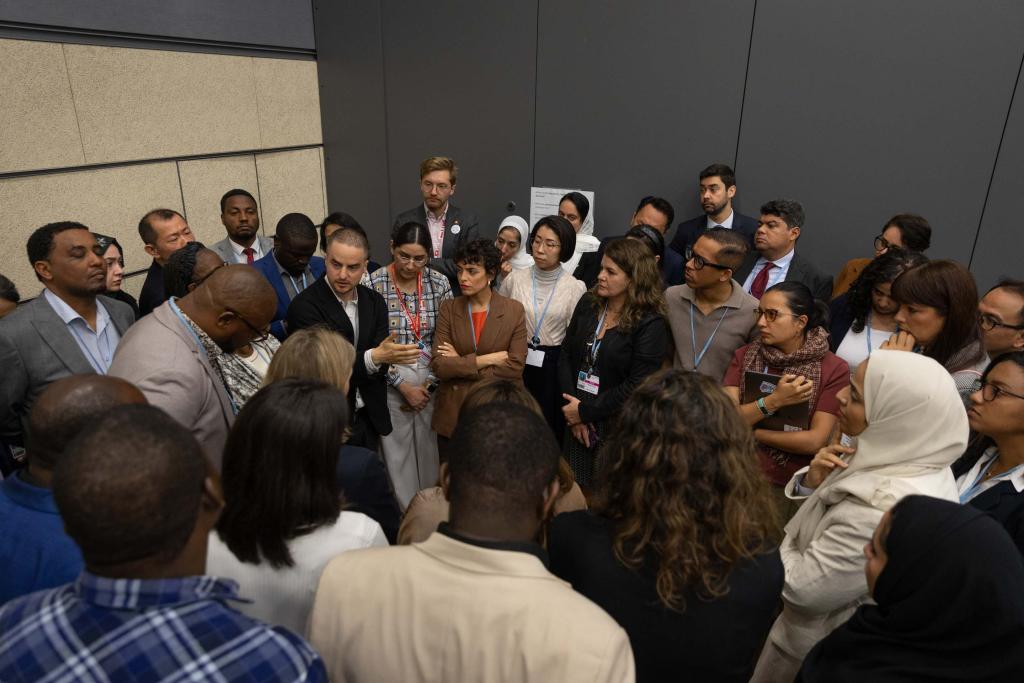
Negotiations on the Global Goal on Adaptation (GGA) closed at the 64th session of the United Nations Framework Convention on Climate Change Subsidiary Bodies in Bonn on a dire note: a Rule 16, meaning countries could not reach an agreement.
The session was supposed to mark the beginning of further technical work on the 59 Belém Adaptation Indicators (BAIs) adopted at the 30th United Nations Climate Change Conference (COP 30). The BAIs have been politically contested, partly due to their last-minute revisions from the suggested final list of 100 potential indicators by experts and the lack of information included to implement them.
Parties arrived with a clear mandate to follow up on COP 30: establish a technical task force to develop the metadata and methodologies needed to make those indicators operational. This work is part of the 2-year Belém-Addis Vision on adaptation (BAVA), a new phase of work to develop guidance for the indicators and ground them in countries’ experiences, which will culminate at COP 32. Sadly, they left empty handed. Under Rule 16, the GGA discussions produced no agreed outcome and will restart from scratch at COP 31 in Antalya.
While this is a setback, it should not stop countries and practitioners from working on monitoring, evaluation, and learning (MEL) for adaptation to advance other commitments nationally and under the United Nations Framework Convention on Climate Change.
Two Main Points of Divergence
The deadlock stemmed from two interlocking fault lines that will be familiar to anyone who has followed GGA negotiations closely.
- The first is finance. Most developing countries insisted that the GGA text expand on the COP 30 commitment to at least triple adaptation finance by 2035. In their view, without adequate means of implementation, the GGA framework and any additional technical work to be implemented remain aspirational. Developed countries did not agree, arguing that adaptation finance belongs in other negotiating tracks, not the GGA room. This is a long-standing and structurally entrenched division, and Bonn did not resolve it.
- The second fault line is the composition of the task force itself. Developed countries preferred an expert-driven body focused on technical outputs. Developing countries pushed for a primarily country-driven process, seeking to ensure political ownership and accountability. This was likely an attempt to evolve from the modalities of the expert group under the UAE-Belém work programme and to avoid a similar outcome to Belém at COP 32 in Addis.
While the work of the expert group produced robust recommendations as a list of potential indicators, countries had little time to engage with the content throughout the process. This meant discussions at COP 30 advanced relatively slowly—until the Presidency took over. On the one hand, one could think that countries interfered with the expert list. On the other hand, one could think the expert group was too expert-led and not grounded in country realities. Both positions reflect legitimate concerns. In the last days of the 64th session of the UNFCCC Subsidiary Bodies (SB64), a two-pronged task force, in which a small group of experts would work more closely under the advice of a set of country representatives, seemed like a way forward, yet they couldn’t reach common ground.
The adoption of the BAIs at COP 30 in Belém was contentious: indicators were pushed through in the closing plenary amid procedural turmoil, with diverging views on means of implementation left unresolved. With the underlying disagreements being papered over at COP 30, it’s not surprising that frustrations have resurfaced at the following session. Bonn was, in part, the cost of that decision process.
Three Next Steps For Countries to Keep Momentum on Evidence for Adaptation
The information from the BAI contributes to what countries report in their national progress reports, Biennial Transparency Reports (BTRs), Adaptation Communications (AdComs), and national communications. These instruments are critical to inform the assessment of the collective progress on adaptation under the second global stocktake (GST2), which will run from COP 31 through to COP 33. Without agreed metadata (the definitions, data sources, baselines, and measurement approaches), the BAIs currently lack the infrastructure needed to generate aggregable data across countries.
But this negotiating impasse does not—and should not—translate into a pause in how countries communicate and report on their adaptation progress. Indicators are only one piece of evidence, as part of wider national MEL systems, informing the GST.
With a focus on implementation, countries can keep the momentum alive on generating evidence in this critical phase.
Three next steps stand out.
Strengthen MEL Systems From National Priorities Outward
The BAIs are voluntary, and not all 59 will be relevant in every context. But most importantly, they are not the core of what makes national MEL systems relevant—the need for context-relevant information to learn what is working, for whom, and how, and to adjust adaptation actions for those who need it most. National and local progress cannot be contingent on multilateral agreements. Keeping this in mind, countries can leverage the momentum from the recent discussion to advance work on the ground by building on existing systems and indicators that reflect national adaptation priorities and institutional realities first and then align with global frameworks. A new practice brief from the National Adaptation Plan Global Network, Steps to Identify and Use Adaptation Indicators for National MEL Systems, sets out eight practical steps to do exactly this.
Start Analyzing the BAIs in Light of Existing Practices
The COP 30 decision invites countries to pilot and test the BAIs and share their experiences as part of the BAVA. This mandate stands regardless of what happened in Bonn. Countries should not wait for agreed methodologies before beginning to assess how the BAIs align (or do not align) with their context, objectives, data systems, and capacities. Doing this now is strategic, as it can strengthen the evidence base for the second round of BTRs due at the end of 2026 and feed into the GST2. Countries that have mapped their existing data against the BAIs will arrive in Antalya with concrete experience to contribute.
Inform the Task Force Design With Country Experiences
The composition question (party-driven versus expert-driven) is not merely procedural. A purely technical task force risks producing methodologies disconnected from national data realities and political contexts; a purely party-driven one risks becoming slow and contested. The most robust outcome would be a hybrid model that combines technical rigour with meaningful and politically salient inputs, a structure that reflects how countries engage in evidence production.
With negotiations restarting from scratch in Antalya, the task force will have less than 1 year to deliver substantive work. The outputs and modalities will need to be delivered on an extremely tight timeline. As such, countries’ and practitioners’ ongoing work on MEL systems between now and COP 31 is exactly the type of grounded experience that should inform how the task force is designed and what it prioritizes.

The Bigger Picture
Multilateral processes move in cycles, and the GGA has seen its share of difficult sessions before delivering real progress. The Rule 16 outcome in Bonn is frustrating, but it does not change the underlying architecture or the imperative for countries to track, assess, learn from, and communicate their adaptation story.
If anything, the Bonn outcome makes the case for stronger foundations for national MEL systems.
The evidence that countries generate now—through BTRs, national adaptation plan progress reports, and AdComs—will matter for GST2 regardless of what happens with the task force.
What also needs to be resolved in due course is the finance question. Adequate means of implementation are needed for effective and equitable adaptation actions, along with the systems and capacities to implement them. Without a dedicated space to address adaptation finance—albeit as part of the GGA, as part of the forthcoming finance work programme, or elsewhere—the technical work on indicators will remain slow to implement.
Photo credit: IISD/ENB - Kiara Worth
About the Authors

Funded by

You might also be interested in
What's at Stake for Climate Change Adaptation at COP 30?
Adaptation is in the spotlight at COP 30. Our experts explain why this COP is so important for adaptation efforts, and where we need to see progress.
Steps to Identify and Use Adaptation Indicators for National Monitoring, Evaluation, and Learning Systems
This publication provides practical steps to help national government teams identify and use adaptation indicators within their national MEL systems.
Why Gender Matters for Adaptation Indicators
Under the UAE-Belém work programme, nominated experts have been working to develop a set of indicators to help track progress in climate change adaptation. Experts review the “long shortlist” of indicators and analyze how well gender responsiveness has been integrated.
Tracking Progress on Monitoring, Evaluation, and Learning for National Adaptation Plan Processes
This synthesis report reviews how 62 countries have integrated monitoring, evaluation, and learning (MEL) into their national adaptation plan (NAP) documents. It also identifies common trends, gaps, and emerging good practices in countries' MEL design and implementation.