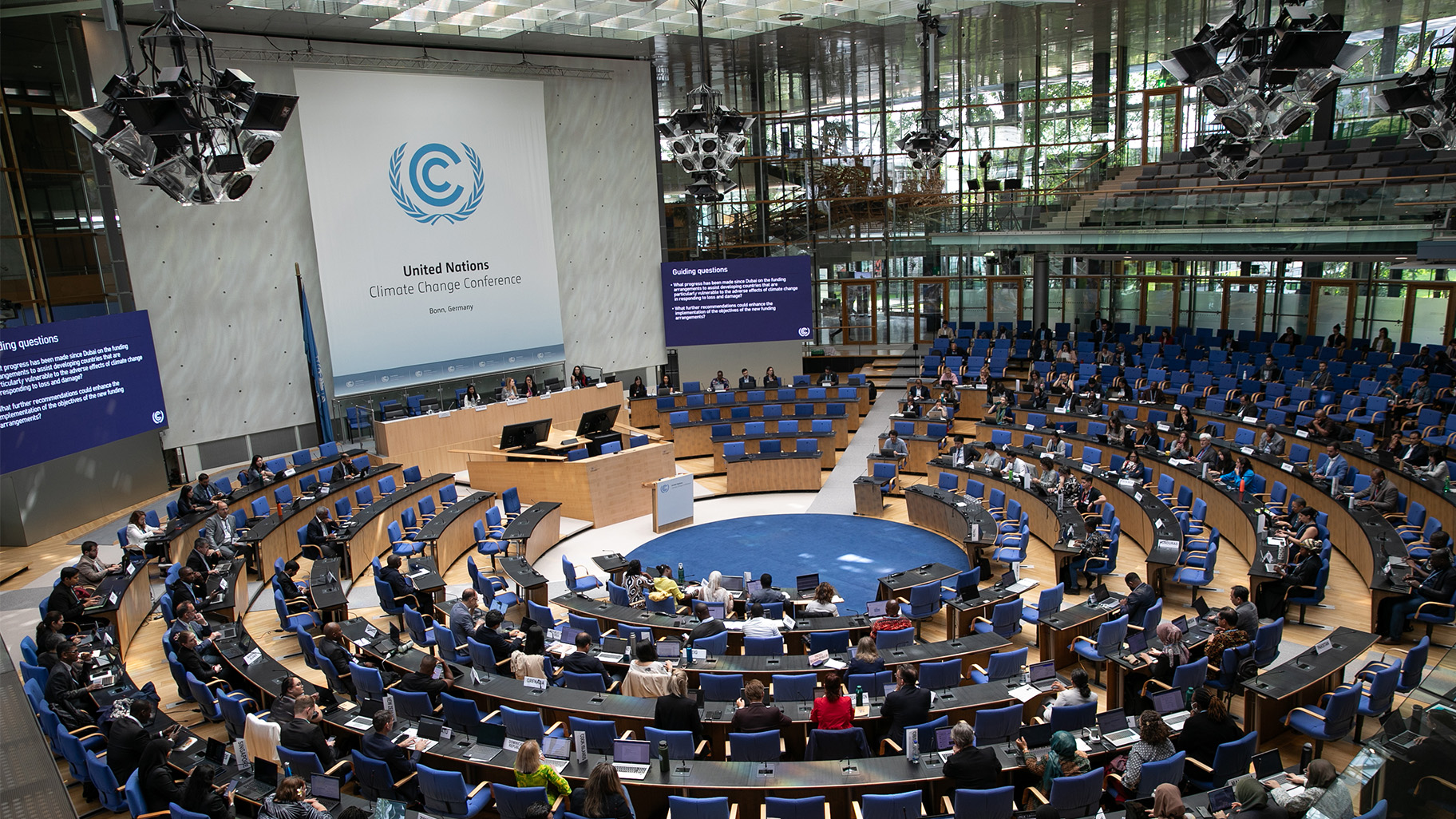
Climate negotiators sit at long tables that curve around a circular UN conference room.

Inside Bonn Climate Change Conference 2026

Bonn, Germany

June 8, 2026 8:00 am - June 18, 2026 7:00 pm CET

(Open with a UN pass)

The climate community returns to Bonn from June 8 to 18th for the 64th sessions of the Subsidiary Bodies of the UNFCCC (SB 64), the first major negotiating session since COP 30 in Belém. 

While Bonn is often viewed as a technical midpoint between COPs, this year’s talks arrive at a moment of growing pressure to turn political commitments into implementation pathways on adaptation, fossil fuels, food systems, trade, and just transition. At the same time, negotiators face an increasingly complex geopolitical environment shaped by energy security concerns, industrial policy competition, and growing pressure on multilateral cooperation. Here are the key things to watch at the 2026 Bonn Climate Meetings.

Need to know: What to watch at SB 64?

Trade and Climate

Trade and climate policy interactions are expected to feature more prominently than ever at this Bonn Climate Conference. For years, climate-related trade measures, including carbon border adjustments, industrial policies, deforestation-related measures, and carbon accounting requirements, have generated increasing political tension between countries. At COP 30, however, governments formally brought these issues further into the UNFCCC space through two parallel initiatives: the launch of a multilateral trade and climate technical dialogue under the Mutirão decision, and Brazil’s Integrated Forum on Climate Change and Trade (IFCCT).

Bonn will feature the first of the three Mutirão-mandated technical dialogues on trade and climate. They will play a crucial role in connecting climate and trade governance processes and in building the trust needed to move this discussion forward. Discussions will aim to find a way for governments to move beyond polarized debates over unilateral measures and instead, develop more practical forms of cooperation. A potential supplementary support for this objective might come from the IFCCT activities, which are expected to begin in Bonn. It will be important to ensure any emerging work under the technical dialogues or the IFCCT complements, rather than duplicates, related work underway in other forums, including the World Trade Organization, Climate Club, and the Organisation for Economic Co-operation and Development’s International Forum on Carbon Mitigation Approaches.

Climate Adaptation  

Climate adaptation will remain one of the most technically dense and politically important parts of SB 64. A major focus will be the next phase of work on the Belém Adaptation Indicators adopted at COP 30 under the UAE Framework for Global Climate Resilience. While COP 30 adopted a set of 59 indicators, this decision was politically contested and many indicators are not ready to be operationalized. Bonn will therefore launch discussions on the technical and institutional arrangements needed to refine the indicators, align methodologies, and determine how they can support future reporting and accountability processes.

Negotiators will also begin discussing how the UAE Framework for Global Climate Resilience, including the indicators, can feed into the second global stocktake, potentially making adaptation progress more visible within the overall climate regime.  

Parties will continue negotiations on National Adaptation Plans (NAPs) and follow up on the outcome of the NAP assessment adopted at COP 30. The discussions will include the provision and mobilization of support for the formulation and implementation of NAPs.

Gender Action Plan

Gender-responsive climate action will remain an important part of the Bonn agenda following the adoption of the Belém Gender Action Plan (GAP) at COP 30. Covering the period from 2026 to 2034, the plan establishes a long-term framework for integrating gender considerations across climate governance, finance, technology, participation, and accountability systems. With 27 activities and 98 deliverables, the new GAP reflects a broader effort to move beyond short-term commitments and create more sustained institutional approaches to gender-responsive climate action.

Concrete implementation of the GAP begins at SB 64, with the delivery of several mandated events. Of particular interest is the expert dialogue on gender and age disaggregated data and gender analysis, which is expected to lay the foundation for upcoming work that aims to strengthen the evidence base for gender-responsive climate policy and action.

Food Systems and Land Use

Discussions on agriculture in the UNFCCC have long been shaped by political sensitivities, however there is increasing recognition that the sector sits at the heart of both climate resilience and emissions reduction challenges and is a vital part of solutions to these challenges. A key element of the discussions in Bonn will be the in-session workshop on identifying needs and scaling up implementation support for climate action in agriculture and food security. The workshop is expected to touch on questions around how climate action in agriculture and food security is financed and how countries can access finance, technical support and policy tools.  

Parties will also continue work under the Sharm el-Sheikh joint work on agriculture and food security, drawing on lessons from recent technical work, improvements to the online knowledge-sharing portal, and inputs to a second synthesis report.

With the current four-year work programme due to conclude later this year at COP 31, SB 64 is likely to serve as a bridge between resolving outstanding elements of the current mandate whilst looking to what comes next.  

Transition Away from Fossil Fuels

Following the landmark recognition of the issue at COP 28 and growing geopolitical instability linked to fossil fuel dependence, countries are increasingly searching for ways to translate broad political commitments into practical national and international roadmaps. Building on this momentum, the Brazilian COP 30 Presidency launched a process to develop an international transition away from fossil fuels roadmap intended to align national transition pathways.

Bonn will likely become the first moment where this roadmap process meaningfully intersects with the formal UNFCCC negotiations. Key findings from the roadmap process are expected to be released during SB 64.

A major question hanging over the talks is how emerging political initiatives outside the formal UN process, including the Santa Marta process on transitioning away from fossil fuels, will interact with the UNFCCC negotiations and build political momentum ahead of COP 31.

Just Transition Work Programme

The Just Transition Work Programme (JTWP) enters a new phase at SB 64.

Established at COP 27 and operationalized at COP 28, the programme was initially designed as a space for dialogue and exchange on how climate action can be pursued in a fair and equitable way. But at COP 30, Parties took a major political step forward by agreeing to establish a Just Transition Mechanism intended to support international cooperation, technical assistance, knowledge-sharing, and capacity building.

Bonn will now become the first real test of whether governments can turn that political signal into a functioning institutional framework. Negotiators are expected to begin work on a draft decision for COP 31—as requested in the final COP 30 text—that could define how the mechanism operates in practice, while also launching the first effectiveness review of the JTWP itself. Discussions are likely to focus on how to move from high-level principles toward implementation support that countries can actually use, particularly in areas such as workforce transition, social protection, economic diversification, and resilience.  

IISD’s Just Energy Transitions in Coal Regions Knowledge Hub will continue tracking the negotiations and identifying where political momentum and gaps are emerging.

Synergies between Conventions

In a year during which the Conferences of the Parties to all three Rio Conventions will convene, Bonn is expected to deepen conversations around synergies between climate change, biodiversity, and land. As governments must solve increasingly interconnected crises across climate, nature loss, and land degradation, there is growing recognition that policy responses must be integrated. Many countries, including the COP 31 President Designate from Türkiye, are trying to align climate plans, biodiversity strategies, and land restoration efforts more systematically, while international organizations are looking for ways to strengthen coordination across processes.

At SB 64, discussions will likely focus on practical mechanisms that can improve policy coherence and implementation. These include strengthening the Joint Liaison Group between the conventions, exploring joint work programmes, and improving harmonization of reporting systems and planning tools. Crucially, the Secretariat of the Convention on Biological Diversity will host a Technical Information Exchange on enhanced cooperation and policy coherence to support the implementation of the Rio conventions, to spur on conversation across conventions and bring together practitioners across the field.  

IISD's Earth Negotiations Bulletin Reporting On-Site

For over 30 years, Earth Negotiations Bulletin has provided authoritative, in-depth reporting at selected environment and development negotiations, distributing summaries of critical talks. Our reporters will be covering the meetings in Bonn, explaining what happened and what it means for climate action.

Subscribe here