From Flooding to Fire: How the Town of Canmore is preparing for climate change
This case study outlines the Town of Canmore's climate change adaptation planning process and the tool that supported it, the Climate Resilience Express tool.
The Town of Canmore has gained a better understanding of climate-related risks and opportunities and prioritized adaptation actions based on local climate projections by undertaking an adaptation planning process guided by the Climate Resilience Express tool.
Using a planning tool streamlined the adaptation planning process for Canmore by enabling town staff and stakeholders to focus their efforts and identify concrete next steps to be incorporated into municipal planning and budget cycles.
Canmore’s Climate Resilience Action Plan signals to stakeholders and the broader community that future climate-related risks are real and that it is necessary to start preparing now.
Canadian municipalities are becoming increasingly concerned about the risks posed by climate change, such as impacts from more frequent and extreme flooding events. For the Bow Valley Corridor in Alberta, climate projections anticipate drier summers, increased rain in the winter, earlier snowmelt and increased frequency of extreme weather events, emphasizing the need for communities to prepare.
The Town of Canmore created a Climate Resilience Action Plan to identify key risks and vulnerabilities as well as to prioritize adaptation actions following the devastating impacts of flooding in 2013. They used the Climate Resilience Express tool to help guide this process. The Climate Resilience Express tool is designed to help municipalities host a one-day workshop to identify climate risks and opportunities, prioritize these risks and opportunities, and, after the workshop, create an adaptation action plan. It was created by All One Sky in partnership with the Municipal Climate Change Action Centre, Alberta Biodiversity Monitoring Institute and the Miistakis Institute.
Through an extended two-day workshop and a series of bilateral meetings, Canmore municipal staff and key stakeholders identified, assessed and evaluated climate-related risks and opportunities and created a ranked list of actions and implementation timeline. Completion of an adaptation plan has led Canmore to implement a number of actions, including a flood risk assessment of the Bow River and incorporation of adaptation priorities into budget planning. This case study presents the process used by Canmore to create its action plan and highlights key insights for other communities.
The Impacts of Climate Change on Mental Health on the Canadian Prairies | A PRAC Forum
How climate change is impacting the mental health and well-being of communities on the Canadian Prairies
March 11, 2019
This research forum, hosted by the Prairies Regional Adaptation Collaborative (PRAC), focused on how climate change is impacting the mental health and well-being of communities on the Canadian Prairies.
The forum contained a mix of expert presentations on the topic and community case studies from the Blackfoot Confederacy Territory, Fort McMurray, and Lac La Ronge. Audience members participated both virtually and in-person at locations in Edmonton, Regina and Winnipeg. Those who participated in-person were able to take part in targeted provincial discussion groups following the webinar.
ABOUT THE PRAIRIES REGIONAL ADAPTATION COLLABORATIVE
The PRAC is an initiative aimed at helping decision-makers in the Prairie provinces target local climate change issues and help integrate climate change adaptation considerations into decision making in policy, planning and operations. It is a federal–provincial cost-shared program between Natural Resources Canada and the governments of Manitoba, Saskatchewan and Alberta. The International Institute for Sustainable Development (IISD) acts as the secretariat for PRAC.
For more information about this webinar can be found here.
Canada could take inspiration from U.S. environmental policy preventing algal blooms
Recent US legislation to combat algal blooms and protect fresh water shows bipartisan environmental action is still possible—and sets an example for other countries.
March 11, 2019
Division and belligerence are now par for the course in a deeply divided American Congress, but while the political fault lines appear to be ever widening, there are still some significant shows of bipartisanship that provide us with some hope for the future.
Take a recent piece of bipartisan legislation that ensures federal funding to combat harmful algal blooms—just signed into law by the President. With political theatrics dominating most column inches, many of these critical environmental stories born from congressional collaboration receive scant coverage. You will be forgiven for having missed it.
Algal blooms are expected to grow as an environmental hazard in North America due to climate change.
Nevertheless, this legislation matters greatly and should provide inspiration for future Canadian environmental policy.
The new law reauthorizes the Harmful Algal Bloom and Hypoxia Research and Control Amendments Act of 2013, allowing federal funds to be released to combat algal blooms deemed of “national significance.” Further, it provides funding for scientific research into the causes and impacts of algal blooms, with a complete national assessment required at least every five years.
This is a clear signal America is taking its algal blooms problem seriously.
From Lake Erie in the north, to the Floridian coasts in the south, Americans have experienced the economic, environmental and health impacts of harmful algal blooms on their doorstep, and have decided to take action.
Such is the expanse of the United States that a federal response is necessary, given algal blooms are the product of complex, wide-ranging networks of inflows and watersheds, most of which span multiple American states and cannot be neatly localized into one jurisdiction.
Sound familiar?
Algal blooms can prove harmful to people who drink it or even inhale its toxins from the air.
In Canada, we suffer from similar ills. Half of perennially algae-infested Lake Erie is situated in Canada, while Lake Winnipeg has long been the poster child for Canada’s algal bloom problem. Similarly, Canadian tourism suffers due to closed beaches and health warnings, and billions of provincial dollars are zapped up trying to combat the issue locally.
Much like the United States, our algae-infested waters are products of many activities from multiple jurisdictions. Consider, for example, the Lake Winnipeg watershed, which spans no fewer than four Canadian provinces and three American states.
A federal mechanism in Canada, allowing local jurisdictions to flag significant flourishes of algal blooms to the federal government, which could then release funds from its coffers to tackle it, would be the only logical way to address this transboundary issue.
Further, the new law’s provision for new research and regular assessment of the state of algal blooms in the country is equally necessary in Canada. While there is some exciting Canadian research being conducted into what causes algal blooms, an allocated federal pot for that type of science would yield even more significant and useful findings.
As the impact of climate change only continues to intensify, algal blooms will prove to be more of an environmental hazard in North America. Canada should proactively safeguard its abundant freshwater supplies by taking algal blooms seriously and treating them as a national issue.
It seems as though a recent bipartisan success story in Congress could prove to be just the blueprint.
The Prairies Regional Adaptation Collaborative (PRAC) worked to increase capacity on the Canadian Prairies to prepare for the impacts of climate change. IISD serves as its secretariat.
We focused on building relationships, exchanging knowledge, and developing skills across the Prairie provinces to strengthen the climate resilience of governments, Indigenous Peoples, the private sector, and others.
The PRAC is a cost-shared initiative of Natural Resources Canada and the governments of Manitoba, Saskatchewan, and Alberta.
Canadians Deserve Decision-Making Based on More than GDP
If Canadians (or citizens anywhere) want well-being to continue for their children and grandchildren, the country’s comprehensive wealth must be sustained.
The original report was a beacon for those concerned about GDP’s inadequacies as a measure of social and economic progress, helping to launch the global movement to go “beyond GDP”. The second report continues to shine that light, showing how over-reliance on GDP as the yardstick of economic performance can mislead decision-makers. It kept them, for example, from seeing the 2008 financial crisis until it hit.
A major contribution to the beyond-GDP movement in the time since has been the series of “inclusive wealth” reports released by the UN Environment Programme (UNEP). Their latest report is cause for both optimism and worry if you’re a Canadian.
Inclusive (or comprehensive) wealth is the value of a nation’s assets: its produced, natural, human, social and financial capital. Comprehensive wealth is important because these assets – factories, forests, skills, relationships, savings and the like – are the basis for most well-being. They provide the foundation on which all goods and services – both market and non-market – are produced. We use them to create products as diverse as food, healthcare, public transit, clean air, wilderness tours, soccer balls and movies, not to mention the thousands of others that are part of a “good life”.
As the foundation for all market and non-market production, comprehensive wealth is clearly important for current well-being. More important is its link with well-being in the future.
In simple terms, if Canadians (or citizens anywhere) want well-being to continue for their children and grandchildren, the country’s comprehensive wealth must be sustained. If not, declines in future well-being are unavoidable.
Here is where the yin and yang for Canadians comes in UNEP’s report.
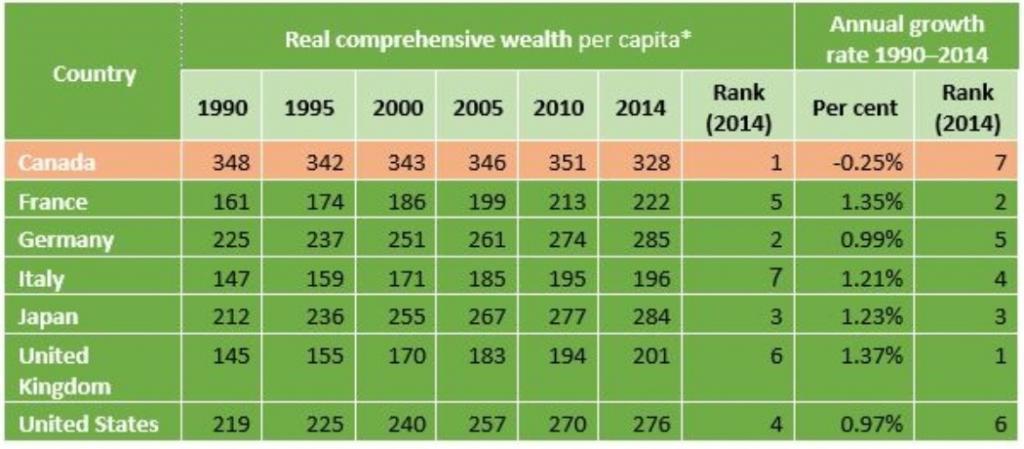
On the positive side, UNEP ranked Canada top among G7 nations in 2014 in terms of comprehensive wealth per capita. In other words, the average Canadian had more assets at his/her disposal in 2014 than any other G7 citizen, largely due to Canada’s massive endowment of forests, minerals, water and other natural capital. Canada had nearly four times as much natural capital per capita as its closest G7 peer, the United States.
The bad news is that Canada ranked last in terms of growth in comprehensive wealth. By the UN’s estimates, Canadian comprehensive wealth actually fell by 0.25 per cent on average each year from 1990 to 2014. In contrast, every other G7 nation succeeded in growing its comprehensive wealth substantially over this period (Table 1).
Table 1: United Nations' estimates of comprehensive wealth for G7 countries, 1990-2014.
Note: All values expressed in thousand constant 2005 U.S. dollars. Source: Managi, S. & P. Kumar (Eds). 2018. Inclusive Wealth Report 2018. London: Routledge
Clearly, other countries are outperforming Canada. In 1990, the average comprehensive wealth in other G7 countries was 53 per cent of Canada’s; by 2014, that share had climbed to 74 per cent. At current rates of growth, Canada will lose its first-place position to Japan in 2024 and will fall to fifth place in less than a generation (by 2039).
This is a recipe for declining well-being in Canada. From failing infrastructure to more pollution, lower wages and cities that are less safe, Canadians stand to lose a lot.
UNEP is not the only organization to find that Canada is managing its comprehensive wealth poorly. In the most detailed study of comprehensive wealth completed for a single country, colleagues at the International Institute for Sustainable Development (IISD) and I came to essentially the same conclusion. Though our findings aren’t quite as dramatic as UNEP’s (we find Canadian comprehensive wealth grew weakly in recent decades rather than declining), they nonetheless point to real concerns about the sustainability of Canadians’ well-being. Canada’s robust GDP growth, on the other hand, tells a much more upbeat – but potentially misleading – story about the country’s progress.
"If Canadians want well-being to continue, the country’s comprehensive wealth must be sustained."
Perhaps most troubling is the fact that the Canadian government, like governments everywhere, does not have a handle on measuring comprehensive wealth. GDP, in contrast, is well measured and, consequently, very influential. As we note in our study, this tips the decision-making scales in favour of short-term GDP growth over long-term sustainability. We think it is time the scales were balanced.
To start with, Statistics Canada should be funded to regularly report on comprehensive wealth – as it has long done with GDP. Then the government should build comprehensive wealth metrics into its decision-making, ensuring that short-term growth objectives do not overshadow the well-being of our children and grand-children.
Every Canadian deserves a future that is as prosperous as the present.
There is a great deal of potential in the cooperation activities of the new side agreement and the new commitments of the environment chapter of the Canada–United States–Mexico Agreement (CUSMA), but for now they are potential only: time and experience will judge their ultimate utility.
The Commission for Environmental Cooperation retains most of its previous responsibilities, with the notable exception of the ability to produce unsolicited (so-called Article 13) reports.
The CUSMA defines “affecting trade or investment” in a novel way, significantly strengthening the standard commitments not to fail to enforce environmental laws, and to respect existing provisions in multilateral environmental agreements on ozone depletion, marine pollution and trade in endangered species.
On November 30, 2018, Canada, Mexico and the United States adopted an Agreement on Environmental Cooperation (ECA) that will take effect when the Canada–United States–Mexico Agreement (CUSMA) enters into force. The ECA will supersede the North American Agreement on Environmental Cooperation (NAAEC), a side agreement that existed under the North American Free Trade Agreement (NAFTA). Unlike NAFTA, which dealt with the environment only in the side agreement, the CUSMA also has an environmental chapter. The interplay of the CUSMA environment chapter (Chapter 24) and the ECA formalizes how the three countries will cooperate on environmental protection and conservation.
Trade agreements can have important environmental effects. We take a look at what’s old, what’s new and what’s noteworthy in the CUSMA when it comes to the environment.
With all that activity, why would IISD Experimental Lakes Area also be considering research on the potential impacts of Canada’s recent cannabis legalization on its freshwater resources?
Quite simply, it is because we have reason to be concerned.
All of our planet’s water is connected
To understand how a human consumption issue can affect fresh water, we need to consider the connectivity of our planet’s water. Water is a finite resource, and when we use it for one purpose it can be altered, affecting how that water can be used afterward. IISD-ELA scientists have been studying this phenomenon for more than 50 years.
Now that cannabis legalization is sweeping North America, we need to better understand its impact on freshwater systems.
For example, in the late 1990s and early 2000s, Dr. Karen Kidd, now a professor at McMaster University, led a team of scientists at IISD-ELA to examine the impacts of the female reproductive hormone, estrogen, on freshwater lakes. The work was based on the understanding that estrogen, either naturally produced by humans or synthetically prescribed in birth control pills, is excreted in urine but is not completely removed by sewage treatment plants. Therefore, measurable concentrations of estrogen are discharged from sewage treatment plants and can be found in rivers downstream from these facilities.
Dr. Kidd and her team showed that, even at the minute concentrations released, fish populations could be dramatically and negatively affected. There are similar examples related to other chemicals routinely found in our fresh water, including other pharmaceuticals such as lipid-lowering drugs, antidepressants, pain medication—even caffeine!
The case for cannabis
Dr. Kidd’s estrogen study is important, because prescriptions for ethynlestradiol, the synthetic form of estrogen found in birth control pills, can be linked to increased concentrations of total estrogen measured in rivers downstream from major Canadian cities. Similarly, when a new prescription drug appears on the market, there is the potential for increased usage, excretion of the original chemical or active metabolites, and impacts to receiving waters.
Why would IISD-ELA be considering research on the potential impacts of Canada’s recent cannabis legalization on its freshwater resources?
Quite simply, it is because we have reason to be concerned.
People consuming cannabis metabolize tetrahydrocannabinol, or THC as you may know it, primarily to a metabolite known as THC carboxylic acid (THC-COOH). This non-psychoactive metabolite is eliminated in urine and feces, is directed to our wastewater treatment facilities and could ultimately appear in bodies of fresh water. But does this necessarily suggest cause for concern following the legalization of cannabis?
Will more Canadians be using marijuana now that it is legal?
A recent study in the United States found that, in Washington State, perceived harmfulness declined and usage increased among adolescents after legalization, while this association was less clear in Colorado. Another recent study from Oregon found that cannabis use by adolescents increased after legalization occurred, but only among active users and not among those who didn’t use cannabis before it was legalized.
In the Netherlands, some association of increased use after adopting a policy of “non-penalization” may have been tempered by the fact that prices remain higher than in other jurisdictions. Health Canada commissioned a study by the Denver-based Marijuana Policy Group, which predicted increased cannabis usage after legalization but with a significant degree of uncertainty included.
IISD Experimental Lakes Area has been researching on whole lakes for over 50 years—a type of research that produces different results from research performed solely in a laboratory.
All of these findings should be taken with a pinch of salt, given that the researchers themselves acknowledge that usage patterns are difficult to nail down, because they are based on self-reporting surveys and there is a tendency for people to either underestimate their usage or simply deny that they use cannabis at all.
Are cannabis metabolites already reaching Canadian waters?
In 2018, Statistics Canada conducted a pilot research program to estimate cannabis usage patterns by analyzing concentrations of THC metabolites in waste water from major Canadian cities. Just the fact that such a study could be initiated emphasizes that cannabis metabolites are present in appreciable concentrations in wastewater and that these compounds could be reaching our freshwater. And we know that cannabis metabolites have also been found in other studies around the world. For the five Canadians cities studied by Statistics Canada, an average load for all sites combined was estimated at 540 micrograms/person/week.
Even though that’s a pretty abstract number, it allows us to make some basic calculations to estimate potential concentrations reaching downstream surface waters. For example, if we apply that loading rate to Winnipeg’s South End treatment plant, which serves 176,000 people, and combine it with the highly variable flow of the Red River, concentrations of THC-COOH could vary between 0.13 and 3.1 nanograms/litre (ng/L), depending largely on the season. That estimate is based on the incoming load to wastewater treatment facilities and does not necessarily account for the removal of THC-COOH by the treatment process.
Each of the existing studies has used short exposure durations, unrealistic concentrations or has been conducted using one species in the laboratory. IISD-ELA knows that results in realistic field settings can be quite different from those obtained in the lab.
What happens when those cannabis metabolites hit our fresh water?
It is important to remember that there is a great distinction between how much of a chemical is in the environment versus the detrimental effects that it may have on aquatic ecosystems and resident wildlife.
Researchers at IISD-ELA are planning to research how long THC-COOH can be present once it is discharged to fresh water; the effects on aquatic life at realistic concentrations; and how much of the metabolite is removed by current wastewater treatment processes.
There have been relatively few scientific studies that have examined potential effects of environmentally relevant concentrations of THC-COOH on aquatic organisms. Increasing oxidative stress and damage to DNA were detected when zebra mussels were exposed to THC-COOH. While the exposure concentrations were high in this study (70–700 ng/L), the amount of time they were exposed to the THC-COOH was short (only 14 days) leaving open the possibility that more chronic exposures could also have effects. It is important to recognize that THC-COOH is relatively stable (days to months) in water, so longer-term exposures are possible in continuously impacted environments.
Where is IISD Experimental Lakes Area planning to take the research next?
Each of the existing studies has used short exposure durations, unrealistic concentrations or has been conducted using one species in the laboratory. IISD-ELA knows that results in realistic field settings can be quite different from those obtained in the lab.
And that’s why IISD-ELA is continuing to consider further investigations into the potential effects of cannabis on our fresh water.
Specifically, we are embarking on research using enclosures to examine the how long THC-COOH can be present once it is discharged to fresh water. We are also studying the effects on aquatic life at realistic concentrations and processes that determine how much of the metabolite is removed by current wastewater treatment processes.
CETA, the landmark trade agreement between the EU and Canada, holds established best practices for trade-accelerated climate action, Bernice Lee and Scott Vaughan argue as the business, civil society and policy communities gather in Brussels to consider how to merge trade and climate action.
January 29, 2019
If the findings of the 2018 special report on the impacts of global warming of 1.5° C from the Intergovernmental Panel on Climate Change have yet to convince decision makers of the urgency of climate action, the economic costs of climate impacts should.
The International Monetary Fund has long warned that climate change poses the biggest economic risks to the global economy. In its latest annual risk report, the World Economic Forum has again placed extreme weather events and the failure to deliver the Paris commitments as the two top risks facing decision makers. The Asian Development Bank recently estimated countries in Southeast Asia could see a loss of 11% in gross domestic product by the end of this century.
A noticeable laggard as part of the climate solution is trade policy.
All the while, the two indicators that matter – annual emissions and average global temperature increases – are going in the wrong direction. Global greenhouse gas emissions have climbed each year since 2012. The years 2015-2017 were, according to the World Meteorological Organization, the hottest ever recorded.
This means more action engaging all economic levers is urgently needed to shift the current trajectories towards lower-carbon outcomes.
A noticeable laggard as part of the climate solution is trade policy. Certainly, actual trade in clean technologies is now substantial and markets are growing.
Yet, experts have argued that trade agreements can support and accelerate climate action, with special measures. Trade levers include getting rid of tariffs and non-tariff barriers that hinder trade in green goods and services, disciplining subsidies that support fossil fuels or other environmentally harmful products and services, and many other areas. The World Trade Organization has discussed these and other opportunities since its founding, but is incapable of acting.
All the more reason why this week’s meeting in Brussels – bringing business leaders and non-governmental organisations together to implement trade and climate action – is so welcome.
The Canada-European Union Comprehensive Economic and Trade Agreement was signed just over a year ago and carves out a number of important provisions to support climate action. All tariffs on all goods – including a growing cluster of low-carbon products and related specialised services – are now or soon will be at zero. CETA sets out new provisions to enable the exchange of professionals. It also opens new and substantial opportunities in public procurement.
Much of the conceptual work that has led to this week’s meeting has been in the works for years, driven by the Organisation for Economic Co-Operation and Development and others. The International Centre for Trade and Sustainable Development – a Geneva-based think tank that recently closed after more than 20 years of work – played an indispensable role in identifying the benefits of aligning trade and environmental protection in ways that deliver benefits measured both in higher environmental outcomes and in helping households see bottom-line benefits in terms of income and improved labour market conditions, especially in developing countries.
CETA provisions have zeroed out all tariffs while introducing innovative clauses, such as a new regulatory forum to provide a non-negotiating setting to identify opportunities for better regulatory alignment. CETA also includes novel provisions like corporate social responsibility, opening potential avenues to examine how voluntary standards championed by a long list of business in low-carbon pathways could be accelerated within a bilateral trade arrangement.
Effective climate action must involve an array of economic solutions. The world can’t wait for the crawling negotiations of the WTO to support climate action. We hope newer examples of trade agreements, including CETA, can show that they can be one part of the larger actions within markets to find low-carbon pathways. This week’s meeting is thus a welcome first step.
Bernice Lee is Research Director for Global Economy and Finance at Chatham House and Executive Director of the Hoffmann Centre for Sustainable Resource Economy.
Scott Vaughan is President and Chief Executive Officer of the International Institute for Sustainable Development and chairman of the IISD Experimental Lakes Area Board.
IISD’s Response to Manitoba’s Proposed New Water Rights Regulations to Protect Wetlands and Make Drainage More Sustainable in the Province
IISD's response to the Government of Manitoba's proposed drainage regulations aimed to ensure no net loss of wetland benefits while streamlining the drainage permitting process.
The Government of Manitoba has proposed drainage regulations to ensure no net loss of wetland benefits while streamlining the drainage permitting process.
In our responses to these regulations, we focus on protecting Manitoba’s wetlands—an integral part of our landscape.
Among other recommendations, we argue that in order to preserve their great value, no licences should be issued to drain semi-permanent and permanent wetlands in Manitoba; that regulations on sub-surface tile drainage must stipulate closure dates to prevent downstream spring flooding and negative water quality impacts; and that all information about applications for drainage permits should be made accessible online.
Read the document for all of IISD’s recommendations to the Government of Manitoba and our suggestions for next steps.
Leveraging Sustainable Finance Leadership in Canada: Opportunities to align financial policies to support clean growth and a sustainable Canadian economy
Our policy roadmap shares how mandatory climate risk disclosure and actions by the Canadian government and financial actors can empower meaningful climate action.
The kinds of changes necessary for Canada to meet its Paris Agreement targets require an infusion of capital beyond what governments and taxpayers can cover.
Mandatory transparency around climate change risks held by business should be a central part of Canada's climate action, particularly given how much capital is invested in Canada’s energy sector.
A three-year policy roadmap for greening Canada’s financial ecosystem is achievable and includes coordinated action from multiple oversight organizations.
Ambitious action is required for Canada (and the world) to meet its Paris Agreement targets. This will require an infusion of capital beyond what governments and taxpayers can cover. The private sector must become deeply involved, encouraged by changes to the financial ecosystem that make climate change action and the low-carbon economy the norm.
In advance of Canada’s Expert Panel on Sustainable Finance releasing their recommendations on the best finance and investment structures for climate action, Leveraging Sustainable Finance Leadership in Canada sets out a three-year policy roadmap to funnel private investment into a sustainable Canadian economy.
While mandatory climate risk disclosure is a central part of the report's recommendations, there are supportive actions a number of government actors and financial organizations will need to take to build a financial system that empowers clean growth and greenhouse gas reductions.