ELA joins African experts to fight algae blooms
Ted Lawrence at the Experimental Lakes is working with researchers in Africa, as they look for ways to preserve and improve water quality.
KENORA, Ont. — Scientists at the Experimental Lakes Area east of Kenora have assessed the results of an experiment that revealed more about the ecological impacts of diverting water in a boreal forest setting.
Ottawa, ON – The Task Force for a Resilient Recovery shares its final report, recommending CAD 55.4 billion in green recovery investments to support long-term jobs and economic growth.
Investments in a post-COVID-19 economic recovery will either kick-start jobs and growth for a cleaner, more resilient economy or lock Canada into a high-pollution future. Today, the Task Force for a Resilient Recovery released its final report, recommending specific measures and investments to help the Government of Canada achieve the former.
The Task Force urges Canada’s leaders to learn from the missed opportunities of 2010, when countries made investments coming out of the 2008/09 financial crisis that resulted in a historic global increase in carbon emissions.
Its final report recommends CAD 55.4 billion in green recovery investments that will support long-term jobs and economic growth and keep Canada on pace with its international peers.
The independent group of 15 finance, policy, and sustainability leaders launched in May to urgently identify and recommend how the government can stimulate an economic recovery from COVID-19 that gets Canadians back to work while supporting Canada’s climate goals.
The final report from the Task Force includes new analysis of international recovery investments, which shows that Canada’s peers are leading the charge toward a recovery built around the massive opportunities of a clean economy and a net-zero emissions future.
The Task Force for a Resilient Recovery makes 22 recommendations for how Canada can stay competitive and prosperous in this global clean economy, including through investments in energy-efficient and climate-resilient buildings, jumpstarting Canada’s production and adoption of zero-emission vehicles, investing in hydrogen and clean energy, and growing the nature economy.
“Drawing on ideas from across Canada and around the world, our recommendations will deliver the safe, clean and long-term economic recovery that Canadians are ready for,” said Richard Florizone, President and CEO of the International Institute for Sustainable Development and chair of the Task Force for a Resilient Recovery.
With the release of the final report, the Task Force for a Resilient Recovery is now formally concluded.
A technical briefing on the final report will be held at 11:30 a.m. EST on September 16. Media can register here.
Vanessa Farquharson
Communications Manager, Editorial Strategy, IISD
613-238-2296 ext. 114
[email protected]
Eric Campbell
Communications Director
613-790-1100
[email protected]
Research conducted at northwestern Ontario's Experimental Lakes Area is soon set to be deployed intercontinentally, as the owner of the freshwater science station partners with a foundation seeking to preserve the health of the African Great Lakes.
The International Institute for Sustainable Development and the African Center for Aquatic Research and Education join forces to strengthen the global large-lakes scientific community.
ANN ARBOR, MI—World-class scientists and researchers from across North America and Africa will soon be putting their heads (and expertise) together to tackle some of the most pressing issues—algal blooms, climate change, invasive species, fragile fisheries, to name but a few—facing the African Great Lakes (AGL).
The AGL are highly valuable natural resources, renowned for their rich fisheries and "biodiversity hotspots." Consequently, they, and the ecosystem services they provide, underpin the welfare and livelihoods of over 50 million people across 10 countries.
This is all thanks to a new major partnership announced today between the International Institute for Sustainable Development (IISD) and the African Center for Aquatic Research and Education (ACARE). The IISD-ACARE collaboration will provide an opportunity for the world’s freshwater laboratory and networks on the African Great Lakes to come together and strengthen science on large freshwater resources and the countries in which they reside.
Despite the recognized importance of the AGL, these vital ecosystems and their livelihood support systems are threatened by the impact of human activity, such as overfishing and pollution at local, regional, and global scales.
To address some of the challenges on the African Great Lakes, IISD-ACARE, will combine the legal and policy expertise of IISD’s vast expert staff with ACARE’s African network of large-lakes experts in Burundi, the Democratic Republic of the Congo, Ethiopia, Kenya, Malawi, Mozambique, Rwanda, Tanzania, Uganda, and Zambia.
“We have recognized that no one organization, institution, or even country, can address the challenges that our global freshwater resources face. It is essential, therefore, to strengthen collaborations for leveraging the combined skills, assets, technologies and resources of public, private, and non-profit entities to deliver sustainable instruction, guidance, and research to protect these resources,” said Dr. Kevin Obiero, Chair, ACARE’s Board of Directors.
“Partnering with the International Institute for Sustainable Development will enhance our ability to strengthen science and positively affect policy and management on these critical resources and provide the experience of working with the global scientific community.”
Strengthening the IISD-ACARE approach is IISD’s Experimental Lakes Area (IISD-ELA)—the only place in the world where scientists can manipulate real lakes to understand what human activity does to fresh water. A series of 58 lakes and their watersheds in northwestern Ontario, Canada, IISD-ELA brings over 50 years of freshwater research like no other and policy analysis to inform decision making.
“ACARE has created a world-class, highly collaborative network of experts on each of the African Great Lakes,” said Dr. Matthew McCandless, Executive Director, IISD-ELA. “Resources from IISD and ACARE’s combined networks will allow us to accomplish three long-term goals: strengthening global and regional research partnerships; facilitating existing, and boosting new, transboundary and inter-jurisdictional lake advisory groups; and, strengthening the capacity of freshwater scientists through experiential education and public engagement.”
During its first year, the new partnership will boost the activities of six Advisory Groups that were created to address issues on each of the African Great Lakes (considered to be lakes Albert, Edward, Kivu, Malawi/Nyasa/Niassa, Tanganyika, Turkana, and Victoria). Members of each group are harmonizing priorities on the lakes to advance work on scientific inquiry, monitoring, climate change, and education and training, among other issues.
To learn more about the partnership and programs, click here.
For more information, or to arrange an interview, please contact:
Ted Lawrence, Executive Director, African Center for Aquatic Research and Education, [email protected]
Sumeep Bath, Communications Manager, IISD Experimental Lakes Area, [email protected]
About ACARE
The African Center for Aquatic Research and Education (ACARE) was established to help strengthen and harmonize science and information exchange through a highly collaborative network of freshwater experts.
Federal Infrastructure Minister Catherine McKenna says the government needs to show Canadians they will get the “triple benefits” of climate action, job creation and inclusiveness for public money spent on the COVID-19 recovery.
Food is cheap. So cheap, it’s hurting the planet. Food systems — the paths meals take from farm to fork and beyond — are among the largest anthropogenic sources of greenhouse gases (GHGs). They don’t need to be.
As we live through this historical moment, we can’t help but wonder if we are learning anything about that other worldwide crisis, the climate emergency.
World-class scientists and researchers from across North America and Africa are putting their heads, and expertise, together to tackle some of the most pressing issues—algal blooms, climate change, invasive species, fragile fisheries, to name but a few—facing the African Great Lakes (AGL) today.
The AGL are highly valuable natural resources, renowned for their rich fisheries and "biodiversity hotspots." Consequently, they, and the ecosystem services they provide, underpin the welfare and livelihoods of over 50 million people across 10 countries. Despite the recognized importance of the AGL, these vital ecosystems and their livelihood support systems are threatened by the impact of human activity by numerous anthropogenic stressors at local, regional, and global scales.
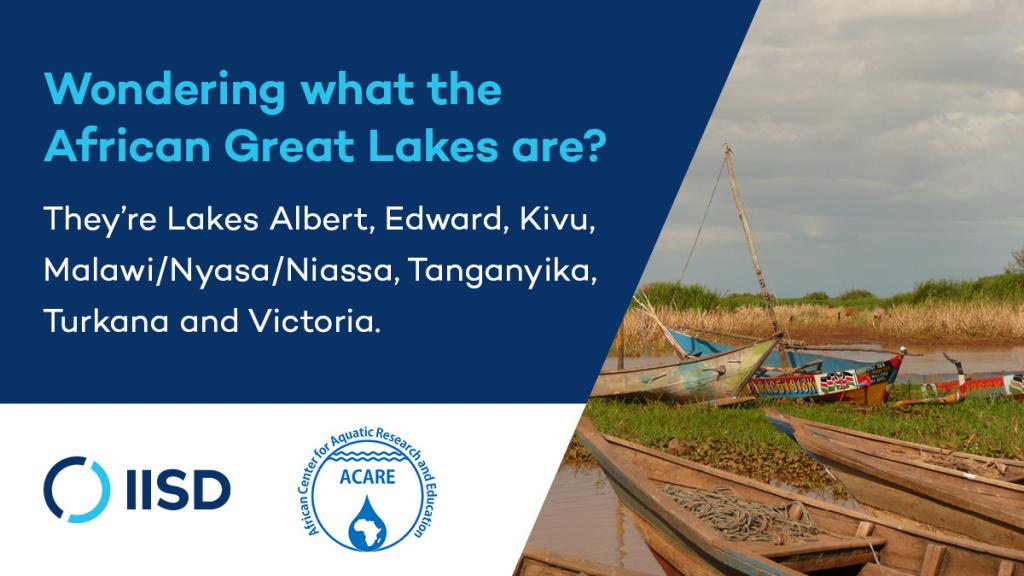
The African Great Lakes are lakes Albert, Edward, Kivu, Malawi/Nyasa/Niassa, Tanganyika, Turkana, and Victoria. You can learn more about the African Great Lakes here.
The partnership between the International Institute for Sustainable Development (IISD) and the African Center for Aquatic Research and Education (ACARE) provides an opportunity for the world’s freshwater laboratory and networks on the African Great Lakes to come together and strengthen science on large freshwater resources and the countries in which they reside.
IISD-ACARE combines the legal and policy expertise of IISD’s vast expert staff with ACARE’s newly created African network of large-lakes experts and scientists in Burundi, the Democratic Republic of the Congo, Ethiopia, Kenya, Malawi, Mozambique, Rwanda, Tanzania, Uganda, and Zambia.
The partnership works to boost the activities of six advisory groups that were created to address specific issues on each of the African Great Lakes. Members of each group are harmonizing priorities on the lakes to advance work on scientific inquiry, monitoring, climate change, and education and training, among other issues.
An exciting flagship project of the initiative—the African Women in Science program—is a 10-month program designed by women, for women, to support the interests, needs, and goals of early-career scientists working on Africa’s freshwater issues. Dozens of women in science have now benefited from the program, including those who share their stories, and how the program has benefited their career, in the video below.
To learn more about the project, or to discuss research and collaboration opportunities, you can visit the ACARE website, or contact us directly.
Senior Policy Advisor
Board Member, IISD Experimental Lakes Area
Executive Director, IISD-ELA
Head Research Scientist, IISD-ELA
Director, Water and Director, Manitoba Relations
Senior Research Scientist, IISD-ELA
Editorial & Communications Manager, Water & IISD-ELA
Research Scientist, IISD-ELA
Since 2012, the work of the trees and plants of B.C.’s coastal rainforest have been generating credits—one credit for every tonne of carbon sequestered—that are bought by the B.C. government, companies and individuals wanting to offset their carbon emissions.