Brief

Nanosilver: What action needs to be taken to protect Canadians from this emerging contaminant?

October 29, 2020
  • Nanosilver is an emerging nanomaterial that is widely known for its antimicrobial properties—it releases silver ions that are highly toxic to bacteria.

  • Nanosilver use in consumer products (and its eventual release into the environment) is currently unregulated in Canada.

  • Canada needs to protect its environment and citizens by following the precautionary principle of regulating nanosilver and providing standards and guidelines for manufacturers and consumers alike.

Nanosilver is an emerging nanomaterial that is widely known for its antimicrobial properties—it releases silver ions that are highly toxic to bacteria.

While it is used in over 440 consumer products, research at IISD Experimental Lakes Area has discovered that nanosilver can have adverse effects on the health of freshwater fish—significant enough to warrant including it as part of Canada’s water safety guidelines for the metal.

In this policy brief, we explore what nanosilver is, why exactly you need to be worried about it, and what Canada should be doing to protect the country's fresh water from this currently unregulated substance.

Brief details

Insight

Why the UN World Data Forum Matters to Canada

Thanks to the power of artificial intelligence, we can 'model' better than ever—data gives us detailed and accurate blueprints of where, say, Canada’s fresh water is headed, set against the backdrops of climate change and ever-increasing pollution.

October 23, 2020

Full disclaimer: this is probably a niche passion, but I just can’t help getting excited about the United Nations World Data Forum this week.

While this year’s event is, of course, happening online, it’s usually a dynamic and interactive affair, which, for me, as a freshwater scientist here in Canada, reveals just how far we have come in terms of we can do with the data we collect in the field to improve the health of our environment. 

An environmental dataset may sound like a pretty cumbersome and vague notion; I am used to people’s eyes politely glazing over when I even mention the term.

But it is actually pretty simple—a critical indicator of what is going on in our environment (say, how much phosphorus is in our lakes or the health of Lake Trout). We take what we learn from these datasets to see if current environmental practices and policies are working, and to decide whether we need to modify existing ones or implement new ones. 

Well, maybe it is not quite that simple.

I work at IISD Experimental Lakes Area in northern Ontario, where we have tracked the health of real lakes for more than 50 years. When we first started, field measurements were often collected at weekly or biweekly intervals, and usually during daylight hours.

There is one clear way to harness the power of all these exciting yet disparate initiatives happening across the country—the nascent Canada Water Agency.

I can regale you with some heady tales of me scribbling down critical data about the chemistry of our lakes into a tiny yellow notebook in a rocking boat amidst torrential downpours.

Today, such data collection is supplemented by satellites and sensors placed directly in the environment, collecting information at second intervals 24/7. A few numbers in a notebook have become thousands, millions or even trillions of datapoints. At a few megabytes, our first laptop computers wouldn’t have been able to store a fraction of this information, let alone process it.

Thanks to the power of artificial intelligence, data also now allow us to model better than ever—providing us with detailed and accurate blueprints of where, say, Canada’s fresh water is headed, set against the backdrops of climate change and ever-increasing pollution.

They can also then easily feed into what we call datastreams. These are larger bodies of datasets from diverse sources (from dedicated scientific facilities to community-based monitoring programs where everyday folk can sample their local river and mail in the results), which reveal truths about larger ecosystems, such as Lake Winnipeg. 

Several years ago, when I was a student, Canada’s much-revered Stephen Lewis gave a public lecture at my university. As if it were yesterday, I can still remember his discussion about the importance of scientific data for decision making and, critically, to build a more just and better planet. While the goal hasn’t shifted since then, the tools at our fingertips have greatly advanced.

As the UN World Data Forum (now underway) was approaching, I was reflecting on how far we have come here in Canada. But it struck me that there is one clear way to harness the power of all these exciting yet disparate initiatives happening across the country, from datastreams to AI, to translate that science and data into real action—the nascent Canada Water Agency.

In a world of limited time and resources, the new agency should involve pulling all these wonderful, diverse streams of work together to build an expansive and comprehensive map of the health of Canada’s freshwater

The federal government has dedicated funds and energy to launch a new pan-Canadian agency to protect the 20% of the world’s freshwater that we are lucky enough to host in this country. Data will, of course, be key. How else do we know where we currently stand and therefore what we need to do? 

But we don’t need to start from scratch.

In a world of limited time and resources, a prudent imagining of the new agency should involve pulling all these wonderful, diverse existing streams of work together to build an expansive and comprehensive map of the health of Canada’s freshwater from which we can make sound policy decisions.

The onus will fall on the agency to make sure these Canadian innovations are sufficiently funded, resourced, empowered to share resources and knowledge, and duly thrive—with the obvious impact being the protection of this critical resource on which we all depend.

The UN World Data Forum, at its core, is really just about people coming together to reimagine how we use what we already have at their fingertips in order to improve the lives of everyday people. 

What better model for our burgeoning Canada Water Agency?

This article originally appeared in The Hill Times on October 22, 2020. It has been reprinted with permission. 

Insight details

Webinar

Virtual Fireside Chat: How Two Continents Are Working Together to Improve The Health Of The African Great Lakes

Did you know that scientists across North America and Africa are putting their heads—and expertise—together on issues including algal blooms, climate change, invasive species, fragile fisheries, to name but a few, to improve the health of the African Great Lakes?

October 28, 2020 9:00 am - 10:00 am Central

(Open to public)

And this matters because the seven African Great Lakes contain around 25% of the world's fresh water and underpin the welfare and livelihoods of over 50 million people across 10 countries.

To hear their stories, and to learn more, we invite you to a virtual fireside chat on Wednesday, October 28, 2020, at 9:00 a.m. (CDT); 10:00 a.m. (EDT); 3:00 p.m. (CET); 4:00 p.m. (CAT); 5:00 p.m. (EAT).

You will discover:

  • Exactly what the African Great Lakes are, and why we need to collaborate in order to protect them
    • from Dr. Kevin Obiero, Chair, ACARE & Centre Director, Kenya Marine and Fisheries Research Institute
  • The critical role that women are playing
    • from Stephanie Smith, Strategic Advisor, IISD-ACARE
  • A case study of work already underway to protect the African Great Lakes
    • from Ms. Cecilia M. Githukia; Research Scientist; Kenya Marine and Fisheries Research Institute, Aquaculture Division


REGISTER HERE

Press release

Young Manitoban Innovators Win $20,000 Seed Funding in National Competition to Save Lake Winnipeg

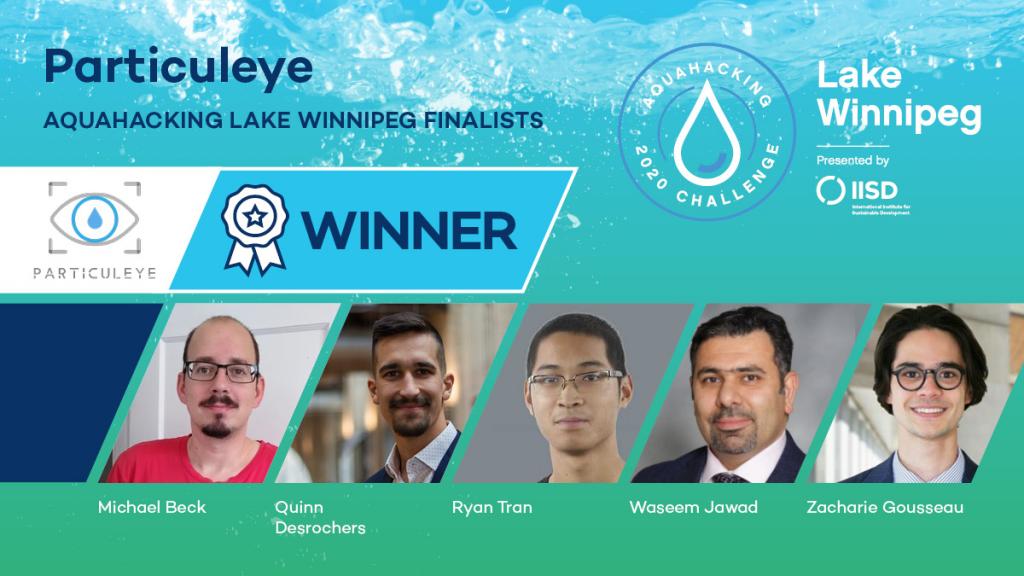
Particuleye Technologies will receive $20,000 in seed funding for earning first place in the AquaHacking Lake Winnipeg 2020 Challenge Final today for their solution to address microplastics pollution in Lake Winnipeg.

October 20, 2020

Winnipeg, MB—The International Institute for Sustainable Development (IISD) and Aqua Forum held the AquaHacking Lake Winnipeg 2020 Challenge Final today via live stream.

Five teams of post-secondary students and young professionals from across Canada pitched their tech-based solutions to address urgent freshwater issues including microplastics, water and land management in agriculture, drinking water in remote centres, and watershed investment. A panel of five judges with expertise in business, technology, and water science determined the winners.

“I’m speechless. It’s unbelievable what this competition does and I can’t wait to see what happens going forward with all the teams and with our solution,” says Quinn Desrochers, CEO of winning team Particuleye Technologies. “Thanks to all the sponsors and supporters, and the mentors who answered all our questions and helped us out along the way.”

Overall, the teams received a total of $50,000 in seed funding plus incubator space to launch their start-ups and make a positive impact on the Lake Winnipeg watershed.

Particulareye winners Lake Winnipeg Aquahacking

The winners are:

1st Place ($20,000): Particuleye Technologies from University of Manitoba, University of Winnipeg, and Queen’s University, addressing microplastics;

2nd Place ($15,000): LasIR Nutrient Technology from University of Manitoba, addressing water and land management in agriculture;

3rd Place ($10,000): Typha Co. from University of Manitoba, addressing watershed investment;

4th Place ($2,500): Water Secure from University of Regina, addressing drinking water in remote centres;

5th Place ($2,500): AbbaTek Group from University of Manitoba and Memorial University of Newfoundland, addressing the issue of microplastics

“I’m so proud of the work our finalist teams put into this Challenge and we at IISD are delighted by the results,” said Jane McDonald, IISD’s Executive Vice President.

“It’s been impressive to watch these youth continue to invest their time, energy, and talent into coming up with innovative solutions to some of the toughest problems plaguing Lake Winnipeg—and they did so amidst a global pandemic! We are confident these teams will continue to make a splash as leaders in the water sector for future generations.”

“Congratulations to all the finalists in the 2020 Lake Winnipeg AquaHacking Challenge!” said Désirée McGraw, President & CEO of Aqua Forum, the organization which oversees the AquaHacking Challenge.

“I salute your commitment to a better future by solving wicked water problems in Canada. We are certain that this is only the beginning of your journey as entrepreneurs and positive disruptors in the water sector. Thank you to everyone that has collaborated toward the success of our first-ever Aquahacking Challenge in the Prairies.  I want to underscore what a pleasure it has been to work with our partner and host, the nationally-respected and globally-renowned International Institute for Sustainable Development.”

To watch the recording of the event, click here.

A program with more information on the teams, their solutions, and more can be found here and you can find a backgrounder on the competition below.

Special thanks to the sponsors and partners of the AquaHacking Lake Winnipeg 2020 Challenge: De Gaspe Beaubien Foundation, RBC Foundation, Lavery Lawyers, Ovivo, Mitacs, IBM, Government of Manitoba, The Winnipeg Foundation, Johnston Group, Canada Life, Eco Canada, James Richardson & Sons, Ltd., The North West Company, Manitoba Technology Accelerator, Economic Development Winnipeg, North Forge, Taylor & McCaffrey LLP, and Aqua Forum.

-30-

For more information and to arrange an interview with the winners, contact:

Sumeep Bath Communications Manager, IISD Experimental Lakes Area

[email protected]

(204) 958-770 ext. 740

Laurence Basso Communications Coordinator, Aqua Forum

[email protected]

(514) 254-9611   

IISD in the news

Lake Winnipeg ‘aquahacking’ contest to announce winning proposal Tuesday

A nine-month-long competition tasking young people on the prairies with solving environmental problems facing Lake Winnipeg is about to declare a winner.

October 20, 2020

IISD in the news details

Topic
Water
Region
Canada
Project
AquaHacking Lake Winnipeg
Impact area
Nature
IISD in the news

Silver particles in consumer goods found to harm fish in Ontario lake study

Microscopic silver particles that are added as an antimicrobial agent to athletic clothing, condoms and yoga mats, among many other products, have been shown to harm fish and freshwater ecosystems when released in quantities that are similar to what is thought to be emerging from wastewater plants across Canada.

October 18, 2020

IISD in the news details

Topic
Water
Region
Canada
Project
IISD Experimental Lakes Area
Impact area
Nature
IISD in the news

Why carbon tariffs could be coming to Canada soon

So-called “carbon border adjustments” involve tariffs imposed by countries with carbon pricing on imports from jurisdictions without equivalent policies. Until recently, such tariffs were generally rejected as being at odds with World Trade Organization rules or objectives, but they have swiftly gained international momentum.

October 16, 2020

IISD in the news details

Topic
Energy
Region
Canada
Impact area
Climate
Sustainable Economies
IISD in the news

BC NDP pledges to review oil and gas royalties

Buried deep in the platform the BC NDP released last week is a single line that could have long-term implications for government revenue and the natural gas and LNG industry.

October 14, 2020

IISD in the news details

IISD in the news

When vision meets COVID-19: Proper city planning more relevant than ever amid current upheaval

Proper city planning more relevant than ever amid current upheaval

Winnipeg’s long-term goals, set out in planning documents, should serve as pillars for the city’s pandemic recovery strategy.

October 13, 2020

IISD in the news details

Press release

Focus on Phosphorus at Winnipeg’s North End Sewage Treatment Plant

The Lake Winnipeg Foundation (LWF), the International Institute for Sustainable Development (IISD) and the Lake Winnipeg Indigenous Collective (LWIC) lay out next steps in a joint statement in response to an updated plan from the North End Water Pollution Control Centre (NEWPCC) Project Steering Committee.

October 9, 2020

Today, the NEWPCC Project Steering Committee, comprised of representatives from both the city and the province tasked with implementing interim phosphorus reduction to improve the health of Lake Winnipeg, released an updated plan.

Continued urgency from both governments is needed to meet their 2019 commitments to accelerate phosphorus reduction to improve the health of Lake Winnipeg.

Previous deadlines to meet the NEWPCC’s phosphorus licence limit of 1 milligram per litre (1 mg/L) have not been met while algal blooms worsen in Lake Winnipeg. According to today’s updated plan, actual commitments to reduce phosphorus are still pending.

As members of the NEWPCC Project Advisory Committee, we have identified two concrete opportunities to tackle the treatment plant’s steadily increasing phosphorus loads and protect Lake Winnipeg well before long-term upgrades are slated to be complete:

  • By April 2022, implement the recommended interim phosphorus solution to reduce phosphorus concentrations as much as possible within the constraints of the plant’s existing infrastructure;
  • By January 2021, commit to designing NEWPCC’s new biosolids facility to address existing constraints and optimize the interim solution, ensuring that compliance with the 1 mg/L phosphorus limit is achieved no later than 2028 when biosolids construction is complete.

LWF, IISD and LWIC remain committed to our roles as advisors throughout this process. This role includes maintaining transparency and accountability, and communicating outcomes to the public. In this role, we stress that as a licensee under Manitoba’s Environment Act, the City of Winnipeg must operate the NEWPCC in a manner that safeguards our province’s lakes and rivers. As provincial regulator, the Government of Manitoba has the responsibility to enforce compliance with the licenses it issues.

The Problem: Excess phosphorus is harming Lake Winnipeg

Research from IISD Experimental Lakes Area has taught us that excessive amounts of phosphorus drive the growth of potentially toxic algal blooms (a process called eutrophication) in freshwater ecosystems, such as Lake Winnipeg.

Since the NEWPCC began operating in the 1930s, First Nations and other communities on the shores of Lake Winnipeg have directly experienced the consequences of its phosphorus pollution. The eutrophication of Lake Winnipeg is not a new environmental challenge, but it is an increasingly urgent one. Improving the health of this ecologically, economically, and culturally important freshwater resource requires phosphorus reduction from all sources across the watershed.

The NEWPCC is the single largest “point source” of phosphorus to Lake Winnipeg. Localized, concentrated point sources of phosphorus – like NEWPCC – are the easiest to identify, quantify and address through the implementation of proven technical solutions.

Total phosphorus concentrations at the NEWPCC are routinely three times higher than the provincial licence limit set in 2005, which states that phosphorus levels in the facility’s effluent must not exceed 1 mg/L. The first deadline for compliance with the phosphorus limit was Dec. 31, 2014; this was subsequently extended to Dec. 31, 2019. Today, the NEWPCC remains non-compliant with its phosphorus licence limit.

The Solution: Implement interim phosphorus removal – then optimize it

LWF, IISD and LWIC have been advocating for a phosphorus-removal process at the NEWPCC called chemically enhanced primary treatment (CEPT). This process is widely used in jurisdictions across North America to reduce phosphorus loading and protect freshwater ecosystems; dozens of municipalities around the Great Lakes have employed variations of CEPT to achieve phosphorus limits of 1 mg/L.

Despite CEPT’s success in other jurisdictions, today’s updated plan suggests that the process can only lower total phosphorus concentration in NEWPCC effluent by 23 per cent, from 3.5 mg/L down to 2.7 mg/L. While this falls short of the phosphorus reduction required at the NEWPCC, it is a necessary first step to addressing the environmental impact of the treatment plant.

The updated plan says that the NEWPCC currently doesn’t have enough biosolids capacity to optimize CEPT and meet the phosphorus limit. Biosolids, also called sludge, are a by-product of wastewater treatment; phosphorus-removal processes like CEPT concentrate phosphorus within sludge, keeping it out of the liquid effluent which is discharged into local waterways. This increases the volume of sludge produced.

If sludge capacity currently limits the effectiveness of CEPT, then the NEWPCC’s new biosolids facility should be built to address this limitation, so that the plant can achieve phosphorus compliance as soon as possible by optimizing the CEPT process.


LWF is an environmental, non-governmental organization advocating for change and coordinating action to improve the health of Lake Winnipeg. Learn more.

LWIC is a collective voice for First Nations around Lake Winnipeg. Learn more.