IISD in the news

Coree Tull and Dave Zehnder: Time to invest in watershed security

Recent report from International Institute for Sustainable Development shows that natural infrastructure, like forests and wetlands, provides same services at half the cost of built infrastructure.

December 6, 2021
IISD in the news

Aucun parti n’agira à la hauteur que requiert la crise climatique (in French)

Alors que la crise climatique exige une réduction drastique et rapide de nos GES à zéro émission pour 2030 comme l’ont réclamée les étudiants à la marche du 24 septembre dernier, les partis politiques de l’Assemblée nationale sont plus que timorés dans leurs objectifs. Maintien de l’objectif de Charest de -37.5% pour la CAQ, -55% pour QS, -45% pour le PLQ de Anglade et -50% pour le PQ.  

December 3, 2021
IISD in the news

Critics want Trudeau to dump oil and gas fund

Green Party MPs and environmental groups say a financial relief program for onshore oil and gas companies should be scrapped after a scathing report by Canada’s climate watchdog was released Thursday.

November 29, 2021
Report

A Business Case for Investment in Canadian Community-Based Water Monitoring

November 25, 2021

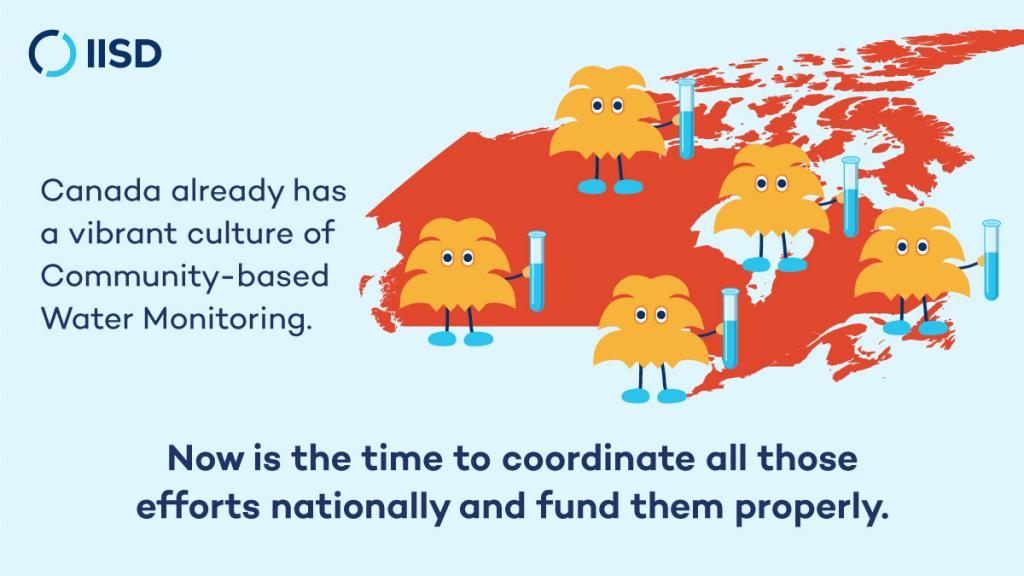
The time to coordinate and fund Canada's vibrant culture of community-based water monitoring (CBWM) is NOW.

In this new report and shorter policy brief we explain:

  • WHY CBWM is a cost-effective and scientifically rigorous way for Canadians to collect data on the quality of fresh water across watersheds,
  • HOW we need to coordinate and fund these efforts,
  • WHEN we need to take action,
  • WHAT the role of the burgeoning Canada Water Agency should be.
Map of Canada with text

Report details

Topic
Measurement, Assessment, and Modelling
Water
Region
Canada
Impact area
Climate
Nature
International Governance
Publisher
IISD
Copyright
IISD, 2021
IISD in the news

The post-covid fossil fuels boom

Don't look now but the world is in a fossil fuels boom. As the economy bounces back from covid-19, the global demand for oil, gas and coal is skyrocketing. Yet didn't international leaders just make new climate pledges that promise to cut out these fossil fuels? How do we make sense of this contradiction? How long will the fossil fuel boom last? And will it send our climate goals out of reach?

November 24, 2021

IISD in the news details

Insight

Canadian Youth Look to Move Mountains for the Climate Crisis

As extreme weather events become more common, young people throughout Canada are looking at how they can influence climate policy and inspire change.

November 24, 2021

Young people in Canada have set their sights on revolutionizing climate action. The new generation of activists is going beyond the traditional avenues of protest and is now engaging directly with policy and power structures. There is much we can learn from the efforts of young climate activists, both in Canada and abroad.

Over the last couple of months, I have had the privilege of meeting with some of Canada’s dedicated young climate activists to hear about their goals and tactics. I have heard from young people who are striking from school, communicating directly with policy-makers, rallying to change the legal voting age, and even going directly into damaged ecosystems to begin restoration work themselves.

Katia Bannister: Combining advocacy and ecological restoration

One of these activists is British Columbia’s Katia Bannister, a teenager who has already dedicated most of her life to nature and the environment. Katia became involved with nature from a young age, thanks to her ethnobotanist mother. “There are photos of me as a one- and two-year old strapped into a baby backpack accompanying my mom as she did fieldwork,” reminisced Katia as we spoke to her. 

As Katia grew older and became more aware of the climate crisis, her love of nature spurred her to action. Over the last several years, Katia has participated and been a leader in some very high-profile advocacy, including the Friday strikes from school (initiated by Greta Thunberg) and the Vote16 movement, which aims to lower British Columbia’s legal voting age to 16. Katia is also the current co-leader of the Cowichan Valley Earth Guardians Crew, which works to create inter-generational change on environmental issues. 

At the moment, Katia’s biggest project is engaging directly with ecological restoration work, going out into damaged ecosystems to pull invasive weeds and propagate native plants. “Ecological restoration is tangible, place-based, and rewarding. It helps to contextualize our personal and collective relationships with the Earth,” explained Katia as she recounted her experience restoring an abandoned railroad site. “I planted riparian plants to strengthen the banks of the estuary, a place that had endured decades of degradation. It was exciting, tangible, and interesting.” 

“Ecological restoration is tangible, place-based, and rewarding. It helps to contextualize our personal and collective relationships with the Earth."

Katia Bannister

After hearing Katia describe her own experiences, I asked her what other Canadians of all ages could do to get involved and make a difference. She told us, “Research potential opportunities to do restoration work in your community. Connect with local conservation organizations. Get out there and get your hands dirty.” 

Sara Campbell: Blending justice issues with climate action

Across Manitoba, Sara Campbell has been involved in environmental and social justice issues since childhood. “I was involved in social justice activism work from a young age with the support of my family,” she explained. Sara is now the Outreach and Education Assistant at the University of Winnipeg’s Campus Sustainability Office. She has been a leader on multiple different sustainability-based projects throughout her life, but Sara’s intersectional activism targets climate justice by centring issues of poverty and injustice as key to reducing our carbon footprint. “Housing is a main determinant in stability and health,” Sara said. “Buildings are also a large opportunity to reduce our emissions to prepare for the pre-existing and upcoming climate realities ahead.” According to Sara, climate justice cannot be achieved in isolation. The various other socio-economic issues that plague our society are inherently intertwined with the climate crisis.

“Buildings are also a large opportunity to reduce our emissions to prepare for the pre-existing and upcoming climate realities ahead.”

Sara Campbell

Sara’s activism goes well beyond traditional methods of protesting. Sara engages directly with policy-makers and has even made policy recommendations at the provincial level of government to former Manitoba premier Brian Pallister. Her proposed policy outlines a method for implementing a basic income program in Manitoba that she believes to be feasible and necessary. “Basic income would substantially improve quality of life to allow people the chance to get out of ‘survival mode’ and to move forward,” Sara told us. 

I concluded our interview by asking Sara: if she could send one message to her fellow activists, what would it be? Her response was simple and clear: “To my fellow activists: We need you. Life is not a game. Be a good ally. Listen. Amplify voices. Step back. Stand up. Keep going. Let’s do this.”

Time to give youth a real say

It is becoming increasingly clear that young people in Canada are done with waiting for older generations to make changes for them. In a recent global survey, 65% of youth respondents said that governments were failing them when it comes to climate action, and three quarters said they thought the future was frightening. This reality has become especially apparent since COP 26 in Glasgow this year, where youth from around the world made their presence known, by protesting portions of the agreement they felt were insufficient, proposing their own ideas, and pressuring negotiators not to lose steam. 

There is a strong appetite from young people to be included in major climate decisions, but there is still more to be done to include youth in decision making. In Canada, we have yet to see meaningful inclusion of youth in federal- and provincial-level decision making, and those reluctant to engage young people in these processes often cite immaturity or lack of life experience as their reason. However, it is clear by the words and actions of the youth who attended COP 26 this year, as well as the youth I have had the privilege of working with myself, that their contributions can help transform climate ambition into concrete climate action. 

We have just achieved an important milestone with the culmination of COP 26, but it is by no means an endpoint. As much as Canada has work to do, there are other countries where youth engagement is just as much, if not more of an issue. The dedicated activists we have in Canada provide us with an opportunity, which the wider policy community needs to help translate into action. If Canada takes youth voices seriously, we could become a role model for countries worldwide in youth engagement for climate action, perhaps even working with other nations to ensure youth voices are heard. We have mountains ahead of us that need to be moved, and if we want this planet to stand a chance in the face of climate change, it is time to give youth a real say. 

Webinar

Canadian Prairie Agriculture Under Climate Change: How can we chart a resilient path?

Join us for a discussion about the future of farming in the Canadian Prairie provinces.

December 2, 2021 11:00 am - 12:30 pm Central Standard Time

(Open to public)

The impacts of a warming climate are already being felt on the Canadian Prairies amid extreme weather events ranging from floods to droughts to wildfires. The past summer was particularly hard on many agricultural producers. On Thursday, December 2, 2021, IISD and ClimateWest held a webinar featuring Prairie-based producers and experts to hear about what these climate challenges mean for agriculture, with an open Q&A and discussion about the road ahead.

This webinar followed the release of a new IISD report, Farming the Future: Agriculture and Climate Change on the Canadian Prairies, which provides an extensive overview and analysis of:

  • The climate risks that Prairie producers face
  • How on-the-farm practices can help producers build resilience, improve their bottom line, and reduce environmental impacts
  • The critical role of federal and provincial policy in supporting producers, their livelihoods, and their competitiveness for international markets. 

The webinar provided an overview of this latest research, along with panellists' perspectives. It also examined the current policy state-of-play and considered lessons learned for the future. IISD’s new report is the first of a two-part series, and this webinar helped lay the groundwork for the upcoming second report about policy solutions.

Speakers included:

  • Ian McCreary, Grain and livestock farmer, McCreary Land & Livestock Ltd. (Saskatchewan)
  • Duncan Morrison, Executive Director, Manitoba Forage & Grasslands Association
  • Debra Davidson, Professor of Environmental Sociology, University of Alberta
  • Lara Ellis, Senior Vice-President, Policy and Partnerships, ALUS

Moderation and opening and closing remarks were provided by:

  • Jane Hilderman, Executive Director, ClimateWest
  • Vanessa Corkal, IISD Policy Advisor
  • Aaron Cosbey, IISD Senior Associate

Watch the webinar video below:

Report

Farming the Future: Agriculture and climate change on the Canadian Prairies

What does the future of farming on the Canadian Prairies look like under climate change? This report summarizes climate risks to, and impacts from, agriculture in the Canadian Prairies. It looks at “sweet spot” solutions that can increase producers’ resilience, improve economic viability, and contribute to Canada’s climate change mitigation goals.

November 18, 2021
  • Agricultural GHG emissions in Canada are 12% of the national total.

  • The Prairies face a number of critical risks, from flooding to heat waves and invasive pests, that could jeopardize agricultural productivity and producer livelihoods.

  • Many on-farm practices can increase resilience and long-term viability of Prairie farming operations while also reducing emissions, but they require increased policy support and public investment.

On the Canadian Prairies, modern farms are caught in the cross-currents of multiple fundamental changes, including a decline in the number of farms, an increase in average farm size, growing fertilizer and pesticide use, and the rising costs of inputs, land, machinery, and other expenses. On top of these, climate change will fundamentally affect the future of farming in the region.

The Prairies face a number of critical risks, from flooding to heat waves and invasive pests, that could jeopardize agricultural productivity and producer livelihoods. Producers may also be affected by the impacts of climate policies in export markets and changing consumer behaviours in response to climate change concerns.

Canada’s agricultural producers have a complicated relationship with climate change that goes beyond simply feeling impacts or adapting to them. The way we farm also has impacts that are large scale enough to matter in Canada’s broader greenhouse gas emission profile. Agriculture in the Prairies contributes 64% of all Canadian agricultural emissions. Across Canada, agricultural emissions are 12% of the national total.

The good news is that we already know how to reduce emissions through beneficial management practices (BMPs), many of which have benefits such as reducing input costs or helping producers to adapt. Many farmers have already adopted certain BMPs, including no-till. But government policy plays a critical role in supporting farm-level changes, and much more is needed to spur the adoption of climate-friendly practices.

This report summarizes climate risks to, and impacts from, farming on the Prairies. It examines the types of BMPs that could be beneficial and looks at gaps and opportunities in current federal and provincial policy to support their adoption. It also proposes next steps for how governments, industry and non-governmental organizations can support Prairie producers to move toward a new, more economically, environmentally, and socially sustainable vision of Prairie farming.

Participating experts

Report details

Topic
Food and Agriculture
Climate Change Mitigation
Region
Canada
Impact area
Climate
Publisher
2020
Copyright
IISD, 2021