Policy Analysis

Rethinking the Global Response to Deforestation

As the European Union's Regulation on Deforestation-free products (EUDR) enters a new implementation phase following the European Commission's recent simplification review, global debates on deforestation are increasingly shifting from compliance toward broader international cooperation on forests, climate finance, and trade ahead of COP 31. 

May 19, 2026

Context

The European Union’s Regulation on Deforestation-free products (EUDR) sparked a global discussion about international efforts to tackle deforestation. With the European Commission (EC) publishing its simplification review of the regulation on May 4, 2026, a new phase is beginning. The debate on trade measures linked to deforestation is increasingly splitting into two distinct conversations: one focused on compliance with instruments such as the EUDR and a deeper exchange about international cooperation on forests, climate, and trade.

These conversations are taking place at a critical moment. The outcomes of the 30th UN Climate Change Conference (COP 30) in Belém, alongside emerging efforts to scale forest finance, suggest that global action on deforestation is entering a new phase, one focused not only on commitments, but on implementation. Whether these different strands can be aligned will shape the effectiveness of the global response.

EUDR: Latest developments

The EUDR has introduced a new level of ambition in addressing deforestation linked to global supply chains. Its core requirements, centred on due diligence, legality (compliance with relevant laws in the country of production), and traceability, aim to ensure that products derived from seven commodities (cattle, cocoa, coffee, palm oil, soy, wood, and rubber) placed on and exported from the EU market are not associated with deforestation.

At the same time, implementation remains complex. Operators and producer countries have raised concerns about administrative burden, data availability, and the costs of compliance, particularly for small and medium-sized enterprises and smallholder producers.

These concerns have already led to adjustments. The original application timeline has been delayed twice, with obligations now applying from December 30, 2026, for large and medium operators and from June 30, 2027, for micro and small operators. The revision also introduced a new category of downstream operators. Retailers and manufacturers who are not the first to place products on the EU market are now classified as such and are relieved of the requirement to submit full due diligence statements if the product is already covered by a valid statement. Small and micro primary operators in low-risk countries need only to submit a one-time simplified declaration. Printed products such as books and newspapers were removed from scope. Printed products such as books and newspapers were removed from the scope. 

Importantly, the revision mandated the EC to carry out a formal simplification review by April 30, 2026. This review reflects a growing recognition that the effectiveness of the EUDR will depend not only on its level of ambition but also on its implementation across diverse contexts. The report published by the EC on May 4, 2026, proposes no further amendments to the core legal text. It considers that the simplification measures introduced since 2023, together with the current package, are sufficient to support implementation.

The package rests on four main elements:

  1. The updated guidance and FAQs clarify key implementation issues. These include how to verify legality in a proportionate way, the largely passive role of downstream operators in collecting reference numbers, and the simplified regime for micro and small primary operators, including the use of one-off declarations.
  2. A draft Delegated Act refines the product scope, currently open for public feedback until June 1, 2026. It proposes targeted additions, such as soluble coffee and certain palm oil derivatives, and exclusions, including leather, samples and retreaded tires. After the feedback period, the commission is expected to adopt the act, which enters into force a day after publication in the Official Journal of the EU unless the European Parliament or the Council objects within the scrutiny period.
  3. The EU Information System, used by operators and traders, is expected to reflect the latest changes and be fully functional from June 2026. It will include new functionalities, such as simplified declarations, registration of new operator categories, and voluntary grouping tools, aimed at facilitating use in practice.
  4. The EC will establish two repositories ahead of the application date: one on relevant legislation in producer countries and one on certification schemes. These are intended to reduce the burden of legality verification by improving access to information. 

The EC estimates that annual compliance costs for companies will fall by around 75%, from approximately EUR 8.1 billion under the original regulation to EUR 2 billion once all simplification measures are considered. At the same time, the EC projects annual environmental benefits of around EUR 7 billion, based on its valuation of avoided deforestation and associated greenhouse gas emissions.

Lastly, the EC report also highlights that as of early 2026, at least 25 producer countries are implementing more than 60 government-led initiatives linked to EUDR compliance, suggesting that the EUDR is shaping and accelerating governance reforms in producer countries. 

In terms of next steps, the EC is expected to

  • finalize the accompanying implementation tools, including the draft Delegated Act on product scope, upgrades to the EU Information System, and the two new repositories on producer-country legislation and certification schemes.
  • continue outreach efforts with operators and producer countries.
  • expand partnerships with producer countries through the Team Europe Initiative on Deforestation-free Value Chains

COP 30 and the Global Landscape

In parallel to EUDR, other deforestation-related developments are taking place. COP 30 in Belém, framed as an “implementation COP,” intended to move beyond high-level commitments and focus on delivery.

At this COP, trade measures were among the most politically sensitive issues. Deforestation-related regulations raised concerns among some countries about potential impacts on developing economies. The decision to continue dialogue on these issues reflects both the lack of consensus and their growing importance.

At the same time, COP 30 reinforced a shift towards implementation. Although not a part of the formal COP 30 collective decision package, known as the mutirão decision, the COP 30 Presidency has committed to advancing a roadmap for halting and reversing deforestation and forest degradation by 2030. As attention turns to COP 31, the key question will be whether this focus on implementation can translate into concrete, coordinated action.

The growing recognition that regulation alone cannot address the structural drivers of deforestation has brought renewed attention to large-scale finance mechanisms that aim to support forest conservation and sustainable production. The COP 30 launch of the Tropical Forest Forever Facility (TFFF) reflects this shift. By seeking to mobilize USD 125 billion from countries, philanthropy and private investors and reward conservation efforts, TFFF aims to address the economic incentives that drive land-use change. However, this initiative does not aim to support the compliance with deforestation-related trade measures, such as EUDR. 

Toward a More Coherent Approach

Taken together, these developments highlight a broader challenge, in which several issues stand out.

First, the distribution of costs and benefits remains uneven. While the EUDR places obligations on operators placing products on or exporting from the EU market, much of the practical burden of compliance falls on producers of the covered commodities under the regulation. This is particularly challenging in contexts where data systems, infrastructure, and institutional capacities are limited. Smallholders are especially at risk of exclusion if these challenges are not addressed.

Second, the link between regulation and finance is still underdeveloped. Without adequate support, compliance requirements may translate into market access barriers rather than pathways to more sustainable production.

Third, implementation challenges and support needs are highly context specific. Drivers of deforestation vary significantly across countries, as do levels of infrastructure, data availability, and institutional capacity. Production structures also differ, particularly in the role of smallholder producers. As a result, approaches to implementation and support cannot rely on a one-size-fits-all approach.

Finally, tensions between trade and climate policies remain unresolved. As seen at COP 30, deforestation-related trade measures are increasingly part of international climate discussions, but consensus on their role and design is still emerging. 

What Comes Next?

The EUDR changed the landscape of instruments used to encourage action on deforestation. But regulation alone is not enough. The effectiveness of the global response will depend not on the existence of individual instruments, but on their ability to function as part of a coherent system. Achieving this will require bridging regulatory ambition with implementation capacity and connecting policy frameworks with financial and technical support.

COP 30 showed both the urgency of action and the difficulty of achieving consensus, particularly on issues that sit at the intersection of climate, trade, and development. As the global community moves toward COP 31, the challenge is no longer simply to ensure the ability to comply with trade-related measures. It is to ensure alignment between regulatory measures, producer perspectives, and financial mechanisms.

Ultimately, success in addressing deforestation and enhancing forest conservation will depend on whether the growing range of initiatives can evolve into an approach that is not only ambitious but also workable, inclusive, and scalable. As governments prepare for the Bonn climate talks and COP 31, these are the priorities that should anchor discussions on deforestation and trade measures. 

Policy Analysis

Rising Investor-State Tax Arbitration Cases Threaten Fiscal Sovereignty: Here’s what the UN Convention on Tax can do

Tax disputes are increasingly being brought before investor-state dispute settlement (ISDS) tribunals, undermining fiscal sovereignty and exposing governments to significant financial liabilities. The UN Framework Convention on International Tax Cooperation, currently under negotiation, offers a chance to stop this. Alexandra Readhead and Josefina del Rosario Lago lay out how.

March 23, 2026

The prevention and resolution of tax disputes has become a central challenge in global tax cooperation. Last year, amid ongoing UN negotiations on a Framework Convention on International Tax Cooperation (UN Convention on Tax)—the first-ever global treaty of its kind—countries agreed that the issue warranted its own dedicated protocol.

This agreement, to be developed alongside the convention, is meant to strengthen cooperation, reduce uncertainty, and provide fair mechanisms for resolving disagreements over international tax claims. But as countries move to draft the text, a pressing and growing reality cannot be ignored: tax disputes are increasingly being taken to ISDS, where private investors challenge national tax measures in international tribunals.

Such cases pose a direct threat to national tax sovereignty, one that negotiators have repeatedly flagged. They expose governments to potentially massive financial liabilities and constrain their ability to implement legitimate tax reforms, including those seeking to align with new international norms and standards.

So far, the UN negotiations have largely focused on disputes between countries under tax treaties, as well as on issues arising in situations where treaty coverage is absent. By contrast, the growing risk of tax disputes being diverted to ISDS mechanisms has received limited attention.

The UN Convention on Tax, through its dispute resolution protocol, presents an opportunity to both ensure that cross-border tax issues are addressed through tax-specific, state-to-state mechanisms and prevent their diversion into ISDS.  


Tax cases are increasingly being taken to ISDS

Arbitration allows parties to take a dispute to a non-governmental decision-maker rather than to a domestic or international court, resulting in a binding decision after both sides have been heard. In tax treaties, this usually takes the form of mandatory binding arbitration, a state-to-state process triggered after the mutual agreement procedure. ISDS, in contrast, comes from international investment agreements or contracts and lets investors sue states directly.

Tax-related ISDS cases have become increasingly common over the past 2 decades. Between 2000 and 2021, they made up about 15% of the 1,190 publicly known treaty-based ISDS cases. Of 165 tax-related ISDS claims in this period, only 51 came before 2009, while 114 were filed between 2010 and 2021. Cases under investment contracts are following the same trend


A threat to tax sovereignty

This rise in ISDS cases is a direct challenge to the right of sovereign states to set and enforce their own tax policies. ISDS gives a private actor standing to challenge tax measures through investment protection standards, in proceedings that are not anchored in the cooperative logic of tax treaties and that can generate binding outcomes with significant fiscal consequences.  

ISDS also suffers from several systemic shortcomings. The process is very costly, slow, and unpredictable. Decision-making is often opaque, legal precedent is limited, and awards can vary widely in how they are calculated. These features create legal uncertainty and can discourage governments from implementing legitimate tax reforms, as they risk costly legal challenges that could affect national budgets. Despite more than a decade of reform efforts at the United Nations, through the United Nations Commission on International Trade Law Working Group III on ISDS reform, these challenges persist, especially for countries with limited legal and financial resources.  

Following costly outcomes from ISDS claims, some states have responded by adopting “carve-outs” to explicitly exclude taxation from the scope of their bilateral investment treaties (BITs). India, for example, reformed its model BIT—which it uses when negotiating such new treaties—after facing major ISDS claims linked to retrospective capital gains taxes in the Vodafone and Cairn disputes, which resulted in billion-dollar awards against the state.

Other countries have added provisions requiring that disputes over whether a measure is a valid tax measure be referred first to the tax authorities in both the state where the investment takes place (“host state”) and the state where the investor is based (“home state”). Their determination is binding on the arbitral tribunal and must be made before ISDS proceedings can move forward.  

But these efforts to reassert tax sovereignty under BITs have largely fallen short. Tax carve-outs succeed in fewer than 20% of cases, partly because many BITs include tax “claw-back” provisions that still allow investors to challenge taxes under certain standards, like expropriation and non-discrimination. Tribunals have also at times interpreted carve-outs narrowly, like in the Yukos case, where the tribunal read a good-faith requirement into the definition of what constitutes a “taxation measure,” thereby limiting the scope of the carve-out. 


The UN Convention on Tax: A chance to stem the tide of tax cases going to ISDS 

Negotiating a protocol dedicated to tax disputes under the UN Convention on Tax is an opportunity to curb the growing number of tax-related ISDS cases and reassert the role of tax-specific, state-to-state dispute mechanisms grounded in tax treaties and domestic law, including recourse to national courts.

At a minimum, the protocol should include a carve-out clause that overrides access to ISDS for tax disputes. A useful starting point for discussion is the approach proposed in the Co-Coordinators' Report on the Relationship of Tax, Trade and Investment Agreements. This proposal would amend Article 25 of the UN Model Tax Convention by adding a new paragraph clarifying that taxation measures implemented pursuant to double tax treaties should not be considered breaches of other international agreements, including BITs, and should not be submitted to dispute settlement mechanisms under those other agreements. This proposal should be understood as a foundation on which negotiators can build to draft a carve-out under the UN Convention on Tax. It has received support within the UN Tax Committee, which underlined the importance of clearly distinguishing tax disputes from investment disputes and ensuring that tax issues are handled by tax specialists rather than investment arbitrators.  

However, further work would be needed to ensure that such a clause effectively addresses the specific features of BITs and the risks associated with ISDS. The first challenge concerns its scope. A wide range of tax measures—including customs duties, value-added taxes, and fiscal incentives linked to special economic zones—have been challenged in ISDS proceedings, yet many of these fall outside the current scope of the proposed convention. Limiting the carve-out to a narrow set of direct taxes would therefore leave significant exposure for states. Ideally, any effort to reduce the flow of tax disputes to ISDS should extend to both direct and indirect taxes, ensuring that the full range of fiscal policy instruments used by governments is adequately protected.

The second challenge lies in the large stock of legacy investment treaties. More than 2,500 international investment agreements remain in force, many dating from the 1990s and 2000s and containing far-reaching ISDS provisions. As a result, even if the UN Convention on Tax introduces safeguards for tax disputes, this legacy treaty network will continue to reinforce the role of ISDS in tax matters. Addressing this problem requires coordinated action between the tax and investment policy communities. This translates into considering reforms to BITs, including renegotiating or terminating outdated agreements, to ensure that tax measures are systematically carved out of ISDS across the existing treaty landscape.

Fortunately, the tax community has already shown that treaty networks can be updated collectively. The OECD’s Multilateral Instrument (MLI) enables countries to amend existing tax treaties in one step, by incorporating new provisions to curb profit shifting agreed multilaterally. More than 100 jurisdictions now participate, covering roughly 2,900 treaties. In this respect, the UN Convention on Tax provides a uniquely positioned forum for developing similar, coordinated solutions. To address the intersection between tax and trade, the 2025 UN Model Tax Convention also provides that disputes over whether a measure falls within the scope of a tax treaty can only be brought before the WTO Council for Trade in Services with the consent of both states. Taken together, these precedents demonstrate that coordinated multilateral action is both legally feasible and politically achievable, and the UN Convention on Tax provides a uniquely positioned forum to recalibrate the boundary between tax sovereignty and investment arbitration. 


Looking ahead: Avoiding the pitfalls of ISDS

As countries work to keep tax disputes out of ISDS, they will also need to think carefully about the dispute-resolution tools that could emerge under the UN Convention on Tax. While mandatory binding arbitration—currently under discussion—differs from ISDS, it still raises important design questions, including transparency, representation, and the independence of arbitrators, all issues discussed during our recent side event at the UN negotiations in February 2026.  

Tax dispute mechanisms should not replicate the weaknesses of investment arbitration. The UN Convention on Tax offers a rare opportunity to ensure that tax disputes remain within tax-specific frameworks and are handled by tax authorities, not investment tribunals. Getting this right will be essential to protect fiscal sovereignty while strengthening global tax cooperation. 


Watch our side event at the 4th Session of the Intergovernmental Negotiating Committee on the UN Framework Convention on Tax (February 2026)

Policy Analysis details

Policy Analysis

Five Reasons Climate Change Adaptation Is a Challenge for Rural Canada, and What We Can Do About It

Canada, like every country in the world, needs to build resilience to the impacts of climate change. However, despite the benefits of planned adaptation, barriers to adaptation progress remain, especially for rural communities. 

March 10, 2026

Climate change adaptation in Canada, as in many countries, is constrained by its complexity.  

Effective climate change adaptation requires a whole-of-society approach. It involves coordinated action across jurisdictions, sectors, disciplines, and knowledge systems with differing perspectives and priorities. With so many actors involved, it is often unclear who should lead adaptation efforts and who should be engaged in planning, implementation, and evaluation. 

These characteristics create obstacles for all actors, but more so for small, remote, and rural communities such as those that dot the Canadian Prairies. The more constrained financial and human resources of these communities, as well as their more limited access to services, pose particular challenges for adapting to increasing climate risk. 

At the same time, rural communities are often on the frontlines of increasingly damaging floods and wildfires, and can be dependent on climate-sensitive economies such as forestry, fishing, and farming. 

Below, we explore five barriers to adaptation progress in rural areas, particularly through the use of nature-based solutions like natural infrastructure, a “multi-solving” solution that will help build resilience while addressing other overlapping crises.

1. One-Size-Fits-All Funding Mechanisms 

Small, rural, and remote communities face distinct barriers to accessing adaptation funding due to limited tax bases, smaller populations, and program requirements such as matching funds or demonstrated returns on investment. Programs like the Federation of Canadian Municipalities’ Local Leadership for Climate Adaptation initiative have increased adaptation planning, but it remains unclear whether the hundreds of rural municipalities in Manitoba and Saskatchewan are benefiting proportionately.

Moreover, despite larger cost-sharing for smaller communities, the high cost of major adaptation measures—such as floodplain restoration, managed retreat, diversions, and wildfire management—continues to limit implementation in rural areas.

2. Insufficient Training and Capacity  

Canada’s workforce is well equipped to design and deliver traditional grey infrastructure, but lacks widespread training in climate-resilient and nature-based solutions. This shift is especially needed in rural, small, and remote communities, where limited staff capacity, aging assets, and heightened climate risks make it disproportionately difficult to adopt proactive approaches. With few local technical experts to rely on, these communities struggle to navigate the complex funding applications, project management demands, and administrative requirements that come with nature-based solutions and climate adaptation. While education and professional development are beginning to address these needs, they are far from mainstream. As a result, new projects often default to conventional designs rather than integrating updated climate projections and natural infrastructure options into planning, design, and implementation—missing opportunities to deliver essential services in ways that also build long-term resilience.

3. Limited Follow-Through

More municipalities have developed—or are in the process of developing—adaptation plans. Due to limited capacity, many smaller communities depend on external specialists and consultants to lead these planning processes. Once the consultancy is over, municipalities can be left uncertain about next steps, roles and responsibilities, and the resources needed to move from planning to implementation. If a local champion doesn’t take ownership or external support doesn’t continue through implementation—often because there is no funding to sustain it—it becomes challenging for plans to be embedded in day-to-day decisions, regularly updated, or translated into concrete actions.

4. Data and Information Gaps

While tools like the Climate Atlas of Canada and ClimateData.ca have improved access to climate projections, gaps remain in the availability and understanding of the non-climate data needed for robust risk and vulnerability assessments. The disaggregated health and social data needed to assess vulnerability to climate risks can be difficult to access or unavailable. Moreover, proxy indicators such as income, education, race, and gender do not capture the complex, place-based, and dynamic nature of the factors that influence the vulnerability of different groups. While this data is critical for targeting vulnerable populations, it is often poorly understood and improperly used.

Communities also face challenges in accessing climate-risk-informed data sets. For example, delays in releasing climate-informed flood-risk maps limit developers’ and planners’ ability to account for changing risks, resulting in continued development in areas increasingly exposed to flooding, wildfire, extreme heat, and other climate hazards.

5. Fixed Mindsets

Scaling nature-based solutions for climate change adaptation requires a shift from grey infrastructure toward hybrid and natural approaches. Municipal engineers and planners must recognize natural areas as infrastructure assets, not just recreational or aesthetic spaces. While initiatives such as the Natural Asset Initiative are advancing this shift, progress remains slow.

Two people stand on a wooden platform lookout point and look out into the distance. The platform overlooks a park during autumn with trees and a river running through it. There are city skyscrapers in the distance.
View of the Bow River valley in Calgary, Alberta. 

Enabling Factors for Adaptation

The International Institute for Sustainable Development’s (IISD’s) work with governments in Canada and around the world has informed our focus on the following seven key factors for enabling adaptation:

  • leadership
  • institutional arrangements
  • financing
  • engagement
  • skills and capacity
  • data, knowledge, and communications
  • technology 

These enabling factors are mutually supportive, which means that a gap in one area can undermine progress in another. Determining which combination of interventions are needed to enhance these factors varies by the local context, the risks being addressed, and the solutions being proposed. 

Of these seven enabling factors, leadership, tailored financing, and coordinated policy across all levels of government are of critical importance for rural Canada. 

Senior-level champions for climate resilience play a key role in driving adaptation planning and mainstreaming its implementation. Significant, sustained progress has been achieved in small communities where a local leader has recognized the growing risk of climate change and prioritized actions, including nature-based solutions, that build resilience to key hazards. 

The iterative adaptation process also requires long-term, predictable funding, otherwise it risks losing momentum before resilience improvements are actually realized. When funding is available, such as through the federally funded Natural Infrastructure Fund announced in 2021, we have observed an uptick in the number of communities that have prioritized investments in the retention and enhancement of their natural infrastructure assets or the development of new natural infrastructure solutions. 

And finally, effective adaptation depends on clear, coordinated policy across all levels of government, and we observe that aligned provincial and federal initiatives have increased municipal adaptation planning and the inclusion of natural infrastructure. Policies at all levels—local, regional, provincial, and federal—shape the implementation of natural infrastructure across the Prairies. IISD research shows that integrating these considerations across governance levels creates an enabling environment that boosts climate-resilient action.

Ways Forward

Finance

A critical and persistent challenge to greater climate adaptation action, particularly in rural, remote, and small communities, is access to financing.  Despite clear evidence that investing in planned adaptation can protect lives and livelihoods while delivering strong economic returns, these arguments have not yet significantly shifted the narrative or driven sufficient public funding for adaptation action. 

Yet for small, rural, and remote communities, public sector funding remains the primary driver of adaptation and natural infrastructure projects—not by choice but by necessity. These communities often face steep barriers to attracting private finance due to their smaller populations, limited economic activity, and higher perceived risk. Climate-resilient and nature-based approaches are difficult to monetize and offer lower returns. Without the technical capacity or financial tools needed to structure complex partnerships, many communities depend heavily on public funding to move forward, especially when upfront costs are high and benefits take years to materialize. 

Efforts to expand the private sector’s role in financing adaptation actions must align with the sector’s expectations regarding the size, risk, and return characteristics of its investments. Private sector investors are more likely to invest in specific sectors, such as infrastructure, agriculture, and water management, where there is greater potential to generate revenue and provide a sufficient return on their investment. 

Successful financing models in the United States and other regions are spurring greater investor confidence in natural infrastructure as a solution to a range of challenges, including climate change impacts. Outcome-based approaches that tie funding to performance show particular promise—especially for restoration projects that generate new ecosystem service revenues. 

Where opportunities exist for expanding private financing in the adaptation space through these instruments, it is crucial to safeguard local land rights, maintain affordability and access for rural and underserved communities, and ensure that monetizing ecosystem services—such as through carbon credits—results in genuine environmental gains.

Infrastructure Investment

Secondly, within the public sector, climate resilience should be integrated into all new built, natural, and hybrid infrastructure investments. A key objective of all federal investments in new and upgraded built infrastructure, such as through the Build Canada Strong Fund and Build Canada Homes agency, must be ensuring their long-term climate resilience. As highlighted in a recent Canadian Climate Institute report, this type of proactive adaptation investment can not only ensure that Canada’s infrastructure is robust in the face of greater climate risks but also save millions of dollars per year in economic and social costs over their lifespan. 

New infrastructure investments must also be designed to facilitate the uptake of climate-resilient natural infrastructure. IISD has identified 14 criteria that influence decisions to invest in natural infrastructure that should inform the design of federal funding programs.

Multi-Solving

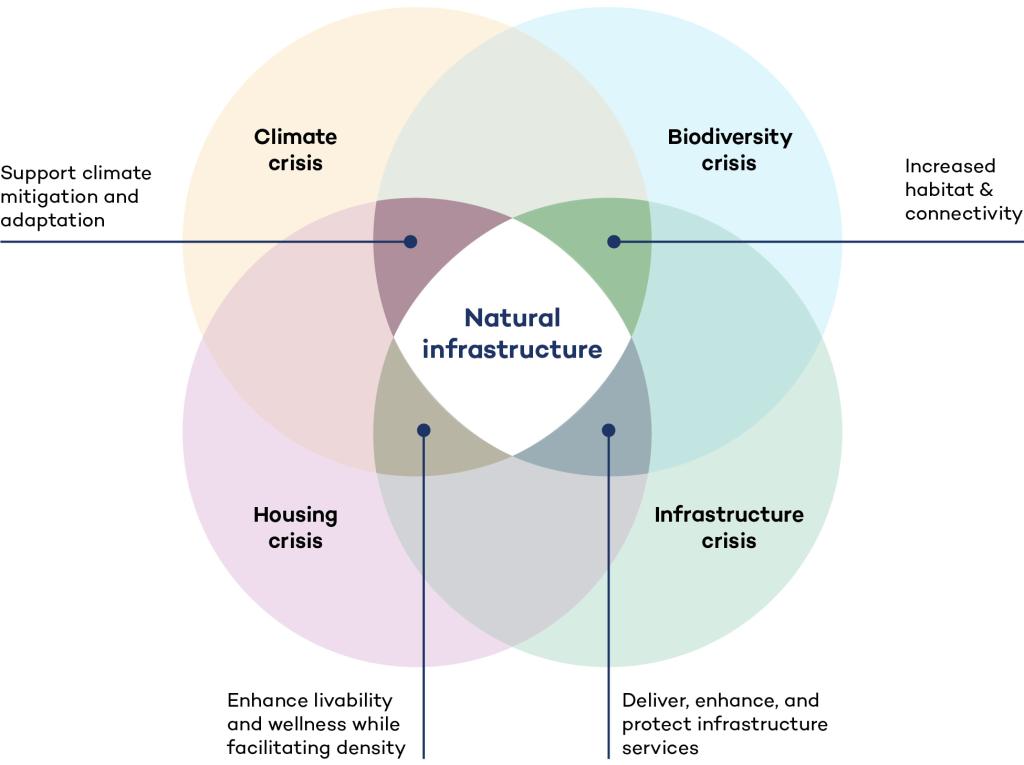
Finally, greater emphasis in policy design and communication should be placed on multi-solving—reflecting the potential for many actions taken to increase resilience to climate change to simultaneously address other social, ecological, and economic crises facing Canada. 

“Multi-solving” overlapping crises - climate, housing, biodiversity, and infrastructure - with natural infrastructure
“Multi-solving” overlapping crises - climate, housing, biodiversity, and infrastructure - with natural infrastructure. Source: Mettler, 2025

The climate, biodiversity, infrastructure, and housing crises are deeply interlinked, and the solutions to them must be equally interconnected. In communities, this can include planting trees within soil cells along streets and boulevards. When connected to the stormwater system, this solution can improve stormwater management, enhance air quality, boost biodiversity, and create more livable spaces, while simultaneously reducing climate risks, such as heavy rainfall and extreme heat events. 

In rural regions, converting flood-prone annual cropland to flood-tolerant perennial grasses demonstrates multi-solving in action. Reconnecting rivers to their floodplains provides natural flood storage, reducing downstream flood risk to communities and infrastructure. At the same time, deep-rooted perennials enhance biodiversity, ease pressure on costly grey infrastructure, and reduce financial and operational stress for producers—advancing climate resilience, ecological health, and agricultural viability in a single intervention. 

Prioritizing the multi-solving benefits of adaptation action not only increases the co-benefits for communities but also strengthens arguments for the greater value of adaptation action and its return on investment.

Policy Analysis

Old Rules, New Realities: How industrial policy is shaking up global trade

As countries rethink industrial policy to meet today’s climate goals, secure supply chains, and foster economic development, tensions are arising with the World Trade Organization’s (WTO’s) decades-old trade rules. Satish Triplicane and Ieva Baršauskaitė examine ongoing informal WTO dialogues and structured discussions, including the Trade and Environmental Sustainability Structured Discussions, highlighting how MC14 offers a forum to share experiences, address emerging industrial policy challenges, and consider potential reforms to align global trade rules with contemporary economic and sustainability priorities.

February 25, 2026

A number of countries have recently been rethinking industrial policy. Once seen as protectionist, these government efforts to shape or support specific sectors are increasingly viewed as essential for achieving climate action, securing supply chains and meeting energy needs, and developing new industries and creating jobs. 

Each economy chooses tools that work best for it, yet, as these policies take hold globally, key questions are emerging: Are the new industrial policy instruments compatible with the existing multilateral trade rules? If not, what changes are needed? Do countries need more or less space in those rules? How do these discussions fit into the broader context of World Trade Organization (WTO) reform? And what role should international cooperation play in shaping the next generation of industrial policies? 

The WTO: An old system meets new realities 

The trading system of the 1990s was shaped by the optimism of a liberalizing global order and reflected a strong belief in the Washington Consensus. It assumed that markets, not governments, would drive efficiency and growth—treating subsidies, local content requirements, and state intervention as distortions rather than instruments for structural transformation. The focus was on tariff reduction and comparative advantage rather than on climate, sustainability, and resilience. 

In 2026, climate ambition is no longer a peripheral topic in trade discussions. Geopolitics is again fractured. Priorities have shifted toward areas such as supply chain and national security, strategic autonomy, and industrial resilience—often at the expense of comparative advantage. Much like the United States and the European Union, China is an established industrial powerhouse, followed by several other emerging economies of the Global South. 

These evolving realities are driving debates about the suitability of the existing multilateral rulebook to the needs of industrial policy instruments used by countries, such as subsidies, local content requirements, export restrictions, tariffs, and technology transfer. Each of these policy measures raises difficult policy questions. 

Subsidies: Subsidies are important instruments for industrial development and green transformation, yet they remain constrained by WTO rules that prohibit export-contingent and local-content-based subsidies and allow measures proven to have adverse effects on other members to be challenged. In the fast-developing 21st-century global economy, some countries face a difficult balancing act; they want to expand support to green or digital transformation, while avoiding the risks of overcapacity and trade distortions in international markets. Countries with limited fiscal space face a different challenge: they are looking for ways to support strategically important domestic industries without certainty on how to do that within the existing WTO disciplines. The absence, after the expiry of Article 8 of the WTO subsidies agreement, of provisions reflecting the positive externalities of some subsidies (such as climate mitigation and carbon footprint reduction), has led some to question whether the current WTO framework shouldn’t do more to accommodate modern industrial and climate priorities, for example, by allowing more policy space for certain green subsidies. 

Local content requirements: These oblige entities to source a certain share of inputs (goods, services, or both) from within the implementing country. While the objective is usually to boost domestic manufacturing, build capabilities in strategic sectors, and create jobs, such measures sit uneasily within the existing WTO framework on national treatment, investment, and subsidies, which restricts preferences for local inputs over imported ones. This tension has sparked debates over the effectiveness of existing rules in accommodating such policies, particularly amid efforts to safeguard local industries in the wake of rising geopolitical and supply chain risks. Export restrictions: Countries use export restrictions to limit exports of resources like agricultural produce or critical minerals to secure their domestic supplies, prevent shortages, or manage price fluctuations. WTO rules discourage such restrictions as they distort trade and unduly limit other countries’ access to goods, unless they are temporary and justified. As more resource-dominant countries rely on export restrictions to manage supply chain risks, geopolitical pressures, and the green technology race, the question is whether and how the WTO rules should be updated to respond to modern concerns over resilience, strategic autonomy, and fair access to essential inputs. 

Import tariffs: Tariffs have historically been used by WTO members for a range of reasons, from increasing fiscal revenues to cushioning domestic industries from foreign competition. They are permitted under the WTO rules, provided they remain within each member’s commitments. But there have recently been questions over the growing use of tariffs in response to global competition and geopolitical tensions. Some countries feel the tariff limits negotiated three decades ago don’t allow them to respond to today’s economic realities. Many more, however, value the predictability that bound tariff rates provide for the multilateral trading system. 

Technology transfer: Technology transfer is critical for developing countries and least developed countries to spur domestic innovation, encourage long-term foreign investment partnerships, and build local capabilities, rather than remain import dependent. The debate on the most efficient ways to transfer technology is almost as old as the concept itself: potential options range from simple import of necessary goods or services to mandates for foreign firms to share their knowledge, skills, and/or intellectual property with domestic partners. Some countries see mandates as creating unfair pressure on foreign firms to share knowledge or intellectual property, which may not only conflict with WTO rules on intellectual property and investment, but also create disincentives for innovation. On the other hand, simply purchasing technology can be prohibitively expensive for many developing countries. With rapidly evolving green technologies, digital infrastructure, and critical innovations, the question of how trade policy could both support and protect innovation while ensuring equitable access to critical technologies is at the heart of the conversation about the industrial policies in many developing economies. 

Next Steps for a Multilateral Conversation 

Governments are wrestling with a range of systemic questions about the suitability of rules designed in a different economic era for the new age of industrial policies aimed at stimulating green transition, digital transformation, and supply chain resilience. An important additional dimension to this conversation is the undeniable fact that countries do not start from the same point: in many developing countries, governments do not have access to fiscal largesse or plentiful natural resources to push their economies forward. It is against this backdrop that the multilateral conversation on industrial policy has gained renewed attention. 

The WTO provides a structured forum for members to administer and discuss existing trade rules. These include standing committees, whose functions are limited to transparency, notification, and discussions on the implementation of the provisions of relevant agreement(s), and the dispute settlement body, which helps clarify how existing rules apply. Formal rulemaking or amendment to existing rules requires an explicit negotiating mandate from members, and no such mandate currently exists for negotiating new rules to address the pressures of modern industrial policy. Thus far, WTO members’ discussion of industrial policy and its intersection with trade rules takes place through structured but informal dialogues and discussions of smaller groups, in which interested members exchange information and explore emerging policy issues. 

These informal WTO dialogues have focused on various industrial policy themes, including the role of state banks and investment funds in financing industrial policies, the relationship between industrial policy and supply chain resilience, the role of WTO rules, transparency challenges, and the WTO’s subsidy disciplines. 

Another initiative, the Trade and Environmental Sustainability Structured Discussions (TESSD), while primarily focused on environment- and climate-related topics, also includes an informal working group on subsidies. This group, which is open to stakeholder participation, has, in recent years, looked into potential positive and negative environmental effects of subsidies, as well as their trade impacts. Discussions have covered various themes and sectors like green industrial subsidies, subsidies related to critical minerals, energy-intensive industries, green hydrogen and renewable energy, and low-carbon transition. The structured discussions have been a place for members to share their experiences and practices, including key design elements of members’ programs and the challenges faced by developing countries. At the WTO's 14th Ministerial Conference MC14, a TESSD package, including a Co-Convenors' Ministerial Communiqué, an Overarching Document for MC14, and outcome documents from the four TESSD Working Groups, is expected to be put forward. 

Lastly, the overall process of WTO reform includes a workstream focused on discussion of the suitability of the WTO rules in light of the pressures governments face. While the discussions in the above forums do not substitute the formal reform process, they are becoming an important channel through which members can test ideas, share technical information, build a shared understanding of issues, and, over time, feed into more formal outcomes. 

Looking to the Future 

The resurgence of industrial policy has exposed the growing tensions between the decades-old rules-based trading system and challenges of today’s polycrisis era—where climate, security, and development challenges intersect. 

Both trade negotiators and civil society organizations are actively engaged in the debate on the need for the WTO framework to change to adapt and reflect positive externalities, address regulatory asymmetries, and fix capacity constraints faced by many developing countries. An intense discussion about the compatibility of many contemporary instruments with multilateral trade rules might not have reached a conclusion, but many feel that their objectives, design, and scale might struggle to fit the existing framework. 

These unresolved debates and discussions illustrate how contemporary industrial policy objectives are increasingly testing the boundaries of the existing WTO framework. Taken together, the discussions outlined above point to persistent uncertainty about the extent to which existing disciplines can accommodate and balance contemporary policy priorities, particularly in areas such as climate action and economic development. As a result, questions about the adequacy of the multilateral trading system in addressing modern industrial policy challenges remain open within the broader debate on the future of the WTO. 

MC14 offers a critical opportunity for ministers to enable their WTO delegates, likely in the context of the WTO reform rubric, to continue this important work that matters to the whole membership. Next steps in the work could focus on identifying common interests and priorities for deeper exploration and analysis before debate turns, eventually, to important questions about the need to adjust the legal framework. Importantly, this conversation must reflect the realities and priorities of developing and least developed members as much as it does the priorities of larger and middle powers.

Policy Analysis details

Topic
Trade
Policy Analysis

International Conversations on Trade and Climate: From the World Trade Organization to the United Nations Framework Convention on Climate Change

Trade-related climate measures are increasingly affecting global commerce, raising questions about transparency, interoperability, and support for developing countries. Ieva Baršauskaitė and Antoine Bonnet examine how trade and climate debates—covering carbon border adjustments, deforestation rules, and related World Trade Organization (WTO) and United Nations Framework Convention on Climate Change (UNFCCC) discussions—are shifting from abstract principles to practical implementation, while emphasizing that the 14th Ministerial Conference (MC14) is a key opportunity to consolidate approaches and foster cooperation across international frameworks.

February 24, 2026

As the 14th Ministerial Conference (MC14) approaches, debates over the trade impacts of climate measures are increasingly present in World Trade Organization (WTO) discussions. This makes MC14 a timely moment to take stock of how these debates have evolved, and of the issues that are now crystallizing across international forums. 

This article reviews recent policy developments and international discussions on trade and climate in the lead-up to MC14, focusing in particular on exchanges at the WTO and at the 30th United Nations Climate Change Conference (COP 30). It shows how the growing implementation of climate-related trade measures has shifted conversations from abstract principles to practical questions of transparency, interoperability, and development, and considers what this evolving landscape means for discussions at MC14 and beyond. 

Real-World Developments in 2025 and Early 2026

The years 2025 and early 2026 marked a turning point in the global trade–climate landscape, as climate-related trade measures increasingly moved from abstract policy debates to concrete implementation. 

Most notably, the European Union’s Carbon Border Adjustment Mechanism (CBAM) entered its definitive phase in January 2026, and further downstream scope expansion has been proposed by the Commission. If such an expansion were agreed, it would add another 180 steel- and aluminum-intensive products, including machinery and appliances, to the current CBAM coverage. 

The EU’s mechanism is not the only border carbon adjustment measure on the books. The United Kingdom published draft legislation for its CBAM, which will enter into force on January 1, 2027. In Australia, Canada, and Chinese Taipei, similar instruments are being actively explored. Brazil and Türkiye, while working on establishing their emissions trading systems, explicitly reference carbon leakage risks and potential policies to address them in their respective legislations. This reflects an early recognition that carbon pricing design cannot be decoupled from trade exposure and leakage risk, even in jurisdictions that are not currently considering the adoption of border carbon adjustments (BCAs). 

The trade and climate debate, though, also addresses the role of forests as carbon sinks. In December 2025, the European Council formally adopted the targeted revision of the EU Deforestation Regulation. Large and medium operators will now be required to comply by December 30, 2026, while small and medium enterprises will have until June 30, 2027. 

International Discussions on Trade and Climate at the WTO and COP 30 in 2025 

These real-world policy developments have been closely reflected in international discussions on trade and climate, notably within the WTO and at COP 30. The main issues driving these discussions were concerns about the consistency of such measures with both the WTO rules and the Paris Agreement, the question of interoperability across different regimes, the cumulative administrative burden faced by exporters, and the capacity of developing countries to comply with them. 

Progress at the WTO 

At the WTO, the topic of climate-related trade measures and BCAs has been the subject of considerable debate, with a total of 251 oral interventions and written communications across different committees and other WTO bodies and processes by 67 WTO members (EU members are counted separately) and eight groups (e.g., Least Developed Country Group, African Group) throughout 2025. The tone of official statements largely reflects the state of the trade and climate debate: calls for better international cooperation gained ground. However, they are met with a steady stream of concerns about the impact of climate-related trade measures on trading partners. 

Important contributions from the WTO members over the last few years reveal three recurring themes: 

First, equity and development concerns, raised most explicitly by the African Group in 2023 and the LDC Group in 2025, focus on potential risks caused by Trade-related Climate Measures (TrCMs) to market access, development prospects, and the Common But Differentiated Responsibilities and Respective Capabilities, unless they are accompanied by support measures. accompanied by support measures. 

Second, fragmentation and compliance costs emerge as a shared concern across the proposals by China and Japan in 2024. China focuses on reducing trade frictions and improving interoperability across TrCMs, while Japan zeros in specifically on the fragmentation of methodologies for measuring embedded emissions as the key technical problem the WTO should address. 

Third, there is a convergence around the WTO’s potential role as a technical and transparency forum, particularly within the Committee on Trade and Environment. The group proposal by Australia, Chile, Costa Rica, Israel, Japan, the Republic of Korea, New Zealand, and the United Kingdom (hereinafter “Japan and Korea-led” group proposal) in 2025 explicitly supports non-binding guidance and technical cooperation, while developing country submissions implicitly condition acceptance of TrCMs on enhanced assistance, capacity building, and inclusive dialogue. 

Overall, the submissions point less toward consensus on the legitimacy of specific TrCMs and more toward shared recognition of the need for cooperation, proportionality, and development-sensitive implementation if such measures continue to expand. 

Within the WTO, 2025 has marked a meaningful shift of trade and climate conversations toward the multilateral format, in particular at the Committee on Trade and Environment (CTE), which seems to have focused on closer analysis of three particular aspects of TrCMs: transparency, interoperability, and the development dimension, which were identified by the current CTE Chair, Swiss Ambassador Erwin Bollinger, after consulting the WTO members. Members will continue discussions on those three pillars in 2026. 

In parallel, 79 WTO members participating in the Trade and Environmental Sustainability Structured Discussions (TESSD) continued their exchanges at the TrCMs Working Group. The main outcome of this process has been the development of a Compilation and Mapping of Trade-related Climate Policies, aimed at enhancing transparency and mutual understanding. While TESSD discussions also touched on practical design issues, including interoperability, these elements were not reflected in the outcome product. This product, along with other TESSD deliverables, is expected to be presented at MC14. 

Discussions at COP 30 

After two weeks of tension around trade-related issues at COP 30 in Belém, Brazil, a Mutirão (a Brazilian Portuguese term referring to a collective, collaborative effort or joint undertaking) decision has established three technical dialogues "to consider opportunities, challenges and barriers in relation to enhancing international cooperation related to the role of trade" that will take place at the 2026, 2027, and 2028 United Nations Framework Convention on Climate Change (UNFCCC) subsidiary bodies meetings. Those discussions will be summarized in a report to be presented at a high-level event in 2028. This is a first introduction of the trade topic into the multilateral UNFCCC conversations, and it is not yet clear what the focus or format of such exchanges will be. While it is the climate-related trade measures that were at the heart of the COP debates, the list of potential topics can be much broader, including trade’s role in support of green transition or of climate adaptation priorities. 

At COP 30, the Brazilian COP Presidency has also launched its own initiative: the Integrated Forum on Climate Change and Trade (IFCCT). The hosts of the initiative are currently consulting potential IFCCT participants on possible modalities and thematic focus; however, it was made clear that all proceedings of IFCCT will be non-binding, non-negotiated, and non-attributable. Just as the technical dialogues at the UNFCCC subsidiary bodies meetings, the IFCCT is also intended to run for an initial 3-year phase until the end of 2028. 

The Meaning of MC14 

In this evolving context, MC14 is best understood as a moment of taking stock and potentially consolidation of the key themes of debate in the trade and climate thematic, rather than a breakthrough. In 2025, the WTO members clearly changed gear after moving the discussion on trade and climate to a multilateral format and began defining the problems the organization will need to continue focusing on in 2026. Much of this momentum reflects the work of the current CTE Chair, Swiss Ambassador Erwin Bollinger, who introduced interactive sessions alongside standard thematic meetings and helped shift engagement from the plurilateral format to the multilateral CTE exchange. The next steps on transparency, such as the template presented in the Japan and Korea-led proposal and the willingness from members to conduct a pilot exercise in June 2026, are expected to be discussed at the last CTE meeting before MC14. 

It is an important step forward—but the conversations on interoperability and development dimension will demand much more engagement, both from diplomats and from stakeholders, in the coming months. They remain fundamentally important discussions to have, and hopefully, the transparency exchange will strengthen WTO members’ trust in the organization’s ability to tackle them. It is significant that the work on trade and climate will also be picked up at the UNFCCC meetings this year. This will be an interesting space to watch. Conversations on trade and climate bring both political tension and practical challenges, as policy moves at different speeds and risks fragmenting markets. Well managed, though, these new forums for debate could prepare the ground for greater understanding and opportunities for practical cooperation that are urgently needed.

Policy Analysis details

Topic
Trade
Policy Analysis

“World Trade Organization Reform” is the headline issue at the 14th Ministerial Conference, but what does it mean, and what are we likely to see?

Institutional reform is a headline issue at the World Trade Organization’s (WTO) 14th Ministerial Conference (MC14), and it is crucial to unpack debates on how the organization makes decisions, the impact of rules on global competition, and how well they support development priorities. Alice Tipping explores these three dimensions of the WTO reform agenda, highlighting the trade-offs, opportunities, and pathways ahead, as well as demonstrating how MC14 can establish a work program to guide future reforms and rebuild trust among members.

February 20, 2026

Behind the slogan of World Trade Organization (WTO) reform lies a complex set of debates about how the organization makes decisions, how its rules shape competition between economies, and how well it serves development priorities. As members prepare for the 14th Ministerial Conference (MC14), expectations are modest, but the choices made now could shape the WTO’s future for years to come. 

Debate about reform of the WTO usually means two things: reforming the WTO as an organization (i.e., its principles, procedures, and practices), and reforming the set of multilateral treaties administered by the WTO (e.g., related to agriculture, trade in services, trade-related intellectual property rights, etc.), that govern much of global trade, including the balance of obligations within those treaties between richer countries and poorer ones. 

Governments have long-standing gripes on all of these issues, and long-standing pressures, combined with the economic and political turmoil of the last year or so, have forced discussion into the open. Over the last few months, a discussion process led by an appointed facilitator, Ambassador of Norway to the WTO Petter Ølberg, has managed to group the wide range of concerns and complaints into three buckets: 

  • decision making
  • how the rules should set a level playing field between economies
  • how the rules should protect, and advance, development priorities 

These buckets reflect the topics on which there is the most convergence, but some members remain uncomfortable with elements of each bucket, and others would like additional topics discussed. 

Decision Making (or the Lack Thereof) and Consensus at the WTO 

Decisions at the WTO are, by practice, taken by consensus, which at the WTO means the lack of objection to a decision, not unanimity in its favour. But over the last few years, objections have become more and more common, stymying both procedural and substantive progress. For instance, members who have wanted to negotiate rules on new topics (e.g., e-commerce and investment facilitation) have gone ahead and done so, and have now agreed “plurilateral” texts of treaties on both topics, with the obligations in each treaty applying only to those participating. They have asked for agreement from all other members to have the treaties incorporated into the WTO’s legal framework, which has not been possible due to the opposition by several members (i.e., a lack of consensus). 

Within the “decision-making” bucket, then, exist two related challenges: the concern that the practice of consensus is being used to prevent some members from moving ahead on issues that are priorities for them, and the risk that allowing sub-sets of members to move forward could sideline issues that matter to others, while also leading to a more fragmented set of global rules. There are also worries that members block even procedural decisions for tactical reasons. Creative options that have been raised as possible ways forward include giving members the ability to “opt in” or “opt out” of certain decisions, or developing different procedural rules for different kinds of decisions. 

How should WTO rules change to “level the playing field” between economies? 

Within the “level-playing-field” bucket are concerns about what rules governments should be subject to, rather than how they are agreed. 

The current system of rules curtails government interventions that distort the global market for goods and services. But pressures on those rules have been rising. Some have been sudden. In 2020, the COVID-19 pandemic made it clear that, overnight, large parts of the global market could simply grind to a halt, and governments intervened heavily—sometimes in ways not aligned with the WTO rules—to keep economies and livelihoods afloat. However, the system seems to have passed that stress test as members recognized the unprecedented and one-off nature of the crisis. A much greater challenge has arisen in the last year, which has seen the United States’ imposition of tariffs against other WTO members that run counter to the key WTO principle of non-discrimination among members, as well as the U.S. commitments to agreed tariff levels. This has left other governments feeling they are fighting a trade war with one hand tied behind their backs; to retaliate effectively, they feel they need to raise tariff levels beyond the limits they agreed back in 1994. 

Other pressures have been building for decades. The scale of the Chinese government’s investments in education and infrastructure, and its direct involvement in the private sector, has led to many developed and developing country governments protecting their own businesses to avoid complete dependence on a manufacturing giant they do not entirely trust. Those with the money compete with subsidies. Those without the money compete with local content requirements and import or export restrictions in an effort to build local capacity. 

The other key long-term pressures are technology and climate change. Adapting to and mitigating climate change requires changes to economies that governments need to lead. In doing so, governments also want their own businesses to benefit from the growth of the new low-carbon economy. Simultaneously, data is becoming a key resource endowment, with processing capacity shaping a country’s ability to add value, both to services and to physical goods. Where data describes the behaviour of individuals or critical national systems, governments can and should shape how that information can be used. 

Finally, an internal source of pressure since the very beginning of the WTO, has come from many developing and least developed countries, who point to imbalances that favour developed countries in several agreements (for example, the agreement on agriculture, the agreement on trade-related aspects of intellectual property rights, etc.) negotiated during the Uruguay Round. These countries have been demanding that these imbalances be fixed so that the rules support truly mutually beneficial trading relationships among all WTO members, developed, developing, and least developed. 

Many governments feel the WTO rules governing how they respond to these pressures are too constraining, or simply out-of-date and unclear. Some feel they are too lenient. Almost all of them want them to be updated and “fairer.” The challenge is that fairness is in the eye of the beholder. One country’s intervention to support a struggling firm and secure a domestic supply of important machinery is, to another country, a trade distortion that costs its businesses market share and its local economies jobs. The WTO rules were set, back in 1994, to balance similar considerations. The question is how governments re-balance the rules to respond to new policy pressures. Ideas for the way forward here include changes to rules on state subsidies and investment, for example, and or to the remedies governments can use when they feel others’ policies are damaging their interests. 

Where does development sit in the reform of the WTO? 

That rebalancing cannot pretend that all economies are starting from the same point. Here is where the third “bucket” of reform discussion becomes crucially important: how should the current work of the WTO—and any new rules—be shaped to protect and advance the interests of developing countries? 

Debate has focused on the concept of “special and differential treatment,” (S&DT) that is, the different treatment that developing country members of the WTO enjoy under WTO treaties. This treatment includes longer timelines for the implementation of new commitments, technical assistance to help with reform work, and sometimes a different level of commitment altogether compared to developed country members. 

The concerns in this bucket are both about how well existing S&DT works and how differential treatment in future rules should look. Some governments argue that S&DT is too wide, covering some very large and competitive developing countries and should be based on the specific needs of a narrower group of members. Others argue that special treatment is an inherent right linked to a member’s (self-determined) status as a developing country and see the solidarity that comes from large developing countries enjoying S&DT as crucial to its continuance for smaller members. Creative options for ways forward include the idea of more targeted differential treatment, with targeting being based on specific policy challenges or specific members: China has already signalled it will opt out of using S&DT in future agreements, for example. 

There are also many links between the development debate and the level playing field: some developing governments see the current rules as too constraining and want more space to support industrialization as part of development plans, for instance. Others see the rules as too narrow and unable to discipline the many sophisticated ways governments distort markets to support their own businesses. Underlying all of these issues is the question of trust: many members feel that the current system of rules is tilted in favour of more powerful countries. As trade policy is increasingly used by those same powerful countries to achieve both economic and political ends, the playing field seems to be tilting even further against smaller players. 

In the lead-up to MC14, WTO delegations will be meeting continuously to develop a 2-year work program on these issues that ministers can endorse. These weeks are important. If members remain trapped in the effort to dominate the work program and exclude others’ priorities, the opportunity to build some fragile trust to begin this conversation will be lost. On the other hand, if they can develop a balanced work program in which all members can see their priority issues reflected and which their ministers can endorse, that will be a success. 

MC14 should not be expected to provide solutions to the complex challenges to the WTO’s current functioning and agreements. But it can and should agree on a balanced work program to address these challenges to lay the foundations of an honest and constructive conversation among WTO members about a new set of rules to play by. 


This article draws from a longer piece the author published in October 2025: What You Need to Know About WTO Reform.

Policy Analysis details

Topic
Trade
Policy Analysis

The World Trade Organization Investment Facilitation Agreement in the Run-Up to the 14th Ministerial Conference

The potential incorporation of the Investment Facilitation for Development Agreement into the World Trade Organization (WTO) framework is a key issue ahead of the 14th Ministerial Conference (MC14). The agreement aims to improve the investment climate by streamlining procedures, enhancing transparency, and providing capacity building and special treatment for developing countries and least developed countries (LDCs). Rashmi Jose examines the development rationale, the debates over its legal basis and plurilateral approach, and the prospects for a ministerial-level decision at MC14, highlighting both the opportunities and the limitations of investment facilitation’s ability to support inclusive development.

February 18, 2026

At the upcoming World Trade Organization (WTO) 14th Ministerial Conference (MC14), members will revisit the question of whether the Investment Facilitation for Development (IFD) agreement should be incorporated into the WTO’s treaty framework as a new plurilateral agreement. This article provides an overview of what the IFD Agreement is about, examines the main debates surrounding its development rationale and proposed legal incorporation into the WTO framework, and outlines what can be expected at the MC14. 

What the IFD Agreement Is About 

The central objective of the IFD Agreement is to improve the investment climate in participating countries by enhancing the predictability and efficiency of government measures related to foreign direct investment (FDI). To achieve this, the agreement establishes a set of investment facilitation disciplines that participating WTO members would commit to implementing. 

Key commitments include improving the transparency of FDI-related measures—such as laws, regulations, and authorization requirements—by ensuring that they are made publicly available in a timely and accessible manner. The agreement also aims to reduce administrative burdens through the streamlining and clarification of procedures for investment applications and authorizations. In addition, it promotes enhanced cooperation on investment facilitation matters, both among governments and between governments and investors. 

Importantly, the IFD Agreement does not address market access commitments, investment protection, or investor–state dispute settlement. Supporters therefore emphasize that the agreement is not intended to expand investor rights, but rather has a practical objective of reducing administrative bottlenecks that can deter FDI—an area of particular value for developing economies, which often face larger governance gaps than developed economies. 

Development Rationale and Expected Benefits—and Their Limits 

The development rationale of the IFD Agreement has been central to its political appeal, particularly among participating developing countries. One frequently emphasized advantage is the agreement’s signalling effect. By committing to a binding and internationally recognized set of facilitation reforms, governments can signal their seriousness about improving and sustaining FDI-related governance reforms. 

Such reforms are expected to reduce information-gathering costs, administrative delays, and perceptions of risk. These factors may, in turn, influence foreign investors’ willingness to undertake longer-term FDI projects. Supporters also note that these types of reform efforts have become increasingly important in a context of diminishing official development assistance, reduced global risk appetite, rising geopolitical tensions, and evolving patterns of globalization. 

At the same time, caution has been expressed about overestimating the agreement’s direct impact on FDI flows, especially for smaller and more vulnerable developing countries, including least developed countries (LDCs). Investment decisions are shaped by a complex mix of factors, notably market-seeking determinants (such as market size and access to regional markets) and asset-seeking determinants (such as natural resources, human capital, and, increasingly, technology-related assets). Investment facilitation reforms can play a supportive role, but they are rarely decisive on their own and should be viewed as one element within a broader investment and development strategy. 

Special and Differential Treatment and Capacity Building

For many developing countries and LDCs, access to special and differential treatment (S&DT) has been a key motivation for their willingness to sign on to the potential IFD Agreement. The agreement includes a robust S&DT framework, modelled on the WTO Trade Facilitation Agreement, allowing developing countries and LDCs to link the implementation of specific obligations to the receipt of technical assistance and capacity-building support. This approach is intended to enable gradual and sequenced implementation aligned with domestic capacities and reform priorities. 

Nevertheless, concerns remain about the scale of resources required to implement and sustain investment facilitation reforms. Compliance with the agreement may require reforms across multiple ministries, agencies, and levels of government. For developing countries and LDCs, which often face significant institutional and administrative capacity constraints, implementing and maintaining such reforms over time may prove particularly challenging. 

In this context, the importance of conducting thorough needs assessment studies has come to the fore. Such studies can help developing countries and LDCs identify implementation gaps, capacity challenges, and the level of capacity-building support required to successfully implement the agreement’s obligations. Related to this are debates about a proposed Investment Facilitation Facility. Should the agreement be incorporated into the WTO framework, the parties will need to decide whether to establish a dedicated funding facility to support its implementation. Greater clarity on whether such a mechanism will be created, and on the timing of its establishment, will therefore be important—particularly given the significant implementation and capacity constraints faced by developing economies. 

A Look Back at the Negotiating History 

Efforts to develop investment facilitation rules at the WTO were initiated in December 2017 by a subgroup of WTO members, initially comprising 70 members, through a Joint Statement Initiative (JSI). Following years of structured discussions and technical negotiations, the process culminated in a finalized legal text in November 2023. 

Over time, participation in the JSI expanded, reaching 128 WTO members as of February 2026. This group includes a substantial number of developing countries and LDCs, alongside high participation by developed countries. 

After the conclusion of the legal text, participants shifted their efforts to having the agreement incorporated into the WTO treaty framework as a plurilateral trade agreement under Annex 4 of the Marrakesh Agreement establishing the WTO. Such a proposal requires the consensus of the entire WTO membership, meaning no WTO member (regardless of whether or not they are participants or non-participants of the JSI process) formally objects to the decision to incorporate. 

To date, consensus has not been achieved. Over the past 2 years, the JSI participants (i.e., the co-sponsors) have made a dozen formal requests for legal incorporation, primarily at the WTO General Council. Until recently, India, Turkey, and South Africa consistently blocked consensus. In December 2025, South Africa announced that it would no longer do so. India and Turkey continue to object, with India in particular articulating detailed reasons for its opposition

A Closer Look at the Legal Incorporation Debate 

Two main debates underpin opposition to the agreement’s incorporation. The first concerns whether there is a legal mandate to negotiate investment facilitation rules at the WTO. India argues that JSI-based plurilateral negotiations, including the IFD initiative and the e-commerce negotiations, should not have been launched without a multilateral mandate. It further contends that the IFD Agreement suffers from a “negative mandate,” given previous multilateral decisions not to pursue negotiations on investment following the dropping of most of the Singapore issues. It has also been argued that investment facilitation falls outside the WTO’s core trade-focused mandate. 

Proponents of the agreement reject these arguments, citing past practice to demonstrate that plurilateral deals have been negotiated and concluded without explicit multilateral mandates, and they further emphasize that the WTO has competencies to cover issues extending beyond narrowly defined trade in goods and services

The second debate focuses on the systemic implications for the WTO of an increased reliance on plurilateral negotiations. Those opposed argue that plurilateral negotiations could further legitimize a shift away from the multilateral agenda, diverting attention and resources from unresolved issues such as agriculture and development. There are also concerns that a more fragmented WTO negotiating agenda may disadvantage developing countries and LDCs, which often lack the capacity to engage effectively across multiple negotiating tracks. 

Supporters of greater variable geometry counter that plurilateral approaches are essential to maintaining the WTO’s relevance, given the long-standing deadlock in the multilateral agenda. They argue that such approaches need not undermine developing country interests, citing the IFD agreement’s high level of developing country participation and its S&DT provisions as evidence of its value to such countries. Additionally, supporters argue that all WTO members, including non-signatories, stand to benefit from the agreement, as the benefits of reforms will be extended to all other WTO members on a most-favoured-nation basis. 

What Is Expected for MC14 

At MC14, IFD co-sponsors are expected to seek a ministerial-level decision to incorporate the agreement into the WTO framework. Whether this succeeds will depend on whether India and Türkiye maintain their opposition or whether consensus can be reached. 

If incorporation is agreed, the IFD Agreement would become a new plurilateral agreement within the WTO framework. If deadlock persists, however, the question will increasingly turn to whether, after more than 2 years of unsuccessful attempts at incorporation, co-sponsors will more actively explore alternative options for finalizing and administering the agreement outside the WTO treaty framework. These alternative options bring their own set of challenges. 

Whichever path emerges, MC14 is likely to serve as an important signal not only for the future of the IFD Agreement, but also for the broader role of plurilateral approaches within the WTO system in the context of the WTO reform.

Policy Analysis details

Topic
Trade
Policy Analysis

Fisheries Subsidies at a Crossroads

Why MC14 could determine the future of ocean sustainability

The World Trade Organization’s (WTO’s) 2022 Agreement on Fisheries Subsidies marked a historic first step in addressing harmful subsidies, but key negotiations on additional disciplines targeting overcapacity and overfishing remain unfinished. As the 14th Ministerial Conference (MC14) approaches, members face a critical moment to build on this progress and provide a clear pathway toward comprehensive rules. Florencia Sarmiento examines the stakes for ocean sustainability, implications for coastal and island developing countries, and opportunities and challenges at MC14 to safeguard fish stocks, livelihoods, and global environmental commitments.

February 18, 2026

As World Trade Organization (WTO) members prepare for the 14th Ministerial Conference (MC14) in Yaoundé, Cameroon, they face a pivotal choice: build on the historic 2022 Fisheries Subsidies Agreement by committing to complete the additional disciplines on overcapacity and overfishing—or risk stalling momentum and undermining a landmark environmental deal. With a sunset clause now in effect, the clock is ticking. 

Around the world, fish stocks are under growing pressure. According to the Food and Agriculture Organization of the United Nations (FAO), 38% of assessed marine fish stocks are overfished. Moreover, this is not only an environmental problem. Hundreds of millions of people depend directly or indirectly on fisheries for food security, jobs, and income, particularly in coastal and island developing countries. 

One driver of overfishing is government subsidies. Certain types of fisheries subsidies lower the cost of fishing or increase revenues, encouraging fleets to fish more, travel farther, and stay at sea longer than would otherwise be economically viable. Global estimates suggest that fisheries subsidies amounted to more than USD 35 billion in 2018, with a large share directed toward activities that increase fishing capacity. In simple terms, public money often enables fishing beyond the sustainable limits of the ocean. 

This is why fisheries subsidies have been on the agenda of the WTO for more than two decades, and why the organization now finds itself at a critical moment ahead of MC14 in Yaoundé, Cameroon. 

What Has Already Been Achieved: A historic first step 

After more than 20 years of negotiations, WTO members reached a landmark agreement in 2022. The Agreement on Fisheries Subsidies, adopted at MC12 in Geneva, was the first WTO agreement explicitly aimed at an environmental sustainability objective. It also responded directly to Target 14.6 of the UN Sustainable Development Goals, which calls for the prohibition of harmful fisheries subsidies. 

Crucially, this agreement entered into force in September 2025, following the deposit of instruments of acceptance by two thirds of WTO members. This marked a major milestone for the multilateral trading system. For the first time, binding global trade rules now place clear limits on government support that contribute directly to the depletion of marine resources. 

The 2022 Agreement, often referred to as Fish 1, prohibits subsidies in the most clearly harmful situations. These include subsidies to illegal, unreported, and unregulated fishing, subsidies for fishing overfished stocks when no rebuilding measures are in place, and subsidies for unregulated fishing on the high seas. These rules matter because they target the subsidies where environmental harm is most evident and hardest to justify. 

Importantly, however, the 2022 Agreement did not cover all of the rules members sought. While its entry into force is a major achievement, it was always intended as a first step rather than a comprehensive solution to the problem of overfishing. 

Why Additional Disciplines Are Needed 

Fish 1 addresses the most alarming situations of subsidized fishing, but it does not tackle the broader problem. Subsidies can still cause harm even when fishing is legal, or when stocks are not yet formally assessed as overfished. Most subsidies go to large vessels, giving them an additional advantage over smaller players, many of whom may also be more vulnerable to the effects of overfishing. Estimates indicate that of the USD 35.4 billion in global fisheries subsidies provided in 2018, only 19% went to small-scale fisheries, while more than 80% went to large-scale industrial fleets. 

This is where the idea of additional disciplines, often referred to as Fish 2, comes in. These negotiations aim to discipline subsidies that contribute more generally to overcapacity in fishing fleets and overfishing, not just in specific and alarming situations. The goal is preventive, to stop subsidies from driving fleets beyond sustainable limits in the first place. 

Without these broader rules, the WTO framework risks addressing the symptoms of overfishing rather than its underlying and structural causes. 

How We Got Here: Progress and near misses 

WTO members committed in 2022 to continue negotiations toward a more comprehensive agreement. Talks resumed in 2023 and gradually gained momentum. Over the course of the year, members narrowed differences on many core issues, leading to a consolidated draft text by the end of 2023. 

In the weeks leading up to MC13 in Abu Dhabi in early 2024, compromises emerged on several sensitive points. During the ministerial itself, ministers and facilitators worked intensively, and a diverse group of members attempted last-minute compromises. The result was striking. Members came extremely close to consensus, closer than at any point in the history of these negotiations, yet agreement ultimately proved elusive. 

Since then, the Chair of the negotiations has repeatedly attempted to build on the progress achieved. Revised texts circulated in mid and late 2024 reflected the so-called “landing zone” identified at MC13. Most members signalled readiness to conclude on this basis. However, the absence of consensus among a small number of large players prevented adoption. 

By mid-2025, convergence remained high, but political shifts meant it had become more fragile. Three major members, one developed and two developing, are now calling for more significant changes to the draft text, although for different reasons. 

What to Expect at MC14 

Political shifts and delays in selecting the new Chair mean expectations for MC14 need to be realistic. Toward the end of 2025, members appointed a new Chair of the negotiations, Ambassador Leslie Ramsammy of Guyana, who has begun consulting delegations on possible paths forward. 

It is unlikely that ministers will arrive in Yaoundé with a fully finalized Fish 2 agreement ready for immediate adoption. At the same time, the clock is now running. 

The so-called “sunset clause” contained in the 2022 Agreement on Fisheries Subsidies provides that, if comprehensive additional disciplines on fisheries subsidies are not adopted within 4 years of the agreement’s entry into force, the agreement will automatically terminate, unless WTO members decide otherwise. Since the agreement entered into force in September 2025, this means that members have until September 2029 to conclude the additional disciplines or risk losing the entire fisheries subsidies agreement. 

MC14 in 2026 and MC15 in 2028 will be decisive milestones in this process, with MC15 being the last scheduled ministerial conference before the end of this 4-year period. MC14 is a critical opportunity to restore momentum and demonstrate collective determination to finalize the additional disciplines. 

A good outcome at MC14 would involve a strong political signal that members are committed to finishing the job by MC15, grounded in the progress already made. 

Failure to provide a clear pathway forward would severely undermine the credibility of WTO members’ commitments to each other, as well as to a key issue for environmental, social, and economic sustainability. 

The WTO’s fisheries subsidies negotiations were never going to be easy. They sit at the intersection of trade, development, and environmental protection, and they touch on sensitive domestic policy choices. Yet the near-miss at MC13 showed that agreement is possible. 

MC14 offers a chance to demonstrate collective determination to conclude new rules. If members miss it, the window to secure meaningful global rules to curb harmful fisheries subsidies and protect the health of the oceans and the communities that depend on them will narrow further.

Policy Analysis details

Topic
Trade
Policy Analysis

Electronic Commerce at the World Trade Organization

Can members find common ground at the 14th Ministerial Conference?

E-commerce has become a central pillar of global trade, but World Trade Organization (WTO) members remain divided on how it should be governed. As the 14th Ministerial Conference (MC14) approaches, decisions on the multilateral Work Programme on Electronic Commerce (WPEC) and the plurilateral Joint Statement Initiative (JSI) on E-Commerce will shape digital trade rules for years to come, particularly for developing countries seeking to bridge the digital divide. Rashid S. Kaukab examines the current debates over the moratorium on customs duties, digital trade governance, and the potential incorporation of the JSI Agreement into the WTO framework, highlighting the opportunities and challenges these negotiations pose for inclusive and sustainable digital trade.

February 18, 2026

E-commerce has moved to the centre of global trade, but World Trade Organization (WTO) members remain divided on how to govern it. As the 14th Ministerial Conference (MC14) approaches, decisions on the multilateral Work Programme and the plurilateral Joint Statement Initiative on E-Commerce (JSI) will shape the rules, opportunities, and challenges of digital trade for years to come—particularly for developing countries seeking to bridge the digital divide.

What Is the Issue, and Why Does It Matter? 

Electronic commerce (e-commerce) is no longer just a niche sector—it has become a central pillar of the global economy. A growing share of the world’s GDP is linked to digital activities, and that share is only expected to rise. But as digital trade expands, so do questions about how it should be governed: who sets the rules, who benefits, and how can we ensure that the digital revolution doesn’t leave developing countries behind? 

For many businesses—including micro, small, and medium-sized enterprises—e-commerce lowers barriers to entry and enables participation in international markets that were previously out of reach. For consumers, it can expand choice and reduce costs. For governments, however, digital trade raises complex regulatory, fiscal, and development challenges. These include, among others, consumer protection, cybersecurity, data governance, taxation, and the widening digital divide between and within countries. 

The WTO is a key global forum for addressing these challenges. Yet WTO members are divided on how, and how fast, rules for e-commerce should evolve. As a result, two parallel tracks now define the WTO’s engagement on e-commerce: a multilateral track, centred on the Work Programme on Electronic Commerce (WPEC) and the moratorium on customs duties on electronic transmissions, and a plurilateral track, embodied in the Joint Statement Initiative (JSI) on E-Commerce. 

As WTO members prepare for MC14 to be held from March 26 to 29, 2026, in Yaoundé, Cameroon, e-commerce is at the top of their agenda. They are expected to make decisions on these two tracks that will have far-reaching implications for the future of e-commerce in the WTO and beyond. 

The Multilateral Work Programme and the Moratorium on Customs Duties 

The WTO first formally addressed e-commerce in 1998. At its Second Ministerial Conference (MC2) held that year in Geneva, Switzerland, WTO members adopted the Declaration on Global Electronic Commerce, committing themselves to exploring trade-related aspects of e-commerce and to continuing their practice of not imposing customs duties on electronic transmissions. 

To operationalize this commitment, the WTO General Council established the WPEC later that year. The WPEC provides a multilateral forum for examining how e-commerce interacts with trade and existing trade rules for trade in goods, trade in services, intellectual property, and development. It also serves as the institutional home for discussions on the moratorium on customs duties on electronic transmissions. 

Since 1998, the WPEC has been the main avenue for all WTO members to discuss wide-ranging issues related to e-commerce. Developing countries, in particular, have used the forum to raise development concerns and digital divide issues. At the 13th Ministerial Conference (MC13) in 2024, WTO members agreed to continue the WPEC under its existing mandates, with a specific focus on addressing the digital divide and improving developing countries' participation in the digital economy, until MC14 or March 31, 2026, whichever comes first. Pursuant to that decision, throughout 2025, discussions within the WPEC have been organized around thematic issues, with technical assistance and capacity building for developing and least developed countries consistently emphasized as a cross-cutting priority. 

These thematic discussions have centred on four main areas: 

  1. Bridging the digital divide through investment in information and communications technology infrastructure, digital skills, and regulatory frameworks.
  2. Sharing national legal frameworks for e-commerce, including cybersecurity and consumer protection laws, to compile best practices without creating new binding rules.
  3. Examining the trade implications of artificial intelligence and its policy impact.
  4. Debating the renewal of the moratorium on customs duties on electronic transmissions, with members divided over its economic and fiscal effects. 

Throughout these discussions, members have proposed several roles for the WTO. These suggestions include the WTO acting as a central hub for information sharing and dialogue, leveraging its convening power to coordinate with other international organizations, and significantly enhancing the delivery of targeted technical assistance and capacity building. Additionally, members see a role for the WTO in helping countries understand and utilize existing trade rules related to e-commerce and in promoting regulatory coherence to prevent global fragmentation in digital trade and emerging areas like artificial intelligence governance. 

Since 1998, the moratorium on customs duties on electronic transmissions, alongside the WPEC, has been renewed at every Ministerial Conference—but always on a temporary basis and often after difficult negotiations. As digital trade has expanded and the range of products delivered electronically has grown, concerns about the impact of the moratorium—particularly among several developing countries—have intensified. 

These developing-country members argue that the moratorium may result in significant foregone tariff revenue, especially as more products shift from physical to digital forms. They also highlight the absence of a clear multilateral definition of “electronic transmissions,” warning that this ambiguity could progressively erode their tariff base and constrain policy space for digital industrialization. These concerns are explored in analyses such as those by Kaukab (2024) and the South Centre (2023) study on Association of Southeast Asian Nation developing countries. 

Supporters of the moratorium counter that imposing tariffs on electronic transmissions would increase costs for consumers and businesses, fragment global digital markets, and be extremely difficult to administer in practice. They argue that governments can raise revenue through alternative instruments, such as value-added taxes, without disrupting cross-border digital flows (see Amon & Krummenacher, 2024). 

These tensions came to a head at MC13 in Abu Dhabi in 2024. After protracted negotiations, members agreed to extend the moratorium and the WPEC only until March 2026 or MC14, whichever comes earlier (MC13 Ministerial Decision). For the first time, the decision also explicitly stated that both the moratorium and the WPEC would expire on that date. 

The JSI on E-Commerce 

The JSI was launched at the WTO’s Eleventh Ministerial Conference (MC11) in Buenos Aires in 2017, when a group of 71 members announced their intention to pursue exploratory work toward future negotiations on e-commerce. Frustrated by the slow pace of multilateral discussions, participants sought to develop modern digital trade rules among willing members. 

Formal negotiations began in 2019, and participation eventually grew to 91 members. In July 2024, the co-conveners of the JSI (Australia, Japan, and Singapore) announced the conclusion of the technical phase of negotiations and released a stabilized legal text for a proposed Agreement on Electronic Commerce

The Agreement covers a wide range of issues, including electronic transactions, paperless trading, digital payments, online consumer protection, cybersecurity, personal data protection, telecommunications regulation, and a permanent prohibition on customs duties on electronic transmissions among parties, which will be reviewed 5 years after the entry into force of the Agreement. 

The Agreement has its critics, too. Several developing countries argue that it entrenches a permanent digital tariff moratorium without sufficient development flexibilities or guaranteed technical assistance. They also raise systemic concerns, warning that incorporating plurilateral agreements into the WTO could weaken multilateral processes such as the WPEC. Proponents, by contrast, argue that the JSI fills a critical gap in global rule-making and helps reduce fragmentation caused by the proliferation of bilateral and regional digital trade agreements. 

What Is on the Table for MC14? 

Two contrasting proposals are shaping discussions regarding the WPEC and the moratorium on customs duties ahead of MC14. Barbados, on behalf of the African, Caribbean, and Pacific Group, circulated a draft Ministerial Decision on November 5, 2025, calling for the continuation and reinvigoration of the WPEC, deeper analysis of the development impacts of the moratorium, enhanced technical assistance, and the extension of the moratorium until the next ministerial conference. On the other hand, the United States, later joined by Costa Rica, Ecuador, Guatemala and Paraguay, submitted a short draft decision on November 25, 2025, proposing a broad definition of electronic transmissions (a transmission made using any electromagnetic means and including the content of the transmission) and committing members to maintain the practice of not imposing customs duties on them, without an end date—effectively making the moratorium permanent. The draft decision does not mention WPEC. 

On the JSI front, the central question for MC14 is whether members can agree to incorporate the Agreement on Electronic Commerce into the WTO framework as a plurilateral agreement under Annex 4 of the WTO Agreement. Several members have so far blocked consensus on this decision, making the outcome uncertain. If incorporation proves impossible, participants may explore alternative pathways, such as provisional implementation or implementation outside the WTO—each with significant legal and political trade-offs. 

These current debates at the WTO encapsulate broader tensions in the global trading system: between speed and inclusiveness, innovation and policy space, plurilateral flexibility and multilateral legitimacy. The WPEC remains the only multilateral forum for structured dialogue on digital trade, including the moratorium on customs duties, particularly from a development perspective. Both have been key pillars of the WTO since 1998. At the same time, the JSI Agreement on E-Commerce reflects the urgency several members feel to update global trade rules for the digital age. The decisions on these issues at MC14 will shape the future of global digital trade governance. 

For more detailed information and analysis, the reader is referred to the recent IISD report by Rashmi Jose and Rashid S. Kaukab, Electronic Commerce and the World Trade Organization: State of Play Ahead of the 14th Ministerial Conference.

Policy Analysis details

Topic
Trade
Policy Analysis

World Trade Organization Agriculture Negotiations at the 14th Ministerial Conference

Where do things stand, and where is progress for least developed countries possible?

Ahead of the 14th Ministerial Conference (MC14), some of the most contentious issues in the World Trade Organization’s (WTO) agriculture negotiations remain domestic support, public stockholding for food security by developing countries at administered prices, and market access for agricultural products. Despite this complex negotiating landscape, Facundo Calvo identifies three areas where meaningful progress could still be achieved for least developed countries (LDCs): reducing trade-distorting cotton subsidies, improving market access for cotton products, and securing exemptions from export restrictions.

February 13, 2026

As members head toward the World Trade Organization’s (WTO’s) 14th Ministerial Conference (MC14), expectations for a breakthrough on agriculture remain low. Long-standing disagreements over domestic support, public stockholding of food at government-set prices by developing countries, and market access for food and agricultural products persist. Yet the agriculture negotiations continue to matter, particularly for least developed countries (LDCs), for whom agriculture is central to food security, rural livelihoods, and broader development prospects. 

Against this backdrop, this article reviews the main issues under negotiation ahead of MC14 and identifies three areas where members could make tangible progress for LDCs, even in the absence of comprehensive outcomes. In doing so, it points to concrete, politically feasible steps that could help address key LDC vulnerabilities within the current negotiating landscape. 

What are the WTO agriculture negotiations about? 

Domestic Support 

Negotiations on domestic support focus on disciplining subsidies that distort agricultural production and trade, including price support and subsidies linked to production. While members broadly agree on the need to reduce trade-distorting support, deep divisions persist over which forms of support should be disciplined (and in which order). 

One group of members calls for comprehensive reductions across all forms of trade-distorting domestic support. In contrast, many developing countries emphasize the need to preserve existing flexibilities to support their agricultural sectors, for example, through subsidies for farm equipment or inputs like fertilizer to low-income or resource-poor producers without quantitative limits. Developing countries also argue that attention should focus on curbing provisions that allow a small group of members to provide high levels of trade-distorting support, an entitlement not available to most other members. 

Disagreements also extend to support considered minimally or non–trade-distorting, which is not subject to quantitative limits under the Agreement on Agriculture. Some members argue that these measures warrant closer scrutiny to ensure they do not, in practice, distort production or trade. Others instead advocate expanding this category to allow greater scope for support aimed at environmental protection or climate-related objectives. 

Public Stockholding of Food at Government-Set Prices by Developing Countries 

Public stockholding programs are widely used to stabilize domestic markets, support farm incomes, and distribute food to vulnerable populations. At the same time, procurement at government-set prices may distort production and trade if subsidized food enters international markets. 

Under existing rules, purchases of food at government-set prices by developing countries are treated as trade-distorting domestic support and count toward subsidy limits. Several developing countries argue that their public stockholding programs risk exceeding these limits, exposing them to potential legal challenges. In 2013, members agreed to an interim “peace clause” shielding such programs from dispute settlement, subject to transparency and safeguard conditions. Although intended as temporary, progress toward a permanent solution has remained elusive, with disagreement over eligible programs and safeguards against spillover effects. 

A major sticking point is the methodology for calculating market price support, which relies on a fixed reference price from 1986 to 1988. Many developing countries argue that this outdated benchmark fails to account for inflation, artificially inflating reported support levels and constraining their ability to use public stockholding programs for food security purposes. 

Market Access 

Market access negotiations aim to reduce tariffs and other border measures that restrict agricultural trade. Progress under this pillar has been particularly slow. Many members have instead prioritized preferential trade agreements, while others remain reluctant to negotiate market access concessions multilaterally. 

In the absence of broader engagement, discussions have often focused on transparency-related issues, such as the treatment of shipments affected by sudden tariff increases. However, a recent proposal has sought to bring several market access issues back to the negotiating table, including tariff simplification through the conversion of non–ad valorem tariffs into ad valorem tariffs, tariff escalation (where processed products face higher duties than primary products), and the persistence of high tariffs and tariff peaks exceeding 100% for certain products. 

Special Safeguard Mechanism 

The proposed special safeguard mechanism would allow developing countries to temporarily raise tariffs in response to import surges or price depressions, providing protection against volatile international markets. While the Agreement on Agriculture includes a safeguard provision, eligibility is limited to a small group of members and products, excluding many developing countries and LDCs. The proposed safeguard is intended to be available to all developing countries and LDCs and to apply across a broader range of agricultural products. However, members remain divided on trigger levels, magnitude and duration of tariff increases, and product coverage. Some agricultural exporters caution that a new safeguard could undermine market access and argue it should be considered alongside broader market access negotiations. 

Cotton 

Despite repeated ministerial commitments to address cotton ambitiously, expeditiously, and specifically, progress has been limited. Cotton-producing countries, most notably the C-4 group from West and Central Africa, have submitted proposals calling for deeper reductions in trade-distorting domestic support to cotton. 

These proposals include proportional reductions in cotton-specific support, limits on production-limiting subsidies, constraints on direct payments, and requirements that support measures have minimal trade-distorting effects. However, members have struggled to move beyond general discussions toward concrete commitments. 

Export Restrictions 

Export restrictions on food and agricultural products have gained renewed attention following episodes of global price volatility. Such measures can exacerbate price spikes on international markets, with particularly severe effects on import-dependent countries

At the 12th Ministerial Conference, members agreed to exempt food purchases by the World Food Programme for humanitarian purposes from export restrictions. Subsequent discussions have focused on improving the transparency and predictability of export restrictions, including notification requirements and information sharing. 

Export Competition 

Export competition disciplines cover export subsidies, export credits, international food aid, and exporting state trading enterprises. Significant progress was achieved through the 2015 Nairobi Ministerial Decision, under which developed countries eliminated export subsidies immediately and developing countries committed to doing so over a longer transition period. 

Current discussions focus on implementation and monitoring, as well as on ensuring that measures with effects equivalent to export subsidies do not undermine the commitments agreed in Nairobi. 

Three Areas That Matter for LDCs 

Reducing Trade-Distorting Domestic Support to Cotton 

Cotton is a key export commodity for several African LDCs, supporting the livelihoods of thousands of smallholder farmers and representing an important source of export earnings. Yet global cotton markets remain heavily distorted by high levels of trade-distorting domestic support provided by a limited number of major producing members. These subsidies depress world prices, undermine the competitiveness of unsubsidized producers, and translate into lower farm-gate prices and reduced incomes for cotton-exporting LDCs. 

These concerns were reiterated in November 2025, when the trade ministers of Benin, Burkina Faso, Chad, Mali, and Côte d’Ivoire adopted the Bamako Ministerial Declaration on Cotton. In the Declaration, these five countries (four of them LDCs) called for the phasing out of all forms of trade-distorting domestic support to cotton, highlighting the urgency of progress in this area. 

Reducing such support would have implications beyond price effects in international markets. It could contribute to improving rural livelihoods, strengthening household incomes, and enhancing food security in cotton-producing LDCs, where smallholder farmers often face limited alternatives for income generation. More predictable export revenues could also help reduce vulnerability to external shocks. 

Enhancing Market Access for Cotton and By-products 

Market access is another core pillar of the cotton negotiations. Cotton-producing LDCs have long called for improved access to cotton and cotton by-products, including duty-free and quota-free treatment by developed countries and other capable developing countries. Improved market access is seen as a necessary complement to domestic support reform, particularly to facilitate value addition and greater participation in cotton value chains. 

While tariffs in the cotton sector have generally declined, cotton fabrics and yarn continue to face higher tariffs than raw cotton, reflecting persistent tariff escalation. Cotton fabrics are subject to the highest duties, followed by yarn and then raw cotton—a structure that disproportionately affects many LDC exporters. 

Addressing these remaining barriers would therefore be important not only to expanding export opportunities but also to supporting broader development objectives, including diversification and industrial upgrading. 

Agreeing on an LDC Exemption From Export Restrictions 

Many LDCs are net food importers and particularly vulnerable to export restrictions on food and agricultural products. This exposure has intensified in recent years, as major producers have imposed export bans and other restrictions in response to domestic price pressures or supply concerns. Against this backdrop, WTO members have explored exempting LDCs from such restrictions to mitigate harmful spillover effects. 

An LDC exemption would complement the decision adopted at the Twelfth Ministerial Conference to exempt food purchases by the World Food Programme, which serves an important humanitarian purpose but does not cover most food imports by LDCs. During recent food price spikes, a substantial share of calories imported by LDCs was affected by export restrictions. Allowing continued access to food imports could shield LDCs from global price increases, with limited impact on exporting countries, given LDCs’ relatively small share of global food trade. 

That said, this would not address affordability constraints faced by poorer consumers in LDCs, as recent food insecurity has been driven more by high prices than by shortages. Complementary measures would therefore be needed, including mechanisms to support the financing of essential food imports during periods of elevated international prices. 

Beyond the Negotiating Table: Agricultural Trade and Sustainable Development at the WTO 

In parallel to the formal negotiations on new rules for agricultural trade, some members have been working on better understanding the linkages between agricultural trade and sustainable development. This interest mirrors a broader trend in trade policy-making: according to the Organization for Economic Cooperation and Development (OECD), governments are increasingly using trade agreements to promote more sustainable agricultural practices. Between 1997 and 2024, OECD members applied or approved 130 trade-related measures addressing sustainable agriculture, with nearly 60% adopted over the past 7 years, largely through regional trade agreements. 

Within the WTO, a diverse group of members (both developed and developing, and with both offensive and defensive interests in the negotiations) have engaged in informal discussions on these issues. These exchanges have been convened under the WTO Dialogue on Sustainable Agriculture, initiated by Brazil and subsequently taken forward by members such as Switzerland and China, as well as other proposals encouraging the WTO to engage with sustainability-related challenges in agriculture. The Dialogue, according to some of its conveners, is designed to respond to growing concerns about potential risks such as unfair competition, trade diversion or price depression, higher compliance costs, regulatory divergence, and unequal access to markets, alongside interest in how trade policy can support more sustainable agricultural outcomes. While they do not seek to establish new binding rules, they signal a willingness among members to explore how trade policies interact with sustainability objectives. 

Such dialogues are relevant for several reasons. They raise awareness of sustainability challenges linked to agricultural trade and create space for discussion outside the pressures of formal negotiations. In doing so, they may foster cooperation and shared understandings even in the absence of new rules, and have the potential, over time, to inform and influence the WTO agriculture negotiations. 

As members continue to use these spaces to test ideas, build shared understanding, and signal priorities, MC14 can serve as moment to endorse the value of this informal, open approach to discussion of what difficult issues. These informal processes are worth watching as forum for potential progress on agriculture at the WTO.

Policy Analysis details

Topic
Trade