In a World of ‘Fake News’, Why Think Tank Transparency Matters
Transparify has just deemed IISD “highly transparent” about our funding sources in its latest report. In a world of 'fake news' our CFO Grace Mota explains this really matters.
December 5, 2017
Transparify—an initiative that provides a global rating of the financial transparency of major think tanks and policy-relevant non-profit organizations—has just released its latest assessment.
And there is some great news for us!
The International Institute for Sustainable Development (IISD) has earned the maximum rating of five stars for the third year in a row, meaning we are deemed “highly transparent” about our funding sources.
A five-star rating from Transparify means we list all our donors and clearly identify funding amounts and sources of funding for particular projects.
IISD was one of the few Canadian think tanks whose financial reporting was deemed "highly transparent" by the
non-profit initiative Transparify.
For IISD, this news could not come at a better time. Like other non-profit organizations, we are feeling the effects of the current, strained funding climate—with fewer potential sources of funding in our sphere of work (namely sustainable development) and much more intense competition for it.
Think tanks play an important role in shaping public policy and public opinion in many countries. The research and evidence generated by organizations like IISD is unbiased, independent-minded and rigorous. Our goal is to provide knowledge that can impact decisions that affect us all. However, if some think tanks are less transparent than others about their motives and funding sources, a shadow of doubt is cast over the entire sector.
Transparent donor recognition can be a crucial criterion for a funder to consider when determining which non-profit to fund. It can really set an organization apart.
As Transparify notes on its website: “…there are concerns that some policy advice provided by some think tanks may be driven more by the vested interests of their funders than by truly independent research and analysis.”
Given this backdrop, a five-star transparency rating matters more than ever—indeed our financial sustainability rests on it. Transparent donor recognition, along with overall financial reporting, can be a crucial criterion for a funder to consider when determining which non-profit to fund. It can really set an organization apart.
Existing and potential funders need to have quick and easy access to financial reporting, to see who else is funding our work, where their money is going, and what it is being spent on. Moreover, funders need to see how their support for our work leads to impact. They want to be able to attribute changes for the better to the dollars they have contributed.
IISD's staff of over 120 people come from across the globe and from many disciplines.
Our work impacts lives in nearly 100 countries.
Openly listing all who choose to fund our work is, for us, a source of great pride. These organizations and individuals have selected us over other organizations and have placed their faith in us to use their funds wisely and responsibly. We are grateful for this and afford our funders due respect and recognition, whether in an annual report, or an easily accessible listing on our website.
It is gratifying to receive this positive news as the calendar year draws to a close. We thank everyone who supported our work this year, as well as all our staff, and look forward to another five-star year in 2018.
You may be surprised to learn that we actually know very little about what happens to fresh water systems when an oil spill occurs. That’s why IISD Experimental Lakes Area is planning a large project to answer those very questions.
December 1, 2017
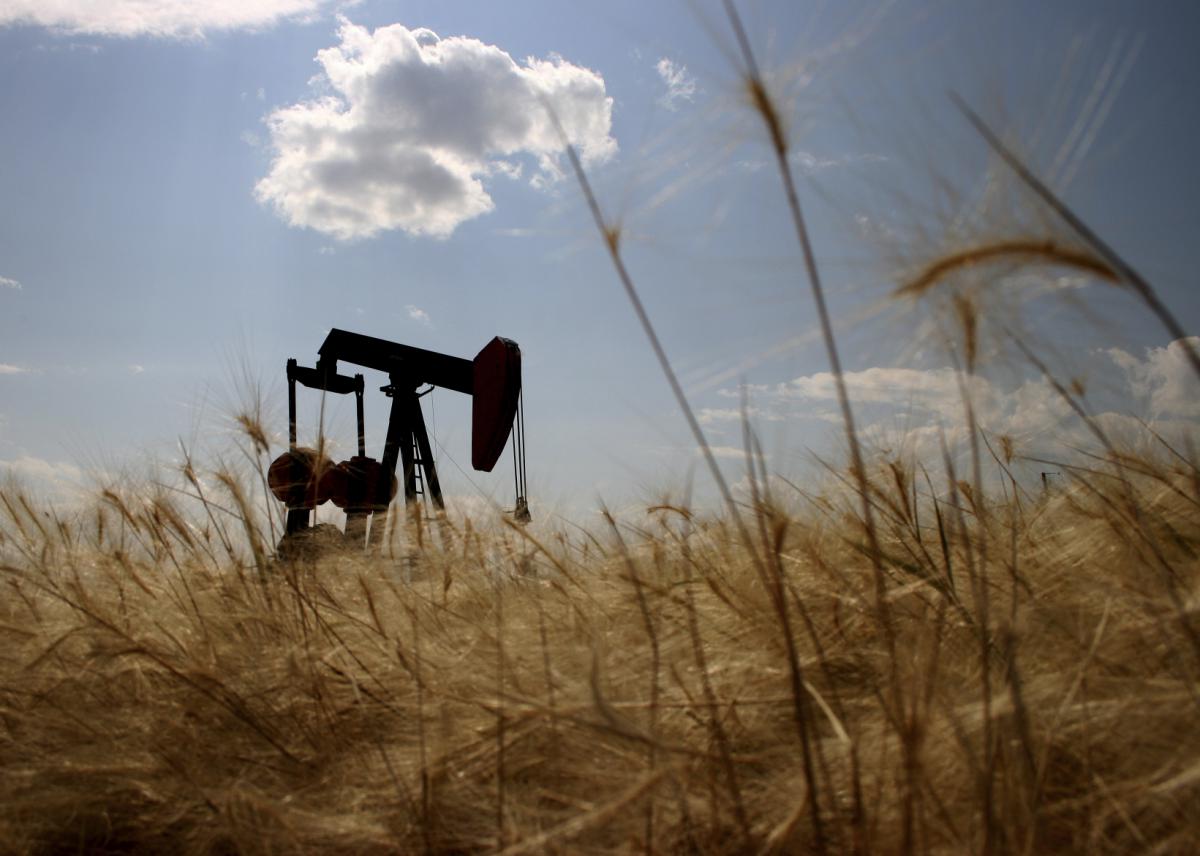
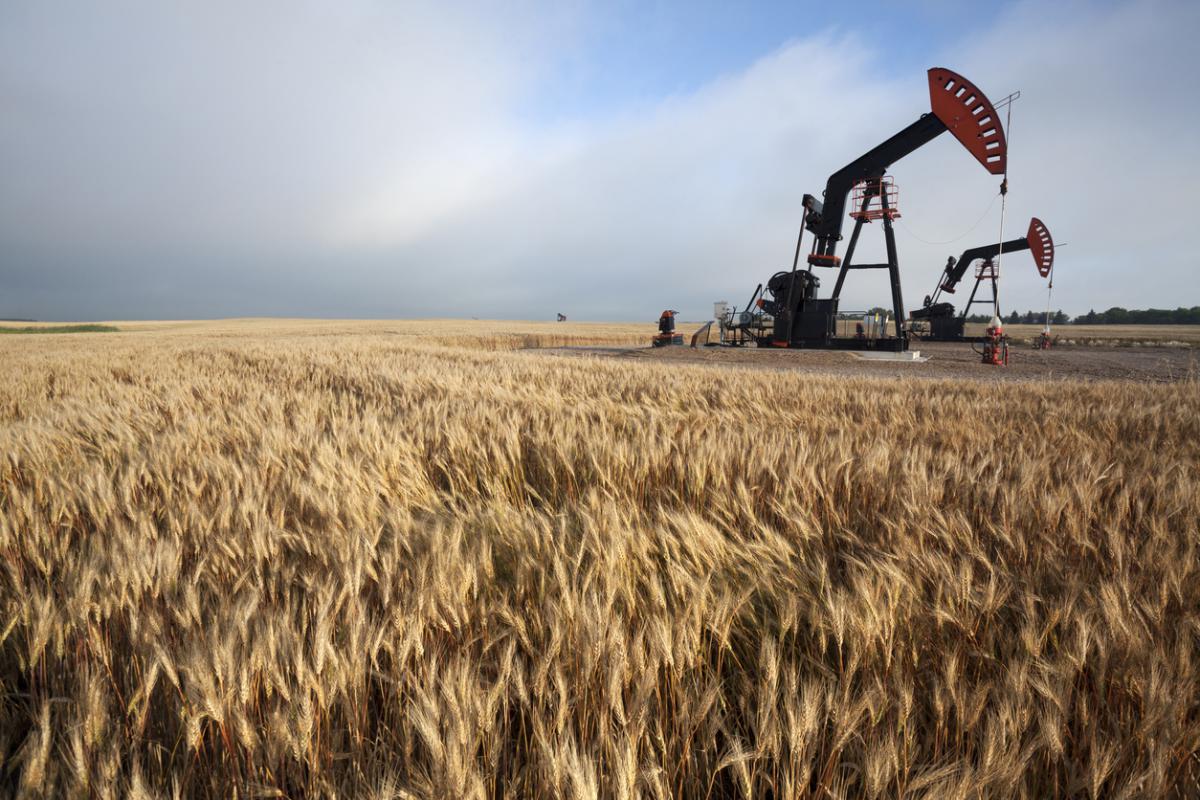
Keystone Pipeline. The Dakota Access Pipeline. The Trans-Alaska Pipeline System. North America has the largest network of energy pipelines in the world, and unfortunately periodic oil spills from pipelines do occur.
Even so, you may be surprised to learn that we actually know very little about what happens to freshwater systems when an oil spill occurs. Moreover, we know very little about how best to clean up those oil spills. A new large project, taking place at IISD Experimental Lakes Area in three stages, is setting out to answer those very questions.
Before we get into the research, let’s take a look at why oil spills could be a problem, how they could affect the surrounding environment and where we need to go from here.
What exactly is an oil spill?
Oil spills occur when oil being transported by truck, rail or pipeline unintentionally spills into the surrounding environment. In some cases, oil may end up in freshwater systems.
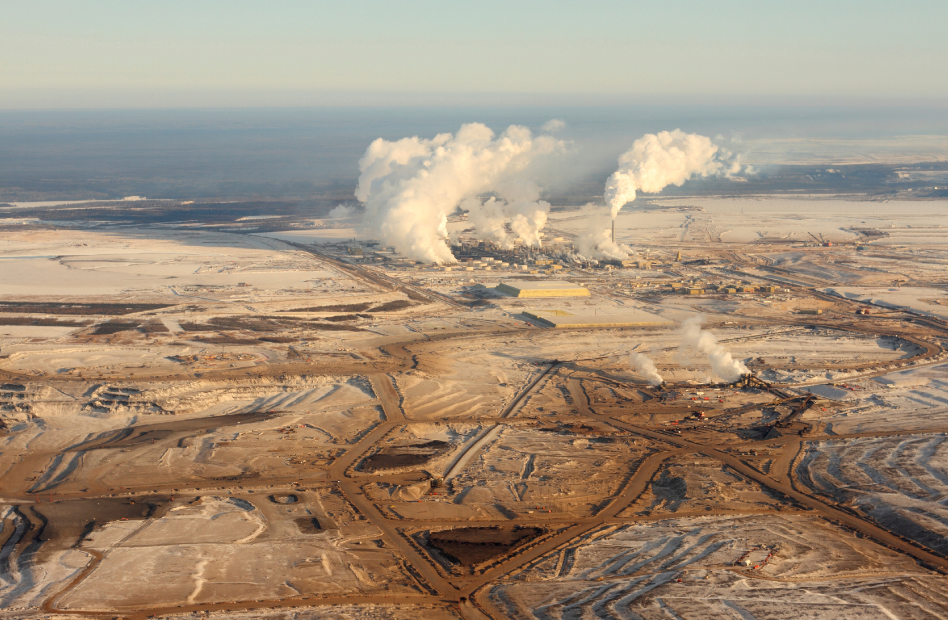
There are many types of oil. In North America, bitumen extracted from the Alberta oil sands is one of the most commonly transported types (by volume). Bitumen is too thick to be transported in pipelines, so it is diluted with other, lighter oils to allow it to flow more easily. The diluted bitumen is called “dilbit” and flows through many pipelines in North America.
Surprisingly there are large gaps in our knowledge regarding the impacts of oil spills in freshwater systems.
Don’t we already know happens when oil enters fresh water?
Surprisingly, no.
Most existing research concentrates on the impact of oil spills on marine environments. In fact, leading and authoritative sources, such as the Royal Society of Canada and the National Academy of Sciences, have identified gaps in our knowledge regarding the impacts of oil spills on freshwater systems.
The implications of potential spills for freshwater systems and their surrounding environments remains uncertain.
And this is all the more surprising given the number of existing or proposed inland pipelines adjacent to freshwater systems. There are already approximately 840,000 km of oil and gas pipelines in Canada and 3.9 million km in the USA.
The implications of potential spills for freshwater systems and their surrounding environments remain uncertain. Because many methods for cleaning up oil spills were developed for the ocean, we also do not know which are most effective in freshwater systems.
We just don’t know enough.
What is happening at IISD Experimental Lakes Area to find out what oil spills do to fresh water?
Given the significant knowledge gaps, a groundbreaking project is taking place at IISD-ELA that will answer pressing questions about what happens when oil enters freshwater systems.
There are three stages of this research.
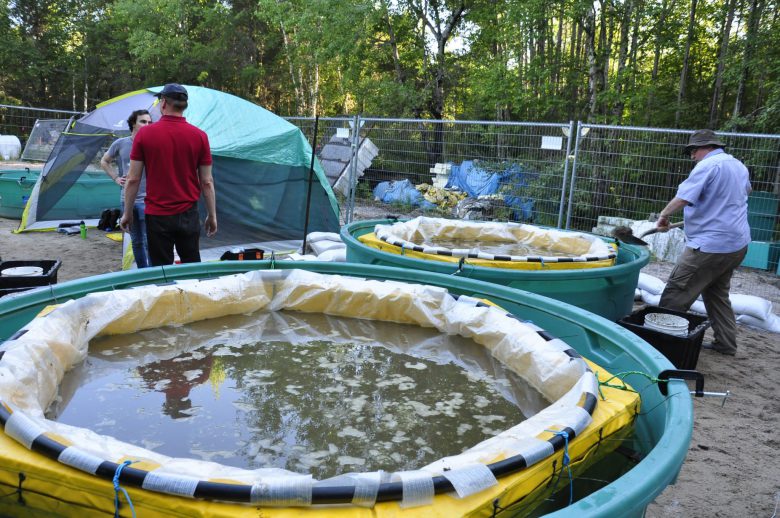
First, a pilot study using three small (2-m diameter) land-based microcosms has already been completed to examine the chemical and physical behaviour of dilbit in fresh water.
Oil is a complex mixture of chemicals whose nature changes with time in the environment. These changes can affect how easily it can be cleaned up (for example, does the oil remain floating or sink?) and its potential toxicity to freshwater wildlife. This early-stage study provided important preliminary information regarding these changes in fresh water that will help to guide the later phases of the research, which will begin in 2018.
A pilot study, using land-based microcosms has already been completed to examine the chemical and physical behavior of dilbit in freshwater.
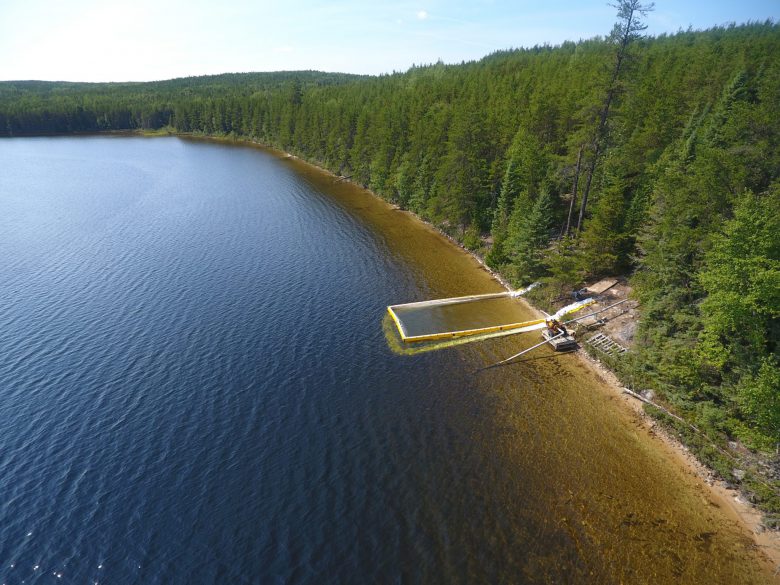
The second stage is a field study. Researchers will use large enclosures (10-m diameter) placed in a lake to examine how diluted bitumen reacts in fresh water over longer periods of time. Researchers will also be directly testing changes in the oil’s toxicity to freshwater bugs, fish and amphibians.
The information from these first two studies will guide a third study, where researchers will examine the most effective methods of cleaning spilled oil from shorelines. Again, only small, contained model spills in an IISD-ELA lake will be used. This study will focus on the shoreline, which is most sensitive to oil and presents the biggest difficulty in terms of cleanup efforts.
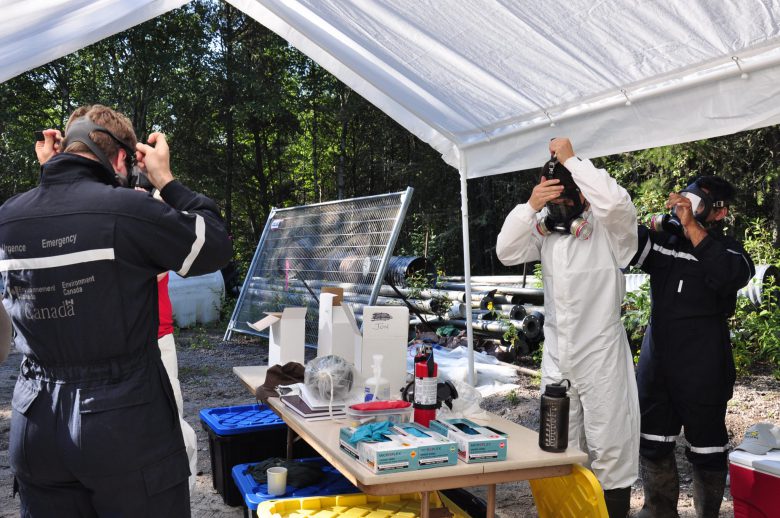
Researchers will also explore the effectiveness of oil-spills remediation (clean-up) techniques in a study conducted on the shoreline of an IISD-ELA lake
Is it safe to study oil in an IISD-ELA lake?
IISD-ELA never embarks on any experiment without rigorous measures to protect the long-term health of the lakes. This includes a comprehensive contingency plan and a scientifically reviewed process to return the lake to the condition it was in before we started the research.
This oil research project is no exception and is going through a rigorous review process. All of the proposed model oil spills will be limited in volume and will be added into contained areas that are isolated from the rest of the lake. We will also install a series of absorbent booms around the isolated areas and at the lake outflow to double and triple protect against any leakages from the isolated areas.
As always, we are committed to removing leftover oil from the lake once the research is complete. A detailed plan to do that is an integral part of the study design as well.
IISD-ELA never embarks on any experiment without rigorous measures to protect the long-term health of the lakes.
What is IISD-ELA doing to ensure that our results are as useful as possible?
As scientists, we strive to approach our research objectively.
Our interest is in providing reliable results that can be used to inform better decision making around pipeline development and to develop more effective methods for cleaning up lakes after oil spills.
Throughout the project development stages, we have made every attempt to collaborate with those who might be affected by the research. IISD-ELA has sought input from First Nations and government departments, the oil production and transportation industries, regulators, universities and local community members.
For example, in September we held an Open House in Kenora (a small town in Ontario close to the research site) to discuss the project with citizens, explain the finer details and answer any questions.
Several studies are currently being pursued at the IISD-ELA to address public and regulatory concerns regarding potential environmental effects of oil spills and uncertainty regarding the best clean-up methods following a spill, especially for freshwater environments. One study, led by Drs. Jules Blais (University of Ottawa), Mark Hanson (University of Manitoba) and Diane Orihel (Queen’s University) will examine the ecological impacts of contained diluted bitumen model spills in a freshwater boreal lake. A companion study, led by Dr. Vince Palace (IISD-ELA) will compare the effectiveness of different methods for cleaning spilled oil form shorelines. Both studies are part of a large multidisciplinary program that includes participation from governments (ECCC, DFO, NRCan, OMECC, OMNRF), regulators (NEB), academic partners (Universities of Manitoba, Ottawa, Queen’s, INRS, Calgary, Saskatchewan, Mcgill) and industry (Canadian Association of Petroleum Producers (CAPP), Canadian Energy Pipelines Association (CEPA)). For more information, please contact Sumeep Bath at [email protected].
Digging up the Dirt on Conflict Minerals Worldwide
A series of recent reports has revealed a new complexity to the familiar topic of the Democratic Republic of the Congo’s “conflict minerals.” Clare Church explores how the trade now not only proliferates outsides of the mobile phone industry, but also outside of the country itself.
November 30, 2017
It’s starting to become a familiar image: a young, Congolese miner working in dire and sometimes violent conditions, searching for the valuable minerals needed to power our smartphones, tablets and other electronic gadgets.
Although documentaries like When Elephants Fight,Al Jazeera news specials, and even celebrities like George Clooney and Ryan Gosling have helped spread awareness of the Democratic Republic of Congo’s (DRC) conflict minerals, the issue itself is not unique to the DRC. Whether it be timber in Cambodia, diamonds in Sierra Leone or jade in Myanmar, armed groups have looted resources both for personal profit and to fund the violence that facilitates their continued exploitation.
The international community—including governments, civil society and the private sector—have attempted to break this cycle between conflict and natural resources for the past two decades: through legislation, guidance, certification schemes, and more.
In popular culture, as well as the U.S. Dodd-Frank Act of 2010, the Democratic Republic of Congo tends to be the focus of the ongoing conversations regarding conflict minerals.
So after all these efforts, how are we doing?
A number of reports released this fall—from Amnesty International, the Enough Project, Global Witness and the Responsible Sourcing Network—demonstrate that a broadening range of minerals continues to be connected to illegal armed groups. And while in recent years conflict minerals in the DRC rightly received a significant amount of attention, these challenges continue to plague a wide range of countries and industries.
Whether it be timber in Cambodia, diamonds in Sierra Leone or jade in Myanmar, armed groups have looted resources both for personal profit and to fund the violence that facilitates their continued exploitation.
The Responsible Sourcing Network, for example, released a report in October outlining all industries’ records with tracking conflict minerals. It found that from 2016 to 2017 there was a decrease in companies’ efforts to report on, address and prevent conflict minerals in their supply chains. While the report recognized adequate reporting for tin, tungsten and tantalum (the 3Ts), it noted that most companies only followed international guidelines superficially.
Amnesty International further showed in their November report Time to Recharge that the natural resources exploited in this violent trade aren’t only limited to the 3Ts and gold, although these minerals are often the main target of public awareness campaigns. With a growing demand for electric vehicles and rechargeable batteries, so too is there a growing demand for cobalt, an element “critical for powering the clean energy revolution.”
After analyzing 29 companies’ records of identifying and addressing human rights abuses in their supply chains, Amnesty International concluded: “Alarmingly, the majority were unable to answer basic questions about where the cobalt in their products came from.” The report went on to say that actors in the middle of the cobalt supply chain “are using their invisibility to contribute to, and benefit from, human rights abuses.”
Profits from minerals in the DRC can fund illegal armed groups, further fueling conflict and violence.
Global Witness reports on conflict minerals internationally, releasing reports on their presence in the DRC, Uganda, Myanmar, Afghanistan, Zimbabwe and the Central African Republic (CAR), among others. Recent reporting exposed the exploitation of jade mines by military groups in Myanmar and the thriving black market for diamonds in CAR. Both of these reveal that the issue of conflict minerals is not confined by any borders.
But there is a reason for optimism.
Significant progress has been made in addressing the links between conflict and the 3Ts and gold in the DRC. The Enough Project’s November report, Demand the Supply, found that 420 mines in the DRC now operate “conflict-free,” a designation possessed by exactly zero mines in 2010. The report applauded pressure from policy-makers, end-user companies and stakeholders, stating that it “contributed to a significant decrease in violence and exploitation in mining areas.”
There is a reason for optimism. Significant progress has been made in addressing the links between conflict and the 3Ts and gold in the DRC.
Policy-makers are also taking steps to expand the scope of conflict mineral legislation beyond the jewelry and technology industries, and beyond the DRC. The Organisation for Economic Development and Co-operation Due Diligence Guidance demands supply chain reporting and risk mitigation for minerals sourced from any conflict-affected or high-risk areas. Adoption is widespread, and both U.S. and European laws make direct reference to the guidance.
This global focus on all minerals will be crucial moving forward. With a shifting demand for minerals resulting from innovations in technology and the renewable energy revolution, it is essential that policy-makers, advocacy groups and companies continue their efforts to eliminate conflict minerals worldwide. Whether producing mobile phones, jewelry, electric vehicles or any other product, conflict and extreme violence should never be a part of the supply chain.
In 2016, global spending on oil and gas projects was more than double the total spent on renewables. That imbalance can be addressed only by restructuring the mechanisms, particularly existing trade treaties, that govern how energy investments are made and managed.
November 27, 2017
In 2016, global spending on oil and gas projects was more than double the total spent on renewables. That imbalance can be addressed only by restructuring the mechanisms, particularly existing trade treaties, that govern how energy investments are made and managed.
GENEVA – Solutions to the climate crisis are often associated with big conferences, and the next two weeks will no doubt bring many “answers.” Some 20,000 delegates have now descended on Bonn, Germany, for the latest round of United Nations climate change talks.
The talks in Bonn should focus on the implementation of the Paris climate agreement. And the path forward is clear. The only way to keep the rise in global temperatures within the limit set in Paris – “well below 2°C” higher than pre-industrial levels – is to shift capital away from fossil fuels and toward zero-carbon projects. To do that, we must change how global energy investments are governed.
The path forward is clear. The only way to keep the rise in global temperatures within the limit set in Paris is to shift capital away from fossil fuels and toward zero-carbon projects.
At the moment, the very governments leading the fight against climate change continue to support and protect investment in fossil-fuel exploration, extraction, and transportation. Rather than investing in efficient housing, zero-carbon mobility, renewable energy, and better land-use systems, these governments say one thing but still do another.
According to the most recent World Energy Investmentreport from the International Energy Agency, global expenditure in the oil and gas sector totaled $649 billion in 2016. That was more than double the $297 billion invested in renewable electricity generation, even though achieving the Paris agreement’s target implies leaving at least three quarters of known fossil-fuel reserves in the ground. As these numbers suggest, institutional inertia and entrenched industry interests continue to stand in the way of shifting investment into sustainable energy.
At the moment, the very governments leading the fight against climate change continue to support and protect investment in fossil-fuel exploration, extraction, and transportation.
Much of the problem can be traced to bilateral investment treaties and investment rules embedded within broader trade pacts, such as the North American Free Trade Agreement (NAFTA), the Energy Charter Treaty, and the EU-Canada Comprehensive Economic and Trade Agreement (CETA). Because these treaties were designed to shield foreign investors from expropriation, they include investor-state dispute settlement (ISDS) mechanisms that allow investors to seek compensation from governments, via international arbitration tribunals, if policy changes affect their business.
This has handcuffed governments seeking to limit fossil-fuel extraction. Compensation from ISDS cases can be staggering. In 2012, an American investor filed a lawsuit against the Quebec government’s decision to deny a permit for hydraulic fracturing under the Saint Lawrence River. Arguing that the denial was “arbitrary, capricious, and illegal” under NAFTA, the Delaware-based energy firm sought $250 million in damages.
In January 2016, the TransCanada energy company used NAFTA to sue the United States, claiming $15 billion in losses after President Barack Obama denied a permit for the Keystone XL oil pipeline. (The company suspended its suit after President Donald Trump approved the project in January 2017).
In 2016, global spending on oil and gas projects was more than double the total spent on renewables.
And in July 2017, Quebec agreed to pay nearly $50 million in compensation to companies after canceling oil and gas exploration contracts on Anticosti Island in the Gulf of Saint Lawrence. These and other payments are in addition to the hundreds of billions of dollars in subsidies that continue to flow to the fossil-fuel industry.
Big payouts do more than drain public coffers; the mere threat of them discourages governments from pursuing more ambitious climate policies, owing to fear that carbon-dependent industries could challenge them in international tribunals.
Fortunately, this state of affairs is not set in stone. Many governments now see reform of the investment regime not just as a possibility, but as a necessity. Last month, the UN Conference on Trade and Development convened a high-level meeting in Geneva, with the goal of developing options for comprehensive reform of the investment regime, including the renegotiation or termination of some 3,000 outdated treaties.
Governments should start by overhauling or exiting the Energy Charter Treaty, the world’s only energy-specific investment pact. The ECT’s investment protections and lack of climate provisions are no longer appropriate. Since its inception, the ECT has served as the basis for more than 100 claims by energy firms against host countries, with some challenging national environmental policies, such as the nuclear phase-out in Germany. Russia and Italy have already withdrawn from the ECT; other countries should do the same or commit to renegotiating it.
Rebalancing the global investment regime is only the first step toward a zero-carbon economy.
Moreover, countries should put climate concerns at the center of their trade and investment negotiations, such as by carving out fossil-fuel projects from investment clauses. That is essentially what France recently proposed, when ecology minister Nicolas Hulot announced his country’s intention to enact a “climate veto” to CETA. Hulot said France would ratify the treaty only if it contained assurances that its climate commitments could not be challenged before arbitration tribunals. Fossil-fuel projects could also be exempted from investment protection in new environmental treaties, such as the Global Pact for the Environment presented by French President Emmanuel Macron to the UN General Assembly in September.
Rebalancing the global investment regime is only the first step toward a zero-carbon economy. To shift capital from fossil-fuel heavy initiatives to green energy projects, countries will need new legal and policy frameworks at the regional, national, and international levels. These agreements should promote and facilitate zero-carbon investments. Big meetings like the one getting underway this week and the Paris Climate Summit next month can kick-start these conversations.
(The authors wish to thank Ivetta Gerasimchuk and Martin Dietrich Brauch of the IISD for their help with this commentary.)
(Copyright: Project Syndicate, 2017)
Share this page:
Insight
Ending Coal: From diplomacy to implementation
We need to bring an end to coal—in a sustainable and economically inclusive way. Ivetta Gerasimchuk explains how.
November 25, 2017
Diplomatically, coal power is on the wrong side of history. Spearheaded by Canada, the United Kingdom and the Marshall Islands, the Powering Past Coal Alliance has just been launched at the UN climate talks in Bonn.
New members are joining the 25 founding governments by the hour—just check the tally on the alliance’s webpage.
The alliance is not just open to national and subnational governments, but also businesses and other organizations. What unites them all is the ambition “to accelerate clean growth and climate protection through the phase-out of… existing traditional coal power” and placing “a moratorium on any new traditional coal power stations.”
Technically though, the world has a new task at hand: implementing coal phase-outs in “a sustainable and economically inclusive way, while providing appropriate support for workers and communities.” This is the necessity of a “just transition,” stressed as the imperative in the Paris Agreement on climate in 2015.
What unites them all is the ambition “to accelerate clean growth and climate protection through the phase-out of… existing traditional coal power” and placing “a moratorium on any new traditional coal power stations.”
IISD and other think tanks have scrutinized coal phase-outs that were implemented in the past—from Ontario in Canada to Beijing and Shanxi in China; and from South Wales in the United Kingdom to Delhi in India. These are all very difficult experiences, and while we cannot use any of the past scenarios as a blueprint for the future, we can learn from each of them. These lessons include several simple principles that will help countries, regions and cities that have committed to phasing out coal:
Develop a plan that analyzes the potential impacts of coal industry decline and evaluates possible policies to address economic, environmental and social impacts.
Identify options for economic diversification, social safety nets and new employment that can support coal workers and their families in the transition.
Establish a dedicated fund to support a just transition and economic diversification. Use savings from fossil fuel subsidy reform, as well as environmental taxes and charges, to fund the transition.
Engage with all stakeholders. An open dialogue with labour groups, communities, industry associations and other interested parties will help to identify challenges and issues with reform, avoiding more serious consequences and helping to defuse opposition to phase out.
There is also a range of legal, social and financial issues to consider, including: pathway dependency for workers and regions; limited options for diversification and retraining; forestalling asset stranding; anticipating and managing investors’ claims for compensations for stranded assets; preventing electricity price increases; institutional inertia; and many more.
We need to bring an end to coal—but in a sustainable and economically inclusive way
There is little doubt that the Powering Past Coal Alliance will outperform its self-imposed target of having more than 50 members by the next round of UN climate talks in December 2018. But by addressing the issues of implementation and mobilizing peer learning between its members, the Alliance will be able to appeal to those who today were conspicuous by their absence in the room—countries with significant coal production and consumption, such as Germany, Poland (host of the next UNFCCC conference) and many Asian nations—and also businesses and organizations beyond the “usual suspects.” For one, getting a signature from a labour organization such the Canadian Labour Congress on the Power Past Coal declaration would be a litmus test for the international community’s ability to truly bring together a coalition that does not just tackle the world’s coal problem—but does so in a socially sustainable way.
Developing Future Leaders: Meet Kali Taylor, a Global Shaper
We check in with Kali Taylor, who has just been named a "Global Shaper," to learn more about the Global Shapers program and what she hopes it will bring for her, both personally and professionally.
November 21, 2017
Kali Taylor, the lead on the Geneva 2030 Ecosystem initiative under IISD's Sustainable Development Goals (SDG) Knowledge Program, was recently named a "Global Shaper."
This program is led by young leaders between 20 and 30 years old who want to develop their leadership potential toward serving society.
Through her work, Kali promotes collaboration and initiatives for Geneva-based actors focused on SDG implementation. IISD has partnered closely with the UN Office at Geneva SDG Lab to fulfill this vision and, as such, Kali is seconded part-time to the UN, representing non-governmental organizations' (NGOs') viewpoints and providing expertise on systems change and innovation best practice.
We checked in with Kali to hear more about Global Shapers and what she hopes it will bring for her, both personally and professionally.
Tell us about Global Shapers. What is it all about?
The Global Shapers Community is a network of young people driving dialogue, action and change. Born out of the World Economic Forum, the Community is a network of inspiring young people under the age of 30 working together to address local, regional and global challenges. With more than 6,000 members, the Global Shapers Community spans 378 city-based hubs in 160 countries.
Born out of the World Economic Forum, the Global Shapers Community is a network of young people driving dialogue, action and change.
What work will you be involved in through this?
The Global Shapers aim to make a difference in their communities. In Geneva, our Hub has three initiatives: one focuses on refurbishing electronics and donating them to local organizations who need them; one makes financial literacy simple for young people; and one promotes investment in childcare facilities by large companies to enable female leadership and career development.
"The Shapers community is incredibly diverse – comprised of people working on everything from traditional finance to artificial intelligence to humanitarian response."
I will be working on the "Child care for Careers" project. In Switzerland, only 15 per cent of mothers work full-time, and this is largely attributable to very high child care costs. We have developed all the material needed to fully understand the benefits of investing in childcare for employee retention and satisfaction and now are working with large companies to encourage implementation of a crèche (nursery facility) at their workplace. You can learn more about the Geneva Hub projects here.
What do you hope to gain from it, personally and professionally?
I have been in Geneva for 18 months now, working with IISD. It is my hope that through the Shapers I can give back to this city that is my new home. In addition, I look forward to expanding my network of interesting young change-makers and making new friends!
Through her work, Kali Taylor promotes collaboration and initiatives for Geneva-based actors focused on implementing the Sustainable Development Goals.
What do you hope your involvement in Global Shapers will bring to IISD?
The work I do at IISD allows me to meet and partner with so many people/organizations working on the Sustainable Development Goals here in Geneva, but it is somewhat confined to the traditional development actors. The Shapers community is incredibly diverse – comprised of people working on everything from traditional finance to artificial intelligence to humanitarian response. It is an incredible opportunity to expand my perspective and bring new ideas into sustainable development challenges.
Share this page:
Insight
Manitoba's Carbon Pricing Plan: What it gets right, and where we go from here
The Government of Manitoba has just announced A Made-in-Manitoba Climate and Green Plan. Jane McDonald breaks down the plan piece by piece to look at the pledges made and explore where the province needs to go from here.
This much-awaited blueprint for how Manitoba will tackle climate change turned out to be a consultation framework that contains the elements of a credible plan—though it still needs to land key details.
After this week’s scathing report by the Province’s Auditor General on the ineffectiveness of past climate policy in Manitoba, we look forward to working with the government to bend the curve on our emissions and invest now in efforts to improve the resiliency of this province.
Let’s break down the plan piece by piece to look at the pledges made and where the province needs to go from here.
We now have the three Prairie provinces converging on the same carbon pricing system, potentially paving the way for further Western Canada cooperation on climate change action.
Carbon pricing: A smart move on structure, but questions remain on long-term effectiveness
Manitoba is adopting a ‘two-track” approach to pricing carbon. First, they have laid out an economy-wide levy on carbon pollution, covering all the major fuel uses—with the exception of marked fuels use in farming operations. This is good practice and in line with coverage in all other existing carbon pricing systems in Canada.
Second, Manitoba’s largest emitters will have some of their emissions exempted from the levy based on the efficiency of their operations. This means companies will still have an incentive to reduce emissions while being shielded from competitiveness pressures. It’s good policy if: (1) the government sets standards that actually drive emission reductions and compare operations here with best-in-class efforts elsewhere and (2) negotiations don’t take years and these standards are in place by 2019.
For help getting these two carbon pricing tracks off the ground, Manitoba can look to lessons from Alberta and the federal government. This is the same system Alberta has in place and is also the approach the Government of Canada has announced it will use for Canadian provinces that don’t come up with their own price on carbon—right now that means Saskatchewan.
At CAD 25 per tonne, Manitoba’s carbon price is expected to generate approximately CAD 260 million in annual revenue. But it is unclear how that revenue will be used.
We now have the three Prairie provinces converging on the same carbon pricing system, potentially paving the way for further Western Canada cooperation on climate change action.
Turning to the actual price set under this system, things get more complicated. The new Manitoba levy will be introduced at CAD 25 per tonne in 2018 and will not increase over time. Arguments that a flat price will miss an important signal to industry and consumers to look for new ways to lower emissions over time are blunted by the province’s modelling, which they say shows their flat price resulting in slightly more emission reductions over the first five years than if they matched the federal benchmark of CAD 50 per tonne by 2022. That is fine, but not the end of the story.
A flat price of CAD 25 per tonne also means that by 2020 Manitoba will not be in compliance with the federal benchmark, which rises to CAD 50 per tonne by 2022. As a result, Manitobans presumably won’t receive some of the federal money on the table through the Low-Carbon Economy Fund and the federal government might end up charging Manitoba "top-up fees."
Additional policies and revenues from carbon pricing will be critical to reducing emissions
At CAD 25 per tonne, Manitoba’s carbon price is expected to generate approximately CAD 260 million in annual revenue. It is also expected to reduce emissions by 1 megatonne over five years. (A list of initial measures are listed at the end of the plan that add up to another megatonne over five years, although it is unclear whether these measures will be pursued or are presented for consultation). We will need to do better than this to contribute to a national and international effort to reduce emissions in line with what scientists say is needed.
A comprehensive analysis of the benefits, risks and costs of different approaches to reducing emissions in this province was not presented in this plan.
A Made-in-Manitoba Climate and Green Plan lists a wide array of other potential actions that could build on Manitoba’s clean electricity advantage and reduce emissions in the highest-emitting sectors of transportation, agriculture and buildings.
But a comprehensive analysis of the benefits, risks and costs of different approaches to reducing emissions in this province was not presented. As the Auditor General of Manitoba points out in last week’s Managing Climate Change report, this has been lacking for too long in our discussions.
Funds from the carbon levy attached to policies that can deliver concrete reductions in these areas will no doubt be essential. While the province has said that all revenue collected will focus first on lessening the impact of a carbon levy on lower and middle-income Manitobans and their families, no other firm commitments have been made—and more consultations will roll out in November in order to reach clarity by the next budget.
Manitoba, like Alberta, is adopting a ‘two-track” approach to pricing carbon.
Heading in the right direction on governance
The Manitoba government has clearly given some thought to how it will be held accountable for its approach, proposing concrete indicators of success across multiple climate and green objectives, including economic impacts.
It has also proposed that an Expert Advisory Panel help government set five-year targets for emission reductions, which could help keep ongoing reviews public and evidence-based. We look forward to further details about the make-up of that panel, how its advice would be developed and funded, and how industry and communities will be involved in the process.
Adaptation efforts are rightly front-and-centre but need investment
Manitoba’s Climate and Green Plan forcefully articulates the scale of the adaptation challenge, recognizing that climate impacts are an immediate threat and, if left unaddressed, will continue to undermine the well-being of Manitoba’s citizens.
The plan recognizes that climate risk management in this province must include planning and investment in reducing flood and drought impacts and points to ecosystem management innovation using natural infrastructure such as wetlands and water retention storage systems as part of the solution.
Indicators of success in this keystone include counting the number of local governments with climate adaptation plans, and dollars invested in green infrastructure projects. However, based on the serious risks identified, the next step will be to develop a provincial adaptation plan that articulates climate vulnerabilities, with clearly defined actions, time frames and, critically, a budget.
Given how many details are still up in the air, IISD looks forward to participating in consultations over the next month to inform and provide detail for A Made-in-Manitoba Climate and Green Plan. This government has started the right discussions in their plan; we look forward to finishing the conversation.
Share this page:
Insight
Zambian Villagers Win the Right to Sue a Mining Company in the United Kingdom
In an interesting development, the United Kingdom Court of Appeal recently upheld the decision of a lower court that British courts have jurisdiction to hear a case in which a United Kingdom-based mining company’s activities caused harm abroad (in Zambia). We explore.
October 27, 2017
In an interesting development, the United Kingdom Court of Appeal recently upheld the decision of a lower court that British courts have jurisdiction to hear a case in which a United Kingdom-based mining company’s activities caused harm abroad (in Zambia).
In this case, 1,826 Zambian villagers sued a United Kingdom-domiciled company that owns a majority share in a copper mine in Zambia. The villagers claim that chemicals from the mine have polluted rivers, streams and aquifers, causing illness, injury, crop failures and loss of income.
“The frequency and severity of spills are higher and more consistent. Before we could not smell [the pollution] but now we can. The ground is contaminated, our crop yield has dropped, the maize crop is about half what it was,” Leo Moulenga, a villager from Shimulala, told the Guardian two years ago.
The Zambian villagers claim that chemicals from the mine have polluted rivers, streams and aquifers, causing illness, injury, crop failures and loss of income.
It is frequently a problem for victims in developing countries to get redress for damages caused by multinational corporations. Often, the only option for victims is to bring the case to a local court. Unfortunately, the local entity of the transnational corporation may no longer exist or have limited assets in-country. It is therefore important to have access to courts in the "home" country of the parent company.
This problem is also at the heart of discussions this week in Geneva at a United Nations meeting on transnational corporations and human rights. In this forum, countries are deliberating on a binding international instrument that includes rules on access to justice and effective remedy. An important part of this discussion focuses on the role of courts in the home state of the parent company. Hopefully, the discussions at the UN will result in an outcome that will ensure courts cannot stay a civil tort case brought by a victim domiciled abroad against a parent company based on so-called forum non conveniens grounds. This means that a court should not be able to refuse a case just because it considers that there is another forum in which the case could be tried more suitably.
The United Kingdom Court of Appeal recently upheld the decision of a lower court that British courts have jurisdiction to hear a case in which a United Kingdom-based mining company’s activities caused harm abroad (in Zambia).
In addition to the important role the UN can play in moving these issues forward, investment treaties and chapters should also include provisions to improve access to justice for those harmed by foreign investment. Some recent investment treaty models (in Africa, for example) commit state parties to ensuring that access to courts in the home state of the foreign investor is possible. Such a reference in the investment treaty helps ensure that transnational companies are held accountable for their actions in the host state and that they cannot escape liability simply because they are transnational in character. These types of clauses are important and can ultimately result in better behaviour in the companies in the country where they operate.
IISD has been developing innovative approaches to investment law and policy for over 15 years. The role of home state courts for transnational investments in civil cases was first incorporated in the 2005 IISD Model Investment Agreement for Sustainable Development.
Four Lessons on Communicating ASM from IIED’s Stories of Change Initiative
In this guest column, IIED's Gabriela Flores presents four of the best lessons she has learned in communicating the complex topic of artisanal and small-scale mining.
October 16, 2017
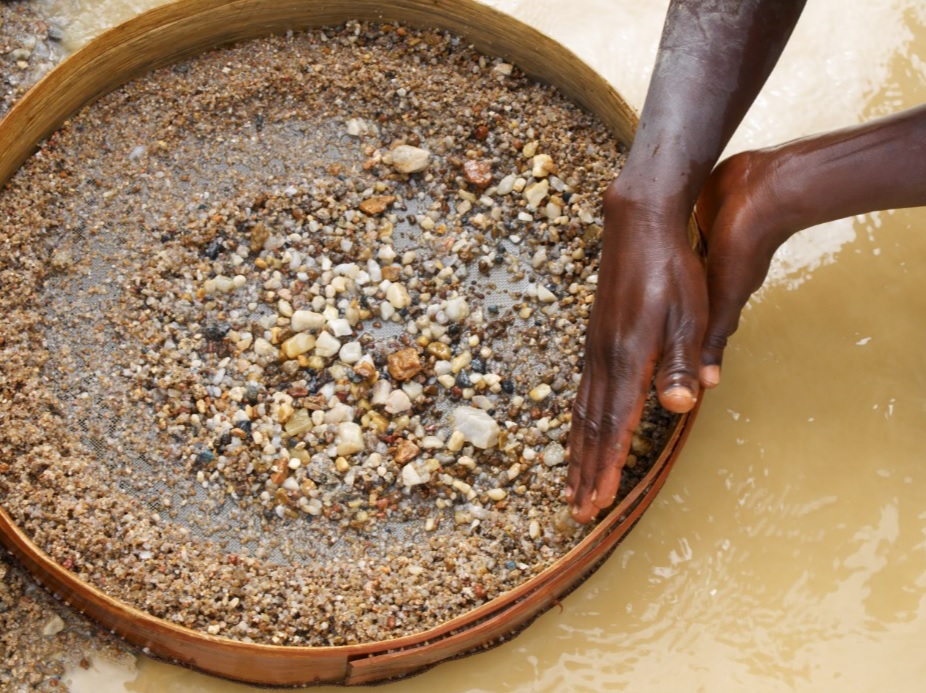
“We want to be appreciated for what we are doing,” were the first words that a Ghanaian adviser to small-scale gold mines said to me in a recent interview.
Coming from someone who travels from small mine to small mine to help operators rehabilitate land after exploitation, his words carried a special weight.
In a country where small-scale mining is synonymous with environmental degradation, workers’ exploitation and unsafe practices, it may not be surprising to hear that good work goes largely unacknowledged. But this failure to acknowledge good practices extends to most countries where the sector is an important economic activity.
Could this failure to promote good practice be depriving artisanal and small-scale miners (ASM) and communities from advancing?
Stories alone cannot transform the sector from one driven by poverty and informality to one that is productive, equitable and sustainable. But they can inspire change.
Informality, disagreement and low levels of trust abound in the ASM sector. At IIED, we believe that one of the antidotes to this troubling situation is effective communications.
It’s clear that the informal sector sorely lacks accurate and reliable information. This includes data about geology, land availability, licensing, access to finance and good practices. Even when this data exists, it is often difficult to access.
Time and time again we hear that there are many ASM initiatives happening, but those involved in the sector don’t always know who is doing what, what is working well and—crucially—what is not working. This thwarts the potential for collaboration and for scaling-up successful pilots.
The IIED ASM dialogues programme has been working for two years to enable a wide range of stakeholders to come together and collaborate. The goal is to help transform ASM into the engine of local sustainable development that it has the potential to be.
ASM is often perceived as an undesirable activity in the countries where it takes place. Negative perceptions can create barriers to progress, in policy and practice.
Based on solutions-focused research, national players develop agendas for change that aim to empower miners, improve governance and create a safer, more secure working environment. The first dialogue was in Ghana and we are now gearing up for a dialogue in Tanzania in November. Effective communication and stakeholder engagement are at the programme’s core.
One of the biggest lessons we have learned is the need to do to more to share good practices and what we call ‘stories of change.’ These are personal stories that illustrate how artisanal and small-scale miners contribute to sustainable development, operate professionally and create wider opportunities for communities.
Stories alone cannot transform the sector from one driven by poverty and informality to one that is productive, equitable and sustainable. But they can inspire change.
Artisanal and small-scale mining is the theme of this year’s Annual General Meeting of the Intergovernmental Forum on Mining, Minerals, Metals and Sustainable Development.
Here are four lessons we have learned.
1. Use facts to show ASM’s contribution to sustainable development
There is wide agreement that ASM can be an important driver of sustainable development, particularly in some of the world’s most impoverished communities. However, how this is already happening or why this is a sector worth supporting is not as widely known.
Start with the basics. The existing contribution of ASM to national mineral production and local employment figures are not generally part of narratives about the sector. In many cases, the information is not readily available. A good communications strategy can promote strategic facts: facts that can make us think twice about the relevance of the sector. For instance: did you know that 35 per cent of the gold mined in Ghana–one of the world’s top ten producers–comes from ASM?
2. Show real people
Most of the information shared about the ASM sector deals with technical, financial or regulatory matters. This dense—yet essential— material can be transformed into something inspiring if it is presented as a means of enabling real people to make a decent living, while respecting the environment.
Our ‘stories of change’ series found and featured miners, suppliers and local community leaders in Ghana, Tanzania and Madagascar. They are turning small mines and quarries into responsible businesses and coming together to tackle the environmental impact of mining. Their stories show that good things are happening and could—with the right support—happen in other places too.
Showcasing stories and images of real people is a crucial part of the communication of sustainable development work.
3. Tackle negative perceptions of ASM
Those of us working at the global level strive to support the sector so it is more sustainable. Yet ASM is often perceived as an undesirable activity in the countries where it takes place. Negative perceptions can create barriers to progress, in policy and practice.
I walked away wishing that some of their patience and perseverance would rub off on me. If we, as communicators, can convey a fraction of their determination, we will be on our way to success.
We need effective communications strategies so erroneous perceptions don’t get in the way of progress at the country level. This cannot be done from London, Geneva or Washington. It is essential to work with national partners who have influence and credibility at the national and local level and can interact with critics and sceptics in the space where national opinions and decisions are made. In Ghana, we work with Friends of the Nation, in Tanzania with Haki Madini and in Madagascar with GIZ. We learn much from their insights and connections, and our programme’s communications are enriched.
4. Don’t be afraid to talk about poor examples
We advocate a focus on good practices. There is enough information about problems and too little about successes and the potential for even greater gains. But we need to be balanced. We have to acknowledge that there have been countless instances where the sector has had detrimental impacts, not least on the environment, health and safety and wellbeing of communities. Supporting the sector and focusing on good practices does not mean that our communications turn a blind eye to its problems.
A more personal lesson for communicating ASM comes from the women gemstone miners we met in Tanzania while working on the ‘stories of change’ series. While they meet the government’s requirements for small-scale miners, provide employment and engage in a range of responsible practices, their gruelling workdays end, more often than not, in disappointment. They rarely find the type of stones that can turn a big profit. When I asked why they continue to mine, every one of them said because they have hope. Their hope, they explained, is that one of these days they will find a stone that will change their lives for good.
I walked away wishing that some of their patience and perseverance would rub off on me. If we, as communicators, can convey a fraction of their determination, we will be on our way to success.
Gabriela Flores is a communications specialist and a senior associate at IIED.
Disaggregated Data is Essential to Leave No One Behind
If we are to truly achieve the SDGs—and be sure to"leave no one behind"—we need the kind of complete picture that only disaggregated data can provide.
October 12, 2017
The 2030 Agenda for Sustainable Development elevates as a core principle the objective to “leave no one behind.”
Through this Agenda and its Sustainable Development Goals (SDGs), the world has committed for the first time to end poverty in all its forms everywhere (SDG 1), eradicate hunger (SDG 2) and ensure healthy lives and well-being for all (SDG 3).
To know if we are achieving this core principle in the midst of progress on these critical goals, we will need to track implementation using specific indicators. Most SDG assessments to date have used national-level data to evaluate SDG progress at the country level. However, if we are to achieve the 2030 Agenda objectives on basic human well-being, we will need to know if the situation of the most vulnerable is improving, especially in terms of poverty reduction and achieving food security.
For the first time, the world has committed to end poverty in all its forms everywhere (SDG 1), eradicate hunger (SDG 2) and ensure healthy lives and well-being for all (SDG 3).
Leaving no one behind will require the use of disaggregated data, to allow an in-depth look at trends across different population groups. This disaggregation, for example, could include breaking data down by gender and age. We know that women tend to earn less, the elderly are often more impoverished, and certain regions and locations such as rural areas can be more vulnerable to hunger than urban areas. Data based on national averages would miss all of these opportunities to identify specific challenges that must be addressed if we are to fully implement the 2030 Agenda.
Disaggregated data will provide a good basis from which to understand progress towards these critical goals, but first countries must collect and disaggregate the data.
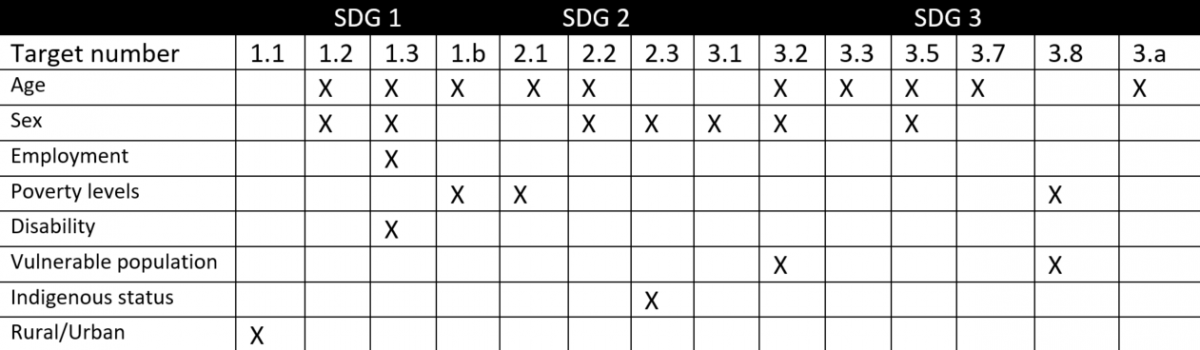
The set of indicators that was approved by the UN Economic and Social Council to track SDG implementation recognizes the need to disaggregate data by social status, gender, age and location. For SDG 1, for example, data disaggregation by location (urban-rural), age, gender, employment and disability (Table 1) is required. The major requirements for data disaggregation focus on gender and age differences in relation to poverty reduction, food security and good health.
Table 1. Summary of major disaggregation required across indicators for SDG 1 (no poverty), SDG 2 (zero hunger) and SDG 3 (good health and well-being). Developed by authors based on the revised list of global Sustainable Development Goal indicators.
Disaggregated data will provide a good basis from which to understand progress towards these critical goals, but first countries must collect and disaggregate the data. Our research indicates that countries will need to increase their focus on disaggregated data if they are to know whether the vulnerable are being left behind.
We reviewed the voluntary national reports that 32 countries submitted to the United Nations High-level Political Forum on Sustainable Development (HLPF) in 2016 and 2017. From the analyzed countries, 69 per cent provide national-level data with no disaggregation. Fewer than 1 in 5 countries (18%) disaggregated data for one out of the three analyzed SDGs and only 13 per cent provided disaggregated data for more than two of the analyzed SDGs.
Countries should direct their attention to data disaggregation now in order to establish proper baselines, develop and implement targeted policies to address the well-being of the most vulnerable, and monitor progress on “leaving no one behind.”
Of the first three SDGs 1, 2 and 3, the most common types of disaggregation are gender and age, and mostly for indicators for SDG 3 on good health and well-being. Developing countries used disaggregation by urban and rural data, even for additional indicators beyond those required by the official indicators.
If the analyzed reports are representative of all countries, our analysis indicates that most countries are failing to adequately track progress towards addressing basic human needs such as poverty reduction and food security among vulnerable populations. Currently, it seems that neither developed nor developing countries are in a position to comprehensively capture progress in achieving these first three SDGs.
Countries should direct their attention to data disaggregation now in order to establish proper baselines, develop and implement targeted policies to address the well-being of the most vulnerable, and monitor progress on “leaving no one behind.” Meetings like last week’s 2017 International Conference on SDG Statistics and additional efforts to build statistical capacity and enhance learning between countries are needed to address the gaps in collection of disaggregated data as soon as possible.