So far, the private sector has been waiting and watching. Now we need visionary companies to step up and join us.
May 28, 2021
This article was originally published by IFPRI. It has been reprinted with permission.
The number of people who go to bed hungry was rising steadily prior to the COVID-19 pandemic due to stresses related to climate, inequality and conflict, and now stands at 690 million. The pandemic has supercharged these trends. The latest UN estimates are sobering, with an additional 130 million projected to be suffering from hunger, even before the devastating pandemic numbers we are currently seeing from India and Brazil.
Worse, official development assistance (ODA) efforts in agriculture and food security have not coped with the increasing challenges. Between 2008 and 2018, their share in total ODA grants decreased from 9% to 8%. By neglecting the root cause of hunger, the global community has had to increase their spending on emergency food aid (which rose by 25% over the same period). What’s more, no African country is on track to meet the commitment to allocate at least 10% of annual public expenditure to agriculture.
But as the ground-breaking Ceres2030 studies—backed up by another study by German organizations, the PARI Report—show, this situation can be turned around. With USD 33 billion in additional annual spending, we can reduce the number of hungry people from 690 million today to 170 million by 2030. Not quite the end of hunger, but a reduction in the percentage of people that are hungry from 9% today to 3% in 2030.
Most of this additional money will come from governments, which must step up their commitments to the fight against hunger—but they are under pressure from the pandemic and the associated economic downturn. Large companies can and should step in as well to play a catalytic role in this effort. So far, the private sector has been waiting and watching. Now we need visionary companies to step up and join us. While many businesses have suffered in the past 12 months, others have prospered and are in a strong position to support ending hunger by 2030. For example, the NASDAQ has risen in value by 64% in the past year and the S&P 500 by 49%.
So far, the private sector has been waiting and watching. Now we need visionary companies to step up and join us.
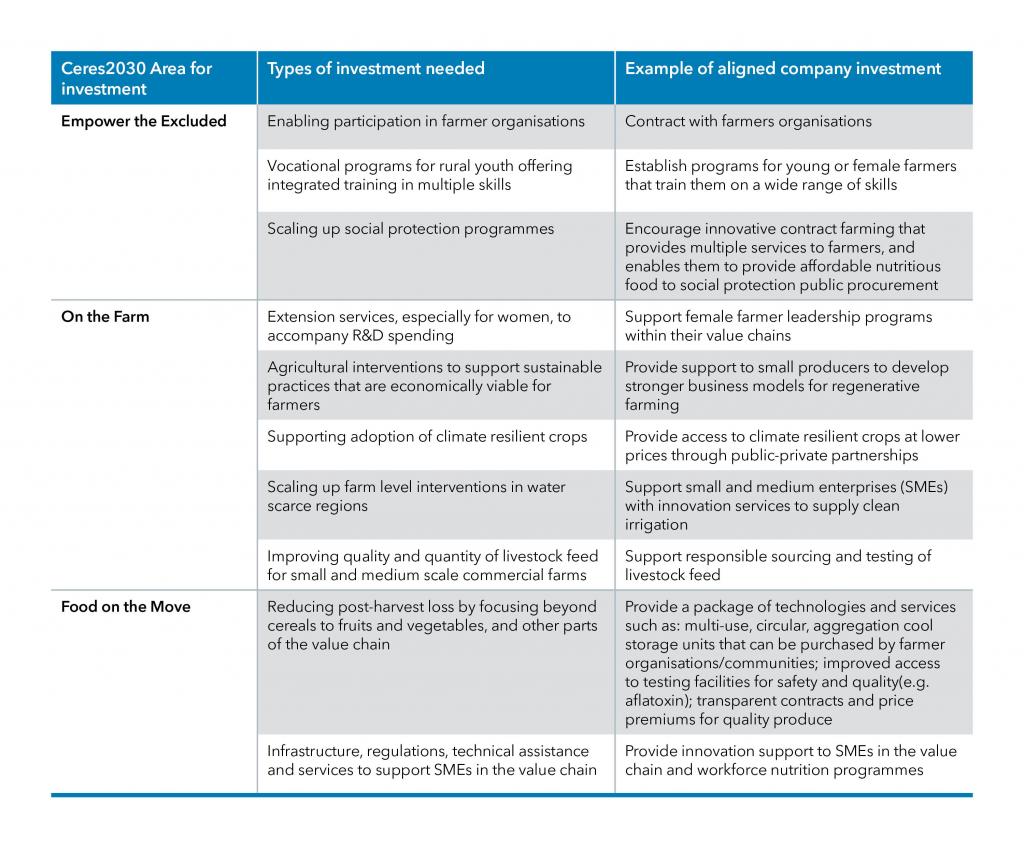
Companies will be able to signal their support by signing the End Hunger, Nourish the Future Pledge to align company investment and spending more strongly with the 10 high-impact investment areas outlined by Ceres2030 below.
The End Hunger, Nourish the Future Pledge is being developed by colleagues at the International Institute for Sustainable Development (IISD), IFPRI, the Global Alliance for Improved Nutrition (GAIN), Grow Africa, and Grow Asia, working with business associations, member states, donors and others in the context of the upcoming UN Food Systems Summit.
The action outlined by Ceres2030 takes place across three broad areas: Investments to empower the excluded (for example: strengthen farmer organizations, education for rural youth, social protection); investments on the farm (for example: farm extension, irrigation, finance, infrastructure, R&D, production subsidies); and investments for food on the move (for example: infrastructure and technical assistance to help small and medium enterprises, investment in storage and sustainable energy and cold chains).
Business participation would be highly catalytic, helping us to arrive at the additional $33 billion investment faster, which will spur an extra $52 billion in local private investment per year. The investments would also double the incomes of 545 million food producers and their families, and help limit greenhouse gas emissions for agriculture to the commitments agreed upon in the Paris Climate Agreement.
The investments would double the incomes of 545 million food producers and their families, and help limit GHG emissions.
Investments at this level would also be a boon for the businesses themselves—helping to expand the very markets that have the most growth potential for many companies while also building important relationships with value chain actors and strengthening supply assurance. Pledging will help them to attract top talent among young, skilled professionals who have consistently expressed a desire to join companies that have a higher sense of purpose; and can boost companies’ environmental, social, and governance (ESG) profiles, which are becoming more important to the investment community.
Here is a chance for companies to give their words action: To stimulate local private sector investment. To help new markets flourish. To build new trusting relationships with value chain actors. To give their own employees a higher sense of purpose. To be the final spark for the final effort to end the obscenity of hunger. To be the, perhaps unlikely, champions that end hunger—for good.
Lawrence Haddad is Executive Director of the Global Alliance for Improved Nutrition (GAIN); Carin Smaller is Director of Agriculture, Trade, and Investment at IISD.
Achieving Sustainable Food Systems in a Global Crisis
Expanding the original scope of the Ceres2030 project, this initiative focused on the interrelationships between food systems, climate change, and diets. The results provided options for country-level transition pathways toward sustainable food systems in Ethiopia, Malawi, and Nigeria.
Can we move beyond hunger and provide affordable, healthy diets to all in a sustainable way?
To help answer this question, IISD and the International Food Policy Research Institute (IFPRI) took a deep dive into the nexus of food systems, climate change, and nutrition in three African countries: Ethiopia, Malawi, and Nigeria. This project built on the work done in Ceres2030: Sustainable Solutions to End Hunger and sought to unpack how we can influence consumption patterns through policy interventions that will lead to better environmental and nutritional outcomes. More specifically, we explored how to improve nutritional outcomes through affordable, healthy diets while using a more climate-resilient production system with fewer greenhouse gas emissions.
The development dynamics and needs of low- and middle-income countries, particularly in Africa, involve an increase in food consumption and production to address the nutritional requirements of their populations. This must be done while ensuring the environmental sustainability and resilience of their agricultural practices.
Currently, none of the studied countries is on track to achieve the United Nations (UN) Sustainable Development Goals (SDGs) by 2030. Challenges in attaining these goals are exacerbated by skyrocketing food, fertilizer, and energy prices; the Russian invasion of Ukraine; the COVID-19 pandemic; and climate change—and in the case of Ethiopia, the conflict in Tigray. To get back on track to achieving the SDGs, policy pathways must favour synergies and limit the trade-offs between climate change, food systems, and nutrition.
This project sought to build the evidence base for how food systems can be transformed to sustainably provide affordable, healthy diets for all while building on the models and data collected by the Ceres2030 project and extending our understanding of consumer preferences. For each country under study, we provided an evidence-based and costed country roadmap for effective public interventions to transform agriculture and food systems in a way that ends hunger, makes diets healthier and more affordable, improves the productivity and incomes of small-scale producers and their households, and mitigates and adapts to climate change.
The project had three components:
A trade-off modelling and costing exercise to deliver a price tag for public spending and the donor contributions associated with the different projected pathways for each country.
Food demand behaviour at the household level to understand the drivers shaping food demand at the household level and their nutritional implications, including defining what constitutes a healthy diet and identifying potential food policies and food system innovations to achieve them.
Country-level engagement consultations to link the research conducted in the previous two components with the country's institutional environment, stakeholders, and national food systems dialogues. Four rounds of consultations will encompass a variety of stakeholders, from domestic actors to international donors. The consultations are designed to encourage feedback on the project and develop joint ownership of the recommendations with national stakeholders to maximize the use of the findings.
Achieving Sustainable Food Systems in a Global Crisis: Summary Report
Our summary report outlines how public interventions in all three countries could help end hunger, make diets healthier and more affordable, and improve small-scale producers' livelihoods in climate-friendly ways.
Achieving Sustainable Food Systems in a Global Crisis: Country Reports
These reports outline what public interventions are needed to transform agriculture and food systems in Ethiopia, Malawi, and Nigeria—and what they will cost.
An initial overview of the current economic, social, and climate trends in the three studied countries, as well as preliminary projections based on the Ceres2030 project model, are available in these country diagnostic reports.
Consultations at the United Nations (UN) 2021 Food Systems Summit
IISD, IFPRI, and Akademiya2063 organized a first series of consultations in order to share the initial results of the research and receive inputs from national stakeholders, with the aim of developing food system pathways to affordable and nutritious diets for all. The consultations were organized as Independent Dialogues of the UN Food Systems Summit.
Through these publications, IISD aims to share the stories of changemakers in its community of practice—ministers, parliamentarians, government lawyers, and other officials—by exploring and demonstrating evidence-based change that has occurred as a result of legal or policy reform.
Stories of Change (SOC) is a series produced by the IISD Agriculture, Trade & Investment Team. The series highlights current and emerging issues that affect legal and policy frameworks in food and agriculture systems, particularly in developing countries. Through these publications, IISD aims to share the stories of changemakers in its community of practice—ministers, parliamentarians, government lawyers, and other officials—by exploring and demonstrating evidence-based change that has occurred as a result of legal or policy reform. The series aims to enhance peer-to-peer exchanges, share knowledge and experiences, provide opportunities to discuss strategy and new ideas, and provide a vital networking opportunity for government officials working on legal framework and policy in agricultural trade and investment. SOC uses real-life examples to communicate changes in practice, knowledge, behaviours, and development that cannot easily be captured in a technical best practice or emerging trends piece.
SOC will not usually attempt to illustrate the overall results of the intervention, instead focusing on one well-chosen example of success that has led to a wider understanding of the impact of legal and policy frameworks for responsible investments. The series is designed to help governments, parliamentarians, and regional and international organizations to understand the risks, benefits, and policy issues raised by current, new, and emerging issues in food and agriculture systems.
Ancillary to this is the Emerging Issues Policy series, which highlights and introduces new risks and opportunities that national governments need to consider as they harness trade and investment in order to make a positive contribution to food security and nutrition, decent work, land rights, gender equality, and sustainable resource management.
Advice and Support for Governments on Promoting Responsible Investment in Agriculture
IISD provides demand-driven advice, support, and training to help governments establish robust laws and policies for promoting responsible investment in agriculture.
Building robust legal and policy frameworks
Achieving food security and nutrition through responsible private sector investment in agriculture is a challenge that many low- and middle-income governments face. Foreign enterprises can provide much-needed capital, jobs, market linkages, know-how, and technology to develop the agricultural sector and improve its contributions to social and economic development. If done badly, however, they can undermine local food security, violate land tenure rights, worsen conditions for marginalized groups, and deplete and degrade natural resources.
For private sector investment to work, particularly foreign investment, governments need a robust legal framework compatible with national priorities and local needs that is informed by good international practices and high-quality evidence from around the world. Governments also need evidence-based strategies and policies to support and inform their legal framework for investment in agriculture.
For over 10 years, IISD’s team of legal and policy experts has been providing high-quality advice and capacity development training to governments and regional bodies on how to reform laws, regulations, policies, and contracts in order to promote responsible investment in agriculture and food systems.
Our focus
We advise and support governments in the drafting of model contracts in various sectors, including large-scale farmland investments, agricultural investment laws, legal frameworks for agricultural growth poles and zones, policies for attracting foreign direct investment in agriculture, contract farming templates and laws, and market opportunities for voluntary sustainability standards.
Our services
IISD’s team is available to provide pro-bono advisory services to low-income governments and regional bodies, free of charge, on:
Legal instruments governing private sector investment in agriculture and food systems, such as laws and model contracts
Policies and strategies for attracting and promoting responsible private sector investment in agriculture and food systems
Market performance trends for key agricultural commodities.
IISD also provides capacity-development services on the above topics in the form of tailored training workshops, cross-sector policy dialogues, and peer-to-peer learning events.
Engage with us
If you are interested in discussing how IISD can support your government or regional body in achieving food security through responsible investment in agriculture, please send an email to [email protected], and we will arrange a call to discuss your government’s needs. Please note, IISD is not able to act for governments in disputes or support live contract negotiations.
Related projects
IISD also publishes research and evidence on responsible investment in agriculture and analyzes emerging policy issues for decision-makers through three publication series.
In fact, our very own version of Who Wants to Be A Limnologist? will be a glorious hour of interactive trivia about those 58 lakes, updates from the field, and much more.
Phone a friend, show off your limknowledge to all your friends, and learn a few things too.
Join the fun Wednesday, April 14 at 12:00 p.m. (Central).
Best Practices Bulletins: Legal tools for responsible investment in agriculture
This series analyzes legal instruments that governments can use to promote responsible investment in agriculture and food systems.
In this best practices series, IISD analyzes key legal and policy issues arising from the legal tools used by states to govern responsible investment in agriculture and food systems, with a particular focus on developing country and sustainable development perspectives.
These bulletins are designed to help government policy-makers and agricultural investment negotiators understand the benefits, limitations, legal risks, and policy issues raised by different legal tools for investment in agriculture.
IISD hopes that the bulletins will support policy-makers and negotiators in deciding whether and how to use certain legal tools to achieve their
country's sustainable development objectives for investment in agriculture and food systems. By doing so, IISD aims to level the playing field in agricultural investment negotiations and ensure access to the latest thinking and approaches.
The African Union’s Declaration on COVID-Related ISDS Risks: Why it matters now
The African Union's Declaration on COVID-Related ISDS Risks gives AU governments further moral and political support as they make decisions aimed at limiting the economic devastation wrought by the pandemic while laying the groundwork for eradicating COVID-19 entirely and rebuilding their economies.
March 2, 2021
Overview
Around the globe, COVID-19 has presented governments with painful economic and health challenges. With over 108 million infections and nearly 2.4 million deaths worldwide as of February 15, 2021, states are continuing to undertake various emergency interventions to curb the virus’s spread, limit its impact, and accelerate efforts at immunization.
The African continent alone has seen over 2.7 million confirmed cases, and with many of these emergency measures hitting businesses hard, there is a looming risk of foreign investors initiating investor–state dispute settlement (ISDS) claims under the web of investment treaties that African governments have with other countries. Indeed, this ISDS risk is not limited to African countries alone, nor is it linked solely to investment treaties. Virtually all states have taken COVID-19-related measures. Moreover, ISDS claims challenging these measures could also emanate from investment contracts and national laws.
Arbitration newsletters and international law firms are already signalling to their clients the claims they could bring against different types of COVID-19-related measures, as well as how they could formulate breaches under the typical investor protections found in most treaties. Mounting a defence against these claims is costly for governments, especially given the myriad demands that the pandemic has already placed on public budgets. Past crises have shown that state actions, even when taken out of necessity and in times of grave and imminent peril, are not immune to ISDS claims. Customary international law defences, such as the doctrine of necessity, may not succeed in front of an arbitral tribunal.
IISD has extensively examined the particular challenges of ISDS claims arising from investment treaties and investment laws. Our research considers why these claims can be problematic for governments, unpacking which kinds of treaty and domestic law provisions could lead to ISDS claims and whether investors can use them to challenge COVID-19 measures. Our research also considers the interaction between national laws and old-generation bilateral investment treaties while presenting options for mitigating ISDS risks. International organizations, such as the United Nations Conference on Trade and Development (UNCTAD) and the African Development Bank, have also highlighted the potential for disputes to arise between investors and states under international treaties.
African Union Decision: Options and support for states
The African Union Commission has responded to this imminent threat by adopting a declaration that raises awareness of the issue among African Union (AU) member states while also inviting them to explore all available options under international law to mitigate this risk. This declaration is also referred to in the UNCTAD’s February 2021 Investment Policy Monitor. Adopted first at ministerial level in November, it has now been adopted by the AU Assembly of Heads of State and Government as of December 2020.
This is an important development that will give AU governments further moral and political support as they make decisions aimed at limiting the economic devastation wrought by the pandemic while laying the groundwork for eradicating COVID-19 entirely and rebuilding their economies.
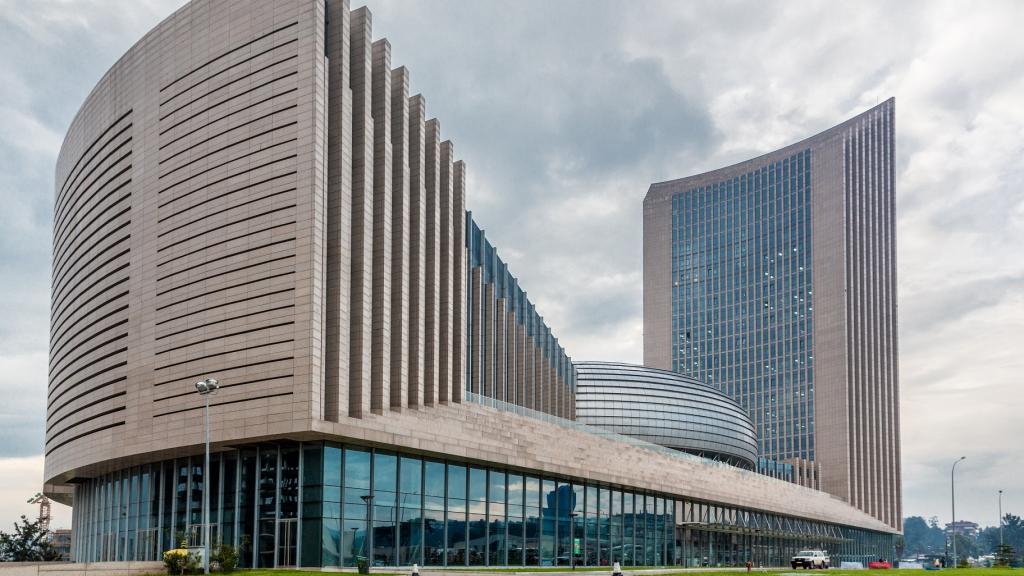
The African Union headquarters in Addis Ababa, Ethiopia. (Photo: iStock)
The declaration consists of a preamble and six policy recommendations. Among some of its recommendations, the declaration invites AU member states to explore all available options under international law to mitigate against the risk of COVID-19-related ISDS claims, considering the interaction between pandemics and international investment law. The declaration also invites them to explore all possibilities for mitigating the risks of ISDS, including a mutual temporary suspension of ISDS provisions in investment treaties in relation to measures that governments have taken to tackle the pandemic. AU member states are also encouraged to consider renegotiating their investment treaties so that these feature provisions that are better suited to exceptional situations, such as pandemics, will also bring these deals in line with new trends at the regional and international levels.
While the declaration sets out a series of international law considerations that are centred around the principles of cooperation, multilateral action, and the proactive exploration of options for mitigating ISDS risk, it also highlights one of the possible options under customary international law that states have at their disposal. Namely, states can seek the suspension of ISDS provisions with their respective treaty partners.
In this article, we explore the viability of this option in mitigating treaty-based ISDS claims while analyzing the advantages and limitations of other available reform options. This is especially important for other regional economic blocs or like-minded countries aiming to take a similar approach and who may wish to coordinate their responses to ISDS risks both internally and with other country groups.
What Are the Key Issues for Governments to Consider?
There are at least three key issues that governments should keep in mind as they determine how to respond to the risk of COVID-19-related ISDS claims.
First, governments would need to assess the extent to which they would like to mitigate against the risk of COVID-19-related ISDS claims and, therefore, whether a broad or narrow response is the most practical approach. This assessment will depend on the language contained in their investment treaties, domestic laws, and investment contracts.
Undertaking this type of assessment will ensure that governments choose an approach that is commensurate to how exposed they are to COVID-19-related ISDS risks.
For most governments, a narrow approach, such as the temporary suspension of ISDS, would be quicker to implement and give them the breathing space to develop broader, more systemic reforms that require more time. The speed of implementing reforms is another practical concern. In crisis situations, the perfect option can be “the enemy of the good,” especially given the pace at which this virus has spread and the swift emergency measures that governments have had to take.
Second, governments would need to consider the most legally sound options relative to their domestic laws and international law. Otherwise, states could adopt solutions that expose them to legal challenges further down the road.
Third, governments would need to assess whether to pursue these options at the bilateral, regional, or multilateral level—or a combination thereof. Indeed, governments may wish to implement various solutions in parallel or sequentially. For example, a government may try one option at first and later switch tack if this approach fails to yield the necessary results.
Keeping these considerations in mind, there are a few other key issues to note before we present reform options. First, states’ public interest measures—be they related to health, trade, or finance—can come under challenge from investors, especially in times of severe national crises. Second, not all government COVID-19-related measures will constitute a breach that is enforceable under ISDS. Third, all the options listed below are legally sound under international law and would not bar access to justice for foreign investors who have domestic or other applicable international processes in force to address any disputes that arise.
How Can Governments Ensure Sufficient Policy Space to Support Their Health Systems and Economies Without Incurring ISDS Risks?
Suspension
The Vienna Convention on the Law of Treaties provides for the suspension of all or part of a treaty. This is set out in Articles 57 and 58 of that convention. An agreement to suspend the operation of ISDS for all COVID-19-related measures could be concluded multilaterally, regionally, or bilaterally. This agreement could be initiated by and concluded between a small group of like-minded states, after which additional states could sign on. This would minimize the potential for lengthy negotiations and could address multiple treaties at once. For this option to be effective, it will need significant buy-in from states—particularly those states whose investors are the most frequent users of ISDS.
Given that virtually all states have taken COVID-19-related measures, the risks of ISDS challenges to those measures extend to all states with investment treaties. Government positions in favour of or against this type of agreement may not fall along the traditional fault lines between capital-importing and capital-exporting states. Sustained diplomatic engagement and moral persuasion to convince as many states as possible to sign on would be a necessary precondition for this option to be effective. Importantly, suspension would be a timely and well-targeted option, as it bars ISDS claims from the outset without requiring the launch of arbitral proceedings to review claims on their merits.
Termination by Consent With a Treaty Partner or Unilaterally
Two states can agree to terminate an investment treaty between them at any time. They can also agree to extinguish the treaty’s “survival clause,” which would otherwise allow established investors to continue bringing ISDS claims for a set period after termination, usually over 10 or 15 years. By contrast, unilateral termination can only be done “in conformity with the provisions of the treaty,” according to Article 54(a) of the Vienna Convention on the Law of Treaties. Most investment treaties allow unilateral termination only after the treaty’s first term has expired—and the terminating state cannot unilaterally extinguish the survival clause.
Termination by consent would clearly be a lawful and effective way of barring COVID-19-related ISDS claims. Its main drawback is the pace: states would need to negotiate to terminate each treaty one by one, which would be slow, onerous, and resource-intensive. Terminating a treaty will impact all claims, not just those that are related to COVID-19, so it may also be seen as an option that is too broad in scope relative to the issue it means to tackle. Unilateral termination would not be an effective way to bar COVID-19-related ISDS claims, given that the survival clause would remain intact.
Joint Interpretation
Joint interpretation can clarify the meaning of a treaty provision and narrow an arbitral tribunal’s interpretive discretion. States could use such a statement in various ways. For example, they could use it to define “COVID-19-related measures” and assert that the parties consider such measures to fall within one of the treaty’s public interest exceptions or outside the scope of the treaty’s substantive protections.
Joint interpretation shares the same procedural drawbacks to termination by consent, requiring a treaty-by-treaty negotiation process that could be time consuming. In addition, arbitral tribunals do not always consider themselves bound by interpretive statements, especially those that go beyond clarifying the states’ original intent when concluding the treaty. Instead, they relate to the parties’ current understanding of the treaty. Unlike with the suspension option, a joint interpretation is likely to leave tribunals with a margin of discretion on how to handle COVID-19-related measures and, therefore, would not bar the ISDS claim from the outset.
Amendment
An amendment changes a treaty’s content by adding new provisions or changing or removing existing ones. An amendment that, for example, carves out COVID-19-related measures from the scope of ISDS could be an effective way to mitigate the risk of ISDS claims. However, like joint interpretation and termination by consent, an amendment would likely need to be negotiated treaty by treaty. An additional drawback is that an amendment usually requires a domestic ratification process (e.g., parliamentary approval) to come into effect. This means that it would not be a timely option.
Options for Broader, Systemic Reforms
UNCTAD has long advised states to consider long-term reforms to address the risks involved with old-generation treaties. The organization has lately developed an International Investment Agreements Reform Accelerator, which aims to expedite the modernization of the existing stock of old-generation International Investment Agreements (IIAs). The reform accelerator was built upon UNCTAD’s Reform Package for the International Investment Regime, which focuses on three phases: moving to a new generation of IIAs (Phase 1), modernizing the existing stock of IIAs (Phase 2), and improving investment policy coherence and synergies (Phase 3). Through renegotiating and developing new model treaties that can be used in future negotiations, countries could proactively address a wider set of risks now and in the future, such as pandemics or other global shocks.
Conclusion
The African Union’s Declaration on COVID-Related ISDS Risks is an important step that paves the way for possible actions by member states according to their needs and priorities. It also sends an important signal to countries and country groups in other world regions: that it is possible to act in concert to avert these ISDS risks while at the same time providing flexibility and policy space in light of the varying circumstances that governments face.
*The authors would like to thank Nathalie Bernasconi-Osterwalder, Sarah Brewin, and Sofía Baliño for their feedback on earlier drafts.
The Africa Agriculture Trade Monitor: What next for the African continent?
February 25, 2021 2:00 pm - 3:00 pm CET
Youtube live-cast on the day of the event
(Open to public)
On January 1st, 2021, the African Continental Free Trade Agreement (AfCFTA) implementation began. Governments, producers, consumers, investors and NGOs watch the launch, eager to see if regional trade integration will deliver the promises of improved livelihoods and food security. This seminar will explore how leading trade experts, diplomats, agripreneurs and farmer cooperatives expect the AfCFTA to impact markets and trade flows across the continent.
The speakers considered the AfCFTA’s effects on Africa’s widespread informal cross-border trade, and how this essential livelihood for women might be integrated into formal systems. As countries recover from Covid-19 disruptions, to what extent can the AfCFTA’s trade integration help reinvigorate regional economies, alleviate poverty and support broader public well-being?
This was a joint event between the he International Institute for Sustainable Development (IISD), the World Trade Organization (WTO) and the International Food Policy Research Institute (IFPRI).
IISD Welcomes AU Ministerial Declaration on the Risks of Investor–State Arbitration for COVID-19 Measures
December 21, 2020
November 24, 2020 – At the 14th meeting of the African Union Ministers of Trade (AMOT) on November 24, 2020, ministers adopted a Declaration on the Risk of Investor–State Dispute Settlement with respect to COVID-19 related measures. This is a landmark move that can help ensure governments have the policy space they need to respond to the pandemic without the risk of costly legal challenges from foreign investors.
H.E. Albert Muchanga, the Commissioner for Trade and Industry of AU Commission, expressed hope that “the action undertaken by the African Union Ministers of Trade will contribute to sustainable development-oriented international law and policy,” like other innovative and forward-thinking approaches developed by AU member states.
IISD welcomes and supports this initiative by African Union Member States, which aims to raise awareness of COVID-19-related ISDS risks, provides member states with guidance on possible policy options that can address this risk effectively, and lends moral and political support to member states as they pursue options in line with their national needs.
“The emergency measures that governments took to respond to the pandemic were vital from a public health perspective, as well as for safeguarding their economies. Ensuring that these measures do not face legal challenges from foreign investors is crucial,” said Nathalie Bernasconi-Osterwalder, Senior Director, Economic Law and Policy, at IISD.
“This decision by the Ministers of Trade of African Union Member States gives some valuable guidance and political support for national policy-makers, as they continue their efforts at tackling the pandemic and planning for the COVID-19 recovery,” she said. The policy actions endorsed by the African Union are centred around the principles of cooperation, multilateral action, and the proactive exploration of options for mitigating ISDS risk. This issue has been the subject of extensive IISD research and consultations with governments, academics, and civil society over the past several months.
IISD has published two commentaries that look at the unique COVID-19-related challenges of investor–state dispute settlement claims arising from investment treaties and national laws. Both look at why ISDS could be a cause for concern and which kinds of treaty and domestic law provisions could lead to ISDS claims. The commentaries also discuss the interaction between such laws and old-generation bilateral investment treaties along with ways to mitigate the risks of investor–state arbitration.
New handbook provides key tools to parliamentarians to foster responsible investment in Africa
Supporting more and better investments in Africa’s agriculture
December 15, 2020
15 December 2020, Accra – A handbook to guide parliamentarians in creating enabling environments for more and better investments in agriculture and food systems was launched today in Africa by the Food and Agriculture Organization of the United Nations (FAO) and the International Institute for Sustainable Development (IISD).
To end poverty and hunger by 2030, the world needs an additional USD 265 billion in annual investments, both from the public and private sectors. Of this, USD 140 billion must focus on agriculture. Parliamentarians are key to help direct these investments toward increasing sustainable productivity, raising incomes, creating job opportunities and ultimately lifting the rural poor out of poverty and hunger.
"Parliamentarians can promote responsible public investments, and they can also create a conducive environment for responsible private investments, attracting larger scale agribusiness investors while ensuring safeguards are in place to protect human rights and the environment," FAO’s Assistant Director-General and Regional Representative for Africa Abebe Haile-Gabriel said.
"Building on more than ten years of work with parliamentarians in Africa, this handbook is a critical contribution to advancing more responsible investment in agriculture, as well as showcasing positive changes in laws and policies around the world," Richard Florizone, the President and CEO of IISD said.
Today’s Africa launch event brought together members of the Pan-African Parliament, the East African Legislative Assembly (EALA) and the Economic Community of West African States (ECOWAS) Parliament, as well as parliamentary advisors and other stakeholders.
Watch the full recording of the event
Africa’s parliamentarians key to sustainable food systems transformation
Agricultural investment is 2.5 to three times more effective in increasing the incomes of the poor than investment in other sectors. However, the negative impacts of poorly planned and executed agricultural investments can outweigh the benefits, for example if the investment results in violations of tenure rights, environmental degradation, and harm to local food security.
Responsible investments in agriculture and food systems: a practical handbook for parliamentarians and parliamentary advisors is an invaluable tool for informing and inspiring parliamentarians on how to mainstream responsible agricultural investments into the public agenda, the legislative process, budgets and oversight of policies.
"It gives me great pleasure to recommend this handbook to all actors and stakeholders concerned about food security, increases in the volume and value of intra-regional agricultural investment and trade, and generating opportunities for economic growth across the West African Sub-region," said Sidie Mohamed Tunis, Speaker of the ECOWAS Parliament.
"Parliamentarians are key agents of change who can tackle inequality and increase prosperity for all by creating an enabling environment for better responsible investment in agriculture and food systems. At EALA, we remain committed to the pursuit and realization of food and nutrition security," said Ngoga Karoli Martin, Speaker of the EALA. "I recommend this handbook to all those concerned about the yawning social, economic and environmental gaps in agriculture and food systems."