Parliamentarians Action #3 | Protecting and Promoting Women’s Land Rights in the Face of COVID-19 and Beyond
September 17, 2020 4:30 am - 7:00 am CEST
(Open to public)
Land is a critical resource from which people derive their livelihoods. However, women around the world remain significantly disadvantaged regarding their right to land. Even when they are recognized as the primary users, they often lack ownership or control of the land or its economic outputs. The COVID-19 pandemic threatens to exacerbate this inequality.
This dialogue's theme, Protecting and Promoting Women’s Land Rights in the Face of COVID-19 and Beyond, covers the importance of women’s land rights for the achievement of the Sustainable Development Goal (SDG) agenda in terms of the eradication of food insecurity, poverty, and gender inequality, as well as the measures to foster gender-equitable land tenure rights during the COVID-19 pandemic and beyond.
The dialogue’s objectives include:
Raising awareness and strengthening knowledge on gender inequalities, land property rights, and the interlinkages with rural poverty and food insecurity. How can the SDG agenda and tools—such as the voluntary guidelines on the responsible governance of tenure of land, fisheries, and forestry—offer opportunities to strengthen women’s land rights?
Enhancing parliamentarians’ commitment to achieving SDG 2 on zero hunger and SDG 5 (particularly indicator 5.a.2) on gender equality through the promotion and adoption of gender-sensitive policy and legal frameworks
Promoting an exchange of knowledge and experiences among parliamentarians, women’s rights organizations, and other relevant stakeholders on specific measures and approaches to enhancing rural women’s land and property rights during and after the pandemic.
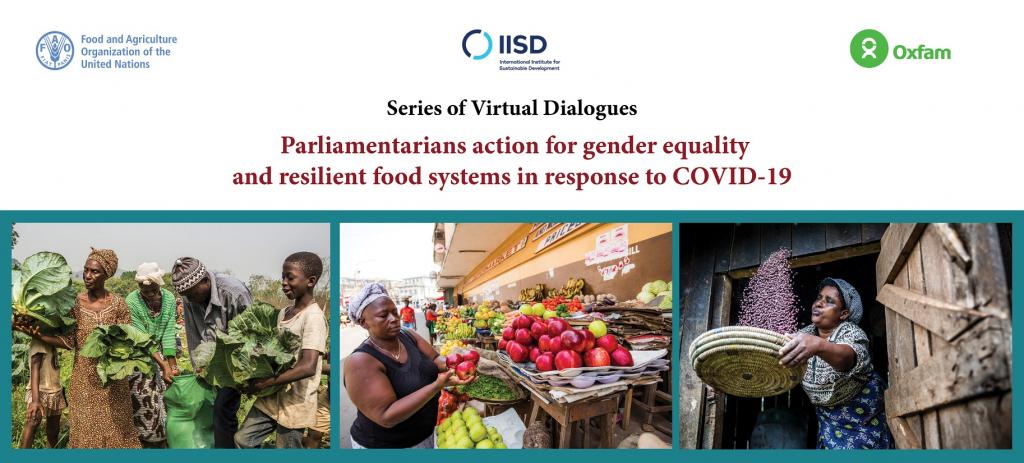
This virtual meeting was the third in a series of dialogues organized by the Food and Agriculture Organization of the United Nations (FAO), IISD, and Oxfam as part of their policy support to the ECOWAS Network of Parliamentarians on Gender Equality and Investments in Agriculture and Food Security. The objective of the series was to enhance the role of African parliamentarians in mitigating the gender-differentiated impacts of COVID-19 on food systems.
Interpretation: Simultaneous translation into French and English will be available.
The series highlights and explains emerging issues that affect the resilience and sustainability of food and agriculture systems, particularly in developing countries.
With this series, IISD continues to fulfil its commitment to creating innovative knowledge and spaces for inclusive and informed debate on how best to achieve sustainable and equitable food and agriculture systems. The series is designed to help governments, parliamentarians, civil society organizations, farmers, the private sector, and regional and international organizations to understand the risks, benefits, and policy issues raised by new and emerging issues in food and agriculture systems.
The series will contribute to the full and informed participation of developing country governments and their societies in the development of just and sustainable national, regional and global food and agriculture systems, focused in particular on legal and institutional frameworks for investment and trade.
Parliamentarian Action #2 | Advancing gender equality in the context of family farming
July 22, 2020 6:30 am - 12:30 pm
(Open to public)
En français plus bas
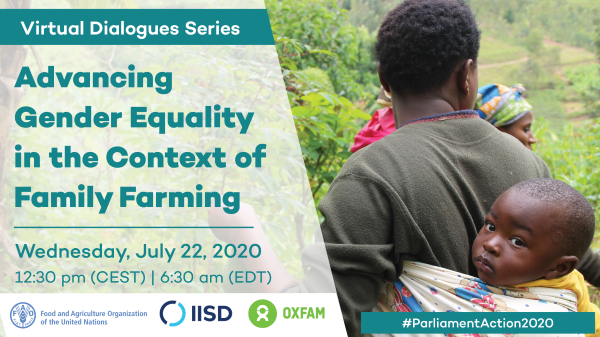
The second virtual dialogue in the Parliamentarians' Actions for Gender Equality and Resilient Food Systems in Response to COVID-19 series was held on July 22, 2020, from 12:30 p.m. to 3:00 p.m. (CEST).
This dialogue's theme, Advancing gender equality in the context of family farming, discussed the role of parliamentarians in the implementation of gender policies, legislation, and investments in support of family farming. In particular, the role of rural women in contributing to sustainable agriculture and food systems during the COVID-19 pandemic and beyond was addressed.
The dialogue specifically:
Raised awareness about the United Nations Decade of Family Farming as an opportunity to address rural poverty, support family farming, and address gender inequalities through the design and implementation of national action plans.
Enhanced parliamentarians’ commitment to the achievement of SDG 2 on zero hunger and SDG 5 on gender equality in order to tackle the specific challenges faced by rural women in family farming.
Promoted a multi-stakeholders’ policy dialogue among parliamentarians, farmers’ organizations, and women’s organizations on how to mitigate the impact of COVID-19 on rural women and family farmers.
This virtual meeting was the second in a series of dialogues organized by the Food and Agriculture Organization of the United Nations (FAO), IISD, and Oxfam as part of their policy support to the ECOWAS Network of Parliamentarians on Gender Equality and Investments in Agriculture and Food Security. The objective of the series was to enhance the role of African parliamentarians in mitigating the gender-differentiated impacts of COVID-19 on food systems.
Watch the webinar's full recording
Speakers:
H.E. Amie Fabureh, Minister of Agriculture, The Gambia
Hon. Angelique Ngoma, President of the Cooperation and International Development Commission of the Parliamentary Assembly of the Francophonie
Hon. Maryse Gaudreault, President of the Network of Women Parliamentarians of the Francophonie
Hon. Omar Darboe, Member of the National Parliament of Gambia
Hon. Veneranda Uwamariya, Member of the National Parliament of Rwanda
Hon. Simona Bucura-Oprescu, Member of the Chamber of Deputies of Romania
Hon. Yves Fernand Manfoumbi, Secretary General of the Parliamentary Alliance Network for Food and Nutrition Security of the ECCAS region
Marcela Villarreal, Director of the Partnership Division, FAO
Nadjirou Sall, Secretary General of Réseau des organisations paysannes et de producteurs de l'Afrique de l'Ouest (ROPPA)
Stéphanie Barrial, Content Manager, World Rural Forum
Ika Krishnayanti, Aliansi Petani Indonesia, Asian Farmers Association
Julie Cissé, Coordinator, Groupe d’initiatives pour le Progrès social
Tiousso Halima, Réseau des organisations paysannes et de producteurs de l'Afrique de l'Ouest (ROPPA)
Clara Park, Regional Gender Officer for Near East and North Africa, FAO
Le deuxième dialogue virtuel de la série les Actions des parlementaires pour l'égalité des sexes et des systèmes alimentaires résilients en réponse au COVID-19 était organisé sous le thème: Faire progresser l’égalité des sexes dans le contexte de l’agriculture familiale. Le dialogue a abordé le rôle des parlementaires dans la mise en œuvre des politiques, des législations et des investissements porteurs de transformation en matière d’égalité des genres et œuvrant en faveur de l’agriculture familiale. En particulier, le rôle des femmes issues des zones rurales dans la contribution à l'agriculture et aux systèmes alimentaires durables pendant la pandémie de COVID 19 et au-delà a été abordé.
Le dialogue a contribué spécifiquement à:
Sensibiliser à la Décennie des Nations Unies pour l'agriculture familiale comme une opportunité pour lutter contre la pauvreté rurale, pour soutenir l'agriculture familiale et pour lutter contre les inégalités entre les sexes, par la conception et la mise en œuvre de plans d'action nationaux.
Renforcer l'engagement des parlementaires en faveur de la réalisation de l'ODD 2 sur la faim et de l'ODD 5 sur l'égalité des sexes afin de relever les défis spécifiques auxquels sont confrontées les femmes rurales dans l'agriculture familiale.
Promouvoir un dialogue politique multipartite entre les parlementaires, les organisations d'agriculteurs et les organisations de femmes sur la manière d'atténuer l'impact de COVID-19 sur les femmes rurales et les agriculteurs familiaux.
Cette réunion virtuelle a été la deuxième d'une série de dialogues organisés par l'Organisation des Nations Unies pour l'alimentation et l'agriculture (FAO), l'IIDD et Oxfam dans le cadre de leur soutien politique au Réseau des parlementaires de la CEDEAO sur l'égalité des sexes et les investissements dans l'agriculture et La sécurité alimentaire. L'objectif de la série a été de renforcer le rôle des parlementaires africains dans l'atténuation des impacts différenciés selon le sexe du COVID-19 sur les systèmes alimentaires.
Panélistes
SE Amie Fabureh, ministre de l'Agriculture, Gambie
Hon. Angelique Ngoma, Présidente de la Commission Coopération et Développement International de l'Assemblée Parlementaire de la Francophonie
Hon. Maryse Gaudreault, Présidente du Réseau des femmes parlementaires de la Francophonie
Hon. Omar Darboe, Membre du Parlement national de la Gambie
Hon. Veneranda Uwamariya, Membre du Parlement national du Rwanda
Hon. Simona Bucura-Oprescu, Membre de la Chambre des députés de Roumanie
Hon. Yves Fernand Manfoumbi, Secrétaire général du Réseau de l'Alliance parlementaire pour la sécurité alimentaire et nutritionnelle de la région CEEAC
Marcela Villarreal, Directrice de la Division des partenariats, FAO
Nadjirou Sall, Secrétaire général du Réseau des organisations paysannes et de producteurs de l'Afrique de l'Ouest (ROPPA)
Stéphanie Barrial, Responsable du contenu, Forum rural mondial
Ika Krishnayanti, Aliansi Petani Indonésie, Association des agriculteurs asiatiques
Julie Cissé, Coordonnatrice, Groupe d’initiatives pour le Progrès social
Tiousso Halima, Réseau des organisations paysannes et de producteurs de l'Afrique de l'Ouest (ROPPA)
Clara Park, Responsable régionale du genre pour le Proche-Orient et l'Afrique du Nord, FAO
Modératrice: Tacko Ndiaye, Administrateur principal de programme / Chef d'équipe Genre, FAO & Francine Picard, Chargée des politiques, IISD
Interprétation: Une traduction simultanée en français et en anglais sera disponible.
Date: 22 juillet 2020
Heure: 12 h 30 (CEST) à 15h00 (CEST) (durée: 2h30)
Ensuring a Balance of Power in the Face of COVID-19
June 17, 2020
Half the world’s population is subject to varying degrees of lockdown in an attempt to contain the COVID-19 pandemic. Governments have adopted measures aimed at limiting disruptions to the normal functioning of society and at mitigating the adverse consequences of COVID-19. Even though containment measures have been universally legitimized by health authorities, they nonetheless affect freedom of religion, freedom of trade and of movement, and sometimes fundamental judicial guarantees as well. Where should one draw the line between public health measures and individual rights?
Faced with an unprecedented crisis, should governments offer solutions that sidestep requirements of transparency, accountability, and responsibility? In Malawi, the High Court blocked the implementation of public lockdown measures on the grounds that the government had failed to show how the country’s poorest citizens would be protected in the fallout. This unprecedented decision contrasts with many places in the world where parliaments have yielded in the face of government action.
Crises are paradoxical times in the world of politics; they heighten the demands for effectiveness that are placed on those in power while simultaneously testing the strength of institutions.
Parliaments play a crucial role as guardians of the democratic process, democratic values, and fundamental freedoms. It is, therefore, critical that they continue to function throughout this crisis while striving to provide democratic controls and to guarantee a balance of powers when possible.
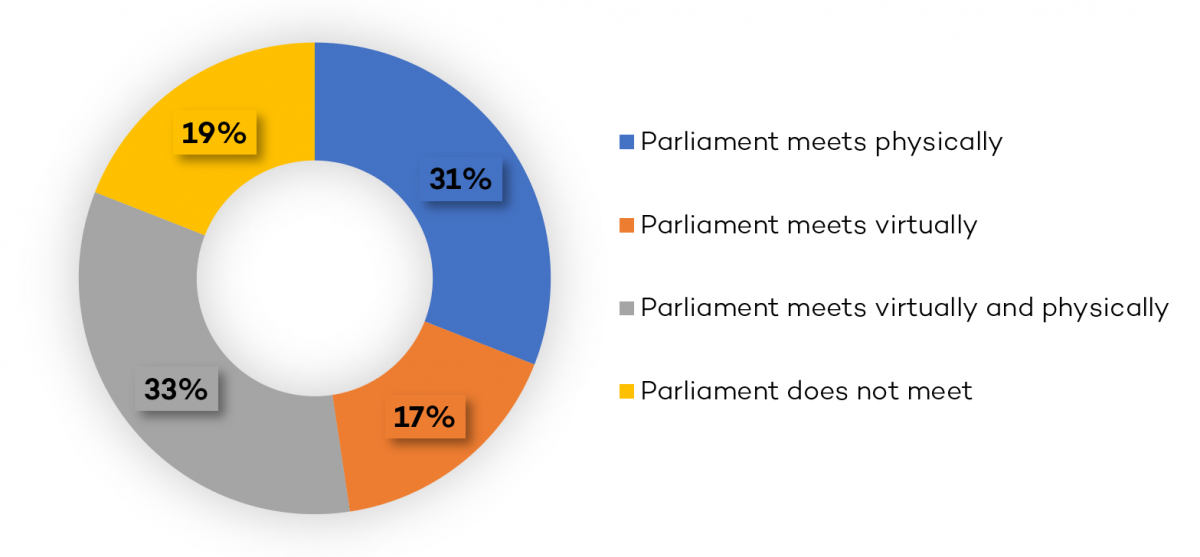
COVID-19 has raised unique challenges for parliaments’ capacity to continue their work. Due to social distancing and containment measures, nearly 20% of parliaments, including those of the United Kingdom, Myanmar, and China are currently not sitting, according to the Inter-Parliamentary Union (IPU). Others have adopted technological solutions to allow parliaments to meet virtually. Just over 30% of legislative assemblies have been able to maintain physical attendance, but with restrictions such as limitations on the number of parliamentarians allowed to attend plenary sessions and committees. In Senegal, 33 parliamentarians out of 165 voted for a bill empowering the President of the Republic to rule by executive decree on issues normally situated in the legal domain in order to respond to the pandemic. For a period of three months, the President is not required to go through the National Assembly to pass legislation on economic, budgetary, financial, legal, health, and security issues.
Effects of the pandemic on the exercise of parliamentary jurisdiction Source: How do Parliaments meet during Covid-19? Author diagram, based on testimonials gathered by the Inter-Parliamentary Union’s Centre for Innovation in Parliament in April 2020
In times of crisis, it is not unusual for the law to give way to other normative supports controlled by executive bodies. However, even if the circumstances of the pandemic warrant a declaration of a state of emergency or the granting of exceptional powers to the executive branch, this in no way should be construed as a blank cheque to the government—all the more so because emergency powers have a disturbing tendency to become permanent. There is a risk of resorting to a state of emergency that goes above and beyond its most basic purpose. The Hungarian Parliament has approved a law allowing its Prime Minister to govern by decree, with no end date. Some leaders have taken advantage of the coronavirus crisis to impose excessive restrictions on human rights, democracy, and the rule of law. If the state uses its power to the fullest extent, it risks becoming a dangerous Leviathan—hence the importance of measures to limit, control, and offset this power.
What Role Can Parliaments Play?
The power to control executive bodies whose prerogatives have been very widely extended to deal with the crisis is therefore paramount. Parliament is above all a supervisory body for the government and must remain so whether in normal times or in times of crisis. Parliamentarians must ensure that emergency measures are implemented correctly and according to democratic standards, that restrictions on freedoms are proportionate and provisional, that the use of armed force is justified and regulated, that economic support funds are paid out where they are needed, and that security and stability are maintained.
Parliaments can also participate in awareness-raising initiatives and promote transparency with regard to the health crisis, which is crucial for preserving the public’s confidence in government responses to the pandemic. Parliamentarians can interact with the public, imparting information and building awareness of the measures adopted by the executive. To this end, the parliamentarians of Sierra Leone are visiting their constituencies to raise people’s awareness of the dangers of the pandemic and to inform them about the precautionary measures they are advised to take.
COVID-19 has propelled the world into a very serious crisis. It is important that parliaments help design responses and support measures. Parliamentarians serve the central function of controlling the governmental response and also of evaluating and adopting emergency responsive legislation directing national funds toward meeting the needs of the population. More than ever, the citizens’ representatives must be present.
Working with new technologies, parliaments are already examining available solutions and the procedural options that will allow for new ways of debating and voting in their now-virtual environment. Collective deliberation remains the most reliable tool for ensuring balanced, fully developed legislation.
The medium- and long-term effects of the measures taken to slow and contain the spread of the disease remain unpredictable. Does safeguarding the democratic process and ensuring respect for the rule of law amount to questioning the balance of power between the government and the parliament? Yes—because otherwise, in times of crisis, what would the word “democracy” really mean?
Parliamentarians' Action for Gender Equality and Food Security as a Response to COVID-19
June 17, 2020 8:00 pm
(Open to public)
In 2020, IISD together with the Food and Agriculture Organization of the United Nations (FAO) and Oxfam organized a series of online dialogues as part of their policy support to the ECOWAS Network of Parliamentarians on Gender Equality and Investments in Agriculture and Food Security.
This series of webinars served to explore and generate a reflection on the role of parliamentarians in mitigating the gender-differentiated impacts of COVID-19 on agriculture and food systems.
In total four webinars were held virtually and attended by 200 participants on average. Please refer to the webinars specific webpages in the right hand margin of this page for further details related to speakers, recording and reports.
Parliamentarians' Action #1 | Gender Equality and Food Security as a Response to COVID-19
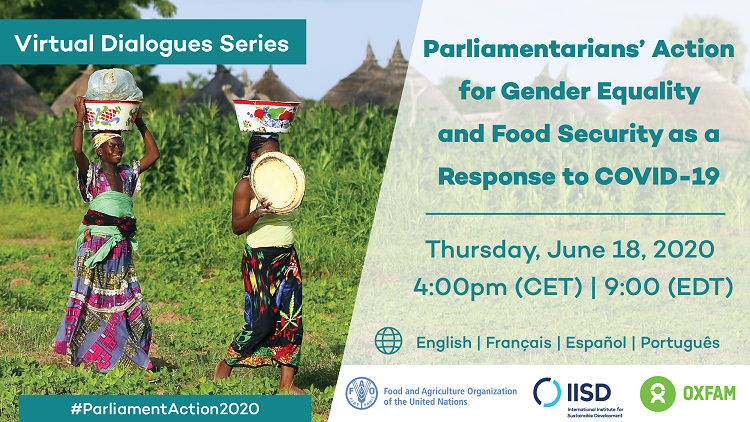
This webinar offered a unique opportunity for a transversal discussion among parliamentarians from Africa, Europe, Latin America, and the Caribbean, and contributed to generating a reflection on their role in tackling the COVID-19 crisis. Participants shared examples of good practices in terms of gender-responsive policy measures undertaken in their respective regions to reinforce food security and food systems.
During this webinar, parliamentarians from Africa, Europe, Latin America, and the Caribbean adopted a call for action in response to the impacts of Covid-19 on gender equality, food secutiry and nutrition. The declaration is available at the bottom of this page in English and in French.
We will act as champions for ensuring that the policy responses to COVID-19 and beyond are gender- responsive by addressing women’s needs and priorities, especially in rural areas, including the adoption of mitigation and temporary special measures, if necessary.
Excerpt from the Parliamentarians Call to Action
During this event, parliamentarians learnt about the call from the Parliamentary Front Against Hunger in Latin America and the Caribbean urging countries not to neglect the fight against hunger and malnutrition during the COVID-19 period.
The webinar enhanced parliamentarians' actions on the implementation of policies and legislation for empowering women in agriculture and food systems during COVID-19 and beyond.
This virtual meeting was the first in a series of dialogues organized by the Food and Agriculture Organization of the United Nations (FAO), IISD, and Oxfam as part of their policy support to the ECOWAS Network of Parliamentarians on Gender Equality and Investments in Agriculture and Food Security. The objective of the series is to enhance the role of African parliamentarians in mitigating the gender-differentiated impacts of COVID-19 on food systems.
Speakers:
Maria Helena Semedo, Deputy Director-General, FAO
Siga Fatima Jagne, Commissioner for Social Affairs and Gender, Economic Community of West African States (ECOWAS)
Ana Regina Segura Martínez, Head of Unit for Rural Development, Food and Nutrition, Spanish Agency for International Cooperation and Development
Monica Eva Copa, President of the Senate, Bolivia
Jario Flores, General Coordinator of the Parliamentary Front Against Hunger in Latin America and the Caribbean
Soraya Rodriguez, Member, EU Parliamentary Alliance on Food Security and Nutrition
Mathias Kasamba, Chairperson, Committee on Agriculture, Tourism and Natural Resource, East African Legislative Assembly
Teresa Cálix Raudales, Honduran Representative and Coordinator, Parliamentary Front Against Hunger in Mesoamerica
Abdoulaye Vilane, Chairperson, ECOWAS Network of Parliamentarians on Gender Equality, Responsible Investment in Agriculture and Food Security
Tacko Ndiaye, Senior Gender Officer, FAO
Francine Picard, Policy Officer, IISD
Date: June 18, 2020, 4:00 p.m. (CET) (duration: 2 hours)
Fair and Sustainable Trade in Food and Agriculture
IISD conducts research and facilitates dialogue to help bring about trade rules that promote equitable and sustainable international trade in food and agricultural products.
The rules that govern international trade in food and agricultural products influence what is grown, where, and how. This has implications for livelihoods and food security in developing countries and for the environmental sustainability of our food systems. However, negotiations on international trade rules too often take place in isolation from these broader public policy considerations.
We produce evidence and analysis to increase understanding of the links between agricultural trade rules and key sustainable development challenges facing low-income countries and vulnerable groups. We also provide a space for informed discussion among a wider set of actors—including those who have not traditionally been involved in talks on trade and markets.
Our work on this topic focuses on three main areas: influencing World Trade Organization (WTO) negotiations, promoting the reform and repurposing of harmful agricultural subsidies, and analyzing how voluntary sustainability standards can help make value chains more sustainable.
WTO Agriculture Negotiations
We aim to influence WTO negotiations to help bring about multilateral trade rules that promote equitable and sustainable international trade in food and agricultural products and support a more resilient and sustainable global food system. We do this by producing evidence and analysis, facilitating dialogue with WTO negotiators on how to design WTO rules that drive sustainable development, and supporting delegations from low-income countries to engage effectively in the negotiations.
Repurposing Public Support to Agriculture
Globally, governments provide over USD 850 billion a year in support to their agriculture sectors. Much of this support incentivizes unsustainable production and consumption patterns. It incentivizes farming practices that drive climate change, environmental damage, and biodiversity loss, threatening the sustainability of our food systems. It also promotes the consumption of unhealthy foods, driving worsening global nutrition and increasing obesity rates. We aim to help governments rethink how they support and subsidize agriculture, with a view to ensuring such support contributes to sustainable development objectives rather than undermining them.
Standards and Value Chains
Our State of Sustainability Initiatives program looks at the role that voluntary sustainability standards (VSSs) and associated initiatives can play in supporting more sustainable forms of production, consumption, and trade. Our work seeks to improve the design and practices of standards, increase synergies between standards and policy, and enhance transparency and accountability in value chains.
Ceres2030 is a novel partnership between academia, civil society, and economists, bringing together three institutions who share a common vision: a world without hunger, where small-scale producers enjoy greater agricultural incomes and productivity, in a way that supports sustainable food systems.
Our mission is to provide the donor community with a menu of policy options for directing their investments, backed by the best available evidence and economic models.
Ceres2030 brings together economic modelling, machine learning, and evidence-based synthesis into one initiative, helping fill a major knowledge gap in the field of agricultural and food policy. Ceres2030 connects this knowledge back to the donor community, making sure decision makers have the cost figures and evidence they need when deciding where and how to make their investments.
Advancing Alignment for Climate-Resilient Development
IISD has published three briefs introducing the concept of alignment and outlining entry points for countries to get started in aligning different policy processes.
Sustainable development, disaster risk reduction and climate change adaptation are inextricably linked and interconnected fields.
Building strategic linkages and coordinating actions among them could increase the effectiveness of different actions and related goals.
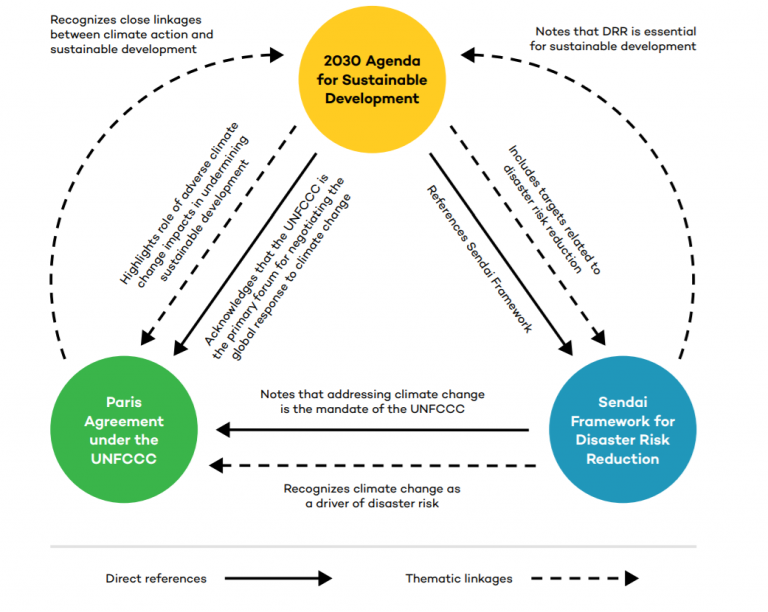
In 2015, the global community adopted the 2030 Agenda for Sustainable Development, the Paris Agreement and the Sendai Framework on Disaster Risk Reduction (DRR). All of them have substantial areas of overlap and clear convergence of objectives related to strengthening resilience, fostering sustainable development and reducing vulnerability to climate change and disasters. For example, the Paris Agreement recognizes the links between climate action and sustainable development while the 2030 Agenda highlights the role of climate change impacts in undermining sustainable development. The Paris Agreement has significant overlap with the Sendai Framework when it deals with losses and damage caused by climate change and extreme weather. Furthermore, Sendai recognizes climate change as a driver of disaster risk and that DRR is essential for sustainable development. In addition, all three frameworks have formulated improved cooperation and international support as a common goal (in SDG 17 of the 2030 Agenda and in both the Sendai Framework and Paris Agreement), creating the foundation for creating functional linkages.
Within countries, policy processes have been established to outline individual commitments and strategies for meeting each nation’s objectives under these global agendas. These include strategies aimed at achieving the SDGs; National Adaptation Plans (NAPs) and Nationally Determined Contributions (NDCs) under the Paris Agreement; and DRR strategies under the Sendai Framework. Alignment of these different processes can increase coherence, efficiency and effectiveness toward achieving development outcomes that are resilient and sustainable.
It is thus critical to promote a coherent approach to the planning, implementation and reporting of the three global agendas. Pursuing alignment will enable smarter use of resources, improve the quality of planning and magnify the impacts. It will also help minimize potential conflicts and counterproductive implementation of measures, achieving joint agenda goals more efficiently and effectively.
While many countries recognize the value of alignment, they struggle to understand what aligned policy processes look like in practice and how this can be achieved. To date, the research on good examples of aligned and integrated policy processes under the different post-2015 global agendas is limited.
IISD has published three briefs introducing the concept of alignment and outlining entry points for countries to get started in aligning different policy processes. These briefs also highlight country perspectives on the alignment of NAPs and NDCs as a basis for broader alignment toward climate-resilient development.
The briefs are complemented by case studies (Colombia, Kenya, Sri Lanka), that explore country-specific emerging good practices and practical learnings in aligning their national-level policy processes under these global agendas.
The overview briefs and case studies are a product of the Support Project for the Implementation of the Paris Agreement (SPA), which is funded by the German Federal Ministry for the Environment, Nature Conservation and Nuclear Safety (BMU) under its International Climate Initiative (IKI). They were produced jointly by IISD and GIZ.
Mobilizing Development Finance for Strategic and Scaled-up Investment in Climate Adaptation
This project aims to advance the mainstreaming of adaptation in development finance strategies, by helping multilateral development banks scale up investments in actions that align with country-defined adaptation priorities.
Addressing the substantial gap between current levels of financing for adaptation and what developing countries require to increase their resilience to climate change is critical to achieving the Paris Agreement’s adaptation goal.
Multilateral development banks (MDBs) have pledged to help address this gap by scaling up their provision of climate finance and by better integrating climate change adaptation considerations into their development finance portfolios. Mainstreaming adaptation considerations into MDB investments would increase the financing available to build resilience to climate change. At the same time, there is a need to ensure that these investments are supporting adaptation actions prioritized by developing country governments.
The “Mobilizing Development Finance for Adaptation” aims to generate the knowledge needed to advance the mainstreaming of adaptation in development finance strategies. This will help MDBs scale up investments in actions that are strongly aligned with country-defined adaptation priorities. It seeks to identify barriers—both within MDBs and developing countries—that limit the use of development financing to address national adaptation priorities and opportunities to overcome these constraints.
Through case study research in Kenya, Nepal and Peru, the research project is examining three key questions:
What approaches are MDBs taking to mainstream adaptation in their development finance portfolios and overcome encountered challenges?
How can developing countries better attract MDB development finance that addresses and is aligned with the adaptation priorities arising from their National Adaptation Plan and/or Nationally Determined Contribution processes?
What is the potential to use innovative finance instruments to scale up financing for adaptation?
Climate Change Hits Vulnerable Communities First and Hardest
Will the 193 United Nations member states who pledged to “leave no one behind” live up to their promise?
September 26, 2019
Building resilience in fragile regions must be a priority, not an afterthought, in our efforts to reach global goals.
We’ve known for a while that conflict and political instability—especially when coupled with extreme weather events such as hurricanes or drought—inevitably leads to poverty, food insecurity, limited access to clean water and sanitation, unreliable infrastructure and displacement.
We know, unequivocally, that the climate crisis will hurt the world’s most vulnerable populations first and hardest, but will the 193 United Nations member states who pledged to “leave no one behind” live up to their promise? And will the socio-political momentum of the Global Climate Strikes, Climate Action Summit and Covering Climate Now commitment by mainstream media do anything to focus the spotlight on these communities who struggle most to have their voices heard?
The situation will almost certainly get worse before it gets better; research has shown that countries with a high dependence on agriculture, a recent history of conflict and discriminatory political institutions in a position of power are particularly likely to experience more violence, food crisis and displacement due to climate change.
How can we stem the tide? One tangible step in the right direction is sharing and amplifying work already being done to boost resilience in these countries and communities. This is exactly what initiatives like the Global Resilience Partnership (GRP) are doing. GRP is comprised of public and private organizations joining forces to ensure vulnerable people in fragile regions are able to thrive in the face of uncertainty, surprise and change. The GRP and its partners believe resilience is fundamental to meeting the Sustainable Development Goals and staying true to the commitment of leaving no one behind. Since more of the world’s poor and hungry will become concentrated in regions that face the combination of extreme weather events and political instability, our focus should be accelerating resilience innovation in these areas.
An example of this is the Linking Social and Financial Capital to Enhance Resilience of Agro-Pastoral Communities (LEAP) initiative, in which the GRP and partner Mercy Corps worked to strengthen the resilience of farmers, livestock herders and others working in agriculture in Mali and Niger by expanding their access to financial services. By making informed decisions about their household finances and learning to better manage risk, participants were able to access new credit options, including warehouse credit for farmers and tailored credit products for women’s groups. More than 200,000 people signed up to receive financial education on a regular basis, and the percentage of women involved in financial decision-making increased substantially.
Going forward, the GRP will build on its experience bringing resilience projects and concepts to Africa and Asia, focusing its future innovation support on fragile regions facing the triple challenge of extreme weather events, food and water insecurity, and political instability. As part of its efforts to synthesize and accelerate learning, GRP also launched its GRP Resilience Insights report at the UN Secretary General’s Summit. It distills learning from more than 60 programs across 16 countries and 150 reports, offering key takeaways regarding how the most effective resilience strategies can be deployed.
While there is great urgency in the climate movement and a need to have “less talk, more action,” we must remember at the same time that steamrolling ahead with ideas that haven’t been researched or tested can backfire (so, too, can projects that haven’t taken local or grassroots opinions into consideration). Yes, let’s act now, but let us also amplify the voices of the least-developed countries and most fragile populations, allowing these voices to influence the global policy agenda and ensure that future climate investments are reaching the people who need them most.
Nathanial Matthews is Program Director at Global Resilience Partnership; Deon Nel is the organization's CEO.