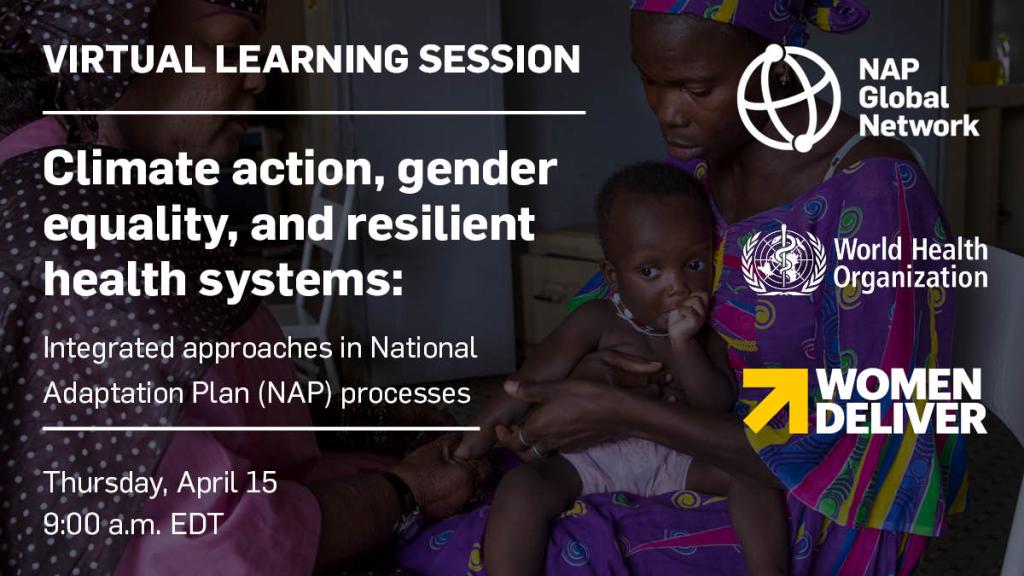
Virtual Learning Session | Climate action, gender equality, and resilient health systems: Integrated approaches in National Adaptation Plan (NAP) processes
Join this virtual learning session to explore the intersections of health, gender equality, sexual and reproductive health and rights (SRHR), and climate resilience!
The impacts of climate change threaten people’s health, with risks ranging from injury and death due to extreme weather events, to effects on mental health. Building the resilience of health systems is an urgent priority, particularly in the aftermath of the COVID-19 pandemic.
At the same time, there is increasing attention to the gender dimensions of climate change, as effective climate action requires consideration of the specific needs of people of all genders and social groups. Underpinning gender equality is the realization of SRHR, which can remove barriers to climate action. NAP processes represent an important opportunity to bring these issues together.
In collaboration with WHO and Women Deliver, we are hosting a virtual learning session to raise awareness of the need for an integrated approach that addresses the impacts of climate change, advances gender equality, and builds resilience of health systems.
Short 5-minute introductions will be given for each topic – with findings and recommendations from recent NAP document analyses – followed by a panel discussion and questions from the public.
Available in English, with live translations in French and Spanish.
Photo credit: Jonathan Torgovnik, Getty Images, Images of Empowerment
The Progressing National SDGs Implementation report provides an independent analysis of reporting by United Nations Member States to the High-level Political Forum on Sustainable Development (HLPF). Supported by a coalition of civil society organizations from around the world and prepared by Cooperation Canada, the report examines the status of 2030 Agenda implementation, unpacks trends in reporting, and identifies good practice.
This year’s report will showcase positive trends with respect to reporting on partnerships—including the role played by civil society—and policy coherence. However, it also underlines the continued silence by Member States in Voluntary National Review (VNR) reports on the closing of the civic space, as well as the lack of reference to national accountability mechanisms. Moreover, this year’s report discusses the impacts of the COVID-19 pandemic on the overall implementation of the sustainable development goals.
The interactive webinar will outline key findings from the report and offer reflections from global and national civil society organizations on the findings. Join the global launch for insights on opportunities for engagement by civil society and other stakeholders at the HLPF and in VNR processes in 2021.
In fact, our very own version of Who Wants to Be A Limnologist? will be a glorious hour of interactive trivia about those 58 lakes, updates from the field, and much more.
Phone a friend, show off your limknowledge to all your friends, and learn a few things too.
Join the fun Wednesday, April 14 at 12:00 p.m. (Central).
South Africa’s electricity sector is dominated by the state-owned utility Eskom. In recent years, private sector actors have invested in renewable energy through the Renewable Energy Independent Power Producer Procurement Programme (REIPPPP), which has steadily increased. Despite this progress, the transition to renewables is not happening fast enough to meet South Africa’s commitments toward the 1.5C target under the Paris Agreement, nor to offset the energy deficit that will result from the decommissioning of coal power plants planned in the country’s Integrated Resource Plan 2019.
Renewable energy also faces substantial opposition due to political interests that support other energy sources and public and institutional resistance to privatization. There is thus a need to explore new models for renewable energy development and investigate the implications of these models for South Africa.
As part of the webinar, we launched the IISD paper “Power by All: Alternatives to a privately owned future for renewable energy in South Africa.” Using 4 international case studies of publicly and community-owned renewable energy, the paper seeks to inform debate on the need for increased publicly and community-owned renewable energy development, while considering the implications these business models have for increasing renewable energy deployment in South Africa.
This session explored the following questions:
Accessing finance has been viewed as a hurdle for community-owned energy—how could this be addressed?
Aside from policy, what barriers hinder municipalities from procuring or generating renewable energy?
Should South Africa move forward with the REIPPPP alone, or pursue a mixed model of public and private ownership of large-scale renewables?
Reducing Deforestation and Enhancing Forest Conservation Through International Trade Policy
This webinar explored novel and existing mechanisms used in international trade policy to encourage forest conservation and reduce deforestation associated with forest commodities such as cocoa, palm oil, soybeans, and timber. The discussion focused on the characteristics, effectiveness, and scalability of voluntary sustainability standards as market-based instruments, as well as the opportunities and limitations of other environmental provisions included in international trade agreements.
This webinar explored ways to reduce deforestation and enhance forest conservation through international trade policy, with a focus on the cocoa, palm oil, soybean, and timber sectors. It took place on March 24, 2021, at 10 a.m. EST / 3 p.m. CET.
Topics discussed:
The characteristics, effectiveness, and scalability of voluntary sustainability standards (VSSs) as tools for reducing deforestation and enhancing forest conservation.
Novel and existing approaches included in international trade agreements to reduce deforestation and conserve forests.
Potential synergies between measures embedded in international trade agreements and VSSs for tackling deforestation and enhancing forest conservation at a large scale in forest-risk commodity sectors.
The audience asked the panelists several questions that could not be answered within the session’s allotted time. The panelists have responded to some of these questions below. More will be coming soon.
What are the unintended consequences of embedding VSSs into international trade agreements when it is usually the more wealthy producers that can join these agreements?
This is an important issue to consider as small-scale farmers and SMEs may experience difficulties getting certified and maintaining the certification. There are, however, different measures that can be established to mitigate/minimize these potential discriminatory effects. These include conducting ex-ante impact assessments prior to the signature of the agreement to identify actions that enable small-scale producers and SMEs to comply with VSSs and access markets (such as capacity building and financial support). The use of new technology by VSSs can also reduce audit and certification costs and make certification more accessible. The technological progress that FSC and other VSSs are making in that regard is promising.
In terms of setting the standards, how do we incorporate the views of consumers and producers? What kind of evidence should be used as a basis for standards?
Each VSS has its own policy for incorporating producers’ views during the establishment of the standard. Benchmarking exercises have also been carried out to inform how VSSs are incorporating producers’ views. For more information, see:
With regards to the incorporation of consumers’ views, some VSSs open the revision/update of their standard to public consultation, which is conducted in several phases. Recent examples include the Rainforest Alliance’s consultations before launching its revised standard in 2020, and what Global G.A.P. is currently doing.
“Many of these provisions about VSSs in RTAs are rather hortatory (for example, in the EFTA-Indonesia Art. 8.10: “the parties commit to support the dissemination and use of sustainability standards, practices and guidelines for sustainably produced vegetable oils”). Is there any indication on how they are being implemented by the parties?”
The EFTA-Indonesia CEPA is still in its early days (it was approved by Switzerland in a referendum held in March 2021). For this reason, we could not talk about implementation experiences yet. Nevertheless, it is worth noting that, for instance, through its Cooperation Programme and the Sustainable Trade Initiative (IDH), Switzerland supports the Indonesian Government in “promoting greater sustainability” in palm oil production. According to SECO, “IDH is active in six provinces to promote sustainable economic development at the regional level. This with a focus on sustainable production, forest conservation and social inclusion of indigenous populations. Direct beneficiaries are especially smallholder oil palm farmers and their families, who are trained in better and more sustainable production methods.”
“How do the trade agreement provisions relate to potential consumer country mandatory due diligence requirements?”
This question touches upon very relevant policy issues currently under discussion in several countries. Examples of this include the European Commission’s 2021 work plan and the European Green Deal, as well as the consultation held in the UK on the “introduction of due diligence on forest risk commodities.” Some trade observers consider that these developments will lead to the introduction of more sustainability clauses in the negotiation of future trade agreements. A more fundamental question would be how such requirements would interact with existing trade agreements.
Valuation in Investment Arbitration: Spotlight on discounted cash flow analysis
March 26, 2021 3:00 pm - 4:30 pm CET
(Open to public)
The critical issue of compensation (or "damages") in international investment law is gaining increased attention due to concerns about the high (and growing) scale of awards. One of the driving forces behind this increase has been arbitral tribunals' increasing willingness to use a valuation technique known as discounted cash flow (DCF) analysis when calculating compensation. This technique has been behind some of the biggest awards in recent years, including the now notorious Tethyan Copper v. Pakistan award of USD 4 billion plus interest.
Why is this technique increasingly used in investment arbitration? What are some of the controversies surrounding its use and what challenges can it pose for states? This webinar brought together four distinguished speakers with a wealth of experience on the challenges and impacts of DCF to discuss these key questions.
Speakers
Christina L. Beharry, International Arbitration Counsel, Foley Hoag LLP
Dr. Toni Marzal, Lecturer, University of Glasgow School of Law
Muhammad Usman Piracha, Senior Legal Consultant (International Disputes), Attorney General, Pakistan
Prof. Louis. T. Wells, Herbert F. Johnson Professor of International Management, Harvard Business School
Watch the webinar's full recording:
IISD’s work on compensation under international investment law
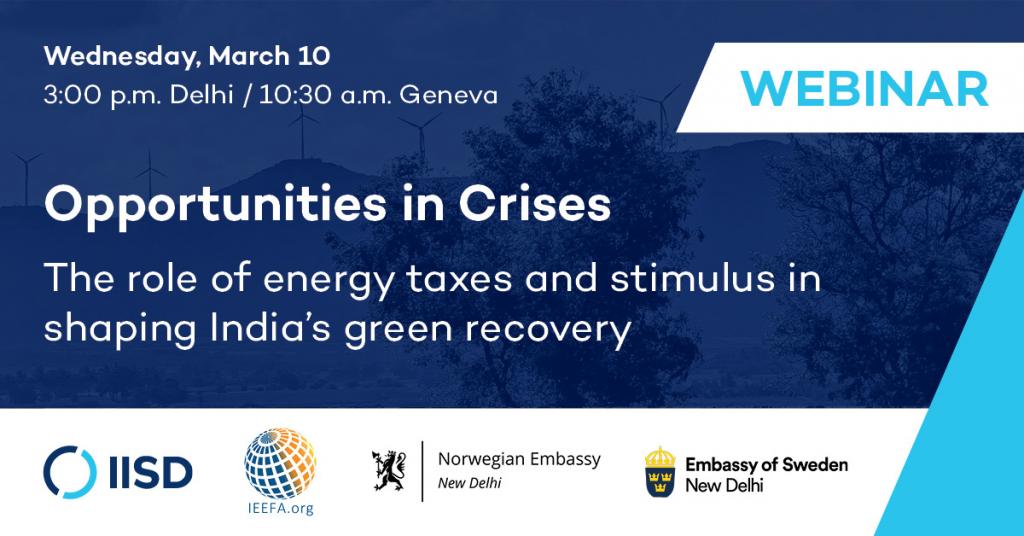
India is a leader among large emerging economies for its innovative use of fossil fuel taxes, such as the coal cess and excise taxes, to raise revenues and foster a clean energy transition. This combination of fossil fuel taxes and support for renewable energy characterizes both the Nordic and Indian approaches to the energy transition.
Nordic countries are internationally recognized for delivering strong economic growth with robust social and environmental policies. Since 2000, the Nordic economies grew 28%, while their carbon dioxide emissions fell by 18%. One of the secrets of their success in balancing these priorities has been the innovative use of energy taxation to recover from an economic crisis, such as the world is facing today.
This webinar, co-organized by IISD, IEEFA, the Royal Norwegian Embassy, New Delhi, and the Embassy of Sweden, New Delhi is unique in bringing together diverse perspectives and specific examples of green fiscal reforms and recovery strategies to inform decision-making by governments and offers valuable insights for researchers and policy experts.
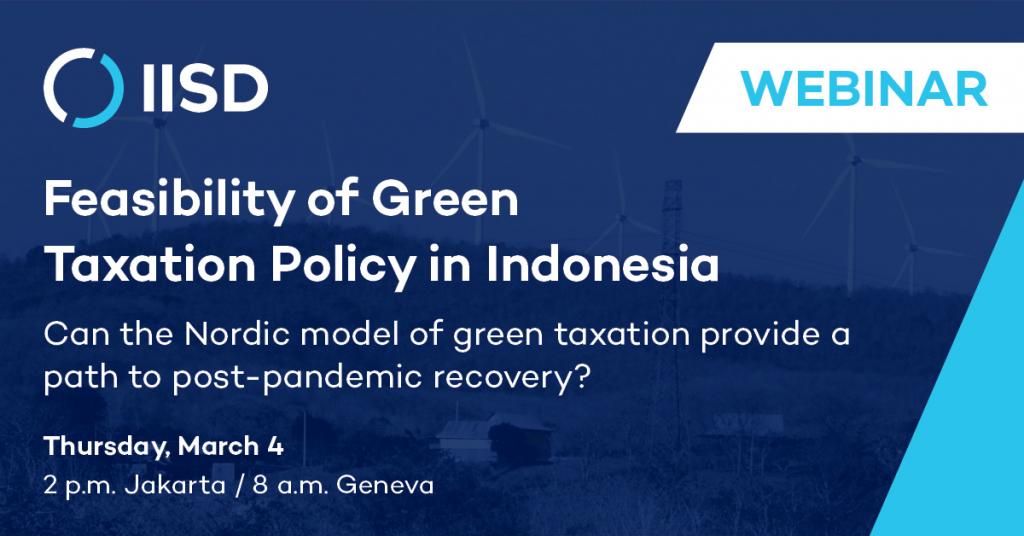
Feasibility of Green Taxation Policy in Indonesia: Can the Nordic model of green taxation provide a path to post-pandemic recovery?
This webinar will discuss Indonesia's tax measures to recover its economy from the COVID-19 pandemic. International experts will speak on lessons learned from international experiences on the implementation of green taxation for post-pandemic recovery.
This webinar is the second session of the International Energy, Environmental and Society Dialogue. The first session covered “Green Recovery in Indonesia: The role of Fossil Fuel Subsidy Reform,” on February 18, 2021.
This session will focus on:
The success story and strategy of the implementation of green taxation policy in Nordic countries
The key challenges and opportunities in Indonesia to implement green taxation
Feasibility of Green Recovery in Indonesia: The role of fossil fuel subsidy reform
This event is part one of three in the International Energy, Environmental, and Society Dialogue (IEESD) webinar series. IEESD is a high-level dialogue amongst policy makers and international experts to provide new insights and international examples of policies supporting green recovery, with the goal of reaching a comprehensive understanding of the challenges and opportunities for the national and international policy-making process and further policy development in Indonesia.
The COVID-19 pandemic has forced governments around the world to adjust their development plans and energy reform efforts. Indonesia is expected to grow its economy by 4.5%–5.5% in 2021, and the government is continuing to recover its economy by spending on different sectors, such as health, education, and infrastructure. This webinar will discuss how the energy sector could accelerate Indonesia's economic recovery, and, more importantly, create a more resilient economy.
This webinar will focus on:
The role of fossil fuel subsidy reform in economic recovery
The barriers to fossil fuel subsidy reform
The impacts of reform
How to make reform more inclusive
This webinar is organized by the International Institute for Sustainable Development and the National Team for the Acceleration of Poverty Reduction (TNP2K).
The coronavirus pandemic is first and foremost a public health tragedy. However, the pandemic, and the measures adopted to control its spread, have placed incredible pressure on social, health, and fiscal systems. As governments look to manage deficits and stimulate their economies to recover from the crisis, now is the time to consider what economic model will best support this process.
The Nordic example of fiscal policy is characterized by their pioneering introduction of energy and carbon taxation in the 1990s in response to a financial crisis. These measures have coincided with a boom in clean energy-related employment and a period of strong economic and environmental development. Could similar approaches work in South Africa or are there other strategies that are better suited to drive recovery here?
Green taxes, including taxes on road fuels, pollution and consumption are already a key part of South Africa’s fiscal system. In this webinar we will explore their role in the fiscal system and potential for expansion as part of measures to stimulate economic recovery in South Africa.
This webinar is being hosted by the International Institute for Sustainable Development in collaboration with the Danish embassy in South Africa and the Finnish embassy in South Africa.
This webinar will attempt to answer the following questions:
What is the Nordic model of green fiscal policy and what can we learn from Nordic experience that could be relevant to fiscal policy debates in South Africa?
What role do green taxes play in South Africa’s fiscal system?
How can the fiscal system help South Africa to recover from the coronavirus pandemic?