Report

Achieving Sustainable Food Systems in a Global Crisis: Summary Report

Ceres2030 Deep Dives into the Nexus of Food Systems, Climate Change, and Diets

This report summarizes the evidence-based and costed country roadmaps for effective public interventions to transform agriculture and food systems in Ethiopia, Malawi, and Nigeria in a way that ends hunger, makes diets healthier and more affordable, improves the productivity and incomes of small-scale producers and their households, and mitigates and adapts to climate change.

January 26, 2023

The world is not on track to achieve the United Nations Sustainable Development Goals by 2030. The prevalence of hunger and poverty—the two core goals which are the litmus test for everything else—are on the rise. This is being made worse by the Russian invasion of Ukraine, skyrocketing food, fertilizer, and energy prices, COVID-19, and climate change. In Africa, the situation is exacerbated by internal conflicts, political unrest, economic recessions, and swarms of desert locusts. To get back on track, it is critical to pursue policy pathways that encourage synergies and limit the trade-offs between hunger, poverty, nutrition, and climate change. This report summarizes the evidence-based and costed country roadmaps for effective public interventions to transform agriculture and food systems in Ethiopia, Malawi, and Nigeria in a way that ends hunger, makes diets healthier and more affordable, improves the productivity and incomes of small-scale producers and their households, and mitigates and adapts to climate change.

The financing gap is immense. This report shows that while it is possible to achieve sustainable food system transformation in Ethiopia, Malawi, and Nigeria, in the next decade, it would require an average additional public investment of USD 10 billion per year from 2023 to 2030 and targeting spending on a more effective portfolio of interventions that achieve multiple sustainable development outcomes. Of the total USD 10 billion, the donor share averages USD 5.8 billion per year, and the country share averages USD 4.2 billion per year. Importantly, comparing the financing gap between the long-term investment needed to achieve Sustainable Development Goal 2 and the short-term investment needed for emergency food assistance shows that while emergency assistance has increased in recent years, there is significant underfunding of the longer-term investment needs. The shortfall in longer-term funding increases the vulnerability to shocks, pushing the number of people affected by hunger and poverty higher. Donors should therefore complement and better link the increased allocation of emergency food assistance with increased investments in longerterm agricultural development priorities to prevent future crises when the next shock hits.

Filling the financing gap of USD 10 billion per year will yield immense economic, social, and environmental benefits. The prevalence of undernourishment in all three countries will decrease to under 3% in 2030 from a current projection of 22% in Ethiopia, 25% in Malawi, and 21% in Nigeria, by 2030. The transition toward healthier diets will be achieved for 248 million people, or roughly 60% of the population in each country. The incomes of 29 million small-scale producers will double on average in 2030 compared to 2015 levels. These economic and social gains will be achieved while confining greenhouse gas (GHG) emissions to nationally determined contribution goals and increasing resilience to climate change of the most vulnerable.

The findings in this report are based on analysis of academic and grey literature, as well as donor-funded projects, micro- and macroeconomic modelling, and engagement and consultations with key stakeholders in Ethiopia, Malawi, and Nigeria. The report summarizes the findings of a project that explores the interactions between reducing hunger and poverty, achieving healthy diets, and addressing climate change within the evolving food systems in three countries—Ethiopia, Malawi, and Nigeria.


The project is funded by the German Federal Ministry for Economic Cooperation and Development (BMZ) and the European Commission, through the GIZ implemented projects Knowledge for Nutrition (K4N) and Agricultural Policy and Food and Nutrition Security. The project was designed as a contribution to, and to build upon the progress made at,  the 2021 UN Food Systems Summit.
Report details

Report

Achieving Sustainable Food Systems in a Global Crisis: Malawi

Ceres2030 Deep Dives into the Nexus of Food Systems, Climate Change, and Diets

This report presents an evidence-based and costed country roadmap for effective public interventions to transform agriculture and food systems in Malawi in a way that ends hunger, makes diets healthier and more affordable, improves the productivity and incomes of small-scale producers, and mitigates and adapts to climate change. The report is part of a project that explores the interaction between achieving healthy diets, reducing hunger and poverty, and addressing climate change within the evolving food systems in three countries—Ethiopia, Malawi, and Nigeria. 

August 31, 2022

Agriculture and food systems in Malawi face key challenges. They need to simultaneously provide sufficient food for all, improve incomes and productivity for small-scale producers, make diets healthier and more affordable, reduce greenhouse gas (GHG) emissions, and build capacities needed to adapt to climate change. Yet, in the past few years, as a result of climate change, economic slowdowns, and COVID-19—and now rising food, fertilizer, and energy prices made worse by the Russian invasion of Ukraine—hunger and poverty have been on the rise, healthy diets are unattainable for most people, and the impacts of climate change are experienced more frequently and severely.

Even among those who do get enough calories, many will be malnourished due, in part, to the unaffordability of diets that both provide sufficient calories and satisfy the complex nutritional requirements of human bodies. The demographic dynamics in Malawi will continue to exacerbate these challenges, with the population expected to grow from 19.1 million people in 2020 to 25.8 million people in 2030. As the population and incomes grow in Malawi, so too will demand for food and more dietary diversity, which will exacerbate environmental challenges. At the same time, Malawi is home to some of the global public goods that are needed to address climate change, preserve biodiversity, and achieve the Sustainable Development Goals (SDGs). Transforming food systems to deliver on hunger, poverty, healthy diets, and climate change while safeguarding global public good will require significant efforts and resources—and therefore global solidarity; in other words, more domestic support and more external aid.

To support the transition to sustainable food systems in Malawi, this report aims to equip country-level decision-makers and the donor community with knowledge regarding the cost of sustainable food system transformation; evidence on which to base decisions regarding where and how to make investments to contribute to access to simultaneously sufficient, safe, and nutritious food (SDG 2.1 and 2.2); smallholder productivity and incomes (SDG 2.3); and environmentally sustainable agriculture production (SDG 2.4).

The report combines a review of country-level policy documents and peer-reviewed literature with a microeconomic analysis of changing diets, food consumption habits, and nutrition; four rounds of consultations with in-country stakeholders; and the country-level findings for Malawi from the project, Ceres2030: Sustainable Solutions to End Hunger. The findings are integrated into a computable general equilibrium (CGE) model, which estimates the cost of ending hunger, doubling the income of small-scale producers, and transitioning to healthier diets while protecting the climate and investing in climate change adaptation. The report is part of a project that explores the interactions between reducing hunger and poverty, achieving healthy diets, and addressing climate change within the evolving food systems in three countries—Ethiopia, Malawi, and Nigeria.

Report details

Report

Country Diagnostic Report: Malawi

Ceres2030 Deep Dives into the Nexus of Food Systems, Climate Change, and Diets

This report provides an overview of the current economic, social, and climate (mitigation and adaptation) trends in Malawi, as well as projections based on the Ceres2030 modelling framework. The report also includes a brief review of relevant policy documents addressing undernourishment and agricultural development, along with an overview of the approach and early findings from country consultations. The report concludes with a brief summary of relevant national trends and planned next steps in the country-level research and analyses.

May 17, 2022

The purpose of this report is to provide an overview of findings from the first round of activities for the four components of the project, namely the nutrition profile (Task 1), the data assessment (Task 2), relevant parts of the literature review (Task 3), and the findings of the first consultations (Task 4). Our research is based on diverse sources of information, including the relevant outcomes of the Ceres2030 project, public policy documents, peer-reviewed literature, and international databases. Using these sources of information, this report provides an overview of the current economic, social, and climate (mitigation and adaptation) trends in Malawi, as well as projections based on the Ceres2030 project model. We also include a brief review of relevant policy documents addressing undernourishment and agricultural development, along with an overview of the approach and early findings from country consultations. The report concludes with a brief summary of relevant national trends and planned next steps in the country-level research and analyses.

Podcast

Down to Earth: How to Protect Africa's Great Lakes

There are great lakes all over the world.

But you may have only heard of the Laurentian—or North American—Great Lakes.

July 15, 2021

In this episode of Down to Earth, we want to introduce you to the African Great Lakes and explain why they matter to so many people—and why they may be more familiar than you think.

We also hear from two researchers, from very different backgrounds, who explore a new partnership between the International Institute for Sustainable Development and the African Center for Aquatic Research and Education that brings researchers across two continents together to work to protect the African Great Lakes.

Webinar

Deep Dives Into the Nexus of Food Systems, Climate Change, and Nutrition

July 28, 2021 8:00 am - 8:50 am CEST

(Open to public)

The 2021 UN Food Systems Summit is taking place in the context of the climate crisis and exacerbated global food insecurity resulting from the COVID-19 pandemic. While the world is facing these challenges and a global response will be needed, developing countries—and in particular African countries—are dealing with an even more extreme situation. Their development dynamics and needs involve an increase in food consumption and production to address the nutritional requirements of their populations in an approach that also ensures the environmental sustainability and resilience of their agricultural practices. Based on developed country experience, there is no evidence that such a transition could be achieved by relying on market economic forces alone, especially if the social inclusiveness of the process has to be guaranteed. Therefore, policy pathways must be identified and implemented that favour synergies and limit trade-offs within the nexus between climate change, food systems, and nutrition.

Speakers

  • Francine Picard, Senior Policy Advisor and Partnerships Lead, IISD 
  • Carin Smaller, Director of Agriculture, Trade and Investment, IISD 
  • Dr. Andrew Kwasari, Senior Special Assistant to the President on Agriculture, Office of the Vice President of Nigeria
  • Christel Weller-Molongua, Director of Rural Development and Agriculture Division in the Global Department at GIZ 
  • Dr. Felix Phiri, Department of Nutrition, HIV and AIDS of the Ministry of Health in Malawi  
  • Willem Olthof, Deputy Head of Unit, DEVCO C1 - Rural Development, Food Security, Nutrition, European Commission  

This session explains how we can influence consumption patterns through policy interventions that will lead to better environmental and nutritional outcomes in three countries—Malawi, Ethiopia, and Nigeria—in order to identify policy roadmaps to sustainable food system transformation. Specifically, by building on the Ceres2030 literature review and cost modelling exercise, this research supports analytical work to strengthen the evidence base for climate-smart nutrition interventions in the context of a sustainable food system. This aligns with the overarching transformative theme of the UN Food Systems Summit.

The purpose of this parallel session is to present the results from the country case studies, together with country focal points from the three countries: the Office of the Vice President of Nigeria, the Ministry of Public Health in Malawi, and the Federal Ministry of Health in Ethiopia. We aim to develop joint ownership of the final recommendations and enhance the utilization of the research in the Food Systems Summit, dialogues, and long-term country-level strategies.

Deep Dives Into the Nexus of Food Systems, Climate Change, and Nutrition in Malawi, Ethiopia, and Nigeria will provide examples of how to develop a country-level roadmap for food systems transformation that could serve as a blueprint for other countries and that is based on the best available evidence, economic modelling, and a deep engagement with national-level stakeholders working together with experts.

This event is the result of a collaboration between the International Food Policy Research Institute (IFPRI), the International Institute for Sustainable Development (IISD), Deutsche Gesellschaft für Internationale Zusammenarbeit (GIZ), the European Union, the Malawi Ministry of Public Health, and the Office of the Vice President of Nigeria.

Interpretation in French and in English will be available.

Webinar

Virtual Fireside Chat: How Two Continents Are Working Together to Improve The Health Of The African Great Lakes

Did you know that scientists across North America and Africa are putting their heads—and expertise—together on issues including algal blooms, climate change, invasive species, fragile fisheries, to name but a few, to improve the health of the African Great Lakes?

October 28, 2020 9:00 am - 10:00 am Central

(Open to public)

And this matters because the seven African Great Lakes contain around 25% of the world's fresh water and underpin the welfare and livelihoods of over 50 million people across 10 countries.

To hear their stories, and to learn more, we invite you to a virtual fireside chat on Wednesday, October 28, 2020, at 9:00 a.m. (CDT); 10:00 a.m. (EDT); 3:00 p.m. (CET); 4:00 p.m. (CAT); 5:00 p.m. (EAT).

You will discover:

  • Exactly what the African Great Lakes are, and why we need to collaborate in order to protect them
    • from Dr. Kevin Obiero, Chair, ACARE & Centre Director, Kenya Marine and Fisheries Research Institute
  • The critical role that women are playing
    • from Stephanie Smith, Strategic Advisor, IISD-ACARE
  • A case study of work already underway to protect the African Great Lakes
    • from Ms. Cecilia M. Githukia; Research Scientist; Kenya Marine and Fisheries Research Institute, Aquaculture Division


REGISTER HERE

Press release

Scientists from Two Continents to Work Together to Improve the Health of the African Great Lakes

The International Institute for Sustainable Development and the African Center for Aquatic Research and Education join forces to strengthen the global large-lakes scientific community.

September 15, 2020

ANN ARBOR, MI—World-class scientists and researchers from across North America and Africa will soon be putting their heads (and expertise) together to tackle some of the most pressing issues—algal blooms, climate change, invasive species, fragile fisheries, to name but a few—facing the African Great Lakes (AGL).

The AGL are highly valuable natural resources, renowned for their rich fisheries and "biodiversity hotspots." Consequently, they, and the ecosystem services they provide, underpin the welfare and livelihoods of over 50 million people across 10 countries.

This is all thanks to a new major partnership announced today between the International Institute for Sustainable Development (IISD) and the African Center for Aquatic Research and Education (ACARE). The IISD-ACARE collaboration will provide an opportunity for the world’s freshwater laboratory and networks on the African Great Lakes to come together and strengthen science on large freshwater resources and the countries in which they reside.

Despite the recognized importance of the AGL, these vital ecosystems and their livelihood support systems are threatened by the impact of human activity, such as overfishing and pollution at local, regional, and global scales.

To address some of the challenges on the African Great Lakes, IISD-ACARE, will combine the legal and policy expertise of IISD’s vast expert staff with ACARE’s African network of large-lakes experts in Burundi, the Democratic Republic of the Congo, Ethiopia, Kenya, Malawi, Mozambique, Rwanda, Tanzania, Uganda, and Zambia.

“We have recognized that no one organization, institution, or even country, can address the challenges that our global freshwater resources face. It is essential, therefore, to strengthen collaborations for leveraging the combined skills, assets, technologies and resources of public, private, and non-profit entities to deliver sustainable instruction, guidance, and research to protect these resources,” said Dr. Kevin Obiero, Chair, ACARE’s Board of Directors.

“Partnering with the International Institute for Sustainable Development will enhance our ability to strengthen science and positively affect policy and management on these critical resources and provide the experience of working with the global scientific community.”

Strengthening the IISD-ACARE approach is IISD’s Experimental Lakes Area (IISD-ELA)—the only place in the world where scientists can manipulate real lakes to understand what human activity does to fresh water. A series of 58 lakes and their watersheds in northwestern Ontario, Canada, IISD-ELA brings over 50 years of freshwater research like no other and policy analysis to inform decision making.

“ACARE has created a world-class, highly collaborative network of experts on each of the African Great Lakes,” said Dr. Matthew McCandless, Executive Director, IISD-ELA. “Resources from IISD and ACARE’s combined networks will allow us to accomplish three long-term goals: strengthening global and regional research partnerships; facilitating existing, and boosting new, transboundary and inter-jurisdictional lake advisory groups; and, strengthening the capacity of freshwater scientists through experiential education and public engagement.”

During its first year, the new partnership will boost the activities of six Advisory Groups that were created to address issues on each of the African Great Lakes (considered to be lakes Albert, Edward, Kivu, Malawi/Nyasa/Niassa, Tanganyika, Turkana, and Victoria). Members of each group are harmonizing priorities on the lakes to advance work on scientific inquiry, monitoring, climate change, and education and training, among other issues.


To learn more about the partnership and programs, click here.

For more information, or to arrange an interview, please contact:

Ted Lawrence, Executive Director, African Center for Aquatic Research and Education, [email protected]

Sumeep Bath, Communications Manager, IISD Experimental Lakes Area, [email protected]


About ACARE

The African Center for Aquatic Research and Education (ACARE) was established to help strengthen and harmonize science and information exchange through a highly collaborative network of freshwater experts.

Scientists from Two Continents Working Together to Improve the Health of the African Great Lakes

World-class scientists and researchers from across North America and Africa are putting their heads, and expertise, together to tackle some of the most pressing issues—algal blooms, climate change, invasive species, fragile fisheries, to name but a few—facing the African Great Lakes (AGL) today.

What are the African Great Lakes?

The AGL are highly valuable natural resources, renowned for their rich fisheries and "biodiversity hotspots." Consequently, they, and the ecosystem services they provide, underpin the welfare and livelihoods of over 50 million people across 10 countries. Despite the recognized importance of the AGL, these vital ecosystems and their livelihood support systems are threatened by the impact of human activity by numerous anthropogenic stressors at local, regional, and global scales.

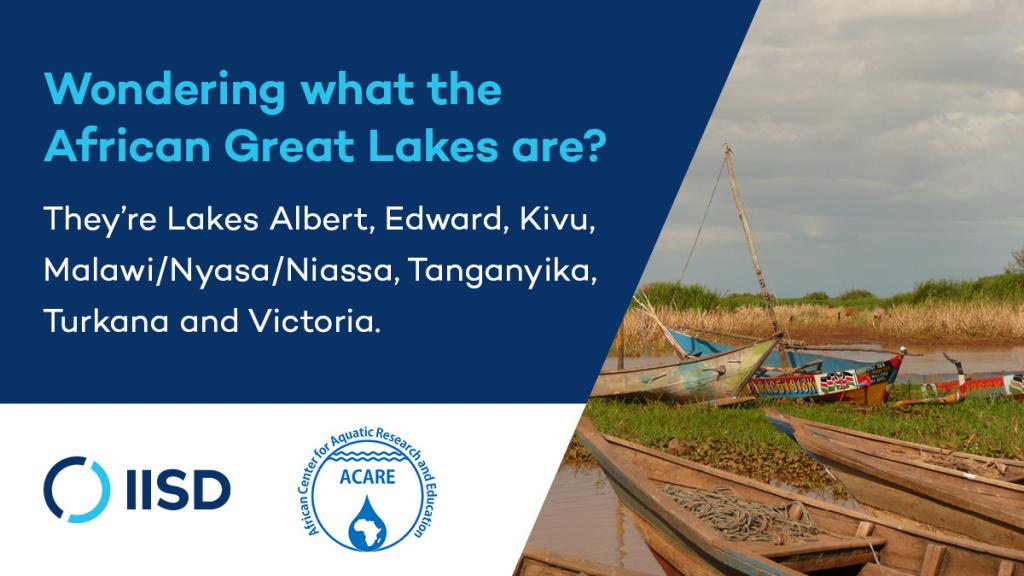
The African Great Lakes are lakes Albert, Edward, Kivu, Malawi/Nyasa/Niassa, Tanganyika, Turkana, and Victoria. You can learn more about the African Great Lakes here.

List of the African Great Lakes


How does this project work?

The partnership between the International Institute for Sustainable Development (IISD) and the African Center for Aquatic Research and Education (ACARE) provides an opportunity for the world’s freshwater laboratory and networks on the African Great Lakes to come together and strengthen science on large freshwater resources and the countries in which they reside.

IISD-ACARE combines the legal and policy expertise of IISD’s vast expert staff with ACARE’s newly created African network of large-lakes experts and scientists in Burundi, the Democratic Republic of the Congo, Ethiopia, Kenya, Malawi, Mozambique, Rwanda, Tanzania, Uganda, and Zambia.


What are we working on?

The partnership works to boost the activities of six advisory groups that were created to address specific issues on each of the African Great Lakes. Members of each group are harmonizing priorities on the lakes to advance work on scientific inquiry, monitoring, climate change, and education and training, among other issues.

An exciting flagship project of the initiative—the African Women in Science program—is a 10-month program designed by women, for women, to support the interests, needs, and goals of early-career scientists working on Africa’s freshwater issues. Dozens of women in science have now benefited from the program, including those who share their stories, and how the program has benefited their career, in the video below.


How can I learn more?

To learn more about the project, or to discuss research and collaboration opportunities, you can visit the ACARE website, or contact us directly.

Policy Analysis

Comparative Commentary to Brazil’s Cooperation and Investment Facilitation Agreements (CIFAs) with Mozambique, Angola, Mexico, and Malawi

Unlike traditional bilateral investment treaties (BITs), which are geared toward investor protection, Brazil’s Cooperation and Investment Facilitation Agreements (CIFAs—or ACFIs in their Portuguese acronym) focus primarily on cooperation and investment facilitation.

September 11, 2015

Unlike traditional bilateral investment treaties (BITs), which are geared toward investor protection, Brazil’s Cooperation and Investment Facilitation Agreements (CIFAs—or ACFIs in their Portuguese acronym) focus primarily on cooperation and investment facilitation.

They promote amicable ways to prevent and settle disputes and propose state–state dispute settlement as a backup; notably, they do not include provisions on investor–state arbitration. The Brazilian approach therefore offers an alternative to governments that wish to reduce unintended risks of arbitration while finding ways to settle disagreements that may arise with investors. This note compares the first four CIFAs concluded and provides an overview and a critical legal commentary of their texts, followed by suggestions and recommendations for existing and future CIFAs.

Policy Analysis details

Report

Assessing Investment Incentives in Malawi

April 11, 2013

This paper discusses the costs and benefits of Malawi's efforts to induce private investment, particularly the economic incentives that the government offers investors.

It begins with a brief overview of Malawi's economic and investment policies, explains the country's ambitions with respect to sustainable economic development, surveys the main investment incentives offered to investors, and discusses the risks and opportunities associated with investment incentives. It is beyond the scope of this brief to provide detailed insights into how Malawi's individual investment incentives are performing with respect to their policy objectives, although further research in this area is strongly required, as discussed in the concluding section of this paper.

Report details

Topic
Trade
Investment Law & Policy
Region
Malawi
Impact area
Sustainable Economies
Publisher
IISD
Copyright
IISD, 2013