Press release

Innovative investment treaty supporting clean energy transition tops global contest

July 24, 2018

A team including experts from the International Institute for Sustainable Development (IISD) was chosen as one of two winners of the Stockholm Treaty Lab’s top prize. The global competition crowdsourced expertise in various areas—including law, economics, science and climate change policy—to encourage climate-friendly investment through international law. 

Over 20 teams from around the world entered the contest, which challenged them to draft a state-of-the-art international agreement that, if adopted by states, would generate investments in climate change mitigation and adaptation, in line with the Paris Agreement on Climate Change and the Sustainable Development Goals (SDGs).

The Creative Disrupters, a team of international lawyers, senior economists, policy advisers and communication specialists from IISD, as well as other experts, submitted an innovative treaty built around three pillars: demoting unsustainable investments, promoting sustainable investments, and ensuring a just transition to sustainable, climate-friendly and resilient economies and societies.

To demote unsustainable investments, for example, the treaty recognizes the right of states to adopt disruptive but necessary measures to address climate change—such as leaving fossil fuels undeveloped.

“To reach the commitments under the Paris Agreement, over two thirds of the proven coal, oil and natural gas reserves in countries should be left in the ground,” explains Ivetta Gerasimchuk, IISD’s lead on Sustainable Energy Supplies. “Our treaty does not allow investors to claim compensation over government policies that aim to keep fossil fuels in the ground.”

Achieving climate change goals also requires significantly scaling up investment in renewable energy and other low-carbon projects. “Our treaty commits states to cooperate on promoting sustainable investment. It also allows them to introduce incentives and adopt green industrial policy measures to foster climate-friendly investments,” says Martin Dietrich Brauch, Associate and International Law Advisor with IISD and Team Captain of The Creative Disrupters.

In a statement announcing the jury’s decision, the Stockholm Treaty Lab noted:

“The text contains innovative and out-of-the box ideas and strong language to promote and encourage green investments while at the same time seeking to address the risks posed by non-green investments and supporting the need for just transitions. The model by which States own the definition of sustainable and unsustainable investments is innovative.”

In coming months, team members from The Creative Disrupters will head to New York, Stockholm and Davos to present the treaty to policymakers. 

Press release details

Impact area
Sustainable Economies
Press release

Media Availability: Canada's carbon crunch as the Premiers meet

July 17, 2018

As Canada’s premiers gather in New Brunswick (July 18-20, 2018), the country’s plan to combat climate change is under hot debate. Resistance from key leaders – including Ontario’s recently elected Premier Ford – has delivered a body blow to Prime Minister Justin Trudeau’s carbon price promises.

Experts from the International Institute for Sustainable Development (IISD) are available to comment on the federal government’s backstop program, the latest statements from each Premier, relevant conditions in each province – and how we move forward as a divided nation.

To speak with any of the following experts, please contact [email protected] or call (204) 958-7700 ext. 706.

David McLaughlin is IISD's Director of Climate Change Canada. With over 30 years of public policy experience in national and provincial government and the private sector, David is a Canadian policy expert on energy, economy, environmental and intergovernmental policy issues.

Press release

Pipeline paralysis should not halt all climate action in Canada: IISD

On June 28, 2018, an expert council of energy industry representatives, Indigenous leaders, researchers and sustainability experts—including Jane McDonald, Managing Director from IISD—provided recommendations to Minister of Natural Resources, Jim Carr, on how Canada can transition to a low-carbon economy.

June 27, 2018

WINNIPEG, MANITOBA – JUNE 28, 2018 – While ending federal investments in fossil fuels remains a critical, contentious goal, a new report shows valuable areas of agreement Canada can act on immediately to advance a green energy transition.

On Thursday, an expert council of energy industry representatives, Indigenous leaders, researchers and sustainability experts—including Jane McDonald, Managing Director of the International Institute for Sustainable Development—provided practical recommendations to the Honourable Jim Carr, Minister of Natural Resources, on how Canada can transition to a low-carbon economy.

“Oil and gas were represented, hydro was at the table, new renewables and First Nations leadership were there,” says McDonald. “We have some substantial disagreements in this country on tackling climate change that still need to be addressed. But the report from this council is a significant step in the right direction because it outlines some ideas all Canadians can get behind.”

The Generation Energy Council Report, Canada’s Energy Transition: Getting to our Energy Future, Together, points to five areas that government, industry and average Canadians should immediately act on:

  • Wasting less power: The unsexy but essential actions that increase energy efficiency, reducing greenhouse gas (GHG) emissions while saving families and businesses money.
  • Switching to clean energy: 80 per cent of Canada’s electricity grid is powered by emissions-free sources; expanding what’s “electrified” in our country to include transportation and industry will be a major victory in GHG reduction.
  • Cleaner fuels: Biofuels, renewable natural gas (from farm waste or landfills) and hydrogen can reduce our GHG production affordably.
  • Producing cleaner oil and gas: Reducing emissions per unit of oil or natural gas produced will require rapid technological innovation.
  • Pathfinding with Indigenous Peoples: Empowering Indigenous Peoples as part of Canada’s energy transition can help remedy our country’s greatest social injustice.

“Let’s make an effort to come out of our corners and keep talking,” says McDonald. “Our energy future is about much more than a pipeline, but only if we make it so.”

Press release details

Impact area
Climate
Press release

Winnipeg Chamber of Commerce Annual Luncheon showcases how the city is aligning with the UN Sustainable Development Goals

The new Peg website uses innovative technology to track how Winnipeg is doing on key issues and, for the first time, links that progress to the United Nations Sustainable Development Goals.

June 14, 2018

Winnipeg, June 15, 2018—Today, the United Way Winnipeg and the International Institute for Sustainable Development (IISD) unveiled a new Peg website—mypeg.ca—and a new report that show how local actions are part of creating a stronger city and healthier world. 

Revealed at the Winnipeg Chamber of Commerce June luncheon, the new Peg website uses innovative technology to track how Winnipeg is doing on key issues and, for the first time, link that progress to the United Nations’ Sustainable Development Goals. 

The new Peg site puts Winnipeg at the forefront of communities connecting their well-being to the 17 global goals. 

“Peg matters because it tells us not just about where we live, but how we live. This award-winning model of community-based sustainability indicators is now being replicated across Canada and around the world. By linking to the SDGs, communities like Winnipeg are showing that local action can have a global impact,” states Jane McDonald, Managing Director of IISD. 

“We have much to celebrate in Winnipeg, including our amazing ability to come together as a community. When we work together—business, government, community organizations, labour and individuals—we make change happen in our city.  Peg tracks our progress—and inspires us to go further,” states Connie Walker, President & CEO of United Way. 

Also being released is the annual Peg report - 2018 Our City: A Peg Report on Sustainability. This year’s annual report was developed in partnership with IISD and United Way as well as Economic Development Winnipeg. The report focuses on our city’s wellbeing related to the three pillars of sustainability – our economic, environmental, and social well-being.  Additionally, for the first time the report shows the linkages to the SDGs, showing how our trends are part of a global picture. 

“I believe that report cards are important for all of us. The Peg Report on Sustainability is an important indicator of where we at are today as a city, what our strengths are, and what areas we need to focus on.” said Dayna Spiring, President and CEO of Economic Development Winnipeg Inc.

Access the full report and explore Peg data on the new website here.                     


For more information please contact: David Hawthorne, Vice President, Marketing & Communications, United Way Winnipeg | Phone 204-924-4250 | [email protected]

Press release details

Press release

New initiative launched to support Canada’s low-carbon transition

Carbon Transitions Initiative will work with partners at the national, regional and local levels, focusing on key action areas such as: industry competitiveness and carbon; agricultural opportunities and carbon; interprovincial cooperation and alignment on climate policy; and climate communications to build public support for action.

May 14, 2018

OTTAWA, May 15, 2018—The Carbon Transitions Initiative launched today with the goal of developing and promoting actionable climate policy advice and ideas for Canadian governments, businesses and communities.

The initiative was created by the International Institute for Sustainable Development (IISD) and will include a comprehensive national program of research, policy and events.

“The world has moved from talking about ‘if’ climate change should be addressed to ‘how’ we will tackle it,” said Scott Vaughan, President and CEO of IISD. “This initiative is a substantial commitment to support climate action in Canada.”

The effort will be led by David McLaughlin, former President and CEO of the National Round Table on the Environment and the Economy, and a former senior climate change advisor with the Government of Manitoba.

Carbon Transitions Initiative will work with partners at the national, regional and local levels, focusing on key action areas such as: industry competitiveness and carbon; agricultural opportunities and carbon; interprovincial cooperation and alignment on climate policy; and climate communications to build public support for action.

“We have gained much experience from our decades of international work, and now is the time for us to fully and directly engage on this critical issue for Canada’s future,” said IISD’s Managing Director, Jane McDonald. “Our roots have always been in Canada, ever since we were established in Winnipeg almost 30 years ago.”

During his time advising the Manitoba government, McLaughlin led the development of the "Made-in-Manitoba Climate and Green Plan". He has extensive service as a senior official at both the federal and provincial levels of government and is one of Canada’s leading public policy experts on government, politics and sustainability.

“I am delighted to take on this key role for IISD,” McLaughlin said. “Our goal is to advance climate solutions that protect the environment and build a low-carbon economy for greater prosperity and opportunity for Canadians. As the name implies, Carbon Transitions Initiative aims to ensure that Canadians not only succeed in this low-carbon economic transition but realize stronger competitive advantages and tangible environmental improvements.”


Biography: David McLaughlin

David McLaughlin is one of Canada’s leading public policy experts on government, politics and sustainability. He led the development of the “Made-in-Manitoba Climate and Green Plan” during his time as Senior Advisor, Climate Change to the Government of Manitoba in 2016-17.
Prior to that, McLaughlin was President and CEO of the National Round Table on the Environment and the Economy, releasing ground-breaking reports on climate change and carbon pricing.

McLaughlin has extensive service as a senior official at both the federal and provincial levels of government. He has been Chief of Staff to Canada’s 18th Prime Minister, to the federal Minister of Finance, and to the Premier of New Brunswick. He served as deputy minister of policy and planning, secretary to the cabinet for policy and priorities, intergovernmental affairs and democratic reform in the New Brunswick government.

A published author, he writes regularly for the Globe and Mail and other publications and is a media commentator on politics and sustainable development.

McLaughlin holds a B.A., Honours from Mount Allison University, an M.A. in International Affairs from Carleton University, and an M.B.A. from the University of Bath, in the United Kingdom. He is an Honorary Fellow of the Royal Canadian Geographic Society.

Press release details

Press release

Media Availability: Is Canada Ready to Implement the UN’s Sustainable Development Goals?

The Office of the Auditor General of Canada has just released a report that reveals the Government of Canada is not adequately prepared to implement the UN’s 2030 Agenda for Sustainable Development. IISD's experts are ready to respond.

April 23, 2018

The Office of the Auditor General of Canada has just released a report that reveals the Government of Canada is not adequately prepared to implement the United Nations’ 2030 Agenda for Sustainable Development.

In a world where water and food shortages are becoming ever more frequent and the effects of climate change are intensifying, the UN's 17 Sustainable Development Goals (SDGs) will prove crucial in achieving social, economic, and environmental sustainable development worldwide.

Experts from the International Institute for Sustainable Development (IISD) are available to comment on what the report’s findings may mean for Canada's contribution to the global agenda on sustainable development, and to explain what the Sustainable Development Goals are, and why they matter.

To speak with any of the following experts, please contact [email protected] or call (204) 958-7700 ext. 740.

Jane McDonald is IISD's Managing Director and Vice-Chair of the Board of IISD Experimental Lakes Area—the world's freshwater laboratory.

Jane works to advance research aimed at protecting the health of fresh water around the world and exploring the impacts (and mitigating the effects of) climate change.

Jane has over 15 years of Canadian and international experience working on environmental issues in both the public and private sectors.

Lynn Wagner is the Group Director of IISD's SDG Knowledge program.

She oversees projects that seek to increase the accountability of decision making for the SDGs, enhance engagement in SDG implementation, develop SDG indicator and reporting tools, and support SDG implementation. 

Stefan Juncurt is the Lead, SDG Indicators and Monitoring for IISD's SDG Knowledge Program.

He works in the areas of sustainable agriculture, genetic resources for food and agriculture, and linkages between international regulation on biodiversity conservation and other issue areas such as trade and climate change.  

Press release details

Press release

Media Availability: Is Canada on track for climate action? Responding to a new report from the Office of the Auditor General

Tomorrow, federal and provincial auditors general release a new report on progress towards climate action in Canada. IISD's experts are ready to respond.

March 25, 2018

Tomorrow, federal and provincial auditors general are releasing a new report on progress towards climate action in Canada. 

Initial indications are that the report shows a lot of urgent work still needs to be done in every province to assess climate risk and scale up resilience measures.

Another question expected to arise from the report is the role of "climate sinks" within Canada to offset greenhouse gas emissions and potentially contribute to increased climate resilience.

Experts from the International Institute for Sustainable Development (IISD) are available to comment on what the report’s findings may mean for national climate mitigation efforts. To speak with any of the following experts, please contact [email protected] or call (204) 958-7700 ext. 740.

Scott Vaughan, IISD’s President and CEO, has over 20 years of experience in environmental protection, environmental economics and sustainable development.

He preceded Julie Gelfand as Commissioner of the Environment and Sustainable Development. In that role, which he held from 2008 to 2013, he was responsible for monitoring sustainable development strategies, overseeing the environmental petitions process, and conducting audits of environmental and sustainable development issues.

Anne Hammill leads the Resilience Program for IISD. Much of her work focuses on understanding how better environmental management can build resilience to climate stress and contribute to peacebuilding.

Anne’s most recent work has been in developing and applying decision-support tools for climate change adaptation, conducting participatory field research on livelihoods and climate change, and building the capacity of governments and civil society to integrate climate risk into policies and field projects.

Henry David (Hank) Venema  is a professional engineer with a diverse natural resource background spanning water resources, agriculture, energy, climate change mitigation and adaptation, rural development, ecosystem management, environmental economics and environmental finance.

He is the Director of Planning for the Prairie Climate Centre, which helps governments, businesses and community members identify and anticipate risks, take advantage of emerging opportunities, build capacity, and enhance economic and environmental resilience to climate change.

Philip Gass is a Senior Policy Advisor with IISD’s Energy Program. His recent work has focused on the development of provincial climate change strategies, the green economy in Canada and internationally, energy policy and the engagement of the private sector in international climate negotiations.

Prior to joining IISD, he spent three years (2006–2008) with the Official Opposition Caucus in the Manitoba Legislature as a substantive policy researcher specializing in the portfolios of Science, Technology, Energy and Mines (including climate change) and Manitoba Hydro.

Press release details

Impact area
Climate
Press release

#EveryDropCounts: UN-Water and IISD team up on SDG 6 information

To mark World Water Day, UN-Water and the International Institute for Sustainable Development are pleased to announce a new agreement to collaborate in providing information on implementation of Sustainable Development Goal 6. 

March 20, 2018

NEW YORK CITY, 22 March 2018—To mark World Water Day, UN-Water and the International Institute for Sustainable Development are pleased to announce a new agreement to collaborate in providing information on implementation of Sustainable Development Goal 6.

The Goal calls for voluntary actions around the world to ensure the availability and sustainable management of water and sanitation for all by 2030.

If we continue to develop on our current path, a recent report indicates the world may face a 40 per cent shortfall in water availability by 2030. This new collaboration seeks to inform and engage actors in an effort to set the world on a different path.

UN-Water coordinates the efforts of United Nations entities and many international organizations working on water and sanitation issues. The International Institute for Sustainable Development, an independent think tank, reports on and organizes information on efforts to implement each of the SDGs through its SDG Knowledge Hub.

The stream of information flowing into the SDG Knowledge Hub about water and sanitation projects and solutions will be enhanced through this collaboration and will incorporate linkages with the other SDGs, to ensure that water and sanitation challenges are seen within a wider context, and taken up in relationship with other Goals, and vice-versa.

ABOUT THE INTERNATIONAL INSTITUTE FOR SUSTAINABLE DEVELOPMENT

The International Institute for Sustainable Development (IISD) is an independent think tank that delivers the knowledge to act. Our mission is to promote human development and environmental sustainability. With offices in Winnipeg, Geneva, Ottawa, Toronto and New York City, our work impacts lives in nearly 100 countries.

ABOUT UN-WATER

Over 30 UN organizations carry out water and sanitation programmes, reflecting the fact that water issues run through all of the UN’s main focus areas. UN-Water’s role is to coordinate so that the UN family ‘delivers as one’ in response to water related challenges.

ABOUT THE SUSTAINABLE DEVELOPMENT GOALS

SDG 6 is one of 17 Goals that all member states of the United Nations adopted in September 2015. The SDGs identify a set of interconnected actions to end poverty and hunger, deliver quality education and clean energy, and spur economic growth and innovation, among other targets to be achieved by 2030. The achievement of universal and equitable access to safe and affordable drinking water for all and adequate and equitable sanitation and hygiene for all, as two of the eight targets set out in SDG 6, will require concerted action by community groups, government leaders and everyone in between. But this action will benefit from parallel efforts to enhance education, foster biodiversity and ecosystem services, and develop quality, reliable, sustainable and resilient infrastructure, to name just three targets under other Goals.

Press release details

Impact area
Nature
Press release

Only 53% of Winnipeggers Have Convenient Access to Public Transit, new study

Just over half of Winnipeggers (53 per cent) have convenient access to public transit. This is according to a new study from IISD—the first to explore convenient access to public transit in Winnipeg.

February 6, 2018

WINNIPEG, February 8, 2018—Just over half of Winnipeggers (53 per cent) have convenient access to public transit.

Moreover, 32.76 per cent of our city’s residents have inconvenient access to transit, with 22.36 per cent potentially having to wait 15–30 minutes for a bus, while 10.4 per cent possibly have to wait for longer than 30 minutes.

This is all according to a new report, Measuring Winnipeggers’ Convenient Access to Public Transit, from the International Institute for International Development (IISD). It is the first time that a comprehensive review of Winnipeggers’ convenient access to public transit has ever been published.

“Traditionally, access to public transit has meant looking only at spatial measures—for example, how far away a bus stop is from your house or place of work,” said Kyle Wiebe, project officer, IISD.

“This new study gives a much more comprehensive picture, as it also includes a temporal measure. It refers to how long you may need to wait at a bus stop before a bus arrives, how many buses come each hour and how long your trip on the bus will be.”

The report also breaks down the convenient access to public transit by neighbourhood. It found that the majority of people who have convenient access to public transit live downtown, in Point Douglas, River Heights, or along the Southwest Transitway Rapid Transit Corridor.

Of the 14.3 per cent of Winnipeggers who have no convenient access to transit, most live primarily on the periphery of the city.

“To inform constructive conversation about public transit in this city, we need to know how convenient public transit is for Winnipeggers,” said Wiebe. “Only then can we begin to improve our city’s transit system so that it offers citizens convenient alternatives to driving their own vehicles.”

IISD has also launched a complementary interactive map that allows users to locate their block within the city and learn how convenient their access to public transit is.

This report is part of a larger body of research that IISD is conducting, contained in its SDG Indicators Portal that measures progress on the Sustainable Development Goals for 13 cities across the country, including Winnipeg.

Press release details

Press release

Remembering Jason Potts

It is with great sadness that we announce that Jason Potts, visionary and leader in championing inclusive sustainability standards, has died. His work towards making trade more sustainable and fair will always live on, emboldened forever by his leadership.


January 30, 2018

It is with great sadness that we announce that Jason Potts, visionary and leader in championing inclusive sustainability standards, has died.

He passed away peacefully on the morning of January 31, 2018 in Montreal, surrounded by his family.

“Jason was a much beloved colleague at IISD; everyone admired his passion for justice and greatly enjoyed working with him. He brought principle, creativity and fervour to each moment of his work,” said Scott Vaughan, President-CEO, IISD. “His work towards making trade more sustainable and fair will always live on, emboldened forever by his leadership.”

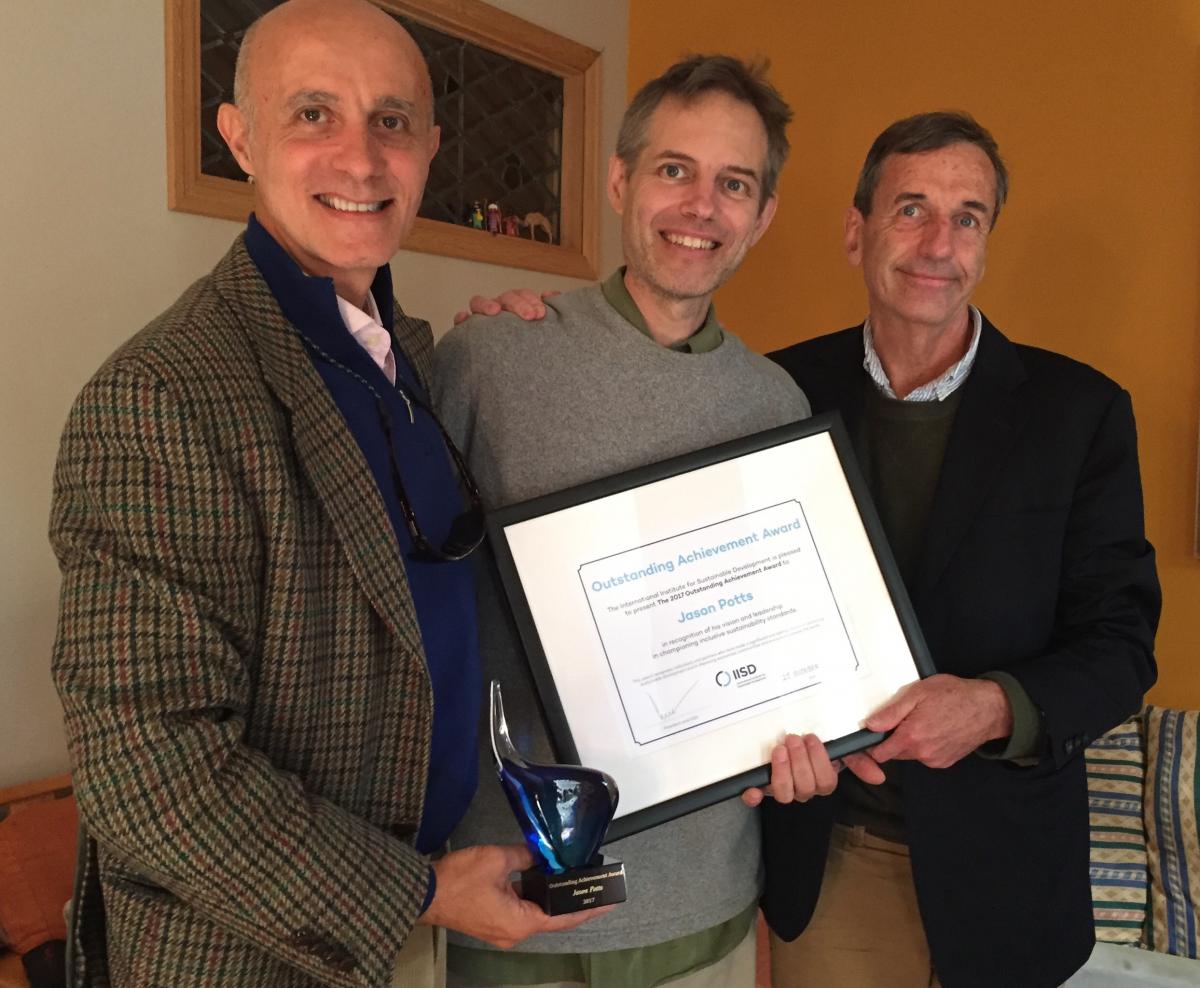
Daniele Giovannucci, co-founder, COSA (left) and Scott Vaughan, President-CEO, IISD (right) present Jason Potts (centre) with IISD's inaugural Outstanding Achievement Award for his work on sustainability standards. 

"Jason was always an incredibly inspiring colleague," said Nathalie Bernasconi-Osterwalder, Director, Economic Law and Policy, IISD. "He was always full of wisdom. He was precise, and a brilliant writer. He was always persuing perfection in his work in the spirit of making the world a better and fairer place. It was never to put himself forward but the cause. He leaves a great vacuum. We will miss him." 

"Jason was truly inspiring as a colleague and as a leader in his field," said Flavia Thomé, Senior Operations Manager, IISD. "His IISD family will miss him, his good humour and brilliant ideas. We hope to make him proud by continuing to work on his projects and advance his work."

Throughout his career, Jason dedicated himself to forging new paths of sustainability and justice to advance communities and protect nature around the globe. At IISD, Jason led the State of Sustainability Initiatives, which tracks and issues regular reports on the characteristics, performance and market trends of sustainability initiatives internationally.

His innovative leadership resulted in globally respected entities such as the Committee on Sustainability Assessment, the Finance Alliance for Sustainable Trade and the Sustainable Commodity Assistance Network, all of which work to champion and monitor sustainable trade.

In recognition of his lifelong commitment to sustainable trade, Jason was recently the first recipient of the IISD Outstanding Achievement Award.

Press release details

Impact area
Sustainable Economies