Press release

G20 Support to Coal Power Plants Increases By More Than Double: Report

G20 governments have more than doubled the amount of financial support they provide to coal power plants in just three years, despite pledging a decade ago to phase out subsidies to all fossil fuels and help prevent catastrophic climate change.

June 24, 2019

Geneva, June 25, 2019 - G20 governments have more than doubled the amount of financial support they provide to coal power plants in just three years, despite pledging a decade ago to phase out subsidies to all fossil fuels and help prevent catastrophic climate change.

In a new report, G20 coal subsidies: Tracking government support to a fading industry, researchers found that despite a historic fall in total investment in coal, the average annual amount G20 governments spent to help build and sustain coal-fired power plants increased from $17 billion to $47 billion between 2014 and 2017. 

The report presents new research from the Overseas Development Institute (ODI), Oil Change International (OCI), the International Institute for Sustainable Development (IISD), and the Natural Resources Defense Council (NRDC) that for the first time tracks G20 governments’ subsidies to coal production and consumption.

Published ahead of the G20 summit in Japan (28 – 29 June), the report examines G20 government support and calculates the average amount spent across 2016 and 2017, the most recent years with available data. Researchers then compared the data to previous analysis which looked at the same figures for 2013 and 2014.

Overall, the report reveals that G20 governments are currently providing at least $64bn each year to prop up the production and consumption of coal. Almost three-quarters of this is going to coal-fired power production, which was the biggest single contributor to the rise in CO2 emissions in 2018.

This year’s G20 host Japan remains one of the largest providers of support, including spending at least $5bn per year on coal overseas, despite Prime Minister Shinzo Abe’s calling for other governments to step up their action on climate change.

Several G20 countries have taken important steps away from coal in recent years, including the UK and Canada who have together created the Powering Past Coal Alliance. However, the stark statistics revealed in the report show G20 countries are nowhere near meeting their promises to stop subsidising coal – and are risking further lock-in to a dirty, outdated power system that is a key driver of the climate crisis.

Lead author Ipek Gençsü, Research Fellow at ODI, said: ‘It has now been ten years since the G20 committed to phasing out subsidies to fossil fuels, yet astonishingly some governments are actually increasing the amount they give to coal power plants. Momentum is growing around the world for governments to take urgent action to tackle the climate crisis. Ending subsidies to coal would bring environmental, social and economic benefits to all and help set a level playing field for clean energy.’

Ivetta Gerasimchuk, IISD Lead for Sustainable Energy Supplies, said: ‘In reality, government support to coal is much larger than our report’s numbers show, because many G20 countries still lack transparency on the many ways they subsidise coal.’

Han Chen, manager of international energy policy at NRDC, said: 'Other G20 governments may struggle to take Japan’s rhetoric on climate change seriously, as this year’s G20 host government continues to pour billions of dollars into propping up coal in Japan and around the world. If Prime Minister Abe is serious about dealing with climate change, he should lead by example and end Japan’s government-backed finance for coal.'

The total amount of government support identified, at least $64 billion per year, comes through three main sources:

  • $28bn per year through governments’ public finance institutions such as bilateral development banks and export credit agencies investing in coal projects, with the majority of this being spent abroad
  • $15bn per year of fiscal support through budget allocations and tax exemptions
  • $21bn per year invested through majority state-owned coal mining and utility companies

The report warns it is likely that in many cases this G20 support has subsidised the same asset multiple times, by firstly incentivising the building of new coal infrastructure, then propping up the operations of those mines and power plants, and finally paying them out to shut early.

In India, where coal-fired power has been one of the main causes of air and environmental pollution, researchers found the banking system, dominated by domestic public institutions, provides around $11bn of public finance mainly for coal-fired power production.

Researchers found that China, the world’s largest consumer of coal for power generation and industry, continues to fund coal abroad with around $10bn of international public finance, mainly for coal-fired power production.

The report calls on the G20 countries to end support for coal and make good on their promises to end subsidies to all fossil fuels. Governments should:

  • Urgently agree to a complete phase-out of support to coal mining and coal-fired power
  • Complete peer reviews of their support to coal and other fossil fuels by 2020
  • Establish country-level plans for ending support to coal which ensure there is a ‘just transition’ for workers and communities, particularly the most vulnerable, and that do not prolong the production and use of coal

G20 coal subsidies: Tracking government support to a fading industry is available online.


About Global Subsidies Initiative (GSI)

The IISD Global Subsidies Initiative (GSI) supports international processes, national governments and civil society organizations to align subsidies with sustainable development.

For more information, please contact: Paulina Mlynarska, [email protected]

Press release details

Impact area
Climate
Press release

Reforming Subsidies Could Help Pay for a Clean Energy Revolution: Report

Reforming the USD 372 billion countries spend each year on fossil fuel subsidies and reallocating between 10 and 30 per cent of the savings to renewable projects would help support a transition to clean energy.

June 16, 2019

(this page was updated on 2019-08-08)

June 17, 2019 – Reforming the USD 372 billion countries spend each year on fossil fuel subsidies and reallocating between 10 and 30 per cent of the savings to renewable projects would help pay for a transition to clean energy.

This is the finding of a new study by the Global Subsidies Initiative (GSI) of the International Institute for Sustainable Development (IISD).

The report authors highlight that the “subsidy swap” concept could not only make the clean energy revolution possible but also save taxpayers’ money for other priorities. “Often fossil fuel subsidies are inefficient, costly to governments and undermine clean alternatives,” said Richard Bridle, IISD Senior Policy Advisor. “All countries should be looking to identify where swaps can kickstart their clean energy transitions.”

“The good news is that fossil fuel to clean energy subsidy swaps are already taking place,” said Bridle. Since 2008, annual global renewable investments have been greater than investments in fossil fuel-based generation. In 2014, annually installed renewable capacity started to exceed annually installed fossil generation capacity. “As renewables have become cheaper, the same dollars can now fund more renewable-powered generation,” he explained.

The report provides examples of four countries—India, Indonesia, Zambia and Morocco—where governments have already been taking concrete actions to reform fossil fuel subsidies and kickstart the replacement of fossil fuel energy sources with renewables. In India, petroleum subsidies have been cut by around 75 per cent since 2014, freeing up funds to support the development of world-leading wind and solar industries. Given country-specific political barriers to policy reform, sharing country experiences is a key tool to show how swaps can be a feasible option for other countries.

“Public money is far better spent delivering the clean energy transition than propping up the fossil fuel industry,” said Bridle. “Currently, there are far more subsidies directed toward fossil fuels than toward supporting renewable energy (USD 100 billion). The reform of subsidies alone is not enough to meet global emissions targets, but it is a good first step. Ultimately, the cost of each energy source should reflect its social and environmental impacts. That means increasing taxes on dirty energy and redirecting subsidies to align with government priorities,“ he concluded.


About Global Subsidies Initiative (GSI)

The IISD Global Subsidies Initiative (GSI) supports international processes, national governments and civil society organizations to align subsidies with sustainable development. For more information, please contact: Paulina Mlynarska, [email protected]
Press release details

Impact area
Climate
Press release

Standard-Compliant Coffee Production is Rising, with Growth from Least Developed Countries

The amount of coffee produced in compliance with voluntary sustainability standards (VSS) is increasing at a higher rate than the overall sector, with significant growth coming from countries with low human development.

June 5, 2019

Ottawa, June 6, 2019 – The amount of coffee produced in compliance with voluntary sustainability standards (VSS) is increasing at a higher rate than the overall sector, with significant growth coming from countries with low human development.

This according to a new report from the International Institute for Sustainable Development (IISD), released today in conjunction with the World of Coffee industry event.

About one-third of all coffee produced globally is VSS-compliant, with the sector experiencing a compound annual growth rate (CAGR) of about 24 per cent between 2008 and 2016. In the same period, VSS-compliant coffee increased at approximately 19 per cent CAGR in countries that rank lower on the Human Development Index (HDI).

The sector’s continued expansion may require moving into new markets that have begun to adopt VSSs, including low human development countries (LHDCs), and working with farmers to support their transition towards more sustainable practices.

“Brazil, Vietnam, and Indonesia are good prospects for increasing sustainable coffee production, given their volume of total coffee produced and VSS presence,” said Vivek Voora, IISD Associate and lead author of the Global Market Report on coffee. “However, Ethiopia and Uganda, followed by Côte d’Ivoire, Madagascar and Papua New Guinea, could benefit the most from expanding VSS-compliant coffee considering their countries’ sustainable development needs as indicated by their HDI value, paired with their total share of global coffee production and VSS presence.”

This potential for expansion in LHDCs may put a strain on farmers in countries battling price volatility and price decline, a lack of resources to strengthen resilience to a changing climate, as well as pest and disease outbreaks which can negatively impact coffee yields and farmers’ profitability.

The coffee sector’s projected growth is fuelled by increasing demand from producing countries and emerging economies traditionally not among major coffee importers, including Brazil, Indonesia and China and the expansion of retail options, such as ready to drink coffee and pods or capsules. However, the growth of VSS-compliant coffee is concentrated mainly in traditional markets such as Europe and the United States and remains lower than supply. This supply-demand imbalance can limit the market growth potential of VSS-compliant coffee and needs to be addressed by value chain actors to benefit from the opportunities that stem from growing coffee demand from producing and emerging countries.

The Sustainable Commodities Marketplace Series from IISD presents sustainable production and consumption market information on agricultural commodities to foster transparency, knowledge and strategic decision-making for sustainable development. Future reports will focus on banana, cocoa, cotton, palm oil, soybean, sugar, and tea.  

Press release details

Press release

Ontario Supporting Freshwater Research and Education

Ontario's government is  investing in a unique, world-renowned northern research facility to help protect the province's freshwater ecosystems.

May 20, 2019

Province Investing in Northern Ontario’s Experimental Lakes Area

KENORA, May 21, 2019—Ontario's government is working for the people by investing in a unique, world-renowned northern research facility to help protect the province's freshwater ecosystems.

Today, Greg Rickford, Minister of Energy, Northern Development and Mines, was in Kenora to announce Ontario is providing more than $2 million in funding to the International Institute for Sustainable Development Experimental Lakes Area (IISD-ELA).

Through the Northern Ontario Heritage Fund Corporation, the IISD-ELA is receiving $30,000 to hire an architectural firm to complete a detailed design and cost estimate for the construction of a water science education and training centre.

The replacement of its outdated facility with a new education and training centre will allow the institute to continue providing and developing initiatives such as the Experimental Lakes Area Student Experience high school program and a field biology program run in partnership with Lakehead University. The new centre will also help expand outreach and collaboration with northwestern Ontario communities and First Nations, as well as increase ecotourism opportunities.

"Our government is proud to be making investments in quality science and research that will help us to protect and enjoy our waterways and freshwater ecosystems," said Rickford. "We have been keen on showing the world that Ontario is open for business and open for jobs - and with today's exciting announcements, we are proud to say that Ontario is open for research as well."

On behalf of John Yakabuski, Minister of Natural Resources and Forestry, Rickford also announced up to $2 million will be provided to the IISD-ELA in 2019-20 to ensure ongoing, multi-year research projects and important long-term monitoring of the Experimental Lakes Area will continue.

"Ontario is fortunate to be home to many lakes, rivers and streams that provide recreational and tourism opportunities, and significant contributions to our economy," said Yakabuski. "That's why making investments in quality science and research that help us to protect these water systems is so important, and it's a pleasure to work with my colleague Greg Rickford on this initiative."

"IISD Experimental Lakes Area is extremely grateful for this continued support from the Government of Ontario," said Jane McDonald, Interim President and CEO, International Institute for Sustainable Development. "As we extend beyond our 50th anniversary, we continue to track emerging threats to freshwater head on, with new and exciting research on oil spills, acid rain, pharmaceuticals, microplastics, algal blooms, environmental DNA and much more."

Quick Facts

  • IISD Experimental Lakes Area, located east of Kenora, is one of the world’s most influential freshwater research facilities. It is a natural laboratory comprised of 58 small lakes and their watersheds set aside for scientific research.
  • The Northern Ontario Heritage Fund Corporation promotes and stimulates economic development initiatives in Northern Ontario by providing financial assistance to projects that foster economic growth and diversification. Since June 2018, the corporation has invested more than $63 million in 501 projects, creating or retaining over 770 jobs.

Press release details

Topic
Water
Impact area
Nature
Press release

Indonesia Would Benefit from Removing Coal Price Cap: report

May 6, 2019

18 trillion IDR consumer subsidy locks in air pollution, raises costs of renewable energy

Jakarta, May 7, 2019 – A new report calls for the Government of Indonesia to remove its price cap on mandatory sales of local coal to Perusahaan Listrik Negara (PLN), the state-owned electricity company.

Released by the International Institute for Sustainable Development (IISD), Indonesia's Coal Price Cap: A barrier to renewable energy deployment highlights alternative strategies to sustain PLN’s finances without harming the integration of renewable energy with its health and environmental benefits.

“Reducing fuel costs of coal generators through price-capped coal while at the same time indexing renewable energy prices at levels often lower than those paid to coal generators greatly disadvantages renewables,” says Richard Bridle, lead author of the report. “The key message of these policies is that coal generation receives special support, so it’s clear why PLN continues to pursue large-scale coal projects.”

The report examines the pros and cons of five alternative strategies to shore up PLN’s finances:

  1. Increasing electricity tariffs across the board while removing coal price cap
  2. Reducing the numbers of consumers able to access discounted tariffs (better targeting)
  3. Replacing coal cap with an equivalent charge on the sale of coal and a technology-neutral payment to PLN
  4. Removing the link between average generation cost (BPP) and procurement of new renewable generators. Set a target for procuring generation and allow the market to drive down prices
  5. Implementing the “polluter pays” principle. Increase taxes and charges on environmentally harmful activities and use the revenues to fund PLN in a technologically neutral way

“For renewable power to scale up to a place where it’s cost competitive for consumers, improving air quality and reducing health costs, the coal price cap needs to be removed,” says Bridle. ”Indonesia already has an aggressive target for increasing renewable energy use and removing the coal price gap would be a key step to secure this legacy.”

Will this increase prices for consumers?

  • Consumer price rises may well be part of the reforms, but removal of subsidies frees up spending for other priorities. In 2015, the removal of gasoline and diesel subsidies freed up IDR 211 trillion (USD 15.6 billion) to fund a wide range of infrastructure and government programmes;
  • Subsidising coal is a very blunt instrument. The same funds could make a much greater fiscal impact if the subsidies were targeted to people and programmes where they are needed most;  
  • To completely avoid price rises for consumers, an equivalent tax could replace the coal price cap. Revenues could fund a range of electricity generators without focussing all support on coal. 

Press release details

Topic
Subsidies
Impact area
Climate
Press release

Coalition Aims to Build Sustainability Into Belt and Road Initiative Projects

IISD is a leading partner in a coalition launched this week devoted to integrating economic, social, and environmental considerations into the Belt and Road Initiative.

April 25, 2019

A coalition launched this week devoted to integrating economic, social, and environmental considerations into the Belt and Road Initiative (BRI).

Over 100 international and Chinese partner institutions are included in this Belt and Road Initiative International Green Development Coalition (BRIGC). The International Institute for Sustainable Development (IISD) is a leading partner.

“We need to adhere to the concept of openness, greenness, and cleanliness,” said Chinese President Xi Jinping at this year’s Belt and Road Forum, held in Beijing from April 25 to 27, 2019. He added that the Initiative needs to “promote green infrastructure construction, green investment, green finance, and protect the common home for the sake of human survival.”

The Belt and Road Initiative announced by President Xi six years ago aims to slash trade costs, improve inter- and intra-regional connectivity, mobilize investment, and fuel economic growth across dozens of countries, from China to Southeast and Central Asia, to parts of the African continent and much of Europe.

“Infrastructure investments, especially in developing countries that are part of the Belt and Road Initiative, must be designed to support the achievement of sustainable development objectives,” said Nathalie Bernasconi-Osterwalder, IISD’s Group Director for Economic Law and Policy. 

The Belt and Road Initiative International Green Development Coalition includes:

  • China’s Ministry of Ecology and Environment
  • The environment ministries of 25 countries that may host BRI projects
  • Eight intergovernmental organizations, including several UN agencies
  • Over 60 non-governmental organizations and research institutes along with 30 enterprises.

The BRIGC aims to help integrate sustainable development considerations throughout the design, execution, and long-term implementation of BRI projects. It will serve as a platform for policy dialogue and communication, as well as for exchanging data and other information on ecological conservation, environmental protection, and the prevention and mitigation of pollution. The coalition will also work on facilitating cooperation on green technology, including on its exchange and transfer.

"It brings together a lot of interesting partners. It's very important for China to have those kinds of partnerships because what we need to see for the Belt and Road to be truly successful has to involve interaction among the countries of the BRI," said Former IISD President Arthur Hanson, one of the Advisors on the coalition’s Advisory Committee.

Green Finance and Investment

The coalition features nine “Thematic Partnerships,” with specific work priorities and related activities. IISD is an international lead partner for one of these Thematic Partnerships—green finance and investment—together with the World Resources Institute. The Chinese lead partner is the Center for Finance and Development of Tsinghua National Institute of Financial Research. These three institutions will take stock of finance and investment approaches and policies in BRI projects and recipient countries, examining what lessons can be learned from recent and ongoing work on these topics. The three partners will also lead workshops and other capacity-building efforts as the BRI progresses.

IISD has a long history helping governments integrate sustainability into legal and policy frameworks for investment. Infrastructure sustainability is another core area of work for IISD, including through its research on green financeinfrastructure, and procurement, as well as its strong record of project valuations through the Sustainable Asset Valuation (SAVi) tool, developed with the MAVA Foundation.

Belt and Road Initiative

Press release details

Impact area
Sustainable Economies
Press release

Media Availability: Zebra Mussels and Fresh Water

During Manitoba's Invasive Species Awareness Week, IISD Experimental Lakes Area is pleased to offer expertise to media on zebra mussels—one of Manitoba waters' most common invasive species—and the effect they can have on our province's fresh water.

April 23, 2019

The Province of Manitoba has proclaimed April 22 to 28 Invasive Species Awareness Week, and is continuing efforts to make the public aware of the negative effects invasive species can have on our environment.

IISD Experimental Lakes Area is pleased to offer expertise to media on zebra mussels—one Manitoba waters' most common invasive species—and the effect they can have on our province's fresh water.

Dr. Scott Higgins is an IISD Experimental Lakes Area Research Scientist who has studied the ecological impacts of zebra mussels across North America and Europe over the last decade. He has authored several research papers and book chapters on their impacts, and co-authored a national risk assessment of zebra mussels in Canada.

To arrange to speak with Dr. Higgins please contact Sumeep Bath at [email protected] or +1 (204) 958 7700 ext 740.   

IISD Experimental Lakes Area is one of the world’s most influential freshwater research facilities. It features a collection of 58 small lakes and their watersheds in Northwestern Ontario, Canada, as well as a facility with accommodations and laboratories for up to 60 personnel. By manipulating these small lakes, scientists are able to examine how all aspects of the ecosystem—from the atmosphere to fish populations—respond.

Press release details

Topic
Water
Impact area
Nature
Press release

Statement on Italy and Indonesia Fossil Fuel Subsidy Peer Review

The International Institute for Sustainable Development commends the governments of Indonesia and Italy on the release of their fossil fuel subsidy peer review results.

April 17, 2019

The International Institute for Sustainable Development (IISD) commends the governments of Indonesia and Italy on the release of their fossil fuel subsidy peer review results.

The Italian report includes 39 subsidies to production and consumption totalling EUR 13 billion in 2016. The Indonesian report highlights significant past reforms to transport fuels and electricity.

Both countries agree there is more work to do. Indonesia speaks in its report about efforts to reform liquified petroleum gas (LPG) subsidies and acknowledges more can be done in electricity. With a new medium-term development plan that references subsidy reform, we are eager to see how they move forward.

Italy, with a new government at the time of the review, asked its advisory panel to provide suggestions for reform and conduct CGE modelling on various reform scenarios to inform their plans. Both requests were welcome, and we look forward to seeing how they inspire Italy’s actions.

IISD thanks both countries for inviting our Global Subsidies Initiative team to be part of the review process. “This was an honour we take very seriously,” says Peter Wooders, Energy Group Director for IISD. “We now call on Canada and Argentina as the next G20 countries scheduled for peer review to continue raising the bar on transparency - government support for the oil, gas and coal sectors must be clear. We note a majority of G20 countries have yet to embark on  reviews and repeat our call for them to commit to voluntary peer reviews of fossil fuel subsidies.”

Press release details

Topic
Subsidies
Impact area
Climate
Press release

World’s Freshwater Laboratory Launches New Project to Revolutionize How We Protect Canada’s Lakes

To mark this year’s Earth Day, the world’s freshwater laboratory is launching an unprecedented two-year project to determine how new technologies, such as artificial intelligence, can revolutionize how we protect the environment.

April 17, 2019

WINNIPEG, April 18, 2019—To mark this Monday’s Earth Day, the world’s freshwater laboratory is launching an unprecedented two-year project to determine how new technologies, such as artificial intelligence, can revolutionize how we protect the environment.

IISD Experimental Lakes Area (IISD-ELA), just four hours east of Winnipeg, will be taking its 51-year dataset—one of the longest and most comprehensive in the world—on the health and history of its lakes and using artificial intelligence to reframe how we understand the health of our environment, and come up with new solutions for its protection.

IISD-ELA’s new research will explore questions such as: how can artificial intelligence make collecting data on the health of a body of freshwater, such as Lake Winnipeg, easier and more accurate? What can new technologies teach us about the impact that climate change will have on our environment over the next 50 years? Could we ever have a “smart” system that warns the public of sewage spills in Winnipeg or zebra mussels on Lake Winnipeg in real time?

“IISD-ELA is a Canadian scientific treasure, and the only place is the world you can experiment on real lakes to truly see what human activity is doing to all aspects of fresh water life,” said Geoffrey Gunn, geographer, IISD Experimental Lakes Area.

“By taking new technologies, such as artificial intelligence, and applying their unique power to our data analysis and our research, we will advance understanding of how aquatic ecosystems respond to stress—everything from changing climate to pollution. This will inspire new technologies and strategies for protecting our freshwater ecosystems.”

This research is being made possible through a $500,000 funding grant from the RBC Foundation, allowing IISD Experimental Lakes Area to advance the role of new technologies and freshwater protection.

“At RBC we believe in the power of innovative technologies like artificial intelligence and blockchain to address and scale solutions to some of the most pressing environmental issues of our time,” said Valerie Chort, vice president, corporate citizenship, RBC. “We’re proud to be working alongside IISD Experimental Lakes Area to develop real-world solutions that advance the role of new technologies and freshwater protection.”

IISD Experimental Lakes Area is the world’s freshwater laboratory. A series of 58 lakes and their watersheds in northwestern Ontario, Canada, IISD-ELA is the only place in the world where scientists can research on and manipulate real lakes to build a more accurate and complete picture of what human activity is doing to freshwater lakes. The findings from its 50 years of ground-breaking research have rewritten environmental policy around the world—from mitigating algal blooms to reducing how much mercury gets into our waterways—and aim to keep fresh water clean around the world for generations to come.

-30-

For more information, or to arrange an interview, contact:

Sumeep Bath,

Communications Manager,

IISD Experimental Lakes Area

(204) 958 7700 ext. 740

[email protected]

Press release details

Impact area
Nature
Press release

Switching kerosene subsidies to solar would cost India less, reduce indoor pollution: Report

India could save money and reduce indoor air pollution by switching kerosene subsidies to solar.

April 17, 2019

Off-grid solar enjoys widespread public support, surveys find

New Delhi (April 18, 2019) – India has almost achieved the historic goal of connecting every household to the electricity grid. The next challenge is 24x7 Power for All. According to a new independent study by the International Institute for Sustainable Development (IISD) and The Energy and Resources Institute (TERI), switching subsidies from kerosene to off-grid solar products would improve electricity access for households still reliant on kerosene.

Despite the success of SAUBHAGYA, millions of households continue to use kerosene lamps during outages or because they cannot afford electricity. But kerosene is problematic because it provides poor-quality light, causes harmful indoor air pollution and is a fire risk. The report shows support for off-grid solar could be made directly to households, through manufacturers or as subsidized credit through financial institutions.

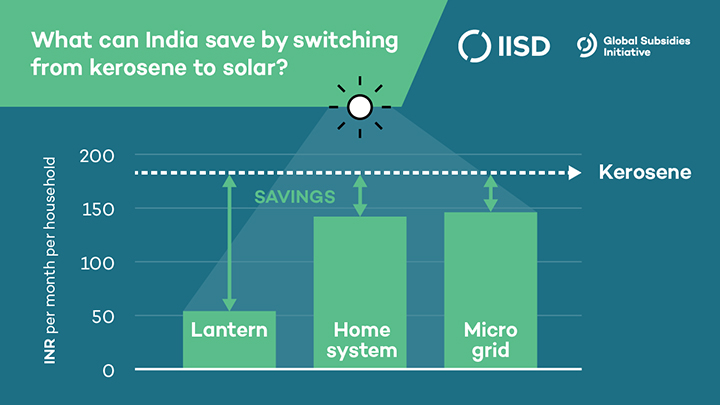
Balasubramanian Viswanathan, IISD Associate and co-author of the study says, “Over the lifetime of the products, solar lanterns, home systems and microgrids are all cheaper than the combined household and government expenditure on kerosene. The government could actually save money by switching support to solar.”

Martand Shardul, Fellow at TERI and co-author, added, “From the state and central level consultations it is clear that the government wants to provision access to energy for lighting to everyone. Communities also aspire to transition to solar based solutions for lighting.”

Kerosene versus solar costs

An earlier joint publication by IISD and TERI in July 2018 explored the business case for a subsidy swap. The 2019 study goes further by providing a six-step implementation plan for governments. The first three steps provide options on funding, targeting recipients and selecting solar products. The next steps are presented as three separate pathways depending on whether the government chooses to subsidize consumers, manufactures or financial products. The goal for each pathway is the same: to assist India’s transition to clean and reliable power for all.


About TERI

The Energy and Resources Institute (TERI) is an independent, multi-dimensional organization, with capabilities in research, policy, consultancy and implementation. It has pioneered conversations and action in the energy, environment, climate change, and sustainability space for over four decades. The institute's research and research-based solutions have had a transformative impact on policy, industry and communities. Headquartered in New Delhi, it has regional centres and campuses in Gurugram, Bengaluru, Guwahati, Mumbai, Panaji, and Nainital, supported by a multidisciplinary team of scientists, sociologists, economists and engineers, and state-of-the-art infrastructure.

Press release details

Topic
Subsidies
Impact area
Climate