
Harmful Subsidies Explained: Eight key takeaways from experts
This year marks 20 years since IISD launched the Global Subsidies Initiative (GSI), which was created to shine a light on the hidden costs of subsidies and support governments undertaking reform. To mark the anniversary, IISD convened a high-level panel at the World Trade Organization (WTO) Public Forum with representatives from government, civil society, and international organizations. Together, they reflected on what has been achieved, why subsidy reform remains a political challenge, and the new opportunities for progress. Here are eight key insights from that discussion.
1. Subsidies are powerful market-shaping tools.

Subsidies don’t just tweak economies; they shape them. They decide what gets produced and consumed, by whom, and at what scale. Early cross-sector reviews showed just how much money was at stake—running into the trillions globally and growing. Subsidies are legitimate public policy tools, and how they are designed defines whether they advance or undermine climate, nature, and equity. Untargeted subsidies to fuel consumption, for example, provide most of their benefits to wealthy households, because they use the most fuel.
2. They are incredibly hard to reform.

If subsidies are so costly, why do they persist? Because they are deeply political, subsidies are woven into national budgets, often benefitting powerful groups that lobby to keep them—one expert called them “the currency of politics.” Once created, they are rarely removed, no matter how inefficient, making reform one of the toughest policy challenges governments face. Finance ministries are key actors, as they dislike inefficient spending and can drive reform to transcend sector-specific interests.
3. Transparency is the first step to reform.

You can’t manage what you can’t measure. From the start, GSI focused on exposing the scale and nature of subsidies—and asking uncomfortable questions about trade-offs. Would you rather maintain an untargeted fuel subsidy or use the same money to fund health care? Shining a light on these issues forces governments and citizens to confront the real costs and benefits of fiscal decisions, enabling them to make informed choices.
4. Reform is both science and art.

The science lies in getting the numbers right: if data isn’t watertight, opponents will shred it. But once the evidence is in place, the art begins—navigating politics, managing winners and losers, and finding ways to support people through the transition. Reforming a subsidy may look neat on paper, but in practice, it means disrupting entrenched interests and household budgets. Understanding and navigating the domestic political economy, while focusing on helping those who will “lose” when subsidies are reformed, is crucial to successful and durable subsidy reforms.
5. Supporting people directly works better than distorting markets.

Focusing on people is a way to shape reform. Most subsidies are blunt instruments. The Organisation for Economic Co-operation and Development (OECD) notes that only 1.6% of global agricultural support actually improves food security for people. Experts argue that it makes more sense to help people directly—whether through income support for fishers during closed seasons or cash transfers for low-income families—than to keep pouring money into blunt price controls that distort markets and production.
6. Green subsidies risk creating new distortions and inequities.

For wealthy economies, subsidies are often strategic: the goal is to support green industries, secure energy supplies, or stay competitive. For developing countries, the picture is starkly different, as they contend with limited fiscal space, pressing poverty concerns, and fewer tools to manage transitions. When rich countries spend lavishly on “good” subsidies to help their companies through the green transition, while poor countries can’t afford to do the same, the playing field tilts further. Green subsidies and incentives are rising, but they risk creating new distortions and inequities if poorly designed.
7. Reform is easier when countries move together.

There is often a first-mover disadvantage in subsidy reform, which can be overcome through coordinated action among countries. Collective action lowers the political cost of reform and makes bold moves more credible. That’s why international cooperation—whether through the WTO, the OECD, or coalitions on fossil fuel subsidy reform such as the Coalition on Phasing Out Fossil Fuel Incentives Including Subsidies alliance—is key. Change is always hard alone, but it gets easier when you do it together.
8. International rules are starting to catch up.

The WTO’s new Agreement on Fisheries Subsidies is one sign of progress. For the first time, global trade rules are explicitly tackling the environmental harm caused by subsidies. Meanwhile, climate and biodiversity commitments are pushing governments to phase out subsidies for fossil fuels and other environmentally harmful products. Such commitments are a positive first step, showing how international frameworks can nudge countries toward change.
The 20th anniversary of GSI underscored the importance of subsidy design for sustainable development, the importance of international cooperation in driving and shaping subsidy reforms, and the crucial role of civil society and research organizations in helping governments move in the right direction.
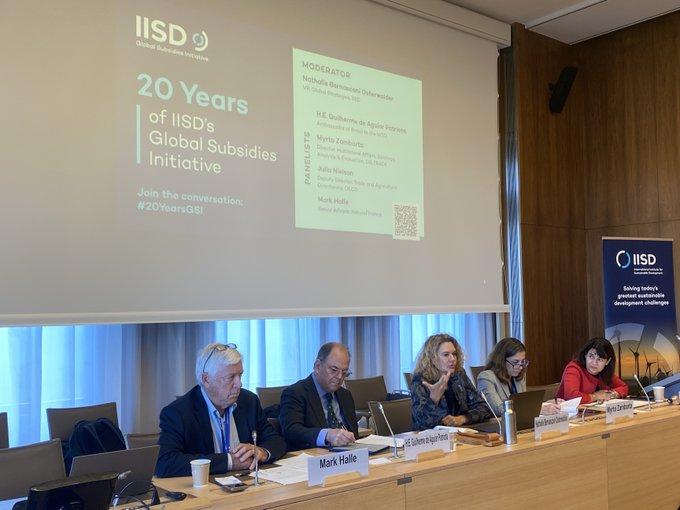
Experts who participated in the Global Subsidies Initiative panel:
Mark Halle, Senior Advisor, NatureFinance; H.E. Guilherme de Aguiar Patriota, Ambassador of Brazil to the WTO; Nathalie Bernasconi-Osterwalder, Vice-President, Global Strategies and Managing Director, Europe, IISD; Myrto Zambarta, Director, Multilateral Affairs, Strategy, Analysis & Evaluation, Directorate General for Trade, European Commission; and Julia Nielson, Deputy Director, Trade and Agriculture Directorate, OECD.
You might also be interested in
Mark Halle talks tough politics of subsidy reform
Twenty years ago, Mark Halle and his team launched the Global Subsidies Initiative to help governments reform harmful government support measures. In a new interview, Mark explains what has changed and how countries can advance subsidy reform.
Milestone Reached as WTO Global Agreement on Fisheries Subsidies Enters Into Force
The WTO’s first-ever legally binding agreement on subsidies will enter into force on September 15, 2025—a historic achievement in tackling harmful subsidies at a global scale and advancing ocean sustainability.
Bonn Climate Talks: What to watch for the fossil fuel transition
As governments return to Bonn for the UNFCCC Subsidiary Bodies meetings (SB64), the transition away from fossil fuels will be a key test of whether growing political momentum can translate into practical progress.
Five Trends That Have Shaped Global Subsidies Over Decades
As we celebrate the Global Subsidies Initiative's 20th anniversary, we asked our experts how thinking on government support has shifted over time.