
Environmental reporting team marks 30 years as key negotiations approach
Need for Earth Negotiation Bulletin’s transparency is clear as countries debate marine plastics treaty, biodiversity targets, climate action
February 23, 2022, Winnipeg, Canada—As world governments struggle to agree on united responses to environmental crises, a reporting team is marking three decades revealing the details of negotiations and which countries have advanced action or built roadblocks.
Founded on 2 March 1992, the Earth Negotiations Bulletin (ENB) is a balanced, timely, neutral reporting service that attends and tracks more than 35 intergovernmental negotiating processes—including climate change, biodiversity restoration, and chemicals governance. Acting as a concise “paper of record” of environmental talks, ENB’s nuanced reports support policymakers, media, researchers, and activists trying to track what countries say in environmental negotiating rooms around the world.
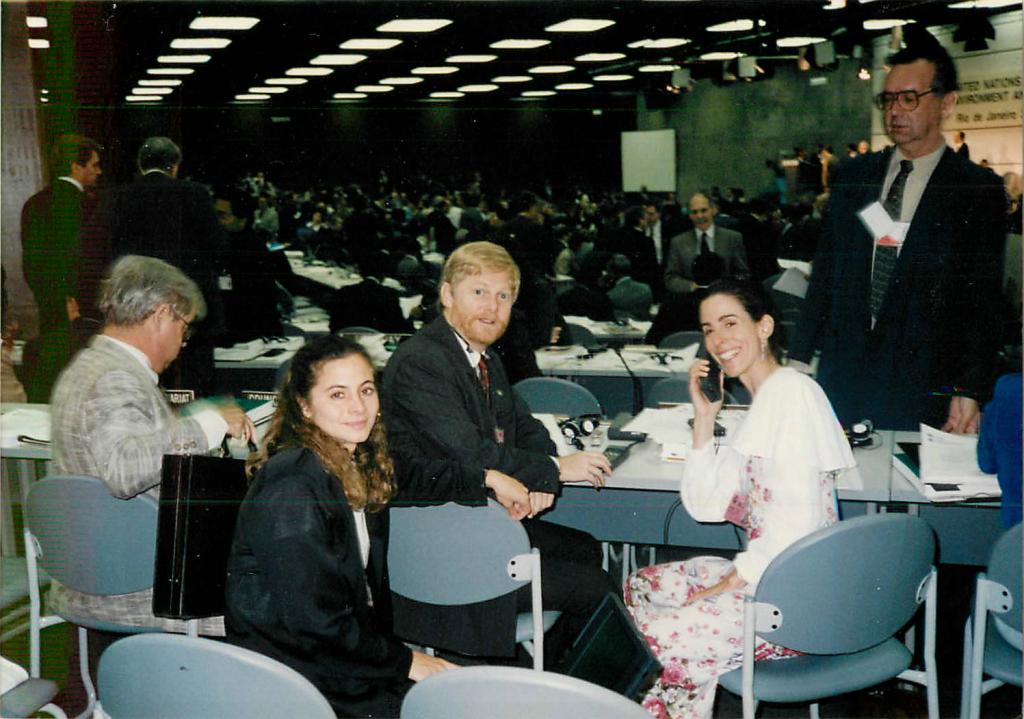
“The need for transparency has only grown,” says Dr. Pamela Chasek, Executive Editor of ENB. As a doctoral student preparing for the 1992 United Nations Conference on Environment and Development in Rio de Janeiro, she cofounded the publication with Johannah Bernstein, an environmental lawyer, and Langston James ‘Kimo’ Goree VI, a former UNDP programme officer and NGO activist from the Western Amazon. “The world’s linked environmental problems are getting worse, with impacts hitting the Global South hardest. Some governments are trying to act together at the scale and speed necessary, and it is crucial people understand how those decisions are being made or slowed on their behalf.”
This year could feature a number of those decisions, as diplomats try to resume in-person talks amid shifting waves of COVID-19 infections and unequal access to vaccines. Highlights for 2022 may include:
- Launch of negotiations for a marine plastics treaty
- Launch of negotiations for a science-policy body (like IPCC or IPBES) for chemicals
- Adoption of a global biodiversity framework, with targets to slow and reverse biodiversity loss
- Adoption of a legally binding instrument to protect high seas biodiversity
“Amid the climate crisis, all countries must have access to these negotiations,” says Dr. Richard Florizone, President and CEO of the International Institute for Sustainable Development (IISD), which has housed ENB since 1992. “Especially people in developing countries and small island nations who have the most at stake and the fewest negotiators at these talks. We’re deeply grateful to the founders for an idea that only grows in importance.”
For media inquiries, interviews, and archival photos, please contact
Matthew TenBruggencate, Senior Communications Officer, IISD, [email protected]
About IISD
The International Institute for Sustainable Development (IISD) is a globally recognized think tank with 3 decades of experience working to solve the world’s most pressing sustainable development challenges. We combine deep expertise in a wide range of issues with a collaborative approach to research, policy advice, and hands-on support to ensure these solutions are brought to life. Headquartered in Winnipeg, Manitoba, we are a diverse team of over 300 professionals working from offices in Canada, Switzerland, and other locations around the world.
You might also be interested in
A Full Calendar for SDG Discussions and Global Environmental Governance
The coming year will be decisive for sustainable development governance, bringing us twice as many meetings of environmental treaty governing bodies as we would expect during non-COVID times.
Health in the Global Environmental Agenda: A policy guide
As awareness grows over the steep health impacts of global environmental changes, how can the health and environment sectors come together for joint action?
The State of Global Environmental Governance 2021
Our reporting team explores lessons learned from trying to advance global environmental diplomacy amid a year of uneven pandemic recoveries.
The State of Global Environmental Governance 2020
Our reporting team explores how the pandemic impacted global negotiations on climate action, biodiversity restoration, and other environmental crises.