Insight

Freshwater Stewardship in Canada

Scott Vaughan explains how IISD is bridging the gap between freshwater science and policy, and how it plans to celebrate Canada's 150th Anniversary.

January 14, 2017

Countries around the world face pressures and stresses on their highly valuable freshwater resources. 

In addition to many long-standing pollution and contamination pressures from sewage, waste water and eutrophication—among the biggest environmental challenges on the planet today—new pressures from the impacts of climate change are creating new stress points on water quality and quantity.

It is no secret that robust science must underpin freshwater policy. Yet bridging science and policy is neither automatic nor simple: science priorities change and new methods to capture data evolve quickly. At the same time, traditional knowledge must act as a central pathway to real stewardship, and policy priorities remain subject to debate.

On January 20, IISD, in collaboration with the University of Ottawa, will host a meeting of public policy specialists and freshwater scientists (including scientists from IISD-ELA) in order to explore these challenges.

Building on this event, as part of its celebration of Canada's 150th Anniversary IISD will mark Canada's remarkable contribution to freshwater science and conservation by hosting an international meeting of water science-policy experts, to take place in Winnipeg, Canada in late 2017.

Insight details

Topic
Water
Region
Canada
Insight

A discussion of the IISD-ELA inspired play 'The Watershed'

'The Watershed', a play inspired by IISD Experimental Lakes Area, is coming to Winnipeg! Hear IISD-ELA's executive director, Matt McCandless speak with the playwright Annabel Soutar about the play and the new era of the world famous research site.

January 5, 2017

'The Watershed', a play inspired by IISD Experimental Lakes Area, is coming to Winnipeg! Hear IISD-ELA's executive director, Matt McCandless speak with the playwright Annabel Soutar about the play and the new era of the world famous research site.

There will be a gala reception and exclusive preview performance on March 14, 2017 in Winnipeg. Click here for more information and for tickets.

Insight details

Region
Canada
Insight

Reactions to Canada's Climate Change Framework: Government leadership

Melissa Harris takes a look at the recent Pan-Canadian Framework on Clean Growth and Climate Change, focusing on government leadership.

December 22, 2016

In December 2016, Canada's First Ministers released their Pan-Canadian Framework on Clean Growth and Climate Change. In this series of blog posts we break down the Framework for you, explaining what is proposed, what the strengths are, and what challenges may lie ahead.

In this blog post, we focus on government leadership.

WHAT IS THE ISSUE?

Greenhouse gas (GHG) emissions from government operations account for a fraction of Canada’s emissions.

Government acquisitions, energy efficiency measures, and infrastructure investments can have an important role in driving the transition to the clean economy future. The significant amount of money that is spent on government procurements can play an important role in driving demand, supporting early stages of technology deployment, improving market acceptance, and reducing costs. It is important for governments to lead by example by applying climate policies to government operations but also by embedding climate action as an integral part of policy and program decisions.

HOW DOES THE PAN-CANADIAN FRAMEWORK PLAN TO ADDRESS THE PROBLEM?

The Framework provides three principles for government leadership on climate:

  1. Emission reduction targets for federal, provincial and territorial government operations;
  2. Scaling up of efforts for highly efficient buildings and zero-emission fleets; and
  3. Clean procurement.

WHAT ARE THE STRENGTHS OF THE PROPOSED SOLUTIONS?

The Government of Canada’s target to reduce emissions by 30 per cent by 2030 – similar to Canada’s international climate targets but applied specifically to government operations – is a bold but achievable target. British Columbia has already achieved a carbon neutral government – the first in the continent.

For the first time, governments across the country have agreed to set targets to reduce emissions resulting from operations. These targets can demonstrate that governments are serious about delivering on Canada’s international climate commitments and are ready to lead by example.

There are also other benefits. Investment in energy efficiency measures across government assets can reduce emissions but also reduce energy waste, resulting in costs saving for tax payers. Deployment of energy efficiency measures can generate clean technology jobs, and lead to development of skills which can then be applied across other sectors of the economy.

The shift away from fossil fuels to zero-emission fleets can also support accelerated deployment of clean energy infrastructure and support emission reduction efforts in the transportation sector. A switch to electrical and cleaner fuels could save governments money over the life of the vehicle.

Government leadership on climate is an important step forward with benefits for the environment and the economy.

WHAT ARE SOME KEY ELEMENTS TO CONSIDER IN IMPLEMENTING A ROBUST POLICY?

While the Framework sent high-level signals about government objectives, it is light on specific details. An important next step is to maintain momentum and set bold and consistent targets across the country. At minimum, provincial and territorial governments should adopt the federal target and set the goal of reducing emissions from government operations by 30 per cent by 2030 while aiming for carbon neutrality by 2050, at the latest. Provincial and territorial governments should work with municipal governments to develop similar targets and supporting policies across all levels of government. Governments should also work with industry to encourage similar voluntary standards across the economy.

In terms of energy efficiency and vehicle fleets, a clear schedule for the transition will important. At a minimum, governments should no longer  purchase any new fossil fuel based vehicles, should develop guidelines for lower carbon fuel purchases, and require highest energy efficiency building and equipment purchases and lease requirements. An immediate directive from finance and treasury departments across governments on this will be necessary.

Finally, and perhaps most importantly, governments need to incorporate climate in policy and program decisions. That means, any future policy and programing decision should ask, as a foundational principle, whether the policy or program is aligned with, and supportive of, climate objectives. Continued investments in policies which inadvertently increase emissions will undermine government leadership on climate. Governments should also make sound procurement decisions that take into consideration adaptation needs.

Insight details

Region
Canada
Insight

Reactions to Canada's Climate Change Framework: International Leadership

In one in a series of blog posts on the Pan-Canadian Framework on Clean Growth and Climate Change, Frédéric Gagnon-Lebrun explains what the Framework will mean for Canada's international leadership on climate change.

December 20, 2016

In December 2016, Canada's First Ministers released their Pan-Canadian Framework on Clean Growth and Climate Change. In this series of blog posts we break down the Framework, explaining what is proposed, what the strengths are and what challenges may lie ahead.

In this post we focus on international leadership.

WHAT IS THE ISSUE?

As a global issue, tackling climate change requires international cooperation at all levels, from national governments to cities’ administrations. The Paris Agreement has enabled a new era of international cooperation on climate change, and its extremely rapid entry into force demonstrates the political buy-in achieved last year.

Canada’s commitment to multilateralism on this file is ever more critical. Along with other developed countries, it has benefited from industrialization while being responsible for significant greenhouse gas (GHGs) emissions that are causing our climate to change. Under the Paris Agreement, developed countries are therefore expected to show leadership and ambition in curbing their emissions pathway. There is still much work to be done, however—even when accounting for national pledges made under the Paris Agreement, a temperature increase of 2.9℃ to 3.4℃ is expected by the end of the century. 

Developing countries have joined the Paris Agreement with another expectation—receiving financial support to make their economies more resilient to climate impacts and less carbon-intensive. Developing and least-developed countries face important challenges in fostering economic growth, while investing to reduce their emissions and adapt to a changing climate. Developed countries have an ethical duty to support developing countries and have committed to mobilize USD 100 billion per year from 2020 onwards.

HOW DOES THE PAN-CANADIAN FRAMEWORK PLAN TO ADDRESS THE PROBLEM?

The Framework spells out Canada’s plan to engage internationally, by

  • Reiterating Canada’s commitment of CAD 2.65 billion by 2020 to vulnerable countries.
  • Indicating that Canada is interested in exploring ways to make use of internationally transferred mitigation outcomes to comply with its 2030 mitigation target.
  • Acknowledging the important role that trade can play in support of climate policy.

WHAT ARE THE STRENGTHS OF THE PROPOSED SOLUTIONS?

The Framework firmly reiterates Canada’s commitment to taking domestic actions and supporting developing countries in taking climate action and dealing with climate impacts. This announcement from North America is timely and welcomed as the world enters a new phase in climate diplomacy. 

Canada’s 2015 pledge on climate finance has been instrumental in building trust from developing countries in international negotiations ahead of the adoption of the Paris Agreement. Many developing countries welcomed Canada’s pledge, partly because it was structured over four years, providing predictability of financing for developing countries.    

Beyond public climate finance, tackling climate change will require massive investments to flow across borders to enable the transition to low-carbon economies. In this regard, Canada’s focus on ensuring that trade rules support climate policy is noteworthy.

WHAT ARE SOME KEY ELEMENTS TO CONSIDER IN IMPLEMENTING A ROBUST POLICY?

Solidarity with developing countries must be at the heart of Canada’s international action, and Canada needs to provide clarity on how it intends to increase its international climate finance to contribute its fair share beyond 2020.

Trade can also play an important role in addressing climate change by facilitating access to sustainable solutions and good practices needed for countries to implement their commitments under the Paris Agreement. Yet the climate and trade agendas have been kept quite separate and have often focused on how they negatively impact or constrain each other. Canada, with its international partners, can play a positive role in framing these talks in a more positive light, exploring opportunities for trade rules to support climate policy and ambitious action.

Showing leadership internationally is as much about cooperating with international partners as it is about setting and meeting ambitious emission reduction targets. Canada has an opportunity to raise its climate ambition domestically, but also by using international mitigation outcomes, thereby benefiting from emissions reductions at a lower cost in other countries. The use of international mitigation outcomes to achieve Canada’s target should be considered in light of what can be reasonably achieved in Canada through investments in innovation and avoiding investments that lock in emission pathways for decades to come.  

International cooperation indeed means being accountable to the other parties to the Paris Agreement. Canada’s federal, provincial and territorial governments must strive to provide clear and comprehensive information on progress in both domestic actions to reduce emissions and its international climate finance commitments.

As countries are developing the accounting rules, transparency and rigour will be of utmost importance, especially around the trade of mitigation outcomes across borders. It will be important to have a robust system that avoids double counting of mitigation outcomes before trading begins.


Insight details

Region
Canada
Insight

Reactions to Canada's Climate Change Framework: Industry

In the third of a series of blog posts on the Pan-Canadian Framework on Clean Growth and Climate Change, Amin Asadollahi explores what the framework will mean for industry.

December 19, 2016

In December 2016, Canada's First Ministers released their Pan-Canadian Framework on Clean Growth and Climate Change. In this series of blog posts we break down the Framework, explaining what is proposed, what the strengths are and what challenges may lie ahead.

In this post, we focus on industry.

WHAT IS THE ISSUE?

In 2014, about two fifths of Canada’s greenhouse gas (GHG) emissions came from industrial sectors.

More than half of industrial emissions are from oil and gas production, processing and distribution—the  fastest-growing source of Canada’s GHG emissions. Alberta’s cap on oil sands emissions will ensure, for the first time, that the sector’s emissions will not go unchecked, but does still provide room for growth, including for projects currently under construction. The emissions cap—combined with performance requirements and a price on carbon—could decrease the GHG intensity of the oil sands. As a result, oil sands production volumes could increase over time without an increase in upstream emissions beyond the cap. This growth raises the need to reduce emissions from other sectors of the economy. It will also be imperative to reinvest revenues generated from the oil and gas sector to support the transition to a clean energy future.

The oil and gas sectors are also responsible for about 40 per cent of emissions of methane, a short-lived climate pollutant whose global warming potential is 86 times higher than that of carbon dioxide. Methane, however, is a short-lived climate pollutant with a life of 12 years versus carbon dioxide, which stays in the atmosphere for thousands of years. In other words, by phasing out short-lived climate pollutants, we will see immediate benefits and can increase the chances of staying within climate-safe limits. Canada agreed to phase out hydrofluorocarbons (HFCs), another short-lived climate pollutant, which is expected to result in the avoidance of 0.5℃ in temperature increase.

HOW DOES THE PAN-CANADIAN FRAMEWORK PLAN TO ADDRESS THE PROBLEM?

The Framework provides three solutions to reduce emissions in the industrial sector:

  1. Reducing methane and HFCs
  2. Implementing energy efficiency measures
  3. Investing in research and the development of clean technologies.

WHAT ARE THE STRENGTHS OF THE PROPOSED SOLUTIONS?

On October 14, 2016, Canada was part of a historic international agreement to phase out HFCs, the single biggest climate commitment ever. Reducing methane by 40 to 45 per cent by 2025 is a step in the right direction on another short-lived climate pollutant. Recognition of the need to invest in energy efficiency across the industrial sector is a similarly positive move. Addressing energy waste is often one of the lowest-cost emission reduction opportunities.

For the industrial sector to reduce its emissions, innovation will be key, and governments can be strategic partners. Continued investment in new technologies and support for pre-commercial demonstration projects should send a strong positive signal to industry on the government’s commitment.

WHAT ARE SOME KEY ELEMENTS TO CONSIDER IN IMPLEMENTING A ROBUST POLICY?

The phase-out of methane can result in near-immediate climate benefits and turn the temperature down in the short term. The Framework, however, does not provide a path towards this objective. Although reducing methane in the oil and gas sector by about half is a good first step, it falls short of what is needed to meet climate objectives, especially where additional emission reduction opportunities may exist. A plan to phase out methane emissions to the extent technologies permit, beyond 2025 and across all sectors, will be needed.

In relation to oil and gas emissions, one way to reduce intentional methane venting is to flare, which is a better alternative but also a wasteful practice. In addition, flaring can result in the production of black carbon, a climate pollutant that can accelerate the melting of sea ice. Canada has agreed to eliminate routine flaring by 2030 and to reduce black carbon emissions. In reducing methane from the oil and gas sector, governments should prioritize conservation and ensure that regulations do not result in increased flaring and black carbon emissions.

Insight details

Region
Canada
Insight

Reactions to Canada's Climate Change Framework: Electricity

In the second of a series of blog posts on the Pan-Canadian Framework on Clean Growth and Climate Change, Phil Gass explores what the framework will mean for the electricity sector.

December 15, 2016

In December 2016 Canada's First Ministers released their Pan-Canadian Framework on Clean Growth and Climate Change. In this series of blog posts, we break down the framework for you, explaining what is proposed, what the strengths are and what challenges may lie ahead.

In this blog post we focus on electricity.

What is the issue?

In 2014 about one tenth of Canada’s greenhouse gas (GHG) emissions came from electricity. About 80 per cent of Canada's electricity is already non-emitting, thanks to a large abundance of hydroelectricity and policies that have supported renewable energy sources, such as wind and solar electricity.

A number of jurisdictions across Canada have moved away from, or are in the process of moving away from, coal electricity in order to reduce GHGs and improve local air quality and human health. Ontario has already phased out coal electricity. Alberta will phase out emissions from coal-fired electricity while requiring a minimum 30 per cent electricity generation from renewable sources by 2030. A robust plan to phase out coal emissions in Saskatchewan is still needed.

Challenges in a post-coal world include: avoiding a quick switch to gas; getting clean electricity to the regions, provinces and local communities that need it; and ensuring efficient and effective support for renewable energy.

Reducing emissions from electricity must be a short-term focus for Canada, as we identify ways to address emissions in other sectors that will require a longer-term strategy.

How does the Pan-Canadian Framework plan to address the problem?

The framework’s clean electricity component has four key elements:

  1. Increasing renewables and low-emitting sources.
  2. Connecting clean power to the places that need it.
  3. Modernizing electricity systems.
  4. Reducing reliance on diesel in Indigenous, northern and remote communities.

Outside of commitments to accelerate coal phase-out and intent to develop performance standards for natural gas, details are noticeably absent in the framework.

What are the strengths of the proposed solutions?

The framework hits the right notes on the need to accelerate the phase-out of coal from the Canadian electricity grid while integrating renewables into the sector.

While it will have a small overall impact on national emissions, the commitment to help communities get off diesel power will be pivotal in providing equal access to clean power and reducing the potential for negative environmental impacts (e.g., spills). In some communities this may include connection to larger grids, while off-grid renewables may be part of the solution in others.

Performance standards for natural gas may reduce the emission intensity of natural gas-fired electricity generation.  Natural gas is, at best, a bridging fuel, and should be treated as such. Avoiding the lock-in of fossil fuels will be necessary to meet mid-century emission reduction objectives. 

What are some key elements to consider in implementing a robust policy?

Smart policy making in the electricity sector should include expansion of electricity grids to promote clean energy trade and considerations to minimize the impact that supports for renewables will have on rate payers. 

Improved connectivity of electricity grids across provinces and to the United States could create economic opportunities while helping individual provinces and our neighbours to the south phase out coal.

Smart renewables policies should be designed to help technologies achieve economic competitiveness without over-subsidizing them, which can lead to higher electricity costs for residents and businesses. With rapid expansion of renewables, governments should also have a robust environmental assessment process.

Finally, federal, provincial and territorial governments need to pay close attention to fossil fuel subsidies for electricity and heating sources.  Reform and elimination of fossil fuel energy consumption subsidies should be a part of the framework, in line with existing commitments to reform subsidies under the G20 commitment.

Insight details

Region
Canada
Insight

Reactions to Canada's Climate Change Framework: Forestry, agriculture and waste

In the first of a series of blog posts on the Pan-Canadian Framework on Clean Growth and Climate Change, Amin Asadollahi explores what the framework will mean for forestry, agriculture and waste.

December 14, 2016

In December 2016, Canada's First Ministers released their Pan-Canadian Framework on Clean Growth and Climate Change. In this series of blog posts we break down the Framework for you, explaining what is proposed, what the strenghts are, and what challenges may lie ahead.

In this blog post, we focus on forestry, agriculture and waste.

What is the issue?

In 2014, about one fifth of Canada’s emissions came from changes to land use and forestry, the agriculture sector, and municipal waste.

Forests, croplands, grasslands, and wetlands are known as natural carbon sinks, which means that they absorb carbon dioxide from the atmosphere. They are home to many species and play a critical role in maintaining balance in our ecosystem. The destruction of these ecosystems, including by human activity, reduce the planet’s natural ability to reduce emissions and can result in the carbon stored to be rereleased back into the atmosphere.

For example, in 2014, Canada’s forests removed about 64 megatonne (Mt) of greenhouse gases (GHGs), while the destruction of grasslands and wetlands, as well as harvested wood products resulted in 143 Mt of emissions.

In the agricultural sector, about half of emissions comes from the digestive process of animals, in methane and nitrous oxide emissions. Both these GHGs have a very high global warming potential.

In the waste sector, which accounted for 29 Mt of Canada’s GHGs, the majority of emissions came from solid waste disposal where breakdown of landfill-produced methane emissions, also known as landfill gas.

How does the pan-Canadian framework plan to address the problem?

The framework proposes to protect and enhance carbon sinks (e.g. through conservation), increase the use of wood products in construction (e.g. through building code requirements), work to develop opportunities for renewable fuels and bioproducts, and support innovation.

What are the strengths of the proposed solutions?

Earlier this month, Canadian conservation organizations urged First Ministers to recognize “the important role of Canada’s terrestrial and marine ecosystems in reducing emissions.” The framework took a positive step forward in this regard, by noting the important role of Canada’s carbon sinks.

Conservation of our natural assets can help prevent release of the carbon stored and conserve ecosystems that absorb carbon from the atmosphere. Restoration efforts (e.g., planting trees) will further these goals while creating a habitat for species to thrive, and help governments with their plans to reverse the decline of at-risk species. Finally, these efforts can provide natural solutions to climate adaptation, such as restoring wetlands to reduce the impact floods.

The waste sector provides untapped opportunities. By expanding landfill gas use, this cleaner burning source of energy which was once wasted could be put to use and create economic opportunities. From an environmental perspective, methane from landfills are of particular concern, and, by turning it into an energy source, short-term and quick climate benefits could be realized.

The agriculture sector could also benefit from climate measures but additional research is needed. Recognizing the need for innovation will make the sector more resilient and can result in economic opportunities.

What are some key elements to consider in implementing a robust policy?

One challenge will be to ensure that carbon sinks credits attributed to Canada’s inventory are real and additional. A robust, objective and transparent accounting system will be necessary.

Sound climate policy could support both emission reduction and biodiversity objectives. When restoring and protecting ecosystems, governments can begin by prioritizing natural habitats to meet a number of objectives. For example, governments could protect and restore critical habitat for species at risk in order to meet emission reduction and conservation objectives. To this end, the Canadian federal government should be mindful of its fast approaching international commitment, under the Aichi Biodiversity Targets, of protecting at least 17 per cent of terrestrial and inland water by 2020, among other areas. It will be important for governments to work closely with Aboriginal communities on conservation efforts.

When it comes to bioenergy policies, governments should ensure that they don’t inadvertently stimulate deforestation and increase the use of fertilizers for feedstock production. The same would be true with increased use of wood products in buildings. If anything, governments should maximize conservation efforts and further improve sustainable forestry practices. Opportunities in landfill gas, on the other hand, should be maximized through requirements that reduce methane emissions to the extent possible.

Finally, while noting the need for innovation, governments could also create conditions in order for the agriculture sector to be both part of the climate solution and capitalize on market opportunities. For example, improved soil management can result in emission reductions and governments can create opportunities for the sector to create carbon offsets. These could provide the agriculture sector with new revenue opportunities under carbon pricing programs.

Insight details

Region
Canada
Insight

Reconciling Differences and Coming Together to Act on Climate

Amin Asadollahi answers some questions on carbon pricing in Canada that were raised during last week's First Ministers' Meeting.

December 12, 2016

The very nature of Canada’s confederation provides for regional differences that can be resolved through a common desire to build a stronger, more prosperous country. Last Friday's First Ministers' meeting to discuss the Pan-Canadian Framework on Clean Growth and Climate Change was no exception.

Most notably, Saskatchewan refused to support the framework, questioning the merits of carbon pricing; British Columbia supported the framework, but tried to make the case that its carbon tax was higher than prices under a cap-and-trade system; and Manitoba did not sign it, pending a resolution to healthcare funding, but the province supports pricing carbon and taking action on climate change.

Three key questions emerged out of the First Ministers' meeting. 

1)     Would taking action on climate hurt the Canadian economy?

Climate change is already affecting, and will continue to have an impact on, our economy and environment. For example, the Prairie Climate Centre, a collaboration between the University of Winnipeg and the International Institute for Sustainable Development, projected average temperature increases in Regina and Saskatoon of about 2℃ and 4℃ by 2035 and 2065, respectively, as well as more frequent extreme weather events. The cost of increased floods, hurricanes and drought will shock local economies.

Saskatchewan questioned whether pricing carbon could affect Canada's competitiveness. It is important to remember that pricing carbon is the most cost effective approach to reducing emissions and is supported by private sector investors and industry. For example, in 2014, support for pricing carbon by 74 countries and over 1,000 companies resulted in the formation of the Carbon Pricing Leadership Coalition.

The essence of pricing carbon is based on the simple "polluter pays" principle. However, there are other ways of reducing emissions. One way is implementing regulations that are more stringent and with costs that can be passed on to consumers. The other approach is government subsidies, which transfer the cost of pollution away from the polluter to society at large.

Saskatchewan supports carbon capture and storage (CCS), which is an important tool and will likely be necessary over the long term. In the short term, governments and the private sector could invest to reduce costs of new technologies. However, there is a fundamental question about whether costs associated with commercial deployment of new technologies such as CCS should be borne by taxpayers, by the private sector, or both. Even if no government funding were provided, CCS projects would require a price on carbon to remain operational.

A price on carbon could increase the bankability of CCS projects over their lifetime. Perhaps that's not such a bad idea after all?

2)     Does reinvesting carbon revenues result in environmental benefits?

Putting a price on carbon pollution creates conditions for behavioural change that will result in a better environment. However, this is only one side of the coin. Governments generate revenue from pricing carbon pollution that they can return to their citizens, invest in measures to reduce emissions, or both.

By returning the revenues to citizens, those that change their behaviour will stand to benefit—and even receive more money than the carbon tax they pay. It is a strong incentive and it works (British Columbia is a good example of this approach).

Alternatively, by investing the money back in the local economy to reduce emissions, governments can put their province on track to reduce emissions and, subsequently, the impact of the carbon price. By recycling revenues back into the economy, governments can create jobs in clean technology and renewable energy, improve public transportation and diversify their economy. Alberta plans to implement this approach while also returning the money to its citizens.

Either way, real-life experience has demonstrated to us that recycling carbon pricing revenues works.

3)     Can prices between the carbon tax and cap-and-trade systems be compared?

British Columbia has had a revenue-neutral price on carbon since 2008 and has seen its emissions decrease while its economy grew faster than those of the rest of Canada. Its carbon tax has been frozen since 2012 and its government has held a firm position that it will not increase its price on carbon until the rest of the country catches up. It has argued that its price on carbon exceeds Ontario's and Quebec's cap-and-trade price.

Alberta will soon catch up, and likely surpass, British Columbia on carbon pricing policy. It would be delusive to directly compare a price under a carbon tax with that of cap and trade. The latter puts a declining limit on emissions, while British Columbia’s carbon tax does not. Also, the price on carbon under cap and trade is driven by market forces. The strength of a carbon tax is its predictable schedule, which allows industry to make sound longer-term investments. And finally, to meet federal requirements, Ontario and Quebec would need to reduce their cap to meet federal 2030 commitments. The two systems are different with varying requirements.

To compare apples to apples, British Columbia could, however, adopt a cap-and-trade system, and set a declining cap on its emissions. Rather than, once again, deferring a decision on increasing its carbon tax by questioning the comparability of cap and trade and carbon tax, the onus should be on the province to demonstrate how its carbon price (at current levels) would result in emission reductions that would be comparable with federal requirements for a cap-and-trade regime. In fact, since freezing its carbon tax, British Columbia's emissions have begun to rise.

Making Progress by Pricing Carbon

Canada's provincial and territorial governments would benefit from designing their own carbon pricing systems, versus one that is imposed by Ottawa. Provinces and territories can ensure that their pricing regime meets local circumstances and that revenues can be recycled to meet policy objectives.

Resisting carbon pricing on an ideological basis will make a jurisdiction less competitive as the rest of the country progresses. The next few years will be critical in developing robust policies and programs in the implementation of the framework, which are discussed here.
Insight details

Region
Canada
Insight

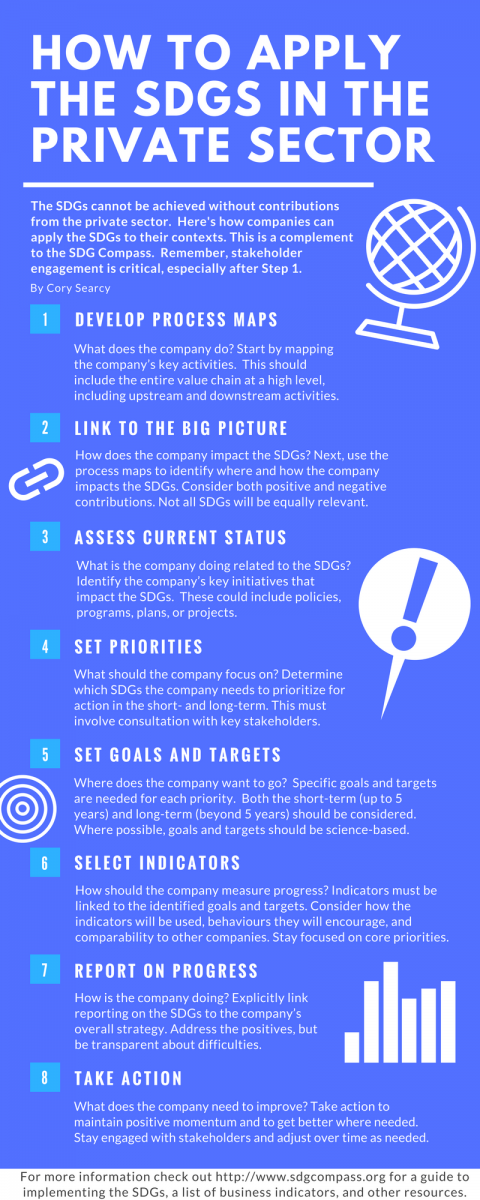
Eight Ways the Private Sector Can Apply the Sustainable Development Goals

Cory Searcy looks at how companies can start implementing the Sustainable Development Goals in their business.

December 5, 2016

The public and private sectors must work together to advance global sustainable development.

However, until recently, one challenge in coordinating joint action was the lack of a shared reference point on key sustainable development priorities. This reference point has now been provided through the adoption of the 2030 Agenda for Sustainable Development and the accompanying Sustainable Development Goals (SDGs).    

It is promising that it is now broadly accepted that the private sector has a critical role to play in achieving the SDGs. The question is no longer whether companies should apply the SDGs, but how they should do so.

A recent survey of over 1,000 CEOs from around the world by the UN Global Compact and Accenture found that 87 per cent “believe the SDGs provide an opportunity to rethink approaches to sustainable value creation.” Another 70 per cent of those CEOs “see the SDGs providing a clear framework to structure sustainability efforts.” These findings indicate strong support for applying the SDGs in a business context.

Moreover, these beliefs are increasingly being put into practice. For example, the 2016 edition of the World Business Council for Sustainable Development’s (WBCSD) study Reporting Matters found that over 50 of its members are publicly reporting in some way on the SDGs. Nonetheless, efforts to develop processes for applying the SDGs in a private sector context are still in their early days.

The most prominent guide for business action on the SDGs is provided by the SDG Compass, which outlines five key steps to “assist companies in maximizing their contribution to the SDGs”: (1) understanding the SDGs, (2) defining priorities, (3) setting goals, (4) integrating, and (5) reporting and communicating.

The SDG Compass also provides a list of over 800 business indicators and a summary of nearly 60 business tools to guide the application of the SDGs to business. We don’t know exactly how many companies are referring to the SDG Compass. Encouragingly, though, 10 companies included in the WBCSD’s Reporting Matters study stated that they use it to guide their actions.

Given the broad scope of the SDGs, applying them in practice can be a daunting challenge. However, they have clear relevance to the private sector and efforts to apply them in that context should be accelerated. Drawing from the SDG Compass and other guidance documents, we have identified eight key steps that businesses should apply in order to support the SDGs.

  1. Develop process maps. Process maps provide a high-level visual representation of what the company does. The maps should consider the company’s entire value chain, including both upstream and downstream activities. 
  2. Link to the big picture. The process maps provide a basis for thinking about how the company affects the SDGs. Companies should not “cherry pick” which SDGs to consider, but some SDGs will clearly be more relevant to some companies than others.
  3. Assess current status. The company may already be engaged in a number of initiatives related to the SDGs. Therefore, we recommend an environmental scan to identify relevant internal and external initiatives that could affect the comapny's contributions to the SDGs.
  4. Set priorities. Building on its current initiatives, the company will need to determine which SDGs merit its greatest attention over the short and long terms. This should be a participatory process involving key internal and external stakeholders.
  5. Set goals and targets. Short- and long-term goals and targets are required for each key priority. Goals and targets should be science- or ethics-based wherever possible.
  6. Select indicators. A concise set of indicators is needed to measure progress towards the company’s goals and targets. There are a growing number of example indicators and initiatives relevant to the SDGs.
  7. Report on progress. The company should publicly disclose its priorities, goals, targets and indicators related to the SDGs. Building on the guidance in the GRI Standards, the company should highlight positive developments, but also be transparent about any difficulties. 
  8. Take action. The most important step is to take action to strengthen the company’s positive contributions to the SDGs. This will require ongoing engagement with key stakeholders.

The steps above overlap with the SDG Compass in a number of ways. For example, both suggest developing maps of the company's value chain as a starting point in identifying relevant SDGs. Both also emphasize the need to set goals, to develop indicators and to report on progress.   

Insight

China's Low-Carbon Revolution

Since the US election, many are speculating about the ascendancy of Beijing as a global leader both on trade and climate policy. In reality, however, China had been moving forward on a comprehensive climate mitigation and adaptation pathway well before the US election.

November 25, 2016

There has been lots of speculation since the election in the United States about the consequences of a diminished at best, or obstructionist at worst, role of the US in climate action.

At the same time, many have been begun wondering about Beijing's ascendency as a global leader both on trade and climate policy.

In reality, China had been moving ahead years before the election with higher ambition, tighter deadlines and wider coverage. The most recent example is a State Council directive (number 61) issued in October, which sets out to advance a 'low-carbon revolution' through a number of detailed targets. These include:

First, by 2020 capping its energy use to 5 billion tons of standard coal equivalent (i.e. the energy generated from burning 5 billion tons of coal), reducing total energy consumption per unit of GDP by 15 per cent, and capping large scale power generation to 550 grams of carbon dioxide per kilowatt hour. 

Second, require energy efficiency standards in key sectors such as industry, construction, transportation and public institutions, and meet targets for renewable energy that include 200 million kilowatt hours of installed wind capacity and 100 million kilowatt hours of solar.

Third, by 2020 limit total coal consumption to 4.2 billion tons, still a staggering figure but a significant reduction compared to a business as usual scenario.

Fourth, make low-carbon development the 'new normal' for all industrial restructuring, and reduce CO2 emissions per unit of industrial added value by 22 pe rcent by 2020 compared to 2015.

And fifth, accelerate low-carbon agriculture, including peaking chemical fertilizer inputs by 2020, pilot low-carbon livestock management, and expand carbon sinks by increasing the national forest coverage rate to 23 percent by 2020, as well as enhancing wetland restoration and carbon sinks capacity.

These are some of the highlights; there are other major pieces of the national plan. Also included are new regulations for a carbon emissions trading system, and steps to consolidate sector-specific, national and sub-national carbon markets under a single nationwide carbon trading market by 2020. The plan also comprises a GHG disclosure system for all companies, calling for state-owned enterprises and listed companies to take the lead.

Finally China reiterated in its October 2016 plan, and again in Marrakech, that it will remain deeply committed to the Paris Agreement.

China’s climate plan reinforces its pivot to a green economy, which is well underway. Today it is the largest issuer of green bonds in the world and continues to pioneer green financial products, services and principles.

Like all plans, the test will be in its sustained implementation and significant reductions in greenhouse gas emissions. The urgency of climate science means other countries need to set out similar comprehensive, time-bound climate revolutions.

Insight details