Brief

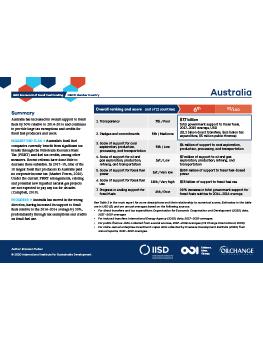
G20 Scorecard of Fossil Fuel Funding: Australia

November 9, 2020

Brief details

Region
Australia
Project
IISD Global Subsidies Initiative
Publisher
IISD
Copyright
IISD, 2020
Policy Analysis

Strategies that work : New South Wales leads infrastructure development in Australia

March 29, 2018

A decade before the financial crisis, Australia was a bastion of infrastructure successes. The country’s four major airports (Melbourne, Perth, Brisbane and Sydney) were privatized. Numerous greenfield projects were also launched, for example, extensive highway construction, and new projects were continually added to the pipeline. 

Some of these new projects, however, faced significant difficulties: some were constructed without robust performance data, leading to overambitious forecasting and overaggressive financial structures. In part, this led Australia to suffer multiple high-profile defaults and brought the country’s infrastructure project pipeline to a halt. 

But, today, Australia is displaying signs of promise once again. And one state, in particular, is among the developed world’s GDP growth outliers: New South Wales (NSW). The state’s economic growth has reached 3.5%, outstripping the country’s average rate of 2.8%, and even the G20 average (which stands at 3%). As such, NSW’s infrastructure model has likely had a multiplier effect on economic activity—and has been identified as a potential playbook for other jurisdictions. 

An Infrastructure Turnaround  

So, how did Australia’s pre-crisis success turn south? Take highway infrastructure as an example: because competition for contracts was strong, the Australian infrastructure procurement mechanism awarded projects to the counterparty paying the most to the government. Though this was not unique to Australia, this incentivized bidding teams to overstate forecasted revenues, based on traffic volume. 

For instance, traffic forecasts for the Lane Cove Tunnel—the 3.6-kilometer twin-tunnel toll road in Sydney—were 37% higher than the recorded traffic levels during its first year of operation. Such practices, coupled with construction difficulties and highly aggressive financing structures for public-private partnership (PPP) projects that did not transfer risk from the involved municipalities, led several projects to insolvency. 

The state of NSW has turned a corner, however. Thanks to its reformed infrastructure strategy, created in 2011, NSW has introduced numerous infrastructure projects to the pipeline. That same year, the NSW state government announced a $20 billion Australian dollar increase in infrastructure spending, in a bid to increase the state’s gross product by almost $300 billion Australian dollars over the next two decades. Measures are in place to prevent the misallocation of resources previously allotted: all investment decisions are subject to stringent business-case approval, with each project’s economic viability and its ramifications for the state’s budget—and its AAA credit rating—taken into consideration. 

As a result, many of NSW’s legacy issues with delivering infrastructure projects have been resolved. Over the past five years, the state has used multiple financing tools, which have played an instrumental role in reassuring investors that NSW is a viable recipient of finance, once again. 

These include: 

  • Partial privatization and asset recycling: To encourage long-term investors back to the market, the state government divested from holdings in businesses, but retained an interest by continuing as the lessor. In May 2017, for instance, NSW sold a 50.4% stake in Endeavour Energy (an electricity provider to 2.5 million citizens). Raising $7.62 billion Australian dollars, the sale freed up capital for other infrastructure projects (a method known as asset recycling)—without the NSW government losing its influence as a joint investor, lessor, licensor and regulator in the utility market. Elsewhere, the state government recently announced it will sell its majority stake in the $12 billion Australian dollar WestConnex toll road project, which will connect two of Sydney’s highways.  

  • Unsolicited proposal process: This tool, though rarely used, enables non-government participants to put forward either infrastructure proposals, or even different modes of service delivery for infrastructure projects. Because the projects typically have low bid costs, there is minimal risk transfer of the transaction costs from the government to private sector. The state would also be involved from the outset as a means of planning for risk mitigation. 

  • Bundling: By aggregating similar, smaller assets into a single portfolio, this financing tool allows projects (which may not have been financeable otherwise) to attract a wider pool of both contractors and investors. The model creates scale and, therefore, grants better access to the capital markets, where longer-term financing options are available. 

NSW: a Blueprint for Other Jurisdictions?  

Though NSW’s infrastructure journey has been a successful one, that’s not to say the financing models it employs are exempt from difficulties; in fact, asset recycling, bundling or unsolicited proposals can immensely complicate the credit analysis of a transaction. But, when executed with the correct mitigants in place, we’ve observed that these tools can introduce new sources of capital for a municipality’s infrastructure projects. 

As such, we believe that NSW’s turnaround could become a blueprint for other municipalities to uphold. The state has brought market confidence to institutional investors—and, not least, much-needed capital to its infrastructure programs. While its replicability the world over is perhaps ambitious, what’s clear to see is this: Australia is home to infrastructure spending plans that are working. 

Policy Analysis

Strategies that work: New South Wales leads infrastructure development in Australia

March 29, 2018

A decade before the financial crisis, Australia was a bastion of infrastructure successes. The country’s four major airports (Melbourne, Perth, Brisbane and Sydney) were privatized. Numerous greenfield projects were also launched, for example, extensive highway construction, and new projects were continually added to the pipeline.
 
Some of these new projects, however, faced significant difficulties: some were constructed without robust performance data, leading to overambitious forecasting and overaggressive financial structures. In part, this led Australia to suffer multiple high-profile defaults and brought the country’s infrastructure project pipeline to a halt.
 
But, today, Australia is displaying signs of promise once again. And one state, in particular, is among the developed world’s GDP growth outliers: New South Wales (NSW). The state’s economic growth has reached 3.5%, outstripping the country’s average rate of 2.8%, and even the G20 average (which stands at 3%). As such, NSW’s infrastructure model has likely had a multiplier effect on economic activity—and has been identified as a potential playbook for other jurisdictions.

An infrastructure turnaround 

So, how did Australia’s pre-crisis success turn south? Take highway infrastructure as an example: because competition for contracts was strong, the Australian infrastructure procurement mechanism awarded projects to the counterparty paying the most to the government. Though this was not unique to Australia, this incentivized bidding teams to overstate forecasted revenues, based on traffic volume.

For instance, traffic forecasts for the Lane Cove Tunnel—the 3.6-kilometer twin-tunnel toll road in Sydney—were 37% higher than the recorded traffic levels during its first year of operation. Such practices, coupled with construction difficulties and highly aggressive financing structures for public-private partnership (PPP) projects that did not transfer risk from the involved municipalities, led several projects to insolvency.

The state of NSW has turned a corner, however. Thanks to its reformed infrastructure strategy, created in 2011, NSW has introduced numerous infrastructure projects to the pipeline. That same year, the NSW state government announced a $20 billion Australian dollar increase in infrastructure spending, in a bid to increase the state’s gross product by almost $300 billion Australian dollars over the next two decades. Measures are in place to prevent the misallocation of resources previously allotted: all investment decisions are subject to stringent business-case approval, with each project’s economic viability and its ramifications for the state’s budget—and its AAA credit rating—taken into consideration.

As a result, many of NSW’s legacy issues with delivering infrastructure projects have been resolved. Over the past five years, the state has used multiple financing tools, which have played an instrumental role in reassuring investors that NSW is a viable recipient of finance, once again.

These include:

  • Partial privatization and asset recycling: To encourage long-term investors back to the market, the state government divested from holdings in businesses, but retained an interest by continuing as the lessor. In May 2017, for instance, NSW sold a 50.4% stake in Endeavour Energy (an electricity provider to 2.5 million citizens). Raising $7.62 billion Australian dollars, the sale freed up capital for other infrastructure projects (a method known as asset recycling)—without the NSW government losing its influence as a joint investor, lessor, licensor and regulator in the utility market. Elsewhere, the state government recently announced it will sell its majority stake in the $12 billion Australian dollar WestConnex toll road project, which will connect two of Sydney’s highways. 
  • Unsolicited proposal process: This tool, though rarely used, enables non-government participants to put forward either infrastructure proposals, or even different modes of service delivery for infrastructure projects. Because the projects typically have low bid costs, there is minimal risk transfer of the transaction costs from the government to private sector. The state would also be involved from the outset as a means of planning for risk mitigation.
  • Bundling: By aggregating similar, smaller assets into a single portfolio, this financing tool allows projects (which may not have been financeable otherwise) to attract a wider pool of both contractors and investors. The model creates scale and, therefore, grants better access to the capital markets, where longer-term financing options are available.

NSW: a blueprint for other jurisdictions? 

 Though NSW’s infrastructure journey has been a successful one, that’s not to say the financing models it employs are exempt from difficulties; in fact, asset recycling, bundling or unsolicited proposals can immensely complicate the credit analysis of a transaction. But, when executed with the correct mitigants in place, we’ve observed that these tools can introduce new sources of capital for a municipality’s infrastructure projects.

As such, we believe that NSW’s turnaround could become a blueprint for other municipalities to uphold. The state has brought market confidence to institutional investors—and, not least, much-needed capital to its infrastructure programs. While its replicability the world over is perhaps ambitious, what’s clear to see is this: Australia is home to infrastructure spending plans that are working.
 

Report

Regulating Carbon in Canada Divergent Approaches: Greenhouse gas mitigation in Canada and Australia

November 19, 2012

With the release of Lessons for Canada: Implementation of Australia's Carbon Pricing Mechanism, IISD has developed a companion piece to provide some additional Canadian context to Tony Beck's analysis of the implementation of carbon pricing in Australia.

We have provided a short briefing with some comment regarding what the Australian experience with carbon pricing can offer for Canadian industry and policy-makers. As the Canadian government continues to move forward with sector-by-sector regulation of greenhouse gases and individual provinces continue to implement and strengthen subnational regulatory and pricing mitigation policies, the Australian experience can provide some valuable insight and offer a "parallel universe" to which Canada can compare its own approach to climate change.

Report details

Topic
Climate Change Mitigation
Region
Canada
Australia
Project
Regulating Carbon Emissions in Canada
Impact area
Climate
Publisher
IISD
Copyright
IISD, 2011
Report

Regulating Carbon in Canada Lessons for Canada: Implementation of Australia's Carbon Pricing Mechanism

November 19, 2012

Through its Regulating Carbon Emissions in Canada initiative, the International Institute for Sustainable Development (IISD) has sought to provide insight regarding the impact of carbon pricing and regulatory schemes in Canada.

While IISD's pieces have focused on Canadian policy strategies, this analysis looks at external carbon mitigation policies and offers lessons and comparison for Canadian policy-makers and industry stakeholders.In this brief, Tony Beck, an expert on Australian carbon markets, looks at the rollout of Australia's carbon pricing scheme, and the impacts of implementation on national and subnational governments, and the private sector.The Australian model provides an alternate model of carbon mitigation to Canada's mix of regulation and carbon pricing. While the two economies are not mirror images, the robust energy sector in Australia, its lengthy history debating carbon pricing approaches, and its mix of national and subnational climate policy provide a useful parallel reference for Canada.

Report details

Topic
Climate Change Mitigation
Region
Australia
Project
Regulating Carbon Emissions in Canada
Impact area
Climate
Publisher
IISD
Copyright
IISD, 2012
Report

The Australian Government's Illegal Logging Prohibition Bill: WTO implications

July 5, 2012

The Australian government is currently legislating to exclude illegally logged timber from imports and from domestic processing.

The proposals in the draft bill include: a prohibition on the import of all timber products containing illegally logged timber, and on the processing of domestically grown raw logs that have been illegally harvested; a requirement on importers and processors to undertake due diligence to mitigate the risk of products containing illegally logged timber; and a comprehensive monitoring, investigation and enforcement regime to ensure compliance.The proposed legislation has been criticized on the basis, among other things, that it conflicts with the disciplines of the World Trade Organization. Similar criticisms have, on occasion, been levelled at other consumer-country measures to exclude illegal timber from their markets, such as the European Union's Forest Law Enforcement, Governance and Trade licensing scheme and Timber Regulation, or the United States' Lacey Act.This paper explores whether the measures proposed in the Australian legislation are likely to be WTO-compatible, and concludes that they should be. The Australian government will need to be careful to ensure the legislation is designed and implemented in ways that do not afford protection to Australian products, and is as non-trade-restrictive as possible. Within those constraints, however, they should not be inhibited from pressing ahead and introducing measures, similar to those being implemented in other consumer countries, to exclude illegal products from the market-and by so doing, improve sustainable development, protect the interests of companies playing by the rules and uphold the rule of law.

Report details

Topic
Trade
Region
Australia
Impact area
Sustainable Economies
Publisher
IISD
Copyright
IISD, 2012