Podcast

Down to Earth: How to Protect Africa's Great Lakes

There are great lakes all over the world.

But you may have only heard of the Laurentian—or North American—Great Lakes.

July 15, 2021

In this episode of Down to Earth, we want to introduce you to the African Great Lakes and explain why they matter to so many people—and why they may be more familiar than you think.

We also hear from two researchers, from very different backgrounds, who explore a new partnership between the International Institute for Sustainable Development and the African Center for Aquatic Research and Education that brings researchers across two continents together to work to protect the African Great Lakes.

Webinar

Webinar on Informing National Governments’ Efforts to Scale Up Finance for Adaptation: Where to next?

The substantial gap between the amount of financing required by developing countries to meet their climate change adaptation needs and current levels of investment must be closed if we are to achieve a climate-resilient recovery.

May 26, 2021 9:00 am - 10:15 am EDT

(Open to public)

As the global community increasingly experiences the impacts of climate change, the need to scale up financing for adaptation becomes even more important. Efforts to scale up finance for adaptation, though, must be undertaken in a strategic manner. They should ensure that limited public sector finance is used in a targeted way to deliver country-defined adaptation priorities and, where possible, crowd-in private sector finance. 

This webinar elaborates on the adaptation finance gap in developing countries, identifies the knowledge gaps that impede the capacity of developing countries to scale up financing for adaptation, and discusses ways in which these knowledge gaps might be overcome.

Examples is also shared of the different approaches developing countries are taking to diversify their finance for adaptation and align investments with their national adaptation priorities.

Scaling up finance for adaptation requires overcoming several barriers, including a need to increase knowledge within developing countries on issues such as: 

  • the benefits of integrating climate adaptation needs in investment decisions, 
  • the feasibility of using innovative financing mechanisms to expand finance for adaptation, and
  • how public finance can be used strategically to leverage financing for adaptation from national and international sources, including multilateral development banks and the private sector.

These issues are explored though this virtual discussion, hosted by the International Institute for Sustainable Development (IISD) in partnership with the International Development Research Centre (IDRC).


Video


Presentation

Webinar

Virtual Fireside Chat: How Two Continents Are Working Together to Improve The Health Of The African Great Lakes

Did you know that scientists across North America and Africa are putting their heads—and expertise—together on issues including algal blooms, climate change, invasive species, fragile fisheries, to name but a few, to improve the health of the African Great Lakes?

October 28, 2020 9:00 am - 10:00 am Central

(Open to public)

And this matters because the seven African Great Lakes contain around 25% of the world's fresh water and underpin the welfare and livelihoods of over 50 million people across 10 countries.

To hear their stories, and to learn more, we invite you to a virtual fireside chat on Wednesday, October 28, 2020, at 9:00 a.m. (CDT); 10:00 a.m. (EDT); 3:00 p.m. (CET); 4:00 p.m. (CAT); 5:00 p.m. (EAT).

You will discover:

  • Exactly what the African Great Lakes are, and why we need to collaborate in order to protect them
    • from Dr. Kevin Obiero, Chair, ACARE & Centre Director, Kenya Marine and Fisheries Research Institute
  • The critical role that women are playing
    • from Stephanie Smith, Strategic Advisor, IISD-ACARE
  • A case study of work already underway to protect the African Great Lakes
    • from Ms. Cecilia M. Githukia; Research Scientist; Kenya Marine and Fisheries Research Institute, Aquaculture Division


REGISTER HERE

Press release

Scientists from Two Continents to Work Together to Improve the Health of the African Great Lakes

The International Institute for Sustainable Development and the African Center for Aquatic Research and Education join forces to strengthen the global large-lakes scientific community.

September 15, 2020

ANN ARBOR, MI—World-class scientists and researchers from across North America and Africa will soon be putting their heads (and expertise) together to tackle some of the most pressing issues—algal blooms, climate change, invasive species, fragile fisheries, to name but a few—facing the African Great Lakes (AGL).

The AGL are highly valuable natural resources, renowned for their rich fisheries and "biodiversity hotspots." Consequently, they, and the ecosystem services they provide, underpin the welfare and livelihoods of over 50 million people across 10 countries.

This is all thanks to a new major partnership announced today between the International Institute for Sustainable Development (IISD) and the African Center for Aquatic Research and Education (ACARE). The IISD-ACARE collaboration will provide an opportunity for the world’s freshwater laboratory and networks on the African Great Lakes to come together and strengthen science on large freshwater resources and the countries in which they reside.

Despite the recognized importance of the AGL, these vital ecosystems and their livelihood support systems are threatened by the impact of human activity, such as overfishing and pollution at local, regional, and global scales.

To address some of the challenges on the African Great Lakes, IISD-ACARE, will combine the legal and policy expertise of IISD’s vast expert staff with ACARE’s African network of large-lakes experts in Burundi, the Democratic Republic of the Congo, Ethiopia, Kenya, Malawi, Mozambique, Rwanda, Tanzania, Uganda, and Zambia.

“We have recognized that no one organization, institution, or even country, can address the challenges that our global freshwater resources face. It is essential, therefore, to strengthen collaborations for leveraging the combined skills, assets, technologies and resources of public, private, and non-profit entities to deliver sustainable instruction, guidance, and research to protect these resources,” said Dr. Kevin Obiero, Chair, ACARE’s Board of Directors.

“Partnering with the International Institute for Sustainable Development will enhance our ability to strengthen science and positively affect policy and management on these critical resources and provide the experience of working with the global scientific community.”

Strengthening the IISD-ACARE approach is IISD’s Experimental Lakes Area (IISD-ELA)—the only place in the world where scientists can manipulate real lakes to understand what human activity does to fresh water. A series of 58 lakes and their watersheds in northwestern Ontario, Canada, IISD-ELA brings over 50 years of freshwater research like no other and policy analysis to inform decision making.

“ACARE has created a world-class, highly collaborative network of experts on each of the African Great Lakes,” said Dr. Matthew McCandless, Executive Director, IISD-ELA. “Resources from IISD and ACARE’s combined networks will allow us to accomplish three long-term goals: strengthening global and regional research partnerships; facilitating existing, and boosting new, transboundary and inter-jurisdictional lake advisory groups; and, strengthening the capacity of freshwater scientists through experiential education and public engagement.”

During its first year, the new partnership will boost the activities of six Advisory Groups that were created to address issues on each of the African Great Lakes (considered to be lakes Albert, Edward, Kivu, Malawi/Nyasa/Niassa, Tanganyika, Turkana, and Victoria). Members of each group are harmonizing priorities on the lakes to advance work on scientific inquiry, monitoring, climate change, and education and training, among other issues.


To learn more about the partnership and programs, click here.

For more information, or to arrange an interview, please contact:

Ted Lawrence, Executive Director, African Center for Aquatic Research and Education, [email protected]

Sumeep Bath, Communications Manager, IISD Experimental Lakes Area, [email protected]


About ACARE

The African Center for Aquatic Research and Education (ACARE) was established to help strengthen and harmonize science and information exchange through a highly collaborative network of freshwater experts.
Scientists from Two Continents Working Together to Improve the Health of the African Great Lakes

World-class scientists and researchers from across North America and Africa are putting their heads, and expertise, together to tackle some of the most pressing issues—algal blooms, climate change, invasive species, fragile fisheries, to name but a few—facing the African Great Lakes (AGL) today.

What are the African Great Lakes?

The AGL are highly valuable natural resources, renowned for their rich fisheries and "biodiversity hotspots." Consequently, they, and the ecosystem services they provide, underpin the welfare and livelihoods of over 50 million people across 10 countries. Despite the recognized importance of the AGL, these vital ecosystems and their livelihood support systems are threatened by the impact of human activity by numerous anthropogenic stressors at local, regional, and global scales.

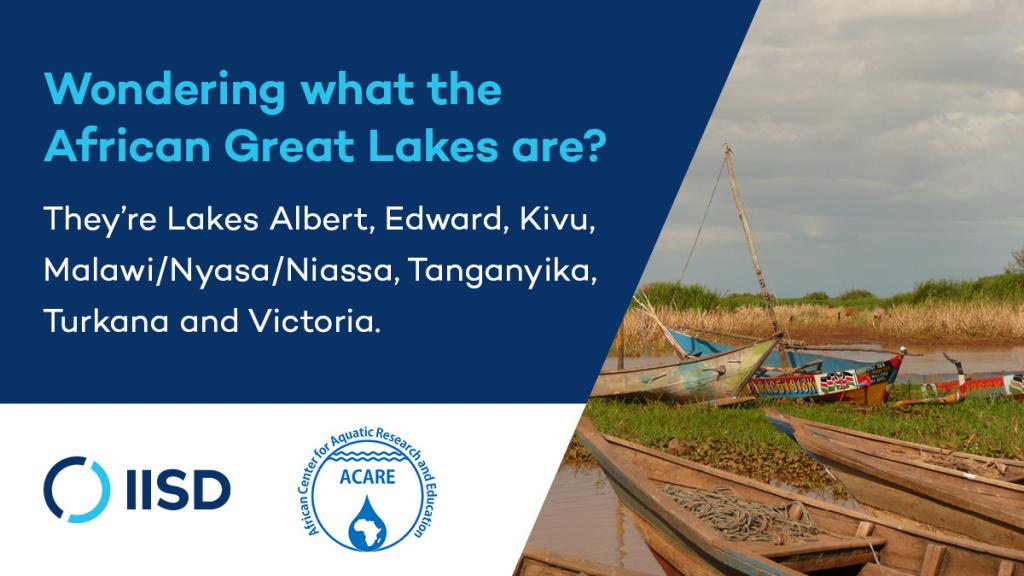
The African Great Lakes are lakes Albert, Edward, Kivu, Malawi/Nyasa/Niassa, Tanganyika, Turkana, and Victoria. You can learn more about the African Great Lakes here.

List of the African Great Lakes


How does this project work?

The partnership between the International Institute for Sustainable Development (IISD) and the African Center for Aquatic Research and Education (ACARE) provides an opportunity for the world’s freshwater laboratory and networks on the African Great Lakes to come together and strengthen science on large freshwater resources and the countries in which they reside.

IISD-ACARE combines the legal and policy expertise of IISD’s vast expert staff with ACARE’s newly created African network of large-lakes experts and scientists in Burundi, the Democratic Republic of the Congo, Ethiopia, Kenya, Malawi, Mozambique, Rwanda, Tanzania, Uganda, and Zambia.


What are we working on?

The partnership works to boost the activities of six advisory groups that were created to address specific issues on each of the African Great Lakes. Members of each group are harmonizing priorities on the lakes to advance work on scientific inquiry, monitoring, climate change, and education and training, among other issues.

An exciting flagship project of the initiative—the African Women in Science program—is a 10-month program designed by women, for women, to support the interests, needs, and goals of early-career scientists working on Africa’s freshwater issues. Dozens of women in science have now benefited from the program, including those who share their stories, and how the program has benefited their career, in the video below.


How can I learn more?

To learn more about the project, or to discuss research and collaboration opportunities, you can visit the ACARE website, or contact us directly.

Report

Sustainability and Voluntary Certification in the Kenyan Tea Sector

IISD convened key representatives from all segments of the Kenyan tea value chain for a multistakeholder meeting of the sector, held on March 6, 2019, in Nairobi, Kenya.

July 19, 2019

Voluntary Sustainability Certification (VSC) has grown rapidly in Kenya over the past decade, driven by significant buyer demand for Rainforest Alliance (RA) certification.

This development has been coupled with rapid growth in participation in the Fair Trade and the former UTZ programs (now merged with RA), a dynamic that has brought opportunities and challenges for the tea sector.

To address these issues, the facilitating organizations (Kenya Tea Directorate, Sustainable Inclusive  Business/KEPSA, and the International Institute for Sustainable Development [IISD]), through the support of the Swedish International Development Agency (SIDA) convened key representatives from all segments of the Kenyan tea value chain for a multistakeholder meeting of the sector, held on March 6, 2019, in Nairobi, Kenya.

Report details

Topic
Standards and Value Chains
Region
Kenya
Project
State of Sustainability Initiatives
Impact area
Sustainable Economies
Publisher
IISD
Copyright
IISD, 2019
Brief

sNAPshot | Kenya’s Monitoring and Evaluation of Adaptation: Simplified, integrated, multilevel

This NAP Global Network Country Brief presents Kenya’s experience with the design of its adaptation monitoring and evaluation (M&E) system.

May 2, 2019

Monitoring and evaluation (M&E) systems to track adaptation outcomes are a crucial element of the National Adaptation Plan (NAP) process. However, these systems are often complex to design and implement.

Challenges include measuring results amid uncertainty, limited baseline information and data availability, and multiple scales of interventions, among others. Kenya is working to overcome these challenges by using a phased approach to develop and implement a doable and effective adaptation M&E system.

This Country Brief presents Kenya’s experience with the design of its adaptation M&E system. It highlights Kenya’s climate change policy context, priority adaptation actions and principles to provide guidance for the design of Kenya’s adaptation M&E system. The brief concludes by proposing next steps to move forward in a phased approach to design and implementation of the country’s adaptation M&E system.

Participating experts

Brief details

Topic
Climate Change Adaptation
Region
Kenya
Project
NAP Global Network
Impact area
Climate
Publisher
IISD
Copyright
IISD, 2019
Brief

Alignment to Advance Climate-Resilient Development | Country Case Study: Kenya

This case study on Kenya is part of a series of briefs focusing on alignment of country efforts under the 2030 Agenda for Sustainable Development, the Paris Agreement and the Sendai Framework for Disaster Risk Reduction. 

October 31, 2019

Key Messages

  • The Government of Kenya has taken significant action to align efforts under the Paris Agreement, Sendai Framework for Disaster Risk Reduction and 2030 Agenda for Sustainable Development. This alignment is driven by the recognition that climate change is a threat to national sustainable development in Kenya, and disaster risk management is a top priority in climate change programming.
  • Kenya’s national adaptation plan (NAP) 2015–2030 and nationally determined contribution (NDC) are implemented through the National Climate Change Action Plan, 2018–2022 (NCCAP). The action plan purposefully aligns with the SDGs and disaster risk reduction agendas, demonstrating systemic alignment through a shared vision for climate-resilient development. The NAP and NDC demonstrate systemic alignment because the NAP is the basis for the adaptation information in the NDC.
  • Much of the adaptation, disaster risk management and SDGs alignment is through the identification of synergies in key policy and strategy documents. Opportunities exist to enhance this alignment through improved coordination mechanisms, climate risk information sharing, harmonized financing strategies, and coordinated monitoring and evaluation systems.
  • The Kenyan experience provides lessons for alignment of the three policy processes, including that NDC implementation plans offer the opportunity to create synergies; multistakeholder adaptation processes offer a starting point for coordination and harmonization; and common reporting using SDG indicators can link the three policy processes.

This case study is part of a series of briefs focusing on alignment of country efforts under the 2030 Agenda for Sustainable Development, the Paris Agreement and the Sendai Framework for Disaster Risk Reduction. The case studies explore early experiences in efforts to align national-level policy processes under these global agendas, highlighting the context-specific nature of the alignment process. This case study focuses on the efforts of the Government of Kenya to link planning for sustainable development, climate change adaptation and disaster management

Brief details

Topic
Climate Change Adaptation
Region
Kenya
Project
NAP Global Network
Advancing Alignment for Climate-Resilient Development
Impact area
Climate
Publisher
IISD
Copyright
IISD, 2019
Report

Adaptive and Inclusive Watershed Management: Assessing policy and institutional support in Kenya

This report explores existing institutional linkages between gender, water and climate change in Kenya.

September 4, 2018

Climate change is negatively affecting Kenya’s water systems. The degradation of wetlands, changing rainfall patterns, increased severity of drought and floods have serious implications for food security and human health.

In Kenya, women are the main collectors of water for household needs and are extensively engaged in the agriculture sector which is the most intensive user of freshwater resources through irrigation. Although women interact with water on a daily basis, they tend to contribute less than men to decision making in water resource management. Moreover, women are denied equal access to land, technology, credit, and other critical resources essential to cope with the adverse impacts of climate change.

Public policies can challenge socially constructed gender stereotypes and empower women in many sectors, including in the water sector. Through its legislative framework, Kenya has made positive steps towards helping women to be well represented in decision-making structures, formulated requirements for government budgets to support women’s empowerment and made some progress in establishing gender-sensitive monitoring systems. Gender equality is also being considered in relation to climate change through various government mainstreaming efforts.

This research is the result of a desk review of policies and institutions and interviews with stakeholders and experts in Kenya working on issues of water resources management, gender and climate change. These include the Ministry of Water, the National Gender and Equality Commission and the University of Nairobi.

See our similar analysis on Uganda.

Report details

Topic
Climate Change Adaptation
Gender Equality
Water
Region
Kenya
Project
Adaptive and Inclusive Watershed Management in East Africa
Impact area
Nature
Publisher
IISD
Copyright
IISD, 2018
Policy Analysis

Gender-Responsive Climate Action

What does gender-responsive climate action look like? Expert commentary on achieving gender-responsive climate action through women’s empowerment, inclusive policy-making and other innovative practices.

June 8, 2018

What does gender-responsive climate action look like? 

At the 23rd session of the Conference of the Parties (COP 23) to the UN Framework Convention on Climate Change (UNFCCC), Parties adopted the Gender Action Plan, which outlines priority areas of action, including gender-responsive implementation of the Paris Agreement and gender balance, participation and women’s leadership.

On the sidelines of COP23, the IISD and the Government of Grenada co-hosted a side event that explored what gender-responsive climate action looks like, bringing together a number of experts to discuss themes such as women’s empowerment, inclusive policy-making and innovative practices to advance gender-responsive climate action.

This article summarizes some of the highlights from these discussions.