From Patchwork to Production
Canadian waters hold some of the world's most promising offshore wind resources. But as tariffs and global supply disruptions put a spotlight on domestic energy development, incomplete and fragmented regulations threaten to leave that potential stranded. Getting the rules right is now a strategic imperative.
From Patchwork to Production is an overview of the complex regulatory context surrounding offshore energy in Canada. It offers recommendations to help support the offshore renewables sector while also enhancing marine protection. It covers areas off all three coasts, including energy activity and regulatory regimes in offshore areas of British Columbia (BC), Newfoundland and Labrador, Nova Scotia, and the Western Arctic–Tariuq Accord Area, as well as the Canada Energy Regulator, as the default offshore energy governing body.
The Rising Tide of Offshore Renewable Energy
Canadian offshore energy production has historically been limited to oil and gas development on the Atlantic coast. The existing regulatory regime exclusively manages oil and gas exploration and development. It includes both offshore accords—establishing joint management between levels of government—and moratoriums on development. A corresponding set of regulations for offshore renewables is in development but not yet finalized.
Getting new rules in place is urgent because Canada’s coastal energy landscape is shifting away from oil and gas. Current production is limited to oil extraction off the coast of Newfoundland and Labrador. In 2024, Canadian offshore oil production averaged 209 thousand barrels per day (MB/day), representing about 4% of Canada’s crude oil production.
Production has declined by more than 40% from a peak of 368 MB/day in 2007, despite new production coming online. The last projects in Nova Scotia closed in 2018, and industry has made no serious bids since then to reopen the province’s offshore oil and gas sector.
Oil and gas development is banned in large areas of Canada’s offshore, with Arctic and Pacific moratoriums in place since 2016 and the 1970s, respectively.
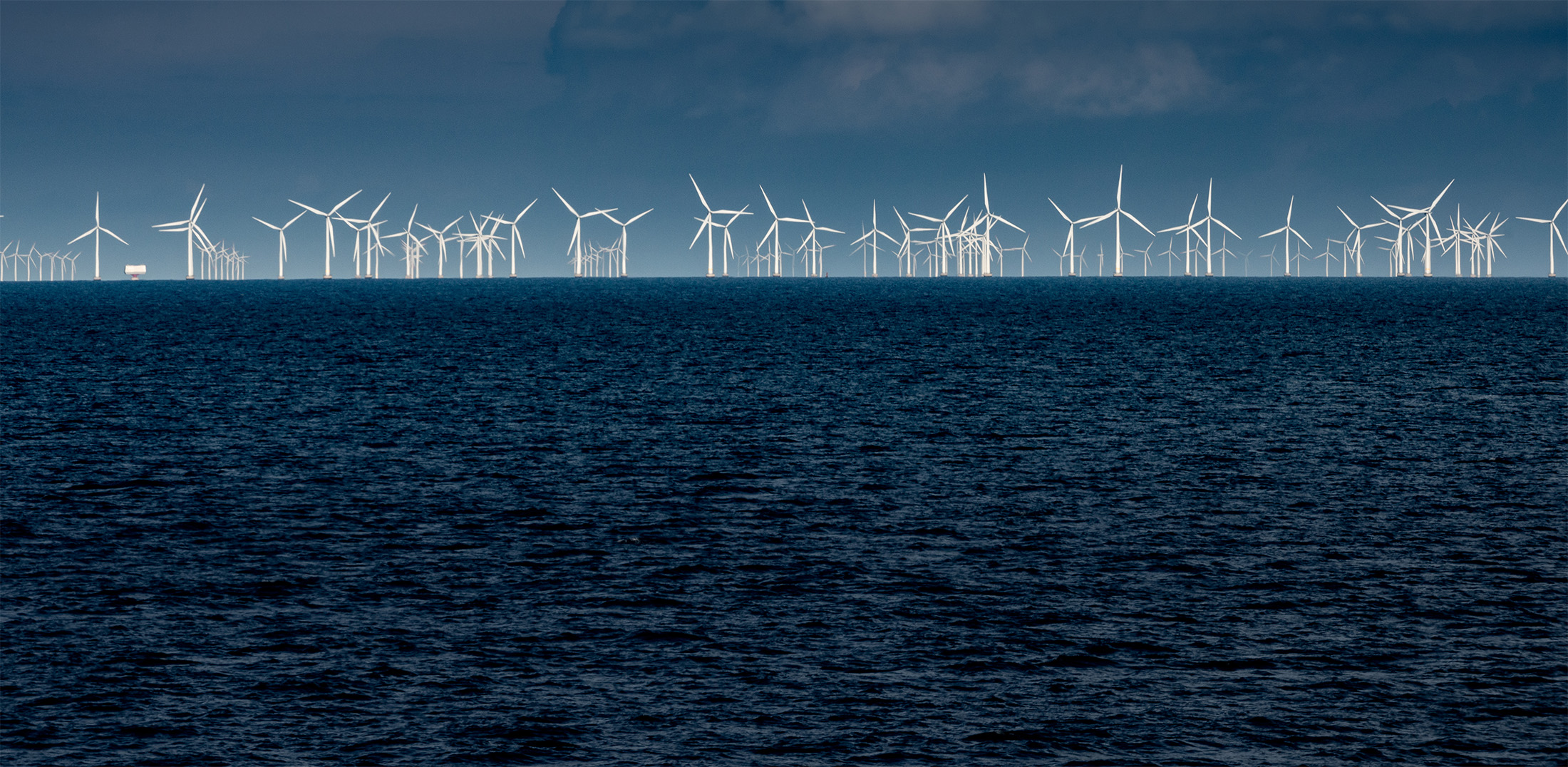
Meanwhile, the spotlight has shifted to the Atlantic coast’s vast offshore wind resources. Wind potential in the Nova Scotia and Newfoundland and Labrador offshore areas is among the highest in the world, with hundreds of potential gigawatts (GW) identified across the region, and tens of GW that could be economically developed.
Who Regulates Offshore Energy?
Regulatory jurisdictions within Canada's marine and offshore areas
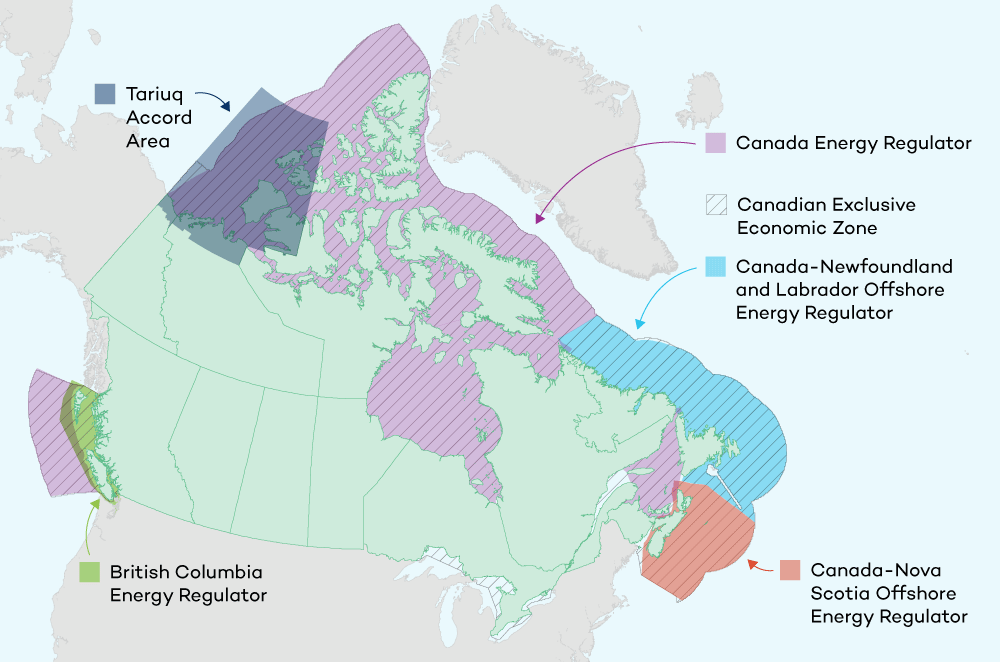
Federal, provincial, and territorial governments all have a stake in regulating offshore energy. The seabed falls under federal jurisdiction, with the Canada Energy Regulator responsible for oil, gas, and renewable energy activity in offshore areas with no joint-management regime.
In practice, all offshore development has been jointly managed. The federal government has signed three offshore accords allowing for joint regulation of certain offshore areas:
- the 1985 Canada–Newfoundland and Labrador Atlantic Accord,
- the 1986 Canada–Nova Scotia Offshore Petroleum Resources Accord, and
- the 2023 Western Arctic–Tariuq (Offshore) Accord.
These accords established joint federal–provincial regulators in the Canada–Nova Scotia and Canada–Newfoundland and Labrador Offshore Areas.
Despite no offshore Arctic energy development, historical industry interest in developing Beaufort Sea oil and gas has led to strong Indigenous involvement in regional resource governance. This includes the 2023 Tariuq Accord for joint management of petroleum resources in the Western Arctic, the first offshore accord to include federal, territorial, and Indigenous governments.
Quebec negotiated and signed an offshore accord for joint management of oil and gas resources in the Gulf of St. Lawrence in 2011, but implementing legislation never passed, and the accord never entered into force.
British Columbia’s jurisdiction covers inland waters between Vancouver Island and the Lower Mainland, granting the province relatively expansive jurisdiction over its coastal area even without an offshore accord. The BC Energy Regulator has oversight of oil, gas, solar, and wind activity in these inland waters, and the Canada Energy Regulator regulates energy activity in remaining offshore areas. These energy regulators are only one piece of the patchwork of coastal protections that can affect development.
Prioritizing Marine Protection
Canada has committed to put 30% of its marine area under protection by 2030, and 15.5% of the country’s oceans were under protection as of March 2025.
While Canada has greatly expanded marine protected and conserved areas over the past decade, these areas are not guaranteed to be free from offshore energy development.
Oil and gas activity is only explicitly prohibited in federal marine protected areas introduced after 2019, and renewable energy is permitted in all of them. Other forms of protected areas may limit some oil, gas, and renewable energy activities, while still allowing activities that meet set standards or conditions.
While offshore oil and gas development is unlikely in protected areas, exploration can harm fragile marine ecosystems, as can renewable energy activity.
No industrial activity, including offshore oil, gas, and renewable energy activity, should be allowed in marine protected and conserved areas. This is also key for Canada to meet its international commitments on marine conservation, which do not consider an area protected if there is potential for oil and gas activity.
Tapping the Potential of Offshore Wind
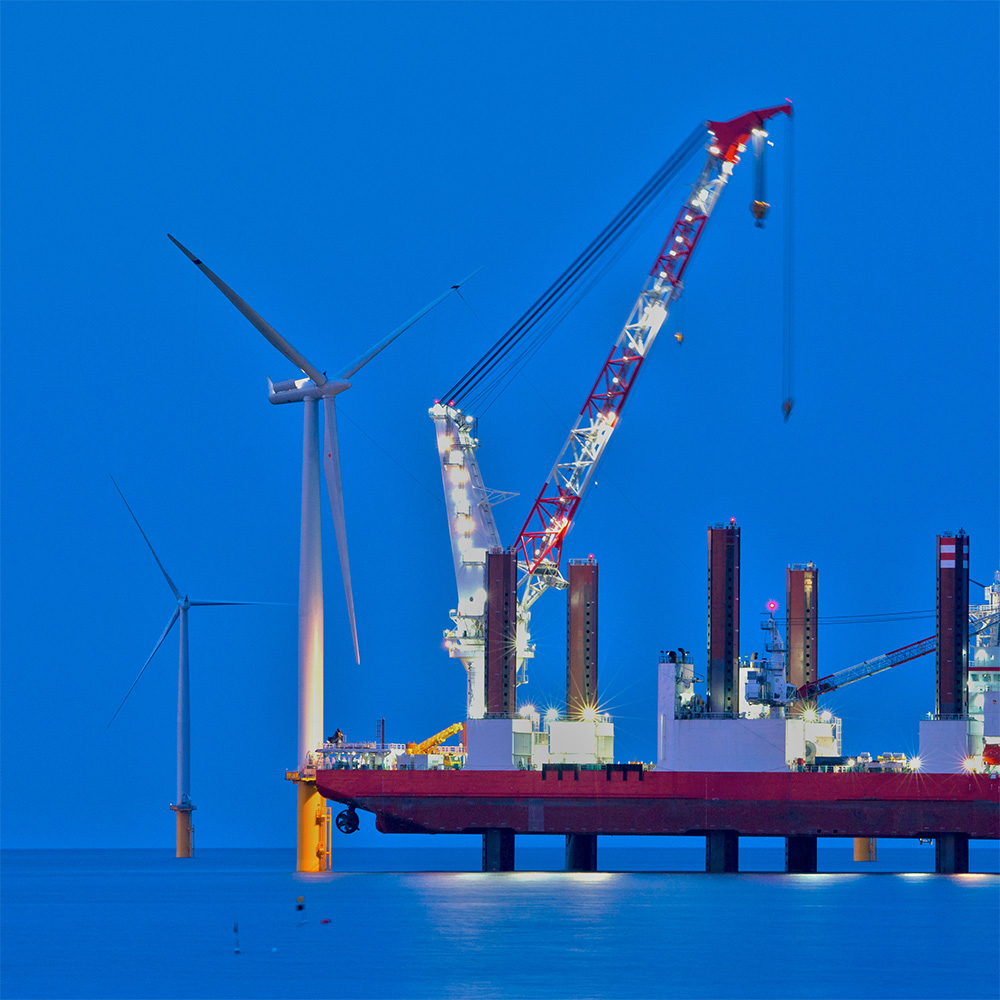
Canada has yet to develop any offshore wind projects. This could soon change. The Nova Scotia Offshore Area can accommodate up to 40 GW of wind capacity, and the provincial government is moving toward a call for bids for the first 5 GW.
40 GW of Nova Scotia offshore wind is the equivalent of a quarter of Canada's installed electricity capacity.
However, offshore renewable energy regulations have not been finalized in the Canada–Nova Scotia Offshore Area nor in other prospective offshore wind sites in BC inland waters or the Canada–Newfoundland and Labrador Offshore Area.
This regulatory uncertainty could cool investment interest at a critical moment. Canada must act to align on a cohesive set of rules that build the confidence and regulatory certainty needed to unlock world-class offshore wind capacity.

Recommendations
A clear, cohesive regulatory environment is key to building momentum and industry confidence in offshore renewable energy development in Canada.
Participating experts
You might also be interested in
The Strait of Hormuz Crisis Emphasizes Why Canada Should Move Away From Oil and Gas—Not Expand It
The closure of the Strait of Hormuz cut off roughly 25% of the world’s seaborne oil and 20% of LNG trade. In response, many countries are diversifying supply chains and increasingly ramping up domestic renewable capacity to improve energy security. Meanwhile, the Government of Canada has taken steps to expand oil and gas production.
Charting the Course
This report assesses three trajectories for Canada's industrial carbon price between 2030 and 2040.
Memorandum of Understanding Agreement Erodes Last Pillar of Canadian Climate Policy
The governments of Canada and Alberta have announced new details on an oil pipeline while significantly weakening the industrial carbon price. Doubling down on oil and gas while much of the world is transitioning away from fossil fuels sets Canada on a path toward greater economic risk and worsening climate impacts.
Weakening Canada's Industrial Carbon Price Raises Emissions With No Clear Economic Benefit
News today of a reported agreement between the federal and Alberta governments that the carbon price paid by industry may not reach CAD 130/tonne until 2040 would represent a significant and unnecessary watering down of the current industrial carbon price.