
The Strait of Hormuz Crisis Emphasizes Why Canada Should Move Away From Oil and Gas—Not Expand It
Every oil price spike looks like an argument for exporters to be drilling more. Importers are drawing the opposite conclusion: the 2022 crisis gave Europe REPowerEU, which aims to expand clean energy and reduce dependence on Russian fuels. As importers face another crisis in 2026, clean energy alternatives are proving ready to present them with an opportunity to finally break free of oil price shocks. With Canada moving to expand oil and gas on the back of the Strait of Hormuz crisis, it risks boosting fossil fuel supply for an increasingly shrinking market that is looking to get off the rollercoaster once and for all.
Need to Know:
- Oil and gas prices are volatile; the closure of the Strait of Hormuz is just the latest example of geopolitical risks and price spikes.
- Canada is a high-cost oil and gas producer requiring high prices and high demand for new projects to be profitable.
- Oil and gas prices are expected to fall around 2030 due to an expected future oversupply and decreased demand driven by renewable energy and electric vehicle uptake.
- Importing countries, such as China, Japan, and Germany, are focusing on renewables to reduce their reliance on imported fossil fuels.
- Oil and gas companies should bear the financial risk of new infrastructure, not taxpayers
- Investments in renewables, electricity grids, home retrofits, and energy efficiency can better support long-term economic growth, lower energy costs, and reduce pollution.
The conflict in Iran and subsequent closure of the Strait of Hormuz have caused turmoil across global oil and gas markets, with prices rising rapidly and many buyers facing supply issues.
The closure of the Strait cut off roughly 25% of the world’s seaborne oil and 20% of LNG trade. In response, many countries are diversifying supply chains and increasingly ramping up domestic renewable capacity to improve energy security. Meanwhile, the Government of Canada has taken steps to expand oil and gas production. In July 2026, the Alberta and Federal governments announced a 90% taxpayer stake in a new West Coast pipeline estimated to cost between CAD 35.2 billion and CAD 43.7 billion. Meanwhile, the governments of Canada and British Columbia have directed at least CAD 3.9 billion in financial support to LNG development—a figure that is likely to grow as policy-makers commit new resources to gas projects. For such projects to be profitable, new oil and gas projects would need sustained long-term demand and high prices—increasing evidence shows this is unlikely to be the case.
Public financing and subsidies for these projects mean taxpayers bear the risks and the costs.
Short-Term Oil and Gas Price Spikes Will Not Support Future Pipelines
Canada is among the world’s highest-cost major oil producers and may have difficulty competing with lower-cost alternatives in the long-term. Middle East producers, for example, only need USD 11 to USD 20 per barrel of oil to break even—far less than Canada’s required USD 40 per barrel as of 2026. This difference in cost is largely a result of Canada’s oil sands, which require a more complicated, energy-intensive process to extract and refine fossil fuels. These oil sands projects are highly capital intensive and need sustained high prices and long-term demand to break even.
When it comes to new LNG projects, the breakeven price in Canada ranges from USD 9 to USD 12 per thousand cubic feet, while for lower-cost producers in Qatar and the United States, this breakeven is between USD 6 and USD 9 per thousand cubic feet. Canadian LNG projects face high capital and infrastructure costs, which are compounded by long construction timelines before projects begin. This, in turn, delays when producers can begin to pay back their capital costs. The United States and Qatar already have extensive infrastructure in place, allowing both to compete at lower LNG prices.
Oil and Gas Price Trends Underline Volatility
The disruption of oil and gas supply has caused energy prices to spike, with Brent Crude reaching a 4-year high of USD 114 per barrel in May 2026. This follows a familiar trend: after Russia’s invasion of Ukraine in 2022, the price of oil topped USD 126 per barrel. The same happened for LNG: with the loss of Russian gas, European countries purchased non-contracted LNG from the international market to fill the gap. The sudden demand caused European benchmark prices to spike dramatically, reaching EUR 339.2 per megawatt-hour.
However, these price spikes don’t necessarily signal a permanent trend:
- Between 2022 and 2025, global oil prices dipped to around USD 72 per barrel for Brent Crude as supplies grew and demand weakened.
- Prices for LNG have dropped in the years following Russia’s invasion of Ukraine as supply adjusted.
- European benchmark prices peaked at EUR 339.2 per megawatt-hour in 2022 before falling to between EUR 22 and EUR 50 from 2023 to 2025.
High prices now do not necessarily guarantee high prices in the future. Oil prices are set according to global benchmarks, and any changes in oil supply can drastically affect global prices. Unlike past oil and gas supply disruptions, there are alternatives like renewables and electric vehicles that permanently reduce demand. This volatility highlights the risks of Canada’s new oil and gas investments, where long-term projects need sustained high oil and gas prices to be viable.

Global Oil and Gas Markets Face Prospects of Oversupply and Demand Destruction
Oil Outlooks
Global oil supply has grown over recent years, with crude oil production rising 22% from 2000 to 2023. The closure of the Strait of Hormuz disrupted oil supply, but if it supports trade again in the near term, the International Energy Agency (IEA) expects a large oversupply in 2027 with oil demand growing by only 2 million barrels per day against a supply increase of 8 million barrels per day. Globally, oil demand, based on the IEA's stated energy policies scenario, is expected to peak by 2030 and then begin to decline, largely driven by the increasing adoption of electric vehicles.
In India, for example, the government has set a target for 30% of its vehicle sales to be electric by 2030. This is likely to have a significant impact on oil demand as road transport accounts for nearly 45% of oil demand globally.
China is the global leader in electric vehicle sales with over 13 million electric cars sold in 2024 alone. The rapid adoption of electric vehicles in China has already greatly reduced its reliance on imported fuels, displacing 1 million barrels per day of oil in 2025 and is set to displace 4 million barrels per day in 2035.
These long-term oil market trends indicate that Canada’s new West Coast oil pipeline—which, if built, is likely to come online by 2032 at the earliest—could enter a market where demand is already declining. Public investments in the project mean taxpayers—not industry—will likely bear the risk of stranded assets.
LNG Outlooks
The outlook for LNG is also weakening. Globally, existing and under-construction facilities are set to increase LNG export capacity by 50% from 2025 to 2030, with market analysts expecting an oversupply before 2030. This estimate does not include the newly proposed LNG projects in Canada. This market glut could extend indefinitely as the global energy transition accelerates, driving down prices—signalling economic risk for new projects. Meanwhile, future LNG demand is increasingly uncertain, with countries in Europe and Asia taking steps to reduce long-term demand.
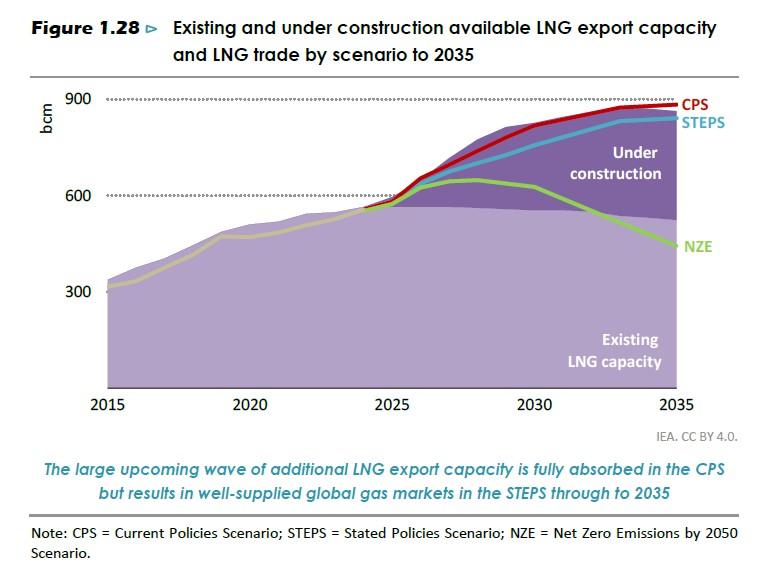
In Germany, Uniper has signed a 20-year sales and purchase agreement with Canada’s Ksi Lisims LNG facility for 2 million tonnes of LNG per year starting in 2032. While Germany has been aggressively building LNG infrastructure, with five LNG terminals becoming operational since 2022, the country’s gas demand is actually declining. In 2025, it was nearly 13.5% below the average demand from 2018 to 2021 and, currently, LNG contracts outpace actual gas demand. Moving forward, Germany has targeted 80% of electricity consumption to be from renewables by 2030.
In the European Union more broadly, the REPowerEU plan, which was implemented in response to Russia’s invasion of Ukraine, is also expected to cause a significant decline in LNG demand by 2027, largely resulting from accelerated electrification and renewable energy deployment.
The closure of the Strait of Hormuz has also impacted long-term gas outlooks. Wood Mackenzie modelled scenarios for future oil and gas demand based on when the Strait reopens. When it comes to LNG, a delayed reopening could accelerate demand destruction as countries look to more secure domestic energy sources to address supply constraints.
Renewables Gain Ground for Energy Security
Renewables provide a secure supply of power, which, once installed, are largely unhindered by geopolitical events. They are also lower cost, with over 96% of newly installed solar and wind capacity in 2024 cheaper than new fossil fuel power.
For energy security, many countries are now moving to reduce their reliance on imported fuels as oil and gas price shocks repeatedly leave them exposed to high costs.
China, one of the world’s largest importers of fossil fuels, has laid out a national framework to integrate energy security, domestic energy supply, electrification, renewable energy, grid modernization, and industrial policy through its 2025 Energy Law. It aims to install 3.6 TW of wind and solar capacity by 2035, and analysis conducted by DNV estimates renewables (solar, wind, hydro) and nuclear will provide approximately 55% of China’s electricity generation by 2030, and 99% by 2060. Similarly, China’s 15th Five-Year Plan calls for becoming an “energy powerhouse” by phasing out import-dependent energy systems and replacing them with renewable energy.
Meanwhile, Japan has created its 7th Strategic Energy Plan, which aims to enhance national security and economic resilience after recent global price shocks. The plan aims to decrease Japan’s reliance on fossil fuel sources for electricity generation from approximately 70% in 2022 to between 30% and 40% by 2040. Renewables are positioned to be the main source for electricity generation at 40% to 50%, with nuclear power covering the remaining 20%.
For Canada, these trends signal economic risks for any new oil and gas projects. Oil projects face challenges from low-cost competition, volatile oil prices, and declining demand with the uptake of electric vehicles. Similarly, LNG is expected to face an oversupply soon, with countries around the world planning to increase their share of domestic renewables over LNG. In this changing market, not only could Canada’s oil and gas projects struggle to compete, but the country risks missing out on emerging renewable and energy efficiency market opportunities. Research finds that investments of CAD 10 billion to CAD 15 billion per year to decarbonize buildings in Canada could yield 200,000 jobs and generate more than CAD 48 billion in economic development, while also reducing emissions and household energy bills. Similarly, an investment of CAD 10.9 billion in energy efficiency could avoid CAD 23 billion in electrical system costs. Meanwhile, by expanding renewable energy, Canada could gain up to 350,000 associated full-time equivalent job-years from 2025 to 2035.

What Does This Mean for Canada?
The closure of the Strait of Hormuz raised oil and gas prices and caused supply shortages around the world—just as the invasion of Ukraine did 4 years prior. Oil and gas demand surged in the short term, but the longer-term strategies of importers tell a different story. After repeated oil and gas price shocks, energy importers are planning to permanently reduce their reliance on fuels and build renewable energy. New oil and gas projects will likely struggle to compete in a world of oversupply and under-demand.
For Canada’s fossil fuel projects, lengthy construction timelines, high breakeven costs compared to competing exporters, and long payback periods mean infrastructure could quickly become stranded. By the time new oil and gas facilities come online, the demand and high prices they need to remain viable may not be reliable enough to pay back upfront investments, let alone stay profitable.
Doubling down on oil and gas expansion carries significant economic risks. When it comes to developing new infrastructure, oil and gas companies should bear the costs, not taxpayers. Instead, Canada should invest in sectors that can create tangible benefits—good jobs, lower energy costs, and less pollution.
Supporting a home retrofit industry, investing in electricity grids and energy efficiency, and establishing renewables as the priority for new power generation are all win-win solutions for Canadians. Rather than reacting to short-term oil and gas price spikes, Canada must invest in long-term sustainability.


You might also be interested in
Canada Set to Provide CAD 3.93 Billion in LNG Support by The End of 2030
The governments of Canada and British Columbia are set to provide more than CAD 3.93 billion in support to the liquefied natural gas (LNG) industry by the end of 2030, according to a new study by the International Institute for Sustainable Development.
Why Canadian LNG Is Not a Path to Global Energy Security or a Stronger Domestic Economy
Unstable prices, costly infrastructure, and growing climate risks—these are just a few of the reasons why LNG is a risky bet for Canada and its trading partners.
Five Key Priorities to End Fossil Fuel Subsidies in Canada
As the G7 president in 2025, Canada has a pivotal opportunity to lead by fully phasing out fossil fuel supports and investing in a cleaner, more equitable future. Here are five recommendations for effective subsidy reform.
Launching a Loss
New research reveals the combined public financial support for liquefied natural gas projects by the governments of British Columbia and Canada will amount to CAD 3.93 billion by 2030.