How Can Trade Policy Address Food Shocks in Africa?
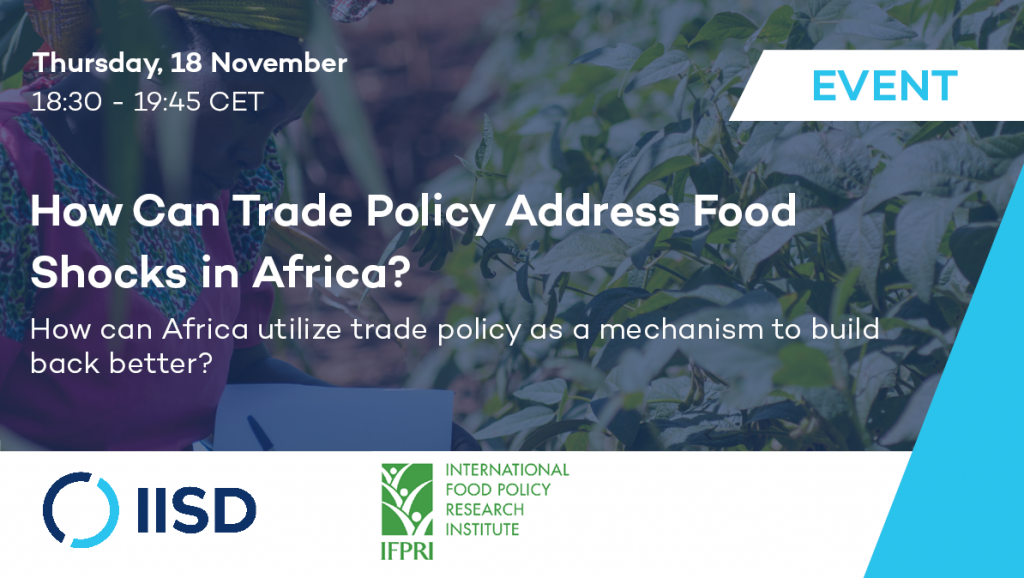
Recent climate, political, and health shocks like the COVID-19 pandemic have exposed some of Africa’s greatest trade vulnerabilities but also highlighted the continent’s greatest opportunities for using trade policy as a mechanism to build back better. This dialogue among trade experts and World Trade Organization (WTO) negotiators will weigh trade policy options in light of the findings from the recent 2021 Africa Agriculture Trade Monitor (jointly published by AKADEMIYA2063 and IFPRI) and IISD’s report on trade policies for food shocks. The dialogue will also explore the trade policy concerns of WTO negotiators representing African constituencies for the Twelfth WTO Ministerial Conference (MC-12).
This is a joint event organized by the International Institute for Sustainable Development (IISD) and and the International Food Policy Research Institute (IFPRI).
Date and time: Thursday, November 18, 2021, 18:30–19:45 CET
Interpretation in English and French will be provided during the event
Upcoming events
2026 Investment Policy Forum
The 17th edition of IISD's Investment Policy Forum will take place from September 16 to 18, 2026, in Dar es Salaam, Tanzania.
IGF 22nd Annual General Meeting
The 22nd IGF AGM will be held under the theme of Trust in an Interdependent World: Advancing inclusion and resilience in mineral value chains.
2026 Mining and Sustainability Forum of the Americas
The 2026 Mining and Sustainability Forum of the Americas takes place in Santiago, Chile on Wednesday, August 26, 2026. The forum’s theme is Mining for Development: Value addition and industrial transformation in Latin America and the Caribbean.