
Enabling Women Leaders in Building Equitable, Inclusive, and Climate-Resilient Cities
SUNCASA presented its gender equality and social inclusion (GESI) approach and achievements at the NGO CSW 70 Forum in New York.
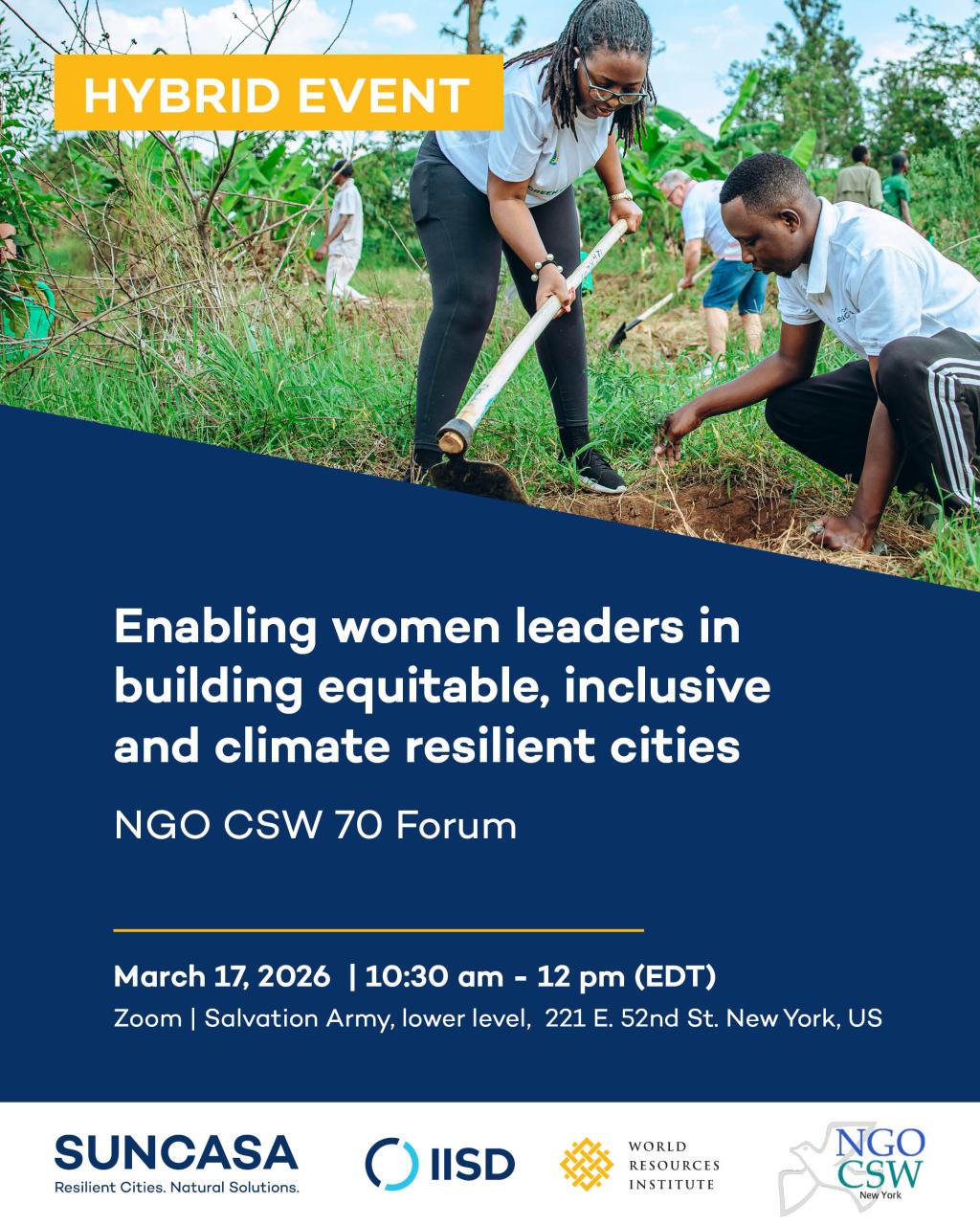
The NGO Committee on the Status of Women (NGO/CSW) Forum celebrates 70 years in 2026. Held annually in New York, the Forum connects global civil society, non-governmental organizations (NGOs), and feminists with the official United Nations Commission on the Status of Women (UN CSW) process.
This year, the Forum featured a dedicated hybrid session highlighting the gender equality and social inclusion (GESI) approach and outcomes of the Scaling Urban Nature-based Solutions for Climate Adaptation in Sub-Saharan Africa (SUNCASA) Project.
Two thirds of African cities face extreme climate risks, with impacts falling hardest on the most vulnerable urban populations. Nature-based solutions (NbS) offer a cost-effective pathway to reduce climate vulnerabilities while enhancing biodiversity. However, women and other underrepresented groups are often excluded from shaping these interventions, despite their central role in stewarding natural resources.
The SUNCASA project addresses this gap by advancing gender responsive, socially inclusive NbS in Dire Dawa (Ethiopia), Kigali (Rwanda), and Johannesburg (South Africa). By responding to locally identified priorities, SUNCASA strengthens community resilience to climate change impacts such as flash floods, landslides, urban heat, and water scarcity, through NbS approaches that intentionally integrate gender equality and social inclusion.
At NGO/CSW 70, SUNCASA’s GESI experts and local GESI partners highlighted the project’s commitment to elevating women’s leadership within urban NbS. Discussions explored the project’s climate adaptation and GESI strategy.
A panel featuring women’s rights and community organizations from all three cities further explored how they are shifting norms, designing inclusive practices, and expanding opportunities—from engaging women in restoration work in Dire Dawa, to establishing a GESI code of conduct and supportive services in Kigali, to facilitating community dialogues on gender norms and intersecting vulnerabilities in Johannesburg. Together, these stories underscore the essential role of gender-responsive NbS in building more equitable and climate-resilient urban futures.
PANEL
Moderators:
- Ayushi Trivedi, SUNCASA GESI Lead, World Resources Institute
- Meghan Stromberg, SUNCASA Project Manager, World Resources Institute
Panellists:
- Bertha Chiroro, GenderCC, Johannesburg, South Africa
- Hadas Temesegen, Harraghe Catholic Secretariat, Dire Dawa, Ethiopia
- Theogene Niyirora, Avega Agahozo, Kigali, Rwanda
ABOUT SUNCASA
SUNCASA is a 3-year project enhancing resilience, gender equality, social inclusion, and biodiversity protection in urban communities in Ethiopia, Rwanda, and South Africa. It is delivered by the International Institute for Sustainable Development and the World Resources Institute, funded by the Government of Canada, and implemented with a wide range of local organizations and communities.
SUNCASA restores urban watershed areas through gender-responsive NbS such as agroforestry, afforestation, reforestation, buffer zone creation, and urban tree planting, ultimately strengthening the resilience of 2.2 million people.

Related content
How to Center Gender and Social Justice in Urban Climate Action
For projects to help communities adapt to climate change, it's vital they engage with champions for gender equality and social inclusion.
Challenging Gender Discriminatory Norms, Practices, and Beliefs in Sub-Saharan Africa
SUNCASA held a series of training sessions to support women and other underrepresented groups in overcoming the barriers preventing their access to natural resources and meaningful participation in nature-based solutions governance.
Tackling flash floods, urban heat, and other climate change threats in three sub-Saharan African Cities
A new project will use solutions found in nature to improve the resilience of 2.2 million people in Dire Dawa (Ethiopia), Kigali (Rwanda), and Johannesburg (South Africa).
Reimagining the River: How art can help us adapt to climate change
Thandokuhle Zungu, a gender equality expert supporting SUNCASA implementation in Alexandra Township, Johannesburg, reveals how imagination, storytelling, and the beauty of collaboration are reshaping climate action.