
How We Built a Community to Tackle Investment Governance Challenges
IISD’s Investment Policy Forum is the world's only platform for investment policy-makers from emerging and developing economies. Learn how it has supported investment policy-makers from over 100 countries to align international investment governance with sustainable development for 20 years.
This month, investment policy-makers and experts from around the world will gather for the 17th edition of IISD’s Investment Policy Forum, this time hosted by the Government of Tanzania in Dar es Salaam, for 3 days of discussions, peer-to-peer learning, and problem solving around the core goal of making international investment a driver of sustainable development.
At the start of the 21st century, emerging and developing economies around the world were facing a growing array of common investment governance challenges. However, awareness within governments of these urgent challenges was limited, and there was no dedicated space for governments to share experiences, discuss solutions, and coordinate strategies between themselves.
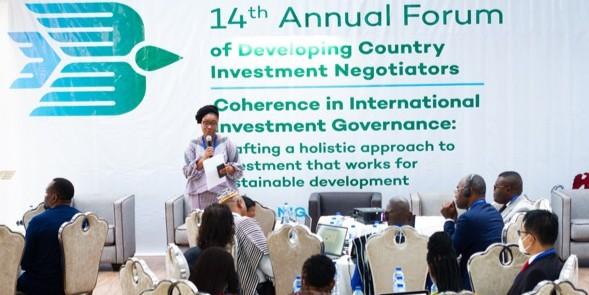
IISD launched the IPF, initially called the Annual Forum of Developing Country Investment Negotiators, to fill this void, with the first edition held in Singapore in 2007. From then on, the IPF has played a critical role in helping set the international investment policy agenda, working with governments to overcome hurdles and making investment governance more sustainable, fair, and resilient.
"The IPF has played a critical role in helping set the international investment policy agenda, working with governments to make investment governance more sustainable, fair, and resilient."
Building a Community of Reformers
Over nearly two decades, the IPF has helped drive change in investment governance in several mutually reinforcing ways:
From government understanding to reform
The discussions at the IPF have helped government officials understand how investment treaties operate in practice and what they can mean for governments' ability to regulate in the public interest. Notably, investor–state dispute settlement (ISDS) clauses, which are embedded in many older investment and trade agreements, allow foreign companies to circumvent domestic courts and sue host government before private tribunals.
The awareness-raising has enabled countries to critically review their existing treaty networks, laws and institutional arrangements; strengthen coordination across government; and develop new approaches to investment treaties. Several countries have developed new model treaties—the template governments use when negotiating new treaties—and established clear negotiating positions and red lines that have subsequently been used in bilateral, regional, and multilateral negotiations.
"As governments gained a clearer understanding of the risks associated with older-generation investment treaties, the IPF has provided a trusted space to examine options for addressing them."
Tackling outdated investment agreements
As governments gained a clearer understanding of the risks associated with older-generation investment treaties, the IPF has provided a trusted space to develop options for addressing them.
Governments have drawn on one another's experiences to create strategies for reviewing their treaty networks and then translate these into action, including through the renegotiation, non-renewal, and termination of treaties, and other measures to reduce or eliminate their exposure to ISDS claims from investors. Over the last 20 years, more than 550 older bilateral investment treaties have been terminated. In short, the Forum has helped governments move from identifying problems with their treaties to actively reshaping their international investment commitments.
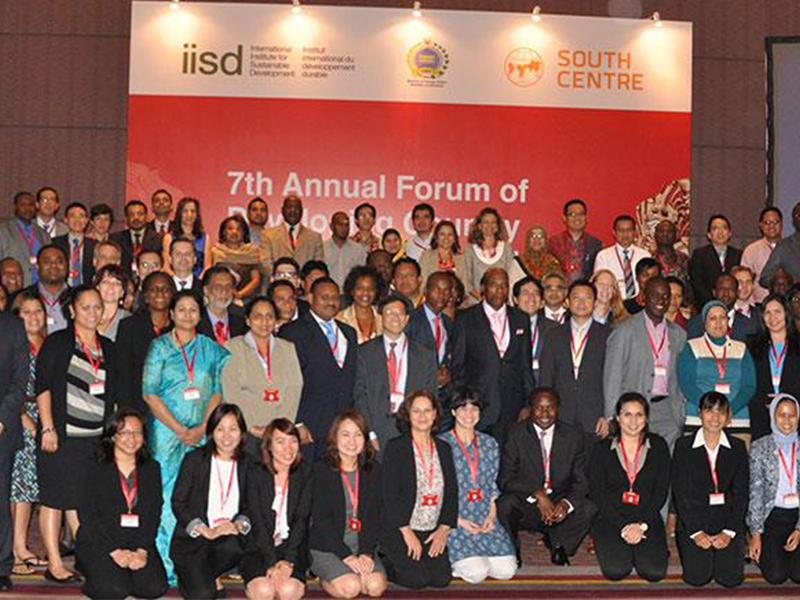
Group picture at the 2013 Forum in Jakarta, Indonesia
Coordinating positions, influencing negotiations
Perhaps most importantly, the IPF has created a community where governments can speak candidly about their experiences, learn from reforms undertaken elsewhere, and gain inspiration and confidence to pursue change themselves. Ideas first exchanged among individual governments have subsequently informed regional approaches, such as the African Continental Free Trade Area Investment Protocol (AfCFTA IP), an innovative continent-wide investment agreement.
The relationships built through the Forum have also enabled developing and emerging economies to coordinate positions and strategies in international negotiations. This has included coordinated engagement in processes such as the United Nations Commission on International Trade Law Working Group III (UNCITRAL WGIII) initiative on ISDS reform or the World Trade Organization's (WTO) Investment Facilitation for Development Agreement (IFDA), which has brought issues onto the negotiating agenda that otherwise likely would have received considerably less attention. This includes tackling the exorbitant damages awarded in ISDS claims at the UNCITRAL WGIII and adding a so-called "firewall clause" to protect against ISDS in the WTO IFDA, respectively.
Turning momentum into coherent and lasting change
After years of raising awareness, building capacity, and generating momentum for change, the IPF has increasingly focused on making sure this momentum is maintained and utilized as effectively as possible. Strengthening the coordination and coherence of reforms has become a growing priority.
"We have seen an encouraging reform momentum build over the past decade. However, there remains a real risk that these reforms are carried out in an incoherent manner: that progress with one instrument, one reform process, or in one region would be offset by a lack of movement, or even backtracking, elsewhere in the investment governance system”, Suzy Nikièma, Director of Sustainable Investment at IISD and the head of the IPF today, says.
“For example, that a country removes ISDS from its treaties, only to provide similar privileges to investors through investment contracts instead. We realized that the IPF is the ideal place to address the 'coherence challenge' in investment governance”, Suzy adds.

"We realized that the IPF is the ideal place to address the 'coherence challenge' in investment governance”
In 2022, the community agreed to make tackling the "coherence challenge" in investment governance the Forum's new multi-year supra theme. The 2023 IPF focused on coherence in national investment governance: how governments can coordinate across the domestic ministries and agencies involved in investment policy decisions. At the 2024 IPF, the community turned to coherence in international investment governance: how governments can navigate between international agreements and commitments that affect their investment policymaking, such as climate commitments under the Paris Agreement or tax rules under the Global Minimum Tax agreement. Both themes were distilled into practical tool kits to help policymakers improve their national and international policy coherence and make sure the discussions lead to concrete change.
The 2026 edition will conclude the theme by bringing these different levels together: building tools to help how governments align and reinforce their investment rules, policies, and instruments across international, regional, and national levels.
Importantly, there are already signs that the focus on reform coherence is paying off. Cases in point: More governments are establishing inter-ministerial committees to coordinate across departments involved in its investment policymaking; regional bodies are developing model investment contracts to help neighbouring countries take a consistent approach toward foreign investors; and a growing number of countries are revising their national investment laws to remove outdated investor-protection provisions (like ISDS) which have already removed from their treaties. This allows governments to ensure these laws are designed to deliver on their strategic priorities such as the energy transition, human rights, or industrial development goals.

Collaborative Solutions for Governance Challenges of Today and Tomorrow
These impacts have not come from the Forum alone. The IPF has been the focal point of a broader, year-round process that combines IISD's advisory support to governments, regional and thematic workshops and dialogues, research, policy tools, and ongoing exchanges among members of the IPF community.
But the IPF gathering itself, now held every two years, plays a distinctive role. It brings together government officials directly responsible for investment policy and negotiations—typically chief investment treaty negotiators and other senior officials from ministries of justice, trade, finance, and investment—as well as investment promotion and other government agencies. Many of these officials stay in their roles, or within the same institutions, across changes in political leadership, providing an important source of institutional continuity and accumulated expertise.
Meeting repeatedly over the years has allowed these policy-makers to build relationships and trust, enabling candid discussion of challenges, including issues that can be difficult to raise in formal negotiating settings, and solution. Over time, these relationships have helped turn what might otherwise have been isolated national reforms into regional initiatives and strategic engagement in international negotiations.
In Dar es Salaam, the community will launch a conversation on the Forum’s focus and format to ensure it keeps delivering real value for its participants and helps them tackle the most pressing sustainable investment challenges of the day, from accelerating investment in the energy transition to navigating the complex governance challenges of AI infrastructure investment.
As the Forum enters its third decade, it will continue to provide a vital space for governments to learn from one another, develop new approaches, and collectively shape the future of investment policy.
The author thanks Nathalie Bernasconi-Osterwalder and Suzy Nikièma for their insights.
Participating experts

Isaak Bowers
Senior Communications Officer
Isaak is a Senior Communications Officer in IISD's Economic Law and Policy program. He has led the communications and media operation for IISD's Investment team since 2023, including on the IPF. The 2026 IPF will be his third edition of the Forum.

Nathalie Bernasconi-Osterwalder
Vice-President, Global Strategies and Managing Director, Europe
Nathalie is IISD’s Vice-President for Global Strategies and Managing Director for Europe. Nathalie has been instrumental in developing the IPF, having participated in every IPF since 2008. She is a visiting professor on international investment law at the Geneva Graduate Institute.

Suzy H. Nikièma
Director, Sustainable Investment
Suzy is IISD's Director for Sustainable Investment and has been head of the IPF for several years. Suzy has vast experience of advising and supporting governments in reforming their investment instruments and is a lecturer on investment and mining law in her native Burkina Faso.
You might also be interested in
CSDDD: EU's Due diligence law vote should drive supply chain sustainability efforts
The European Parliament has voted to adopt the Corporate Sustainability Due Diligence Directive, aiming to address the environmental and social impacts of the supply chains of Europe's large corporations.
Guidance Handbook for the Revised Common Investment Area
A practical guide to help member states of the Common Market for Eastern and Southern Africa (COMESA) translate the revised Common Investment Area (CCIA) Agreement into national legal and institutional action.
Decoding the Belt and Road Initiative’s Legal Architecture
This article unpacks the Belt and Road Initiative's legal architecture—covering hard law (such as treaties and contracts), soft law (such as memoranda of understanding), and the unique role of China's state-owned enterprises—and sets out recommendations for host country policy-makers on how to navigate this hybrid legal environment.
Navigating the New Belt and Road Initiative: Why host-country agency is the key to success
As the Belt and Road Initiative, China’s global development drive, shifts focus to more renewables, technology, and small-scale projects, IISD sets out how policy-makers in host countries should adapt their approach.