More Winnipeggers are using food banks
February 20th is the World Day of Social Justice – recognizing the need for food, shelter, and other basic needs. What does Peg tell us about hunger in our own city by looking at food bank use in Winnipeg?
February 20th is the World Day of Social Justice – recognizing the need for food, shelter, and other basic needs. What does Peg tell us about hunger in our own city by looking at food bank use in Winnipeg?
Peg tells us…
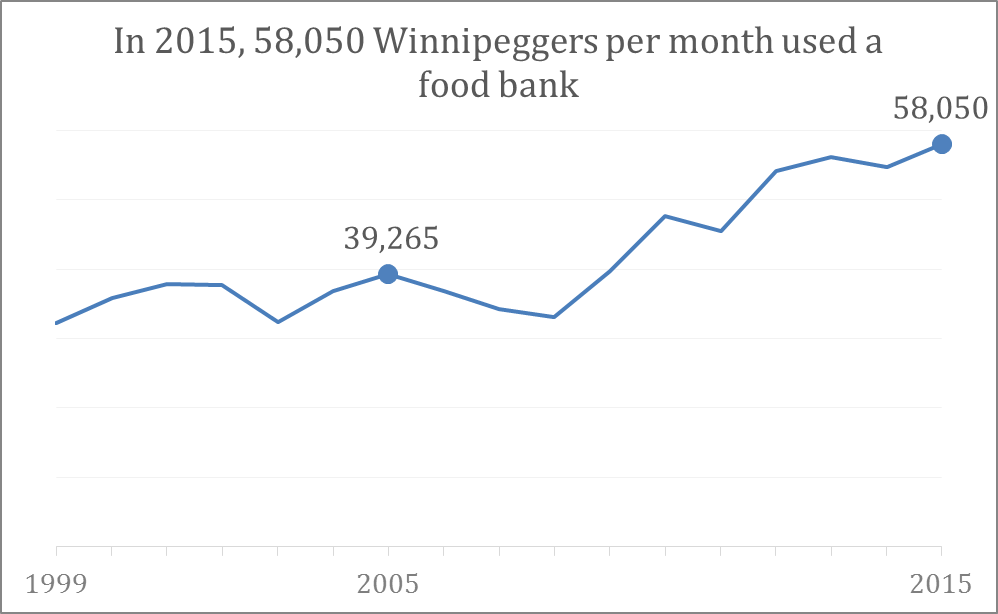
In 2015, there were 58,050 Winnipeggers receiving food from Winnipeg Harvest’s food bank and meal/snack programs each month – the highest number of participants to date.
The facts are:
• While there have been fluctuations year to year, the number of Winnipeggers using a food bank each month has been steadily rising since 1999.
• In the last ten years, the number of users increased by almost 20,000 – from 39,265 in 2005 to 58,050 in 2015.
Why does this matter?
• Most food banks have a mission to share food with hungry families while undertaking other activities (such as training and learning opportunities) that moves communities towards a future where hunger is minimized and the services of a food bank are no longer required.
• The use of food banks can reflect both the efficacy of the food bank system in reaching a large number of people in need, and the number or proportion of people within a community with the need for food, usually due to poverty.
• Food bank use can also serve as a proxy for the economy as well as the effectiveness of social policies, as food banks are often the first signs of economic trouble and/or income inequality (Food Banks Canada, 2010).
More facts on this subject available at:
Peg data:
Source of the data: Peg’s data for the Food Bank Use indicator is provided by Winnipeg Harvest.
Media inquiries:
We’d love to connect you with someone who can tell you more about Peg, the data, or who is making a difference in the community. Please contact:
Sumeep Bath, Media and Communications Officer
International Institute for Sustainable Development (IISD)
About us:
Peg (mypeg.ca) is a community indicator system that measures the health of our community year over year – in ways that count. Peg is led by two partnering organizations – the International Institute of Sustainable Development (IISD) and United Way of Winnipeg (UW).
Regularly, the team at Peg releases data and facts that help us understand our city better. This is one of those regular reports. Others can be found at
.Peg is the starting place for Winnipeg citizens, educators, policy makers, and many others to learn more about our city so we can lead change to create a better city for our children and their children. At Peg we can all learn how our lives, our neighbourhood and our city is changing – for the good and the bad. Learn more at www.mypeg.ca.
About IISD
The International Institute for Sustainable Development (IISD) is a globally recognized think tank with 3 decades of experience working to solve the world’s most pressing sustainable development challenges. We combine deep expertise in a wide range of issues with a collaborative approach to research, policy advice, and hands-on support to ensure these solutions are brought to life. Headquartered in Winnipeg, Manitoba, we are a diverse team of over 300 professionals working from offices in Canada, Switzerland, and other locations around the world.
You might also be interested in
Stalemate on the Global Goal on Adaptation in Bonn: What it means
Countries couldn’t reach an agreement on the Global Goal on Adaptation, but it doesn't change the need for them to track and assess their efforts.
A Measure of Care
As countries consider how to move beyond GDP in better measuring prosperity, this report explores how to ensure the unpaid labour of women is counted.
State of Global Environmental Governance 2025
Analysis of the wins and setbacks in international environmental negotiations in 2025 amid unprecedented challenges to multilateralism.
IISD’s Best of 2025: Publications
As 2025 draws to a close, we’re revisiting our most downloaded publications of the year.