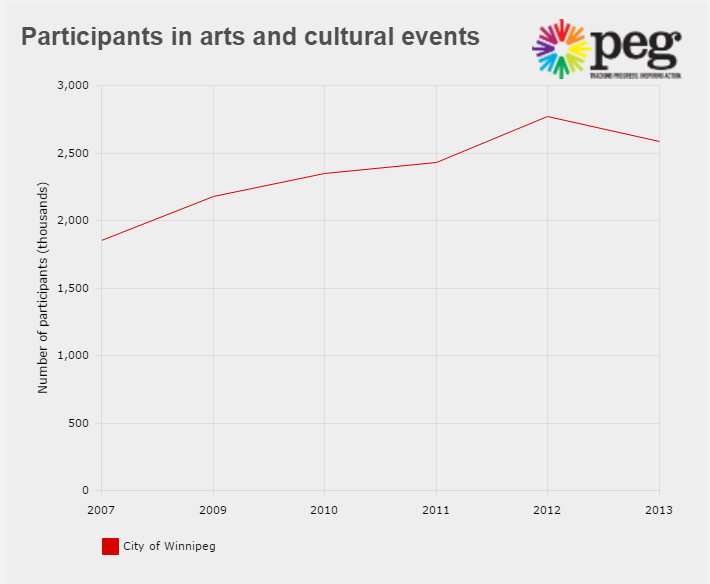
40% more Winnipeggers participate in arts and cultural events than five years ago
It’s officially summer in Winnipeg! With some of the city’s biggest festivals and events coming up, we took a look at two Peg indicators: Participation in Arts & Cultural Events and Parks & Open Space.
It’s officially summer in Winnipeg! With some of the city’s biggest festivals and events coming up, we took a look at two Peg indicators: Participation in Arts & Cultural Events and Parks & Open Space. Peg, Winnipeg’s community indicator system (mypeg.ca), tells us…
Participation in Arts & Cultural Events
Between 2007 and 2013, the number of participants in arts and cultural events in Winnipeg increased by almost 40%! In 2013, there were 2,588,000 visits to arts and cultural events in the city. The arts are a critical element of any community's social vitality, and also contribute significantly to the economy (Statistics Canada 2012).
Parks and Open Space
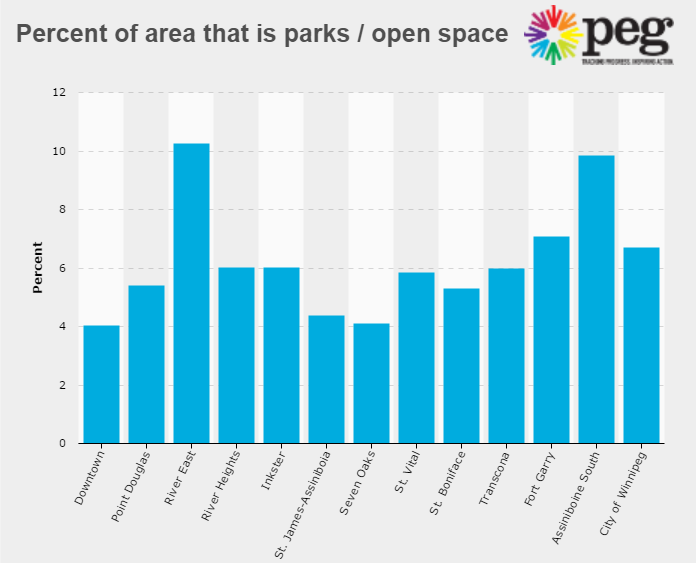
In 2010, 6.71% of Winnipeg land was dedicated to parks or open spaces. This ranged from a low of 4.03% Downtown, to 10.25% in River East. Parks and open space are a key link between the built environment and other aspects of wellbeing including the natural environment, health, social vitality, and the economy.
* More detail and source data for the above facts available at http://www.mypeg.ca/more-info, under the Parks and Open Space and Participation in the Arts tabs. Peg’s data on Participation in the Arts is provided by the Winnipeg Arts Council, and Parks and Open Space data is provided by the City of Winnipeg.
More facts on this subject available at:
http://www.mypeg.ca/explorer#ParksOpenSpace
http://www.mypeg.ca/explorer#Arts
Media inquiries:We’d love to connect you with someone who can tell you more about Peg, the data, or who is making a difference in the community. Please contact:
Sumeep Bath, Media and Communications Officer
International Institute for Sustainable Development (IISD)
(204) 958-7740 | [email protected]
About us:
Peg (mypeg.ca) is a community indicator system that measures the health of our community year over year – in ways that count. Peg is led by two partnering organizations – the International Institute of Sustainable Development (IISD) and United Way of Winnipeg (UW).
Regularly, the team at Peg releases data and facts that help us understand our city better. This is one of those regular reports. Others can be found at http://www.mypeg.ca/blog.
Peg is the starting place for Winnipeg citizens, educators, policy makers, and many others to learn more about our city so we can lead change to create a better city for our children and their children. At Peg we can all learn how our lives, our neighbourhood and our city are changing – for the good and the bad. Learn more at www.mypeg.ca.
About IISD
The International Institute for Sustainable Development (IISD) is a globally recognized think tank with 3 decades of experience working to solve the world’s most pressing sustainable development challenges. We combine deep expertise in a wide range of issues with a collaborative approach to research, policy advice, and hands-on support to ensure these solutions are brought to life. Headquartered in Winnipeg, Manitoba, we are a diverse team of over 300 professionals working from offices in Canada, Switzerland, and other locations around the world.
You might also be interested in
Stalemate on the Global Goal on Adaptation in Bonn: What it means
Countries couldn’t reach an agreement on the Global Goal on Adaptation, but it doesn't change the need for them to track and assess their efforts.
A Measure of Care
As countries consider how to move beyond GDP in better measuring prosperity, this report explores how to ensure the unpaid labour of women is counted.
State of Global Environmental Governance 2025
Analysis of the wins and setbacks in international environmental negotiations in 2025 amid unprecedented challenges to multilateralism.
IISD’s Best of 2025: Publications
As 2025 draws to a close, we’re revisiting our most downloaded publications of the year.