Report

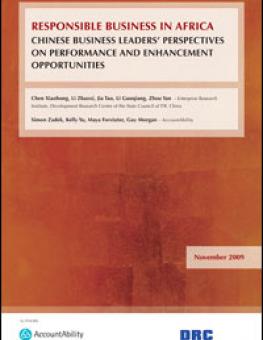
Responsible Business in Africa: Chinese Business Leaders' Perspectives on Performance and Enhancement Opportunities

January 12, 2011

This paper, authored by Chinese and international scholars and practitioners, is the result of a process that surveyed a number of senior Chinese outward investors, exploring their current practice in Africa and the challenges they face in the context of corporate social responsibility.

It concludes with a set of recommended actions to help those investors perform better both as profitable enterprises and as agents of sustainable development.

Report details

Region
Africa
Impact area
Sustainable Economies
Copyright
, 2011
Report

The Southern African Response to Food Security and the Global Food Crisis

August 17, 2010

Given the recent global food price hikes, which revealed the vulnerability of social and economic development in the face of food insecurity, this paper contextualizes the situation in the Southern African Development Community (SADC).

This report analyzes the policy responses of some of the countries in this bloc and their implication for intraregional trade and regional integration and the broader objectives of food security. Generally, countries in Southern Africa are in a more or less permanent food-security crisis, and policy formulation and responses are geared toward this reality on an ongoing basis. Therefore, in examining the regional response, there is not a huge divergence between ongoing policies and responses and immediate reactionary responses to the food crisis. However, this paper attempts to situate these policy measures in the continental Comprehensive African Agriculture Development Program (CAADP), which has broad support across Africa and is the focal point for addressing the impacts of the crisis via a coordinated policy response in the region.

Key Findings:

  • Southern African countries are in a more or less permanent food security crisis, and policy formulation and responses are geared toward this reality on an ongoing basis. There is thus not a huge divergence between ongoing policies and responses and immediate reactionary responses to the food crisis.

  • SADC countries intend to institute a strategic reserve of four grains, with livestock as a fifth product; however, it is noted that attempts to use strategic grain reserves to help stabilize grain prices have undermined market incentives for private traders to perform normal trading functions that could otherwise have satisfied governments' food security objectives in most years.

  • Rural households adjust better to agricultural price increases than urban households, because rural households can fall back on subsistence farming for consumption or even turn into net suppliers of agricultural products in a rising price market.

  • The above indicates why not only access to food is important, but also having the domestic capability to produce food, if this is based on comparative advantage linked to natural endowment, which is an attribute of the African agricultural sector. This provides a solid basis for challenging proponents of continued subsidization of agricultural exports in developed countries.

  • There is an inherent danger in inappropriate government trade policies. For example, taxes could aggravate price increases, encourage smuggling and impoverish local farmers; lower import tariffs could reduce government revenues; price controls could be counterproductive; and untargeted consumer subsidies could be extremely expensive for government budgets.

Key recommendations:

  • It is crucial for engendering food security to prevent the global food crisis from weakening the region, and it is essential for SADC to seize the opportunity of making food security a tool that contributes to unlocking the agricultural potential of the region to produce enough food for its people, enhancing its commercial capacities to generate tradable surpluses and creating jobs for rural people.

  • Policy measures available in the short run include providing safety nets and social protection to the most vulnerable consumers in both rural and urban areas and supporting the ability of smallholder farmers to increase short-term production.

  • Improved trade policies can also yield important gains, using existing and emerging WTO rules.

Report details

Region
Africa
Publisher
IISD
Copyright
IISD, 2010
Report

Regional Energy Security Dynamics in Southern Africa: Electricity Mixes in the Context of Global Climate Change Mitigation Pressures

August 16, 2010

Following recent power shortages in Southern Africa, energy security, particularly the need to ensure reliable, widespread and affordable power supplies, has become a major policy priority for governments in the region.

This paper looks at the main drivers of electricity generation in the region and evaluates the challenges that the region is likely to face as it seeks to expand its power-generating capacity.

Key Findings:

  • Energy security is hindered because energy planning and service provision has been limited to nation states and is the preserve of monopolist state-owned enterprises. This approach is sub-optimal because, while national authorities only plan for their geographical area, energy sources do not respect these boundaries, which underscores the importance of regional energy integration.

  • South Africa, on account of the size and carbon intensity of its economy and the tension between expanding access to electricity to meet social and economic imperatives and sustainable development, is an anchor country in the region.

  • There is already significant electricity trade taking place amongst countries of the Southern African Development Community (SADC) via the South African Power Pool (SAPP).

  • There is the need for the region to diversify its energy sources and incorporate other energy types to include renewable energy.

  • The region lacks adequate policies that would accelerate the demonstration, development and deployment of low-emission energy technologies.

Key Recommendations:

  • Despite concerns about whether the political commitment exists to drive forward the program of the regional power pool, SAPP offers the region the best avenue to energy security. But the road is still long, hence solid and sustained political commitment to and support for the objectives of the regional power pool will be required.

  • There is a need for clear and transparent regulatory frameworks that will remove obstacles for investors and suppliers of electricity sourced from renewable energy.

Report details

Region
Africa
Publisher
IISD
Copyright
IISD, 2010
Report

Beyond Barriers: The Gender Implications of Trade Liberalization in Southern Africa

February 25, 2010

Summary:

Although trade can be a catalyst for gender equality, the effects of trade liberalization and economic globalization on women, in particular, so far have been mixed. For example, while in a large number of cases, trade in general has improved women's empowerment and livelihood, in some other cases, the benefits accrued by women from trade liberalization have been marginal, relatively lower than those accrued by men. Worse, in some other cases, trade liberalization has also exacerbated gender inequalities and women's economic and social status.(1)

The primary criticism levelled against international trade agreements from a gender perspective is that the measurement of international trade in terms of a net economic benefit and market-based criteria has largely ignored societal imbalances, which in turn results in long-term trade inefficiencies. This criticism is supported by the fact that Article XX of the General Agreement on Tariff and Trade (GATT), which allows for the reconciliation of trade and non-trade related norms in the trade context, is silent on the issue of women's rights. Trade agreements have also been criticized for reducing the policy space afforded to national initiatives in general, and the same may well apply to the empowerment of women and their participation in formal economic activities. But these very agreements can be used to streamline and reduce inequalities at all stages of the economic process, such as in identification of and participation in activities, access to resources, possession of the necessary skills, simple formal trading channels and control over income earned. We proffer suggestions on the necessity and means of doing so.

Key findings:

  • Gender relations are not outside the economy in some realm of "preferences," "aptitudes" and "traditions," but rather permeate all economic activities.

  • The characteristic that identifies the engagement of women above all others in economic activities in Africa is the informal economy; for example, around 70 per cent of the informal traders in sub-Saharan Africa are women.

  • Social perpetuation of gender gaps is not, it appears, the most compelling obstacle to women being involved in trade. In fact, national, institutional and legal hurdles have a more adverse effect on women attempting to develop their earning capacity.

  • The percentage of women who would be affected by trade facilitation aimed at the formal economy would be much smaller than changes brought about bearing in mind the existence of and impact upon the informal economy.

  • However, national or local measures are not always effective and external requirements may well bring about actual differences. Thus, there is a crucial role to be played by trade agreements to fill in all these gaps.

  • It is possible that trade agreements may not be mindful of, or may be indifferent to, national and local policies while incorporating gender-sensitivity. Here, international instruments on gender not directly related to trade can play an important role in creating a rights-based framework where women seek economic rights by way of entitlement. They can also ensure that national governments have the appropriate protective enabling instruments in place to avoid any deterrence or distortions to trade policies.

  • However, regional trading arrangements are likely to offer opportunities that are best suited to women because they do not necessarily need large export markets and may find neighbouring markets more familiar and easier to deal with.

Key recommendations:

  • The most common phrase that one comes across is the requirement to adopt a "gender perspective" on trade relations. What is evident, therefore, is a methodological intervention whereby the analysis of the desirability of trade choices requires addressing gender concerns.

  • It appears that the regional trade agreements (RTAs) in the region should address the reality of informal cross-border trade so as to minimize the negative effects of free trade agreements (FTAs) on vulnerable groups such as women.

  • There should be supportive institutional measures adopted rather than a move towards eradicating informal cross-border trade altogether; at the same time, the hazards inherent in such trade should be removed. This calls for an enhanced role for regional governance bodies in assessing the positive role of informal trade and how they may inform regional trading arrangements.

  • It would be useful to have a yardstick against which RTAs can be measured for their gender sensitivity, which would reduce considerably negotiator hesitancy and the administrative costs of incorporating gender concerns into individual RTAs.
Report details

Topic
Gender Equality
Trade
Region
Africa
Impact area
Sustainable Economies
Publisher
IISD
Copyright
IISD, 2010
Report

A Thirst for Distant Lands: Foreign investment in agricultural land and water

May 15, 2009

This paper examines how water is the main driver behind a new wave of foreign investment in the agriculture sector. Investors have made it clear that acquiring land without water resources has no economic value. Governments with scarce or depleted water resources are actively acquiring fertile land with abundant water resources. What is often referred to as the "great global land grab" may actually turn out to be a "water grab."

Report details

Topic
Food and Agriculture
Region
Africa
Impact area
Sustainable Economies
Publisher
IISD
Copyright
IISD, 2009